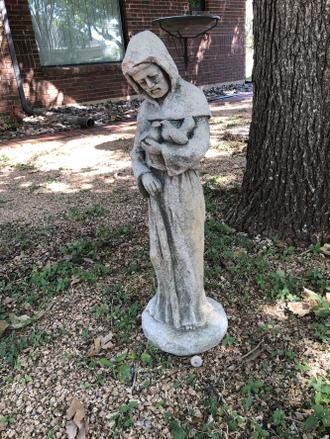
Kazantzakis’s Saint Francis does not offer the domesticated Francis of postcards, bird sermons, brown robes, and gentle piety. It gives us a starving, bleeding, excessive, almost unbearable man who takes the Gospel so literally that ordinary life itself begins to look like apostasy.
If The Odyssey: A Modern Sequel explores the external limits of freedom, sending Odysseus outward through civilizations, religions, revolutions, and deserts until no harbor can hold him, and if The Last Temptation of Christ turns that same struggle inward, making the body and soul of Jesus the battlefield of salvation, then Saint Francis (published in Greek one year later) pushes Kazantzakis’s spiritual drama into its most ascetic and joyful form. It is the novel of holy poverty, but poverty understood as a metaphysical weapon. Francis does not merely give up possessions. He declares war on possession itself.
Kazantzakis does not write a Catholic hagiography in the conventional sense. He writes a myth of spiritual combustion. His Francis is not holy because he is meek but because he has accepted the terrible command that governs Kazantzakis’s entire universe: matter must be transubstantiated into spirit. Human beings are not placed on earth in order to be comfortable, moderate and respectable. They are entrusted with flesh, hunger, fear, shame, weakness, love, hope and death so that they may burn these things and send the smoke upward. The body is not simply rejected; it is also used as fuel.
Kazantzakis’s Odyssey says:
My life is a strong arrow, mounted toward the sky
but now the earth allures it to a sweet descent.
(Book III, 1172-1173)
And his autobiographical novel – Report to Greco starts with an epigraph:
Three kinds of souls, three prayers:
I am a bow in your hands, Lord. Draw me, lest I rot.
Do not overdraw me, Lord. I shall break.
Overdraw me, Lord. And who cares if I break.
Taken together, the lines from the Odyssey, the epigraph to Report to Greco, and Francis’s own language reveal one of Kazantzakis’s central images: the human being as a tension between the downward pull of earth and the upward propulsion of spirit. The body is not merely a prison, nor simply an enemy to be despised. It is the bow whose very strain makes the flight of the arrow possible. In this sense, Kazantzakis transforms Bergson’s élan vital into a dramatic image: life ascends only by resisting matter, yet it can ascend only through matter. The body must be overcome, but not bypassed; it must be bent, wounded, disciplined, and finally converted into spiritual force. This also helps explain Kazantzakis’s attraction to pre-Christian Greek vitality: he does not seek a purely disembodied (pre-axial) spirituality, but a tragic vision in which body, struggle, suffering, and sacred ascent still form one indivisible process.
This is why Francis cannot follow any middle road. Moderation belongs to those who want to remain intact. Francis wants to be consumed. When he says that man stands within the bounds of moderation but God stands outside them, he formulates the Kazantzakian view of sanctity. God is not found in balance, but in excess*; in the leap beyond security; not in the respectable compromise between earth and heaven, but in the impossible demand that earth itself become heaven through agony.**
*Much like ancient Greek heroes - often not pious and modest, but simply extreme in some way and that is why they often meet terrible ends.
**And even Satan might rise from the bowels of hell and be forgiven (Francis’s wish)
The God of this novel is not a comforting father watching from above. He is the imperiled, struggling God of Kazantzakis’s mature imagination: the divine force trapped in matter, crying out from within creation, demanding to be liberated through human courage. Francis hears this God not as consolation but as command. Again and again, after each victory, after every renunciation, after each step beyond ordinary human limitation, the inner cry returns: not enough! Rebuild San Damiano — not enough. Abandon wealth — not enough. Embrace poverty — not enough. Kiss the leper — not enough. Give up the world — not enough. Give up even the desire for heaven.
This is the source of the novel’s terrifying energy. Francis’s sanctity is an escalation. He must become what he is by being driven beyond what he can bear. Like Kazantzakis’s Christ, he does not begin in the narrative as a finished ideal. He is hammered into sanctity. The halo is not given; it is forged. The saint is the struggling man brought to incandescence.
Brother Leo is crucial because without him Francis might become too remote, too absolute, too inhuman. Leo is the frightened and faithful witness, the ordinary human soul dragged behind the impossible. He is hungry when Francis wants to fast, cold when Francis feels divine wings around him, terrified when Francis wants to leap. He understands the attraction of the warm fire, the full belly, the small shelter, the little mercy of satisfaction. This real historical figure becomes for Kazantzakis the human weight that makes Francis’s ascent visible.
Together, Francis and Leo form one divided being. Francis is the upward flame; Leo is the earth that resists being burned. Francis is the soul’s insane demand; Leo is the body asking why salvation must hurt so much. Their relationship prevents the novel from becoming abstract theology. It gives the struggle a body, a companion, a witness, and sometimes a protest in the voice of reason. Leo loves Francis, but he cannot fully follow him. Through Leo, the reader is allowed to admire Francis without pretending that such sanctity is easy, balanced, or even entirely sane and attainable for a normal human.
Francis is one of Kazantzakis’s purest images of freedom. But the freedom here is not Odyssean restlessness. Francis does not prove his freedom by abandoning every harbor. He proves it by emptying himself so completely that nothing can possess him. Odysseus is free because no value can finally hold him. Francis is free because one value — poverty — has consumed him so absolutely that all lesser values lose their power.
Francis’s kinship with birds, wolves, sun, moon, water, fire, and death is not the pleasant ecology of a gentle medieval soul. It is the result of dispossession. He can call the sun brother and the moon sister only because he no longer wants to own the world. Perhaps for him once creation is no longer useful, it becomes sacred. This is one of the novel’s deepest paradoxes. Francis renounces the earth and receives it back transfigured. He strips himself naked and becomes kin to everything.
The encounter with the leper is one of the novel’s great Kazantzakian moments because it reveals that transcendence does not mean bypassing horror. Francis does not reach God by avoiding the repulsive, diseased, wounded, and humiliating parts of existence. He reaches God by embracing precisely what his flesh fears most. The leper is not an obstacle to spirituality but its gate. Francis discovers Christ in the rotting body and sanctity begins where disgust is transfigured into love.
The opposition between flesh and spirit in Kazantzakis’s works should never be read too crudely. The flesh is dangerous because it seeks comfort, repetition, sleep, satisfaction. But it is also the necessary battlefield. Without the body, there is no ascent. Without hunger, there is no fasting. Without desire, there is no renunciation. The body is “Brother Donkey”: stubborn, ridiculous, burdensome, but also loyal, and necessary. Francis’s late tenderness toward his own body prevents the novel from collapsing into a simple dualism. The body is not evil. It is the poor animal that has carried the soul toward God. Francis even asks his own body for forgiveness.
Francis’s rejection of family, wealth, erotic fulfillment, and social respectability can be unsettling. The novel does not allow us to dismiss these things as false values. One of the possible roads to God is to marry, have children and start a family. These values are real, beautiful and human. But for Francis they are not final. His calling is so extreme that even legitimate happiness becomes temptation when it asks the soul to stop too soon. Francis wants the most difficult road.
Later in the novel the order Francis founds begins to harden into institution. Brother Elias introduces pragmatism, hierarchy, and organization. The Franciscan flame becomes administrable. This is not merely a historical disappointment; it is one of the central tragedies of religious life. Revelation erupts as fire, but institutions preserve fire by turning it into rule and structure. Here Saint Francis touches the same disturbing insight that appears in The Last Temptation: the living sacred event cannot enter history without being interpreted, organized, defended, and partially falsified. Francis’s poverty is too pure to survive unchanged in the world. The saint creates a flame; the institution builds a lantern around it. The lantern protects the flame, but it also limits its light.
The culmination on Mount Alvernia is the logical endpoint of Francis’s whole existence. He does not merely admire Christ. He wants to undergo Christ. The stigmata are the final transubstantiation of body into meaning / logos / spirit.
And then comes Kazantzakis’s most radical move: Crucifixion, Resurrection, and Paradise are revealed as one. This is wonderful Kazantzakian extremity rooted in dialectic and holism. Paradise is not a reward after agony. Resurrection is not a cancellation of the cross. The cross itself, fully accepted, already contains resurrection.*** The true saint must renounce not only earthly possessions but even heavenly reward.
***The narrative of The Last Temptation does not include a resurrection at all.
Saint Francis does not send the hero to the end of the earth, nor between humanity and divinity. The hero is important because he shows what the human soul might become when it refuses to remain safely enclosed in itself.
Francis does not remain a grub because the cocoon is warm. But neither does he become a butterfly by despising the cocoon. He tears through it, blesses it, and leaves it behind. Then, wounded and singing, he calls even death his sister.