

What do you think?
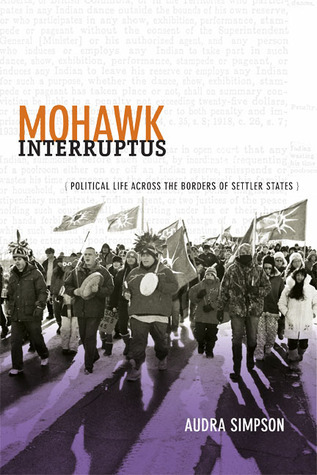
Mohawk Interruptus: Political Life Across the Borders of Settler States
Mohawk Interruptus is a bold challenge to dominant thinking in the fields of Native studies and anthropology. Combining political theory with ethnographic research among the Mohawks of Kahnawà:ke, a reserve community in what is now southwestern Quebec, Audra Simpson examines their struggles to articulate and maintain political sovereignty through centuries of settler colonialism. The Kahnawà:ke Mohawks are part of the Haudenosaunee or Iroquois Confederacy. Like many Iroquois peoples, they insist on the integrity of Haudenosaunee governance and refuse American or Canadian citizenship. Audra Simpson thinks through this politics of refusal, which stands in stark contrast to the politics of cultural recognition. Tracing the implications of refusal, Simpson argues that one sovereign political order can exist nested within a sovereign state, albeit with enormous tension around issues of jurisdiction and legitimacy. Finally, Simpson critiques anthropologists and political scientists, whom, she argues, have too readily accepted the assumption that the colonial project is complete. Belying that notion, Mohawk Interruptus calls for and demonstrates more robust and evenhanded forms of inquiry into indigenous politics in the teeth of settler governance.
280 pages, Hardcover
First published April 14, 2014
Ratings & Reviews
Friends & Following
Create a free account to discover what your friends think of this book!
Community Reviews
Displaying 1 - 30 of 43 reviews

Read
January 29, 2021Scholarly. Anthropology, Indigenous studies. The book emerges from ethnographic research conducted among Mohawk people from Kahnawà:ke, and the author herself is Mohawk and from Kahnawà:ke. Unlike a lot of anthropological research, the book takes up questions of key concern to the community itself – things like membership, belonging, and borders – in the context of scrutinizing the settler colonial regimes that have created the past and present in which those are experienced. In the process of doing so, it critically re-examines the quite long history of anthropological engagement with Haudenosaunee peoples, which has often been focused on producing a reified understanding of "culture" disconnected from history, colonization, power, and people's everyday lives, that then gets turned into a regulatory mechanism for judging authenticity. Simpson argues that this is particularly visible in the case of Kahnawà:ke, in part because it has as a community been rendered peripheral in what is often referred to as "Iroquois studies" for a number of historical reasons. It is also a community that is fiercely sovereigntist, that has received extensive, often hostile, outside attention for its debates regarding membership, and whose members regularly do what they can to refuse the settler regulation of mobility across the colonial border imposed through Mohawk territory. Just in terms of general political education, the book does very useful work contextualizing things like the famous resistance in the early 1990s at Kanehsatà:ke, the tax avoidance by tobacco companies that was constructed in settler media as "Mohawk cigarette smuggling," the forms that membership debates take, and the range of Mohawk resistance related to the border. It theorizes sovereignty in interesting ways, and describes how notwithstanding the settler state's claim to absolute sovereignty over its territories, there is in fact a good case to be made for the existence of "nested sovereignties," in which ongoing Haudenosaunee refusal, kinship, and everyday practices and structures of feeling have maintained a difficult but living practical sovereignty that persists within the space claimed by the settler state. Perhaps of most direct interest and use to me was the work early in the book critiquing anthropology – a form of professionalized listening to the Other that emerged in the context of Empire – both in general and specifically in how it has manifested as "Iroquois studies." The book is also interesting in how it thinks about refusal as a general political tactic taken up by Mohawk people from Kahnawà:ke and other Haudenosaunee people, and also in the context of ethnography – listening to people talk about their lives for the purpose of producing more broadly circulating knowledge – and writing. Very interesting book.

Read
July 20, 2020This is a phenomenal text, one of my absolute favorite scholarly works. I love Simpson's use of political treaties, anthropological field surveys, interviews, and theoretical responses to scholars of Indigeneity and Citizenship. As a roughly ethnographic text (which she frames as a practice against the fixity of colonial anthropology), I also love her grounding of the personal voice. She's able to render a lot of dense material into a clear format through that positional foundation, which also gives a further degree of purpose and levity to work that might be rendered thin and dry if it were coming from another scholar.
Simpson brings us, from a native Mohawk position, to reflect on communal belonging and how that concept is mediated between politics, history, and sociality. So, while this book is written from a particular vantage- that of the Mohawk of Kahnawà:ke- it can also be taken to develop extended questions of identity and formations of belonging- whether that be on the condition of nationhood, tribe, race, gender, etc. She surveys a whole history of settler-colonial intrusions into Indigenous sovereignty to do so- arriving at a concept of feeling-citizenship where sociality and embodied presence can be argued to potentially trump (depending on the occasion) more formal/legal conceptions of membership-status.
It is all very insightful, valuable, and productivity work. Coming from a Feminist Mohawk it could be said that her study emphasizes, and rightfully so, questions of gender and local Mohawk politics, but (again), she always creates a space that both respects the particularity of such a context whilst also extending the material to questions that she hasn't made the focus of her own project. Recommended to anyone with an interest in topics concerning Indigeneity, settler-colonialism, sovereignty, conceptual membership/belonging, ethnography, and anthropology.
Simpson brings us, from a native Mohawk position, to reflect on communal belonging and how that concept is mediated between politics, history, and sociality. So, while this book is written from a particular vantage- that of the Mohawk of Kahnawà:ke- it can also be taken to develop extended questions of identity and formations of belonging- whether that be on the condition of nationhood, tribe, race, gender, etc. She surveys a whole history of settler-colonial intrusions into Indigenous sovereignty to do so- arriving at a concept of feeling-citizenship where sociality and embodied presence can be argued to potentially trump (depending on the occasion) more formal/legal conceptions of membership-status.
It is all very insightful, valuable, and productivity work. Coming from a Feminist Mohawk it could be said that her study emphasizes, and rightfully so, questions of gender and local Mohawk politics, but (again), she always creates a space that both respects the particularity of such a context whilst also extending the material to questions that she hasn't made the focus of her own project. Recommended to anyone with an interest in topics concerning Indigeneity, settler-colonialism, sovereignty, conceptual membership/belonging, ethnography, and anthropology.
June 3, 2019
Masterful synthesis of Indigenous social theory, settler colonial historiography and ethnographic methodology. I would recommend for grad students looking for a model of a state of the art contemporary ethnography.

July 9, 2017
This is a complex and nuanced analysis of issues surrounding Mohawk sovereignty and identity, written for an academic audience. I found Simpson's discussion of the Jay Treaty and its implications for Mohawk people crossing the Canada-US border particularly illuminating.

March 9, 2018
I think clearly this is a critical work to think about refusal and how refusal is taken up both by scholars (as in "ethnographic refusal" which ought to be taught waaaaay more often in methods and ethics courses like why don't we talk about that more??) but also as a way of Indigenous politics that is really worth thinking about. I think for NN folks, this is definitely worth thinking about borders and recognition/refusal, and in thinking about what constitutes sovereignty and recognizable sovereignty. I will probably be returning to this at some point, because it's such a critical work and some of it was fairly dense, but I do think it has so much to contribute in terms of thinking about mobility and its limits.

November 3, 2022
read this for my anthro theory class and thoroughly enjoyed it! it’s super dense but the concepts Simpson introduces are interesting and highlight a side of indigenous studies that has historically been ignored. i’d recommend to people interested in anthropology but probably not anyone else haha
February 5, 2026
Awesomeee
December 16, 2018
A true interdisciplinary feat that demonstrates the real ways Kahnawake Mohawk and other Natives imagine and claim sovereignty in the settler colonial reality we’re faced with.

February 15, 2023
This book is at best academically dense, at worst impenetrable. While dealing with an important case study of the concept of “nested sovereignty,” it’s pretty inaccessible. From run-in sentences with multiple clauses, subclauses, and qualifiers that take up almost a whole paragraph to peppered references to academic schools of thought (“in the vein of Derrida,” “like a close reading of Said’s work,” “in Pierre Bourdieu’s sense”) without providing any context or follow-up, it was hard to plough through, even as someone with a graduate-level education in the humanities. If this last sentence was hard to read, get ready for a lot of the same but with six-syllable abstract terms.
The most disappointing part is that *I want to know more* about Mohawk resistance to ongoing colonialism. While a text with such an impossibly high entry barrier might be great as a PhD dissertation, it’s hard to engage with it in any practical way and thus seems like a missed opportunity to spread awareness about the political plight of Kahnawà:ke.
Excerpts:
“Indigeneity and its imbrication with settler colonialism question the conditions of seeing (perhaps of writing) that are laid out in the master-bondsman allegory; this allows us to consider another vantage point in another perceptual and argumentative theater or space of recognition.”
“More than figuring the matter of "othering" or rendering exotic and external to the self (an imagined Western self), this was a deep intellectual history of the textual, philological, and philosophical practice of evacuating history, specificity, complexity, and sentience from the space of the living.”
“The deep context of dispossession, of containment, of a skewed authoritative axis and the ongoing structure of both settler colonialism and its disavowal make writing and analysis a careful, complex instantiation of jurisdiction and authority, what Robert Warrior has called "literary sovereignty" (Warrior 1995).”
The most disappointing part is that *I want to know more* about Mohawk resistance to ongoing colonialism. While a text with such an impossibly high entry barrier might be great as a PhD dissertation, it’s hard to engage with it in any practical way and thus seems like a missed opportunity to spread awareness about the political plight of Kahnawà:ke.
Excerpts:
“Indigeneity and its imbrication with settler colonialism question the conditions of seeing (perhaps of writing) that are laid out in the master-bondsman allegory; this allows us to consider another vantage point in another perceptual and argumentative theater or space of recognition.”
“More than figuring the matter of "othering" or rendering exotic and external to the self (an imagined Western self), this was a deep intellectual history of the textual, philological, and philosophical practice of evacuating history, specificity, complexity, and sentience from the space of the living.”
“The deep context of dispossession, of containment, of a skewed authoritative axis and the ongoing structure of both settler colonialism and its disavowal make writing and analysis a careful, complex instantiation of jurisdiction and authority, what Robert Warrior has called "literary sovereignty" (Warrior 1995).”
May 13, 2025
Audra Simpson’s Mohawk Interruptus: Political Life Across the Borders of Settler States emerged over a decade ago, yet its poignance and relevance to issues of indigenous sovereignty and governance persist today. With a background in political anthropology, Simpson thinks about affective governance in the Mohawk nation across the U.S. and Canada, particularly in the dynamics between Iroquoia and Kahnawà:ke. She uses this book to challenge anthropological methods by centering indigenous self-determination and refusal, and exploring an interwoven fabric of sovereignties, narratives, and histories in order to question what it means to hold membership within an indigenous nation.
Simpson grapples with several recurring questions throughout this book, including how complex personal narratives could possibly align within one comprehensive history or literary canon, and how ethnographic methods can challenge “tradition” and the notion of desire when centered on indigenous cultures. She also explores how to illustrate the complex histories and sovereignty of Kahnawà:ke in relation to other nations, races, and legal orders—including the Indian Act and the Jay Treaty—as a Mohawk herself.
Interweaving field survey interviews, literary and film analysis, historical narratives, often with her own personal reflections, the reader is guided on a journey that completely disrupts the dominating singular narratives on indigenous nation formations. The book absolutely provides an insightful archive of knowledge, constructed as a rich ethnography, yet it also has a meta function in exercising refusal itself—an experimental aspect that really connects Simpson to her subject and puts her data collection into practice.
The book was structured as six chapters, plus a conclusion, each centered on a different theme that acted as mini case studies into particular aspects of Kahnawà:ke nation construction and membership. As Simpson weaves together different methodologies across her thematic timeline, she naturally introduces a progressive series of arguments and questions across each chapter and organizes them through subheadings—of which she is careful to reflect upon and connect across chapters. She will often provide teasers into what the following chapter holds, and is conscious about referencing previous questions she posed in earlier sections, to craft flowing through lines that ebb and flow at appropriate points.
“Ethnographic Refusal: Anthropological Need” was the standout chapter of this book, as it bridged the histories that Simpson detailed in the previous three sections with the impacts of refusal on representations of sovereignty and nationhood. I especially enjoyed the survey interview she included here, in which Simpson understood in real time that she was experiencing a moment of ethnographic refusal with her interviewee. This chapter also revealed the overarching function of the book as an ethnography that pivots upon refusal, which provided a newfound perspective on the content that Simpson may have chosen to withhold throughout the book, and what the people she connected with chose to withhold from her.
Simpson is also very clear and direct with her arguments throughout the book, and presents a thorough introduction at the start of each chapter to guide the reader through her intricate web of sources. However, these introductions tend to be quite dense, and her lengthy sentence structure in these sections came across as convoluted at times. The language itself was not necessarily inaccessible, but rather its immediate impact gives the reader a lot to untangle before the meat of the chapter begins. I also would have loved to see more personal reflections being interwoven with field notes and literary analysis—because Simpson’s own identity was closely tied to her subject matter, this book seemed to provide a glimpse into Simpson’s introspective journey while learning about the histories of the Mohawk Nation. Those moments provided a sense of grounding within these complex concepts and questions, by interrupting the ethnographic flow and translating them into real human experience.
Though I am not an indigenous person, I really resonated with Simpson’s analysis of ethnographic refusal replacing “recognition” and dismantling “difference” in anthropology. I also found Simpson’s conclusions on membership to be especially poignant in today’s political climate, and her encouragement of further work on the gendered and racialized policies of I.C.E., citizenship practices, and experiences would be a fascinating pursuit. I can only imagine how the border crossing stories that Simpson’s friends retold in this book would be exacerbated in today’s settler colonial reality, and they certainly raise critical questions about how grounded forms of membership are gendered and racialized—a subject that must be taken up in further ethnographic works on citizenship and national belonging.
Overall, I was intrigued by Simpson’s variety of methods and personal reflections, and enjoyed seeing the different facets in which she thinks about ethnographic refusal in Kahnawà:ke social dynamics. I would certainly recommend this to someone who is pursuing indigenous studies, and to anyone who is able to comprehend dense academic texts, and is curious about what breaking anthropological method conventions looks like.
Not only does Mohawk Interruptus provide an excellent introduction to indigenous politics, but it literally “interrupts” the traditional ways that anthropologists conduct ethnographies in a fascinating way. The notion of ethnographic refusal ought to be understood more broadly, and utilized by anthropologists—and the communities they study—much more often.
Simpson grapples with several recurring questions throughout this book, including how complex personal narratives could possibly align within one comprehensive history or literary canon, and how ethnographic methods can challenge “tradition” and the notion of desire when centered on indigenous cultures. She also explores how to illustrate the complex histories and sovereignty of Kahnawà:ke in relation to other nations, races, and legal orders—including the Indian Act and the Jay Treaty—as a Mohawk herself.
Interweaving field survey interviews, literary and film analysis, historical narratives, often with her own personal reflections, the reader is guided on a journey that completely disrupts the dominating singular narratives on indigenous nation formations. The book absolutely provides an insightful archive of knowledge, constructed as a rich ethnography, yet it also has a meta function in exercising refusal itself—an experimental aspect that really connects Simpson to her subject and puts her data collection into practice.
The book was structured as six chapters, plus a conclusion, each centered on a different theme that acted as mini case studies into particular aspects of Kahnawà:ke nation construction and membership. As Simpson weaves together different methodologies across her thematic timeline, she naturally introduces a progressive series of arguments and questions across each chapter and organizes them through subheadings—of which she is careful to reflect upon and connect across chapters. She will often provide teasers into what the following chapter holds, and is conscious about referencing previous questions she posed in earlier sections, to craft flowing through lines that ebb and flow at appropriate points.
“Ethnographic Refusal: Anthropological Need” was the standout chapter of this book, as it bridged the histories that Simpson detailed in the previous three sections with the impacts of refusal on representations of sovereignty and nationhood. I especially enjoyed the survey interview she included here, in which Simpson understood in real time that she was experiencing a moment of ethnographic refusal with her interviewee. This chapter also revealed the overarching function of the book as an ethnography that pivots upon refusal, which provided a newfound perspective on the content that Simpson may have chosen to withhold throughout the book, and what the people she connected with chose to withhold from her.
Simpson is also very clear and direct with her arguments throughout the book, and presents a thorough introduction at the start of each chapter to guide the reader through her intricate web of sources. However, these introductions tend to be quite dense, and her lengthy sentence structure in these sections came across as convoluted at times. The language itself was not necessarily inaccessible, but rather its immediate impact gives the reader a lot to untangle before the meat of the chapter begins. I also would have loved to see more personal reflections being interwoven with field notes and literary analysis—because Simpson’s own identity was closely tied to her subject matter, this book seemed to provide a glimpse into Simpson’s introspective journey while learning about the histories of the Mohawk Nation. Those moments provided a sense of grounding within these complex concepts and questions, by interrupting the ethnographic flow and translating them into real human experience.
Though I am not an indigenous person, I really resonated with Simpson’s analysis of ethnographic refusal replacing “recognition” and dismantling “difference” in anthropology. I also found Simpson’s conclusions on membership to be especially poignant in today’s political climate, and her encouragement of further work on the gendered and racialized policies of I.C.E., citizenship practices, and experiences would be a fascinating pursuit. I can only imagine how the border crossing stories that Simpson’s friends retold in this book would be exacerbated in today’s settler colonial reality, and they certainly raise critical questions about how grounded forms of membership are gendered and racialized—a subject that must be taken up in further ethnographic works on citizenship and national belonging.
Overall, I was intrigued by Simpson’s variety of methods and personal reflections, and enjoyed seeing the different facets in which she thinks about ethnographic refusal in Kahnawà:ke social dynamics. I would certainly recommend this to someone who is pursuing indigenous studies, and to anyone who is able to comprehend dense academic texts, and is curious about what breaking anthropological method conventions looks like.
Not only does Mohawk Interruptus provide an excellent introduction to indigenous politics, but it literally “interrupts” the traditional ways that anthropologists conduct ethnographies in a fascinating way. The notion of ethnographic refusal ought to be understood more broadly, and utilized by anthropologists—and the communities they study—much more often.

April 4, 2015
Slightly heavy on the academic language at parts, but an incredible book that made me look differently at sovereignty. Also one of the best breakdowns of the colonial lens anthropology has had toward the Mohawks.
May 29, 2026
On Mohawk refusal:
When Audra Simpson discusses refusal, she refers to the use of rejection as a political tool in order to live a life that is true to Mohawks. This is not just a personal choice, but a collective action. She introduces the idea of refusing something that is generally considered a positive thing, a passport, and how Mohawk's refusal of it should not be taken at face value. Instead, she explains it is the denial of participating in settler citizenship, a total refusal of belonging to the state and “politically being Iroquois” (Simpson 7). Simpson explains that accepting government credentials or proof of some affiliation in which they are defined by the federal government, is to accept misrepresentations of themselves. She explains the origins of state recognition by using Patrick Wolfe’s argument to explain how settler colonialism is tied to territory, then she writes, “...political recognition is a technique of settler governance” (Simpson 20). Which ties directly to a pattern that we have seen in several of the texts, asserting the right to self-determination by Native people. Meaning that the act of refusal is simply an exercise of their sovereignty.
As a result, the act of refusing to participate, is actively “asserting actual histories and thus legislating interpretive possibilities in contestation–interpretations of treaty, possibilities of movement, electoral practices–not only individual selves” (Simpson 22). This is exemplified in her example of the Iroquois Nationals Lacrosse Team refusing to concede and obtain another form of identification when the United Kingdom deemed their Haudenosaunee passport illegitimate. Instead of only interpreting this as a refusal to not take part in the game of being Canadian, Simpson explains that for the players, this act would mean ignoring “the deep history, philosophy, and authority of Iroquois governance” (Simpson 25). This circles back to the acceptance of misrepresentation, it would mean accepting the questioning of their government’s legitimacy. Yet another example of an attempt to ignore Native sovereignty and homogenize heterogeneous people.
When Audra Simpson discusses refusal, she refers to the use of rejection as a political tool in order to live a life that is true to Mohawks. This is not just a personal choice, but a collective action. She introduces the idea of refusing something that is generally considered a positive thing, a passport, and how Mohawk's refusal of it should not be taken at face value. Instead, she explains it is the denial of participating in settler citizenship, a total refusal of belonging to the state and “politically being Iroquois” (Simpson 7). Simpson explains that accepting government credentials or proof of some affiliation in which they are defined by the federal government, is to accept misrepresentations of themselves. She explains the origins of state recognition by using Patrick Wolfe’s argument to explain how settler colonialism is tied to territory, then she writes, “...political recognition is a technique of settler governance” (Simpson 20). Which ties directly to a pattern that we have seen in several of the texts, asserting the right to self-determination by Native people. Meaning that the act of refusal is simply an exercise of their sovereignty.
As a result, the act of refusing to participate, is actively “asserting actual histories and thus legislating interpretive possibilities in contestation–interpretations of treaty, possibilities of movement, electoral practices–not only individual selves” (Simpson 22). This is exemplified in her example of the Iroquois Nationals Lacrosse Team refusing to concede and obtain another form of identification when the United Kingdom deemed their Haudenosaunee passport illegitimate. Instead of only interpreting this as a refusal to not take part in the game of being Canadian, Simpson explains that for the players, this act would mean ignoring “the deep history, philosophy, and authority of Iroquois governance” (Simpson 25). This circles back to the acceptance of misrepresentation, it would mean accepting the questioning of their government’s legitimacy. Yet another example of an attempt to ignore Native sovereignty and homogenize heterogeneous people.

February 24, 2025
“These techniques - occupying, treating, forceful elimination, containment, assimilation, the practice of immigration (called such in the United States and Canada, rather than "settlement") - all form self-authorizing techniques and frameworks that sustain dispossession and occupation.”
The Iroquois Confederacy (the Six Nations of Mohawk, Oneida, Onondaga, Cayuga, Seneca and Tuscarora people) long existed before the United States, Canada, and the U.K.
They had a constitution and governing ways long before settlers arrived. They even influenced the framers of the U.S. Constitution.
Colonialism is savagery. It requires that the colonized give up their land, governance, food source, gender-relations and life-ways to assimilate into the settler state.
Borders, passports, and settler citizenship reinforce and entrench settler states. Audra Simpson examines the Mohawk (Kahnawà:ke) refusal to accept these colonial constructs and outright reject their integrity.
Life on the reservation, concepts of membership and tradition are discussed along with gendered and racial impacts of U.S. and Canadian laws defining indigenous citizenship.
The Iroquois Confederacy (the Six Nations of Mohawk, Oneida, Onondaga, Cayuga, Seneca and Tuscarora people) long existed before the United States, Canada, and the U.K.
They had a constitution and governing ways long before settlers arrived. They even influenced the framers of the U.S. Constitution.
Colonialism is savagery. It requires that the colonized give up their land, governance, food source, gender-relations and life-ways to assimilate into the settler state.
Borders, passports, and settler citizenship reinforce and entrench settler states. Audra Simpson examines the Mohawk (Kahnawà:ke) refusal to accept these colonial constructs and outright reject their integrity.
Life on the reservation, concepts of membership and tradition are discussed along with gendered and racial impacts of U.S. and Canadian laws defining indigenous citizenship.

Read
April 12, 2026Notes from the reading:
The Indian Act, first enacted in 1876, systematically replaced indigenous, often matrilineal, definitions of belonging with a patrilineal, Eurocentric system designed to assimilate Indigenous peoples and reduce the number of recognized "Indians.” By adopting European standards of lineage—where identity and property were transmitted through the father—the Act discriminated against women, stripping them of status and community ties if they married non-status men, while granting status to non-Indigenous women who married status men.
Audra Simpson highlights that blood quantum is a settler-colonial tool, enforced via the Indian Act, designed to legislatively erase Indigenous people by reducing them from political nations to racialized minorities. By enforcing strict, arbitrary blood percentages for membership, colonial governments aimed to restrict rights, reduce land claims, and eventually "breed out" Indigenous populations through intermarriage.
The Indian Act, first enacted in 1876, systematically replaced indigenous, often matrilineal, definitions of belonging with a patrilineal, Eurocentric system designed to assimilate Indigenous peoples and reduce the number of recognized "Indians.” By adopting European standards of lineage—where identity and property were transmitted through the father—the Act discriminated against women, stripping them of status and community ties if they married non-status men, while granting status to non-Indigenous women who married status men.
Audra Simpson highlights that blood quantum is a settler-colonial tool, enforced via the Indian Act, designed to legislatively erase Indigenous people by reducing them from political nations to racialized minorities. By enforcing strict, arbitrary blood percentages for membership, colonial governments aimed to restrict rights, reduce land claims, and eventually "breed out" Indigenous populations through intermarriage.

November 3, 2021
I read this for an anthropology class and gave a presentation on it. After three initial retellings of Indigenous plights in chapter 1, I would have appreciated more ethnography in Chapter 2 as well (to snowball interest a bit more.) Chapter 3's critique of past anthropological ethnographies on Indigenous peoples was a bit heavy and repetitive on the author's disapproval of their (of the time) methods. I agree, the methodology is unsightly to a scholar now, but it overshadowed the benefits of the study mentioned briefly afterward.
Overall it was a compelling and valuable read on the Kahnawakehrenon and the transnational processes they have endured and continue to face. I did not know much about First Nation peoples previously, and while I believe I still do not know a lot, I am glad I read this book to learn something.
Overall it was a compelling and valuable read on the Kahnawakehrenon and the transnational processes they have endured and continue to face. I did not know much about First Nation peoples previously, and while I believe I still do not know a lot, I am glad I read this book to learn something.

December 14, 2020
This is a very good sociological/anthropological study of the political position of the Kahnawà:ke Mohawk reserve. In particular Simpson is focused on what she calls the politics of refusal--the refusal to allow the community's life, membership, borders, and traditions to be defined by settler colonial governments that often fail to understand the ethics and politics of the Mohawk. These issues of refusal (including the refusal to travel under US or Canadian passports, the refusal to acknowledge settler colonial guidelines for determining tribal membership, and the refusal to acknowledge an international boundary that the Mohawk have never agreed to allow through their territory) are tied up with issues of recognition and definition.

February 22, 2022
Elaborate unpacking of a complex and complicated situation, unresolved and ongoing. Well researched and articulated.
"Indigenous peoples within and beyond Kahnawà:ke continue to strive and in so doing sustain questions of profound theoretical and political importance-questions of persistence, vigor, and dignity in the face of grinding power-as well as the disavowal of staggering wrongdoing."
"Indigenous peoples within and beyond Kahnawà:ke continue to strive and in so doing sustain questions of profound theoretical and political importance-questions of persistence, vigor, and dignity in the face of grinding power-as well as the disavowal of staggering wrongdoing."
September 11, 2024
I read this for my native sovereignty class and it has changed my brain chemistry lol I'm definitely going to revisit this again and again in future. It's incredibly academic and challenging so I don't know that I'd recommend it broadly, but absolutely worth a read if you're interested in the subject and willing to look up some words and theories along the way!
December 12, 2024
Profoundly wise articulation of Indigenous sovereignty. Her writings on ethnographic refusal seem increasingly relevant as it describes a conscious decision by Indigenous Peoples to withhold knowledge from external entities as a form of resistance against repeated commodification and harm - as well as a critique of the ongoing colonization embedded in our public institutions and discourse.
February 20, 2021
This book is brilliant, and it offers some very exciting frameworks for refusing settler-colonial politics of recognition and assimilation. It gave me hope that anthropology can do more than "decolonize" and be anti-colonial as well. A roadmap!

Read
September 9, 2021Unrated because I had to read this for an anthropology class, but highly recommend to anyone interested in learning about the history of the Haudenosaunee/Iroquois Confederacy and/or wanting to learn more about the intersections of Native studies and anthropological studies.

February 24, 2025
there was a lot of this that i didn't understand but i think that's because i wasn't this book's intended audience. author made some good points but for the most part the very existence of this seemed contradictory to its primary argument, "refusal".

June 6, 2018
So frustratingly difficult to read. Vague research of vague and questionable importance. I can’t stand the way some anthropologists write, it’s just awful.


February 26, 2022
It’s somewhat comforting to hear someone you know and someone as talented as Audra to be telling part of the story and is what I feel is needed right now.

March 18, 2022
The critique of anthropology’s obsession with culture is FIRE
January 27, 2023
A personal and theoretical intervention into the feeling of sovereignty.
Read
September 24, 2024Audra Simpson’s ethnographic refusal has influenced me so much. Immense gratitude. Love my chosen mentors!

October 13, 2024
Read for Decolonizing Anthropology
This was SO DENSE but really interesting I want to read it again when I have more time!!!
This was SO DENSE but really interesting I want to read it again when I have more time!!!
December 7, 2024
Too located within the academy for me.
Displaying 1 - 30 of 43 reviews