

What do you think?

O sujeito lacaniano – entre a linguagem e o gozo
Insurgindo-se contra a rigidez dos pensamentos pós-estruturalistas, que anunciam a "morte do sujeito", o autor explora o significado do "tornar-se sujeito", desvelando noções centrais como: o Outro, objeto a, inconsciente estruturado como linguagem, alienação e separação, metáfora paterna e diferença sexual.
256 pages, Paperback
First published January 1, 1995
About the author
Bruce Fink
65 books175 followersBruce Fink is a practicing Lacanian psychoanalyst and analytic supervisor. He trained as a psychoanalyst in France for seven years with and is now a member of the psychoanalytic institute Jacques Lacan created shortly before his death, the École de la Cause freudienne in Paris, and obtained his Ph.D. from the Department of Psychoanalysis at the University of Paris VIII (Saint-Denis). He served as Professor of Psychology from 1993 to 2013 at Duquesne University in Pittsburgh, Pennsylvania, and is currently an affiliated member of the Pittsburgh Psychoanalytic Center.
Dr. Fink is the author of six books on Lacan (which have been translated into many different languages, including Spanish, Portuguese, German, Polish, Croatian, Greek, Turkish, Japanese, Korean, and Chinese):
• The Lacanian Subject: Between Language and Jouissance (Princeton: Princeton University Press, 1995)
• A Clinical Introduction to Lacanian Psychoanalysis: Theory and Technique (Cambridge: Harvard University Press, 1997)
• Lacan to the Letter: Reading Écrits Closely (Minneapolis: University of Minnesota Press, 2004)
• Fundamentals of Psychoanalytic Technique: A Lacanian Approach for Practitioners (New York: W.W. Norton and Co., 2007)
• Against Understanding: Commentary, Cases, and Critique in a Lacanian Key, 2 volumes (London: Routledge, 2013-2014)
He has translated several of Lacan’s works, including:
• The Seminar, Book XX (1972-1973): Encore, On Feminine Sexuality: The Limits of Love and Knowledge (New York: Norton, 1998)
• Écrits: A Selection (New York: Norton, 2002)
• Écrits: The First Complete Edition in English (New York: Norton, 2006), for which he received the 2007 nonfiction translation prize from the French-American Foundation and the Florence Gould Foundation
• On the Names-of-the-Father (Cambridge: Polity Press, 2013)
• The Triumph of Religion (Cambridge: Polity Press, 2013)
• The Seminar, Book VIII: Transference (Cambridge: Polity Press, forthcoming)
He is also the coeditor of three collections on Lacan’s work published by SUNY Press:
• Reading Seminar XI: Lacan’s Four Fundamental Concepts of Psychoanalysis (1995)
• Reading Seminars I and II: Lacan’s Return to Freud (1996)
• Reading Seminar XX: Lacan’s Major work on Love, Knowledge, and Feminine Sexuality (2002)
He has presented his theoretical and clinical work at close to a hundred different conferences, psychoanalytic institutes, and universities in the U.S. and abroad since 1986.
In recent years, he has authored mysteries involving a character based on Jacques Lacan: The Adventures of Inspector Canal (London: Karnac, 2010, and translated into Finnish). A second volume, Death by Analysis, was published by Karnac in 2013, to be followed by two further mysteries in 2014 (The Purloined Love and Odor di Murderer).
Dr. Fink is the author of six books on Lacan (which have been translated into many different languages, including Spanish, Portuguese, German, Polish, Croatian, Greek, Turkish, Japanese, Korean, and Chinese):
• The Lacanian Subject: Between Language and Jouissance (Princeton: Princeton University Press, 1995)
• A Clinical Introduction to Lacanian Psychoanalysis: Theory and Technique (Cambridge: Harvard University Press, 1997)
• Lacan to the Letter: Reading Écrits Closely (Minneapolis: University of Minnesota Press, 2004)
• Fundamentals of Psychoanalytic Technique: A Lacanian Approach for Practitioners (New York: W.W. Norton and Co., 2007)
• Against Understanding: Commentary, Cases, and Critique in a Lacanian Key, 2 volumes (London: Routledge, 2013-2014)
He has translated several of Lacan’s works, including:
• The Seminar, Book XX (1972-1973): Encore, On Feminine Sexuality: The Limits of Love and Knowledge (New York: Norton, 1998)
• Écrits: A Selection (New York: Norton, 2002)
• Écrits: The First Complete Edition in English (New York: Norton, 2006), for which he received the 2007 nonfiction translation prize from the French-American Foundation and the Florence Gould Foundation
• On the Names-of-the-Father (Cambridge: Polity Press, 2013)
• The Triumph of Religion (Cambridge: Polity Press, 2013)
• The Seminar, Book VIII: Transference (Cambridge: Polity Press, forthcoming)
He is also the coeditor of three collections on Lacan’s work published by SUNY Press:
• Reading Seminar XI: Lacan’s Four Fundamental Concepts of Psychoanalysis (1995)
• Reading Seminars I and II: Lacan’s Return to Freud (1996)
• Reading Seminar XX: Lacan’s Major work on Love, Knowledge, and Feminine Sexuality (2002)
He has presented his theoretical and clinical work at close to a hundred different conferences, psychoanalytic institutes, and universities in the U.S. and abroad since 1986.
In recent years, he has authored mysteries involving a character based on Jacques Lacan: The Adventures of Inspector Canal (London: Karnac, 2010, and translated into Finnish). A second volume, Death by Analysis, was published by Karnac in 2013, to be followed by two further mysteries in 2014 (The Purloined Love and Odor di Murderer).
Ratings & Reviews
Friends & Following
Create a free account to discover what your friends think of this book!
Community Reviews
Displaying 1 - 30 of 123 reviews

June 14, 2021
I have been taught that psychoanalytic thought, and especially Lacan's, is bullshit through and through. I am so glad that I've taken the time to seriously consider Lacan in spite of this norm in my field of analytic philosophy. Every discipline comes with its own biases; each cannot help but be conservative with respect to its founding figures. So when it comes to understanding especially complex phenomena like agency and language, it is important to read across disciplines. After reading Fink's introduction to Lacan, I am amazed at how incredibly limited analytic philosophical approaches to these subjects are (although Lacan is just as limited in his own ways). I do feel that many points could've been made in a more straightforward manner. But at least compared to other psychoanalytic literature I've glimpsed at, Fink's writing is clear and informative.
Here are the main takeaways from the book, which are shocking from the perspective of analytic philosophy of mind. Lacan argues that there is no such thing as absolute authenticity; our "innermost" thoughts or personal voice are in fact as alien to us as thoughts or words that seem disconnected from our agency, such as slips of the tongue or spontaneous imagery. This is because in order to become conscious of need or desire, it must be articulated within language. Language precedes us and is beyond our control; it consists in concepts and vocabularies that have been developed by many people over many decades preceding us. So when a need or desire is linguistically articulated, it is necessarily formatted in a socially acceptable way and takes on a form that differs from that of the original, pre-linguistic need or desire.
This idea itself is not new to analytic philosophy. Plenty of pragmatist, post-Kantian thinkers argue for the same conclusion (e.g., Wittgenstein, Rorty, Goodman, Brandom). But Lacan treats this idea from an angle foreign to these thinkers. According to Lacan, this necessarily fated "gap" between our conscious experience and the unconscious (i.e., our prelinguistic needs and desires which we cannot know about nor access) is the engine that generates our subjectivity. Fink fails to explain exactly through what process this generation occurs. But my guess is this: if there were no discrepancy, we'd simply have stable needs and desires, and regularly satisfy them. But with the discrepancy, we need to try again and again with new formulations of our needs and desires; this leads to actually having new needs and desires, and when we act on those, we discover new ways of life.
Another innovation of Lacan (with respect to analytic philosophy) is that our primary desire above all is to re-enact some original state, which actually never existed but is a fantasy that we've constructed, although we're typically unaware of that. This is the state of being in total union with the mother's breast (which I'm assuming Lacan uses in a symbol manner, although Fink doesn't say this explicitly). There is no difference between subject and object; there is no external world, no "other" that is outside of us and beyond our control. But the mother's breast was in fact an external object; infants just didn't conceptualize it that way.
As infants grow up, they realize that their mother desires people and objects other than the infant's self. The infant is insecure; she desires for the mother to love only her and no one else. She desires that original (fantastical) state union. In attempting to re-achieve that union, she will either adopt the same desires as her mother, or change herself so that she can fulfill the functions of the objects and people whom her mother desires. (These are two very different actions, but Fink doesn't disambiguate them, which is confusing). Lacan calls these actions as our desiring "object (a)" (where "a" is the first letter of the French word for "other").
In simpler terms (if my understanding is correct), we're driven to change ourselves so that other people will accept and love us. This is a commonplace truth; Lacan adds, beyond our normal intuitions, that there is a core, unconscious belief in what we must amount to (or an object/goal we must achieve) in order for others to love us. This belief is often irrational; there are so many mistakes and contingencies in our infant/childhood that lead to our misunderstanding what other people desire. But we are oblivious to this belief and its irrational character; it simply fuels all of our conscious needs and desires.
Lacan holds that we gain health and freedom when we come to terms with the fact that we are responsible for whatever beliefs we have about other people's desires, and thereby for who we ought to become so that they will desire us. We made a choice to believe that our mother desired a certain person or object, and so that which seems to be necessity (the state of society and the world, and what it demands of us) is in fact a product of our agency. Lacan calls the therapeutic process of taking ownership over one's desires as "subjectivization" or "traversing fantasy." I wish there was at least one example in the book about what this process might look like; but there are none, and so I don't have a clear idea of what this responsibility really is.
Here is a confusion I am left with. Lacan focuses on the phenomenon of alienation in the contexts of language and of the other (which the mother symbolizes). Our desires and needs are transformed when we articulate them and make them conscious; and we have beliefs about what our mother desires, and we change ourselves as to satisfy those. What is the relationship between these two forms of alienation? Are they just superficially or loosely similar in the sense that we lose some original state of being in both cases? Fink seems to imply that they have a significant relation, but this is left unclear.
Here is a major issue I take with Lacan's thought. He believes that the unconscious transacts in words, and associations between words are governed by certain linguistic principles (e.g., phonetic or syntactical similarity). For example, if two words are phonetically similar (e.g., bank and spank), these might be related so that if we consciously have a thought that involves the referent of one word, the referent of the other might leap into our awareness, seemingly out of nowhere. While in our conscious language use, associations are governed by our semantic understanding of language, reasons, and epistemic considerations, the unconscious forgoes all of that.
This seems wrong. Where is the evidence that the unconscious deals with words and their formal properties? Evolutionarily speaking, animals have always been coupled to their environments, and so it would make more sense for our unconscious to transact in possibilities for action in the environment. Language is a relatively new, cultural invention. It is plausible to me that the associations established by the unconscious hold between affordances (i.e., J.J. Gibson's term for possibilities for action afforded by objects in the environment). For example, consciously when I perceive a mug of coffee, I believe that it is just a tasty beverage that will make me more awake. But if I have some quirk in my developmental history in which I regularly described my ex's brown and sleepy eyes as being "coffee eyes," perhaps my perception of the mug actually primes me to yearn for my ex, to freeze up in the face of fearful memories regarding him, or to enter some other behavioral dispositions related to my ex. I might lack conscious awareness of these behavioral dispositions; I only feel weird emotions but either fail to, or automatically suppress, attention to the more detailed states of which these emotions are a part.
If I replace Lacan's claims about language in the unconscious with claims about affordances, I am compelled by the view that slips of the tongue, dreams, and other phenomena driven by the unconscious are extremely significant and afford interpretation. But it still seems risky to try to interpret these; we need criteria of accuracy to guide interpretations, but I've yet to encounter any in psychoanalytic literature. I wonder if we switch from language to affordances, whether it might make it easier to identify criteria of accuracy; maybe there's a way to empirically test which behavioral dispositions one enters when encountering some object, for example.
Here are the main takeaways from the book, which are shocking from the perspective of analytic philosophy of mind. Lacan argues that there is no such thing as absolute authenticity; our "innermost" thoughts or personal voice are in fact as alien to us as thoughts or words that seem disconnected from our agency, such as slips of the tongue or spontaneous imagery. This is because in order to become conscious of need or desire, it must be articulated within language. Language precedes us and is beyond our control; it consists in concepts and vocabularies that have been developed by many people over many decades preceding us. So when a need or desire is linguistically articulated, it is necessarily formatted in a socially acceptable way and takes on a form that differs from that of the original, pre-linguistic need or desire.
This idea itself is not new to analytic philosophy. Plenty of pragmatist, post-Kantian thinkers argue for the same conclusion (e.g., Wittgenstein, Rorty, Goodman, Brandom). But Lacan treats this idea from an angle foreign to these thinkers. According to Lacan, this necessarily fated "gap" between our conscious experience and the unconscious (i.e., our prelinguistic needs and desires which we cannot know about nor access) is the engine that generates our subjectivity. Fink fails to explain exactly through what process this generation occurs. But my guess is this: if there were no discrepancy, we'd simply have stable needs and desires, and regularly satisfy them. But with the discrepancy, we need to try again and again with new formulations of our needs and desires; this leads to actually having new needs and desires, and when we act on those, we discover new ways of life.
Another innovation of Lacan (with respect to analytic philosophy) is that our primary desire above all is to re-enact some original state, which actually never existed but is a fantasy that we've constructed, although we're typically unaware of that. This is the state of being in total union with the mother's breast (which I'm assuming Lacan uses in a symbol manner, although Fink doesn't say this explicitly). There is no difference between subject and object; there is no external world, no "other" that is outside of us and beyond our control. But the mother's breast was in fact an external object; infants just didn't conceptualize it that way.
As infants grow up, they realize that their mother desires people and objects other than the infant's self. The infant is insecure; she desires for the mother to love only her and no one else. She desires that original (fantastical) state union. In attempting to re-achieve that union, she will either adopt the same desires as her mother, or change herself so that she can fulfill the functions of the objects and people whom her mother desires. (These are two very different actions, but Fink doesn't disambiguate them, which is confusing). Lacan calls these actions as our desiring "object (a)" (where "a" is the first letter of the French word for "other").
In simpler terms (if my understanding is correct), we're driven to change ourselves so that other people will accept and love us. This is a commonplace truth; Lacan adds, beyond our normal intuitions, that there is a core, unconscious belief in what we must amount to (or an object/goal we must achieve) in order for others to love us. This belief is often irrational; there are so many mistakes and contingencies in our infant/childhood that lead to our misunderstanding what other people desire. But we are oblivious to this belief and its irrational character; it simply fuels all of our conscious needs and desires.
Lacan holds that we gain health and freedom when we come to terms with the fact that we are responsible for whatever beliefs we have about other people's desires, and thereby for who we ought to become so that they will desire us. We made a choice to believe that our mother desired a certain person or object, and so that which seems to be necessity (the state of society and the world, and what it demands of us) is in fact a product of our agency. Lacan calls the therapeutic process of taking ownership over one's desires as "subjectivization" or "traversing fantasy." I wish there was at least one example in the book about what this process might look like; but there are none, and so I don't have a clear idea of what this responsibility really is.
Here is a confusion I am left with. Lacan focuses on the phenomenon of alienation in the contexts of language and of the other (which the mother symbolizes). Our desires and needs are transformed when we articulate them and make them conscious; and we have beliefs about what our mother desires, and we change ourselves as to satisfy those. What is the relationship between these two forms of alienation? Are they just superficially or loosely similar in the sense that we lose some original state of being in both cases? Fink seems to imply that they have a significant relation, but this is left unclear.
Here is a major issue I take with Lacan's thought. He believes that the unconscious transacts in words, and associations between words are governed by certain linguistic principles (e.g., phonetic or syntactical similarity). For example, if two words are phonetically similar (e.g., bank and spank), these might be related so that if we consciously have a thought that involves the referent of one word, the referent of the other might leap into our awareness, seemingly out of nowhere. While in our conscious language use, associations are governed by our semantic understanding of language, reasons, and epistemic considerations, the unconscious forgoes all of that.
This seems wrong. Where is the evidence that the unconscious deals with words and their formal properties? Evolutionarily speaking, animals have always been coupled to their environments, and so it would make more sense for our unconscious to transact in possibilities for action in the environment. Language is a relatively new, cultural invention. It is plausible to me that the associations established by the unconscious hold between affordances (i.e., J.J. Gibson's term for possibilities for action afforded by objects in the environment). For example, consciously when I perceive a mug of coffee, I believe that it is just a tasty beverage that will make me more awake. But if I have some quirk in my developmental history in which I regularly described my ex's brown and sleepy eyes as being "coffee eyes," perhaps my perception of the mug actually primes me to yearn for my ex, to freeze up in the face of fearful memories regarding him, or to enter some other behavioral dispositions related to my ex. I might lack conscious awareness of these behavioral dispositions; I only feel weird emotions but either fail to, or automatically suppress, attention to the more detailed states of which these emotions are a part.
If I replace Lacan's claims about language in the unconscious with claims about affordances, I am compelled by the view that slips of the tongue, dreams, and other phenomena driven by the unconscious are extremely significant and afford interpretation. But it still seems risky to try to interpret these; we need criteria of accuracy to guide interpretations, but I've yet to encounter any in psychoanalytic literature. I wonder if we switch from language to affordances, whether it might make it easier to identify criteria of accuracy; maybe there's a way to empirically test which behavioral dispositions one enters when encountering some object, for example.

December 29, 2008
To my mind Bruce Fink is by far the BEST writer explaining Lacanian theory in English, and that includes the works of Slavoj Zizek. There is no question that you should read all of his books, but you should start with this one. It focuses on the theoretical and philosophical side of Lacanian theory. The next two books by Fink that you should read are "A Clinical Introduction to Lacanian Theory: Theory and Practice" and "Fundamentals of Psychoanalytic Technique: A Lacanian Approach for Practitioners," which take Lacanian theory out of the abstract and discuss them in real world terms, as clinical practices. Don't skip the footnotes in this book-- they are essential. The appendices are also vital, for they include a list of Lacan’s “symbols” and what they represent, which have been invaluable to me. I have returned again and again to the works of Finks, and cannot recommend they highly enough. A fantastic introduction to Lacan which, step by step, goes into a great depth of detail and gives you a solid foundation for continued research. By no means the only text you should read about Lacanian theory, but, if you were to read only one, make it this one.

April 30, 2025
Je pense là où je ne suis pas, donc je suis là où je ne pense pas.
میاندیشم آنجا که نیستم، هستم آنجا که نمیاندیشم.
در نظر لاکان، «سوژهی دوپاره» یا «سوژهی خطخورده» ($)، نامِ آن گسست بنیادینیست که بهواسطهی ورود به زبان در هستی انسان پدیدار میشود. این ورود، اگرچه شرط امکانِ سوژهشدن است، در عین حالْ بنیانِ یک نقصان ساختاریست؛ چرا که زبان، با تمامی قوام نمادینش، همواره بخشی از تجربهی زیسته و تمنای سوژه را وانهاده و به حاشیه میراند. از اینرو، سوژه در کشاکشی دائمی میان امر آگاه و ساحت ناخودآگاه قرار میگیرد.
در این میانه، ناخودآگاه چونان دیگری بزرگ (le Grand Autre) عمل میکند که جایگاه قانون، زبان و فرهنگ است، در حالیکه منِ آگاه بر تصویری از خود استوار است که در آینهی بازشناسیهای خیالی و اجتماعی شکل گرفته. این دوگانگی، سوژه را در وضعیتی واگرا نگاه میدارد؛ وضعیتی که در آن، خود هرگز با خویشتن یکی نمیشود، چرا که بخشی از او، در همان لحظهی سوژهشدن، در زبان گم میگردد.
فینک مفاهیم کلیدی لاکان مانند «دیگری بزرگ» (Grand Autre)، «ابژهی کوچک a» (objet petit a)، و «ژوئیسانس» (jouissance) را بررسی میکند. او توضیح میدهد که چگونه سوژه در فرآیند «بیگانگی» (aliénation) و «جدایی» (séparation) شکل میگیرد؛ به این معنا که فرد برای تبدیل شدن به سوژه، باید از طریق زبان خود را تعریف کند، اما این زبان همواره بخشی از تجربه و میل او را سرکوب یا حذف میکند.
در این چارچوب، «ژوئیسانس» بهعنوان لذتی آمیخته با رنج مطرح میشود که از افق لذتهای متعارف فراتر میرود و زبان از بازنمایی کامل آن ناتوان است. فینک نشان میدهد که سوژهی لاکانی همواره در تلاش برای پر کردن این خلأ است، اما زبان بهعنوان ابزار اصلی ارتباط، همواره این تلاش را ناکام میگذارد.
در نهایت، فینک با بررسی دقیق این مفاهیم، تصویری روشن از سوژهی لاکانی ارائه میدهد؛ سوژهای که همواره در تعلیق میان ناخودآگاه و زبان، خود را بازمییابد.
--
سخنی در مورد ترجمه
۱. این کتاب با ترجمهی «محمدعلی جعفری» نیز در بازار موجود است؛ گرچه «محمدعلی جعفری» پیشتر و بعدتر آثاری مرتبط با لاکان را به فارسی ترجمه کرده و مترجمی توانمند است اما درمقام مقایسه با «علی حسینزاده» ناتوان باقی میماند. ترجمهی «علی حسینزاده» نهتنها دقیق، یکپارچه و منسجم است، بلکه خواندنش لذتبخشتر از خواندن آن دیگر ترجمه است.
۲. «علی بهروزی» بیهنر و کودن که دست بهترجمه اثری از ژیژک دربارهی لاکان زده، که کاش دستش میشکست و هرگز چنین کاری نمیکرد، چنان ترجمهی گُهای بهدست داده که از برگههای کتابش میتوان بعنوان کود استفاده کرد. برای آنکه زبانتان به دشنام آلوده نشود سمت کتاب «چگونه لاکان بخوانیم؟» نروید، مگر بهقصد خواندن آن به زبان اصلی.
میاندیشم آنجا که نیستم، هستم آنجا که نمیاندیشم.
در نظر لاکان، «سوژهی دوپاره» یا «سوژهی خطخورده» ($)، نامِ آن گسست بنیادینیست که بهواسطهی ورود به زبان در هستی انسان پدیدار میشود. این ورود، اگرچه شرط امکانِ سوژهشدن است، در عین حالْ بنیانِ یک نقصان ساختاریست؛ چرا که زبان، با تمامی قوام نمادینش، همواره بخشی از تجربهی زیسته و تمنای سوژه را وانهاده و به حاشیه میراند. از اینرو، سوژه در کشاکشی دائمی میان امر آگاه و ساحت ناخودآگاه قرار میگیرد.
در این میانه، ناخودآگاه چونان دیگری بزرگ (le Grand Autre) عمل میکند که جایگاه قانون، زبان و فرهنگ است، در حالیکه منِ آگاه بر تصویری از خود استوار است که در آینهی بازشناسیهای خیالی و اجتماعی شکل گرفته. این دوگانگی، سوژه را در وضعیتی واگرا نگاه میدارد؛ وضعیتی که در آن، خود هرگز با خویشتن یکی نمیشود، چرا که بخشی از او، در همان لحظهی سوژهشدن، در زبان گم میگردد.
فینک مفاهیم کلیدی لاکان مانند «دیگری بزرگ» (Grand Autre)، «ابژهی کوچک a» (objet petit a)، و «ژوئیسانس» (jouissance) را بررسی میکند. او توضیح میدهد که چگونه سوژه در فرآیند «بیگانگی» (aliénation) و «جدایی» (séparation) شکل میگیرد؛ به این معنا که فرد برای تبدیل شدن به سوژه، باید از طریق زبان خود را تعریف کند، اما این زبان همواره بخشی از تجربه و میل او را سرکوب یا حذف میکند.
در این چارچوب، «ژوئیسانس» بهعنوان لذتی آمیخته با رنج مطرح میشود که از افق لذتهای متعارف فراتر میرود و زبان از بازنمایی کامل آن ناتوان است. فینک نشان میدهد که سوژهی لاکانی همواره در تلاش برای پر کردن این خلأ است، اما زبان بهعنوان ابزار اصلی ارتباط، همواره این تلاش را ناکام میگذارد.
در نهایت، فینک با بررسی دقیق این مفاهیم، تصویری روشن از سوژهی لاکانی ارائه میدهد؛ سوژهای که همواره در تعلیق میان ناخودآگاه و زبان، خود را بازمییابد.
--
سخنی در مورد ترجمه
۱. این کتاب با ترجمهی «محمدعلی جعفری» نیز در بازار موجود است؛ گرچه «محمدعلی جعفری» پیشتر و بعدتر آثاری مرتبط با لاکان را به فارسی ترجمه کرده و مترجمی توانمند است اما درمقام مقایسه با «علی حسینزاده» ناتوان باقی میماند. ترجمهی «علی حسینزاده» نهتنها دقیق، یکپارچه و منسجم است، بلکه خواندنش لذتبخشتر از خواندن آن دیگر ترجمه است.
۲. «علی بهروزی» بیهنر و کودن که دست بهترجمه اثری از ژیژک دربارهی لاکان زده، که کاش دستش میشکست و هرگز چنین کاری نمیکرد، چنان ترجمهی گُهای بهدست داده که از برگههای کتابش میتوان بعنوان کود استفاده کرد. برای آنکه زبانتان به دشنام آلوده نشود سمت کتاب «چگونه لاکان بخوانیم؟» نروید، مگر بهقصد خواندن آن به زبان اصلی.

January 6, 2015
My third time reading it and it is simply a great "in" to Lacan's labyrinthian thought. It should be taken as an in to Lacan himself, not as a substitute for Lacan, and like all great introductions to thinkers Fink notes this from the beginning. The chapters on alienation and separation are especially good. Given the complexity of his thought, Fink does as good a job as one could ask, I think. Excited to get into Lacan proper.

January 11, 2023
An astoundingly clear cut elucidation of Lacanian psychoanalysis; as for the content itself I’m still uncertain of its usefulness. The same kind of reticence comes up whenever I hear Marxists try to construe their own discourse as a science, since one can always attempt to portray it as some kind of fully furnished organon. It’s the same with psychoanalysis, certainly thrilling to read through, but one is seriously sceptical of its extension into other fields (outside of being the worst kind of cultural/literary critic - thumbing in flaccid theory so as to reductively analyse some Lynch film). Maybe Fink will prove this intuition wrong in his Clinical Introduction, because I have been lead to believe that psychoanalysis has just about the same efficacy/success rate as CBT (even if Fink, regurgitating Lacan, sees discussions of efficacy, correcting character traits etc. as merely improving some arbitrary good instead of doing what is important, namely, dialectising the master signifier and traversing over fantasy).
I suppose that any seemingly coherent theorem (even with Lacan’s stipulations that his system not be seen as a closed economy, that there remains something ineffable at the base, the ineluctable nature of object (a), aptly referred to as Gödelian structuralism) provides a placebo, the subject-as-presumed-to-know will reign in all therapeutic fields as long as we are cowardly enough to continue to cry out for therapy.
So why choose Lacanian psychoanalysis? It seems to be the most bookish of the analytic tradition — maybe it can be seen as the best avenue toward a who’s got the biggest dick style competition between analyst and analysand to see who is more well read and intelligent (of course the analyst isn’t meant to give into this, is instead likely to cough or seem disinterested - but come on, the guy’s still human). Also.... how is one to believe in therapy, or more specifically its value? I struggle to see how all the elusiveness in the world incarnated by the analyst as analyst-becoming-the-elusive-position-of-desire could breach the dam of the analysand’s stubbornness on this one point.
I’m rambling now. Good book.
I suppose that any seemingly coherent theorem (even with Lacan’s stipulations that his system not be seen as a closed economy, that there remains something ineffable at the base, the ineluctable nature of object (a), aptly referred to as Gödelian structuralism) provides a placebo, the subject-as-presumed-to-know will reign in all therapeutic fields as long as we are cowardly enough to continue to cry out for therapy.
So why choose Lacanian psychoanalysis? It seems to be the most bookish of the analytic tradition — maybe it can be seen as the best avenue toward a who’s got the biggest dick style competition between analyst and analysand to see who is more well read and intelligent (of course the analyst isn’t meant to give into this, is instead likely to cough or seem disinterested - but come on, the guy’s still human). Also.... how is one to believe in therapy, or more specifically its value? I struggle to see how all the elusiveness in the world incarnated by the analyst as analyst-becoming-the-elusive-position-of-desire could breach the dam of the analysand’s stubbornness on this one point.
I’m rambling now. Good book.

Read
January 14, 2021No huhuhh nyt saatu tää luettuu... Luin vastikään Zizekin Ideologian ylevä objektin, jossa sovelletaan Lacanin fantasiakäsitystä ideologioiden tutkimukseen ja kiinnostuin syvällisemmin Lacanin omasta ajattelusta. Lacan on siinä mielessä erikoinen psykoanalyytikko, että se ottaa hyvin filosofisen ja jopa metafyysisen astelman teoriassaan. Kirjan mukaan ja meikänki mielestä Lacanin hulluin akateeminen temppu on samaanaikaan asettua strukturalistiseen maailmankuvaan mutta silti puolustaa materiaalista subjektia ja ihmisyyttä!
Vaikka kirja oli iha niiku introduction Lacanin ajatteluun oli kyl välil silti vaikeuksii ymmärtää kaikkee xd. Mut suositteleen sataprossaa kaikille, joilla on kiinnostusta ymmärtää todellisuutta ihmisen psykologian kautta!!!
Vaikka kirja oli iha niiku introduction Lacanin ajatteluun oli kyl välil silti vaikeuksii ymmärtää kaikkee xd. Mut suositteleen sataprossaa kaikille, joilla on kiinnostusta ymmärtää todellisuutta ihmisen psykologian kautta!!!

September 18, 2021
I liked how this book runs the gamut from "genuinely accessible to people with no background in psychoanalysis" to "esoteric discussions of Lacan's attempt to invent a programming language" or whatever those appendices are supposed to be about. I particularly like the opening of chapter 1 and the other little vignette-type descriptions of concrete analytic situations. They are excellent introductions to basic and polyvalent psychoanalytic concepts. I know that Fink has a bad reputation as a conservative Millerian, and he does seem to be insistently critical of several feminist authors in this book, but he also seems to insist on several important theoretical points that keep Lacanian psychoanalysis open to feminist and queer-theoretic recuperation, such as the repeated clarification that, contra some feminist critiques of Lacan, the sexuation of the subject into masculine and feminine relationships to signification is very strictly distinct from bodily anatomy; the phallus has a particular signifying function, for example, rather than a contingent physical form. I'll let you know when I find it.

January 9, 2023
Fink is very good at offering the read with some general insights into a clinical take on Lacanian psychoanalysis. I've found this book to be useful at different times, and it is a nice reference point to work from his theory and back to the theory theory, as Fink is kind of a make Lacan into one single big theory thinker, rather than Lacan as there are different times and different ways he thought (makes sense from a clinical perspective), as such it sort of teaches you what are some overarching lessons. Very good resource... that is worth having on one's shelf.

January 5, 2011
This book has, at least for now, revived my faith in the value of clinical psychoanalysis. So much so that now I'm not sure why I abandoned it to begin with. Probably had something to do with last semester's ample suppository of Foucaultian nonsense. Or at least it would be easy to blame Foucault. But that would be quite un-Lacanian of me. A "truer" explanation would be that I had simply stopped understanding clinical Lacan. Which that isn't to say Lacan can be understood. As he said of the Ecrits: it is not a book meant to be read. Quite literally, in my experience, the Ecrits are impossible to read. Which is unforgivable to most readers. And academics are the worst about it; publish or perish; all we want to do is feign understanding enough to perform it. And if something doesn't lend itself to easy performance, then we dismiss it. This is the logic of hyper-consumerist capitalism: give me something that makes sense so I can go sense an other thing. And unfortunately this is what American psychoanalysis has turned into. It's no longer Lacanian or even Freudian. It's just another playground full of humanists pushing each other back and forth on swings made of bullshit. Psychoanalysis is not supposed to make you feel better; it's not a master discourse; it's not a science; it's not a place where you go to cry about the fact that nobody loves you anymore because your dog died and now all of your dreams feature rainbows masquerading as your next door neighbor's elephantital scrotum. It is all those things, of course. But it's something more. Fink does a pretty great job of defending it, mostly to dispel the rampant myths about what actually goes on in therapy (myths which you believe. Yes, you.). Fink explains why we shouldn't be afraid of assuming the position of the analysand. Of assuming a position that may force you to do something real, for the first time, with you.
But on the other hand, "panopticism" is a really fun word.
But on the other hand, "panopticism" is a really fun word.

October 25, 2014
This was a remarkably rewarding read. I've read a few books on Lacan so far, and this was a perfect intermediate-level discussion. For beginners, I would definitely suggest getting some of the Lacanian basics down first (I highly suggest Lionel Bailly's Lacan: A Beginner's Guide) before tackling this book. Although Fink is a remarkably clear writer with an unparalleled understanding of Lacanian analysis, things honestly get pretty heavy pretty quick.
Highly suggested for those familiar with the fundamentals like Real/Symbolic/Imaginary, castration/separation, desire of the Other, object (a), the paternal metaphor, Name-of-the-Father, four discourses, etc. Probably the most valuable (and difficult) portion is the chapter on Lacan's mathemes of sexuation, a topic which I don't think I will ever, ever truly get. (I'm not really sure anyone grasps sexuation, to be honest.)
You'll finish the book feeling like you've never understood so much yet so little about Lacan. And that's precisely the beauty of it. The book ends with this quote from Lacan, which says it all:
"Reading in no way obliges you to understand. You have to read first."
Highly suggested for those familiar with the fundamentals like Real/Symbolic/Imaginary, castration/separation, desire of the Other, object (a), the paternal metaphor, Name-of-the-Father, four discourses, etc. Probably the most valuable (and difficult) portion is the chapter on Lacan's mathemes of sexuation, a topic which I don't think I will ever, ever truly get. (I'm not really sure anyone grasps sexuation, to be honest.)
You'll finish the book feeling like you've never understood so much yet so little about Lacan. And that's precisely the beauty of it. The book ends with this quote from Lacan, which says it all:
"Reading in no way obliges you to understand. You have to read first."

May 17, 2023
Read this before you start reading Lacan or Zizek. In my opinion the most comprehensive and insightful secundary literature on Lacan for beginners. The book is especially useful if you're trying to get a good grip on the difficult Lacanian concepts like alienation, object a, the Other, jouissance etc. while also learning about psychoanalytic theory and praxis as a 'whole'. All wonderfully explained in under 200 pages!

March 31, 2015
Don't venture into the wilderness of Lacan without a guide. This guy wants to help you, and he can. Seriously. Don't go it alone, man.

January 25, 2018
The key to the Lacan crypt.

July 17, 2023
I can't stand the "algebra"+diagrams lol.

March 20, 2022
lacan is lame but lightening bolts are so badass

February 20, 2023
After an extended (dare I say barren?) hiatus was recently broken by my revisiting of psychoanalytic theory and its texts, I picked up once again Fink’s 1995 book, first read in 2008, and I was immediately reminded of its immense worth to the introduction of Jacques Lacan.
Unlike other texts from Fink, this one foregrounds Lacan’s philosophy, whilst deferring the treatment of more practical topics such as Lacanian psychoanalytic practice, its differences to other psychoanalytic schools of thought, and the subject positions seen in the Lacanian clinic (hysteric, psychotic, pervert), to other works.
On the one hand, his text affords a rare example of both lucidity and assiduousness, managing a mammoth task of deftly carving up for the novice the immense weight of Lacan’s multifarious (and sometimes mutilated) volume of work; on the other hand, it is careful to pinpoint moments where Fink’s own interpretation foregrounds the particular exposition he affords.
Since its initial publication, some elements have seen further development (e.g. Chapter 8 on sexuation). Yet his writing still encapsulates the core tenets of Lacan’s thinking: subjectivity, the Other, the unconscious, desire, jouissance, object (a), the letter, the phallic function, the four discourses, etc.
Inevitably a text such as this will displace and repress, attending to topics that the author feels require more emphasis than others (e.g. Fink treats with less emphasis the roles of metaphor and metonymy in thought, a point explained to no end in other introductory works). For the sympathetic reader, though, this book can serve as a mainspring for further forays, and remains certainly a worthy read for those with either no history of Lacan or those wanting to refine some of their thoughts.
Unlike other texts from Fink, this one foregrounds Lacan’s philosophy, whilst deferring the treatment of more practical topics such as Lacanian psychoanalytic practice, its differences to other psychoanalytic schools of thought, and the subject positions seen in the Lacanian clinic (hysteric, psychotic, pervert), to other works.
On the one hand, his text affords a rare example of both lucidity and assiduousness, managing a mammoth task of deftly carving up for the novice the immense weight of Lacan’s multifarious (and sometimes mutilated) volume of work; on the other hand, it is careful to pinpoint moments where Fink’s own interpretation foregrounds the particular exposition he affords.
Since its initial publication, some elements have seen further development (e.g. Chapter 8 on sexuation). Yet his writing still encapsulates the core tenets of Lacan’s thinking: subjectivity, the Other, the unconscious, desire, jouissance, object (a), the letter, the phallic function, the four discourses, etc.
Inevitably a text such as this will displace and repress, attending to topics that the author feels require more emphasis than others (e.g. Fink treats with less emphasis the roles of metaphor and metonymy in thought, a point explained to no end in other introductory works). For the sympathetic reader, though, this book can serve as a mainspring for further forays, and remains certainly a worthy read for those with either no history of Lacan or those wanting to refine some of their thoughts.

March 29, 2022
Anlamamanın deli tadı

Read
September 8, 2020As is the custom whenever I wrote on academic books, tis' is not so much of a review as it is a note and summary of the ideas presented in the book.
The Lacanian subject is the inverse of Descartes' cogito
Under set theory, the cartesian subject can be mapped as this:
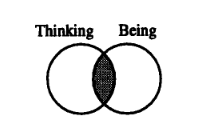
For Descartes, the conscious subject is the master of its own thought. It was the moment when we are thinking that our being is affirmed.
To Lacan, such a view is rather utopian. From the viewpoint of the self or ego, "I" runs the show: that aspect of us that we call "I" believes that it knows what it thinks and feels, and believes that it knows why it does what it does. Psychoanalysis begins with the presupposition that that Other kind of talk stems from an other which is locatable in some sense; it holds that unintentional words that are spoken, blurted out, mumbled, or garbled come from some other place, some other agency than the ego. Freud called that Otherplace the unconscious.
We are not the only one in the house; there is an Other.
We are born crying, a scream into the void, a languageless utterance. Whenever we cry, our parents come to us and interpret our cries in their language. "The baby must be hungry!" or "The baby must be lonely!" From our parents' imposition of language upon our bodily acts and needs, we begin to learn language. These desires, we learn, are named hunger and loneliness within language.
Inevitably, there comes a time when our parents fail to come to our cry. Either mom is busy, or dad is out of the house. We realize that we have to do something to keep them near us; to strategize on how we could keep our parents' attention. We construct an image of ourselves that we think is the best at keeping our parents' attention, fulfilling all their desire. Mom said that "I" was a good boy when I finished eating my oatmeal, and Dad comes to pick me up when "I" beg him; this "I" is constructed with the purpose of fulfilling our needs.
Eventually, even this "I" would fail. Our parents will, at one time of our need, fail to answer our call. We realize that they, too, are fallible. We realize that there is something bigger than our parents; a structure in our social universe that sets our parents, our playmates, and our environment in motion. The structure can be capitalism, patriarchy, or religion; structures that Lacan identifies as "the big Other". The big Other speaks to our parents, determining their lives, desiring them and being desired by them. Eventually, we realize that our parents' relationship with this big Other is the same kind of relationship we have with our own parents.
The realization heralds the splitting of the subject; there is the "I" that we imagine ourselves to be when interacting with others, and there is also the "other" of language.
While we have the feeling, much of the time, of choosing our words, at times they are chosen for us. We may be unable to think and express something except in on every specific way (that being the only formulation our language—or at least that part of the language we have assimilated and have, as it were, at our disposal—provides); and words are occasionally blurted out that we do not have the impression of having chosen. The Other is speaking through our mouth; the other thing in our mind.
Now going back to the cogito...
The subject, as Lacan understands the term, cannot take refuge in an idyllic moment where thought and being coincide. Rather, one is forced to choose one or the other. One can "have" either thought or being, but never both at the same time.

The Lacanian subject comes down to the following: The subject is nothing but this very split. Lacan's variously termed "split subject," "divided subject," or "barred subject" consists entirely in the fact that a speaking being's two"parts" or avatars share no common ground: they are radically separated (the ego or false being requiring a refusal of unconscious thoughts, unconscious thought having no concern whatsoever for the ego's fine opinion of itself).
This momentous split is a product of the functioning of language in us as we first begin to speak as children.
The splitting of the I into ego (false self) and unconscious brings into being a surface, in a sense, with two sides: one that is exposed and one that is. Though the two sides may not ultimately be made of radically differential—linguistic in nature—at any given point along the surface there is a front and a back, a visible face and an invisible one.
The Lacanian subject is the inverse of Descartes' cogito
I think, therefore I am ... cogito ergo sum
Under set theory, the cartesian subject can be mapped as this:
For Descartes, the conscious subject is the master of its own thought. It was the moment when we are thinking that our being is affirmed.
To Lacan, such a view is rather utopian. From the viewpoint of the self or ego, "I" runs the show: that aspect of us that we call "I" believes that it knows what it thinks and feels, and believes that it knows why it does what it does. Psychoanalysis begins with the presupposition that that Other kind of talk stems from an other which is locatable in some sense; it holds that unintentional words that are spoken, blurted out, mumbled, or garbled come from some other place, some other agency than the ego. Freud called that Otherplace the unconscious.
the unconscious is the Other's discourse
We are not the only one in the house; there is an Other.
We are born crying, a scream into the void, a languageless utterance. Whenever we cry, our parents come to us and interpret our cries in their language. "The baby must be hungry!" or "The baby must be lonely!" From our parents' imposition of language upon our bodily acts and needs, we begin to learn language. These desires, we learn, are named hunger and loneliness within language.
Inevitably, there comes a time when our parents fail to come to our cry. Either mom is busy, or dad is out of the house. We realize that we have to do something to keep them near us; to strategize on how we could keep our parents' attention. We construct an image of ourselves that we think is the best at keeping our parents' attention, fulfilling all their desire. Mom said that "I" was a good boy when I finished eating my oatmeal, and Dad comes to pick me up when "I" beg him; this "I" is constructed with the purpose of fulfilling our needs.
Eventually, even this "I" would fail. Our parents will, at one time of our need, fail to answer our call. We realize that they, too, are fallible. We realize that there is something bigger than our parents; a structure in our social universe that sets our parents, our playmates, and our environment in motion. The structure can be capitalism, patriarchy, or religion; structures that Lacan identifies as "the big Other". The big Other speaks to our parents, determining their lives, desiring them and being desired by them. Eventually, we realize that our parents' relationship with this big Other is the same kind of relationship we have with our own parents.
The realization heralds the splitting of the subject; there is the "I" that we imagine ourselves to be when interacting with others, and there is also the "other" of language.
While we have the feeling, much of the time, of choosing our words, at times they are chosen for us. We may be unable to think and express something except in on every specific way (that being the only formulation our language—or at least that part of the language we have assimilated and have, as it were, at our disposal—provides); and words are occasionally blurted out that we do not have the impression of having chosen. The Other is speaking through our mouth; the other thing in our mind.
Now going back to the cogito...
The subject, as Lacan understands the term, cannot take refuge in an idyllic moment where thought and being coincide. Rather, one is forced to choose one or the other. One can "have" either thought or being, but never both at the same time.
The Lacanian subject comes down to the following: The subject is nothing but this very split. Lacan's variously termed "split subject," "divided subject," or "barred subject" consists entirely in the fact that a speaking being's two"parts" or avatars share no common ground: they are radically separated (the ego or false being requiring a refusal of unconscious thoughts, unconscious thought having no concern whatsoever for the ego's fine opinion of itself).
This momentous split is a product of the functioning of language in us as we first begin to speak as children.
The splitting of the I into ego (false self) and unconscious brings into being a surface, in a sense, with two sides: one that is exposed and one that is. Though the two sides may not ultimately be made of radically differential—linguistic in nature—at any given point along the surface there is a front and a back, a visible face and an invisible one.
Read
December 16, 2022the last 4 chapters are incomprehensible and that says a lot about Lacan's writings considering this is an (somewhat) introduction book to Lacan

June 14, 2021
این چهارمین کتابی بود که دربارهی لکان خوندم و بنظرم بهترینشون. دربارهی اینکه در این کتاب با چه بخشی از اندیشههای لکان آشنا میشید، خود بروس فینک، نویسندهی کتاب، توضیح خوبی در انتهای کتاب داده:
«در نهایت هیچ کس از این کتاب احساس رضایت کامل نمی کند، چون هر کسی گمان می کند من به اندازه کافی به مهم ترین مباحث نظری در رشته او نپرداختهام. منتقد ادبی احساس میکند برای سبک و بلاغت لاکان و ایده استعاره او کم مایه گذاشتهام؛ فیلسوف احساس میکند که با بی قیدی به مناظره های عظیم درباره منطق و نظریه مجموعه ها بی اعتنا بودهام و صورتبندی های قدیمی را چنان معرفی کردهام که گویی جدیدترین دستاوردها محسوب می شوند؛ روانکاو احساس میکند که توجه من به نظامهای منطقی نظری بیش از مسائل بالینی معتبر بوده است و به موضوعاتی چون مرگ و ژوئیسانس بی اعتنا بودهام؛ فمینیست احساس میکند که به اندازه کافی به دیدگاههای مبسوط لاکان درباره تفاوت جنسی نپرداختهام و به این ترتیب به نواقص آن توجه نکردهام؛دانشجو احساس می کند که شرح بی فایدهای از خاستگاههای اغلب انتزاعی ایدههای لاکان ارائه دادهام و آنها را به شکل واضح و سرراست معرفی نکردهام؛ استاد دانشگاه احساس میکند که به شکل مأیوس کنندهای فضای ناچیزی به تعیین موقعیت نظرهایم در میان نوشته های متاخر دیگر درباره لاکان اختصاص دادهام.
برای این منتقدان، که بی تردید تا حدودی حق با آنان است، فقط این جواب را دارم که حوزه کاری دانشگاهیان و درمانگرانی که به لاکان علاقه نشان میدهند آنقدر متنوع است که حتی نمیتوانم امید آشنایی با تمام آنها را در سر بپرورانم. در مقام روانکاو، فقط به مدد تجربه درکی از دستاوردهای لاکان پیدا میکنم زیرا روانکاوی شوندگانم مرا به نحوی ناگزیر به جانب بعضی مفاهیم سوق میدهند. فعالیت بالینی اغلب فرصت تعبیر قطعهی جذاب اما مبهمی از کار لاکان را که چون بارقهای می درخشد به من می دهد. امیدوارم در نوشته های آیندهام برخی از نابسندگی ها و ناهمترازی های این کتاب را برطرف کنم؛ با وجود این، چهبسا برخی خوانندگان هنوز احساس کنند که به مباحث مهم مورد نظر آنان توجه نشان نمیدهم. اما این به عهده آن دسته از افراد با معلومات در یک رشته است که معانی نهفته مربوط به آن رشته را از کار لاکان ( یا هر کس دیگر) استخراج کنند.»
«در نهایت هیچ کس از این کتاب احساس رضایت کامل نمی کند، چون هر کسی گمان می کند من به اندازه کافی به مهم ترین مباحث نظری در رشته او نپرداختهام. منتقد ادبی احساس میکند برای سبک و بلاغت لاکان و ایده استعاره او کم مایه گذاشتهام؛ فیلسوف احساس میکند که با بی قیدی به مناظره های عظیم درباره منطق و نظریه مجموعه ها بی اعتنا بودهام و صورتبندی های قدیمی را چنان معرفی کردهام که گویی جدیدترین دستاوردها محسوب می شوند؛ روانکاو احساس میکند که توجه من به نظامهای منطقی نظری بیش از مسائل بالینی معتبر بوده است و به موضوعاتی چون مرگ و ژوئیسانس بی اعتنا بودهام؛ فمینیست احساس میکند که به اندازه کافی به دیدگاههای مبسوط لاکان درباره تفاوت جنسی نپرداختهام و به این ترتیب به نواقص آن توجه نکردهام؛دانشجو احساس می کند که شرح بی فایدهای از خاستگاههای اغلب انتزاعی ایدههای لاکان ارائه دادهام و آنها را به شکل واضح و سرراست معرفی نکردهام؛ استاد دانشگاه احساس میکند که به شکل مأیوس کنندهای فضای ناچیزی به تعیین موقعیت نظرهایم در میان نوشته های متاخر دیگر درباره لاکان اختصاص دادهام.
برای این منتقدان، که بی تردید تا حدودی حق با آنان است، فقط این جواب را دارم که حوزه کاری دانشگاهیان و درمانگرانی که به لاکان علاقه نشان میدهند آنقدر متنوع است که حتی نمیتوانم امید آشنایی با تمام آنها را در سر بپرورانم. در مقام روانکاو، فقط به مدد تجربه درکی از دستاوردهای لاکان پیدا میکنم زیرا روانکاوی شوندگانم مرا به نحوی ناگزیر به جانب بعضی مفاهیم سوق میدهند. فعالیت بالینی اغلب فرصت تعبیر قطعهی جذاب اما مبهمی از کار لاکان را که چون بارقهای می درخشد به من می دهد. امیدوارم در نوشته های آیندهام برخی از نابسندگی ها و ناهمترازی های این کتاب را برطرف کنم؛ با وجود این، چهبسا برخی خوانندگان هنوز احساس کنند که به مباحث مهم مورد نظر آنان توجه نشان نمیدهم. اما این به عهده آن دسته از افراد با معلومات در یک رشته است که معانی نهفته مربوط به آن رشته را از کار لاکان ( یا هر کس دیگر) استخراج کنند.»

August 8, 2023
Absolutely brilliant. I wrote a really long review of this and then deleted it all, because at the end of the day you simply have to read it for yourself (probably after multiple failed attempts at reading Lacan himself). Fink shows that there’s much more to Lacan than meets the eye and does a superb job at situating Lacan’s thought within the entirety of his 20+ years of writing. Even though I can’t stand him, I think Zizek summarizes it best when he says that the brilliance of Lacan is in overcoming the dichotomy of structuralism and poststructuralism in showing that/how the structure has a subject. This is really exactly what Fink shows here as well. Highly recommended.

February 19, 2017
The Lacanian Subject is excellent. Fink is a stupendous reader of Lacan and a clear explicator of Lacan's most difficult and confounding ideas. What this text offers, primarily, is a helpful gloss on much of what Lacan says about subjectivity. This text is not a comprehensive reading of all of Lacan's work, nor does it attempt to accomplish such an impossible task. The partiality (both in the sense of incompleteness and in the sense of Fink's personal investments in reading Lacan a certain way) of this text is one of its strength, but must be taken into account. The text is imperfect, both because of Fink's reading of Lacan in certain moments (particularly in regard to the Real) and because of Lacan's own formulations (particularly in regard to so-called sexual difference of sexuation). Imperfections and contradictions taken into account, though, The Lacanian Subject remains both a pleasure to read and essential for most contemporary students of Lacan.
With praise sufficiently lavished, most of my review will actually account for the text's problems, though perhaps they are my own problems as a relative newcomer to Lacan. Still, they are worth noting for those approaching this text for the first time or coming away from having read it for the first time. As I have alluded, Fink's reading of the Real falls somewhere between insufficient and unhelpful. Fink defines the Real as "that which has not yet been symbolized, remained to be symbolized, or even resists symbolization" (25). This definition should be immediately suspect at even the most cursory glance, as resisting symbolization and yet to be symbolized have a near-contradictory tension between them. Lacan might suggest we simply hold that contradiction in view, but the rendering of the Real as yet-to-be-symbolized is an unsatisfying reading of Lacan. One might attribute this issue to the earliness of this text in terms of Fink's output. A colleague of mine suggested that Fink drew more from early Lacan (The Four Fundamental Concepts of Psychoanalysis in particular) for this text, thus producing such a schematic understanding of the Real. But let me be clear: the Real is not some kind of juggling act where that which is unsymbolized comes to be symbolized through analysis but the remainder propagates the Real in equal measure to that which is symbolized, as Fink claims. The Real remains a traumatic core of experience, but never of the experience of any given subject. The Real and its connection to jouissance means that any encounter with the Real never happens to the subject. That is to say, the so-called "person" who might have an encounter with the Real (perhaps in the form of sexual jouissance) would not be the subject. Subjectivity and the Real are mutually exclusive, and indeed an encounter with the Real would never accrue to the subject but only exist as a possible source of trauma.
A more helpful explication Fink authors, to pick one out in particular, is his analysis of the phallus, the mOther's desire, the child, and the name-of-the-father on pages 54-57. The psychoanalytic categories Fink provides accounts of make clear the arbitrariness of these familiar titles. Fink fills these signifiers with the meaning of psychoanalytic structure rather than the detritus of family relation. His reading of Lacan here is most convincing. This same line of argument (the name-of-the-father has nothing to do with any given father, but rather represents any signifier that draws the attention of the child's primary caretaker away from the child) becomes less convincing around page 115 when Fink addresses so-called sexual difference in Lacan, though through no fault of Fink's own.
Lacan's vision of gender difference, or so-called sexual difference or sexuation, as explicated by Bruce Fink, is a tautology. Lacan explicates two psychoanalytic categories of "Man" and "Woman" having nothing to do with biology (or, conceivably, social conditioning that is understood to produce gender as such) and more to do with relations to Lacan's symbolic and Real, and of course how one accesses jouissance. The partner of so-called Man is that of the object a. The partner of so-called Woman is the phallus, the phallus as the signifier of the Other's desire. Woman is situated in closer relation to the Real than Man. This issue is one of capitalizing on the notion of women as less productive entities, because it is through Man's foregoing of jouissance and full alienation in language (castration) under the phallic function makes the Man productive in society. Because Woman never fully gives up "her" jouissance, "she" is necessarily less productive. However, Woman does operate sometimes under the phallic function and thus is partially alienated in language. But doesn't this all sound like the feminine mystique? Lacan argues that, paraphrased by Marie-Hélène Brousse in The Lacanian Review issue 2, that masculine jouissance (of Man) is "a jouissance by means of a fantasy linked to an object" and feminine jouisance (of Woman) is "a jouissance of the order of rapture." Fink reads Lacan identically.
But, again, I don't dispute that these accounts of two muturally exclusive forms of subjectivity and subject constitution are useful. I have avoided the term "subject" up until now, but it seems to me that these two categories do explicate two fundamentally different types of subjectivity. And yet, again, why Man and Woman? And why do certain aspects of Lacan's formulation fit cleanly into crass gendered stereotypes of men and women determined in biological or social terms? Such a coincidence is a call for additional questioning on the part of the work Lacan's formulations are doing.
Needless to say, what Lacan terms Man and Woman can no more serve as the basis for sexual difference than depression and anxiety. Lacan's schemes and their attachment to the public signifier of man and woman are symptomatically impacted by the bifurcation of sex/gender during his period of writing and thinking. Despite Lacan's acknowledgments of sexual different that is different from different (when biological organs and gender identity do not coincide, or when biological organs do not signify in such a way that gender assignment was possible at birth), his view of masculine/feminine ends up both tautological and reductive simply because of the terms he chooses and the deployment of these categories to explain certain neurosis.
Fink's other particularly wonderful articulations of Lacan come when he discusses the role of metaphor in the production of subjectivity and in the relation of the ethical positioning of the psychoanalytic subject. In these cases, I'll let Fink speak for himself. On page 71 Fink writes, "Metaphor, [in opposition to understanding], brings about a new configuration of thoughts, establishing a new combination or permutation, a new order in the signifying chain ... That kind of modification cannot occur without implicating the subject." On page 68 Fink paraphrases Freud and writes, "I must come to be where foreign forces—the Other as language and the Other as desire—once dominated. I must subjectify that otherness. It is for this reason that we can say that the Lacanian subject is ethically motivated, based as it is on this Freudian injunction .... the essential clinical task is to make [the I] appear there where it was [in the cause/unconscious]."
Though I have probably spent more time being critical of Fink and Lacan here than praising them, it must be made clear that I adore them both. If you are anything like me, then reading The Lacanian Subject would be well worth your time.
With praise sufficiently lavished, most of my review will actually account for the text's problems, though perhaps they are my own problems as a relative newcomer to Lacan. Still, they are worth noting for those approaching this text for the first time or coming away from having read it for the first time. As I have alluded, Fink's reading of the Real falls somewhere between insufficient and unhelpful. Fink defines the Real as "that which has not yet been symbolized, remained to be symbolized, or even resists symbolization" (25). This definition should be immediately suspect at even the most cursory glance, as resisting symbolization and yet to be symbolized have a near-contradictory tension between them. Lacan might suggest we simply hold that contradiction in view, but the rendering of the Real as yet-to-be-symbolized is an unsatisfying reading of Lacan. One might attribute this issue to the earliness of this text in terms of Fink's output. A colleague of mine suggested that Fink drew more from early Lacan (The Four Fundamental Concepts of Psychoanalysis in particular) for this text, thus producing such a schematic understanding of the Real. But let me be clear: the Real is not some kind of juggling act where that which is unsymbolized comes to be symbolized through analysis but the remainder propagates the Real in equal measure to that which is symbolized, as Fink claims. The Real remains a traumatic core of experience, but never of the experience of any given subject. The Real and its connection to jouissance means that any encounter with the Real never happens to the subject. That is to say, the so-called "person" who might have an encounter with the Real (perhaps in the form of sexual jouissance) would not be the subject. Subjectivity and the Real are mutually exclusive, and indeed an encounter with the Real would never accrue to the subject but only exist as a possible source of trauma.
A more helpful explication Fink authors, to pick one out in particular, is his analysis of the phallus, the mOther's desire, the child, and the name-of-the-father on pages 54-57. The psychoanalytic categories Fink provides accounts of make clear the arbitrariness of these familiar titles. Fink fills these signifiers with the meaning of psychoanalytic structure rather than the detritus of family relation. His reading of Lacan here is most convincing. This same line of argument (the name-of-the-father has nothing to do with any given father, but rather represents any signifier that draws the attention of the child's primary caretaker away from the child) becomes less convincing around page 115 when Fink addresses so-called sexual difference in Lacan, though through no fault of Fink's own.
Lacan's vision of gender difference, or so-called sexual difference or sexuation, as explicated by Bruce Fink, is a tautology. Lacan explicates two psychoanalytic categories of "Man" and "Woman" having nothing to do with biology (or, conceivably, social conditioning that is understood to produce gender as such) and more to do with relations to Lacan's symbolic and Real, and of course how one accesses jouissance. The partner of so-called Man is that of the object a. The partner of so-called Woman is the phallus, the phallus as the signifier of the Other's desire. Woman is situated in closer relation to the Real than Man. This issue is one of capitalizing on the notion of women as less productive entities, because it is through Man's foregoing of jouissance and full alienation in language (castration) under the phallic function makes the Man productive in society. Because Woman never fully gives up "her" jouissance, "she" is necessarily less productive. However, Woman does operate sometimes under the phallic function and thus is partially alienated in language. But doesn't this all sound like the feminine mystique? Lacan argues that, paraphrased by Marie-Hélène Brousse in The Lacanian Review issue 2, that masculine jouissance (of Man) is "a jouissance by means of a fantasy linked to an object" and feminine jouisance (of Woman) is "a jouissance of the order of rapture." Fink reads Lacan identically.
But, again, I don't dispute that these accounts of two muturally exclusive forms of subjectivity and subject constitution are useful. I have avoided the term "subject" up until now, but it seems to me that these two categories do explicate two fundamentally different types of subjectivity. And yet, again, why Man and Woman? And why do certain aspects of Lacan's formulation fit cleanly into crass gendered stereotypes of men and women determined in biological or social terms? Such a coincidence is a call for additional questioning on the part of the work Lacan's formulations are doing.
Needless to say, what Lacan terms Man and Woman can no more serve as the basis for sexual difference than depression and anxiety. Lacan's schemes and their attachment to the public signifier of man and woman are symptomatically impacted by the bifurcation of sex/gender during his period of writing and thinking. Despite Lacan's acknowledgments of sexual different that is different from different (when biological organs and gender identity do not coincide, or when biological organs do not signify in such a way that gender assignment was possible at birth), his view of masculine/feminine ends up both tautological and reductive simply because of the terms he chooses and the deployment of these categories to explain certain neurosis.
Fink's other particularly wonderful articulations of Lacan come when he discusses the role of metaphor in the production of subjectivity and in the relation of the ethical positioning of the psychoanalytic subject. In these cases, I'll let Fink speak for himself. On page 71 Fink writes, "Metaphor, [in opposition to understanding], brings about a new configuration of thoughts, establishing a new combination or permutation, a new order in the signifying chain ... That kind of modification cannot occur without implicating the subject." On page 68 Fink paraphrases Freud and writes, "I must come to be where foreign forces—the Other as language and the Other as desire—once dominated. I must subjectify that otherness. It is for this reason that we can say that the Lacanian subject is ethically motivated, based as it is on this Freudian injunction .... the essential clinical task is to make [the I] appear there where it was [in the cause/unconscious]."
Though I have probably spent more time being critical of Fink and Lacan here than praising them, it must be made clear that I adore them both. If you are anything like me, then reading The Lacanian Subject would be well worth your time.

December 10, 2025
Heb enkel en alleen de eerste 4 delen gelezen inclusief de voetnoten. De appendix heb ik weggelaten (momenteel nog niet aan de orde).
Zeker en vast een aanrader! (Alhoewel is er enige 'voorkennis' vereist in zoverre deze mogelijk is).
Heel mooi gestructureerd aan de hand van inleidende vragen die doorheen het respectievelijke hoofdstuk worden beantwoord (en nog in synchrone volgorde ook!)
Must-read for sure, en genieten natuurlijk :)
Het hoofdstuk over het transfereren van het fantasme is vrij rigoureus maar héél fascinerend.
En als laatste het stukje omtrent de vier verschillende discours zijn MENTAL (Dikke s.o. naar Hegel).
Peace!
Zeker en vast een aanrader! (Alhoewel is er enige 'voorkennis' vereist in zoverre deze mogelijk is).
Heel mooi gestructureerd aan de hand van inleidende vragen die doorheen het respectievelijke hoofdstuk worden beantwoord (en nog in synchrone volgorde ook!)
Must-read for sure, en genieten natuurlijk :)
Het hoofdstuk over het transfereren van het fantasme is vrij rigoureus maar héél fascinerend.
En als laatste het stukje omtrent de vier verschillende discours zijn MENTAL (Dikke s.o. naar Hegel).
Peace!

July 29, 2025
An excellent resource on the Lacanian conceptualization of the subject. I think a few sections in the middle weren’t the most clear (esp. his chapter on sexuation and the section on the traversing of the fantasy), but I’m sure they’ll be more clear once I start really digging into the late-middle and late Lacan. I think Fink might be wrong on the Thing being a precursor to Lacan’s concept of the objet (a), but that’s getting far off and into the weeds of the aims of the book.
February 20, 2025
Fink, a masterful interpreter of Lacan, presents The Lacanian Subject with more abstraction than his clinically grounded works. The text unfolds with less systematic rigidity, moving fluidly between concepts without a fixed point of orientation—an approach thoroughly faithful to Lacan’s eccentric epistemology. I will undoubtedly revisit this work many times to better grasp Lacan's enigmatic thought, especially regarding those formulas and concepts that I haven't even started digesting.

September 10, 2026
3.5
“According to Lacanian theory, every human being who learns to speak is thereby alienated from her or himself—for it is language that, while allowing desire to come into being, ties knots therein, and makes us such that we can both want and not want one and the same thing, never be satisfied when we get what we thought we wanted, and so on.”
“According to Lacanian theory, every human being who learns to speak is thereby alienated from her or himself—for it is language that, while allowing desire to come into being, ties knots therein, and makes us such that we can both want and not want one and the same thing, never be satisfied when we get what we thought we wanted, and so on.”

June 7, 2020
Intense! Fink does a great job in his demonstrations and explanations of Lacan, and I definitely feel like I have somewhere to stand on now. I tried taking notes in a notebook to keep track of formulations and mathemes, but the fact remains that Lacan is not simple and you can't simplify him! Either way, I definitely recommend this for beginners like me (not complete beginners though).

February 9, 2025
Skickligt familjevänligt intro till Lacan som nästan lyckas lura dig att han var en helt normal person. Snyggt. Lämnar dig med många frågetecken och crazy-ass figurer (😭) som troligen aldrig kommer att besvaras, bara förskjutas. #KBTarekommerhata #nothingisreal🔥🎸

Read
January 30, 2024A book that clarified a lot for me, even though I got through only about half before having to break my reading and even though I forgot most of it now. Probably about as helpful as Lacan is ever going to get for those not yearning to drink from the source itself.

Read
March 5, 202525% less fuckable and counting
Displaying 1 - 30 of 123 reviews