

What do you think?
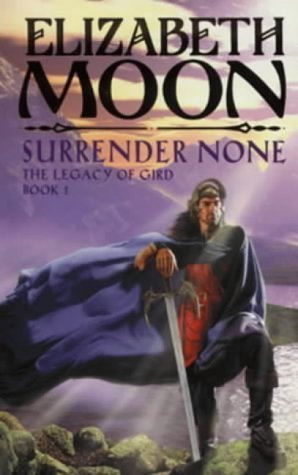
The Legacy of Gird #1
Surrender None
Paksenarrion could never have fulfilled her destiny had it not been for one who came before. Gird, the peasant, the armsman, the Liberator who taught his people that they could fight - and win - against oppression. This is his story, the first of two prequels to the "Deed of Paksenarrion" trilogy.
512 pages, Paperback
First published June 1, 1990
About the author
Elizabeth Moon
139 books2,686 followersElizabeth Moon was born March 7, 1945, and grew up in McAllen, Texas, graduating from McAllen High School in 1963. She has a B.A. in History from Rice University (1968) and another in Biology from the University of Texas at Austin (1975) with graduate work in Biology at the University of Texas, San Antonio.
She served in the USMC from 1968 to 1971, first at MCB Quantico and then at HQMC. She married Richard Moon, a Rice classmate and Army officer, in 1969; they moved to the small central Texas town where they still live in 1979. They have one son, born in 1983.
She started writing stories and poems as a small child; attempted first book (an illustrated biography of the family dog) at age six. Started writing science fiction in high school, but considered writing merely a sideline. First got serious about writing (as in, submitting things and actually getting money...) in the 1980s. Made first fiction sale at age forty--"Bargains" to Marion Zimmer Bradley's Sword & Sorceress III and "ABCs in Zero G" to Analog. Her first novel, Sheepfarmer's Daughter, sold in 1987 and came out in 1988; it won the Compton Crook Award in 1989. Remnant Population was a Hugo nominee in 1997, and The Speed of Dark was a finalist for the Arthur C. Clarke Award, and won the Nebula in 2004.
She served in the USMC from 1968 to 1971, first at MCB Quantico and then at HQMC. She married Richard Moon, a Rice classmate and Army officer, in 1969; they moved to the small central Texas town where they still live in 1979. They have one son, born in 1983.
She started writing stories and poems as a small child; attempted first book (an illustrated biography of the family dog) at age six. Started writing science fiction in high school, but considered writing merely a sideline. First got serious about writing (as in, submitting things and actually getting money...) in the 1980s. Made first fiction sale at age forty--"Bargains" to Marion Zimmer Bradley's Sword & Sorceress III and "ABCs in Zero G" to Analog. Her first novel, Sheepfarmer's Daughter, sold in 1987 and came out in 1988; it won the Compton Crook Award in 1989. Remnant Population was a Hugo nominee in 1997, and The Speed of Dark was a finalist for the Arthur C. Clarke Award, and won the Nebula in 2004.
Ratings & Reviews
Friends & Following
Create a free account to discover what your friends think of this book!
Community Reviews
Displaying 1 - 30 of 69 reviews

July 12, 2020
"I told you a little – about my daughter and her husband – but not all that eld me here. It began long before, and over the years I built a wall fo the stones I swallowed – stones of anger and stones of sorrow. A wall to keep myself at peace, and safety within – and it did not work." He ran a hand through his thinning hair, and scrubbed his beard. "I don't know if any law is fair, but the law the lords put on us in not fear, and no man can live safe under it. I don't know if all the lords are alike, but some of 'em – Kelaive, for one – and not only greedy, but cruel. They like to hurt people; they like to see people suffer. Such men cannot rule wisely, or fairly. And when such men rule, no one can live an honest life. [...] I have taken that wall down," Gird said. "Those stones – those stones I will throw at our enemies. Those stones, which I bring to this circle – because the Lady herself cannot give us peace unless we drive off the alien lords who rule us."
I thoroughly enjoyed Surrender None, but will acknowledge that it is neither perfect, nor for everyone. It is the story of a peasant rebellion, but a far cry from the peasant rebellions of Red Rising and The Final Empire. Instead, it is the slow saga of a man, pushed to his breaking point by a cruel lord, systematically rallying those around him to fight back and overthrow their magelords.
The good parts first:
- Like The Bone Ships and Sixteen Ways to Defend a Walled City, I loved Moon’s portrayal of leadership in action. We see in painstaking detail just what it takes to bring order to outlaws and rally the masses. It’s not about grand statements and flashing swords, it’s about the enduring and accumulating consequences of cleanliness and order, small wins and unexpected encounters, vision and justice. Gird’s insistence that personal cleanliness and camp order came first reminded me of the Broken Windows Theory of crime. This posits that major crimes originally emanate from disorder and incivility, and if you tackle the latter, you’ll reduce the former. With a wash and a tidy, the outlaws found a sense of pride and worth, and gained credibility with visitors who were, in turn, willing to recommend them to others. I was rather surprised to find that, though the peasants moved from sticks and scythes to pikes, they never did progress to swords. I appreciated the realism here. After all, swords take an incredible amount of individual training and a completely different set of tactics to those of unskilled pike warfare.
”I wish I had done what you did,” he said. “I wish I’d thought of that. All I thought of was fighting itself – I kept trying to learn swordfighting –”
- I adored the descriptions of life living off nature. It brought me back to my childhood romping around the Welsh countryside building dens, and my teens doing survival courses and endlessly reading The Clan of the Cave Bear books. At times, life for the outlaws more closely resembled the Stone Age than the medieval era, with nothing but animal skins to wear and frogs to eat. You suddenly realise just how fortunate you are to have clothing that fits, and food three times a day and medicines when you need them.
- I was totally surprised to find that non-human creatures, gnomes, played such pivotal role in Gird’s story. Over six months, they taught Gird law, tactics, combat, and literacy, enabling him to expand his efforts and increase his chance of success. I read the The Deed of Paksenarrion years ago and remember it being a non-magical, human-only, medieval-type world. Clearly I’d forgotten not only the gnomes but also the elves, the dwarves, the Kuaknom (tree lords), and even the mage-born humans!
- And lastly: Gird. I can’t say I loved him like I have some protagonists, but I did like him and respect him. Above all else, he felt eminently real to me. He was strong but turned from cruelty or bravado. He was clever enough to know how much he didn’t know, and wise enough to learn from those that did. He was fallible – on one occasion drinking to belligerence – but he owned up to his mistakes, took responsibility for them, and acted to ensure they never happened again. He didn’t want glory, he just wanted peace, and was prepared to work to get it.
Now the less good parts:
- I found the first hundred pages hard. You watch Gird’s slow descent to rock bottom at the hands of Count Kelaive. There’s torture, unprovoked beatings, and rape. His family dies around him and he doesn’t yet know there’s any alternative. It’s a dark time. The front inside cover of my edition held a quote from later in the book when Gird confronts a group of brigands. I think it says it all:
”My first two sons died of fever; the lord refused us herb-right in the wood. My wife lost two babes young, one from hunger and one from fever. My eldest daughter they raped; killed her husband. The babe died unborn. My youngest son they struck down; he lives. Another daughter they struck down, breaking her arm; I know not if she lives or dies. And my brother’s children, that I’d taken in: two of them dead, by the lords’ greed. And that’s children. I lost friends, my parents, my brother.”
Reading this at the start, it made me wary of characters - fearing to grow attached and later have them die. And yet, Moon does allow you a measure of distance from it all. As the timeline skips along, you miss the death of one or other, and never really see Gird’s thoughts or feelings on the events. Each is just one more nail in the lords’ coffins.
- This leads to another problem I had with the book. There’s very little emotion. Gird sometimes gets angry and sometimes side, but I can probably count the occurrences of each on one hand. He’s a stoic character, sure, and hardened by years of hardship. But it’s clear that, on the whole, Moon prefers to write about action and activity than the softer, less substantial side of things. This includes relationships which leads in turn to another negative.
- Aside from Gird, the book doesn’t have a lot of significant characters. He’s certainly on a lonely crusade, but even so, I would have expected and enjoyed more relationship building, particularly with his daughter, Rahi, his second, Cob, and his scribe, Selamis. These are the secondary characters we spend most time with and yet I can tell you almost nothing about them. Only when we get two short passages from Selamis’ point of view near the very end do I feel like I gained any real insight into the character. Fortunately, he’s who we’ll be following in Liar's Oath so we’ve got lots to look forward to.
- At times, I found the writing rather confusing, as if we were missing a sentence, or at least a few words. This would usually happen when some sort of god-like element was at play and Moon was trying to by mystical. It wasn’t mystical, it was just annoying. On the whole I found the writing denser than usual, requiring a slower pace of reading to digest. That, at least, I didn’t mind.
- I also found the geography confusing at times. The map is somewhat spartan with its labels and some places seemed to be called different things in different places – Ierin vs Lerin, for example.
- And lastly and appropriately, the ending. On the one hand, I thought it was done well. Gird never wanted glory and you don’t get to see any. As soon as he is able, he switches his focus from fighting to law, justice and trade, and so so do we. Furthermore, throughout the book, the explanatory brushes strokes got wider and wider, as we grew familiar with practice and events took on a life of their own. However, by the end, this meant that the rise and fall of neighbouring Tsaia happened in two pages. It all felt rather underwhelming and quite rushed.
- Oh and one more small niggle: does anyone have any idea how old Gird is at the different stages of this book? It frustrated the hell out of me that we were never told.
Overall:
Needless to say the book has its faults. But it’s also an incredible, and in my mind unique, account of the transformation of a man and his nation through sheer will and vision alone. Gird faces seemingly impossible odds, but, with one methodical step in front of the other, he matches and surpasses anything anyone could ever have expected.
Now, I look forward to reading Liar's Oath, and The Deed of Paksenarrion again soon.
If you like Surrender None, you might like:


1&2 for their peasant rebellions, 3&4 for their portrayal of leadership in action, 5 for its descriptions of living off the land.
Please note: I read the omnibus edition of the Legacy of Gird but wanted to review the books separately and as I read them.
April 7, 2008
OK, so there are a few cover blurbs that have always irritated the bejeesus out of me. The damn David Eddings thing is one ("philisophical and technical problems with the genre" my fanny), and the "assimilating Tolkien" atrocity that gets attached to this novel is another. Look: it's *clearly* working through D&D, not Tolkien direct. The fucking gnomes and dark elves should have been the clue there, guys. Anyway, the Paks trilogy is really powerful epic fantasy, probably her best work. Meant to be one novel, I first read it as a trilogy, and I have to say, leaving the 2nd of 3 novels with your heroine insane, disgraced, and crawling through the muck is a pretty ballsy move. The thing with Elizabeth Moon is that she's *really* interested in morality and ethics, and while that has always seemed a little forced in her space opera, it fits *really* well in this kind of fantasy. Surrender None is technically weaker, but still moving, and a "how someone would become a demigod" match to the "how someone would become a paladin" Paks story.

March 20, 2011
Not really quite 4 stars, but close. I was surprised. I've only read her SF series, Vatta's War, before & thought she was pretty good, but not a great writer. This fantasy had a lot more depth, though. It was very well done & not your typical sword & sorcery or epic fantasy. It concentrated on areas that most fantasies gloss over; the common people & many of the everyday issues they face. I really liked how she managed to bring all these issues into sharp focus without bogging down into too much boring detail. The story flowed because of the details she provided, not in spite of them. Fantastic.
The hero of the story isn't very special in any but the most human sense. He's a peasant who makes his share of mistakes, has trouble learning to read & write at the most basic level, but is an honest, hardworking man. He marches through his life, often with few choices & no real clue as to which is best. He just tries to do the next right thing. It makes for an understated, but staggering life of achievement.
I have not read Moon's "Deed of Paksenarrion" trilogy. This is the first of 2 prequels & I think that's what caused the only jarring notes in this book for me - the reason I didn't really want to give it 4 stars, but a bit less.
Because of the ending, I can see where this leads to the next prequel, Liar's Oath, but I'm not in a rush to read it. I probably will, eventually.
The hero of the story isn't very special in any but the most human sense. He's a peasant who makes his share of mistakes, has trouble learning to read & write at the most basic level, but is an honest, hardworking man. He marches through his life, often with few choices & no real clue as to which is best. He just tries to do the next right thing. It makes for an understated, but staggering life of achievement.
I have not read Moon's "Deed of Paksenarrion" trilogy. This is the first of 2 prequels & I think that's what caused the only jarring notes in this book for me - the reason I didn't really want to give it 4 stars, but a bit less.
Because of the ending, I can see where this leads to the next prequel, Liar's Oath, but I'm not in a rush to read it. I probably will, eventually.

May 29, 2026
I read and enjoyed a lot of Moon's science fiction but didn't much care for this fantasy novel. It's part of a long series about the world of Paksenarrion which most readers seem to have enjoyed a whole lot, so I'm not sure why it didn't work for me. It seemed too slowly paced and self-referential, and I couldn't get invested in any of the characters. It's well written, but not enough happens. I finished it out of stubbornness and then moved on to the Esmay Suiza space opera books, which I liked a lot.

January 22, 2014
A great story, in a truly enjoyable "universe"..

May 7, 2015
Surrender None is a peculiar and, I think, not entirely successful book. It purports to be the life of Gird, the saint that is the religious focus of most of the people in the earlier Paks trilogy. But it tries to walk the line between being a close look at a historical figure and a hagiography of a saint, falling very much more on the former side, and it never really finds its stride.
The description of Gird's unpleasant early life as a very poor farmer under a sadistic overlord is leisurely, but still manages to have decade-long jumps. We get to see his first meeting with his wife, and their wedding, but between one chapter and the next she's years dead. There is a long training montage in the middle, broken up into various sections, that I always kind of enjoy but doesn't really do much in the way of character or plot advancement, and one very odd episode that seems wedged in simply to establish that not all the lords are evil. Then there are battles, again with some odd episodes that don't really flow - Gird has a drinking problem that for some reason only crops up in his extreme youth and again once in his middle age, Gird has an assistant, Luap, who is shifty, Gird visits the next country over and gets an overview of the political system there. The actual fighting is fine, and the section where he begins to establish his rule in a decent-size city is quite good, but the whole thing is just choppy.
And the end has the distinct smack of desperation on the part of the author - we're four hundred pages in, and he's still not a saint by any stripe, despite the mysteriously paladinish horse. So there's a brief setup, again separated in years from the end of the war, and then a moment of what's supposed to be transcendence but just sort of seems like cheating, to me. Long-seated prejudice and racial hatred can't be cured by a speech, or a martyr's death. It doesn't seem like a reasonable way to get to Paks's future, and it doubly doesn't make sense in light of Gird's eventual mythos.
I don't hate Surrender None, but I certainly don't love it. It's got most of Moon's weaknesses, and few of her strengths. (Oh, and we're four out of four for rape scenes.)
The description of Gird's unpleasant early life as a very poor farmer under a sadistic overlord is leisurely, but still manages to have decade-long jumps. We get to see his first meeting with his wife, and their wedding, but between one chapter and the next she's years dead. There is a long training montage in the middle, broken up into various sections, that I always kind of enjoy but doesn't really do much in the way of character or plot advancement, and one very odd episode that seems wedged in simply to establish that not all the lords are evil. Then there are battles, again with some odd episodes that don't really flow - Gird has a drinking problem that for some reason only crops up in his extreme youth and again once in his middle age, Gird has an assistant, Luap, who is shifty, Gird visits the next country over and gets an overview of the political system there. The actual fighting is fine, and the section where he begins to establish his rule in a decent-size city is quite good, but the whole thing is just choppy.
And the end has the distinct smack of desperation on the part of the author - we're four hundred pages in, and he's still not a saint by any stripe, despite the mysteriously paladinish horse. So there's a brief setup, again separated in years from the end of the war, and then a moment of what's supposed to be transcendence but just sort of seems like cheating, to me. Long-seated prejudice and racial hatred can't be cured by a speech, or a martyr's death. It doesn't seem like a reasonable way to get to Paks's future, and it doubly doesn't make sense in light of Gird's eventual mythos.
I don't hate Surrender None, but I certainly don't love it. It's got most of Moon's weaknesses, and few of her strengths. (Oh, and we're four out of four for rape scenes.)

March 14, 2018
I like a lot of Elizabeth Moon’s stories, including ones set in this world. However, this backstory of Gird quite literally put me to sleep, multiple times, before I finally gave up. I just couldn’t get into all the battles and strategy and how camp got set up. Unfinished.

November 9, 2009
I loved The Deed of Paksenarrion. Saddly this book isn't nearly so good. It's interesting to me to follow Gird in his development but only because of the relatonship to Paks. I'd say read it for background, but it's not the book that Paksenarrion is.
October 5, 2023
I'm glad I've read it, but I probably won't read it again? It's... Fine. Slow, and it just seems clunky in comparison to The Deed of Paks and the new Paksworld books. 🤷🏻♀️ I'm now on Oath of Gold, and it's the same thus far, but reading it once won't hurt!

April 8, 2025
A really excellent fantasy book.

January 17, 2009
A wonderfully engaging book about the struggle of a poor man who rises above his peasant upbringing to change an oppressive society. I actually think that this is one of Moon's best fantasy novels. Considering its relatively short length, it packs in a well rounded character and a lot of plot without over-egged detail. A very satisfying read all round.

November 7, 2017
I took my time with this; the story deserved deliberate reading. Perhaps not the most exciting story, but a history well worth my time. I look forward to the next book and the other series that this is ahead of.
August 25, 2020
I really enjoyed this book for the background lore on how the Girdsmen came to be. The Deed of Paksenarrion trilogy makes some side references to the peasant revolt origins of the Girdsmen and paladins of Gird, and it was cool to see where all the terminology like Bartons, Yeomen/Yeomen Marshalls, cohorts etc came from and why, as alternatives to standard military terminology. For fans of the original Paks trilogy, I think it provides some cool additional info and content.
The other thing I enjoyed about it - for similar reasons as the original trilogy - is Elizabeth Moon's style of storytelling. I think some readers who strongly prefer standard modern storytelling structures with in depth character development as a "must" etc may feel a bit put off by it. But for me, I find her style is very reminiscent of Icelandic sagas and medieval Arthurian legend. Just as far as the way the plot moves and flows, it's very much just about telling the tale rather than spending a great deal of time on in-depth character development, various side plots etc. The whole point is just to tell the story itself, which can mean the sort of time jumps or scene jumps that you see more in medieval literature or in folktales/fairy tales. Personally, that more folkloric or saga-like style is one of the things that attracts me to this series. Not to say I don't also enjoy other styles, but I find something very cozy about her storytelling.
The Paksenarrion books also always dealt very heavily with the topics of morality and ethics, and main characters with very strong moral codes. I honestly kind of like Elizabeth Moon's approach to this in the Paks books, now including in Surrender None with Gird himself. In a lot of modern fantasy, there's an obsession with "morally grey characters" as "more realistic" (which I don't think is always true) or seeing good/evil as a grey area. Which, indeed what different people consider good/evil can certainly differ a great deal, but I do enjoy the portrayal of characters like Paks (and to an extent Gird) who just generally try to be a good person, who hold higher moral standards for themselves. Even when they fail, they ultimately strive to be better human beings. Yet at the same time, Moon's main characters also struggle with their own desire to do good and sometimes get drawn down darker paths. I really like the manifestation of that with the cult of Liart, and how that ill-intent or darkness acts like a poison that can slowly start seeping its way into people who may otherwise have good intentions. But also distinguishing those situations from villains who are indeed quite obviously evil. I think there is this reaction against so-called "cartoonish evil for the sake of evil villains" in more recent fantasy, but frankly I find"monstrous" villains (who may well be evil for the sake of it) pretty relevant and realistic. Looking at some of the truly monstrous politicians or CEOs of today, many who unreservedly don't give a shit about the lives they destroy, the misery or death they cause while putting profits above all else. I'm not particularly interested in looking at them in a "morally grey" or "more compassionate" way as they happily destroy the lives of millions. One can acknowledge people as very human while also understanding that humans can become fundamentally terrible, committing heinous acts. No one is "born evil", but some "leaders" in today's world show the human ability to become pretty damn monstrous. So yes, I do quite like her treatment of good and evil, but also the way any person might unintentionally do harm without necessarily meaning to or even noticing the change in their behaviour. It's certainly not black and white, but imo draws necessary lines in the sand.
The only thing about this book that eventually caused me to hesitate with a 4-star rating was that after a while I started getting a bit annoyed with Gird's character. I definitely prefer Paks! He started off fine, but I think what eventually came across as a paternalistic role and seeing other peasants essentially as children bothered me a bit. As much as there was a challenge to the feudal and ethnic structures that oppressed peasants and subordinated them to the nobles from old Aare, eventually it came off as Gird being the exception of the "intelligent peasant/not like the other peasants". It just also seemed a bit odd to see him essentially take over as sole leader of such a massive movement (though he kept claiming otherwise) without getting to see much of the "collaborative" or "collective" side. That said, I know that the story is meant to have religious/spiritual parallels (as the original trilogy did), so it could be where that paternalism is coming from, as far as essentially being the origin story of a new saint/deity.
That said, despite my eventual issues with Gird's character, I really enjoyed the additional lore and background info on the eventual world of Paks. Loved the storytelling, atmosphere, themes and much more. There is ultimately something very magical about this particular world that I really enjoy. I suspect others enjoyment depends on how their preferences jive with the above factors.
The other thing I enjoyed about it - for similar reasons as the original trilogy - is Elizabeth Moon's style of storytelling. I think some readers who strongly prefer standard modern storytelling structures with in depth character development as a "must" etc may feel a bit put off by it. But for me, I find her style is very reminiscent of Icelandic sagas and medieval Arthurian legend. Just as far as the way the plot moves and flows, it's very much just about telling the tale rather than spending a great deal of time on in-depth character development, various side plots etc. The whole point is just to tell the story itself, which can mean the sort of time jumps or scene jumps that you see more in medieval literature or in folktales/fairy tales. Personally, that more folkloric or saga-like style is one of the things that attracts me to this series. Not to say I don't also enjoy other styles, but I find something very cozy about her storytelling.
The Paksenarrion books also always dealt very heavily with the topics of morality and ethics, and main characters with very strong moral codes. I honestly kind of like Elizabeth Moon's approach to this in the Paks books, now including in Surrender None with Gird himself. In a lot of modern fantasy, there's an obsession with "morally grey characters" as "more realistic" (which I don't think is always true) or seeing good/evil as a grey area. Which, indeed what different people consider good/evil can certainly differ a great deal, but I do enjoy the portrayal of characters like Paks (and to an extent Gird) who just generally try to be a good person, who hold higher moral standards for themselves. Even when they fail, they ultimately strive to be better human beings. Yet at the same time, Moon's main characters also struggle with their own desire to do good and sometimes get drawn down darker paths. I really like the manifestation of that with the cult of Liart, and how that ill-intent or darkness acts like a poison that can slowly start seeping its way into people who may otherwise have good intentions. But also distinguishing those situations from villains who are indeed quite obviously evil. I think there is this reaction against so-called "cartoonish evil for the sake of evil villains" in more recent fantasy, but frankly I find"monstrous" villains (who may well be evil for the sake of it) pretty relevant and realistic. Looking at some of the truly monstrous politicians or CEOs of today, many who unreservedly don't give a shit about the lives they destroy, the misery or death they cause while putting profits above all else. I'm not particularly interested in looking at them in a "morally grey" or "more compassionate" way as they happily destroy the lives of millions. One can acknowledge people as very human while also understanding that humans can become fundamentally terrible, committing heinous acts. No one is "born evil", but some "leaders" in today's world show the human ability to become pretty damn monstrous. So yes, I do quite like her treatment of good and evil, but also the way any person might unintentionally do harm without necessarily meaning to or even noticing the change in their behaviour. It's certainly not black and white, but imo draws necessary lines in the sand.
The only thing about this book that eventually caused me to hesitate with a 4-star rating was that after a while I started getting a bit annoyed with Gird's character. I definitely prefer Paks! He started off fine, but I think what eventually came across as a paternalistic role and seeing other peasants essentially as children bothered me a bit. As much as there was a challenge to the feudal and ethnic structures that oppressed peasants and subordinated them to the nobles from old Aare, eventually it came off as Gird being the exception of the "intelligent peasant/not like the other peasants". It just also seemed a bit odd to see him essentially take over as sole leader of such a massive movement (though he kept claiming otherwise) without getting to see much of the "collaborative" or "collective" side. That said, I know that the story is meant to have religious/spiritual parallels (as the original trilogy did), so it could be where that paternalism is coming from, as far as essentially being the origin story of a new saint/deity.
That said, despite my eventual issues with Gird's character, I really enjoyed the additional lore and background info on the eventual world of Paks. Loved the storytelling, atmosphere, themes and much more. There is ultimately something very magical about this particular world that I really enjoy. I suspect others enjoyment depends on how their preferences jive with the above factors.

Read
October 27, 202326.10.23 'parrion' p11 no result on google - could be jargon for dye? Could be a raw material found only on Moonworld?
Peace at all costs, and appeasement of the aggressors as a basis for society? Extreme example.
'folokai' p13 - some kind of monster?
'"... pirik—" the bargain sum, Gird remembered: not a price paid, as if he were a sheep, but a sum to mark the conclusion to any bargain. The price was somewhat else.' p13 Interesting. Ominous.
Sibs used as an abbreviation for siblings. Is this a clue to why the drink is called sib? It sounds rather like some sort of chai.
Is there no week? Or is it simply not relevant because the days of his service don't fit it?
'"... Open heart, open hands: the Lady's blessing."' p17
The pace surprises me, like the Deed of Paksenarrion, for some reason. It's a tight mixture of specific incidents described in detail and overviews of varying periods.
fucking spurs
'he had never seen any lord, or anyone with powers beyond the stewards ability to ferret out the truth when someone lied.' p32 is this an actual power the steward uses or is it just skill and wit on the part of the steward? Does Gird know this?
> Allium tricoccum (commonly known as ramp, ramps, ramson, wild leek, wood leek, or wild garlic) is a bulbous perennial flowering plant in the amaryllis family Amaryllidaceae. It is a North American species of wild onion or garlic widespread across eastern Canada and the eastern United States. Many of the common English names for this plant are also used for other Allium species, particularly the similar Allium ursinum, which is native to Europe and Asia.
'He wished he could be an onion, safe underground.' p42
There's an emphasis on nature, even while acknowledging the distance between the farmer and the land, compared to someone like the Kuakgan, and I appreciate that. It's not always done, even when someone's supposed to have had a background as a farmer or sth like that.
Everyone just seems small-minded. I mean, they're meant to, I just find small-minded people annoying.
How dare they judge him.
> athwart
/əˈθwɔːt/
preposition
1. from side to side of; across.
"a counter was placed athwart the entrance"
2. in opposition to; counter to.
adverb
1. across from side to side; transversely.
"one table running athwart was all the room would hold"
2. so as to be perverse or contradictory.
"our words ran athwart and we ended up at cross purposes"
'For the first time in his life, he realized he could do harm he could not mend.' p49
'"... Remember what tree the forester chooses."
He'd heard that often and often before. It was not in the Lady's ritual, but it was the village's favorite truth: notice brings trouble. As bad to be always first in reaping as always last; as bad to be richest as poorest. The tall tree catches the forester's eye, and the fattest ox suggests a feast. He had never liked it, since he could not have hidden among others if he wanted to. What, he had wondered, was the tall tree supposed to *do*?' p54 fucking Tall Poppy
> vill: (in medieval England) the smallest administrative unit under the feudal system, consisting of a number of houses and their adjacent lands, roughly corresponding to the modern parish.
'He glared at the coals beneath the burning wood, that half-magical heap of coloured lights and mysterious shapes that seemed to be struggling to say something. A long hiss ended in a violent pop, and he jumped.
'I wonder what it said that time.' The girls voice held humor, as well as warmth. Gird didn't look at her.
'What all fires say,' he said.
'Here's home and safety,' she said. And then, surprisingly, 'Here's danger; here's death.'' p61
This feels a bit Druss and Rowena.
Parrion seems to be... area of expertise, or skill in, or right to practice.
hearthing - seems to refer to an area, like steading? Could be related to Wiktionary definition? : 7.(Germanic paganism) A household or group in some forms of the modern pagan faith Heathenry.
''You don't think a man knows himself best?'
Laughter burst out of her again. 'Who could? Can water know it's wet, or stone know it's hard? What could it measure itself against? ...'' pp67-68
'A daughter's parrion was a family's most valuable possession, the secrets and inherited talent of generations of women passed to a chosen carrier.' p73
A fridge for Mali?
'Esea was, after all, a god of light...' p85
> The more rural members of the population lived in cotholds. These were much smaller vassal holds, often consisting of a single extended family located near the fields, pasture, or other site of the holders' agricultural pursuits.
From the Pern wiki - McCaffrey and Moon worked together on Planet Pirates
'The steward came again, to value the cottage and the lord's property therein. Gird had the death fee to pay, part in coin and part in livestock - his precious heifers, two of them - and then the steward confirmed him in his father's place, as 'half-free tenant of this manor,' whose clothes and few personal tools might be handed down to his heir. The rest - the land, the cottage, the livestock, the major tools such as ox-yoke, plow, and scythe - were the lord's and he was 'allowed' to use them.' pp90-91
> A selion is a medieval open strip of land or a small field used for growing crops, usually owned by or rented to peasants. A selion of land was typically one furlong long and one chain wide, so one acre in area. However exact measurements could vary depending on the geography of the land.
'cracked pot' p101 used as an expression - reference by Erikson?
> bolus
1. a small rounded mass of a substance, especially of chewed food at the moment of swallowing.
2. a type of large pill used in veterinary medicine.
MEDICINE
a single dose of a drug or other medicinal preparation given all at once.
mid 16th century (denoting a large pill): via late Latin from Greek bōlos ‘clod’.
'Gird set the bucket carefully aside and gathered up his youngest child, letting him sob. He wanted to do that himself, would have given anything for a strong shoulder to cry on, but all the ones he'd known were gone.' p113
'... he wondered if it was bad luck to burn doorwood ...' p114
'Pidi replied with the triple of triples Gird had taught him.' p116 SOS
'Cob, behind him, grinned, wagged his head, and made the shame sign with his fingers.' p146
> levet
noun
obsolete
: REVEILLE
probably from Italian levata call to arms, action of raising, from feminine of levato, past participle of levare to raise, from Latin
Is there relevance here? Does it make a repeated bugling sound or did Moon just hear the word and like it, did she hear the word and forget it, or is it just coincidence?
'"I found most of the roots and barks for sib." He showed Gird a small pile which Gird would not have recognised. "There's no kira in sight of camp, and you told me not to leave—"
"Good for you. Do you know how much of each?" He certainly didn't. Pidi nodded.
"But it takes a long time. Do you want me to start it?"' p156
'"Thank Alyanya's grace for that," said Gird. He shivered, flicked his fingers to avert the trouble, whatever it had been (and he could guess well enough) ...' p182
p238 I kinda wish they'd introduced themselves, Gird's all 'the green-eyed man' this and 'the brown man' that and 'the black-bearded man' fought.
> strait
1. a narrow passage of water connecting two seas or two other large areas of water.
"the Straits of Gibraltar"
2. used in reference to a situation characterized by a specified degree of trouble or difficulty.
adjective ARCHAIC
(of a place) of limited spatial capacity; narrow or cramped.
"the road was so strait that a handful of men might have defended it"
close, strict, or rigorous.
"my captivity was strait as ever"
Middle English: shortening of Old French estreit ‘tight, narrow’, from Latin strictus ‘drawn tight’
'merin' p248
Gird seems ignorant of the role the sun plays in the lifecycle of plants - it seems odd given he's a farmer? Or maybe the perspective's just warped from Esea being the Aare god.
> mure
/mjʊə/
verbARCHAIC
imprison or shut up in an enclosed space.
Origin
late Middle English: from Old French murer, from Latin murare, from murus ‘wall’.
'The gnomes had had names for the units, based on size, from the five-gnome pigan to the hundred-gnome gerist, but the language of his own people had nothing but 'horde' and 'skirra.' The former meant everyone in the steading or hearthing who could fight, and the latter meant a small raiding party sent to steal livestock.' p358
'You can't mend it; best end it.' p371
'craftcot' p381 I assume from context a cottage with crafting equipment accompanying or modified in some way for craft?
figan soup?
' tracing one line with a blunt thumb, for he did not put the pointing finger, the shame finger, on anything that might be sacred.' p440 could the shame sign be some combination of both index fingers
tiroc p454
It feels like there could be a lot more detail in this story but at the same time you don't want to get bogged down.
She doesn't make much of the deaths of Gird's yeomen - or Gird doesn't. Is this an oversight or just the fact that he lives so close to nature and in such a repressed and brutal society that it's become commonplace to him - he lists at one point all of his immediate circle that died, before he became a member of the Stone Circle. There are rituals for the dead, but Gird doesnt dwell on people's absence or his grief, isn't shown to think about them unprompted. Paks does, from memory, so I'm inclined it just comes down to character and circumstance.
Gird is relatively small/close-minded which seems likely, accurate, a logical result of rule of one people by another.
> mode 4.
MUSIC
a set of musical notes forming a scale and from which melodies and harmonies are constructed.
late Middle English (in the musical and grammatical senses): from Latin modus ‘measure’, from an Indo-European root shared by mete1; compare with mood2.
> descant
noun
noun: descant; plural noun: descants
/ˈdɛskant/
1.
MUSIC
an independent treble melody sung or played above a basic melody.
ARCHAIC•LITERARY
a melodious song.
2.
LITERARY
a discourse on a theme.
verbLITERARY
/dɪˈskant,dɛˈskant/
talk tediously or at length.
late Middle English: from Old French deschant, from medieval Latin discantus ‘part-song, refrain’.
How a dead man gon be interesting in book two.
🕳️
I was ready to be disappointed, I sort of assumed it would be a bit of a rush job or with less substance than Paksenarrion, but it's not at all. There's a different, older perspective (I think it's set more than 300 years earlier) which allows for more worldbuilding at a really good pace, just odds and bits here and there, there's the culture clash from (and the revolution against) an immigrant people that provides a solid reasoning for a little more discussion of such, and there's the fact that the whole book more or less takes place in one country, whereas Paks was dashing round all over the place. I think I understand a little better now the unreasonable level of prejudice against magic-users. Like Paksenarrion it's a solid book that's worth reading and even a small amount of study. I do, after this first read quick on the heels of my... fourth? read of Paksenarrion, prefer The Deed of Paksenarrion as a story - the ending of Surrender None seems a little abrupt and... opaque? It's almost like she cut a manuscript in half, which I mean I appreciate because it means that there's a lower chance of errors and contradictions, the results of having a solid plan in place and the ability to use extensive oversight before publishing speak for themselves, but I wouldn't call it a satisfying conclusion. Not in a cliffhanger way though, not frustrating, I'm just left wanting more. Lucky I already have the sequel.
All in all I don't really understand the low rating - maybe people didn't read the publishing dates and, like Goodreads, thought this was the first book published? Maybe they were expecting something a little more spectacular or more similar to Paksenarrion? Maybe like me they're just unsatisfied by the ending? Maybe they just don't appreciate it. I enjoyed it, I appreciated it a little, and I definitely think there's more depth here that will be revealed through successive rereads. I grew to like and appreciate Paksenarrion more over time.
Peace at all costs, and appeasement of the aggressors as a basis for society? Extreme example.
'folokai' p13 - some kind of monster?
'"... pirik—" the bargain sum, Gird remembered: not a price paid, as if he were a sheep, but a sum to mark the conclusion to any bargain. The price was somewhat else.' p13 Interesting. Ominous.
Sibs used as an abbreviation for siblings. Is this a clue to why the drink is called sib? It sounds rather like some sort of chai.
Is there no week? Or is it simply not relevant because the days of his service don't fit it?
'"... Open heart, open hands: the Lady's blessing."' p17
The pace surprises me, like the Deed of Paksenarrion, for some reason. It's a tight mixture of specific incidents described in detail and overviews of varying periods.
fucking spurs
'he had never seen any lord, or anyone with powers beyond the stewards ability to ferret out the truth when someone lied.' p32 is this an actual power the steward uses or is it just skill and wit on the part of the steward? Does Gird know this?
> Allium tricoccum (commonly known as ramp, ramps, ramson, wild leek, wood leek, or wild garlic) is a bulbous perennial flowering plant in the amaryllis family Amaryllidaceae. It is a North American species of wild onion or garlic widespread across eastern Canada and the eastern United States. Many of the common English names for this plant are also used for other Allium species, particularly the similar Allium ursinum, which is native to Europe and Asia.
'He wished he could be an onion, safe underground.' p42
There's an emphasis on nature, even while acknowledging the distance between the farmer and the land, compared to someone like the Kuakgan, and I appreciate that. It's not always done, even when someone's supposed to have had a background as a farmer or sth like that.
Everyone just seems small-minded. I mean, they're meant to, I just find small-minded people annoying.
How dare they judge him.
> athwart
/əˈθwɔːt/
preposition
1. from side to side of; across.
"a counter was placed athwart the entrance"
2. in opposition to; counter to.
adverb
1. across from side to side; transversely.
"one table running athwart was all the room would hold"
2. so as to be perverse or contradictory.
"our words ran athwart and we ended up at cross purposes"
'For the first time in his life, he realized he could do harm he could not mend.' p49
'"... Remember what tree the forester chooses."
He'd heard that often and often before. It was not in the Lady's ritual, but it was the village's favorite truth: notice brings trouble. As bad to be always first in reaping as always last; as bad to be richest as poorest. The tall tree catches the forester's eye, and the fattest ox suggests a feast. He had never liked it, since he could not have hidden among others if he wanted to. What, he had wondered, was the tall tree supposed to *do*?' p54 fucking Tall Poppy
> vill: (in medieval England) the smallest administrative unit under the feudal system, consisting of a number of houses and their adjacent lands, roughly corresponding to the modern parish.
'He glared at the coals beneath the burning wood, that half-magical heap of coloured lights and mysterious shapes that seemed to be struggling to say something. A long hiss ended in a violent pop, and he jumped.
'I wonder what it said that time.' The girls voice held humor, as well as warmth. Gird didn't look at her.
'What all fires say,' he said.
'Here's home and safety,' she said. And then, surprisingly, 'Here's danger; here's death.'' p61
This feels a bit Druss and Rowena.
Parrion seems to be... area of expertise, or skill in, or right to practice.
hearthing - seems to refer to an area, like steading? Could be related to Wiktionary definition? : 7.(Germanic paganism) A household or group in some forms of the modern pagan faith Heathenry.
''You don't think a man knows himself best?'
Laughter burst out of her again. 'Who could? Can water know it's wet, or stone know it's hard? What could it measure itself against? ...'' pp67-68
'A daughter's parrion was a family's most valuable possession, the secrets and inherited talent of generations of women passed to a chosen carrier.' p73
A fridge for Mali?
'Esea was, after all, a god of light...' p85
> The more rural members of the population lived in cotholds. These were much smaller vassal holds, often consisting of a single extended family located near the fields, pasture, or other site of the holders' agricultural pursuits.
From the Pern wiki - McCaffrey and Moon worked together on Planet Pirates
'The steward came again, to value the cottage and the lord's property therein. Gird had the death fee to pay, part in coin and part in livestock - his precious heifers, two of them - and then the steward confirmed him in his father's place, as 'half-free tenant of this manor,' whose clothes and few personal tools might be handed down to his heir. The rest - the land, the cottage, the livestock, the major tools such as ox-yoke, plow, and scythe - were the lord's and he was 'allowed' to use them.' pp90-91
> A selion is a medieval open strip of land or a small field used for growing crops, usually owned by or rented to peasants. A selion of land was typically one furlong long and one chain wide, so one acre in area. However exact measurements could vary depending on the geography of the land.
'cracked pot' p101 used as an expression - reference by Erikson?
> bolus
1. a small rounded mass of a substance, especially of chewed food at the moment of swallowing.
2. a type of large pill used in veterinary medicine.
MEDICINE
a single dose of a drug or other medicinal preparation given all at once.
mid 16th century (denoting a large pill): via late Latin from Greek bōlos ‘clod’.
'Gird set the bucket carefully aside and gathered up his youngest child, letting him sob. He wanted to do that himself, would have given anything for a strong shoulder to cry on, but all the ones he'd known were gone.' p113
'... he wondered if it was bad luck to burn doorwood ...' p114
'Pidi replied with the triple of triples Gird had taught him.' p116 SOS
'Cob, behind him, grinned, wagged his head, and made the shame sign with his fingers.' p146
> levet
noun
obsolete
: REVEILLE
probably from Italian levata call to arms, action of raising, from feminine of levato, past participle of levare to raise, from Latin
Is there relevance here? Does it make a repeated bugling sound or did Moon just hear the word and like it, did she hear the word and forget it, or is it just coincidence?
'"I found most of the roots and barks for sib." He showed Gird a small pile which Gird would not have recognised. "There's no kira in sight of camp, and you told me not to leave—"
"Good for you. Do you know how much of each?" He certainly didn't. Pidi nodded.
"But it takes a long time. Do you want me to start it?"' p156
'"Thank Alyanya's grace for that," said Gird. He shivered, flicked his fingers to avert the trouble, whatever it had been (and he could guess well enough) ...' p182
p238 I kinda wish they'd introduced themselves, Gird's all 'the green-eyed man' this and 'the brown man' that and 'the black-bearded man' fought.
> strait
1. a narrow passage of water connecting two seas or two other large areas of water.
"the Straits of Gibraltar"
2. used in reference to a situation characterized by a specified degree of trouble or difficulty.
adjective ARCHAIC
(of a place) of limited spatial capacity; narrow or cramped.
"the road was so strait that a handful of men might have defended it"
close, strict, or rigorous.
"my captivity was strait as ever"
Middle English: shortening of Old French estreit ‘tight, narrow’, from Latin strictus ‘drawn tight’
'merin' p248
Gird seems ignorant of the role the sun plays in the lifecycle of plants - it seems odd given he's a farmer? Or maybe the perspective's just warped from Esea being the Aare god.
> mure
/mjʊə/
verbARCHAIC
imprison or shut up in an enclosed space.
Origin
late Middle English: from Old French murer, from Latin murare, from murus ‘wall’.
'The gnomes had had names for the units, based on size, from the five-gnome pigan to the hundred-gnome gerist, but the language of his own people had nothing but 'horde' and 'skirra.' The former meant everyone in the steading or hearthing who could fight, and the latter meant a small raiding party sent to steal livestock.' p358
'You can't mend it; best end it.' p371
'craftcot' p381 I assume from context a cottage with crafting equipment accompanying or modified in some way for craft?
figan soup?
' tracing one line with a blunt thumb, for he did not put the pointing finger, the shame finger, on anything that might be sacred.' p440 could the shame sign be some combination of both index fingers
tiroc p454
It feels like there could be a lot more detail in this story but at the same time you don't want to get bogged down.
She doesn't make much of the deaths of Gird's yeomen - or Gird doesn't. Is this an oversight or just the fact that he lives so close to nature and in such a repressed and brutal society that it's become commonplace to him - he lists at one point all of his immediate circle that died, before he became a member of the Stone Circle. There are rituals for the dead, but Gird doesnt dwell on people's absence or his grief, isn't shown to think about them unprompted. Paks does, from memory, so I'm inclined it just comes down to character and circumstance.
Gird is relatively small/close-minded which seems likely, accurate, a logical result of rule of one people by another.
> mode 4.
MUSIC
a set of musical notes forming a scale and from which melodies and harmonies are constructed.
late Middle English (in the musical and grammatical senses): from Latin modus ‘measure’, from an Indo-European root shared by mete1; compare with mood2.
> descant
noun
noun: descant; plural noun: descants
/ˈdɛskant/
1.
MUSIC
an independent treble melody sung or played above a basic melody.
ARCHAIC•LITERARY
a melodious song.
2.
LITERARY
a discourse on a theme.
verbLITERARY
/dɪˈskant,dɛˈskant/
talk tediously or at length.
late Middle English: from Old French deschant, from medieval Latin discantus ‘part-song, refrain’.
How a dead man gon be interesting in book two.
🕳️
I was ready to be disappointed, I sort of assumed it would be a bit of a rush job or with less substance than Paksenarrion, but it's not at all. There's a different, older perspective (I think it's set more than 300 years earlier) which allows for more worldbuilding at a really good pace, just odds and bits here and there, there's the culture clash from (and the revolution against) an immigrant people that provides a solid reasoning for a little more discussion of such, and there's the fact that the whole book more or less takes place in one country, whereas Paks was dashing round all over the place. I think I understand a little better now the unreasonable level of prejudice against magic-users. Like Paksenarrion it's a solid book that's worth reading and even a small amount of study. I do, after this first read quick on the heels of my... fourth? read of Paksenarrion, prefer The Deed of Paksenarrion as a story - the ending of Surrender None seems a little abrupt and... opaque? It's almost like she cut a manuscript in half, which I mean I appreciate because it means that there's a lower chance of errors and contradictions, the results of having a solid plan in place and the ability to use extensive oversight before publishing speak for themselves, but I wouldn't call it a satisfying conclusion. Not in a cliffhanger way though, not frustrating, I'm just left wanting more. Lucky I already have the sequel.
All in all I don't really understand the low rating - maybe people didn't read the publishing dates and, like Goodreads, thought this was the first book published? Maybe they were expecting something a little more spectacular or more similar to Paksenarrion? Maybe like me they're just unsatisfied by the ending? Maybe they just don't appreciate it. I enjoyed it, I appreciated it a little, and I definitely think there's more depth here that will be revealed through successive rereads. I grew to like and appreciate Paksenarrion more over time.
This entire review has been hidden because of spoilers.

May 22, 2018
I don't really know how to rate this. I enjoyed it but there were a few things that really took my enjoyment away:
-The first is probably that I wasn't really in the mood when I first began for this kind of book. So that's all on me.
-The next two are more on the book. One: The sentence structure was really puzzling at times. I would have to re-read and re-read or even read out loud to figure out what it was trying to say.
-There were also a few confusing time jumps. Not that many and it usually wouldn't have bothered me, but together with the sentence structure it was made worse.
-I found at times it sort of dragged. Maybe this is mostly because I wasn't in the mood for this kind of book when I first began it, but I think it's actually pretty equal in how much the book dragged vs. my mood.
-I wish there had been more worldbuilding, though. I found it a bit confusing to jump straight into the world with no knowledge really of their gods, or history.
-If I had been more in the mood for fantasy I probably would have wanted way more. For the most part, this book has almost no fantasy elements.
So, I enjoyed it, but not enough to recommend it, and not enough to re-read it. Just enough to start the sequel.
-The first is probably that I wasn't really in the mood when I first began for this kind of book. So that's all on me.
-The next two are more on the book. One: The sentence structure was really puzzling at times. I would have to re-read and re-read or even read out loud to figure out what it was trying to say.
-There were also a few confusing time jumps. Not that many and it usually wouldn't have bothered me, but together with the sentence structure it was made worse.
-I found at times it sort of dragged. Maybe this is mostly because I wasn't in the mood for this kind of book when I first began it, but I think it's actually pretty equal in how much the book dragged vs. my mood.
-I wish there had been more worldbuilding, though. I found it a bit confusing to jump straight into the world with no knowledge really of their gods, or history.
-If I had been more in the mood for fantasy I probably would have wanted way more. For the most part, this book has almost no fantasy elements.
So, I enjoyed it, but not enough to recommend it, and not enough to re-read it. Just enough to start the sequel.

April 13, 2020
Moon, Elizabeth. Surrender None. 1990. Legacy of Gird No. 1. Orbit, 2000.
The Gird trilogy is a prequel to 1988’s The Sheep Farmer’s Daughter and its trilogy. The world here is straight-up fantasy, heavily influenced by the iconography of Dungeons and Dragons and its ilk, with mages, gnomes and warriors of various kinds. Our hero, Gird, is a sturdy peasant who signs on as an ostler and guard to a caravan but soon finds himself touched by a deity and leading a peasant army against a powerful evil king. It would be forgettable if that was all it was, but Gird is a more nuanced character than one might expect. He must wrestle with the ethical dilemmas provoked by his actions. He grows morally as the novel progresses in a way most genre characters never approach. I am told there are many spoilers to the next trilogy, but I have not read it, so be cautioned.
The Gird trilogy is a prequel to 1988’s The Sheep Farmer’s Daughter and its trilogy. The world here is straight-up fantasy, heavily influenced by the iconography of Dungeons and Dragons and its ilk, with mages, gnomes and warriors of various kinds. Our hero, Gird, is a sturdy peasant who signs on as an ostler and guard to a caravan but soon finds himself touched by a deity and leading a peasant army against a powerful evil king. It would be forgettable if that was all it was, but Gird is a more nuanced character than one might expect. He must wrestle with the ethical dilemmas provoked by his actions. He grows morally as the novel progresses in a way most genre characters never approach. I am told there are many spoilers to the next trilogy, but I have not read it, so be cautioned.
March 2, 2024
Too late I realised this was a prequel. Although it stands on its own - it carries the complete life of the main character Gird - it does feel like it was written to explain and/or justify events that were referred to in the main books. Grid himself is a historical figure in the main books (I presume, I have not read them) and as the writing progresses, it does feel like that, with his story not being critically important to the book series.
The story line jumps often, spending chapters on single day events and then jumping months & years in a matter of a few pages. There is not a lot of build up in the story, it almost has a biographical feel to it. As such, I started to disconnect in the second half of the (long) book, and skipreading by the end.
The story line jumps often, spending chapters on single day events and then jumping months & years in a matter of a few pages. There is not a lot of build up in the story, it almost has a biographical feel to it. As such, I started to disconnect in the second half of the (long) book, and skipreading by the end.

December 13, 2023
Listened. Re-read, initially in 2012 as part of the Legacy of Gird omnibus (which includes Liar's Oath - so bad that I won't re-read it). An optional read for fans of Paks-World. Interesting insights into Gird the living being, but weirdly edited. There were a lot of chronological jumps, which *can* work well, but are strangely done here, often with little or no reference to the outcome of quite important events/people from the earlier time period. Just made for a read that was less satisfying than it easily could have been.

May 19, 2020
I read the Paksenarrion series and I was happy to find two more books set in the same universe. I was also excited to learn more about Gird. This book has been quite disappointing.
It starts with a lot of violence. As the story progresses we learn more about Girt but the story skips large parts of his life. The other novels set in the universe had compelling characters and interesting political and economical background. I found these elements were lacking in Surrender None.
It starts with a lot of violence. As the story progresses we learn more about Girt but the story skips large parts of his life. The other novels set in the universe had compelling characters and interesting political and economical background. I found these elements were lacking in Surrender None.

May 10, 2021
I am a big fan of fantasy and science fiction novels especially if they are long and have several books in the series. I really enjoy a series of books that I can immerse myself in and I first picked up an Elizabeth Moon novel because it was long and part of a multi-novel series. I continue to read her books because I find them engrossing and highly enjoyable.

July 23, 2023
Don't stumble to gawk at the horrible cover quality - if you've journeyed with Paks through Elizabeth Moon's preceding fantasy epic, you'll want to dive into this pre-history that is dense with the earth and law and mysteries of a peasant history of revolution. It is well worth the time.

May 9, 2017
A fantasy I literally couldn't put down!

April 21, 2019
didn't finish

June 12, 2019
It started of mesmerizing, then it seemed as if the Author thought of something to add which was not added seamlessly.

November 12, 2019
Loved it, but long.


February 14, 2020
This book is good part of the series and would also recommend the series

September 17, 2020
A worthy and enjoyable prequel to the Paksenarrion novels

October 8, 2020
Too long, hard to “get” characters. Not interesting enough. Too long, jumps around clumsily through different time periods. Meh. Not recommended
November 22, 2020
ITS A JOURNEY, man, first time i read a fantasy book that the main character arent born great, buthis life journey is the one who make him to be great. This is why i love the book
Displaying 1 - 30 of 69 reviews