For me, finishing a good book is a sad affair--you've come to the end of a relationship with this thing in your hand, this thing that has hopefully helped you grow in some small way and has challenged the way you've thought, whether it be about something large or something very small. When you finish a good book, you may always revisit the relationship, but it's with a nostalgia of what you used to have in that relationship; it's "present-you" reading the "you-who-was" when you engaged with the book the first time, when you experienced that full relationship from first meeting, the awkward handshake, the nerve-wracking "do we hug or is that weird?" moment to the honeymoon period and all the way to the amicable split, the "thank you for the great times and memories, but you need to move on" that the book tells you in the white space after its final words.
When you finish a great book, though, a book that you feel deserves to be rated five stars or included on Time's "Best of" list, or The New York Times "Best of" list, or any "Best of" list--when it's a book that you feel like you should give to one or two or five of your closest friends (I'm stealing a line from Stielstra here), finishing is no longer a sad affair. It's because the relationship is different. This is a relationship with a friend that you meet every few months for coffee, a relationship you wish you could savor daily but know that there are more relationships out there to which you must commit--there is so much, sometimes too much, more to read out there, and you're a reader or a scholar-of-life that must try these different relationships to feel that growth, sometimes minute, sometimes so large that you want to tattoo the wisdom gleaned from a quote across your body so you can tell anyone that asks what you learned and how you learned it (so please just ask).
You owe it to yourself to try to find those relationships. You're always searching for the next great book, the book that is no longer the sad affair of an ending because you can always pull a great book off the shelf and revisit chunks. Instead of that sad, "you-who-was" nostalgia you get, your mind expands even more. It changes again and again and again.
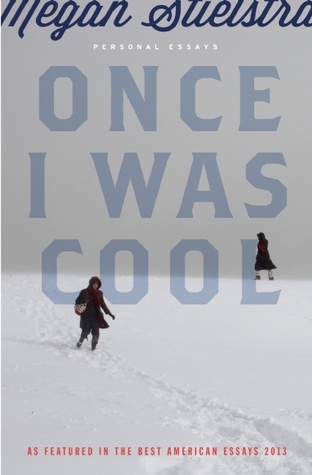
_Once I Was Cool_ does that for me. Okay, I'm not going to lie and say that I'm not one of many in Megan Stielstra Fan Club (I think there are too many people that knew her and her work before me that can claim to be its president) because I am TOTALLY in the fan club. But this is an unbiased review. Reading her collection, I reread essays after doing the initial "Wow, yeah, that's the Megan I know" on my first read (because I'm lucky enough to have had her/have her as an instructor and mentor and friend), but then I'd reread them and say, "What is this essay doing? What is the style of this? Why is this structure the best for this essay? How does she get three themes of equal weight and subtly in a few short pages? How does she get a theme that is so not subtle but make it personal to her and to me as the reader? How does she get to make me care about every things she writes about here?" Because that's what she does. She makes you think. She makes you consider the essay itself, not just what is in it, and see how this form can do myriad objectives.
Her essay on the essay? I will teach this to my students alongside "Shitty First Drafts" and know this will inspire a conversation about autonomy in writing, the subversion of the idea of writing-toward-a-test and the five-paragraph essay, and the idea that the word "essay" is from Montaigne's use of "essai" (I teach them Montaigne because Montaigne is a bad-ass) and it means "trail" and "attempt" and that an essay could just be a verb--"try"--and that we can essay. We essay together. We will essay in this class! And then it made me consider my favorite essays, so many of which I could mention and about which I could draw many emoticon hearts, but reading her essay on essays made me immediately go back and reread Brian Doyle's "Joyas Voladoras."
And then there's "Channel B," which was included in the _The Best American Essays 2013_ for a great reason. This is an essay that is crafted so well, that is so tight and concise and explodes my mind as a male to consider what it must be like to be in the throes of postpartum depression. It makes me wonder what it is like to be a first time parent. It helps me to see there is hope in every situation. But it also helps me to see how a memoir can be crafted, how elements of storytelling can frame something so personal to the writer while giving it huge and universal thematic elements.
And an essay is in there about excuses. And about being kind to others. And about the wisdom you learn from your children. And about knowing, just knowing, when you find love. And about the love of friendship and the transformative power of caring.
Stielstra easily could have become overly sentimental or twee in many of the essays. But she's too rock-and-roll for that. She's too much much of a bad-ass writer. And, she's too concerned with the human emotion--the real human emotion--so instead, she bravely reveals pieces of herself in her essays instead of pandering to an audience. She's not afraid to make you maybe a bit uncomfortable if it will make you learn.
At once a collection of memoiristic essays and once a collection of writing tips, _Once I Was Cool_ is also a collection of essays on how to be a decent person in this world, how to love, and how to teach (whether you are a teacher or parent or just a person in this world that may inspire someone, anyone, ever).
_Once I Was Cool_ is once, now, and forever a very cool book, indeed.