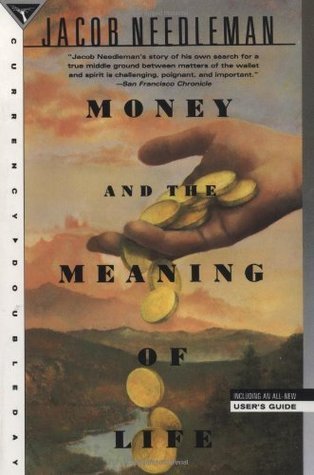
If we understood the true role of money in our lives, writes philosopher Jacob Needleman, we would not think simply in terms of spending it or saving it. Money exerts a deep emotional influence on who we are and what we tell ourselves we can never have. Our long unwillingness to understand the emotional and spiritual effects of money on us is at the heart of why we have come to know the price of everything, and the value of nothing. Money has everything to do with the pursuit of an idealistic life, while at the same time, it is at the root of our daily frustrations. On a social level, money has a profound impact on the price of progress. Needleman shows how money slowly began to haunt us, from the invention of coins in Biblical times (when money was created to rescue the community good, not for self gain), through its hypnotic appeal in our money-obsessed era. This is a remarkable book that combines myth and psychology, the poetry of the Sufis and the wisdom of King Solomon, along with Jacob Needleman's searching of his own soul and his culture to explain how money can become a unique means of self-knowledge. As part of the Currency paperback line, it includes a "User's Guide" an introduction and discussion guide created for the paperback by the author -- to help readers make practical use of the book's ideas.
Jacob Needleman is Professor of Philosophy at San Francisco State University, former Visiting Professor at Duxx Graduate School of Business Leadership in Monterrey, Mexico, and former Director of the Center for the study of New Religions at The Graduate Theological Union in Berkeley, California. He was educated in philosophy at Harvard, Yale and the University of Freiburg, Germany. He has also served as Research Associate at the Rockefeller Institute for Medical Research, as a Research Fellow at Union Theological Seminary, as Adjunct Professor of Medical Ethics at the University of California Medical School and as guest Professor of Religious Studies at the Sorbonne, Paris (1992).
While this book has some valuable concepts contained within it, the writing itself is so poor I found it challenging to follow. The author's attempt to wrap this book in a story needlessly made the book drag on without adding any value to it. This would perhaps have been more enjoyable in a concise 70 pages than it was in 300.
I decided to read this book after my third reading of Needleman's What is God?, which is one of the best books I've recently read. Money is another major conundrum in my life, so I thought I would have a look at this book, which actually, in an odd way, has much the same message as What is God? The whole point of life, Needleman insists, is uniting with the great I Am, but he emphasizes in this book that we can't thereby neglect the "lower" things; we have to give money and sex and material things their due in our life. As Jesus said, we render unto Caesar the things that are Caesar's, but we actually have to do that. When monks try to completely repress these lower things in their lives, they come back with a vengeance (as the Catholic Church, "rejecting" money, actually acquired vast wealth. The rejection of sex had similar results). The Protestant church, in trying to correct the hypocrisy of the Catholic church, actually made a kind of religion out of acquiring wealth, as Max Weber pointed out. That is another kind of error. What we need to do with money and these other "lower" things is not neglect or ignore them, but put them to the service of our higher task of knowing God. Needleman follows the teachings of Gurdjieff, so his way of knowing God is quite specific and practical (though not easy).
I actually felt this major message came through in the first 70 pages or so, and that the rest of the book didn't have a whole lot to add. But that first part of the book was definitely worth it for me.
I was hoping for a more philosophical treatment of money in this book by a philosopher, but it didn't rise much higher than most money-man books. The general idea was that one should find a balance between the obsession with money as an ideal (it was kinda funny that he used Trump as an example of this [being the 1991 pre-politics version as that was when this was written]) and the total disregard of cash of the hippies. It has pretty generic arguments and a weak section of Socratic dialogue with the author as the wise sage. The apocryphal info on the Biblical King Solomon and the quotes from Maimonides and Rumi were interesting, but I thing I'll go to the source material for more on them.
Note: the title says "Money AND the Meaning" not Money IS the meaning... You'll find this book in the philosophy section - it is highly entertaining and compelling. I rarely re-read books - this is one that I will.
Bizarrely readable. Starts off strong and evokes lots of different familiar feelings - of wanting to feel busy, important, meaningful in your everyday life.
I don't think I actually understood the central thesis of the book though. It was something to do with going between and embracing both your higher and your lower self, rather than trying to erase the lower self. But it was never clear, really, how one might create or maintain this bridge. Without this I feel like I lost a lot of what the book had to offer.
Despite that, the story-like style of Needleman is oddly engaging, and he will quite often come out with a one-liner that so obviously rings true.
The one that sticks out the most to me was about marriage - that one may marry for money or prestige, but would ultimately always prefer to marry for love. It is love and duty which ought to guide us, not the promise of material gain.
In that sense, sometimes the advice we need to hear is remarkably simple.
A very philosophical book it is not an easy read. It tends to meander about and not really to my taste but I am glad I read it it was assigned to me in a management class years ago and I never got around to reading it decided to clear off my shelves of someday books and this is one more off my list. I would recommend this book for philosophy majors not the general public.
I agree with many other reviewers that the book is repetitive and not that well organized. Also, the dualism he expresses, compartmentalizing life into "higher" and "lower," I find somewhat bothersome.
Needleman, a philosopher, treats money not as a topic to be avoided in spiritual or philosophical conversation but as one of the most revealing lenses into how we actually live, arguing that most of us have never honestly examined our real relationship to it, only inherited unexamined anxiety or guilt.
The book moves through philosophy, psychology, and his own reflections to ask what it would mean to relate to money consciously rather than reactively, neither worshipping it nor pretending it doesn't matter. Denser and more philosophical than most personal finance writing, closer to Your Money or Your Life in spirit, but with less practical structure and more open inquiry.
Disappointing, muddled, and at points unreadable. The book, much of it word salad, becomes increasingly painful and masturbatory throughout.
The author wants to tell the reader that money isn't grubby or bad per se, that it can and should be used as an instrument of self-discovery, and that when used this way money can be a beautiful, effective and practical tool. But the author doesn't seem to want to say this and be done with it.
The reader experiences the same frustrations found in M... [see the rest on my book review site.]
There are many problems with this book (see other reviews to get an idea of the range of them.) But for me the main issue was that the central, organizing premise is clearly not true. Needleman actually slips it past the reader; in what I thought was a rather sneaky and even canny way and then writes on as if "well that's taken care of. We all agree this basic untrue premise is true." I honestly thought the whole thing was a load of baloney. I think you have to be very lost to find this clarifying.
A bit of a slog through this one. It’s a philosophical book written as a conversation between the author and his students, however it goes in to deep self-reflection and exposition. The primary question it looks to answer is why is money so prevalent and important in modern life. The author starts from a dualistic metaphysical view and argues that over history money has gotten wrapped up in man’s attempts to work through that conflict. The problem is that what is believed to be spiritual aspects are really physical manifestations which is why money becomes so tightly coupled.
Read this a couple years ago. Made a good point about it being problematic when you are several steps removed from the real affects of your decisions with money (e.g. investment products that bring easy gains but mask how the money is made).
I also really liked being introduced to the mythology of King Solomon and Asmodeus.
"What Weber and other speak of as the 'Protestant Ethos' as it relates to the spirit of capitalism, is the effort to find God in man's material life without the spiritual methods of the way in life, the scale of which I have tried to speak of through the legend of Solomon, and which is spoken of in whispers in every great spiritual tradition of the world."
Someone recommended this to me. I wish I hadn’t purchased it. It’s a 30-year old philosophy thesis that missed the mark completely. Or maybe it just misses the mark for today - 30 years after it was written. Maybe it was of some value to money-hungry Americans in the 1990s but today it’s a waste of paper and time. Ugh. I’m trying hard not to judge the person who recommended it. lol.
just like what my Dad always teaches me. money is secondary, it is a tool to support our primary need and purpose. never switch them.
the most enlightening part is "Give to Caesar what is due to Caesar" Matthew 22:21. we still live on earth and have responsibilities. talking about money, often times it's a dirty arena, so we can't just be a dove, but also a snake.
An ok book, tracing our relationship with money through time. An important topic, I think, but this was an odd (for me) mixture of autobiography, homey speculation, random historical wanderings and actual good philosophical discussion. So... good but not what I was hoping for.
I wasn’t a fan of the way the book “flowed” - felt a little “all over the place.” There were moments where I was perplexed and other moments where I was fascinated. All in all, I’m glad I read the book. It did make me think about things I had never thought about before.
I can’t stop talking about this book. It feels like a key to some water park locker left behind by an eccentric billionaire who liked water slides. Inside the locker, it’s either money or wet clothes, but you have to find out for yourself.
A metaphysical perspective on money matters. Just what I was looking for to right my perception of the use of money in society as someone who also strives for growth in the spiritual realm.
Mel Ziegler, cofounder, Banana Republic has read Needleman's book Money and the Meaning of life and had this to say about it: "Money and the Meaning of Life reads like a spiritual detective story. [Needleman] shows us how to redeem ourselves through probing what this down-and-dirty deity means to us." This was from the publisher and is likely in the book but I got ADD doing my homework and found myself poking around the internet. So I thought this was an interesting observation of the book because I felt it had a sort of Da Vinci Code feel to it.
Jacob Needleman presents the idea and history of money in a new way and definitely goes down with the greats on the ideas of wealth and enlightenment. I've had to read it through twice and found myself taking notes. Very good.