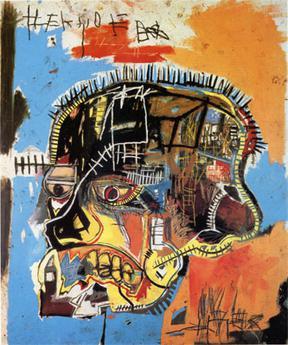
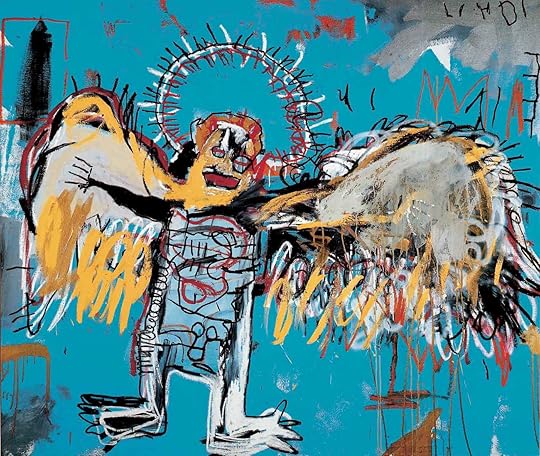
Winner of the Randolph Caldecott Medal and the Coretta Scott King Illustrator Award Jean-Michel Basquiat and his unique, collage-style paintings rocketed to fame in the 1980s as a cultural phenomenon unlike anything the art world had ever seen. But before that, he was a little boy who saw art in poetry books and museums, in games and in the words that we speak, and in the pulsing energy of New York City. Now, award-winning illustrator Javaka Steptoe's vivid text and bold artwork echoing Basquiat's own introduce young readers to the powerful message that art doesn't always have to be neat or clean--and definitely not inside the lines--to be beautiful.
Radiant child by Javaka Steptoe, a book about artist Jean-Michel Basquiat, was awarded the Caldecott Medal as the most distinguished picture book for children earlier this year.
The book takes you through Jean-Michel's childhood and all of his inspiration and ideas about how he wants to be an artist. He's influenced by books, art museums and at times his mother.
We thoroughly enjoyed the story which becomes emotional at times. The illustrations were very well put together and keep the reader interested. I especially enjoyed the back biography page which has many more facts about him.
For teens and young adults, there's a documentary called "Jean-Michel Basquiat: The Radiant Child", which is extremely revealing and explains much more about his life. It's excellent and worth watching for those who want to learn more about him.
This book is the 2017 Caldecott Medal winner. To see more award information please visit our blog at www.twogalsandabook.com
True Story: I’m working the children’s reference desk of the Children’s Room at 42nd Street of New York Public Library a couple years ago and a family walks in. They go off to read some books and eventually the younger son, I’d say around four years of age, approaches my desk. He walks right up to me, looks me dead in the eye, and says, “I want all your Javaka Steptoe books.” Essentially this child was a living embodiment of my greatest dream for mankind. I wish every single kid in America followed that little boy's lead. Walk up to your nearest children’s librarian and insist on a full fledged heaping helping of Javaka. Why? Well aside from the fact that he’s essentially children’s book royalty (his father was the groundbreaking African-American picture book author/illustrator John Steptoe) he’s one of the most impressive / too-little-known artists working today. But that little boy knew him and if his latest picture book biography “Radiant Child: The Story of Young Artist Jean-Michel Basquiat” is even half as good as I think it is, a whole host of children will follow suit. But don’t take my word for it. Take that four-year-old boy’s. That kid knew something good when he saw it.
“Somewhere in Brooklyn, a little boy dreams of being a famous artist, not knowing that one day he will make himself a KING.” That boy is an artist already, though not famous yet. In his house he colors on anything and everything within reach. And the art he makes isn’t pretty. It’s, “sloppy, ugly, and sometimes weird, but somehow still BEAUTIFUL.” His mother encourages him, teaches him, and gives him an appreciation for all the art in the world. When he’s in a car accident, she’s the one who hands him Gray’s Anatomy to help him cope with what he doesn’t understand. Still, nothing can help him readily understand his own mother’s mental illness, particularly when she’s taken away to live where she can get help. All the same, that boy, Jean-Michel Basquiat, shows her his art, and with determination he grows up, moves to Manhattan, and starts his meteoric rise in the art scene. All this so that when, at long last, he’s at the top of his game, it’s his mother who sits on the throne at his art shows. Additional information about Basquiat appears at the back of the book alongside a key to the motifs in his work, an additional note from Steptoe himself on what Basquiat’s life and work can mean to young readers, and a Bibliography.
Javaka Steptoe apparently doesn’t like to make things easy for himself. If he wanted to, he could illustrate all the usual African-American subjects we see in books every year. Your Martin Luther Kings and Rosa Parks and George Washington Carvers. So what projects does he choose instead? Complicated heroes who led complicated lives. Artists. Jimi Hendrix and guys like that. Because for all that kids should, no, MUST know who Basquiat was, he was an adult with problems. When Steptoe illustrated Gary Golio’s bio of Hendrix ( Jimi: Sounds Like a Rainbow) critics were universal in their praise. And like that book, Steptoe ends his story at the height of Basquiat’s fame. I’ve seen some folks comment that the ending here is “abrupt” and that’s not wrong. But it’s also a natural high, and a real time in the man’s life when he was really and truly happy. When presenting a subject like Basquiat to a young audience you zero in on the good, acknowledge the bad in some way (even if it’s afterwards in an Author’s Note), and do what you can to establish precisely why this person should be mentioned alongside those Martin Luther Kings, Rosa Parks, and George Washington Carvers.
There’s this moment in the film Basquiat when David Bowie (playing Andy Warhol) looks at some of his own art and says off-handedly, “I just don’t know what’s good anymore.” I have days, looking at the art of picture books when I feel the same way. Happily, there wasn’t a minute, not a second, when I felt that way about Radiant Child. Now I’m going to let you in on a little secret: Do you know what one of the most difficult occupations to illustrate a picture book biography about is? Artist. Because right from the start the illustrator of the book is in a pickle. Are you going to try to replicate the art of this long dead artist? Are you going to grossly insert it into your own images, even if the book isn’t mixed media to begin with? Are you going to try to illustrate the story in that artist’s style alone, relegating images of their actual art to the backmatter? Steptoe addresses all this in his Note at the back of the book. As he says, “Instead of reproducing or including copies of real Basquiat paintings in this book, I chose to create my own interpretations of certain pieces and motifs.” To do this he raided Basquiat’s old haunts around NYC for discarded pieces of wood to paint on. The last time I saw this degree of attention paid to painting on wood in a children’s book was Paul O. Zelinsky’s Swamp Angel. In Steptoe’s case, his illustration choice works shockingly well. Look how he manages to give the reader a sense of perspective when he presents Picasso’s “Guernica” at an angle, rather than straight on. Look how the different pieces of wood, brought together, fit, sometimes including characters on the same piece to show their closeness, and sometimes painting them on separate pieces as a family is broken apart. And the remarkable thing is that for all that it’s technically “mixed-media”, after the initial jolt of the art found on the title page (a full wordless image of Basquiat as an adult surrounded by some of his own imagery) you’re all in. You might not even notice that even the borders surrounding these pictures are found wood as well.
The precise age when a child starts to feel that their art is “not good” anymore because it doesn’t look realistic or professional enough is relative. Generally it happens around nine or ten. A book like Radiant Child, however, is aimed at younger kids in the 6-9 year old range. This is good news. For one thing, looking at young Basquiat vs. older Basquiat, it’s possible to see how his art is both childlike and sophisticated all at once. A kid could look at what he’s doing in this book and think, “I could do that!” And in his text, Steptoe drills into the reader the fact that even a kid can be a serious artist. As he says, “In his house you can tell a serious ARTIST dwells.” No bones about it.
How much can a single picture book bio do? Pick a good one apart and you’ll see all the different levels at work. Steptoe isn’t just interested in celebrating Basquiat the artist or encouraging kids to keep working on their art. He also notes at the back of the book that the story of Basquiat’s relationship with his mother, who suffered from mental illness, was very personal to him. And so, Basquiat’s mother remains an influence and an important part of his life throughout the text. You might worry, and with good reason, that the topic of mental illness is too large for a biography about someone else, particularly when that problem is not the focus of the book. How do you properly address such an adult problem (one that kids everywhere have to deal with all the time) while taking care to not draw too much attention away from the book’s real subject? Can that even be done? Sacrifices, one way or another, have to be made. In Radiant Child Steptoe’s solution is to show Jean-Michel within the lens of his art’s relationship to his mother. She talks to him about art, takes him to museums, and encourages him to keep creating. When he sees “Guernica”, it’s while he's holding her hand. And because Steptoe has taken care to link art + mom, her absence is keenly felt when she’s gone. The book’s borders go a dull brown. Just that single line “His mother’s mind is not well” says it succinctly. Jean-Michel is confused. The kids reading the book might be confused. But the feeling of having a parent you are close to leave you . . . we can all relate to that, regardless of the reason. It’s just going to have a little more poignancy for those kids that have a familiarity with family members that suffer mental illnesses. Says Steptoe, maybe with this book those kids can, “use Basquiat’s story as a catalyst for conversation and healing.”
That’s a lot for a single picture book biography to take on. Yet I truly believe that Radiant Child is up to the task. It’s telling that in the years since I became a children’s librarian I’ve seen a number of Andy Warhol biographies and picture books for kids but the closest thing I ever saw to a Basquiat bio for children was Life Doesn’t Frighten Me as penned by Maya Angelou, illustrated by Jean-Michel. And that wasn't even really a biography! For a household name, that’s a pretty shabby showing. But maybe it makes sense that only Steptoe could have brought him to proper life and to the attention of a young readership. In such a case as this, it takes an artist to display another artist. Had Basquiat chosen to create his own picture book autobiography, I don’t think he could have done a better job that what Radiant Child has accomplished here. Timely. Telling. Overdue.
This is a non fiction children's book about a very popular artist from New York City. The story itself is made child appropriate--leaving out his drug addiction and early death at 27--and while it has a few sad parts, it also has a lot of wonderful moments. Although the art featured in the book isn't Basquiat's--it's the author's work done as a tribute--it is absolutely beautiful regardless. The color is vibrant, and the collage style of painting on found objects and scraps was lovely. This book is worth picking up for the art alone. It won the Caldecott for a reason and rightly so. I'm really glad I read it. The art and this young man's story will stay with me for a long time. I highly recommend this for the budding artist or art lover in your life.
How rare to learn so much from a children's book. Maybe not that rare, and yet I learned so much. I never watched the movie about Basquiat I meant to so this was all new to me. I love this book and the story is fascinating to me.
First the Art, Wow, I'm blown away. Javaka used wood and things from all over the city in the style of Basquiat to do his own work for this book. So it is original art that is inspired by Basquiat and his style to tell his story. I love that stuff. So beautiful and now I need to go check out Basquiat and his work, which is the point.
Basquiat was born to a parents from islands. His mom would draw with him. At age 7 he was in an accident and his mom gave him a Grey's Anatomy book to draw the bones and structures and this helped him. His mother developed mental illness and had to be put in a home. Basquiat left home at 17 for NYC from Brooklyn where to took the art world by storm.
He used anything he could find to make his art on and it was a collage type of expression.
My Niece is into drawing and she loves this book too. I love this book.
In many ways, Javaka Steptoe's Radiant Child is simply and gracefully a beautifully told account, presenting not only how and even why Jean-Michel Basquiat becomes an artist but also that art is for one in the eye of the beholder (and that what some might consider beautiful, others might not, although this could and should have been a bit more specifically and clearly demonstrated and pointed out by the author, as there exists in my opinion some potential areas of and for confusion) and for two that art and artistic expression can often also be a source of healing, of actual therapy (but also, alas, how individuals with an artistic mindset and temperament will unfortunately at times experience life both more intensely and more difficultly, such as Jean-Michel Basquiat's mother, who seemingly ends up institutionalised, breaking her son's heart, as Jean-Michel Basquiat and his mother Matilde are described as having been very close, as kindred spirits of the soul).
Now I have read a number of intensely negative reviews of Radiant Child that seem to take great umbrage at the fact that as a teenager and young adult Jean-Michel Basquiat goes out alone at night and draws, paints his art as graffiti on city walls, buildings, structures. And while I can to a point understand that some if not even many people might well regard graffiti as not really art but as vandalism, in my own humble opinion, art is art. And sometimes, public displays of artistic expression uncommissioned and perhaps even unwanted on buildings, walls and other public structures are actually what it takes, are necessary to make gallery goers, art aficionados, art dealers etc. (and the general public) take notice and become aware of a young or an emerging artist (and some artists do in fact both have the desire and often an intense personal requirement and need to produce, to create art anywhere and everywhere, that they are complelled, that they cannot resist the urge to engage in public displays of their artistic soul and talents).
Furthermore, and as someone who always tends to require both solitude and often silence when I am writing (or engaging in) anything even remotely creative, I do appreciate oh so very much that Javaka Steptoe has shown in his presented narrative of Radiant Child that art is often (and perhaps even mostly) very much a solitary action, that while the end result, the end product of artistic expression might well be public (and will even need to be public if an artist wants to be recognised and have his or her works displayed in art galleries and museums), the actual creation of art is often intensely private and that many, if not actually the majority of artists do indeed much prefer to work alone, without distractions, and often much require this for their creative processes to adequately come to fruition (and that too much social contact even prevents or at least can significantly hinder creativity).
But while I guess part of me does understand why the most troubling aspects of Jean-Michel Basquiat's short life have not been mentioned by Javaka Steptoe within the text of Radiant Child and just relegated to the back and his author's notes, another part of me does wish that even within the narrative itself, Basquiat's struggles with especially substance abuse had at least been alluded to, as for me, and after researching Jean-Michel Basquiat a bit online, it truly and sadly does in fact appear as though he possesed a rather fragile and easily shatterable soul and was probaly using drugs to self medicate when expressing his thoughts, his feelings, his fears and innermost self via his artwork was clearly no longer sufficient (and in my opinion, and although this is all troubling and sadly so, Jean-Michel Basquiat's ultimately unsuccessful struggles against addiction are as much, were as much part of his life as his paintings, his collages, his sculptures, and I strongly feel that this does need to be presented, warts and all, within the text proper of Radiant Child, and quite frankly, having this information only appear in the author's notes leaves me both rather disappointed and even a tiny bit insulted).
Now with regard to the accompanying illustrations that won Javaka Steptoe the 2017 Caldecott Medal, they are glowing, colourful, full of expressive emotion and indeed do a simply wonderful job illustrating, presenting not only Jean-Michel Basquiat as an artist but as a person (his life, his artistic oeuvre, his legacy), how he lived and how he worked, produced, created. However, as much as I have indeed and in fact liked and even loved Javaka Steptoe's pictorial offerings, I do have to admit that I am finding it supremely annoying that there are none of Jean-Michel Basquiat's actual works of art reproduced in Radiant Child (and while this might well be due to legal and copyright reasons, it is still a most lamentable shortcoming and frustration that has also at least somewhat lessened my reading pleasure, as what is a book about the life and times of an artist, without pictures of his or her actual work).
And finally, while I read Radiant Child as a download on my Kindle, I would NOT really tend to all that much recommend this book in an electronic format, as while the illustrations are indeed lovely and expressive even on the Kindle, the text is so small that reading it has proven very annoying and eye-strain producing, even with zooming in, even whilst wearing reading glasses.
This is beautifully illustrated and a good introduction to Basquiat's art style. Biographically, it focuses on his childhood and the importance of his mother, which is probably a good choice, since there is so much of his adult and even teen years that I can see many parents not wanting their kids to read about.
I'm always conflicted about this issue, in general. I can see not wanting to talk about drug abuse and pansexuality; on the other hand it seems a bit disingenuous to leave those out when they were important to the individual. I guess this is one of those books where I'd suggest parents read it first and do a little research and think about what they want to tell their kids? Steptoe does include Matilde Basquiat's mental illness, so parents should at least be prepared to discuss that, as reading about someone's mom being taken away and not living with them any longer will probably raise questions.
An introduction to the life of artist Jean-Michel Basquiat with an emphasis on his formative influences and meteoric rise to fame. I really like how this book reads. The way the author deals with Basquiat's mother's mental illness is age-appropriate and does a great job of showing how important her influence was on his work as well as how much her absence in the home affected him.
I also like that this book takes readers only up to the point that Basquait attains success, not to his untimely death. By focusing the narrative in this way, the author celebrates the art and makes such a life more accessible to children who may also feel pulled toward the arts. The back matter does a great job of cluing readers into how the rest of Basquiat's life played out, and also teaches them about motifs and symbolism which encourages them to explore the mixed media artwork.
I appreciated the author's note that explains why the author felt compelled to write and illustrate a book about Basquiat for children. This book is excellent and highly recommended for grades 1-5.
I have such conflicting emotions from this book. I thought the art was dynamic and did a great job describing and showing the kind of artist Basquiat became and his artistic progression from childhood to adulthood. But when so many momentous life events are left out of the book and the afterword, I think we're removing a lot of the struggles that Basquiat overcame and would've undoubtedly influenced his artwork as well as who he became as a person. I understand that you may edit a book for age appropriateness but when you remove too much, are you still doing what you set out to do which is to illuminate another person's story? The author did encourage readers to learn more about Basquiat and his art for themselves online or in museums. I thought this was a vague suggestion and would've appreciated specific titles or resources to help launch this investigation for kids, teachers and parents.
I've never heard about Jean-Michel Basquiat before, so Radiant Child did an excellent job showing me what I've been missing out on. I especially appreciate the additional information about Basquiat and his art in the back matter, but I wish there were some examples of his work somewhere in the book.
However, Radiant Child did encourage me to venture into the online world and further acquaint myself with Basquiat and his art, which is exactly what Javaka Steptoe has intended. Such an unusual, captivating, vibrant art by such a charismatic personality!
Steptoe's original mixed-media collage illustrations, which are painted on wood pieces found in the neighborhoods of New York City where Basquiat himself had lived and created, truly succeed in capturing the radiant spirit of Basquiat's art without directly reproducing it:
The artwork is vibrant and creative. The true story is honest and tragic. It has a terrific chance at winning the Coretta Scott King Award for 2017. It would be so cool and fantastic if he won the John Steptoe award.
I, too, found it difficult to enjoy Radiant Child: The Story of Young Artist Jean-Michel Basquiat though I could appreciate the effort. Although, I'm not sure how I felt about the author calling Jean-Michel's artwork "sloppy, ugly and sometimes weird, but somehow still BEAUTIFUL" -- I'm not sure I liked the labeling of the artwork like that. On the one hand, I can appreciate conveying to children that art doesn't have to be "pretty" to be appreciated or worthy. That sometimes we can express difficult feelings through artwork. But I also felt that labeling it like that was unnecessary. If anything I would have preferred it to say something like "some people found it ugly" or something to that effect. Not such a universal statement. Anyway, that said, unfortunately, I am one of those who is not a fan of that style of artwork and so I really can't say I enjoyed the book or illustrations all that much. I also think it would have been nice for the author to have included a few of Basquait's actual art pieces at the end of the book. I realize the point was for children to look up the art online or in museums, and hopefully spark more exploration, but not every kid has immediate access to internet or museums. I think there's a danger readers will simply experience the imitation and not the genuine article.
Picture book biography of artist Jean-Michel Basquiat, who I had never heard of prior to reading this book. Clearly I'm in the minority, and I'm missing something the Caldecott committee and many others can see, but I'm not in love with this book. I appreciate a diverse range of art styles, but the illustrations in this book are just not my thing. As a biography, I'm still not sure after reading it how Basquiat became famous. I also disagree with burying the mention of his drug addiction and early death in the single-page bio at the back of the book; at some point, child readers will stumble upon that information and then be disillusioned with someone they had formerly looked up to as a role model.
Javaka Steptoe's original artwork in this book won it the 2017 Caldecott Medal as the previous year's most distinguished American picture book, but he's not the artist who takes center stage in Radiant Child: The Story of Young Artist Jean-Michel Basquiat. A youth of no extravagant financial means who rose to stardom through imagination and pure talent, it's impossible to know how many artists Jean-Michel inspired. One of them, Javaka Steptoe, repays that inspiration in this book, a warm tribute to a brilliant painter whose life was tragically cut short. Rather than mourn what might have been, Radiant Child celebrates what was, and there's much to praise about Jean-Michel Basquiat's creations.
The boy dreamed of being a famous artist. A serious injury from a car accident stalled him for a while, and sadness over his mother's mental breakdown threatened to swallow him, but Jean-Michel never forgot the inspiration she was to him as a budding artist. He left home at age seventeen and made his mark in New York City as a graffiti artist, spray-painting concrete, wood, and metal. His ability couldn't be masked by urban decay, and in his twenties he made it big as one of America's premier painters. Jean-Michel's raw, emotional art was a tribute to his mentally ill mother, and though he succumbed to his own demons and died at age twenty-seven, his legacy only grew. It's hard to deny that Jean-Michel lived up to his potential in the few years he had to demonstrate it.
Jean-Michel Basquiat's story is powerful and sobering, but I'm not sure a picture book does it justice. The gray areas and moral ambiguities that defined his life are skimmed over in Radiant Child because there isn't room to address them. Javaka Steptoe's artwork, however, is sensational. The painted wood paneling is like nothing I remember seeing, meaningful homage to Jean-Michel's surprising style. One could be satisfied flipping through this book just to look at Javaka Steptoe's paintings. I'll give Radiant Child one and a half stars, and I considered rounding up to two. It wouldn't have been my Caldecott choice, but it's an impressive artistic accomplishment.
Every child, artistic or not, should read this book. Often, American art finds itself admired via white lives and not the splendor found through black hands.
Jean-Michel Basquiat shared his art for a short time. His glory will live on in galleries, museums, and in stories for children showing how his dream become reality.
I love Basquiat - which is why I was disappointed in this picture book. I don't appreciate the sugar-coating of facts even for children. Just say he was "homeless," he was a "graffiti artist," etc. The illustrations are beautiful, however it is odd to have a book about an artist and not include Basquiat's actual art, rather have the illustrator express the artists work within his own illustrations. Huh?!?
This book felt more like a tribute to the artist than a biography. Outside of the short summary of his life on the back page, there was very little information for a child to come away with. I was hard pressed after reading the main text to come up with any influences or points of development as an artist aside from the single mention of a trip to a museum to see Picasso. Obviously the Caldecott is awarded for the illustrations, but I was disappointed that the book did not contain more copies of his works or explanations of his themes or motifs--something mostly relegated, like his biography, to the back pages rather than the main text. If I was recommending a book for a child to use as a source for a report on Basquiat, this would not be it.
Using vivid and bold images and pieces of New York City, Javaka Steptoe created a marvelous visionary interpretation of Jean-Michel Basquiat’s artwork. Before he became famous in the 1980's, Basquiat saw art all around him in books, words, museums, and games. His work was not pretty nor neat but passionate and energized. While recovering from being hit by a car at seven years old, his mother gave him Gray’s Anatomy, which influenced his art. He was raised by a loving Puerto Rican mother with mental issues and a Haitian father fond of jazz. He would draw day and night moving from graffiti to art exhibits. Basquiat used his artwork to express his views on politics, struggles, black culture, anti-capitalism, anti-colonialism, and the powerless. I was surprised to learn of his love of Pablo Picasso’s 1937 painting, Guernica, which is a powerful and haunting painting I have admired for years. Known as a “radiant, wild, a genius child”, his life was tragically cut short when he died of a heroin overdose at age 27. Highly recommend.
2017 Caldecott Winner A true story of Jean-Michel Basquiat. Lots of colorful pages. Each page could be viewed for a couple minutes taking in all the detail. Heartfelt story. I just don't know that the book passes the 'again' test for kids. It is a good story to hear how he overcame his struggle when his mom had to leave per mental difficulties. Then visits his mom to show her the art he is making.
Jean-Michel Basquiat was a bright flash of light in the art scene in all of his life. It was good to read about the feelings that informed his art, and the messages he wanted to send out into the world.
My group were a little conflicted to hear that much of his art was graffiti, not a proper work product in their experience, but they were philosophical about it.
I'm annoyed that my enjoyable history of sniffing at Caldecott Medal winners has come to a screeching halt.
DAMMIT THIS IS SO GOOD.
Steptoe's art is divine, giving the reader a great sense of Basquiat's style without feeling in itself scribbly, cryptic or off-putting. And given how FREAKING SAD Basquiat's life was, the fact that Steptoe wrote a truthful, poetic and honest but not depressing picture book for kids about him and his work is such an achievement. (The back matter goes into more detail for those who want it.) He frames this as a story of art helping a child with a loving but mentally ill mother and a difficult life. I can't say enough about the textured, colorful art, painted on scraps of wood that Steptoe scavenged, street-art-style, from New York City neighborhoods relevant to Basquiat's story.
Just wow. (Do I expect a ton of little kids will love it? I do not! But artsy, soulful ones will get it, big-time.)
Sometimes you sit down to read an award-winning book and think, "Huh... What did the committee see here that I didn't?" Sometimes, though, you read an award-winning book and think, "Wow! The committee nailed this one and I would vote for it myself one hundred plus times." The latter was most definitely the case with Radiant Child, which won the Caldecott medal and the Coretta Scott King Illustrator Award and was listed on multiple must-read book lists.
Steptoe does an amazing job tackling the life of renowned artist Jean-Michel Basquiat and making it accessible to younger readers. Basquiat's childhood accident is here, as well as his mother's breakdown, but they're approached with gentleness and sensitivity. His path to acclaimed artist is breathtaking and Steptoe's illustrations are a phenomenal homage to Basquiat's art. The end notes are very well done and add essential information for older, more mature readers.
It's not often that compelling biographies come along, for readers of any age, but Radiant Child definitely fits the bill. If you (and/or your child) haven't read it yet, do yourself a solid and treat yo'self.
Just as his subject, Jean-Michel Basquiat, did, the author relies on found objects, including wood and other materials found in New York City, to create the illustrations here. The colors are bright and fill the pages, serving as apt visual reminders to readers that art is often messy and moves beyond the lines and pages. While the author clearly doesn't address some of the artist's personal struggles, including drug addiction, until the back matter, he does make it clear that life wasn't easy for him. After all, the boy was injured by a car at an early age and watched as his beloved mother struggled with mental illness, something not usually discussed in a picture book for children. Readers will quickly realize that this artist found inspiration from the world around him and was unconcerned with how others saw his work. He had a vision, and he followed that vision faithfully. So often, we associate art with museums and highbrow pursuits, but this artwork, born in the streets of Basquiat's neighborhood, has a fierce independence and vibrancy to it that puts the lie to those assumptions. While there are necessarily holes in the story, readers are provided a glimpse of the creative mind and process of a unique modern artist. It is shocking to realize that he crammed all that living into 27 years, which makes me curious to know what he might have accomplished had he lived several more decades. While it might have been enlightening to include a photo or two of Basquiat's work, the illustrator certainly does homage to the man and his work with his own creations. Those personal, artistic responses filled with collages and dramatic painting are powerful indeed, and reveal as much about Steptoe's vision of the world around him as Basquiat's. Only time will tell how much of an impact this artist will have on the art world. Some might argue that he was at the right place at the right time while others might argue that his work was highly original and influential. Young readers might enjoy doing some additional research to learn more. I would have appreciated having some references and useful websites included. Still, it's exciting to have this man's story told for a young audience.
Jean-Michel Basquait knew as a young child he wanted to be an artist and we readers could see because he spent almost all of his time painting. He learned to appreciate art from his mother who designed and sewed, cooked and cleaned and through her hard work their home looked like a stylish magazine. Jean-Michel’s mother would join him on the floor and draw with him. His mom helped him learn to appreciate art by taking him to museums and theatre. She taught him art is everywhere even in the words we speak and in the street games of little children.
Radiant Child was a fascinating read and the pictures were breathtaking.
I have to admit I've never seen Basquiat's artwork before, even though I've heard of him. However, now that I've read this little biography, I feel compelled to look up some of his paintings. I love Javaka Steptoe's illustrations in this one, and, since he created them based on the works of Basquiat, I think I'll like Basquiat's as well. Steptoe used found objects, objects associated with street life, to paint his illustrations on, which is what Basquiat did. It's too bad that Basquiat died so young. The world lost a great talent all because of drugs. Recommended.
A terrific picture book that doubles as excellent nonfiction. It's the story of artist Jean-Michel Basquiat, who grew up in Brooklyn and discover his talent for art very early. His art was colorful and interesting and definitely not traditional in any sense. Sadly, he passed away at an early age due to drug addiction.
Steptoe's illustrations are amazing and complex; a real tribute to his subject.
This is the true story of Jean-Michel Basquiat's journey to become a famous artist. It's a story about perseverance and overcoming hardship, about family and putting your heart into your work. It's beautifully done.
I think this would be a great mentor text to use as an art teacher doing a unit on collage and abstract contemporary art.
Simply beautiful. Text is perfect for the stunning illustrations. I look forward to sharing this book with customers, putting it on display for customers and purchasing a copy for my home library.
"Art is the street games of little children, in our style and the words that we speak. It is how the messy patchwork of the city creates new meaning for ordinary things."