

What do you think?

Mr. Cornell's Dream Boxes
Children young and old will delight in the artistic splendor of this illustrated nonfiction tale from the author of Henri's Scissors, which Booklist called an "exemplary picture-book biography."
Joseph Cornell loved to draw and paint and collect things. With these drawings and paintings and collected treasures, he made marvelous shadowboxes--wonderlands covered in glass. And who did he most like to share them with? Children, of course. For they noticed all the details and took in all the magic Mr. Cornell had created.
In this inspiring nonfiction picture book, Jeanette Winter has painted a moving portrait of a New York artist who always felt his work was best understood by children.
Joseph Cornell loved to draw and paint and collect things. With these drawings and paintings and collected treasures, he made marvelous shadowboxes--wonderlands covered in glass. And who did he most like to share them with? Children, of course. For they noticed all the details and took in all the magic Mr. Cornell had created.
In this inspiring nonfiction picture book, Jeanette Winter has painted a moving portrait of a New York artist who always felt his work was best understood by children.
40 pages, Hardcover
First published August 19, 2014
Ratings & Reviews
Friends & Following
Create a free account to discover what your friends think of this book!
Community Reviews
Displaying 1 - 30 of 49 reviews

January 13, 2017
Fine, but I suspect useless -- Cornell's work is fairly accessible to children, and probably in its real detail more interesting to them than these simplified drawings. I don't see this book as particularly helpful as an introduction to Cornell's boxes, if one were needed, which I don't think it is. The illustrations aren't very reminiscent of Cornell's art, so the book isn't even useful for gauging whether your kid will like Cornell. Just show them some photos of the actual art pieces.

I was indifferent to the contrived frame of some random kid peering in at Cornell (seriously, kid, where are your manners?).

I was indifferent to the contrived frame of some random kid peering in at Cornell (seriously, kid, where are your manners?).

April 1, 2020
"If you had lived on Utopia Parkway not so long ago," begins this delightful picture-book biography of assemblage artist Joseph Cornell, "you might have walked past this house," referring to the Queens home of the now famous creator of magical box-collages assembled from found objects. Cornell neither drew nor painted - he made 'Wonderlands' in boxes, filled with "dreams and memories." Employed as a fabric salesman, he created these objects for his own pleasure, and for the children in his neighborhood, whom he considered his primary audience. Eventually word spread of his creations, and other artists and collectors sought him out. Although he achieved great success, Cornell never forgot who his true audience was, and his final exhibition, held in 1972 at the Cooper Union, was created especially for children.
Jeanette Winter, whose other picture-book biographies include such titles as The Watcher: Jane Goodall's Life with the Chimps and The Librarian of Basra: A True Story from Iraq , here crafts an informative read, one which encourages children to "see" Cornell in his natural habitat, as he went about his work. As an admirer both of Cornell's boxes and Winter's biographies, I was excited to discover Mr. Cornell's Dream Boxes recently, and pleased to find that it lived up to my expectations. Both narrative and artwork are appealing, presenting the story of a man who followed his passion, whether that entailed creating intricate boxes full of objects found around New York City, or keeping journals that eventually totaled more than 30,000 pages. The artwork, with its dark outlines against white pages, in the spread featuring Cornell's house, or its muted purplish blues, used in depicting the various box themes, ably captures its subject matter. All in all, a lovely little biography, one I would recommend to children interested in art or the artistic process.
Jeanette Winter, whose other picture-book biographies include such titles as The Watcher: Jane Goodall's Life with the Chimps and The Librarian of Basra: A True Story from Iraq , here crafts an informative read, one which encourages children to "see" Cornell in his natural habitat, as he went about his work. As an admirer both of Cornell's boxes and Winter's biographies, I was excited to discover Mr. Cornell's Dream Boxes recently, and pleased to find that it lived up to my expectations. Both narrative and artwork are appealing, presenting the story of a man who followed his passion, whether that entailed creating intricate boxes full of objects found around New York City, or keeping journals that eventually totaled more than 30,000 pages. The artwork, with its dark outlines against white pages, in the spread featuring Cornell's house, or its muted purplish blues, used in depicting the various box themes, ably captures its subject matter. All in all, a lovely little biography, one I would recommend to children interested in art or the artistic process.

September 3, 2014
It's wonderful to see one of my favorite artist getting the attention he deserves and to be able to introduce my children to his work.

June 23, 2018
I love books that inspire children to be creative by using found or collected things. Wonderful, true story.

August 2, 2018
With only two books about Joseph Cornell geared towards children - this one and "The Amazing Collection of Joey Cornell" - this one certainly seems aimed at a younger audience. But the story itself isn't especially engaging, and as many have said, quite boring. His life, and interest in arts and bits of things, love of sweets, love of film, massive collections, are so much more interesting than this! I wasn't in love with the newest book, either, but it is far more engaging and probably more interesting for young readers than this one.
I do like this book's illustrations and recreation of his boxes much better than the other book, though, so points there!
I do like this book's illustrations and recreation of his boxes much better than the other book, though, so points there!

August 10, 2017
While I appreciate Jeanette Winter's introduction to Joseph Cornell and his "dream boxes", this book was written and illustrated at such a introductory level that it would quickly bore many children and their parents. The failure to show Cornell's actual artwork leaves the reader hopelessly uneducated about the artist. It would have been so easy to layer this book such that readers of all levels would have found something of interest.

December 11, 2019
I am in love with the deceptively simple illustrations and text of this book. The sparse text and art are all the more moving for their simplicity. Love it. The more I read about Joseph Cornell the more I love him, and this book certainly contributed to that.

April 15, 2018
Jeanette Winter fans like me probably aren't giving unbiased reviews... but this is great!

April 22, 2018
I've always loved Cornell's boxes. There is something so idiosyncratic about them, lonely but touching. This is a nice introduction that children can easily understand.

May 17, 2018
A brilliant little picture book about a fascinating outsider artist.

August 6, 2018
There is a nice little history presented in this book. The framing device works quite well. It's just the artwork was not to my taste.

November 16, 2020
Fascinating. My kid immediately wanted to see photos of his dream boxes.

Read
December 2, 2020Magical and fascinating. My kid immediately wanted to see photos of his dream boxes. This would be a great book to read and then make shadow boxes. Very inspiring!

August 2, 2022
author's note included - helpful. Photos of kids viewing his boxes.

April 18, 2024
Easy read, sweet and airy. Nice back matter—just enough of a springboard for further research.
Read
December 7, 2016Title: Mr. Cornell’s Dream Boxes
Author: Jeanette Winter
Illustrator (if separate from author):
Genre: Biography (K-2)
Theme(s): biography, life
Opening line/sentence: “If you had lived on Utopia Parkway not so long ago,…”
Brief Book Summary: This book talks about the interests of Joseph Cornell, who built small, dream boxes of things he remembered. The book talks directly to the reader, and it explained what Mr. Cornell might do when he’s not making his dream boxes and that he really likes sweets.
Professional Recommendation/Review #1:
Publishers Weekly - 5/26/2014
Winter follows her picture-book biographies of artists including Matisse, O’Keeffe, and Rivera with a look at reclusive artist Joseph Cornell, who made glass-fronted wooden boxes filled with delicate, surreal collections of objects—star charts, cutouts of parrots and ballerinas, marbles in wineglasses—all crafted in the cellar of his home on the marvelously named Utopia Parkway. “He saw only dreams and memories, and he filled his boxes with them.” Winter connects specific memories from Cornell’s life with the creations they grew into, showing each memory in a cloud of periwinkle blue on left-hand pages (“Mr. Cornell remembered blowing soap bubbles”) opposite the box it inspired (a pipe emitting what look like white seashells). While Winter’s lyrical prose is true to the gentle strangeness of Cornell’s work, the digital artwork, done in the style of flat tempera painting, doesn’t convey the fine detail of the boxes, and no photographs of them are included. An afterword supplies more information (Cornell arranged his last exhibition for children, hanging the boxes low for them to see), but the few photos there focus on the viewers, not the work. Ages 4–8. Agent: Susan Cohen, Writers House. (Aug.)
Professional Recommendation/Review #2:
Kirk's Reviews - 6/10/2014
A gentle homage to artist Joseph Cornell explores artistic inspiration for very young readers and listeners.Winter presents Cornell in the context of home on Utopia Parkway: caring for his brother upstairs, dreaming in his backyard, assembling his unique shadow boxes in the cellar of the house in Queens, New York, where artists and collectors eventually come to visit, as the author’s note reveals. Winter offers a look at a form of artistic expression within reach of her audience, explaining that Cornell was neither painter nor sculptor, yet he created “WONDERLANDS covered in glass.” She charmingly discloses that Cornell loved sweets and imagines child readers or listeners as one of the neighbors Cornell might have invited to a special exhibit of his boxes. Winter’s digitally rendered art is delicate and inviting. Images repeat and transform from imagined glimpses through the windows of Cornell’s house to a view into the artist’s dreams and memories. The plain outlines of his house are overlaid with images of a swan and a moon in one illustration, bright birds in another. She conveys the dreamlike quality of his work, even when strange or disquieting: “He remembered learning about stars, / and how the endless sky scared him.”Winter captures in two dimensions a great deal of the evocative nature of Cornell’s three-dimensional work in a way that will be intriguing for the very young. (Picture book/biography. 3-7)
Response to Two Professional Reviews: I really agree with this first review that the book shows a lot of great illustrations, but none that truly capture the detail in Mr. Cornell’s dream boxes. I also agree that I’d like to see more detail in the artwork than in the viewers at the end of the story. Some real-life pictures would be very helpful.
Evaluation of Literary Elements: The story of Cornell is told in a very fun way, that even young children can understand. Instead of only adding factual information, Winter tells the story as if it’s happening to the reader. The picture detail is great, but not when showing Cornell’s actual work. I like that other background information was added in the story other than what kind of artwork he did or what it looked like.
Consideration of Instructional Application: I would use this book as a read-aloud in a K-2 classroom. I would then have students come up with things to put in their own dream box, from past memories or dreams that they’ve had. I would have students share with the class, and they would draw pictures or make boxes out of paper to keep the pictures in.
Author: Jeanette Winter
Illustrator (if separate from author):
Genre: Biography (K-2)
Theme(s): biography, life
Opening line/sentence: “If you had lived on Utopia Parkway not so long ago,…”
Brief Book Summary: This book talks about the interests of Joseph Cornell, who built small, dream boxes of things he remembered. The book talks directly to the reader, and it explained what Mr. Cornell might do when he’s not making his dream boxes and that he really likes sweets.
Professional Recommendation/Review #1:
Publishers Weekly - 5/26/2014
Winter follows her picture-book biographies of artists including Matisse, O’Keeffe, and Rivera with a look at reclusive artist Joseph Cornell, who made glass-fronted wooden boxes filled with delicate, surreal collections of objects—star charts, cutouts of parrots and ballerinas, marbles in wineglasses—all crafted in the cellar of his home on the marvelously named Utopia Parkway. “He saw only dreams and memories, and he filled his boxes with them.” Winter connects specific memories from Cornell’s life with the creations they grew into, showing each memory in a cloud of periwinkle blue on left-hand pages (“Mr. Cornell remembered blowing soap bubbles”) opposite the box it inspired (a pipe emitting what look like white seashells). While Winter’s lyrical prose is true to the gentle strangeness of Cornell’s work, the digital artwork, done in the style of flat tempera painting, doesn’t convey the fine detail of the boxes, and no photographs of them are included. An afterword supplies more information (Cornell arranged his last exhibition for children, hanging the boxes low for them to see), but the few photos there focus on the viewers, not the work. Ages 4–8. Agent: Susan Cohen, Writers House. (Aug.)
Professional Recommendation/Review #2:
Kirk's Reviews - 6/10/2014
A gentle homage to artist Joseph Cornell explores artistic inspiration for very young readers and listeners.Winter presents Cornell in the context of home on Utopia Parkway: caring for his brother upstairs, dreaming in his backyard, assembling his unique shadow boxes in the cellar of the house in Queens, New York, where artists and collectors eventually come to visit, as the author’s note reveals. Winter offers a look at a form of artistic expression within reach of her audience, explaining that Cornell was neither painter nor sculptor, yet he created “WONDERLANDS covered in glass.” She charmingly discloses that Cornell loved sweets and imagines child readers or listeners as one of the neighbors Cornell might have invited to a special exhibit of his boxes. Winter’s digitally rendered art is delicate and inviting. Images repeat and transform from imagined glimpses through the windows of Cornell’s house to a view into the artist’s dreams and memories. The plain outlines of his house are overlaid with images of a swan and a moon in one illustration, bright birds in another. She conveys the dreamlike quality of his work, even when strange or disquieting: “He remembered learning about stars, / and how the endless sky scared him.”Winter captures in two dimensions a great deal of the evocative nature of Cornell’s three-dimensional work in a way that will be intriguing for the very young. (Picture book/biography. 3-7)
Response to Two Professional Reviews: I really agree with this first review that the book shows a lot of great illustrations, but none that truly capture the detail in Mr. Cornell’s dream boxes. I also agree that I’d like to see more detail in the artwork than in the viewers at the end of the story. Some real-life pictures would be very helpful.
Evaluation of Literary Elements: The story of Cornell is told in a very fun way, that even young children can understand. Instead of only adding factual information, Winter tells the story as if it’s happening to the reader. The picture detail is great, but not when showing Cornell’s actual work. I like that other background information was added in the story other than what kind of artwork he did or what it looked like.
Consideration of Instructional Application: I would use this book as a read-aloud in a K-2 classroom. I would then have students come up with things to put in their own dream box, from past memories or dreams that they’ve had. I would have students share with the class, and they would draw pictures or make boxes out of paper to keep the pictures in.
Read
August 10, 2016Title: Mr. Cornell's Dream Boxes
Author: Jeanette Winter
Genre: Biography
Theme(s): Artists, Imagination, Biography
Opening line/sentence: If you had lived on Utopia Parkway not so long ago, you might have walked past this house.
Brief Book Summary: This book explores the self taught artist Joseph Cornell. In the book it shows some of his work, which was mainly wooden boxes that showed 3D images in them. Children had an interest in his boxes so Jeanette Winter tried to portray that through making this a children's book.
Professional Recommendation/Review #1: An eye-opening introduction for children to the work of artist Joseph Cornell, who created enchanting shadow boxes, begins, If you had lived on Utopia Parkway not so long ago ... It goes on to describe what a child walking by Mr. Cornell s house might have seen, even as she or he went unseen: Mr. Cornell wouldn t have noticed you looking in. He saw mostly dreams and memories, and he filled his boxes with them. Jeanette Winter deftly incorporates factual elements of Cornell s life, as well as things he pondered and imagined that inspired his art, into a quietly captivating narrative. Despite the text s brevity, Winter also weaves in small, child friendly details, like Cornell s love for sweets, and his delight in sharing his dream boxes with children. Her stylized art emphasizes small scenes and individual elements suggestive of the shadow boxes. An author s note with black-and-white photographs further grounds the narrative in details of Cornell s life and his desire to share his work, especially with children. (CLCD)
Professional Recommendation/Review #2: (2) K-3 Joseph Cornell was a unique twentieth-century artist best known for his work in assemblage. Winter emphasizes the whimsy of Cornell's tiny enclosed worlds while quietly working in biographical details. Digital illustrations resembling cut paper jibe with the subject matter, as images are combined and assembled (often within neat boxes) on clean pages to enlarge ideas in the spare prose. (Hornbook)
Response to Two Professional Reviews: I enjoyed how the second review incorporates how Cornell was a twentieth century artist. The first one gives a background of the book, but I like how the second one focus's more specifically on Joseph Cornell.
Evaluation of Literary Elements: I liked how on each page Winter had a small set of words portraying a specific picture on the page. It was neat to see how those words were scattered throughout the page rather than in a regular format like most books are. I also liked how she had some words bigger than the others and some smaller.
Consideration of Instructional Application: After reading this book to the class I would have the students create their own 3D boxes. We could use cardboard boxes rather than wood, and the students could create any scene they wanted to within these boxes.
Author: Jeanette Winter
Genre: Biography
Theme(s): Artists, Imagination, Biography
Opening line/sentence: If you had lived on Utopia Parkway not so long ago, you might have walked past this house.
Brief Book Summary: This book explores the self taught artist Joseph Cornell. In the book it shows some of his work, which was mainly wooden boxes that showed 3D images in them. Children had an interest in his boxes so Jeanette Winter tried to portray that through making this a children's book.
Professional Recommendation/Review #1: An eye-opening introduction for children to the work of artist Joseph Cornell, who created enchanting shadow boxes, begins, If you had lived on Utopia Parkway not so long ago ... It goes on to describe what a child walking by Mr. Cornell s house might have seen, even as she or he went unseen: Mr. Cornell wouldn t have noticed you looking in. He saw mostly dreams and memories, and he filled his boxes with them. Jeanette Winter deftly incorporates factual elements of Cornell s life, as well as things he pondered and imagined that inspired his art, into a quietly captivating narrative. Despite the text s brevity, Winter also weaves in small, child friendly details, like Cornell s love for sweets, and his delight in sharing his dream boxes with children. Her stylized art emphasizes small scenes and individual elements suggestive of the shadow boxes. An author s note with black-and-white photographs further grounds the narrative in details of Cornell s life and his desire to share his work, especially with children. (CLCD)
Professional Recommendation/Review #2: (2) K-3 Joseph Cornell was a unique twentieth-century artist best known for his work in assemblage. Winter emphasizes the whimsy of Cornell's tiny enclosed worlds while quietly working in biographical details. Digital illustrations resembling cut paper jibe with the subject matter, as images are combined and assembled (often within neat boxes) on clean pages to enlarge ideas in the spare prose. (Hornbook)
Response to Two Professional Reviews: I enjoyed how the second review incorporates how Cornell was a twentieth century artist. The first one gives a background of the book, but I like how the second one focus's more specifically on Joseph Cornell.
Evaluation of Literary Elements: I liked how on each page Winter had a small set of words portraying a specific picture on the page. It was neat to see how those words were scattered throughout the page rather than in a regular format like most books are. I also liked how she had some words bigger than the others and some smaller.
Consideration of Instructional Application: After reading this book to the class I would have the students create their own 3D boxes. We could use cardboard boxes rather than wood, and the students could create any scene they wanted to within these boxes.

March 3, 2017
I just want to create a program around this book. It's great!

October 17, 2014
Written as a tribute to the real Mr. Cornell, Jeanette Winter takes her readers on a trip of discovery to meet a man that left a lifelong impression on her.
When Joseph Cornell was not crisscrossing New York City selling textiles, he was caring for his mother and brother; but in his free time, Mr. Cornell could be found in his basement, making memory boxes from random items that he found as he traveled throughout the city. Items that reminded him of adventures during his life.
Mr. Cornell was a quiet man that kept to himself, he saw mostly dreams and memories that he placed in his shadow boxes to share with children and in doing so, he also shared his love of art with those that lived on Utopia Parkway and beyond.
I am not sure if this book will appeal to most readers, the concept might be a bit over a young listeners understanding, but if you can get your slightly older reader interested and follow up with making a memory box of their own, you will have a definite winner on your hands.
When Joseph Cornell was not crisscrossing New York City selling textiles, he was caring for his mother and brother; but in his free time, Mr. Cornell could be found in his basement, making memory boxes from random items that he found as he traveled throughout the city. Items that reminded him of adventures during his life.
Mr. Cornell was a quiet man that kept to himself, he saw mostly dreams and memories that he placed in his shadow boxes to share with children and in doing so, he also shared his love of art with those that lived on Utopia Parkway and beyond.
I am not sure if this book will appeal to most readers, the concept might be a bit over a young listeners understanding, but if you can get your slightly older reader interested and follow up with making a memory box of their own, you will have a definite winner on your hands.

February 5, 2015
Joseph Cornell, who never studied art, spent his free time creating shadow boxes representing the memories and dreams that mattered most to him. This picture book, a tribute to the talented Queens, New York, resident, gives a brief overview of his daily life and his art. I liked the fact that the picture book pushes readers to consider art in different ways and that it highlights someone probably regarded eccentric by most counts. There is something endearing about an adult munching on brownies and a sweet beverage and sharing his creations with youngsters. The digital illustrations feature examples of some of his work and glimpses of his life. Whether young readers can understand the abstract quality of his boxes is debatable, but they surely must have drawn some inspiration and reassurance from his example. The back matter adds information about Cornell to the text and also includes photographs of fascinated children looking at his boxes.
March 23, 2016
"Mr. Cornell made shadow boxes...WONDERLANDS covered in glass." -Jeanette Winter
When I found this book at the library, I immediately checked it out. Joseph Cornell is one of my favorite artists to study! In the past, I've created a few of my own shadow boxes with him as my inspiration. Jeanette's portrayal of Cornell's life was very sweet. I especially liked how Cornell's whimsical dream boxes were uniquely recreated using her own imagination and creative style. In my opinion, this non-fiction biography would be a treat for children ages 4-8 years (Preschool-3rd grade). It is written in a way that invites YOU, as the reader, to learn more about Cornell and how he created his interesting little "wonderlands." I would suggest using this picture book to introduce Joseph Cornell and his legacy. It's a fun way to explore how Cornell unexpectedly developed a passion for art and discovered a refreshing new way to interpret the world around us.
When I found this book at the library, I immediately checked it out. Joseph Cornell is one of my favorite artists to study! In the past, I've created a few of my own shadow boxes with him as my inspiration. Jeanette's portrayal of Cornell's life was very sweet. I especially liked how Cornell's whimsical dream boxes were uniquely recreated using her own imagination and creative style. In my opinion, this non-fiction biography would be a treat for children ages 4-8 years (Preschool-3rd grade). It is written in a way that invites YOU, as the reader, to learn more about Cornell and how he created his interesting little "wonderlands." I would suggest using this picture book to introduce Joseph Cornell and his legacy. It's a fun way to explore how Cornell unexpectedly developed a passion for art and discovered a refreshing new way to interpret the world around us.

January 27, 2015
I saw Cornell's boxes at the Art Institute in Chicago several years ago. I had never heard of him and I was fascinated. I can see children being captivated as well. This is a good introduction with not too much detail, but enough to give a sense of his dreaming, his desire to capture his dreams and memories, his creativity with found objects. The comments about his love of sweets and photos at the end showing children looking at Cornell's boxes and eating brownies add to the accessibility of Cornell. I enjoyed the author's note at the end about the exhibition for children and Cornell's demeanor with the children. Now I just need to get an opportunity to see those boxes again.

December 13, 2015
Very simple picture book about a unique artist, Joseph Cornell (1903-1972), who made shadow boxes filled with objects he found while selling textiles door to door. He became a successful artist and stopped his sales job. His last exhibit was just for kids! The storyline of the book is a girl walking by his house who sees a light in the cellar--it's Mr. Cornell at work, putting his dreams and memories into his art. He also took care of his brother (who had cerebral palsy) and his mother. Beautiful illustrations in the book, on white background--they look like they are stamped or engraved. Has a selected bibliography.

June 17, 2016
Winter presents a fascinating look at Joseph Cornell, a Queens, New York resident, who created art using found objects.
Here's a look at a few of his boxes:

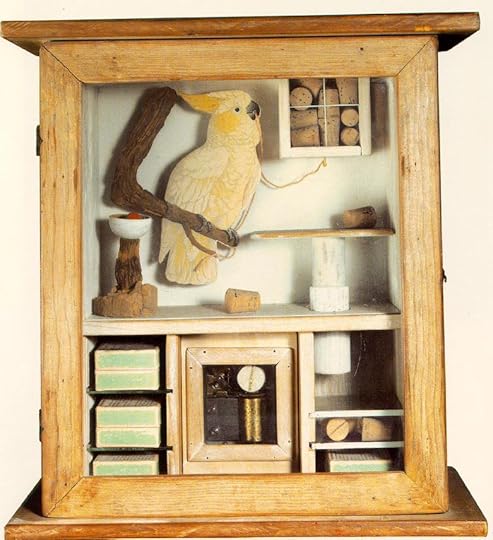
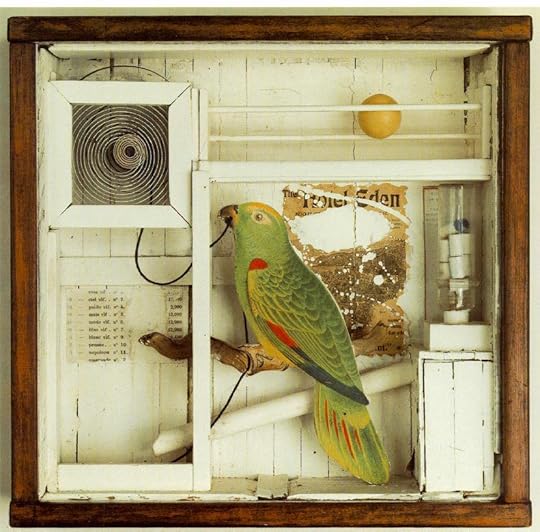
Dozens more can be seen on google images - Joseph Cornell boxes
Here's a look at a few of his boxes:
Dozens more can be seen on google images - Joseph Cornell boxes

July 14, 2014
A picture book bio about a man who made beautiful shadow box artwork and immensely enjoyed sharing his gifts with children.
I like the simple way in which readers are presented with the way in which Mr. Cornell created his imaginary worlds and readers are asked to decide whether he was an artist, a toy maker, a magician, all three?
Back matter includes an author's note with pictures of Joseph Cornell and his last exhibition.
Great read aloud for PreK-2 and one that begs for an extension activity in which children are given the materials to create their own imaginary worlds.
I like the simple way in which readers are presented with the way in which Mr. Cornell created his imaginary worlds and readers are asked to decide whether he was an artist, a toy maker, a magician, all three?
Back matter includes an author's note with pictures of Joseph Cornell and his last exhibition.
Great read aloud for PreK-2 and one that begs for an extension activity in which children are given the materials to create their own imaginary worlds.

September 7, 2014
This would be great to share with students who may be creating their own shadow boxes, as well as those who like to collect seemingly random objects. It provides inspiration to create as well as keep a journal. The introduction to Joseph Cornell seems secondary.
White background gives emphasis to each of Mr. Cornell's dreams and bold, bright yet simple illustration of each event described. Large black text is easy to read.
White background gives emphasis to each of Mr. Cornell's dreams and bold, bright yet simple illustration of each event described. Large black text is easy to read.

August 15, 2014
Jeanette Winter delivers another fascinating biography. I really enjoyed the way she approached the storytelling aspect of it- as looking in more closely to the everyday life of Joseph Cornell the same way one would his creations!

September 26, 2014
Another great book from Jeannette Winter, this one covering the life of a relatively obscure artist who created shadow boxes. I liked it a lot and it's simple enough that I could share it with any audience and they couldd probably enjoy it. Well done.

October 14, 2014
We enjoyed this, though I did feel that it could have been a bit more detailed/informative. Also I wish it had more actual photos of some of his works. But it was nicely done and inspired us to do more internet research - so it served its purpose!

June 21, 2015
Joseph Cornell was a NY man who collected interesting objects and created shadow boxes with them. This is a dreamy, simple, picture book introducing us to his work and luring us to dream and create on our own. Would be a perfect art class tie-in.
Displaying 1 - 30 of 49 reviews