Paul Goodman was an American writer and public intellectual best known for his 1960s works of social criticism. Goodman was prolific across numerous literary genres and non-fiction topics, including the arts, civil rights, decentralization, democracy, education, media, politics, psychology, technology, urban planning, and war. As a humanist and self-styled man of letters, his works often addressed a common theme of the individual citizen's duties in the larger society, and the responsibility to exercise autonomy, act creatively, and realize one's own human nature. Born to a Jewish family in New York City, Goodman was raised by his aunts and sister and attended City College of New York. As an aspiring writer, he wrote and published poems and fiction before receiving his doctorate from the University of Chicago. He returned to writing in New York City and took sporadic magazine writing and teaching jobs, several of which he lost for his overt bisexuality and World War II draft resistance. Goodman discovered anarchism and wrote for libertarian journals. His radicalism was rooted in psychological theory. He co-wrote the theory behind Gestalt therapy based on Wilhelm Reich's radical Freudianism and held psychoanalytic sessions through the 1950s while continuing to write prolifically. His 1960 book of social criticism, Growing Up Absurd, established his importance as a mainstream, antiestablishment cultural theorist. Goodman became known as "the philosopher of the New Left" and his anarchistic disposition was influential in 1960s counterculture and the free school movement. Despite being the foremost American intellectual of non-Marxist radicalism in his time, his celebrity did not endure far beyond his life. Goodman is remembered for his utopian proposals and principled belief in human potential.
First half largely bunk. I find it hard to believe Goodman had actually read Chomsky's Syntactic Structures based on how he characterizes his findings, I think his ultimate overly-broad reduction of "scientific" linguistics is sort of stupid, and its best bits are most reiterations of concepts like speech act theory, Nietzsche on cliché, etc. The second half repeats many of the same issues -- in spite of endeavoring to write a whole book on language, Goodman reveals quite a bit of ignorance of pretty basic understandings of language, such as how he seems to not understand what a "synthetic language" is while writing on the "complexity" of so-called "primitive languages."
The only chapter I found particularly valuable is chapter 10, "Literary Style as Hypothesis," suggesting style presents a hypothesis on reality. Made me think much of what contemporary fiction in particular, or at least the broad sweep of popular literary fiction at present, speaks to re: grander social consensuses on reality. Obviously much of that style is shaped by current trends in cultural production re: turnaround that I think influence style greatly, but that material process is itself born of a theory of reality. Or at least contains one.
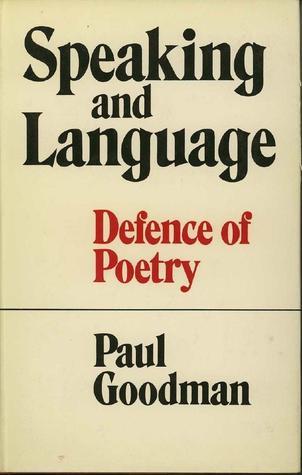
More a critique of linguistics than a defense of poetry, Goodman's book is smart, a little too self-referential for its own good (Goodman's favorite thinker may be Paul Goodman), and open to a lot of critiques itself. Still, there are some gems about poetry among these sentences, though I want more.
I can’t remember how this book arrived on my to-read list, but I went through the trouble of tracking down a used copy, so it must have been a convincing recommendation.
The “Defense of Poetry” subtitle is largely a tease — a reference to other works with similar titles that Goodman was apparently thinking about when he wrote this. Most of the book is about linguistics and speech, and it’s not uninteresting, but I still struggled to get immersed in the ideas presented. Eventually he proceeds to looking at language in literature (not just poetry), and I found a little more to latch on to there, but only in disparate pieces. Strangely Goodman himself explained exactly my experience in reading his book when he speaks of Hemingway’s grammatically passive style and declares, “A disadvantage is that it can rapidly become boring, as Hemingway often is, because it is hard to make the bits add up and increasingly there is resistance to taking the bits in.” Link to this review on my booklog