Jump to ratings and reviews
Rate this book

Switch: The Complete Catullus

Rate this book
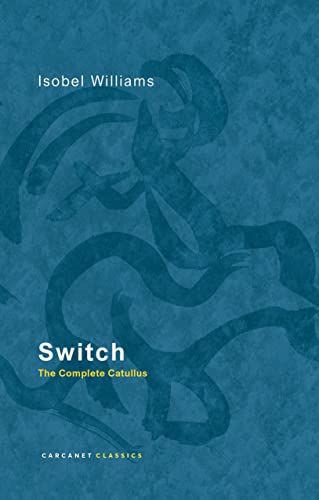
During the latter phases of Covid, Isobel Williams completed her celebrated translations of the polyamorous ancient Roman poet Catullus. The poems that proved impossible when she prepared Shibari Carmina, published to acclaim in 2021, finally surrendered to her. 'Translating Catullus has been, for me, like cage fighting with two opponents, not just A Top Poet, but the schoolgirl I was, trained to show the examiner that she knew what each word meant.' The conflict was resolved by a third component, the context of shibari, a Japanese form of rope bondage with its own knotty terminology. Due to its severe restraints Catullus came alive in all his 'tormented intelligence and romantic versatility'. Critics called the work 'explosive and impactful', 'one of the most exciting translation volumes of recent years', 'lyrical, funny, engaging, and insightful', 'a bracingly foul, but also a shrewd and funny Catullus' – 'Isobel Williams' naughty translation puts the Roman poet in a bondage dungeon.' He will never be quite the same again. Like its incomplete predecessor it is illustrated with bondage drawings by the translator herself.

220 pages, Paperback

Published October 26, 2023

8 people are currently reading
55 people want to read

About the author

Isobel P. Williams is a retired medical consultant physician who has gone on to become an author, speaker and lecturer on polar matters. Her work includes biographies of Edward Wilson and Edgar Evans.

Ratings & Reviews

What do you think?
Rate this book

Friends & Following

Create a free account to discover what your friends think of this book!

Community Reviews

5 stars
2 (28%)
4 stars
3 (42%)
3 stars
1 (14%)
2 stars
1 (14%)
1 star
0 (0%)
Displaying 1 - 3 of 3 reviews
96 reviews
Read
January 10, 2025
One thing I liked about this book is how the corrupt form in which Catullus's poems come to us is neither disguised, as with the Oxford World Classics' version, or disregarded, as it seems sometimes in Anne Carson's Sappho. Instead, Williams finds resourceful ways to dramatise, theatricalise, and even eroticise, the act of translation: it seems to happen there, on the page, right in front of us. She is a different type of artist to Carson, whose Carmina in 'Men in the Off Hours' are hard to beat as modern versions of Catullus, but she captures in her own way this sense that his thing was newness. The next moment always arrives that little bit sooner than expected. Williams puts this in terms of the shifting power dynamics in bondage. This makes the book feel experimental in a good way. That Williams was determined to 'do' every poem by Catullus helps the collection, because it presents the book's conceit as an exercise rather than a key, a question repeatedly posed rather than an answer. Some work better than others, but none fail so miserably as to upset a sense that we are witnessing, over the course of the book, one large effort to rig this antique author by shibari, and make his words and work submit. Instead they stay on squirming.
Profile Image for rachel selene.
393 reviews5 followers
dnf
July 7, 2024
deeply pains me to dnf this but alas. this was my first time reading catullus in translation (beyond my own translations at least) and i can definitely appreciate the attempt that was made here but the result just isn’t for me! surprisingly i think i prefer the more traditionally faithful translation style
Profile Image for Judiejodia.
47 reviews4 followers
October 17, 2023
the same take-away as shibari carmina: worth the read for the poems that are splendid, but not every poem is a banger. still, the entire collection is a tour de force. catullus' spitfire sparkles.
Displaying 1 - 3 of 3 reviews

Can't find what you're looking for?

Get help and learn more about the design.