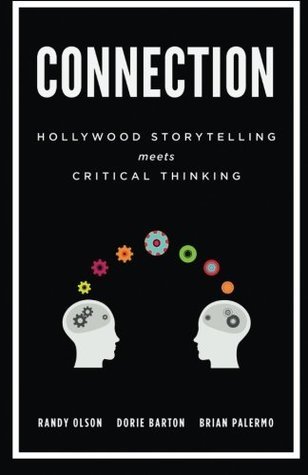
The power and importance of storytelling is now widely accepted, but this book goes further to focus on storymaking. CONNECTION brings together a former scientist, a story consultant, and an improv actor to give you the critical thinking of science combined with a century of Hollywood knowledge in the creation and shaping of stories. The material is relevant to lawyers, politicians, public health workers, educators, activists-- everyone. In today's "Twitterfied" world, CONNECTION provides the narrative tools for effective communication.
I picked up this book intending to understand how to communicate science better to the wider public and as a complete beginner in storytelling/science communication, I must say this book is amazing. It's written in a friendly and casual tone, flows nicely, reads easily, and explains the core concepts well.
The book is divided into three distinct parts. The first part provides a great introduction to what a story is and its structure. The second part builds upon the first part with more complexity, and most importantly for any new beginners like me, both the first and second parts contain actionable and structured advice. The third and last part of the book on improv and appealing to emotions is the weakest, not for its lack of message or importance, but mostly for its lack of structure and actionable advice (which is in the book, but for some reason gets hidden away in the appendix). It also namedrops way too many celebrities to prove the point. Despite those shortcomings, the third part was still okay, just less polished than the first two.
This book greatly improved my understanding of how to communicate scientific findings in a more interesting and relatable way, so I give ''Connection: Hollywood Storytelling meets Critical Thinking'' 5/5 stars.
Este divertido trío (un científico, una actriz y escritora, y un actor y comediante), tras burlar tantas "diferencias culturales" entre los científicos y el resto de sectores de una sociedad, justifican con divertidas historias reales la utilidad - y necesidad - del "Storytelling" en la comunicación científica. Pero no es únicamente compartir esa utilidad, sino el libro ofrece también una especie de "recetario" para estructurar y redactar mejores historias con las que el público se identifique y recuerde.
El "storytelling" ha estado en la historia de la humanidad por milenios, y como herramienta de marketing y comunicación se promociona en todos lados hoy día. Sin embargo, ponerlo en práctica apropiadamente requiere mucha práctica. En "Connection" los autores comparten no sólo ese "recetario" que podemos utilizar para practicar, sino ejemplos específicos de casos de ciencia y legislación, y ciencia y periodismo, y hasta algunos detalles de neurociencias que resaltan el efecto del "storytelling" en nuestros cerebros, la importancia en el uso de emociones, y lo necesario que es que "humanicemos" las historias en lugar de solamente ir recitando listas de "hechos" que nadie recordará jamás.
"Even if you have the most groundbreaking information in the history of humankind, if you don't communicate that information effectively, your work is moot."
Advertencia: para bien o para mal, luego de comprender la estructura básica de una buena historia, ninguna película, serie, o libro volverá a ser lo mismo.
This review is for my own notes, so pardon my less than thorough critique.
I read this book looking for narrative and writing tips. I was about to teach a college first-year writing seminar and felt out of my depth. Although I didn't find exactly what I was looking for, and didn't use the contents in my course, I found the book to be useful in different ways. The formulas presented by the authors are straightforward and easily identifiable in any narrative. Stories all have a beginning, middle, and end; there's a setup, a conflict, and a resolution. The importance of emotion is very much highlighted in the last third of the book, and I think we really need to pay attention to how we are swayed by emotional storytelling in this increasingly divided climate.
I'd recommend this book to anyone who is trying to persuade someone else: whether through writing a personal statement, interviewing for a job, or pushing for action.
Incredibly useful and entertaining. I always had a hunch for what a good story sounds like or when something is just not doing it for me. But to hear it out in words, techniques and tricks to determine the rules and basics of a good story made me not only have to go with my gut - now I can actively tease apart the story and find how to make it even better. Very much recommend this book to anyone: science, writers, politicians, bed-time story tellers.
A good basic guide to story telling while incorporating simple frameworks like WSP and ABT. I found it different enough from books that strictly follow story beats. It was difficult to understand at first how the 3 different authors connect the story selling idea but after several passes I began to understand the key messages of each.
I read this book for a student organization I'm in at school, which is aimed at helping scientific researchers more effectively communicate about their subjects to the public. This book takes what seems to be a very innovative approach to this topic: namely, using Hollywood storytelling formulas to communicate about science. The authors--who run workshops on communication for business people and scientists--are extremely engaging and seem to have a very good grounding in both science and the art of storytelling (they pull heavily from Joseph Campbell and others). They talk about how everyone laughs at the stock stories like the heroes journey, but the reason they get used over and over again is because they work, and they're trying to show scientists how to put them to work to their advantage. They have some extremely useful tips and exercises about connecting (especially via emotions) with your audience, making sure you have a very firm grasp of the easiest-to-communicate, most basic version of your story, and how to make your story relatable (using, basically, those Hollywood formulas). I've become a much keener observer of how people give talks / story structure while reading this book, in ways that I think will be very beneficial to my career. It was also a lot of fun, with lots of interesting personal and scientific anecdotes.
Most of my problems with the book were organizational. The book is split into three major sections (one by each of the different authors) and while this mostly works out well, it occasionally leads to confusing structure, such as one author frequently referring to something but leaving it to the next author's section to actually define it or explain it in detail. And I'm a bit skeptical of some of their more "creative" ideas. There's a loot of emphasis on the last part on how improv training can help you communicate better, but I think outside of the authors' workshops (where they do a lot of this) this might be less actionable, if you will, for readers. Not everyone can pay to take improv classes (or is lucky enough to live in an area where they are offered). If they really want to get people to do improv, I think they could have offered some more resources for how to access it, or some alternatives. I think the group I'm working with is going to try some of the exercises they mention, so maybe my tune will change after that, but for now I am skeptical a) that it's actually that effective and b) of the authors for putting so much emphasis on something that might just not be logisitcally possible for a lot of the scientists reading the book.
Overall, though, this is a great book that I think has the potential to be really helpful. I would recommend it to scientists, but also to people who want to communicate better in other walks of life. It would probably also be fun (if a bit of an overview) for screenwriting buffs.
Over the last few years I've read a lot of books on storytelling, and quite a few on storytelling in film. This is the first one that has really grabbed me, and given me a useful, and practical approach. Let's see - I've read a couple by Syd Field, Robert McKee, The writer's Journey, Save the Cat.... They all had something of interest, and I'm sure they work for lots of people. But this one worked for me.
It's divided in three sections - the first by Randy Olsen - scientist turned writer/director. The second by Dorie Barton - an actress with a real grasp of the principles of story. And Brian Palermo, who writes about Improv.
For me the last section was the weakest - but still useful. I've been interested in Improv since being introduced to Keith Johnstone and his writings on the topic in one of my OU Creative Writing Courses.
But the other two sections were brilliant and really helped to distil the essence of story and how to construct one that works on an intellectual and an emotional level.
Not just for fiction either. I've been reading a lot about Malcolm Gladwell this week, and pondering the power of the press and of politicians in constructing stories that distort and manipulate. This is one book, thankfully, that is keen to show scientists and other people who need to communicate with the public how to construct a good story - and while also emphasising the necessity of sticking to the truth. The facts.
Useful, practical, and also thought provoking. An excellent read.
Divided into three sections: one on conveying technical information effectively, one on how to tell a story, and a third on improv comedy. I see where they were going with the third part, but it's superfluous and can be summed up as "take an improv class."
You can completely skip that part and get full value out of this book. I've used the process outlined at a few conference presentations and have been complemented on both. The topics of discussion had every potential to be mundane or bogged down in technical details, but applying the story telling techniques made them engaging.
Very nice treatment of what makes stories work with simple, fill in the blank algorithms to create effective stories for even the reluctant storyteller (read: most of us in most professions). The first two parts of the book are very effective and built fairly seamlessly on one another. The third part is less effective, but then the author here had the harder job of communicating how to capture emotion and immediacy (easy to do in person, much harder in text).
This is by far the best book I've ever read on writing and presenting ideas. There are many books and YouTube videos that tell you to use a narrative in order to effectively convey ideas, but this is the only one I've read so far that actually explains what narratives are and how to build effective narratives.
Connection is one of the most fantastic storytelling books I ever read. EVERY author should have this book if they seek to connect with their audience.