

What do you think?

Sanatçıların Hayat Hikâyeleri
"Olayların doğal akışı içinde birçok insan çeşitli çarpıcı nitelikler ve yeteneklerle doğar. Ama zaman zaman, doğayı aşan bir biçimde, tek bir kişiye Tanrı öyle harikulade ve öylesine bol miktarda güzellik, zarafet ve yetenek bahşeder ki o kişi öteki insanları çok gerilerde bırakır, bütün hareketleri Tanrı'dan esin almışa benzer, aslında yaptığı her şey, beşerî hünerden ziyade düpedüz Tanrı'dan gelir. Bu söylediklerimin Leonardo da Vinci için geçerli olduğu herkesçe kabul ediliyordu..."
Giorgio Vasari, İtalyan Rönesansı'nın belli başlı sanatçılarının hayat hikâyelerini yayımladığında, sanat tarihi disiplininin temellerini de attı. Vasari'nin kullandığı biyografik yöntem, asırlar boyunca sanat tarihi yazımına öncülük etti ve model oluşturdu. İlk baskısı 16. yüzyılda gerçekleştirilen ve ilk sanat tarihi kitabı olarak nitelendirilen Sanatçıların Hayat Hikâyeleri'nden yapılan bu kapsamlı seçki, Rönesans'ın doğuşunu ve gelişimini dönemin belli başlı sanatçıların hayatları ve yapıtları üzerinden anlatıyor. Cimabue ve Giotto'dan Alberti gibi perspektif teorisyenlerine ve Rönesans sanatının doruğunu temsil eden Raffaello, Leonardo ve Michelangelo gibi büyük ustalara uzanan Vasari, sanatçılarla ilgili ilginç anekdotların yanı sıra yapıtları hakkında da son derece ayrıntılı bilgiler veriyor.
İtalyan Rönesansı'na tanıklık etmiş Floransa, Roma, Venedik gibi kentlere, mimari ve resimsel başyapıtların sırlarına, Medici ailesinin dünyasına, sanatçıların esin kaynaklarına uzanan renkli bir geçmiş yolculuğu...
(Tanıtım Bülteninden)
Giorgio Vasari, İtalyan Rönesansı'nın belli başlı sanatçılarının hayat hikâyelerini yayımladığında, sanat tarihi disiplininin temellerini de attı. Vasari'nin kullandığı biyografik yöntem, asırlar boyunca sanat tarihi yazımına öncülük etti ve model oluşturdu. İlk baskısı 16. yüzyılda gerçekleştirilen ve ilk sanat tarihi kitabı olarak nitelendirilen Sanatçıların Hayat Hikâyeleri'nden yapılan bu kapsamlı seçki, Rönesans'ın doğuşunu ve gelişimini dönemin belli başlı sanatçıların hayatları ve yapıtları üzerinden anlatıyor. Cimabue ve Giotto'dan Alberti gibi perspektif teorisyenlerine ve Rönesans sanatının doruğunu temsil eden Raffaello, Leonardo ve Michelangelo gibi büyük ustalara uzanan Vasari, sanatçılarla ilgili ilginç anekdotların yanı sıra yapıtları hakkında da son derece ayrıntılı bilgiler veriyor.
İtalyan Rönesansı'na tanıklık etmiş Floransa, Roma, Venedik gibi kentlere, mimari ve resimsel başyapıtların sırlarına, Medici ailesinin dünyasına, sanatçıların esin kaynaklarına uzanan renkli bir geçmiş yolculuğu...
(Tanıtım Bülteninden)
390 pages, Paperback
First published January 1, 1568
About the author
Giorgio Vasari
1,049 books159 followersGiorgio Vasari was an Italian painter and architect, known for his famous biographies of Italian artists.
Ratings & Reviews
Friends & Following
Create a free account to discover what your friends think of this book!
Community Reviews
Displaying 1 - 30 of 69 reviews

February 11, 2012
This 2005 Dover edition is an abridged version of a 1967 two volume edition of Giorgio Vasari’s Lives of the Most Excellent Painters, Sculptors, and Architects, often called today Lives of the Artists, or just “Vasari’s Lives”. The translation used is that of Mrs. Jonathan Foster (1851). The artists included are Giotto, Masaccio, Fra Filippo Lippi, Botticelli, Leonardo, Raphael, Michelangelo, and Titian. These eight artists are covered in less than 250 pages. Of the eight lives, that of Michelangelo takes up over 100 pages.
In the review, I'll use the book’s shortest chapter, on Sandro Botticelli, for examples.
Strengths
The book is extremely interesting, in parts. When the work was first published in Florence in 1550, Michelangelo and Titian were still living, and Botticelli, Leonardo, and Raphael had all died only 30-40 years previously. (The earliest of these artists, Giotto, had died in 1337, over two centuries prior to Vasari's work.) To read the views of these artists' lives and works written by someone this close in time to them, someone who was himself immersed in the culture of the Italian Renaissance, can be intoxicating.
There’s no doubt of the historic importance of the book. It was the first history of art ever written, and though it only treated Italian art (and even there tended to favor somewhat chauvinistically Florentine artists), the Introduction to the book makes many favorable points about it. The minute descriptions of hundreds of works of art, though elementary, “laid the groundwork” for many of the elements of art history – “the development of compositional structure and the manipulation of color, the analysis of the meaning of changes in style and subject matter” - which were to be taken up by later historians.
And the prominence of Lives in the title, instead of something like “works”, or “paintings”, points to one of its strengths: not only do we read short biographies of the artists as introductions to each essay, but more biographical data appears repeatedly throughout. This is still a feature of modern popular articles or books on artists. (As distinct from thick academic books on art history, which focus more on the art than the artist, if I can put it that way.)
For example, in the 8 page chapter on Botticelli, we read that Botticelli had been paid a large sum for the paintings he executed in the recently built Sistine Chapel in the early 1480s. Vasari continues
Weaknesses
Here’s one of the paintings, actually a large fresco, that Botticelli did in the Sistine Chapel.
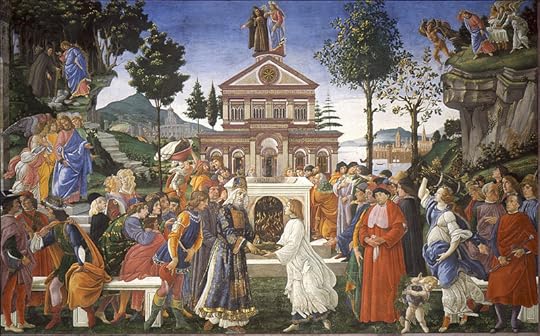
The Temptations of Christ (1480-82)
345×555 cm (136×219 in)
Vasari refers to this work as “The Temptation of Christ in the Wilderness’. Since the fresco obviously shows (on the left, center and right of the upper part) the three Biblical temptations, one might wonder whether Vasari ever saw the fresco, or had forgot what he’d seen when he wrote.
This example illustrates that, in trying to look up a painting described or named by Vasari, it can be confusing to figure out what he’s referring to - unless you’re reading an edition in which the translator has done this work for the reader, or perhaps an editor has added an explanatory note.
Another problem is again related to our modern views of these Renaissance works of art, and is also illustrated in the Botticelli article.
Here are probably the two most famous paintings (now) by Botticelli.
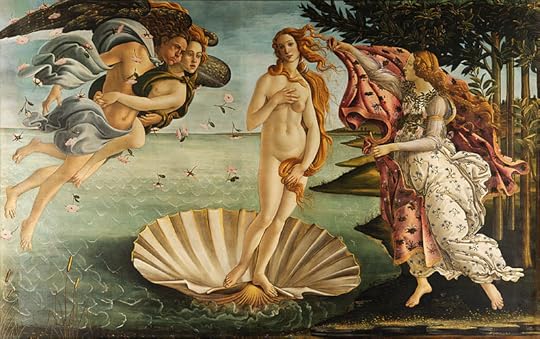
The Birth of Venus (mid 1480s)
172x279 cm (68×110 in)
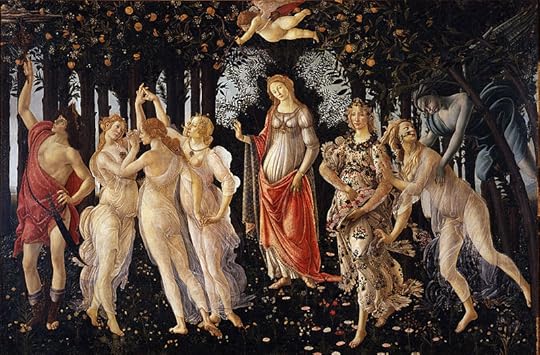
Primavera (~1482)
202×314 cm (80×124 in)
And here’s what Vasari says of them:
In the increasingly secular centuries since Vasari wrote, these paintings have come to overshadow Botticelli’s other works - to such an extent that in the book I have of the history of art (History of Art), the author devotes all four pages on Botticelli to nothing but these paintings. And what he says about them is immensely interesting.
Finally, the last problem I had with this book is that Vasari gives many long (long!) lists of art works described in (excruciating) detail, that I found pretty boring to read, especially since the book (not surprisingly) contained no pictures of the art.
My personal verdict
The first of the above weaknesses is perhaps excusable; the second is certainly hard to blame Vasari for; and the third could be helped quite a bit by a copiously illustrated edition.
It’s likely the case that most every professional art historian has their own copy of Vasari; but it would be used as a reference book, not pleasure reading.
For the modern reader interested in Renaissance art, Vasari’s Lives is probably not the best choice. But still … that gossipy, judgmental, perhaps even inaccurate personal stuff about the artists can be very interesting, and, yes, pleasurable to read.
One just has to be prepared to skip or skim when the going gets tough.
Not a good history of art – but still a worthwhile recounting of the Lives of the artists.
. . . . . . . . . . . . . . . . . . . .
Previous review: Portrait of the Artist as a Young Man
Random review: Samuel Johnson Is Indignant Lydia Davis short fiction
Next review: Science Fiction Hall of Fame, Vol. Two B
Previous library review: Pablo Picasso a retrospective
Next library review: Cathedral The Story of Its Construction
In the review, I'll use the book’s shortest chapter, on Sandro Botticelli, for examples.
Strengths
The book is extremely interesting, in parts. When the work was first published in Florence in 1550, Michelangelo and Titian were still living, and Botticelli, Leonardo, and Raphael had all died only 30-40 years previously. (The earliest of these artists, Giotto, had died in 1337, over two centuries prior to Vasari's work.) To read the views of these artists' lives and works written by someone this close in time to them, someone who was himself immersed in the culture of the Italian Renaissance, can be intoxicating.
There’s no doubt of the historic importance of the book. It was the first history of art ever written, and though it only treated Italian art (and even there tended to favor somewhat chauvinistically Florentine artists), the Introduction to the book makes many favorable points about it. The minute descriptions of hundreds of works of art, though elementary, “laid the groundwork” for many of the elements of art history – “the development of compositional structure and the manipulation of color, the analysis of the meaning of changes in style and subject matter” - which were to be taken up by later historians.
And the prominence of Lives in the title, instead of something like “works”, or “paintings”, points to one of its strengths: not only do we read short biographies of the artists as introductions to each essay, but more biographical data appears repeatedly throughout. This is still a feature of modern popular articles or books on artists. (As distinct from thick academic books on art history, which focus more on the art than the artist, if I can put it that way.)
For example, in the 8 page chapter on Botticelli, we read that Botticelli had been paid a large sum for the paintings he executed in the recently built Sistine Chapel in the early 1480s. Vasari continues
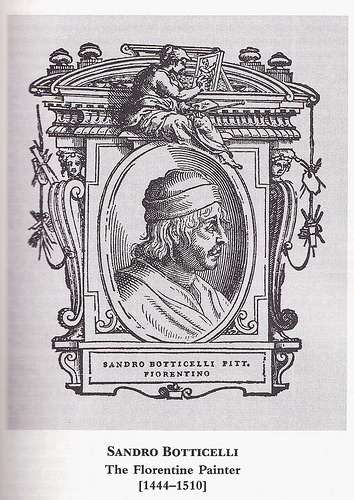
but this [sum] he consumed and squandered totally during his residence in Rome, where he lived without due care, as was his habit. Having completed the work assigned to him, he returned at once to Florence, where, being whimsical and eccentric, he occupied himself with commenting on a certain part of Dante, illustrating the Inferno and executing prints, over which he wasted much time; and neglecting his proper occupation, he did no work, and thereby caused infinite disorder in his affairs.Finally, each chapter is illustrated with a plate (unattributed). For Botticelli, we have this.
Weaknesses
Here’s one of the paintings, actually a large fresco, that Botticelli did in the Sistine Chapel.
The Temptations of Christ (1480-82)
345×555 cm (136×219 in)
Vasari refers to this work as “The Temptation of Christ in the Wilderness’. Since the fresco obviously shows (on the left, center and right of the upper part) the three Biblical temptations, one might wonder whether Vasari ever saw the fresco, or had forgot what he’d seen when he wrote.
This example illustrates that, in trying to look up a painting described or named by Vasari, it can be confusing to figure out what he’s referring to - unless you’re reading an edition in which the translator has done this work for the reader, or perhaps an editor has added an explanatory note.
Another problem is again related to our modern views of these Renaissance works of art, and is also illustrated in the Botticelli article.
Here are probably the two most famous paintings (now) by Botticelli.
The Birth of Venus (mid 1480s)
172x279 cm (68×110 in)
Primavera (~1482)
202×314 cm (80×124 in)
And here’s what Vasari says of them:
For different houses in various parts of [Florence], Sandro painted many pictures of a round form, with numerous figures of women undraped. Of these there are still two examples at Castello, a villa of the Duke Cosimo, one representing the birth of Venus, who is borne to earth by the Loves and Zephyrs: the second also representing the figure of Venus crowned with flowers by the Graces; she is here intended to denote the Spring, and the allegory is expressed by the painter with extraordinary grace.That’s it. But, not only is this description quite unlikely to convey anything useful to a reader about what the paintings actually look like, but the way the first sentence reads, it seems to imply that the pictures are of a “round form”; or at best it’s ambiguous.
In the increasingly secular centuries since Vasari wrote, these paintings have come to overshadow Botticelli’s other works - to such an extent that in the book I have of the history of art (History of Art), the author devotes all four pages on Botticelli to nothing but these paintings. And what he says about them is immensely interesting.
Finally, the last problem I had with this book is that Vasari gives many long (long!) lists of art works described in (excruciating) detail, that I found pretty boring to read, especially since the book (not surprisingly) contained no pictures of the art.
My personal verdict
The first of the above weaknesses is perhaps excusable; the second is certainly hard to blame Vasari for; and the third could be helped quite a bit by a copiously illustrated edition.
It’s likely the case that most every professional art historian has their own copy of Vasari; but it would be used as a reference book, not pleasure reading.
For the modern reader interested in Renaissance art, Vasari’s Lives is probably not the best choice. But still … that gossipy, judgmental, perhaps even inaccurate personal stuff about the artists can be very interesting, and, yes, pleasurable to read.
One just has to be prepared to skip or skim when the going gets tough.
Not a good history of art – but still a worthwhile recounting of the Lives of the artists.
. . . . . . . . . . . . . . . . . . . .
Previous review: Portrait of the Artist as a Young Man
Random review: Samuel Johnson Is Indignant Lydia Davis short fiction
Next review: Science Fiction Hall of Fame, Vol. Two B
Previous library review: Pablo Picasso a retrospective
Next library review: Cathedral The Story of Its Construction

July 3, 2014
Men of genius sometimes accomplish most when they work the least, for they are thinking out inventions and forming in their minds the perfect idea that they subsequently express with their hands.
― Giorgio Vasari, The Lives of the Most Excellent Painters, Sculptors, and Architects
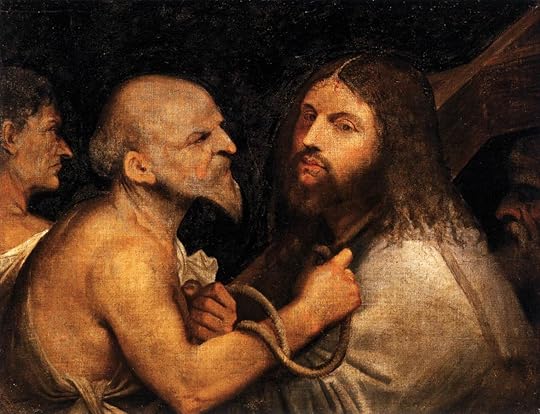
I normally don't gravitate towards abridged books, but Vasari's 'The Lives of the Most Excellent Painters, Sculptors, and Architects' is a book that needs to be: 1) read by art history experts in its entirety (2000+ pages), 2) picked through periodically, like an encyclopedic “Garden of Delights”, 3) read abridged, in a version that focuses on the Renaissance's best (Vasari was interested in distinguishing the better from the good and the best from the better). My time here is limited. I only have so much time for the good. In my brief life here I want to hang with the Gods not with the minor prophets. I want Michelangelo not Niccolò Soggi. Sorry Niccolò.
The Modern Library/Gaston du C. de Vere translation, was a great version. It had all the Teenage Ninja Mutant Renaissance artists, but still provided plenty of architects, sculptures and painters that I was either completely uninformed about or lacked much knowledge. Vasari has a natural narrative momentum, even if he does sometimes lose his narrative genius when he's consumed with listing and describing all of an artists works. It is a fine balancing act, to try and describe the artists' life, work, and importance and make the essay complete, without making the piece a laundry list of oil and marble.
One final note. This is one of those books that seems destined to become an amazing hypertext book or app. There were times while reading it I wished I was reading a digital copy that would provide links to pictures, blue prints, smoothly rotating statues, etc. What I wanted was a through the looking-glass, artist's version of The Elements app by Theodore Gray. I want a multiverse of art, history, maps and blueprints. I want to fall into a hypertext of Renaissance Florence and Rome. Audiobooks or paper just fail to do justice to this beautiful subject.
― Giorgio Vasari, The Lives of the Most Excellent Painters, Sculptors, and Architects
I normally don't gravitate towards abridged books, but Vasari's 'The Lives of the Most Excellent Painters, Sculptors, and Architects' is a book that needs to be: 1) read by art history experts in its entirety (2000+ pages), 2) picked through periodically, like an encyclopedic “Garden of Delights”, 3) read abridged, in a version that focuses on the Renaissance's best (Vasari was interested in distinguishing the better from the good and the best from the better). My time here is limited. I only have so much time for the good. In my brief life here I want to hang with the Gods not with the minor prophets. I want Michelangelo not Niccolò Soggi. Sorry Niccolò.
The Modern Library/Gaston du C. de Vere translation, was a great version. It had all the Teenage Ninja Mutant Renaissance artists, but still provided plenty of architects, sculptures and painters that I was either completely uninformed about or lacked much knowledge. Vasari has a natural narrative momentum, even if he does sometimes lose his narrative genius when he's consumed with listing and describing all of an artists works. It is a fine balancing act, to try and describe the artists' life, work, and importance and make the essay complete, without making the piece a laundry list of oil and marble.
One final note. This is one of those books that seems destined to become an amazing hypertext book or app. There were times while reading it I wished I was reading a digital copy that would provide links to pictures, blue prints, smoothly rotating statues, etc. What I wanted was a through the looking-glass, artist's version of The Elements app by Theodore Gray. I want a multiverse of art, history, maps and blueprints. I want to fall into a hypertext of Renaissance Florence and Rome. Audiobooks or paper just fail to do justice to this beautiful subject.

July 8, 2018
An artist lives and acquires fame through his works; but with the passing of time, which consumes everything, these works—the first, then the second, and the third—fade away.
After Plutarch’s Lives, Vasari’s Lives of the Artists is likely the most iconic collection of biographies of famous men. He published two editions of the book, the first in 1550, the second in 1568; and both found success in Vasari’s lifetime and have continued to sell well ever since. In life Vasari was a typical Renaissance man, achieving fame for his paintings (he decorated the Palazzo Vecchio) and his architecture (he was responsible for the loggia of the Uffizi), in addition to his work as a biographer. Granted, his paintings are not highly regarded nowadays (though many are pleasing enough to my eyes); but this posthumous verdict did not prevent him from making a fine living. And when you write the first book of art history in the history of art, the rest hardly matters.
The edition I own is highly abridged, as are nearly all popular versions, since the original contains dozens upon dozens of painters, sculptors, and architects—most of whom the casual reader does not know of or care for. This explains why most of the Lives are so short. Indeed, fans of any particular Renaissance artist are liable to be disappointed by Vasari’s treatment. He runs through Sandro Botticelli in all of ten pages, for example, barely pausing to mention the Birth of Venus. Indeed, many of these biographies are hardly biographies at all, just extended catalogues of works. This is certainly useful for the art historian (though Vasari made many mistakes) but it does not make for electrifying reading.
The modern psychoanalyzing mode of artistic biographies was, of course, entirely alien to Vasari, and he seems to regard the artist’s personality as a source of gossip but not of insight. This does not prevent him from including many good stories. Like Plutarch himself, Vasari is rich in anecdote—and, as in Plutarch, half of them are probably false. Fact or fiction, however, a good story is preferable to a dry fact. We hear of Cimabue agreeing to take on Giotto as a pupil, after seeing the young boy scratching on a stone; or of Paolo Uccello staying up long nights to work on problems of perspective. Whether these stories help us to understand the paintings is doubtful; but they do help to bring alive this amazing time in history.
Vasari begins the book with a sketch of the history of art as he understood it. His opinion is not a masterpiece of subtlety. In essence, the Greeks and Romans understood that art begins by copying nature, and so produced excellent works; then art fell into barbarism (Vasari coined the term “gothic” to describe medieval art) in which the ancient knowledge was lost and artists had no knowledge of proper technique; finally the painter Giotto came and revived the arts, inaugurating a process that culminated in the works of Michelangelo. I must say that this view, though little more than naked prejudice, is at least refreshing in Vasari’s conviction that art was ascending and culminating in his own epoch. (Most of us are disposed to think it is declining.) It is striking that Michelangelo’s historic importance was understood even during his own lifetime. This was not an age of poor Van Goghs working in lonely shacks. The great artists were recognized and rewarded when they lived; and younger artists were seen to have surpassed their masters—novel concepts in our romantic age.
The Life of Michelangelo, whom Vasari knew and worshipped, is by far the longest and forms the core of this collection. Indeed, all the other lives can be seen as mere leadup to the great Florentine, who fulfils all the promise of former ages. Vasari here turns from chronicler to hagiographer, praising Michelangelo with every breath. You might even say that Vasari turns into quite the Boswell, including various bits of Michelangelo’s conversation, and also several letters written to him by the great artist, as if to prove that Michelangelo really was his friend. All this makes for good reading, even if the worshipful tone is grating. The second longest Life in my collection is that of another Florentine (Vasari was a fierce patriot of his home city), Filippo Brunelleschi. This life is perhaps even better than that of Michelangelo, as Vasari charts the squabbles and drama behind the scenes of Brunelleschi’s dome.
Vasari’s style is easygoing and almost conversational, and the pages go by quickly. He strikes me as a man full of shallow opinions but of a generous mind and a steady judgment. This book—full of errors, lacking any historical context, and greatly out of step with modern opinion—could hardly be read as a standalone volume on Renaissance painting. But every book on the subject borrows, knowingly or unknowingly, from Vasari, who has given bread to scholars and delight to readers for generations with this charming book.
I have endeavored not only to record what the artists have done but to distinguish between the good, the better, and the best, and to note with some care the methods, manners, styles, behavior, and ideas of the painters and sculptors; I have tried as well as I know how to help people who cannot find out for themselves to understand the sources and origins of various styles, and the reasons for the improvement or decline of the arts at various times and among different people.

August 5, 2022
Floransa’ya gidenler şehri gezdiklerinde Vasari adına sık sık göndermede bulunulduğunu farkederler. Giorgio Vasari’nin (1511-1674) “Sanatçıların Hayat Hikayeleri” adlı kitabı tarihteki ilk “sanat tarihi” kitabı olması nedeniyle çok önemlidir. Biyografik bilgilerin yanında, yazarın dönemine ve daha eski dönemlere ait tarihi bilgiler vermesi açısından da dikkat çekicidir. İlk 1950 yılında basılan kitap birkaç baskı ile genişletilerek bugünkü halini almış ve 1958 de basılmıştır. Vasari aslında bir mimar ve ressamdır, ancak yazdıkları ile tarihçi ve yazar sıfatını da haketmiştir. Mimari eserleri arasında Uffuzi Galerisi, kendi ismiyle anılan Floransa’daki Palazzo Vecchio ile Palazzo Pitti’yi eski köprü üzerinden birbirine bağlayan geçit “Vasari Koridoru” önemli yapıtlarıdır. Keza Palazzo Vecchio’nun 500’ler Salonu (Salone dei Ciquecento) ve diğer duvar resimleri de inanılmaz güzeliktedir.
Kitap üç bölümden oluşuyor ve her bölümün başında Vasari’nin önsöz niyetine sanatın tarihsel gelişimine ilişkin gözlem ve genel değerlendirmeleri yeralıyor. İlk bölümde antik Yunan ve yine Yunan dediği Bizans sanatçıları ile Romalı sanatçılardan bahsediyor. İkinci dönem Floransalı ressam Cimabue ve onun öğrencilerinden biri olan Giotto ile başlar. Bu bölümde artık sanatta yeterliliğe ulaşmış olarak gördüğü 12 sanatçı daha yer almaktadır. Bunların arasında Uccello, Ghibertti ve Masaccio ilk bahsedilenlerdir. 26 yaş gibi çok genç bir yaşta ölen Masaccio’ya ayrı bir parantez açmıştır Vasari. Onun çalıştığı ve çok güzel yapıtlarını barındıran Brancacci Şapeli’nin bir okul olduğunu, çok sayıda sanatçının burayı ziyaret ederek sanatlarını geliştirdiklerini vurgulamaktadır. Brunelleschi, Donatello, Fra Angelico, Fra Filippo Lippi, Boticelli ve Mantegna da bu bölümde anlatılan sanatçılar arasındadır. Üçüncü dönem daha modern bir dönemi anlatır ve Leonardo da Vinci ile açılır. Giorgione, Correggio, Raffaello, Michelangelo ve Tiziano ile tamamlanır.
Vasari kitabında yer verdiği sanatçıların eserlerini çok ayrıntılı olarak yazmıştır, öyleki şömine pervazlarından küçük vazolara, mum kutularından, arma yapımlarına kadar yaptıkları tüm yapıtları listelemiştir. Bunların hepsini okumak biraz sıkıyor insanı ama hayranlık duygusu da artıyor birlikte. Ayrıca çok sayıda anektod, duyduğu dedikodular, hikayeler de aktarış tarzıyla Vasari’nin kitabına renk katmaktadır. Bu arada Michelangelo ile olan dostluğu ve mektuplaşmalarını da nerdeyse başka bir kitap olacak kadar ayrıntılandırmıştır. Benim ilgimi çeken bir husus kendisi de çok başarılı bir sanatçı olan Vasari’nin hiçbir kıskançlık duygusu taşımaması, meslektaşlarını yüceltmede hiç cimri davranmaması, tevazu içinde notlarını kaleme alması oldu. Şimdiki sanatçılarla kıyas kabul etmez bir nahiflik olarak değerlendirdim bunu. Elimizdeki kitap Vasari’nin orijinal kitabından seçkiler içermektedir. Esası çok daha hacimli adeta bir İtalyan Rönesansındaki sanat eserlerinin ve yapıların envanterini çıkarmış bir kitap niteliğindedir. Çevirisini Elif Göktepe’nin yaptığı 400 sayfalık bu kısaltılmış kitabın başına Uşun Tükel tarafından çok yararlı bir bir sunuş yazısı da konulmuştur. Kitabın daha faydalı olması açısından editör tarafından kitap sonunda yeralmak üzere, kitapta bahsi geçen yapıtlara ait çok sayıda görsel konulsaydı keşke.
Okuduğum en ilginç “tarihi” bir sanat tarihi kitabı olduğunu söyleyebilirim. Tabii bulmak zor bu kitabı.
Kitap üç bölümden oluşuyor ve her bölümün başında Vasari’nin önsöz niyetine sanatın tarihsel gelişimine ilişkin gözlem ve genel değerlendirmeleri yeralıyor. İlk bölümde antik Yunan ve yine Yunan dediği Bizans sanatçıları ile Romalı sanatçılardan bahsediyor. İkinci dönem Floransalı ressam Cimabue ve onun öğrencilerinden biri olan Giotto ile başlar. Bu bölümde artık sanatta yeterliliğe ulaşmış olarak gördüğü 12 sanatçı daha yer almaktadır. Bunların arasında Uccello, Ghibertti ve Masaccio ilk bahsedilenlerdir. 26 yaş gibi çok genç bir yaşta ölen Masaccio’ya ayrı bir parantez açmıştır Vasari. Onun çalıştığı ve çok güzel yapıtlarını barındıran Brancacci Şapeli’nin bir okul olduğunu, çok sayıda sanatçının burayı ziyaret ederek sanatlarını geliştirdiklerini vurgulamaktadır. Brunelleschi, Donatello, Fra Angelico, Fra Filippo Lippi, Boticelli ve Mantegna da bu bölümde anlatılan sanatçılar arasındadır. Üçüncü dönem daha modern bir dönemi anlatır ve Leonardo da Vinci ile açılır. Giorgione, Correggio, Raffaello, Michelangelo ve Tiziano ile tamamlanır.
Vasari kitabında yer verdiği sanatçıların eserlerini çok ayrıntılı olarak yazmıştır, öyleki şömine pervazlarından küçük vazolara, mum kutularından, arma yapımlarına kadar yaptıkları tüm yapıtları listelemiştir. Bunların hepsini okumak biraz sıkıyor insanı ama hayranlık duygusu da artıyor birlikte. Ayrıca çok sayıda anektod, duyduğu dedikodular, hikayeler de aktarış tarzıyla Vasari’nin kitabına renk katmaktadır. Bu arada Michelangelo ile olan dostluğu ve mektuplaşmalarını da nerdeyse başka bir kitap olacak kadar ayrıntılandırmıştır. Benim ilgimi çeken bir husus kendisi de çok başarılı bir sanatçı olan Vasari’nin hiçbir kıskançlık duygusu taşımaması, meslektaşlarını yüceltmede hiç cimri davranmaması, tevazu içinde notlarını kaleme alması oldu. Şimdiki sanatçılarla kıyas kabul etmez bir nahiflik olarak değerlendirdim bunu. Elimizdeki kitap Vasari’nin orijinal kitabından seçkiler içermektedir. Esası çok daha hacimli adeta bir İtalyan Rönesansındaki sanat eserlerinin ve yapıların envanterini çıkarmış bir kitap niteliğindedir. Çevirisini Elif Göktepe’nin yaptığı 400 sayfalık bu kısaltılmış kitabın başına Uşun Tükel tarafından çok yararlı bir bir sunuş yazısı da konulmuştur. Kitabın daha faydalı olması açısından editör tarafından kitap sonunda yeralmak üzere, kitapta bahsi geçen yapıtlara ait çok sayıda görsel konulsaydı keşke.
Okuduğum en ilginç “tarihi” bir sanat tarihi kitabı olduğunu söyleyebilirim. Tabii bulmak zor bu kitabı.

October 1, 2021
Vasari is right to gush
I dip into Vasari now and then for various reasons. So I’ve read the lives of the artists over the years in pieces, never from start to end. I think I found my copy back in 1983 when I was studying the Renaissance by correspondence for high school. My new little outer suburban school was small and didn’t offer many subjects and lacked an academic drive. It was a big mistake to take it because I needed to hear things like Vasari’s words uttered by someone in person who loved art as much as Vasari. I dropped out, though I’ll say in my defence that distance learning has improved since then. Though I still love the historical period and reflect on it regardless of my non-academic achievement.
I just read the quoted passage below and thought what a significant moment it expresses, both in the work of Michelangelo’s Pieta that it describes and the ideas of the time it expresses. I realised that this was one of those moments in history when the observation of the human replaced the devotion to the divine in our thinking. Human endeavour in art had come so far, the technical and imaginary capability of the artist stands supreme. But Vasari says it better, even though he’s quite an articulate gusher.
https://images.gr-assets.com/photos/1...
”For the Pieta was a revelation of all the potentialities and force of the art of the sculptor. Among the many beautiful features (including the inspired draperies) this is notably demonstrated by the body of Christ himself. It would be impossible to find a body showing greater mastery of art and possessing more beautiful members, or a nude with more detail in the muscles, veins, and nerves stretched over their framework of bones, or a more deathly corpse. The lovely expression of the head, the harmony in the joints and attachment of the arms, legs and trunk and the fine tracery of pulses and veins are all so wonderful that it staggers belief that the hand of an artist could have executed this inspired and admirable work so perfectly and in so short a time. It is certainly a miracle that a formless block of stone could ever have been reduced to a perfection that nature is scarcely able to create in the flesh. Michelangelo put into his work so much love and effort that (something he never did again) he left his name written across the sash over Our Lady’s breast.”
So I thought I’d share this wonderful excerpt. I copied it all out so I could feel the words as I wrote them.
Note how Vasari so clearly values the mastery of a man over nature in this work a perfection that nature is scarcely able to create in the flesh
The focus is solely on the human, even to the point that he believes it’s fitting for the artist to sign over the breast of the mother of Christ. The artist choses to level himself with the divine. Or brings the mother back to her human origins. She’s far too beautiful here to be just a god, since beauty is something that seems to pre-occupy we mortals. After all she is mourning her son and a member of the holy trinity. As mother of Christ, as I understand it, Mary was venerated since 431 at the council of Ephesus. The church has a whole culture of veneration that seems to place her among the divine. So, her appearance in the Pieta places her between the human and divine (perhaps I should’ve continued my study).
https://images.gr-assets.com/photos/1...
Vasari’s publishing of these pages is in itself a significant statement of historical change. Art is now seen in a new way; old paradigms were broken through.
One day I will work out how to add a picture to the text.
I dip into Vasari now and then for various reasons. So I’ve read the lives of the artists over the years in pieces, never from start to end. I think I found my copy back in 1983 when I was studying the Renaissance by correspondence for high school. My new little outer suburban school was small and didn’t offer many subjects and lacked an academic drive. It was a big mistake to take it because I needed to hear things like Vasari’s words uttered by someone in person who loved art as much as Vasari. I dropped out, though I’ll say in my defence that distance learning has improved since then. Though I still love the historical period and reflect on it regardless of my non-academic achievement.
I just read the quoted passage below and thought what a significant moment it expresses, both in the work of Michelangelo’s Pieta that it describes and the ideas of the time it expresses. I realised that this was one of those moments in history when the observation of the human replaced the devotion to the divine in our thinking. Human endeavour in art had come so far, the technical and imaginary capability of the artist stands supreme. But Vasari says it better, even though he’s quite an articulate gusher.
https://images.gr-assets.com/photos/1...
”For the Pieta was a revelation of all the potentialities and force of the art of the sculptor. Among the many beautiful features (including the inspired draperies) this is notably demonstrated by the body of Christ himself. It would be impossible to find a body showing greater mastery of art and possessing more beautiful members, or a nude with more detail in the muscles, veins, and nerves stretched over their framework of bones, or a more deathly corpse. The lovely expression of the head, the harmony in the joints and attachment of the arms, legs and trunk and the fine tracery of pulses and veins are all so wonderful that it staggers belief that the hand of an artist could have executed this inspired and admirable work so perfectly and in so short a time. It is certainly a miracle that a formless block of stone could ever have been reduced to a perfection that nature is scarcely able to create in the flesh. Michelangelo put into his work so much love and effort that (something he never did again) he left his name written across the sash over Our Lady’s breast.”
So I thought I’d share this wonderful excerpt. I copied it all out so I could feel the words as I wrote them.
Note how Vasari so clearly values the mastery of a man over nature in this work a perfection that nature is scarcely able to create in the flesh
The focus is solely on the human, even to the point that he believes it’s fitting for the artist to sign over the breast of the mother of Christ. The artist choses to level himself with the divine. Or brings the mother back to her human origins. She’s far too beautiful here to be just a god, since beauty is something that seems to pre-occupy we mortals. After all she is mourning her son and a member of the holy trinity. As mother of Christ, as I understand it, Mary was venerated since 431 at the council of Ephesus. The church has a whole culture of veneration that seems to place her among the divine. So, her appearance in the Pieta places her between the human and divine (perhaps I should’ve continued my study).
https://images.gr-assets.com/photos/1...
Vasari’s publishing of these pages is in itself a significant statement of historical change. Art is now seen in a new way; old paradigms were broken through.
One day I will work out how to add a picture to the text.

December 11, 2011
I took a Master's level Art History class on Giorgia Vasari at FSU a few years ago and this was the translation of the book that the professor wanted us to buy for the class. And for good reason. It's probably the most complete and accurate translation of Vasari's works out there and is downright affordable in this edition (yes $44 is affordable for this. It's a nice two volume edition with a slipcover to store the books in and the books themselves have a nice sturdy binding. If you have to buy a translation of Vasari's works or just want to explore what the first art historian wrote, you can't go wrong with this edition.

February 19, 2021
This is a great book covering a selection of the Italian Renaissance artists from Vasari's Lives of the Artists. It is thoughtfully illustrated for its time and has some lovely additions such as portraits of each artist and a chapter on patrons. I recommend this edition over the usual paperback despite it being only a selection. It makes reading Vasari all the more meaningful because there are visual references. The short extra essays bring essential context.

February 24, 2012
My undergraduate degree is in Art History so I've read my fair share of Art History books. It was interesting to me the way he presented artists which was very different than any Art History book I've ever read. Most Modern Art Historians tell you why the artist is important and what he or she did for art but I've never heard it said that this artist's work was so beautiful that you wonder if he is human or if his hand was touched by God -- That's how Vasari presents the artists. He puts a lot of his own opinion in the biography of these artists and their works. I really enjoyed reading his opinion because by the third artist I realized that sometimes Vasari's opinion of what was great art was completely different than my own opinions. It made me think that maybe it's because so much has happened in art through the centuries that time and modernism may have changed the way we look at art. It was very interesting. I even read all of the biography of Michalangelo even though he wasn't my favorite artist to begin with, Vasari loved him so much that I think I like Michaelangelo better now. I also re-discovered some artists such as Antonio da Corregio and Andrea Mantegna, who I forgot about, though I do not know why.

August 15, 2026
Uzun ama oldukça keyifli bir okumaydı. Bazı sanatçıları hiç tanımadığım için yer yer ağır ilerlese de, Rönesans’ın sanatçılarını o dönemde yaşamış ve birçoğunu bizzat tanımış Vasari’nin gözünden okumak kitabı benim için çok özel kıldı. Sanatçıların yalnızca eserlerini değil, kişiliklerini, birbirleriyle ilişkilerini ve dönemin sanat ortamını da görmek çok güzeldi. Özellikle Michelangelo’ya ayrılan oldukça uzun ve ayrıntılı bölüm en çok ilgimi çeken kısımlardan biri oldu. Vasari’nin her zaman tamamen tarafsız bir kaynak olmadığını akılda tutmak gerekiyor; ama yaklaşık beş yüz yıl önce yaşamış birinin kendi çağının sanatçılarını nasıl gördüğünü doğrudan okumak başlı başına çok değerli bir deneyimdi. Kitap o dönem çıktığında Michelangelo’nun bu eseri görmesi de ayrıca güzel bir durum.

February 18, 2018
Overall, I quite enjoyed the varied lives depicted by Vasari. However, the more impactful point that I took from this book is Vasari's theories on the development of art. His prefaces are slightly long winded but they are the parts in which he sets forth his idea of the decline of art and it's eventual rebirth from Cimabue to Titian.
My only issues with the book are centred around the translators. I normally don't have an issue with an older style of English but I honestly found this translation irksome and incredibly long winded at points. Phrases could have easily been updated by the editor. There is no translators note so I'm not aware of whether or not this is a special or famous translation. It's such a shame because I was loving the narratives.
Besides this the editor provided good footnotes but bizzarely did not include any for Vasari's descriptions of the Academy of Florence. He obviously put a lot of effort into the 200+ pages for the other parts of the book and I sorely missed it in this part.
My only issues with the book are centred around the translators. I normally don't have an issue with an older style of English but I honestly found this translation irksome and incredibly long winded at points. Phrases could have easily been updated by the editor. There is no translators note so I'm not aware of whether or not this is a special or famous translation. It's such a shame because I was loving the narratives.
Besides this the editor provided good footnotes but bizzarely did not include any for Vasari's descriptions of the Academy of Florence. He obviously put a lot of effort into the 200+ pages for the other parts of the book and I sorely missed it in this part.

February 1, 2020
Nikada u životu mi nije bilo teže da pročitam neku knjigu od ove. Gore je čak i od udžbenika iz marksizma (da, ja sam iz te generacije), a statistika je u odnosu na ovo zabavno štivo. Stil pisanja je ... nepostojeći... Svaki umetnik je opisan istim rečima, svi su pokazali neverovatan talenat od malena i nadmašili svoje učitelje. Isti prostor je dat i onima koji su poživeli dvadesetak godina i onima koji su dostigli duboku starost, bez obzira da li je od njihovog rada sačuvano svega nekoliko dela ili stotine. Nešto više prostora je dato Mikelanđelu, a i to zato što je Vazari bio njegov učenik.
Ono malo što sam znala o ovim umetnicima, sada je zamagljeno jednoličnim opisima, prostim nabrajanjem i izjavama da je nešto urađeno "izvanredno lepim načinom", što se ponavlja, i ponavlja, i ponavlja...
Nije mi jasno zašto se ova knjiga navodi kao neizostavno štivo za ljubitelje umetnosti, meni je bila neopisivo dosadna.
Ono malo što sam znala o ovim umetnicima, sada je zamagljeno jednoličnim opisima, prostim nabrajanjem i izjavama da je nešto urađeno "izvanredno lepim načinom", što se ponavlja, i ponavlja, i ponavlja...
Nije mi jasno zašto se ova knjiga navodi kao neizostavno štivo za ljubitelje umetnosti, meni je bila neopisivo dosadna.


April 22, 2026
The Lives of the Most Excellent Painters, Sculptors, and Architects by Giorgio Vasari brings Renaissance artists to life with vivid anecdotes, sharp opinions, and an obvious admiration for their genius, making the book both historically significant and genuinely engaging. It offers a rich window into the period (its personalities, rivalries, and evolving artistic ideals) grounded in firsthand accounts and early art commentary.
That said, it can lean heavily into encyclopaedic detail, particularly when describing specific works or technical elements. At times, the sheer volume of information slows the reading experience, especially if you’re not deeply invested in every artist or piece mentioned. Still, the depth is part of its value—this is a text that rewards patience and curiosity, offering layers of insight for those willing to sit with it.
Proof that even masterpieces come with footnotes—and sometimes, a lot of them.
That said, it can lean heavily into encyclopaedic detail, particularly when describing specific works or technical elements. At times, the sheer volume of information slows the reading experience, especially if you’re not deeply invested in every artist or piece mentioned. Still, the depth is part of its value—this is a text that rewards patience and curiosity, offering layers of insight for those willing to sit with it.
Proof that even masterpieces come with footnotes—and sometimes, a lot of them.
Did Not Finish
October 6, 2024Skimmed through the book, probably a very good one for the times it was written, but now it is a bit shallow in my opinion for today’s times. Plus, it is not illustrated, which is odd for a book taking about art.

Read
March 30, 2026Bereft of intrigue.

August 4, 2025
Written in the 16th century, Vasari’s work vividly captures the progression of art through one of the most innovative and creative periods in history
notes:
- the Renaissance was a time of bold experimentation and innovation, driven by individuals who challenged conventions to create timeless masterpieces
- The transformation of European art began with Cimabue, a Florentine painter who challenged the rigid conventions of Byzantine traditions. At a time when art relied on flat, symbolic imagery, Cimabue introduced shading, form, and a sense of movement, giving his figures a lifelike quality that was revolutionary for the era. His work marked a turning point in art history, laying the groundwork for the Renaissance’s focus on naturalism and human emotion.
- Giotto’s success was a direct result of Cimabue’s willingness to experiment and challenge artistic conventions, inspiring a ripple effect that would transform European art.
- Giotto, a student of Cimabue, transformed painting by moving beyond the stiff, symbolic forms of earlier art. His work brought humanity and emotional depth to religious scenes, making them relatable and compelling.
- One of Giotto’s most celebrated achievements is his fresco cycle in the Arena Chapel in Padua. These frescoes vividly depict scenes from the lives of Christ and the Virgin Mary, focusing on human drama and interaction.
- In his depiction of architectural settings, such as the temple in The Presentation of the Virgin, Giotto used overlapping forms and foreshortening to suggest depth and dimension.
on architecture:
- Arnolfo di Cambio was a visionary architect whose work marked a turning point in the evolution of Renaissance architecture. Moving away from the fortress-like structures of the medieval period, he introduced designs that emphasized harmony, proportion, and grandeur. His creations not only showcased technical brilliance but also reflected the cultural aspirations of his time, elevating architecture as a symbol of civic pride and spiritual devotion.
- One of Arnolfo’s most significant contributions was his work on the Florence Cathedral, or Santa Maria del Fiore. He envisioned a structure that would dominate the city’s skyline while embodying ideals of beauty and functionality. The cathedral’s design combined Gothic elements, such as pointed arches and ribbed vaults, with a sense of openness and light that was uncommon in medieval architecture
- Arnolfo’s work not only shaped the physical landscape of Florence but also inspired future architects to push the boundaries of design. His ability to merge structural ingenuity with artistic vision laid the groundwork for a new era in architecture. By reimagining the role of buildings in public and spiritual life, Arnolfo established architecture as a central pillar of Renaissance culture.
- Through his innovative designs, Arnolfo di Cambio bridged the gap between the medieval and Renaissance worlds, demonstrating how architecture could embody both technical mastery and cultural ambition.
artistic expression:
- One of Donatello’s most iconic works is his bronze statue of David. Unlike the rigid, heroic depictions of biblical figures common in medieval art, Donatello’s David is a youthful, contemplative figure, standing in a relaxed contrapposto pose. The sculpture’s subtle details, such as the soft musculature and thoughtful expression, convey both vulnerability and triumph. This blend of naturalism and symbolism was revolutionary, as it celebrated the human aspect of the biblical hero while embodying Florence’s civic identity.
- Another hallmark of Donatello’s work was his ability to convey raw emotion. His wooden sculpture of Mary Magdalene departs from traditional depictions of saintly beauty, portraying the Magdalene as gaunt and weathered, reflecting her life of penance and spiritual devotion.
on perspective:
- Filippo Brunelleschi was a revolutionary figure whose innovations bridged the gap between science and art. His most transformative contribution was the invention of linear perspective, a groundbreaking technique that allowed artists to depict three-dimensional space on a flat surface with mathematical accuracy. This innovation not only changed the way art was created but also influenced architecture, making perspective a cornerstone of Renaissance aesthetics.
- Brunelleschi’s experiments with perspective began with his studies of ancient Roman architecture and his observations of how space could be represented accurately. He famously demonstrated linear perspective with a painting of the Florence Baptistery, using a vanishing point and orthogonal lines to show how objects appear smaller as they recede into the distance. This method gave artists a powerful tool to create realistic and immersive compositions, fundamentally altering the visual language of art.
- Brunelleschi’s design for the dome of Florence Cathedral, Santa Maria del Fiore, is a testament to his mastery of both engineering and artistic vision. The dome, constructed without traditional wooden scaffolding, used a double-shell structure and ingenious support techniques to achieve its monumental scale. Brunelleschi’s understanding of geometry and perspective ensured the dome’s structural integrity while creating a harmonious and visually striking addition to the city’s skyline.
on polymaths:
- Leonardo da Vinci is often regarded as the quintessential Renaissance figure, seamlessly merging art and science to create works of unparalleled depth and innovation. His relentless curiosity and interdisciplinary approach allowed him to explore anatomy, engineering, and natural sciences, all of which informed and elevated his art. This fusion of creativity and intellect set Leonardo apart as a true polymath and a defining figure of his time.
- One of Leonardo’s most iconic works, the Mona Lisa, exemplifies his ability to unite art and science. The painting’s lifelike quality stems from Leonardo’s meticulous study of human anatomy and his innovative use of sfumato, a technique that creates soft transitions between light and shadow. This approach gave the Mona Lisa her enigmatic expression and a sense of depth that was revolutionary for its time.
- His anatomical studies, based on dissections of human and animal bodies, resulted in detailed sketches that revealed the inner workings of muscles, bones, and organs. These drawings were not only scientifically accurate but also artistically rendered, showcasing Leonardo’s ability to combine precision with aesthetic beauty. This dual focus on art and science deepened his understanding of the human form, enriching his artistic creations.
- His sketches of flying machines, hydraulic systems, and war devices demonstrate his visionary thinking and his belief in the interconnectedness of all knowledge. This interdisciplinary approach was revolutionary, breaking down barriers between fields and showing how art and science could complement and enhance one another.
on mastery:
- Michelangelo Buonarroti is celebrated as one of the greatest artists of the Renaissance, renowned for his ability to convey human emotion, physicality, and spirituality with unparalleled skill. His works in sculpture, painting, and architecture redefined artistic perfection, leaving a legacy that continues to inspire.
- One of Michelangelo’s most iconic works is the statue of David. Carved from a single block of marble, the sculpture captures the tension and vitality of the human body in exquisite detail. David’s poised stance, defined musculature, and intense gaze demonstrate Michelangelo’s deep understanding of anatomy and his ability to imbue his figures with life and purpose. This masterpiece became a symbol of Florence’s civic pride and resilience, embodying the ideals of strength, beauty, and human potential.
- Michelangelo’s work on the Sistine Chapel ceiling further showcased his genius, particularly his ability to merge narrative with stunning visual impact. The frescoes, which depict scenes from the Book of Genesis, are a monumental achievement in composition and execution. Figures like Adam in The Creation of Adam are rendered with dynamic energy, conveying both physical strength and spiritual significance.
- His architectural designs embodied the Renaissance ideals of proportion, symmetry, and beauty, elevating architecture to new heights.
- Michelangelo’s relentless pursuit of perfection and his ability to evoke profound emotion through his art redefined what was possible in the creative world.
on competition:
- One of the most notable rivalries was between Filippo Brunelleschi and Lorenzo Ghiberti, who competed for the commission to design the bronze doors of the Florence Baptistery. Ghiberti ultimately won, but this rivalry spurred Brunelleschi to focus on his architectural pursuits, leading to his revolutionary work on the dome of Florence Cathedral. This competition exemplified the Renaissance spirit, where the drive to outdo one another resulted in some of the most iconic works of the period.
- the construction of Florence Cathedral brought together architects, engineers, and craftsmen, each contributing their expertise to realise Brunelleschi’s ambitious vision
- Michelangelo’s dramatic and muscular figures in the Sistine Chapel contrasted with Raphael’s harmonious and balanced frescoes in the Vatican. While their approaches differed, each artist drew inspiration from the other’s work, pushing their craft to greater heights
- During the Renaissance, a lively debate emerged over whether painting or sculpture was the superior art form. This discussion extended beyond technical comparisons, delving into profound questions about art’s purpose—should it prioritise realism, emotional expression, or durability? Both mediums had passionate defenders, and their arguments reflected the evolving role of art in society.
- Sculptors championed their medium for its permanence and realism. Painters, on the other hand, emphasised their medium’s versatility and emotional depth.
- Ultimately, this debate underscored the Renaissance’s broader fascination with the nature of artistic creation
notes:
- the Renaissance was a time of bold experimentation and innovation, driven by individuals who challenged conventions to create timeless masterpieces
- The transformation of European art began with Cimabue, a Florentine painter who challenged the rigid conventions of Byzantine traditions. At a time when art relied on flat, symbolic imagery, Cimabue introduced shading, form, and a sense of movement, giving his figures a lifelike quality that was revolutionary for the era. His work marked a turning point in art history, laying the groundwork for the Renaissance’s focus on naturalism and human emotion.
- Giotto’s success was a direct result of Cimabue’s willingness to experiment and challenge artistic conventions, inspiring a ripple effect that would transform European art.
- Giotto, a student of Cimabue, transformed painting by moving beyond the stiff, symbolic forms of earlier art. His work brought humanity and emotional depth to religious scenes, making them relatable and compelling.
- One of Giotto’s most celebrated achievements is his fresco cycle in the Arena Chapel in Padua. These frescoes vividly depict scenes from the lives of Christ and the Virgin Mary, focusing on human drama and interaction.
- In his depiction of architectural settings, such as the temple in The Presentation of the Virgin, Giotto used overlapping forms and foreshortening to suggest depth and dimension.
on architecture:
- Arnolfo di Cambio was a visionary architect whose work marked a turning point in the evolution of Renaissance architecture. Moving away from the fortress-like structures of the medieval period, he introduced designs that emphasized harmony, proportion, and grandeur. His creations not only showcased technical brilliance but also reflected the cultural aspirations of his time, elevating architecture as a symbol of civic pride and spiritual devotion.
- One of Arnolfo’s most significant contributions was his work on the Florence Cathedral, or Santa Maria del Fiore. He envisioned a structure that would dominate the city’s skyline while embodying ideals of beauty and functionality. The cathedral’s design combined Gothic elements, such as pointed arches and ribbed vaults, with a sense of openness and light that was uncommon in medieval architecture
- Arnolfo’s work not only shaped the physical landscape of Florence but also inspired future architects to push the boundaries of design. His ability to merge structural ingenuity with artistic vision laid the groundwork for a new era in architecture. By reimagining the role of buildings in public and spiritual life, Arnolfo established architecture as a central pillar of Renaissance culture.
- Through his innovative designs, Arnolfo di Cambio bridged the gap between the medieval and Renaissance worlds, demonstrating how architecture could embody both technical mastery and cultural ambition.
artistic expression:
- One of Donatello’s most iconic works is his bronze statue of David. Unlike the rigid, heroic depictions of biblical figures common in medieval art, Donatello’s David is a youthful, contemplative figure, standing in a relaxed contrapposto pose. The sculpture’s subtle details, such as the soft musculature and thoughtful expression, convey both vulnerability and triumph. This blend of naturalism and symbolism was revolutionary, as it celebrated the human aspect of the biblical hero while embodying Florence’s civic identity.
- Another hallmark of Donatello’s work was his ability to convey raw emotion. His wooden sculpture of Mary Magdalene departs from traditional depictions of saintly beauty, portraying the Magdalene as gaunt and weathered, reflecting her life of penance and spiritual devotion.
on perspective:
- Filippo Brunelleschi was a revolutionary figure whose innovations bridged the gap between science and art. His most transformative contribution was the invention of linear perspective, a groundbreaking technique that allowed artists to depict three-dimensional space on a flat surface with mathematical accuracy. This innovation not only changed the way art was created but also influenced architecture, making perspective a cornerstone of Renaissance aesthetics.
- Brunelleschi’s experiments with perspective began with his studies of ancient Roman architecture and his observations of how space could be represented accurately. He famously demonstrated linear perspective with a painting of the Florence Baptistery, using a vanishing point and orthogonal lines to show how objects appear smaller as they recede into the distance. This method gave artists a powerful tool to create realistic and immersive compositions, fundamentally altering the visual language of art.
- Brunelleschi’s design for the dome of Florence Cathedral, Santa Maria del Fiore, is a testament to his mastery of both engineering and artistic vision. The dome, constructed without traditional wooden scaffolding, used a double-shell structure and ingenious support techniques to achieve its monumental scale. Brunelleschi’s understanding of geometry and perspective ensured the dome’s structural integrity while creating a harmonious and visually striking addition to the city’s skyline.
on polymaths:
- Leonardo da Vinci is often regarded as the quintessential Renaissance figure, seamlessly merging art and science to create works of unparalleled depth and innovation. His relentless curiosity and interdisciplinary approach allowed him to explore anatomy, engineering, and natural sciences, all of which informed and elevated his art. This fusion of creativity and intellect set Leonardo apart as a true polymath and a defining figure of his time.
- One of Leonardo’s most iconic works, the Mona Lisa, exemplifies his ability to unite art and science. The painting’s lifelike quality stems from Leonardo’s meticulous study of human anatomy and his innovative use of sfumato, a technique that creates soft transitions between light and shadow. This approach gave the Mona Lisa her enigmatic expression and a sense of depth that was revolutionary for its time.
- His anatomical studies, based on dissections of human and animal bodies, resulted in detailed sketches that revealed the inner workings of muscles, bones, and organs. These drawings were not only scientifically accurate but also artistically rendered, showcasing Leonardo’s ability to combine precision with aesthetic beauty. This dual focus on art and science deepened his understanding of the human form, enriching his artistic creations.
- His sketches of flying machines, hydraulic systems, and war devices demonstrate his visionary thinking and his belief in the interconnectedness of all knowledge. This interdisciplinary approach was revolutionary, breaking down barriers between fields and showing how art and science could complement and enhance one another.
on mastery:
- Michelangelo Buonarroti is celebrated as one of the greatest artists of the Renaissance, renowned for his ability to convey human emotion, physicality, and spirituality with unparalleled skill. His works in sculpture, painting, and architecture redefined artistic perfection, leaving a legacy that continues to inspire.
- One of Michelangelo’s most iconic works is the statue of David. Carved from a single block of marble, the sculpture captures the tension and vitality of the human body in exquisite detail. David’s poised stance, defined musculature, and intense gaze demonstrate Michelangelo’s deep understanding of anatomy and his ability to imbue his figures with life and purpose. This masterpiece became a symbol of Florence’s civic pride and resilience, embodying the ideals of strength, beauty, and human potential.
- Michelangelo’s work on the Sistine Chapel ceiling further showcased his genius, particularly his ability to merge narrative with stunning visual impact. The frescoes, which depict scenes from the Book of Genesis, are a monumental achievement in composition and execution. Figures like Adam in The Creation of Adam are rendered with dynamic energy, conveying both physical strength and spiritual significance.
- His architectural designs embodied the Renaissance ideals of proportion, symmetry, and beauty, elevating architecture to new heights.
- Michelangelo’s relentless pursuit of perfection and his ability to evoke profound emotion through his art redefined what was possible in the creative world.
on competition:
- One of the most notable rivalries was between Filippo Brunelleschi and Lorenzo Ghiberti, who competed for the commission to design the bronze doors of the Florence Baptistery. Ghiberti ultimately won, but this rivalry spurred Brunelleschi to focus on his architectural pursuits, leading to his revolutionary work on the dome of Florence Cathedral. This competition exemplified the Renaissance spirit, where the drive to outdo one another resulted in some of the most iconic works of the period.
- the construction of Florence Cathedral brought together architects, engineers, and craftsmen, each contributing their expertise to realise Brunelleschi’s ambitious vision
- Michelangelo’s dramatic and muscular figures in the Sistine Chapel contrasted with Raphael’s harmonious and balanced frescoes in the Vatican. While their approaches differed, each artist drew inspiration from the other’s work, pushing their craft to greater heights
- During the Renaissance, a lively debate emerged over whether painting or sculpture was the superior art form. This discussion extended beyond technical comparisons, delving into profound questions about art’s purpose—should it prioritise realism, emotional expression, or durability? Both mediums had passionate defenders, and their arguments reflected the evolving role of art in society.
- Sculptors championed their medium for its permanence and realism. Painters, on the other hand, emphasised their medium’s versatility and emotional depth.
- Ultimately, this debate underscored the Renaissance’s broader fascination with the nature of artistic creation

December 4, 2021
Bu kitap resmen yillardir elimde sürünüyordu artik azmettim bitirdim. İcindeki sanatcilara saygimdan bir vermedim ancak bu nasıl sıkıcı bir dildir... Ronesans doneminde yasamis Giorgio Vasari tarafindan o donemde yasamis (bizzat arkadaslari) yaklasik 20 ressam ve heykeltırasin yasam oykuleri ve eserleri anlatiliyor. Sorun su ki eserlerinin fotograflari eklenmedigi icin sayfalarca anlattigi eserleri ve detaylarini gozunde canlandirmak zor. İnternetten baksan o anlattigi donemde henuz eserlere isimler de verilmediginden bulmak zor. Ara ara ilginc hikayelere rast geldim ancak genel olarak cok zorlandim okurken. Sanat tarihi uzerine calisan veya arastirma yapan kisiler icin essiz bir kaynak olabilir ama normal okuyucu kitlesine hitap eden bir yapit oldugunu düşünmüyorum. Fotograflarla zengilestirilse bence çok daha guzel olurdu.

January 1, 2021
2020 yılında okuduğum son kitap ve severek okudum. Okuması zor bir kitap; fakat bilmediğim çok şey öğrendim. Çok sayıda sanatçının hayat hikayeleri, daha doğrusu ürettiği eserleri ve diğer sanatçılar ile arasındaki bağı okuyorsunuz. Celil Sadık'ın "Uygarlığın Ayak İzleri" isimli ilk çıkan kitabındaki dip notlarında tavsiye edilen kitaptı. Okumaktan ve Sanat Tarihine ait yeni şeyler öğrenmekten memnuniyet duyduğum bir kitap oldu.

October 26, 2015
A great book to delve into whether you have a love of Italian Renaissance Art or not.An exceptional read.
July 25, 2023
Una densa enciclopedia d'arte, ma eccessivamente toscanocentrica
Un'opera mastodontica che offre un'imponente mole di informazioni sui grandi maestri dell'arte. L'autore ha svolto un lavoro encomiabile nell'approfondire la vita e le opere di numerosi artisti, trasmettendo una vasta conoscenza nel campo.
Tuttavia, devo ammettere che la lettura di questo libro risulta impegnativa. La sua natura nozionistica può rendere difficile il proseguimento della lettura per i non esperti o per coloro che cercano una narrazione più fluida e coinvolgente.
Un altro aspetto che mi ha colpito negativamente è la netta inclinazione toscanocentrica dell'autore. La maggiore enfasi sull'arte toscana può risultare un limite, poiché trascura l'importante contributo artistico di altre regioni italiane.
Personalmente, ho apprezzato l'opera, ma ho trovato il suo contenuto così denso da richiedere uno sforzo considerevole per essere digerito. Tuttavia, se siete appassionati d'arte e desiderate esplorare a fondo la vita e le opere di numerosi artisti, potrebbe essere una lettura gratificante.
Un piccolo appunto riguarda la distribuzione dello spazio dedicato agli artisti all'interno del libro. Mi è sembrato che Michelangelo fosse particolarmente sovra-rappresentato rispetto ad altri giganti dell'arte come Leonardo o Raffaello, cosa che potrebbe essere stata bilanciata meglio.
In conclusione, "Le vite dei più eccellenti pittori, scultori e architetti" è un'opera enciclopedica e completa che offre un ampio panorama dell'arte, ma richiede dedizione e pazienza per essere apprezzata appieno.
Un'opera mastodontica che offre un'imponente mole di informazioni sui grandi maestri dell'arte. L'autore ha svolto un lavoro encomiabile nell'approfondire la vita e le opere di numerosi artisti, trasmettendo una vasta conoscenza nel campo.
Tuttavia, devo ammettere che la lettura di questo libro risulta impegnativa. La sua natura nozionistica può rendere difficile il proseguimento della lettura per i non esperti o per coloro che cercano una narrazione più fluida e coinvolgente.
Un altro aspetto che mi ha colpito negativamente è la netta inclinazione toscanocentrica dell'autore. La maggiore enfasi sull'arte toscana può risultare un limite, poiché trascura l'importante contributo artistico di altre regioni italiane.
Personalmente, ho apprezzato l'opera, ma ho trovato il suo contenuto così denso da richiedere uno sforzo considerevole per essere digerito. Tuttavia, se siete appassionati d'arte e desiderate esplorare a fondo la vita e le opere di numerosi artisti, potrebbe essere una lettura gratificante.
Un piccolo appunto riguarda la distribuzione dello spazio dedicato agli artisti all'interno del libro. Mi è sembrato che Michelangelo fosse particolarmente sovra-rappresentato rispetto ad altri giganti dell'arte come Leonardo o Raffaello, cosa che potrebbe essere stata bilanciata meglio.
In conclusione, "Le vite dei più eccellenti pittori, scultori e architetti" è un'opera enciclopedica e completa che offre un ampio panorama dell'arte, ma richiede dedizione e pazienza per essere apprezzata appieno.

August 8, 2026
A very detailed look at artists from the Renaissance period, including a theory of how that art developed. Giotto (he of the perfect O), Donatello, Leonardo da Vinci, Raphael and Michelangelo are just some of the artists covered, The section on Michelangelo could be a separate book, and others are dealt with very comprehensively.
But it is not a biography of the artists, it does cover some of their lives but mainly concentrates on their works. So I found myself glossing over a lot of the descriptions, perhaps if I had searched for the works online I might have appreciated the work more. It took me over a year to finish it, dipping in and out whenever I felt the urge!
But it is not a biography of the artists, it does cover some of their lives but mainly concentrates on their works. So I found myself glossing over a lot of the descriptions, perhaps if I had searched for the works online I might have appreciated the work more. It took me over a year to finish it, dipping in and out whenever I felt the urge!

February 20, 2023
This is the Heritage Club 1967 2 volume edition: 730 pages 32 lives 32 color plates.
Enjoyable and opinionated by the 'father' of art history who was not only an artist himself but also a contemporary of many of those he writes about. What he doesn't talk much about is the politics against which his lives take place. I would highly recommend reading a history or two (or Wikipedia) before undertaking this work.
Enjoyable and opinionated by the 'father' of art history who was not only an artist himself but also a contemporary of many of those he writes about. What he doesn't talk much about is the politics against which his lives take place. I would highly recommend reading a history or two (or Wikipedia) before undertaking this work.

Read
October 18, 2024Such a large and rich book. So many people, overwhelming amount of art. Great to read through once, but it is takes a bit of dedication. You cannot progress too fast, because then you might as well skip it. You have to settle down with each and every artist as they are passing through. Like a city, you need to live in it a while to get to know it, know how it moves, and after reading it once you know about those places that need to be revisited. Wonderful.

May 31, 2023
Bueno, podría haber sido peor, al menos se comprende. Eso sí, Vasari peca de creerse superior por haber vivido la época dorada del Renacimiento y ser contemporáneo de Miguel Ángel. Se cansa de criticar el arte medieval, diciendo que solo Giotto se salga de esa época oscura y analfabeta. La moralidad de Vasari es bastante cuestionable.
2/5. Muy aburrido, pero se entiende.
2/5. Muy aburrido, pero se entiende.
June 18, 2023
That was a slog!
As a good read this is probably two star. It is dry, repetitive and in places hard work.
As a historical source it is vital five star level: Vasari being one of, if not the source of art history.
(Although he can't be relied on for facts. The footnote about an alleged murder springs to mind...)
As a good read this is probably two star. It is dry, repetitive and in places hard work.
As a historical source it is vital five star level: Vasari being one of, if not the source of art history.
(Although he can't be relied on for facts. The footnote about an alleged murder springs to mind...)
January 2, 2023
Imprescindible para un estudiante de Historia del Arte

September 12, 2023
A nice historical work on Italian Renaissance art. It's an abridged version, but covers most of the major painters, sculptors, and architects of the time.

Read
April 14, 2024Painting painting sculpture painting sculpture sculpture painting painting. Inappropriate Turtles joke. Giftshop.
I’m a barbarian.
Next!
I’m a barbarian.
Next!

Read
October 26, 2024"Thank you APAH" we all say in unison
March 31, 2025
Pensei que ia ser mais interessante, sobre outra coisa, mas não decepcionou.
Displaying 1 - 30 of 69 reviews