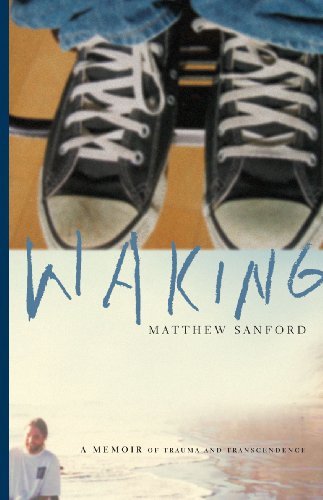
Matthew Sanford's inspirational story about the car accident that left him paralyzed from the chest down is a superbly written memoir of healing and journey—from near death to triumphant life.
Matt Sanford's life and body were irrevocably changed at age 13 on a snowy Iowa road. On that day, his family's car skidded off an overpass, killing Matt's father and sister and left him paralyzed from the chest down, confining him to a wheelchair. His mother and brother escaped from the accident unharmed but were left to pick up the pieces of their decimated family.
This pivotal event set Matt off on a lifelong journey, from his intensive care experiences at the Mayo Clinic to becoming a paralyzed yoga teacher and founder of a non-profit organization. Forced to explore what it truly means to live in a body, he emerges with an entirely new view of being a "whole" person.
Waking is a chronicle of that process. By turns agonizingly personal, philosophical, and heartbreakingly honest, this groundbreaking memoir takes the reader inside the body, heart, and mind of a boy whose world has been shattered. The author allows us to follow with him as he rebuilds from the ground up, searching for "healing stories" to help him reconnect his mind and his body. To do so, he must reject much of what traditional medicine tells him and instead turn to yoga as a centerpiece of his daily practice. The author finds not only a better life, but meaning and purpose in the mysterious distance that we all experience between mind and body.
In searing candid, frequently poetic language, Sanford pulls back the curtain on what it means to survive devastating trauma, from returning to a broken life to the uncertainty of finding sexual intimacy with a paralyzed body. But first and foremost the author offers a powerful message about the endurance of the human spirit, and the body that houses it.
Matthew Sanford once led an ordinary life in a loving family. But at the age of 13, a devastating car crash took the lives of his father and sister and left him paralyzed from the chest down. Advice from his doctors to “forget his lower body,” however, was what really crippled Sanford, leading him to ignore his once-athletic body, until at age 25 he discovered yoga and the healing power of the mind-body connection. Now 47 and still paralyzed, Matthew has inspired and enhanced the lives of thousands as a leading voice in the integrative health movement, a nationally recognized yoga teacher, award-winning author, and an accomplished public speaker. His inspirational story proves that a mind-body approach to trauma and loss can enhance quality of life. He wants the world to know that healing is possible even when a cure is not. Sanford’s pioneering work began in 1998 when he started teaching an adaptive yoga class for people living with a wide range of disabilities. Realizing all individuals could benefit from having a deeper connection between mind and body, he founded Mind Body Solutions in 2002, a non-profit 501c(3) organization dedicated to transforming trauma, loss and disability into hope and potential by awakening the connection between mind and body. Mind Body Solutions is redefining ability and disability by offering a variety of resources, workshops and classes. In 2011, Sanford and Mind Body Solutions created, "Beyond Disability: A Yoga Practice with Matthew Sanford,” a ‘how to’ seated practice benefiting anyone with limited mobility, be it the result of a disability such as paralysis, cerebral palsy or traumatic brain injury, injury from military duty, even aging and diabetes. Sanford delivers keynote presentations and teaches workshops at national yoga conferences and major yoga studios around the country; presents seminars to major health care organizations, including the Mayo Clinic and Sharp’s Hospital; and is a valued corporate speaker, bringing his innovative message to companies through speeches, workshops and programs. Corporate clients include Medtronic, Best Buy, Target and Cargill. Sanford is using his pioneering experience with yoga, paralysis and disability to transform our current approach to rehabilitation, which includes a growing initiative for veterans. In 2007, Sanford served as a keynote presenter at Donna Karan’s Urban Zen Initiative, a forum that brought together renowned leaders in integrative medicine and healing therapies. Sanford shares his philosophy on the importance of the mind-body relationship in his award-winning book WAKING: A Memoir of Trauma and Transcendence. In 2007, Waking received both a Minnesota Book Award and Northeastern Minnesota Book Award. Sanford received a Karma Yoga Award (2003) from Yoga Journal for his work as founder of Mind Body Solutions, which also operates a yoga studio for traditional students. He also received the Judd Jacobson Memorial Award (2004) for his work with yoga and disabilities and KARE-TV’s Eleven Who Care Award (2007) for his years of service teaching adaptive yoga in the community. In 2008, Sanford was recognized as a national hero with a Volvo For Life Award. View Sanford’s Volvo documentary on YouTube. Sanford received the 2010 “Pioneer in Integrative Medicine” award from the Institute for Health & Healing at California Pacific Medical Center, one of the most comprehensive integrative medicine programs in the nation. Past honorees include Doctors Deepak Chopra, Dean Ornish and Dr. Mehmet Oz. He has been featured throughout the media including the Today Show, Dr. Oz/Oprah & Friends, People Magazine, and Natural Health. Sanford graduated with a BA in philosophy from the University of Minnesota, Phi Beta Kappa, summa cum laude, and received a Master of Arts from the University of Santa Barbara in philosophy. A documentary on Sanford’s life and work is currently being developed. Sanford lives in Orono, Minn. For more information visit: www.mat
Matthew Sanford is amazing. Just a few of my favorite quotes from the book:
Suddenly feeling lost in a familiar place
My body interacts with the world and records it regardless of whether my mind is having any experience Healing can travel in so many directions
I also know to trust time...time keeps moving. It may move slowly, it may be withour contour or flare, but it keeps moving
Trust that the passage of time brings results
The silence we carry is not loss. It is the presence of death as it travels within us
...to help my son live as gracefully and magically as possible,
There is a wealth of strength within us; there is nothing we can't handle
Life presents its purpose and beauty in all sorts of ways
The trick is to stay open to one's strength, to not deny it or strive to prove it, but to simply have it ...to answer such questions we need healing stories,
The focus of this book is the mind-body connection and while I haven't experienced the kind of trauma the author has, I did have a new awareness and respect for my body during childbirth. That baby was coming whether I tried to stop her or not. Pretty incredible what the body can accomplish.
The story of his family's auto accident and his recovery was fascinating. And I believe that his physical therapy and therapists ignored the connection between mind and body. Perhaps that has changed some with time?
The incredible part of this book was realizing that I went to junior high with Matt Sanford. He was student body president at Ordean when I was in 7th grade. At first, I didn't remember him, but then I found him in my yearbook and that triggered some memories. I never knew him, but it was hard to not notice the only kid in a wheelchair. He has also been in the Star Tribune newspaper in regards to his yoga.
I read this book because it is the One Book, One Lakeville choice for 2012. I just may join more of the community discussions this year. [read on my new Kindle]
I love Matthew Sanford's genuine voice. It's plain--this is a book without frills. It is welcoming--Sanford tells a good story. But most of all, this book is driven by passion. Sanford cares so much about the interconnections between body and spirit, his prose can't help but move the reader. When I closed this book, I was struck by how love for a subject can transcend craft.
As a spiritual memoir, I found WAKING refreshing--the primary spiritual practice is yoga, and Sanford does a beautiful job illustrating the power of yoga to bring about wholeness in a broken body. This book is an excellent model for how our bodies are active players in our spiritual lives.
What struck me was his notion of "healing stories" and how some of these stories did or did not work for him. The stories from the doctors that his legs were dead and there was nothing more to be found out from them, was countered by his much later studying Yoga. Through yoga he re-discovered that the silence that is his lower body, still has a lot of connectedness with the rest of his body and his mind. Through yoga he offers a different paradigm from which to understand paralysis, and the paralyzed body.
Wow! This is a moving, accessible, page-turner of a memoir by Matthew Sanford, a yoga teacher who became a paraplegic at age 13 in a car accident in which his father and sister were killed. His paralysis has led him to a profound understanding of suffering, silence in the body and the mind-body connection/disconnection. A favorite quote: "I am without tears because I am reaching for my most familiar healing story: using the silence to achieve a deadened acceptance. I am not pounding the steering wheel; that would be angry. I am not sobbing; that would be realized grief. Instead, I close my eyes, feel my head upon the wheel, feel a sudden quiet within my car. I mutter, This is my life… this is what it is. Of course, I am not breathing when I think these words. I am static, gripped in the space after exhalation, giving a life-denying offering to the life that is mine. Once the silence deadens me, I can reboot with the tragic feeling of a broken life and a decision to willfully live anyway."
Do yourself a favor, if you have a family member or a friend with a spinal cord injury, read this book. I ended up working as a consultant to Matthew Sanford as he developed his plans for spreading his message and his practice of reuniting the mind and body for people where that connection has been broken. He’s a remarkable person with an important set of ideas and tools for anyone with spinal cord injuries or other significant disruptions in the mind body connection.
What a treasure this book must be to Mattew Sanford and his family. He survived a horrific accident that not only killed his father and sister but left him a paraplegic at the age of 13. His very open and descriptive tale on his recovery and tale of “trauma to transcendence” was heartbreaking yet showed amazing strength. What he survived would likely have killed many! He shows the true power of the mind, body, spirit connection. ~ A Bibliophile ❤️📚
Unbelievable. Everyone who practices or teaches yoga should read this. Anyone who works in health care or the medical field should read this. Anyone with a pulse should read this. This memoir offers revolutionary insight into pain, the mind-body connection and healing from trauma. Truly surprising, raw and inspirational.
Sanford describes the mind-body connection like no one else I've read. I would consider this writing essential for any yoga practitioner seeking transformation.
Beautiful, human, deeply vulnerable, emotional and insightful.
Thank you Matthew Sanford for sharing your story in such an accessible, poetic and philosophical way.
I had to read this in bits in pieces because each chapter landed heavy on my heart and my soul.
Reading this was a journey, I am grateful for the role it has had in my healing story and I feel it helps me be better equipped to be a part of the healing story of others.
Difficult story to read about Matthew's loss of family and the use of his lower body as a result of a car accident at the age of 13 years old. The subsequent discovery of yoga as a young adult and the mind body connection that discovery brings helps Matthew work through unrealized trauma and bring healing to him.
This book caused me physical reactions at the physical and emotional trauma the author experienced, but had such depth and hope. A great read for anyone practicing yoga, people who work with those differently abled, or have experienced trauma themselves.
What a treasure this book must be to Mattew Sanford and his family. He survived a horrific accident that not only killed his father and sister but left him a paraplegic at the age of 13. His very open and descriptive tale on his recovery and tale of “trauma to transcendence” was heartbreaking yet showed amazing strength. What he survived would likely have killed many! He shows the true power of the mind, body, spirit connection.
This book was selected as part of my yoga book club. I recommend it to anyone. The story of Mathew’s life is unimaginably painful and so relatable because he likens his traumatizing experience to the everyday occurrences that we all face... easy, quick read and moving, often humorous and always humbling.
Waking: A Memoir of Trauma and Transcendence chronicles both the physical and spiritual journey of a man who became a paraplegic at the age of 13 after surviving a horrific car crash. Both Sanford's father and sister were killed in the crash. He documents his own struggles as well as the struggles of the rest of his surviving family members with great empathy, from his mother's struggles as a widow raising a disabled child and his brother's burden of having to be fiercely independent and a rock for his family to lean on throughout the hard times. Matt is encouraged to reconcile “the silence” and disconnect between his mind and his lower body and attempts to come to terms with it and live a normal life. Despite his best efforts, he sinks into depression and longs for greater meaning and a mind-body connection. He discovers yoga, which has a profound impact on his relationship with his body as well as his spiritual growth and mental health. He begins to reconcile the disconnect between his mind and body and through yoga, he experiences healing and transformation. While Sanford does advocate for yoga heavily throughout the novel, he also offers a powerful critique of the lack of integrating mind-body awareness in the rehabilitation process. The story focuses less on relationships and emotions and more on physical transformation, which can make it hard for readers to connect with him. It would be a great choice for yoga enthusiasts, those interested in alternative medicine, as well as those interested in stories about overcoming obstacles.
I loved this book. Read it because I read about his interviews with Krista Tippett in On Being. Then listened to his Ted Talks. Sanford is an amazing man who endured a horrific accident at the age of thirteen, followed by a coma, a diagnosis of paraplegia and many surgeries. Eventually, he realized that "manning up" was not the way for him to become whole. He found a wonderful teacher who helped him to see that what he had already discovered about the silence between his body and mind was a gift rather than a curse. He eventually found a yoga teacher who helped him extend this understanding about the connection between his mind and body, and became a yoga teacher for both able bodied and challenged people. I'd love to work with someone who has been trained in this yoga philosophy and work with him/her myself. The book deals with hard circumstances, but it is so human and uplifting, anything but a downer. I couldn't stop reading.
The first half of this book is very difficult to read and digest as a parent especially, but definitely just as a human being. If you can get through the horror and devastation of the accident, subsequent hospitalization, surgery and rehab this story turns out to be amazing and shocking and inspiring all rolled in one. It is absolutely fascinating how Matt was so in tune with himself that he discovered an energetic relationship between his mind and physical body through yoga. I don’t think most fully functioning humans can ever tap into this, let alone paraplegics. It is so wonderful that his life’s work is to help others. I would hope Matt’s story gives hope and guidance to anyone who experiences a debilitating injury. I do wonder what happened with his mother and brother as we never really got back to them again in the story. Fair warning: the ending is also quite difficult to read due to yet another tragedy.
a beautiful journey intersecting disability and being fully present through yoga. Matthew has thrilling insights to understanding and accessing the energetic connection to one's body. that healing is an art. about moving slower and pushing softer. stillness. and that the principles of yoga are non discriminating. any body can do yoga especially when done with the original intention of yoga: as an exploration of consciousness.
I heard an amazing interview with Matthew Sanford on the NPR program "Speaking of Faith" and promptly ordered the book. His story is riveting; I am in danger of riding past my subway stop on the way to work with this book in hand.
This was mostly a 2.5 for me. I admired it. I admire the author. I just felt more “outside” the memoir than inside the journey. I will be hearing the author speak tomorrow and will participate in the yoga. Perhaps I’ll change my mind!
(This review intended for yoga teachers/practitioners & those interested in adaptive yoga :))
This week I've been thinking about some deep stuff. I just finished Matthew Sanford's book, "'Waking: a Memoir of Trauma and Transcendence". Sanford became paralyzed as the result of a car accident that took the life of this father and older sister. He was thirteen at the time of this accident. Although he eventually adjusted to a new life as a paraplegic, the excruciating injuries, surgeries, and rehabilitation left him with massive amounts of trauma and loss. He was taught that his goal in rehab was to build as much upper body strength as possible so that he could drag his torso and lower limbs around like dead weight. The pain and trauma of these experiences taught him to disconnect from his body.
Sanford eventually found his way to yoga, and to a teacher who had an uncommon gift of openness, creativity and collaboration. Yoga became essential in his journey toward healing and transcendence.
Sanford writes extensively about the mind-body connection and how, through proper alignment within the poses that he's able to perform, he's been able to reconnect to his paralyzed body. Alignment is key, which is why he practices Iyengar yoga. Sanford's asana practice includes four simple poses: dandasana, upavista konasana, baddha konasana, and siddhasana. At first glance, these are simple poses and one might wonder, "Why bother?" But to Sanford, this simple asana practice has been transformative.
This is where things get deep. Sanford writes that, despite what he was taught by his doctors and rehab therapists, sensation doesn't occur simply through the neurological connection of the spinal cord. There's an ENERGETIC connection to the body as well. For example, when Sanford sits in dandasana, with his legs straight out in front of him, his palms beside him pressed into his mat, and his chest raised (in proper alignment), he is able to energetically feel his legs. The mind-body connection is complete.
What I do know, and what strongly resonates with me after reading Sanford's story, is that it's easy to get caught up in the "doing" of the poses such that we fail to see that yoga is here to reveal so much more to us: something about being alive and connected to ourselves and to existence. In order for someone like Sanford to participate and benefit from yoga in the way that he obviously has, this has to be true. And if it's true for him, it's true for every one of us. Namaste.
For November book club, I read “Waking: A Memoir of Trauma and Transcendence” by Matthew Sanford. Matthew Sanford teaches yoga workshops at Mind Body Solutions in Minnetonka, MN. He was also featured on a recent episode of “On Being.”
When he was 11 years old, Sanford was in a car accident that paralyzed him from the waist down. For six months, he was in recovery at the Mayo Clinic. While he was there, doctors and nurses taught him to adjust to his fractured body. Over and over, they told him he would never walk again and would never feel anything below his waist. They told him to focus on his working arms; his only goal was to build strength in his upper body so that he could propel his wheelchair. The doctors told him that his legs were little more than counterweights to keep his body from tipping forward and out of his chair.
For ten years, Sanford tried to lead as close to a “normal” life as he could. He finished middle school, went to high school and the University of Minnesota, and moved to California to start a graduate program in Philosophy. Throughout that time, he struggled with depression and the after-effects of trauma.
When he was 25 years old, he moved back to Minnesota. One day, he started taking modified yoga classes at the Akido Center on University Avenue in St. Paul. During these classes, Sanford would use his arms to move his legs into various postures. For the first time since he became paralyzed, someone told him to use his legs. This small thing completely changed how he saw his body. That first class started Sanford on a path that helped him reconnect with his body.
Sanford writes that we are made of emotional, physical, and mental components and what happens in our minds has a somatic effect on the rest of our body (and vice versa). A few years after his initial experience with yoga, Sanford created Mind Body Solutions, a center in Minnetonka that educates yoga teachers on how to modify traditional postures for students living with disabilities.
One of my career goals is to be a licensed clinical social worker and yoga therapist for people with cognitive and physical disabilities. I am also interested in using other alternative therapies—such as art and writing—to help people understand and overcome trauma. This book inspired me, and it confirmed what I intuitively knew about the benefits of yoga. I’m saving my pennies so I can take a workshop with Matthew Sanford one day!
This is a book where Matthew Sanford shares his own story without judgment, protection, and sentimentality.[1] It's a book about appreciating and believing in your own experience.[2]
At the age of thirteen, Matthew was in a car accident that killed his father and sister. It also left him paralyzed from the chest down.[3] Matthew met his yoga teacher, Jo Zukovich, twelve years later.[4] This changed his life and lead to an exploration of the possibilities of yoga and paralysis together.
Jo Zukovich had the patience and foresight not to force the Iyengar system of yoga onto Matthew's body. Instead, Jo had faith in the system's underlying principles. Iyengar emphasizes alignment and precision. Jo and Matthew discovered that alignment and precision increase mind-body integration regardless of paralysis.[5]
The mind is not strictly confined to a neurophysiological connection with the body. Matthew discovered that if he listens inwardly to his whole experience, he can actually feel into his legs. It is simply a matter of learning to listen to a different level of presence, a form of presence that subtly connects the mind to the body.[6] Matthew describes this form of awareness a tingling, a sense of hum.[7]
Although Matthew's life has taken much away, it has also revealed a powerful insight. The outer layer of Matthew's legs and torso have been stripped away through the paralysis, but he has also learned to experience a more direct contact with an inner presence of consciousness. The silence Matthew encountered within his paralysis is the nexus within his mind-body relationship.[8]
Matthew's memoir is a page-turning story, which I find most fascinating. Life presents its purpose and beauty in all sorts of ways.[9] The challenge is to step more deeply into our lives, to stay open to our own experience — to not deny it, but rather to simply have it.
Notes: [1] Matthew Sanford, Waking: A Memoir of Trauma and Transcendence (Rodale, 2006), p. 245. [2] Ibid.. [3] Ibid., p. xv. [4] Ibid., p. 161. [5] Ibid., p. 188. [6] Ibid., p. 193. [7] Ibid., pp. 194, 198. [8] Ibid., p. 200. [9] Ibid., p. 233.
Silence and healing stories described in Introduction. Re: silence: "It is the source of the feeling of loss, but also a sense of awe." Re: healing stories: "They come together to create our own personal mythology, the system of beliefs that guide how we interpret our experience. Quite often, they bridge the silence that we carry within us and are essential to how we live."
"Perceiving foreknowledge of one's fate is one way to [heal trauma]...This longing for a connection deeper than random defines the human condition" (40-1).
"Feeling without knowing, that is our fate" (46).
"Perhaps intense trauma reaches back into memory and erases what needs forgetting. Maybe it's like the precise moment one falls asleep- remembering its passage might reveal a necessary secret" (48).
"Dr. McMeken performs an essential healing task. He relights my imagination" (52).
"This is a moment familiar to most of us, a time when life suddenly becomes different, like the day when getting kissed by a parent is no longer comfortable or skipping no longer feels cool. In such examples, childhood innocence is discarded- for example, the act of skipping- so that something else can be embraced; that is wanting, wanting to be a 'bigger' kid" (80).
"Living thus far has taken quite a toll. And yet, I would trade nothing. The richness and possibilities I can feel come directly from what I have experienced. I stand in awe of the transformative potential embodied by our consciousness. This awe, however, still possesses the flavor of the moment just after gin and tonics ['Is this it?']. This fact does not weaken the drama of life. It begins it" (88).
"Living within a world created by adults is nothing new, not for me, not for any child. It is how we live" (95).
"The solution presented by the medical model- overcoming the silence with my will- reflects a deeply embedded healing story. Thus far, human survival has been a confrontation, whether with nature, other animals, or each other...The process has not been pretty, nor has it been easy, but the ability to overcome adversity through the exertion of our will has been crucial to our survival" (98).
"Sex for me was not a lusty, backseat experience. It had to be planned, thought about, and discussed. Even in these first few experiences, I was beginning to learn something that I have carried with me for a lifetime. Sexual expression is a shared exploration of intimacy and bodies. One consequence of my spinal cord injury has been a de-emphasizing of the central role played by sexual intercourse. While I am capable of it and even enjoy it, there is so much more to sexual intimacy than an explosion of physical sensation between the legs. I doubt that I would have known this as deeply had I not been a paraplegic" (144-5).
"The hardest times also begin healing. Living and dying occur simulatenously" (155).
"Where does a path begin?" (162).
"How did I get stuck in this all-or-nothing loop? Such a simple thought is a revelation. I have nothing to prove, no increase in physical strength is necessary for me to move forward. Rather, I can think, problem solve, and find my own way back from the floor...It may not be pretty or powerful or inspiring, but it works.
Finding the floor and a way back is healing. It may sound too simple, too easy to lift a damaged heart. But most of our shackles are invisible. I am leaving my wheelchair via a blue velvet chair. This is healing" (170-1).
"I am learning that my body has retained the memory; it has been holding pieces of my history until I was ready...These memories are not visual. They are not thoughts. They are experienced, something like the inward feeling of falling in a dream, only to wake up just before rolling off the bed. They are pauses of fright and held in the silence before breath. They are my body bearing witness to what my mind could not" (179-80).
"Healing, however, is not instantaneous. It is earned. There is no way to step around my body's past experience" (180).
"We all experience different levels of dying throughout our lives- the process of living guarantees it...then there are also the quiet deaths. How about the day your realized that you weren't going to be an astronaut or the queen of Sheba? Feel the silent distance between yourself and how you felt as a child, between yourself and those feelings of wonder and splendor and trust. Feel your mature fondness for who you once were, and your current need to protect innocence wherever you might find it. The silence that surrounds the loss of innocence is a most serious death, and yet it is necessary for the onset of maturity.
"What about the day we began working not for ourselves, but rather with hope that our kids might have a better life? Or the day we realized that, on the whole, adult life is deeply repetitive? As our lives roll into the ordinary, when our ideals sputter and dissipate, as we wash the dishes after yet another meal, we are integrating death, a little part of us is dying so that another part can live" (181).
Back of the elephant parable/lesson (185-6).
"I also know to trust time...Time keeps moving. It may move slowly, it may be without contour or flare, but it keeps moving...In those horrifically endless moments in intensive care, I learned how to stay faithful to living, to trust that the passage of time brings results- one way or another...If I stay faithful and keep my head down, if I work with integrity, the Universe will take what it needs. The number of years I spend doesn't matter because my faithful consistency causes time to lose its edges" (217).
"If nothing else, my life has taught me one thing: The mind and body that I have are the only mind and body that I have. They deserve my attention. And when I give it, I receive so much more in return. Learning to fall gracefully through one's mind-body relationship is not a submission. One learns to fall gracefully in order to roll" (222).
"You are living and dying simultaneously. This is the story of our aging consciousness. It is both the beginning and the end. It is a paradox of our existence and it gives me reason for hope.
Life and death, silence and action, emptiness and fullness at the same time- these are the inward features of everyone's life. They are truths that do not lead to answers. Instead, they invite us to believe in and appreciate our own experience. When we do, when we listen carefully to what we experience, the next story begins, the practical one, the story of what happens beyond waking" (243).
"I carry an insight that transforms the experience of living with a disability. It is simple; so ordinary that is easily passed over. The experience of presence within the body is a precious gift- a secrety to living well...Simply put, this change in the quality of your inward sensation is what I mean by presnece. When mind and body intersect, the result is the sensation of presence" (248-9).
What moves a person to action? How does one transform the experience of loss? Visions grow from the center outward, not in a straight line (quotes from beginning sentences of Afterword).
Waking: A Memoir of Trauma and Transcendence is Matt’s story — and it is an astounding story of pain, trauma, healing, awareness and re-awakening of body, mind and breath. At the age of 13, a car accident left him paralyzed from the chest down. Broken, battered and damaged, Matt trusted the medical world when they convinced him that any sensations he had in his lower body weren’t real; that the only connection that matters is one that leads down his spinal cord and results in the ability to walk. But Matt was never going to walk again, so he learned to ignore the subtle signs that suggested a connection still existed. For over a decade Matt sat in silence, completely dislocating any relationship between his mind and his broken body. Until he found Jo, a yoga instructor that was willing to patiently work with him to heal that which he didn’t think existed — an energetic sensation within the mind-body relationship. And so begins the search for his body.
No book has made me more acutely aware of my breath and my body. I found myself breathing deeply, just so I could feel the breath move through my body. I flexed my toes just so I could feel the sensation in my calves and thighs. I tried to imagine what it would be like to feel the profound sense of silence in the lower half of my body, to not be able to wiggle my toes or bend my knees at will. And I whispered words of gratitude for the mind-body connection that allows me to do and feel all of these things.
I also sit in awe of Matt and his courage and resilience. What gives Matt this extraordinary strength of character? Why is that some people crumble under adversity, while others, like Matt, thrive? He has fought more personal battles and overcome more tragedy than I care to imagine. In fact, at times it was hard for me to read about his personal struggles, his setbacks, his tragedies. How much can one person endure and still come out the other side without bitterness or without a broken spirit? Apparently, a lot.
“I have never been heartbroken. It is not possible. What I thought was broken was actually my heart revealing its depth …… Hearts are transcendent. They do not break, minds do.”
For all these reasons, I found Waking to be immensely powerful and a valuable read. But this is where the audience will diverge — those that consider their bodies to be a purely physical vehicle will probably not appreciate the last one-third of the book. This is where Matt discusses the energetic relationship that exists between the mind and body and it may be too woo-woo, for lack of a better term. And those that do believe in this connection between the mind and body may be disappointed that he doesn’t spend more time discussing the energetic relationship that allows him to feel where there is no feeling. This is ground-breaking stuff. I feel teased, as if he just brought me to the edge of understanding and then came to an abrupt stop. I want more. I want to understand how to connect my mind and body at this level. As a devoted yoga student, I want this to change the way I listen to my body during class; to change the way I carry myself through the world. Perhaps patience just isn’t my strong suit.
Regardless, I encourage to open your mind to new possibilities and read Matt’s story. It is both heartbreaking and uplifting. I guarantee you, you will never view your body the same way after reading it.