

What do you think?

Agent of Rome #4
The Black Stone
273 AD. Obsessed by the solar religions of the east, the emperor Aurelian sets out to obtain every sacred object within his realm. But one - a mysterious rock said to channel the power of the sun god - lies beyond his reach. Warrior-priest Ilaha has captured the legendary stone and is using it to raise an army against Rome. For imperial agent Cassius Corbulo and ex-gladiator bodyguard Indavara, stopping him constitutes their greatest challenge yet. Assisted by a squad of undercover soldiers and a Saracen chieftain, they trek south across the deserts of Arabia, encountering sandstorms, murderous money-lenders and a ruthless German mercenary. And when they finally reach Ilaha's mountain fortress, they face thousands of warriors who will give their lives to protect him ... and the black stone.
470 pages, Hardcover
First published June 5, 2014
About the author
Nick Brown
15 books118 followersA keen reader from a young age, Nick graduated from Enid Blyton to Douglas Hill and JRR Tolkien, and from there to Ian Fleming, Michael Crichton and C.J. Sansom. After three years studying in Brighton, he travelled to Nepal where he worked at an orphanage and trekked to Mount Everest. After qualifying as a history teacher in 2000, he worked for five years in England before taking up a post at an international school in Warsaw.
Nick had completed a few screenplays and a futuristic thriller before being inspired to try historical fiction after reading C.J. Sansom’s Dissolution: “Researching the Roman army and life in the third century was a fascinating but time-consuming project and the book went through many drafts before arriving at its final form. I had always intended Cassius to be a somewhat atypical protagonist and when I came across the research about the Roman ‘secret service’, I knew I’d found an ideal vocation for my reluctant hero.”
If he’s not writing he might be found at the cinema, in a pub or playing football.
Nick is represented by the David Grossman Literary Agency (general@dglal.co.uk)
Follow Nick on Twitter @randomrome or Agent of Rome on Facebook.
Nick had completed a few screenplays and a futuristic thriller before being inspired to try historical fiction after reading C.J. Sansom’s Dissolution: “Researching the Roman army and life in the third century was a fascinating but time-consuming project and the book went through many drafts before arriving at its final form. I had always intended Cassius to be a somewhat atypical protagonist and when I came across the research about the Roman ‘secret service’, I knew I’d found an ideal vocation for my reluctant hero.”
If he’s not writing he might be found at the cinema, in a pub or playing football.
Nick is represented by the David Grossman Literary Agency (general@dglal.co.uk)
Follow Nick on Twitter @randomrome or Agent of Rome on Facebook.
Ratings & Reviews
Friends & Following
Create a free account to discover what your friends think of this book!
Community Reviews
Displaying 1 - 30 of 30 reviews

June 1, 2014
The Black Stone has been stolen from a small priesthood; the Roman century guarding it have been slaughtered and the men who took it have left very little evidence that they were even there. The Black Stone is a religious idol for followers of Elagabal a Syro-Roman sun god. It is seen as a conduit for him on Earth: a way for him to commune with his followers. The Emperor wants it for his private collection, so the familiar trio have been assigned to its recovery. A task easier said than accomplished.
"Though black, the strange surface of the rock seemed to glitter and gleam. After c acoolective intake of breath, a third of the Saracens dropped down and bowed thier heads."

The scale of this mission is much larger than those that came before it. The consequences of them failing this task have further reaching implications. They don’t realise this when they accept it, but by the end of it they learn how the completion of this mission will avoid a Madman’s war. Suffice to say Cassius, Indavara and Simo have another difficult assignment to contend with. By piecing together fragmented clues Cassius learns of a possible location for the artefact, except he doesn’t know how to get there. Howerver, Ulixes a roguish ex-legionary does. Now all they have to do is solve his problems and convince him to help them. But, can they truly trust his selfish ways?
In addition to this, they can’t go alone. They must train a small auxiliary force of twenty men to accompany them. The task is too big for just the three of them. The group set of the disguise of merchants and attempt to convince those they encounter that they are genuine. Though to one in particular, Khalima, it is obvious they are not what they say they are.
Since the last instalment the trio have developed a stronger bond. Indavara and Simo have become strong friends by themselves. Indavara has more of voice in this novel. He is no longer just Cassius’ bodyguard but, almost his equal in the investigation. However, Cassius would not agree. Cassius has his fair share of Roman superiority and arrogance. Simo is his slave and a Christian. Cassius does not like this; he believes Simo can have only one master. The relationship of the three is tested as Simo’s Christianity clashes with Cassius’ Roman ways and Indavara is stuck in the middle. I really enjoyed Cassius’s opinions on Christianity; I felt they were incredibly appropriate for his character and a Roman of this period.
As ever the pacing of this next instalment is brilliant. The narrative of the protagonists is broken up with that of the antagonists. Gutha is a mercenary in service to Iliha, the madman I mentioned earlier. As the trio and their Auxiliaries near the location of the stone, we see the extent of Iliha’s ambition and how the stone is connected to it. The resolution of this book is fantastic and occurs after the well-drawn out plot creates heaps of anticipation.
Furthermore, this is another exciting instalment to a brilliant series that I strongly recommend reading. I’ve enjoyed it that much that I’ve read all four books in just over a week and the fourth book was a re-read. I look forward to the release of the next book in the
franchise!
Also a random point to note- some of the comments may not makes sense as I have updated my review after I have read the rest of the series.
Below are links to my reviews of the rest of the series:
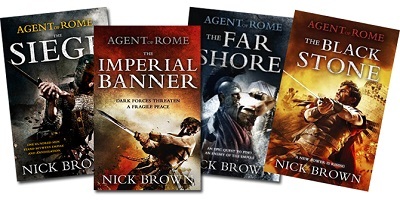
-Book 1 The Siege
-Book 2 The Imperial Banner
Book 3 - The Far Shore
"Though black, the strange surface of the rock seemed to glitter and gleam. After c acoolective intake of breath, a third of the Saracens dropped down and bowed thier heads."
The scale of this mission is much larger than those that came before it. The consequences of them failing this task have further reaching implications. They don’t realise this when they accept it, but by the end of it they learn how the completion of this mission will avoid a Madman’s war. Suffice to say Cassius, Indavara and Simo have another difficult assignment to contend with. By piecing together fragmented clues Cassius learns of a possible location for the artefact, except he doesn’t know how to get there. Howerver, Ulixes a roguish ex-legionary does. Now all they have to do is solve his problems and convince him to help them. But, can they truly trust his selfish ways?
In addition to this, they can’t go alone. They must train a small auxiliary force of twenty men to accompany them. The task is too big for just the three of them. The group set of the disguise of merchants and attempt to convince those they encounter that they are genuine. Though to one in particular, Khalima, it is obvious they are not what they say they are.
Since the last instalment the trio have developed a stronger bond. Indavara and Simo have become strong friends by themselves. Indavara has more of voice in this novel. He is no longer just Cassius’ bodyguard but, almost his equal in the investigation. However, Cassius would not agree. Cassius has his fair share of Roman superiority and arrogance. Simo is his slave and a Christian. Cassius does not like this; he believes Simo can have only one master. The relationship of the three is tested as Simo’s Christianity clashes with Cassius’ Roman ways and Indavara is stuck in the middle. I really enjoyed Cassius’s opinions on Christianity; I felt they were incredibly appropriate for his character and a Roman of this period.
As ever the pacing of this next instalment is brilliant. The narrative of the protagonists is broken up with that of the antagonists. Gutha is a mercenary in service to Iliha, the madman I mentioned earlier. As the trio and their Auxiliaries near the location of the stone, we see the extent of Iliha’s ambition and how the stone is connected to it. The resolution of this book is fantastic and occurs after the well-drawn out plot creates heaps of anticipation.
Furthermore, this is another exciting instalment to a brilliant series that I strongly recommend reading. I’ve enjoyed it that much that I’ve read all four books in just over a week and the fourth book was a re-read. I look forward to the release of the next book in the
franchise!
Also a random point to note- some of the comments may not makes sense as I have updated my review after I have read the rest of the series.
Below are links to my reviews of the rest of the series:
-Book 1 The Siege
-Book 2 The Imperial Banner
Book 3 - The Far Shore

September 17, 2021
Read this book in 2014, this book is set in the year, AD273, and in this fabulous adventure we find Imperial agent, Cassius Corbulo, his bodygaurd, Indavara, are sent on a mission to capture the mysterious and powerful Black Stone.
And so they travel to Arabia, to meet and give battle to this warrior-priest, Ilaha, who wants to raise an army against Rome, but before that will happen everything will come to a head when Corbulo and his forces will reach Ilaha's fortress, and there they will encounter one of the most ferocious battles, all for the Black Stone and its power.
Highly recommended, for this is a great series and one that is very underestimated in my view, so much so that I would like to say, check them out and get hooked, and what this episode is concerned I like to call this: "An astounding Corbulo Mission"!
And so they travel to Arabia, to meet and give battle to this warrior-priest, Ilaha, who wants to raise an army against Rome, but before that will happen everything will come to a head when Corbulo and his forces will reach Ilaha's fortress, and there they will encounter one of the most ferocious battles, all for the Black Stone and its power.
Highly recommended, for this is a great series and one that is very underestimated in my view, so much so that I would like to say, check them out and get hooked, and what this episode is concerned I like to call this: "An astounding Corbulo Mission"!

June 30, 2014
I was in the right mood for an escapist action/adventure, and this novel really delivered! The Agent of Rome series just gets better and better! I really liked this novel for its unusual setting [3rd century Arabia] and non-stop action [which started from the very first page of the Prologue]. The eponymous black stone, a relic of the sun god, Elagabal, is stolen from its temple in Emesa by the German henchman and other followers of a cult leader, the priest Ilaha. Ilaha wants to bring the Arabian [Nabataean] nomad tribes under his sway and to overcome Rome. Because of its importance to Emperor Aurelian, Cassius and a specially chosen and trained twenty-man squadron of Roman army auxiliaries, are tasked with the mission of finding it, stealing it back, and with returning it to its proper place. First, the novel is concerned with recruiting and training the men. The entry into the city where the stone is kept, and its recovery and return of Cassius, his servant. bodyguard, and his band of auxiliaries was really thrilling. My heart was in my mouth several times.
A very strong point of the whole Agent of Rome series is the deeper character development of Cassius, Indavara [his bodyguard] and Simo [his personal attendant]. They are such a great ensemble; I hope they always remain together. The book emphasized the tense relationship that develops between Cassius and the other two. Cassius is still immature, petulant, and selfish. Because of Cassius' own guilt, remorse, and wrongful blame, we see the shabby way he treats Simo after an incident in which Cassius and Simo had been involved. I did find myself with a few tears in my eyes at the unfairness. I felt like sitting him down and having a good talk with him as mother to son. If the talk wouldn't have any effect or at least get him to begin thinking about changes in attitude, I'm prepared to give him a good smack. I do hope he will grow up in subsequent books. I like it that Cassius is not an unthinking sword-swinging automaton; he uses his natural quick wits and he's not afraid to express emotions other than anger, such as fear or sorrow. I do wish the author had used his working title: The Black Stone of Emesa; the present title is rather bland and could mean anything. I appreciated the maps and 'Historical Note'. I liked the description of the violent sandstorm and of such geological features as the odd rock formations in the desert. This book had everything: courage, danger, violence, deception, friendship, loyalty. I wanted to read this novel slowly to make it last, but it was so enthralling I couldn't put it down. It is certainly worth rereading.
A very strong point of the whole Agent of Rome series is the deeper character development of Cassius, Indavara [his bodyguard] and Simo [his personal attendant]. They are such a great ensemble; I hope they always remain together. The book emphasized the tense relationship that develops between Cassius and the other two. Cassius is still immature, petulant, and selfish. Because of Cassius' own guilt, remorse, and wrongful blame, we see the shabby way he treats Simo after an incident in which Cassius and Simo had been involved. I did find myself with a few tears in my eyes at the unfairness. I felt like sitting him down and having a good talk with him as mother to son. If the talk wouldn't have any effect or at least get him to begin thinking about changes in attitude, I'm prepared to give him a good smack. I do hope he will grow up in subsequent books. I like it that Cassius is not an unthinking sword-swinging automaton; he uses his natural quick wits and he's not afraid to express emotions other than anger, such as fear or sorrow. I do wish the author had used his working title: The Black Stone of Emesa; the present title is rather bland and could mean anything. I appreciated the maps and 'Historical Note'. I liked the description of the violent sandstorm and of such geological features as the odd rock formations in the desert. This book had everything: courage, danger, violence, deception, friendship, loyalty. I wanted to read this novel slowly to make it last, but it was so enthralling I couldn't put it down. It is certainly worth rereading.

May 20, 2014
Agent of Rome is one of my favourite series of historical fiction and this latest addition doesn't disappoint - quite the opposite. Its ending is astonishing and wonderful, not necessarily in the ways you would expect. So good to spend more time with Cassius, Simo and Indavara.

June 4, 2014
Full disclosure: I won this in a GoodReads giveaway in exchange for an honest review.
Well, well, well, Agent Corbulo, we meet again. I’ve got to stop winning your books like this. I admit I had a chuckle when I won this, the fourth book in the series, after having won the second book in the same series in a giveaway back in March, but I’m not complaining. When I won the second book, I was a little dubious because I’ve seen a lot of run-of-the-mill Roman soldier novels, and I didn’t know if this series would be one of those. This time however, I was confident I’d be getting into a good read, and The Black Stone didn’t let me down.
Let's get what very few bad points there were out of the way. I do tend to prefer historical epics, so admittedly the more insular scope of this series of personal adventures is not quite "me" so to speak. Corbulo is still occasionally a bit of an ass; there are one or two moments when I found myself mentally shooting him a frown or a roll of the eyes - though to be fair, he's deliberately written that way. I'd also like to see some more active central female characters - though obviously as a historian of ancient history I understand the constraints the author is under.
So, the good stuff. There is some nice character development here; Indavara becomes dissatisfied with his lot, the relationship between Corbulo and Simo is strained, and at the end Corbulo cries due to the horrible things he’s seen on this latest mission – big props to the author for that, I don’t think there’s many Roman soldier series who would actually let their main character be disturbed by what he's seen and done and openly cry. The characters are really beginning to evolve into complex individuals with their own issues and dynamics with each other, and conflicts are arising that hint at some significant plotlines further on down the lines. My appetite is suitably whetted for the direction this series will go.
It’s also obvious how much work the author has put into research, even without having read the author’s note – just the level of detail and attention paid to small things really speaks that loudly throughout the story, to me at least as a historian. I really do appreciate that, not just as someone passionate about history, but also as a reader, because the story feels more authentic and real when the facts are accurate and care and attention has been put into those small details. And ultimately that really helps immersion, in getting swept away in the flow of a story.
The plot? Well, there’s not many spoilers to give away, as we’re told right from the beginning whodunit. The tension comes from wondering whether or not Corbulo will find and retrieve the stone, and how he will pull off this feat. You know, I can’t decide if I like this plot more or less than the plot of the second book, in which Corbulo must uncover the mystery of who stole a sacred flag. I did enjoy the drawn out mystery in the second one, and the inevitable temptation for the reader to throw their own theories out there, and the ending of that one was very high tension. In this one there’s not as much of a mystery, and the tension, for Corbulo’s character at least, is dissipated a little earlier than it was in The Imperial Banner. But on the other hand, The Black Stone has a plot that feels more ambitious. This time Corbulo’s going out into enemy territory and is surrounded on all sides, so the risk is higher, plus his journeys in this one take him much farther afield, lending the book a bigger scope. The plot is an invented one, though it is grounded in plausibility and that kept my investment in it on the level. Being the historian I am I’ve been known to object to historical inaccuracies, but it’s the silly mistakes, the absurdities, or the out-of-character or offensive inaccuracies that I dislike. If it’s a deliberate authorial choice that is well-written and is still plausible and authentic within its setting, I can totally get on board - and this one is done tremendously well.
I must admit to liking the construction of these characters. Corbulo is smart, and the plots of this series are smart too, and that appeals to me. That said, our trio of Corbulo, Indavara, and Simo, have their faults. I’m longing for Indavara to shake off his stubbornness and find out more about his mysterious origins. And I was with Corbulo in his feelings of betrayal about Simo – it just seemed so unfair for him to be judged when he did all he could to mitigate circumstances and the incident in question was something he had no control over. That said, I must admit sometimes I don’t exactly warm to Corbulo either. He’s basically decent, and smart, which makes for a pretty likeable character, but he’s a little bit thoughtless when it comes to looking out for his friends or interacting with women. I put it down to his age, and am rather hoping that over the course of future books he'll grow as a character; he could do with being a bit more mature. The fact that these characters have flaws though really makes them feel more believable and human. Corbulo’s lack of martial skill is another deliberate flaw, and one that I rather like actually. It marks him out as different to the other Roman-soldier novel protagonists – here’s a Roman military buddy series where the protagonist’s skill with a blade is distinctly lacking; he’s forced to rely on his wits for the most part, and the skill of Indavara instead, and he’s genuinely in trouble when it comes to a serious fight.
Although I've read books two and four in the series, and not one and three, two and four definitely stand alone on their own merits, and explain what happened previously without giving away the big mysteries of those books. That's great, as I don't feel lost or confused reading these, but at the same time the preservation of the mysteries means I can still go and read those others without knowing what is going to happen.
Definitely a series that I would recommend, and one that stands out from the crowd.
8 out of 10

April 2, 2015
A crack squad of undercover Intelligence officials, on a desperate, life or death, race against time mission deep in enemy territory in the southern Arabian peninsula, against a backdrop of rising insurgency…
The situation now, in Yemen? The new ‘Bourne'? The new James Bond? A modern anti-terrorist thriller?
Nope, nope and maybe, partly-nope.
For this is a thrilling novel set in AD273 and the undercover mission is being carried out by a specially selected squad of Roman soldiers, under the command of Agent of Rome, Cassius Corbulo.
Corbulo has been delegated by his boss, who is doing something his boss wants done and as his boss is Emperor, it needs to be done, yesterday. Or earlier. Cassius’ mission he has no choice but to ‘choose’ to accept, is to travel through hostile territory, break into the enemy’s stronghold, re-capture a magical and mysterious black stone and get out again. Alive - if possible. The Emperor, Lucius Domitus Aurelianus, wants the black stone, largely because that’s what Roman Emperor’s do. Want things they don’t have. The problem is that Ilaha, who has set himself up as rebel leader and self-styled high priest of the Sun God religion, wants to use the black stone’s possibly other-worldly powers, to enrapture and enrage the desert peoples, raise a huge army and rise up and smash Rome’s rule in the region.
So, all to play for…
The 'Agent of Rome' series has come a little out of left-field for me. It is different to the Roman series’ I’ve been reading recently, in that it isn’t trying to imagine how actual, documented, historical events (might have) unfolded. Here, we’re in (the latter) stages of the Roman period, but the story is an imagining of the kind of thing which might have gone on, rather than what actually happened. A little outside history’s spotlight, I thought. As I understand it, over a fifty year period from AD235, some 26 Emperors were declared by the Senate. Documenting that mess would be a little difficult, not to say confusing, I’d say. Here, in 273, the current situation is that “for the first time in years we seem to have an Emperor who knows what he’s doing.” When it comes to mysterious black stones, anyway.
'The Black Stone' is number four in the 'Agent of Rome' series, though I was advised that it was pretty well self-contained. It is. The story uses the devices many of the best do, to remind you that there is a ‘previously, on The Agent of Rome,’ dropping mostly the ‘that reminds me of the time’-type comments, without ever getting in the way and having me feel that I couldn’t possibly get the most out of it without having read the others. I could. You can. That’s probably at least partly due to its clear, open, even welcoming style. I knew next to nothing about the period and was therefore glad I felt treated like an adult, out for excitement. Which is why I read.
The characters are good, solid, well-drawn and totally believable. The main man Cassius is an honest, positive character. Resourceful, adaptable and intelligent, with an eye for the small details, though not entirely convinced of his (obvious to others) abilities. A little like us all, then. And an ideal spy. He is from northern Italy, so maybe not being Roman, as in from Rome, and influenced by the power for power’s sake political turbulence of Rome, allows for his more worldly objectivity and practicality. He has an ex-gladiator bodyguard called Indavara, who is clearly the kind of friend you’d want at your side, or to have your back in a fight. But who has, thanks to memory loss, an intreguing (not least to him) unknown past, pre-Gladiator that is. Makes him kind of stateless, rootless, living for the here and now. It was interesting, that the story trusted him to go off on his own a few times. Such that he is at least as ‘main’ a character, as the story’s figurehead Cassius. The black sheep in a Roman-kind of way, is Cassius’ newly converted to Christianity slave Simo. Who finds that believing in a religion promoting non-violence isn’t going to go down all that well with your Roman gods-believing boss when his back is against the wall.
There is some great, enjoyable interplay between the main characters. Realistic, understandable dialogue - as in, you understand where they’re coming from. “'Indavara really likes that mule.' 'What can I tell you. Similar level of intellect.’” He also embellished the main story with many smaller interesting incidents and brushes with danger along the way, that further expanded on the period feel, placing you and the characters comfortably in their time and surroundings. With the area seeming to be as unstable then as it is now and what looks like the early use and sale of what would later become oil, it seems very little has changed in 1800-odd years.
I always think the mark of a good book is that you forget you’re actually holding paper and reading words on a page, you’re watching the video it’s set playing in your head. I couldnt have enjoyed 'The Black Stone' any more if I’d tried. It’s a world I want to come back to again. Soon. And you know what’s sad? I slowed down reading the last third. Because I didn’t want to it to finish. But what’s happy? I’ve got the others in the series ready to read.
More world-class reviews on Speesh Reads
The situation now, in Yemen? The new ‘Bourne'? The new James Bond? A modern anti-terrorist thriller?
Nope, nope and maybe, partly-nope.
For this is a thrilling novel set in AD273 and the undercover mission is being carried out by a specially selected squad of Roman soldiers, under the command of Agent of Rome, Cassius Corbulo.
Corbulo has been delegated by his boss, who is doing something his boss wants done and as his boss is Emperor, it needs to be done, yesterday. Or earlier. Cassius’ mission he has no choice but to ‘choose’ to accept, is to travel through hostile territory, break into the enemy’s stronghold, re-capture a magical and mysterious black stone and get out again. Alive - if possible. The Emperor, Lucius Domitus Aurelianus, wants the black stone, largely because that’s what Roman Emperor’s do. Want things they don’t have. The problem is that Ilaha, who has set himself up as rebel leader and self-styled high priest of the Sun God religion, wants to use the black stone’s possibly other-worldly powers, to enrapture and enrage the desert peoples, raise a huge army and rise up and smash Rome’s rule in the region.
So, all to play for…
The 'Agent of Rome' series has come a little out of left-field for me. It is different to the Roman series’ I’ve been reading recently, in that it isn’t trying to imagine how actual, documented, historical events (might have) unfolded. Here, we’re in (the latter) stages of the Roman period, but the story is an imagining of the kind of thing which might have gone on, rather than what actually happened. A little outside history’s spotlight, I thought. As I understand it, over a fifty year period from AD235, some 26 Emperors were declared by the Senate. Documenting that mess would be a little difficult, not to say confusing, I’d say. Here, in 273, the current situation is that “for the first time in years we seem to have an Emperor who knows what he’s doing.” When it comes to mysterious black stones, anyway.
'The Black Stone' is number four in the 'Agent of Rome' series, though I was advised that it was pretty well self-contained. It is. The story uses the devices many of the best do, to remind you that there is a ‘previously, on The Agent of Rome,’ dropping mostly the ‘that reminds me of the time’-type comments, without ever getting in the way and having me feel that I couldn’t possibly get the most out of it without having read the others. I could. You can. That’s probably at least partly due to its clear, open, even welcoming style. I knew next to nothing about the period and was therefore glad I felt treated like an adult, out for excitement. Which is why I read.
The characters are good, solid, well-drawn and totally believable. The main man Cassius is an honest, positive character. Resourceful, adaptable and intelligent, with an eye for the small details, though not entirely convinced of his (obvious to others) abilities. A little like us all, then. And an ideal spy. He is from northern Italy, so maybe not being Roman, as in from Rome, and influenced by the power for power’s sake political turbulence of Rome, allows for his more worldly objectivity and practicality. He has an ex-gladiator bodyguard called Indavara, who is clearly the kind of friend you’d want at your side, or to have your back in a fight. But who has, thanks to memory loss, an intreguing (not least to him) unknown past, pre-Gladiator that is. Makes him kind of stateless, rootless, living for the here and now. It was interesting, that the story trusted him to go off on his own a few times. Such that he is at least as ‘main’ a character, as the story’s figurehead Cassius. The black sheep in a Roman-kind of way, is Cassius’ newly converted to Christianity slave Simo. Who finds that believing in a religion promoting non-violence isn’t going to go down all that well with your Roman gods-believing boss when his back is against the wall.
There is some great, enjoyable interplay between the main characters. Realistic, understandable dialogue - as in, you understand where they’re coming from. “'Indavara really likes that mule.' 'What can I tell you. Similar level of intellect.’” He also embellished the main story with many smaller interesting incidents and brushes with danger along the way, that further expanded on the period feel, placing you and the characters comfortably in their time and surroundings. With the area seeming to be as unstable then as it is now and what looks like the early use and sale of what would later become oil, it seems very little has changed in 1800-odd years.
I always think the mark of a good book is that you forget you’re actually holding paper and reading words on a page, you’re watching the video it’s set playing in your head. I couldnt have enjoyed 'The Black Stone' any more if I’d tried. It’s a world I want to come back to again. Soon. And you know what’s sad? I slowed down reading the last third. Because I didn’t want to it to finish. But what’s happy? I’ve got the others in the series ready to read.
More world-class reviews on Speesh Reads

November 4, 2014
Another excellent book and fantastic series, each book continues to get better as this series goes on. I can't come up with a single flaw this book had, the pace, action and overall story were perfect but most of all I loved how we really got more out of Cassius this book. You get to see his emotions towards the events around him and how it really has taken its toll on him. This book was a pleasure to read, one of the very best I've come across. This book for me was one of those "this is why I love reading" books.

July 29, 2014
Over the course of the last few years I have delved into quite a few books that are parts of a series. The Agent of Rome series by Nick Brown being one of the best of them. The Black Stone, the fourth book in the series, continues the adventures of Cassius Corbulo, his slave/attendant Simo and his bodyguard Indavara. In this tale they are on the trail of the mysterious black stone, an ancient object of worship that has been stolen and one that the Emperor Aurelian really wants back. The thief has it taken to a very remote spot in the Hejaz Mountains in Arabia where he is building a cult following for a sun god and where he is also fomenting rebellion among the nomadic tribes against Rome. The narrative brings out a perfect feel for the inhospitable, treacherous and dangerous terrain Corbulo and his crew must cross just to get to the location. Corbulo is not your typical Roman soldier; he is not a warrior, but a deeply sensitive and very intelligent man and it takes all of his smarts to outwit his foes.
One of the things an author must accomplish in any series of books that utilize the same main characters is a continuing sense of character development. Nick Brown passes this test with flying colors. The reader gets to know more and more about the three companions as the relationships between them are tested; to the limit in some instances, and one does not know until the end if they pass those tests. Another strength of the author, the drama and intrigue of the plot, held me spellbound during the climatic last half of the book. Once again I raise my coffee cup in salute for another masterful story and cannot wait to start on book five. 5 stars.
On Twitter @hooverbkreview
On Facebook at https://www.facebook.com/pages/Clash-...
One of the things an author must accomplish in any series of books that utilize the same main characters is a continuing sense of character development. Nick Brown passes this test with flying colors. The reader gets to know more and more about the three companions as the relationships between them are tested; to the limit in some instances, and one does not know until the end if they pass those tests. Another strength of the author, the drama and intrigue of the plot, held me spellbound during the climatic last half of the book. Once again I raise my coffee cup in salute for another masterful story and cannot wait to start on book five. 5 stars.
On Twitter @hooverbkreview
On Facebook at https://www.facebook.com/pages/Clash-...

November 24, 2014
Another phenomenal book by Brown, and in this "Agent of Rome" series. This book dives even deeper into the relationship of the 'trio'. Cassius especially is torn apart and put back together again in this book. It comes full circle as well, from the splitting in the beginning of the story, where Indavara was going to leave, to the end of the story, where he wanted the 'trio' to remain together. Gutha was an AMAZING character, and I love how Nick doesn't just force Indavara down our throats as this all mighty killing machine - because in reality I would like to think Gutha would have won. That is what makes it so good, he keeps you guessing. One of my favorite parts about this book are pages 471, 472, and 473 - The Historical Note. I love how Nick can take something and spin it into an entire book which is filled with Non-Fiction but spun to be Historical Fiction.
Another great read, and I cannot wait until the next installment of this series (or anything from Nick).
Another great read, and I cannot wait until the next installment of this series (or anything from Nick).
This entire review has been hidden because of spoilers.

March 28, 2019
This installment of my favorite ancient secret agent does not disappoint. In addition to tons of action and clever plot twists, I have really enjoyed the development of the relationship between Corbulo and his bodyguard Indavara. Looking forward to reading more adventures in this series.

April 8, 2022
('We are the shadow and the dragon's call
Born to fight and die, order of the dark
We bring the rain, we ride along the dawn
Knights within the heart, servants of the blood
Forevermore' Warriors - Warkings)
And warriors is what the majority of the characters in this book are.
Last year i started with reading this great series in dutch, not knowing it hasnt been translated since book 4, so, this was my first Agent Of Rome book in English! It was something i need to get used to. Words are different, but im not going to look them up 😅 further in the sentence i figured out what it meant.
With every new book, the back says 'its their greatest challenge yet', and I think, 'can it be really worse than the previous challenge?', well, it can! Cassius and co need to retrieve a stolen black stone (basically stealing it back) and what can go wrong, goes wrong. Many many deaths and a scary tall german, an insane (and ditto grandmother) warrior priest that wants an army against rome. As always, excellent written 👌🏻
Born to fight and die, order of the dark
We bring the rain, we ride along the dawn
Knights within the heart, servants of the blood
Forevermore' Warriors - Warkings)
And warriors is what the majority of the characters in this book are.
Last year i started with reading this great series in dutch, not knowing it hasnt been translated since book 4, so, this was my first Agent Of Rome book in English! It was something i need to get used to. Words are different, but im not going to look them up 😅 further in the sentence i figured out what it meant.
With every new book, the back says 'its their greatest challenge yet', and I think, 'can it be really worse than the previous challenge?', well, it can! Cassius and co need to retrieve a stolen black stone (basically stealing it back) and what can go wrong, goes wrong. Many many deaths and a scary tall german, an insane (and ditto grandmother) warrior priest that wants an army against rome. As always, excellent written 👌🏻
July 29, 2018
Once again a very enjoyable read, and again, a joy to watch the development of the characters. My only gripe with these books is that I can't put them down, but they never fail to take me to another world. Thank you Nick Brown.

March 24, 2021
Another cracking entry in the Agent of Rome series. I must admit I was going to give it a 4 at one point but the final quarter was full of suspense, action, intensity and emotion it lifted The Black Stone into the top bracket. This series has been just so consistently good (perhaps excepting #1), it has set the bar very high for any forthcoming stories.

December 3, 2017
The first four books in this marvellous series are not well served by their covers, and I think this, the fourth and final volume with a cover in this style, is the worst. Looking at it, you'd be justified in thinking the book it covers told the adventures of some muscle-bound Roman lunk whose only recourse when faced with a problem is to get out his sword. In fact, while tense and exciting, it's a long way from the hack 'n' slash of the wish-fulfilment school of historical fiction written for male readers. Cassius Corbulo, the hero, is cerebral rather than brawny, the series itself plays with different genres, mashing up detective fiction, thrillers and espionage, with very little in the way of the military hist-fic that the cover promises. But what makes the stories stand out is the developing, and deepening, relationship between patrician and pagan when it suits him Cassius, his Christian slave, Simo, and his bodyguard, Indavara, who worships Lady Fortune. The dynamics and power imbalances implicit in such relationships are brought out skillfully by Nick Brown, and these are what make me want to read more (alongside a cracking plot with all sorts of unexpected turns of fortune). The books are also developing an interesting realist take on the outcomes of these sorts of contests: often, the bad guys do get away. All in all, another excellent installment in the Agent of Rome series.

July 17, 2014
For Imperial agent, Cassius Corbulo the last three months have been something of a holiday, While Bostra was hardly a Rome or Antioch it was still a pleasant posting and his duties were hardly taxing .
The arrival of his boss, Abascantius to Bostra suggests his life of ease is coming to an end. With rebellion breaking out in neighbouring Palmyra and the tribes of Arabia growing restless the Emperor himself is leading his armies to bring the area under Roman control once more.
the-black-stone-by-nick-brown
For the authorities in the east everything must be perfect for the Emperor’s arrival but when a mysterious enemy attacks a temple and spirits away the Black stone of Edessa, a stone claimed by the Emperor then they must get the stone back before he arrives.
Cassius is charged with finding out who stole the Stone and what they intend to do with it. With an escort of select troops, Cassius with his faithful followers Indavana and Simo must travel into the desert and into the middle of the restless tribes.
As they travel deeper into the relentless desert they see signs that the tribes are ready to rise up against the Roman yoke and Cassius’s mission gets more and more complicated.
Can Cassius travel into the heart of the storm and not only find the Black Stone but also retrieve it before the Emperor arrives in the East?
The Black Stone is the fourth book in Nick Brown series featuring Imperial Agent Cassius Corbulo.
This series just gets better and better and The Black Stone is the best book so far.
Unusually for series set in the Roman period the author tends to avoid the large set piece battles and the massed ranks of the legions that other books seem to fixate on.
This gives the books a very “local” feel, instead of sweeping across the whole empire the books focus on one particular area of the Empire. The last book (The Far Shore) looked at Roman colonists on the African coast and this book focuses on the Tribes of Arabia and their relationship with Rome.
The one advantage of this plot device is that you get to really understand the customs and traditions of the area. The author can devote much more time to really developing how they interact with Rome and then officials sent to administer them.
Another interesting facet of these books are the three main characters. Cassius, Indavara and Simo are all complex and interesting characters. All three of them are struggling with who they are and maybe this is why they get on so well and the relationship really works in the books.
Cassius is the reluctant hero, unlike most “heroes” he isn’t particularity brave or proficient with weapons, he dislikes violence and would rather live a life of debauched idleness. His one strength is his sense of duty and a desires to complete his mission successful.
Cassius is an excellent character and is one of the main reasons the books work, he is very likeable without being the superhuman killing machine most heroes are portrayed as.
Both Indavara and Simo both have different internal struggles that affect their relationship with Cassius. Simo struggles between his duty to Cassius and his desire to follow the teaching of Christ and this cause some real tension between the two.
Indavara is struggling with who he is the most, a cold eyed killer he remembers nothing before his life in the arena. This plot line is one of the most interesting because you can see the conflict between the efficient killer and the nice, normal guy that is trying to break out.
In this book the first cracks appear in the relationships between all three and their struggles between loyalty to each other and the desire for happiness.
The Black Stone is a cracking read, the plot is fast paced and the action scenes very exciting. The escape from the enemy stronghold in particular is very good.
I can’t recommend this book, or series enough and I’m glad to say it keeps getting better and better.
The arrival of his boss, Abascantius to Bostra suggests his life of ease is coming to an end. With rebellion breaking out in neighbouring Palmyra and the tribes of Arabia growing restless the Emperor himself is leading his armies to bring the area under Roman control once more.
the-black-stone-by-nick-brown
For the authorities in the east everything must be perfect for the Emperor’s arrival but when a mysterious enemy attacks a temple and spirits away the Black stone of Edessa, a stone claimed by the Emperor then they must get the stone back before he arrives.
Cassius is charged with finding out who stole the Stone and what they intend to do with it. With an escort of select troops, Cassius with his faithful followers Indavana and Simo must travel into the desert and into the middle of the restless tribes.
As they travel deeper into the relentless desert they see signs that the tribes are ready to rise up against the Roman yoke and Cassius’s mission gets more and more complicated.
Can Cassius travel into the heart of the storm and not only find the Black Stone but also retrieve it before the Emperor arrives in the East?
The Black Stone is the fourth book in Nick Brown series featuring Imperial Agent Cassius Corbulo.
This series just gets better and better and The Black Stone is the best book so far.
Unusually for series set in the Roman period the author tends to avoid the large set piece battles and the massed ranks of the legions that other books seem to fixate on.
This gives the books a very “local” feel, instead of sweeping across the whole empire the books focus on one particular area of the Empire. The last book (The Far Shore) looked at Roman colonists on the African coast and this book focuses on the Tribes of Arabia and their relationship with Rome.
The one advantage of this plot device is that you get to really understand the customs and traditions of the area. The author can devote much more time to really developing how they interact with Rome and then officials sent to administer them.
Another interesting facet of these books are the three main characters. Cassius, Indavara and Simo are all complex and interesting characters. All three of them are struggling with who they are and maybe this is why they get on so well and the relationship really works in the books.
Cassius is the reluctant hero, unlike most “heroes” he isn’t particularity brave or proficient with weapons, he dislikes violence and would rather live a life of debauched idleness. His one strength is his sense of duty and a desires to complete his mission successful.
Cassius is an excellent character and is one of the main reasons the books work, he is very likeable without being the superhuman killing machine most heroes are portrayed as.
Both Indavara and Simo both have different internal struggles that affect their relationship with Cassius. Simo struggles between his duty to Cassius and his desire to follow the teaching of Christ and this cause some real tension between the two.
Indavara is struggling with who he is the most, a cold eyed killer he remembers nothing before his life in the arena. This plot line is one of the most interesting because you can see the conflict between the efficient killer and the nice, normal guy that is trying to break out.
In this book the first cracks appear in the relationships between all three and their struggles between loyalty to each other and the desire for happiness.
The Black Stone is a cracking read, the plot is fast paced and the action scenes very exciting. The escape from the enemy stronghold in particular is very good.
I can’t recommend this book, or series enough and I’m glad to say it keeps getting better and better.

May 15, 2014
Review
Since book one of this series i have been a fan, I don’t normally find myself gravitating towards mixed genres and this series with its Roman Spies, investigations all mixed in with classic blood and sandals Roman battles is as mixed as you can find.
BUT…it works and works well. I think for me its because it doesn’t really have the big muscle-bound hero, on one person who is just amazingly good at fighting or intelligent beyond his peers etc.. Cassius Corbulo is young, too young, and scared, he never wanted to be part of the Frumentarii, he wanted to be an Orator, to belong to the cerebral arts, to enjoy his status at the top of society. At the beginning he would never have survived without his bodyguard Indavara a man with his own troubled past. The series is set against varying locations of the empire, but always at a time when the Roman world was still struggling with all the varied religions and revolts, as much as it wanted to absorb other cultures, it struggled with the Christ Cult and to add to Cassius’s problems his slave Simo is a member.
Books 4 The Black Stone: unlike books two and three which (were excellent books) showed incremental improvements, the improvements I look for in authors as a series progresses. Book four however goes to a whole new level, the plot is woven with multiple layers of religious intrigue and intolerance, political intrigue, fighting, comradeship and the ever growing relationship and maturity of our band of hero’s. Cassius learns more about his limits, his courage, and his friends. Indavara starts to learn and over come his past. The relationship between these two has matured to a whole new level in this book.
The story the black Stone is well thought out and put together, and has the layers to keep you galloping along at a decent pace. But its the characters that make it a winner, the development of the characters in the book alone is excellent (let alone the series). There are many teasing glimpses of Indavara and his past which i feel will become the focus if a future book in the series. There is very real wear and tear on the team and their personalities and the dynamic as a group. Its this frailty this real humanity that shines out from the page and makes this such a good book. Its so easy to make a near invincible hero or villain, but Nick creates shades of grey. Good guys do bad things for the sake of others or politics, or just that its expedient. Bad guys do good things on a whim, or because they just want to walk away. All of it means that when reading it you can empathise with the characters, to think..”Yeah..I get that”. The introduction of Gutha was a master-stroke, the perfect bad guy foil to Indavara, you spend so much of the book waiting for them to face off. Also the mystery of a Germanic warrior in the far east, adds such an element of difference to the tale, also bad guy is probably the wrong term, he is a mercenary, he fights for money and his master, so good guy / bad guy in this time period is a matter of perspective, His side pays him, and while they do, they are the good guys! I found this sort of thinking refreshing in a book of this type, rather than the standard good v evil. (im going to stop now before i give something away)
At almost 500 pages you get your moneys worth and a whole lot more, not once did this book feel like it should have been trimmed, despite the length the writing is sparse where it needs to keep the pace flowing and descriptive where you need to feel the heat and desolation of the desert. By the end of the book i guarantee you will be wanting more!
This book is Highly recommended
(Parm)
Since book one of this series i have been a fan, I don’t normally find myself gravitating towards mixed genres and this series with its Roman Spies, investigations all mixed in with classic blood and sandals Roman battles is as mixed as you can find.
BUT…it works and works well. I think for me its because it doesn’t really have the big muscle-bound hero, on one person who is just amazingly good at fighting or intelligent beyond his peers etc.. Cassius Corbulo is young, too young, and scared, he never wanted to be part of the Frumentarii, he wanted to be an Orator, to belong to the cerebral arts, to enjoy his status at the top of society. At the beginning he would never have survived without his bodyguard Indavara a man with his own troubled past. The series is set against varying locations of the empire, but always at a time when the Roman world was still struggling with all the varied religions and revolts, as much as it wanted to absorb other cultures, it struggled with the Christ Cult and to add to Cassius’s problems his slave Simo is a member.
Books 4 The Black Stone: unlike books two and three which (were excellent books) showed incremental improvements, the improvements I look for in authors as a series progresses. Book four however goes to a whole new level, the plot is woven with multiple layers of religious intrigue and intolerance, political intrigue, fighting, comradeship and the ever growing relationship and maturity of our band of hero’s. Cassius learns more about his limits, his courage, and his friends. Indavara starts to learn and over come his past. The relationship between these two has matured to a whole new level in this book.
The story the black Stone is well thought out and put together, and has the layers to keep you galloping along at a decent pace. But its the characters that make it a winner, the development of the characters in the book alone is excellent (let alone the series). There are many teasing glimpses of Indavara and his past which i feel will become the focus if a future book in the series. There is very real wear and tear on the team and their personalities and the dynamic as a group. Its this frailty this real humanity that shines out from the page and makes this such a good book. Its so easy to make a near invincible hero or villain, but Nick creates shades of grey. Good guys do bad things for the sake of others or politics, or just that its expedient. Bad guys do good things on a whim, or because they just want to walk away. All of it means that when reading it you can empathise with the characters, to think..”Yeah..I get that”. The introduction of Gutha was a master-stroke, the perfect bad guy foil to Indavara, you spend so much of the book waiting for them to face off. Also the mystery of a Germanic warrior in the far east, adds such an element of difference to the tale, also bad guy is probably the wrong term, he is a mercenary, he fights for money and his master, so good guy / bad guy in this time period is a matter of perspective, His side pays him, and while they do, they are the good guys! I found this sort of thinking refreshing in a book of this type, rather than the standard good v evil. (im going to stop now before i give something away)
At almost 500 pages you get your moneys worth and a whole lot more, not once did this book feel like it should have been trimmed, despite the length the writing is sparse where it needs to keep the pace flowing and descriptive where you need to feel the heat and desolation of the desert. By the end of the book i guarantee you will be wanting more!
This book is Highly recommended
(Parm)

June 26, 2014
The fourth in the Agent of Rome series. And an excellent series it is too, with the author growing in confidence and ability.
Cassius Corbulo is a “grain-man”, in essence a Roman spy sent on a variety of undercover missions. Smart, but no warrior, he needs the assistance of his bodyguard and his slave to get by. The dynamics of the relationships between them are one of the highlights of the series, they don’t always get on and there is a slave and master relationship that they struggle with but feels realistic. Good strong characters they have developed through the series. And while this is obviously a Roman action thriller, there is also a vein of humour with some nice one liners (also in keeping with the characters).
Here the mission is to lead a small group of soldiers to recover a sacred item from a tribal leader. So it is about the journey, the character dynamics, the politics of the time and some action of course.
You sense that Nick Brown is in his stride and enjoying working with the characters he has developed. A real talent here that offers something a little bit different from the other action stories set in this era.
Cassius Corbulo is a “grain-man”, in essence a Roman spy sent on a variety of undercover missions. Smart, but no warrior, he needs the assistance of his bodyguard and his slave to get by. The dynamics of the relationships between them are one of the highlights of the series, they don’t always get on and there is a slave and master relationship that they struggle with but feels realistic. Good strong characters they have developed through the series. And while this is obviously a Roman action thriller, there is also a vein of humour with some nice one liners (also in keeping with the characters).
Here the mission is to lead a small group of soldiers to recover a sacred item from a tribal leader. So it is about the journey, the character dynamics, the politics of the time and some action of course.
You sense that Nick Brown is in his stride and enjoying working with the characters he has developed. A real talent here that offers something a little bit different from the other action stories set in this era.

October 15, 2014
I am becoming very attached to Nick Brown's world. I am intrigued by his three main characters....Cassius, the very young, clever but inexperienced Roman officer, Simo, the very efficient slave and Indavara, the ex gladiator, equally young, equally clever but much more experienced. They have incredible adventures, the books are well written and exciting.....I hope the next book in the series comes along soon.

May 31, 2014
A very interesting and enjoyable book.
I will certainly try and read the first three books of Agent of Rome :)
Thank you Nick Brown for the giveaway.
I will certainly try and read the first three books of Agent of Rome :)
Thank you Nick Brown for the giveaway.

June 2, 2014
I received this book during a giveaway and wasn't sure what to expect, as I hadn't read any of the others in the series.
I actually quite enjoyed it and will likely pick up the first one soon.
I actually quite enjoyed it and will likely pick up the first one soon.
August 5, 2014
Excellent plot, the best in the Agent of Rome series thus far. Mysterious atmosphere, exciting action, and further deveolopment of the main characters Cassius, Indavara and Simo.

October 19, 2014
Originally posted at: http://thebookplank.blogspot.com/2014...
About two weeks ago I read Nick Brown's short story, Death This Day, which takes place before the actual events of The Siege, the first book in his Agent of Rome series. After just a few paragraphs into it, I really got the urge to read more Roman stories and luckily I still had The Black Stone awaiting one. The Black Stone is already the 4th book in the Agent of Rom series written by Nick Brown, with his first book he had already completely won me over and continuing in this series has only gotten me further excited about the upcoming books in the series. I am a big fan of Roman fiction and read some great stories but the Agent of Rome series is and will remain one of my favorites.
In the previous book, The Far Shore, Nick Brown took us to the island of Rhodes where Cassius had to retrieve a specific document, but finds himself intertwined in something much larger. Having faced the treacherous seas, Cassius much prefers his stay on solid ground and this is also where his next assignment takes place. I am a big fan of what Nick Brown is doing with the Agent of Rome series. Often when you read the urban fantasy detective stories or Sherlock Holmes stories, they can be considered case files, and this is a trend that is emerging in the Agent of Rome series as well. As I have said in my earlier reviews, these books focus on Cassius Corbulo who is an agent of Rome's secret police, the frumentarri, they are like the police officers. So in short these books highlight a new case for Cassius to solve. Really cool stuff to have such an historical correct "detective" themed stories.
The story of The Black Stone picks up with a scene that shows that the black stone, a stone that is said to have divine powers, is stolen from the Romans from their temple in Emesa. This was far from a simple walk in, pick up the stone and walk away kind of scene, it was brutal and vicious this is something that readily inspired the harsh and gritty Roman, alternate history feeling to the story. Ok so an important relic of the Romans is stolen and it is Cassius Corbulo's task to retrieve it. Now this might sound as a fairly easy task, a done deal, but first Cassius needs to cross the desert and locate the stone and the locals are far from helpful. Luckily for Cassius he isn't on his own in this ordeal, he is helped by his trusty companion Simo and his bodyguard and man with a past Indavara. Additionally to them Cassius also get the call over 20 extra soldiers. In the end there are some very nice confrontations between the different forces at play. Now the premise of the story might sound a bit simple and plain but just let me tell you this, it is far from it. The idea's are straightforward but Nick Brown involves a lot of extras in his story to build a very rich and detailed world and fully bring his characters to the forefront.
This latter aspect of first the Agent of Rome series and secondly The Black Stone makes it a very enjoyable story top read, not necessarily giving the focus on the bloody gladitorial battles (and don't get me wrong I like those a lot, Gladiator, is still one of my favorite movies), but also focusing on showing the world and more importantly the development of the characters within the world and how they live in it.
For the world, Nick Brown has alraedy shown various locations in his preceding books, from islands, treacherous seas and the political "corrupt" Rome this time around he takes you across the desert of Arabia. I am not that familiar with the whole history of it but the feeling that Nick Brown inspires when you read these scenes feel very authentic and like you are right there next to Cassius in the desert. The writing style describes this readily pulls you into the story and just doesn't let you go. A few days ago I tweeted about a particular scene in the book which really put a huge grin on my face. It showed Cassius at his wittiest and perhaps funniest so far. When you look at the whole of the story the often grim and bleak prospect of the Roman world, that is outside the gates of the grandiose and rich Rome, this little witty moment really made the story for me. Something opposite to the humorous moments are what happens in the end. This gave a very realistic feeling to everything. With all the horrible stuff that Cassius has gone through its only natural. All in all great writing and very diverse; jumping for hardend battle scenes to personal and emotion confrontations. Nick Brown knows how to get the setting just right.
As for the characters, Nick Brown develops his "steady" cast even further. In the review of The Far Shore I mentioned that the focus was more on some other character but this time around Cassius is once again the spotlight, and definitely for the better. Cassius has already seen a lot of things and these previous events have already greatly build his characters. In the beginning of the book when Simo is missing this did lead to some funny scenes where he has becomes perhaps a bit to reliant on his servant and when he is not around he cannot be bothered. But when push comes to shove, Cassius does show that he is not reliant on any additional character to make his own decisions and not necessarily to pick his clothes for the day. Cassius' overall development in The Black Stone really marks him as a very real character especially given the what happens in the end, didn't see it coming but was a very great ending to see, and looking back over everything, very natural. Next you have Cassius'' bodyguard Indavara, I like him, I like him a lot. The beginning of the book when he is in the contest, just good stuff, it brings out, for some the worst and for others the best in his character. For me the best in any case. Indavara, the ex-gladiator has a past and now he just wants normality but that is definitely hard to get, he wants to play fair but other don't and then yes, when you mess with Indavara you get what you deserve. As for his servant Simo, he was in every story so far for me a bit of a background persona more doing what Cassius told him to do, but in this part, Nick brown does voiced him for me more stronger with his own opinion and his own actions. I think this really showed that Nick Brown want you as a reader to experience every character in full color. It clearly falls to note that a lot of time and effort is put into developing real characters. This is a very strong point to the Agent of Rome series.
So far Nick Brown has written four very solid stories in the Agent of Rome series and with each new addition, the series only keeps on getting better. Showing more of the Roman empire, different warring tribes and of course developing the character even more. These stories can be viewed as individual "case files" for Cassius to solve as you see with the popular detective series but if you read them as a whole the books get much more justice.
One again Nick Brown has written a powerful story with The Black Stone, not only wanting to show the Roman times but also showing how people lives in that time, happy moments and bad moments. This isn't Roman fiction that centers around action alone but also on human emotional actions. Nick Brown has shown that he is a strong writer and his stories fall in the category of over to soon. Luckily for me there are 3 more books in the making and the next one is due out next summer. I must urge you to pick up these books asap they won't disappoint you.
About two weeks ago I read Nick Brown's short story, Death This Day, which takes place before the actual events of The Siege, the first book in his Agent of Rome series. After just a few paragraphs into it, I really got the urge to read more Roman stories and luckily I still had The Black Stone awaiting one. The Black Stone is already the 4th book in the Agent of Rom series written by Nick Brown, with his first book he had already completely won me over and continuing in this series has only gotten me further excited about the upcoming books in the series. I am a big fan of Roman fiction and read some great stories but the Agent of Rome series is and will remain one of my favorites.
In the previous book, The Far Shore, Nick Brown took us to the island of Rhodes where Cassius had to retrieve a specific document, but finds himself intertwined in something much larger. Having faced the treacherous seas, Cassius much prefers his stay on solid ground and this is also where his next assignment takes place. I am a big fan of what Nick Brown is doing with the Agent of Rome series. Often when you read the urban fantasy detective stories or Sherlock Holmes stories, they can be considered case files, and this is a trend that is emerging in the Agent of Rome series as well. As I have said in my earlier reviews, these books focus on Cassius Corbulo who is an agent of Rome's secret police, the frumentarri, they are like the police officers. So in short these books highlight a new case for Cassius to solve. Really cool stuff to have such an historical correct "detective" themed stories.
The story of The Black Stone picks up with a scene that shows that the black stone, a stone that is said to have divine powers, is stolen from the Romans from their temple in Emesa. This was far from a simple walk in, pick up the stone and walk away kind of scene, it was brutal and vicious this is something that readily inspired the harsh and gritty Roman, alternate history feeling to the story. Ok so an important relic of the Romans is stolen and it is Cassius Corbulo's task to retrieve it. Now this might sound as a fairly easy task, a done deal, but first Cassius needs to cross the desert and locate the stone and the locals are far from helpful. Luckily for Cassius he isn't on his own in this ordeal, he is helped by his trusty companion Simo and his bodyguard and man with a past Indavara. Additionally to them Cassius also get the call over 20 extra soldiers. In the end there are some very nice confrontations between the different forces at play. Now the premise of the story might sound a bit simple and plain but just let me tell you this, it is far from it. The idea's are straightforward but Nick Brown involves a lot of extras in his story to build a very rich and detailed world and fully bring his characters to the forefront.
This latter aspect of first the Agent of Rome series and secondly The Black Stone makes it a very enjoyable story top read, not necessarily giving the focus on the bloody gladitorial battles (and don't get me wrong I like those a lot, Gladiator, is still one of my favorite movies), but also focusing on showing the world and more importantly the development of the characters within the world and how they live in it.
For the world, Nick Brown has alraedy shown various locations in his preceding books, from islands, treacherous seas and the political "corrupt" Rome this time around he takes you across the desert of Arabia. I am not that familiar with the whole history of it but the feeling that Nick Brown inspires when you read these scenes feel very authentic and like you are right there next to Cassius in the desert. The writing style describes this readily pulls you into the story and just doesn't let you go. A few days ago I tweeted about a particular scene in the book which really put a huge grin on my face. It showed Cassius at his wittiest and perhaps funniest so far. When you look at the whole of the story the often grim and bleak prospect of the Roman world, that is outside the gates of the grandiose and rich Rome, this little witty moment really made the story for me. Something opposite to the humorous moments are what happens in the end. This gave a very realistic feeling to everything. With all the horrible stuff that Cassius has gone through its only natural. All in all great writing and very diverse; jumping for hardend battle scenes to personal and emotion confrontations. Nick Brown knows how to get the setting just right.
As for the characters, Nick Brown develops his "steady" cast even further. In the review of The Far Shore I mentioned that the focus was more on some other character but this time around Cassius is once again the spotlight, and definitely for the better. Cassius has already seen a lot of things and these previous events have already greatly build his characters. In the beginning of the book when Simo is missing this did lead to some funny scenes where he has becomes perhaps a bit to reliant on his servant and when he is not around he cannot be bothered. But when push comes to shove, Cassius does show that he is not reliant on any additional character to make his own decisions and not necessarily to pick his clothes for the day. Cassius' overall development in The Black Stone really marks him as a very real character especially given the what happens in the end, didn't see it coming but was a very great ending to see, and looking back over everything, very natural. Next you have Cassius'' bodyguard Indavara, I like him, I like him a lot. The beginning of the book when he is in the contest, just good stuff, it brings out, for some the worst and for others the best in his character. For me the best in any case. Indavara, the ex-gladiator has a past and now he just wants normality but that is definitely hard to get, he wants to play fair but other don't and then yes, when you mess with Indavara you get what you deserve. As for his servant Simo, he was in every story so far for me a bit of a background persona more doing what Cassius told him to do, but in this part, Nick brown does voiced him for me more stronger with his own opinion and his own actions. I think this really showed that Nick Brown want you as a reader to experience every character in full color. It clearly falls to note that a lot of time and effort is put into developing real characters. This is a very strong point to the Agent of Rome series.
So far Nick Brown has written four very solid stories in the Agent of Rome series and with each new addition, the series only keeps on getting better. Showing more of the Roman empire, different warring tribes and of course developing the character even more. These stories can be viewed as individual "case files" for Cassius to solve as you see with the popular detective series but if you read them as a whole the books get much more justice.
One again Nick Brown has written a powerful story with The Black Stone, not only wanting to show the Roman times but also showing how people lives in that time, happy moments and bad moments. This isn't Roman fiction that centers around action alone but also on human emotional actions. Nick Brown has shown that he is a strong writer and his stories fall in the category of over to soon. Luckily for me there are 3 more books in the making and the next one is due out next summer. I must urge you to pick up these books asap they won't disappoint you.
August 2, 2023
Looking back at the first three books I realise that I have not left any reviews but only that I have marked them 4/5 so that means that they must have been pretty good but also that it doesn’t help me catch up on the stories because it was a while ago when I read part 3.
I found that the first 2/3 of this book were a little bit on the boring side but the last 1/3 really made up for it. It was then that all the characters and the plot came to life.
A precious and holy stone had been stolen from the Romans in an Arabian post and Cassius was given the task of retrieving it which he had to do under disguise as a travelling merchant and given only twenty men to do so it was going to be a life or death mission. Together with his bodyguard Indavarus and his meek but loyal slave Simo they set off without any real plan. They were met with many problems along the way but after they reached the mountain fortress of Galaquc their problem of stealing the stone was going to be much harder than they could have even imagined, then at the very end Cassius was faced with a heart rending dilemma which he found too hard to bear.
As I said, I really, really enjoyed the last 1/3 to the extreme and I will definitely read part 5 but because of the slow build up I can only mark this 3/5.
I found that the first 2/3 of this book were a little bit on the boring side but the last 1/3 really made up for it. It was then that all the characters and the plot came to life.
A precious and holy stone had been stolen from the Romans in an Arabian post and Cassius was given the task of retrieving it which he had to do under disguise as a travelling merchant and given only twenty men to do so it was going to be a life or death mission. Together with his bodyguard Indavarus and his meek but loyal slave Simo they set off without any real plan. They were met with many problems along the way but after they reached the mountain fortress of Galaquc their problem of stealing the stone was going to be much harder than they could have even imagined, then at the very end Cassius was faced with a heart rending dilemma which he found too hard to bear.
As I said, I really, really enjoyed the last 1/3 to the extreme and I will definitely read part 5 but because of the slow build up I can only mark this 3/5.
Read
April 5, 2020Stone

June 26, 2016
When the sacred Black Stone of Emesa is stolen by a mysterious enemy of Rome, Cassius is set the task of recovering it for his Emperor. The identity and location of the thieves are unknown. Nevertheless, Cassius must create a small task force to gain information from an imperial spy in Petra and then use that information to track down the stone. However, the Corn Man soon finds out that the theft of the sacred object could be linked with Rome’s allies the Tanukh: a confederation of Arabian tribes that traditionally guards Rome’s frontier. Cassius must come up with a plan to return the stone to Rome and ease relations with Rome’s old ally, ensuring another rebellion does not spark in the Empire’s eastern provinces.
Yet again Brown has managed to create a captivating and thrilling historical fiction book. I think the Agent of Rome series is by far my favourite Roman series out there at the moment. This is because Brown creates excellent characters and actually gives them personalities that make them feel human.
Typically in Roman novels of this type, there are always two main ‘chalk and cheese’ protagonists that really shouldn’t get along. Usually it’s a young buck that has been thrust into leadership and throughout the books that follow, the youngster grows into an amazing warrior and leader. Then there is the old veteran, who has distain for the young officer because of his quick elevation to command, but then over time gains a sense of respect for the young man as he develops into this great leader.
I believe Cassius and Indavara aren’t like that. Sure, Cassius was thrown into his position but he was literally bred from birth to deal with these situations as he comes from a rich family. Nevertheless, he is no hero and honestly not a character I like, as he is cowardly and very self-centred. However, this makes him a great character to read about as he is someone different from the usual zero-to-hero protagonist that defines this genre of historical-fiction. His partner in the books is also unusual because at times I don’t think he even likes Cassius. In addition, there is an air of mystery around Indavara, which I’m excited to learn more about in future novels. This again makes him interesting to me because he is not the two dimensional character you usually see in this genre. We don’t really know what his motives are because we don’t know that much about him, which is great for the reader as this factor sometimes makes him unpredictable.
Finally, another character that shone in this book was Gutha, the German mercenary working for the Arabians. I thought the small parts in the book about his past were very interesting and I would love to read more about him in a short story, so Nick if you’re reading this, please consider it because I’d be the first to review it!
To conclude this was a great edition to the Agent of Rome series and I can’t wait to read the next two books. I would suggest it to fans of authors like Ben Kane, Anthony Riches and Simon Scarrow. If you are a historical fiction fan please check out this series, it is a true gem in a genre that I am starting to feel more and more disillusioned with.
For more book reviews google adam-p-reviews.
Yet again Brown has managed to create a captivating and thrilling historical fiction book. I think the Agent of Rome series is by far my favourite Roman series out there at the moment. This is because Brown creates excellent characters and actually gives them personalities that make them feel human.
Typically in Roman novels of this type, there are always two main ‘chalk and cheese’ protagonists that really shouldn’t get along. Usually it’s a young buck that has been thrust into leadership and throughout the books that follow, the youngster grows into an amazing warrior and leader. Then there is the old veteran, who has distain for the young officer because of his quick elevation to command, but then over time gains a sense of respect for the young man as he develops into this great leader.
I believe Cassius and Indavara aren’t like that. Sure, Cassius was thrown into his position but he was literally bred from birth to deal with these situations as he comes from a rich family. Nevertheless, he is no hero and honestly not a character I like, as he is cowardly and very self-centred. However, this makes him a great character to read about as he is someone different from the usual zero-to-hero protagonist that defines this genre of historical-fiction. His partner in the books is also unusual because at times I don’t think he even likes Cassius. In addition, there is an air of mystery around Indavara, which I’m excited to learn more about in future novels. This again makes him interesting to me because he is not the two dimensional character you usually see in this genre. We don’t really know what his motives are because we don’t know that much about him, which is great for the reader as this factor sometimes makes him unpredictable.
Finally, another character that shone in this book was Gutha, the German mercenary working for the Arabians. I thought the small parts in the book about his past were very interesting and I would love to read more about him in a short story, so Nick if you’re reading this, please consider it because I’d be the first to review it!
To conclude this was a great edition to the Agent of Rome series and I can’t wait to read the next two books. I would suggest it to fans of authors like Ben Kane, Anthony Riches and Simon Scarrow. If you are a historical fiction fan please check out this series, it is a true gem in a genre that I am starting to feel more and more disillusioned with.
For more book reviews google adam-p-reviews.

July 4, 2014
What can I say? Nick Brown set himself a very high standard with his first novel, which was outstanding for a debut. And despite that, he managed to top it with book 2 and again with book 3. Book 4, then. Sometimes I am, at this point in a series, a little worried that the fire and ingenuity will have gone from the writing. I have to say that I did not worry about that with Nick. His writing is always top-notch, his plots seamless and his narrative excellent. I had no doubt that this would match up to his high standard, and it did.
In the first book, we say Cassius Corbulo thrown into the action defending a siege against incredible odds. In the second, he was set to hunting down a stolen banner than could avert or start a war. In book 3 he began a manhunt, following a murder investigation. Book 4 should realistically feel familiar, being another plot concerning the tracking down and recovery of a stolen item. Worry not. It is a fresh and thrilling investigation and in no way similar to, or derivative of, book 1.
I will only deal briefly with plot in case of spoilers. This story involves a perilous journey through the desert lands of modern Syria and Jordan in an attempt to recover the infamous Black Stone of Emesa, a sacred object that the deranged emperor Elagabalus had utilised in his weirdness decades earlier. His journey will bring him – undercover, of course, and with a sneaky column of local auxiliaries – into direct conflict with a madman rising like scum to the top of the southern Saracen tribes and inciting hatred against Rome and its taxes. Set to recovering the stone by his Service seniors and to uncovering the true nature of the tribes’ defiance by the province’s governor, Corbulo is going to find himself torn in numerous directions and trying to stay alive and keep his command intact while achieving several conflicting missions.
Enough. If I’ve not convinced you to buy it, I will now. Go buy it or I’ll send you an angry bear in the post!
Seriously, there are two things that deserve to be said about The Black stone.
1. I noticed in this, more than any of the other three, a true case of well-written and plotted and thoroughly realistic character progression. Corbulo, Simo and Indevara are so well portrayed here that they feel like close friends, and the changes the dreadful circumstances into which they are thrown wreak upon both them and their relationships are beautifully written. And watch out too for a couple of really stupendous new characters, including a bad guy that goes solidly into the ‘I wish I’d invented him’ folder.
2. The ease of the book. Some books are wonderful, but hard work, and you have to make yourself concentrate on. Others are easy reads, because they are rather basic. Very few are easy reads, that pull you headlong through the book, but are also wonderful pieces of literature. This is one. Go get this series and read them through. You will not be disappointed.
… and I have the angry bears on order. You have been warned.
In the first book, we say Cassius Corbulo thrown into the action defending a siege against incredible odds. In the second, he was set to hunting down a stolen banner than could avert or start a war. In book 3 he began a manhunt, following a murder investigation. Book 4 should realistically feel familiar, being another plot concerning the tracking down and recovery of a stolen item. Worry not. It is a fresh and thrilling investigation and in no way similar to, or derivative of, book 1.
I will only deal briefly with plot in case of spoilers. This story involves a perilous journey through the desert lands of modern Syria and Jordan in an attempt to recover the infamous Black Stone of Emesa, a sacred object that the deranged emperor Elagabalus had utilised in his weirdness decades earlier. His journey will bring him – undercover, of course, and with a sneaky column of local auxiliaries – into direct conflict with a madman rising like scum to the top of the southern Saracen tribes and inciting hatred against Rome and its taxes. Set to recovering the stone by his Service seniors and to uncovering the true nature of the tribes’ defiance by the province’s governor, Corbulo is going to find himself torn in numerous directions and trying to stay alive and keep his command intact while achieving several conflicting missions.
Enough. If I’ve not convinced you to buy it, I will now. Go buy it or I’ll send you an angry bear in the post!
Seriously, there are two things that deserve to be said about The Black stone.
1. I noticed in this, more than any of the other three, a true case of well-written and plotted and thoroughly realistic character progression. Corbulo, Simo and Indevara are so well portrayed here that they feel like close friends, and the changes the dreadful circumstances into which they are thrown wreak upon both them and their relationships are beautifully written. And watch out too for a couple of really stupendous new characters, including a bad guy that goes solidly into the ‘I wish I’d invented him’ folder.
2. The ease of the book. Some books are wonderful, but hard work, and you have to make yourself concentrate on. Others are easy reads, because they are rather basic. Very few are easy reads, that pull you headlong through the book, but are also wonderful pieces of literature. This is one. Go get this series and read them through. You will not be disappointed.
… and I have the angry bears on order. You have been warned.
May 1, 2015
This is a book that I received through Goodreads.
The Black Stone is the fourth installment of a series of novels under the general banner of Agent of Rome. It is however the first of the series that I have read.
The main character of the book is Cassius Corbulo who is the "Agent of Rome" and who is called upon to undertake special missions for the Empire. In this instance the mission involves a dangerous journey in an attempt to recover a seemingly "sacred" stone that was stolen from the Romans by a chieftain who plans to use the stone both to promote his own supremacy among other chieftains in the region and to bring them together in a possible struggle with the Romans.
The book works exceptionally well as an adventure story and has a good mixture of action and character development. Much of the story involves three central characters: Corbulo (the special agent); Indavara ( a body guard to Corbulo and an ex gladiator); and Simo ( a servant to Corbulo whose conversion to Christianity puts him at odds with his master). These three characters carry most of the story although supporting characters are also well developed by the author.
Given the important relationships between the three main characters, I believe my enjoyment of the book would have been heightened had I read the three previous books of the installment so as to more fully understand how their relationships had started and what brought them together in the first place. Having said that the book does stand well as a stand alone novel.
The Black Stone is the fourth installment of a series of novels under the general banner of Agent of Rome. It is however the first of the series that I have read.
The main character of the book is Cassius Corbulo who is the "Agent of Rome" and who is called upon to undertake special missions for the Empire. In this instance the mission involves a dangerous journey in an attempt to recover a seemingly "sacred" stone that was stolen from the Romans by a chieftain who plans to use the stone both to promote his own supremacy among other chieftains in the region and to bring them together in a possible struggle with the Romans.
The book works exceptionally well as an adventure story and has a good mixture of action and character development. Much of the story involves three central characters: Corbulo (the special agent); Indavara ( a body guard to Corbulo and an ex gladiator); and Simo ( a servant to Corbulo whose conversion to Christianity puts him at odds with his master). These three characters carry most of the story although supporting characters are also well developed by the author.
Given the important relationships between the three main characters, I believe my enjoyment of the book would have been heightened had I read the three previous books of the installment so as to more fully understand how their relationships had started and what brought them together in the first place. Having said that the book does stand well as a stand alone novel.

September 22, 2015
I really like this one.
Mainly because of the human side of Corbulo.
He's not made for war yet finds himself in the army and everything that comes with it.
His struggles with what he needs to do, the consequences of his actions.
He's not some super hero, he's just a guy with a lot of luck in a world that's not really his and finds or at least tries to find a way to deal with it.
Mainly because of the human side of Corbulo.
He's not made for war yet finds himself in the army and everything that comes with it.
His struggles with what he needs to do, the consequences of his actions.
He's not some super hero, he's just a guy with a lot of luck in a world that's not really his and finds or at least tries to find a way to deal with it.

December 26, 2015
Another cracking story and read, highly recommend people reading these !

April 26, 2016
VERY enjoyable!
Displaying 1 - 30 of 30 reviews