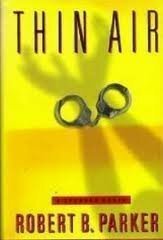
I have mixed feelings about Thin Air.
I like the setup of the story: Homicide cop Sergeant Frank Belson confides in Spenser that his new second wife, Lisa St. Claire, has disappeared. Frank doesn’t want to talk much about it (he’s a macho cop, after all), and he doesn’t want Spenser to look for her. He’ll do it himself. But after Frank gets shot and ends up in intensive care in the hospital, Spenser takes it upon himself to find Lisa.
He doesn’t have much to go on. Lisa’s past is a mystery. Even her name may not be real. But Spenser finds a few meager clues, which lead him to the run-down, largely Hispanic city of Proctor near the New Hampshire border. He realizes that in order to make any headway, he’ll need to deal with local power broker Freddie Santiago. And for that, he’s going to need help. So he calls in a favor from Los Angeles mob boss Victor Del Rio (Stardust). Del Rio sends his man Chollo to help Spenser as both his translator and an extra gun.
So far so good. But the story bogs down a bit when Spenser and Chollo have to endure several monotonous stakeouts. The action ultimately picks up again, but by that point, I thought the story had lost some momentum.
One of my favorite elements of the Spenser series is missing from Thin Air: Hawk. When Susan asks Spenser if Hawk is helping him with the case, he replies that Hawk is in Burma. Susan: “Burma? What can Hawk be doing in Burma?” Spenser: “Better not to know … Gives us deniability.”
But Spenser needs someone who speaks Spanish anyway, so Chollo fills Hawk’s usual role. This includes some of the back-and-forth banter with Spenser that typically makes the Spenser-Hawk scenes so enjoyable. And Chollo fills the role pretty well, with some humor and some sharp observations about Spenser. For instance, when Spenser tells him that Boston mob boss Joe Broz owes him a favor, Chollo says: “You big with the bad guys, Spenser. You got Santiago helping you, Mr. Del Rio helping you, now this guy Broz, that I don’t know, he’s helping you. And I’m helping you. You sure you are a good guy?” “No,” I said. “I’m not sure.”
I’ve commented before that Susan often annoys me. Sometimes she does add insights that help Spenser with a case, but often her role is just to feed Spenser’s ego with her coy responses to his idealization of her, and by extension, because she’s his woman, of himself. And the annoyance factor has increased with the recent addition of “Pearl the Wonder Dog,” whom Susan insists on referring to as “the baby.” I know it’s supposed to be cute and funny, but … well, I guess I’m just not a dog person.
Parker has chosen to alter his usual style in this book by adding multiple sections, told in the first person, in which Lisa is experiencing and reacting to being held against her will. So almost from the beginning, the reader has a pretty good idea of what has happened to her. Telling part of the story from the victim’s perspective is an interesting choice. It adds tension because we know what Spenser is up against. But unfortunately, these frequent sections are long and drawn out and excessively dramatic, and once we understand what’s going on, they don’t do much to advance the story.
I give Parker credit for experimenting with this technique, but I don’t particularly like the result. I found myself trying to rush through the Lisa sections. I enjoy reading the Spenser books for the “detecting,” the action, the humorous banter, and the musings about society and human nature. I try (usually unsuccessfully) to overlook the Susan factor. So while I liked Thin Air, I think I would have enjoyed it more if it had been a more typical Spenser narrative without the victim’s perspective sections.
Extra credit. It’s throwaway lines like this that keep me coming back to the Spenser books: “The brisket was the kind of meal that Irish Catholics got posthumously if they died in a state of grace.”