Pseudonyms: Howard Lee; Frank S Shawn; Kenneth Robeson; Con Steffanson; Josephine Kains; Joseph Silva; William Shatner. Ron Goulart is a cultural historian and novelist. Besides writing extensively about pulp fiction—including the seminal Cheap Thrills: An Informal History of Pulp Magazines (1972)—Goulart has written for the pulps since 1952, when the Magazine of Fantasy & Science Fiction published his first story, a sci-fi parody of letters to the editor. Since then he has written dozens of novels and countless short stories, spanning genres and using a variety of pennames, including Kenneth Robeson, Joseph Silva, and Con Steffanson. In the 1990s, he became the ghostwriter for William Shatner’s popular TekWar novels. Goulart’s After Things Fell Apart (1970) is the only science-fiction novel to ever win an Edgar Award.
In the 1970s Goulart wrote novels starring series characters like Flash Gordon and the Phantom, and in 1980 he published Hail Hibbler, a comic sci-fi novel that began the Odd Jobs, Inc. series. Goulart has also written several comic mystery series, including six books starring Groucho Marx. Having written for comic books, Goulart produced several histories of the art form, including the Comic Book Encyclopedia (2004).
This is another one of Goulart's madcap exercises in zaniness. It hasn't aged as well as many of his others (there are some objectionable terms and references), but I believe it's still a funny adventure if the reader bears in mind it was written in the mid-1970s about the far future twenty-first century. Some of the elements appear interestingly relevant, such as a government force called the TSA, a crazy criminal president, computers that lie to the user... Goulart was always amusing, but rarely so prescient.
An early example of a witty satirical dystopia from the post-Nixon era with rare speculation about black people in the future, woven into a standard commercial action-adventure plot, but has some amazing moments. Someday Goulart's work will be studied to show changing cultures in the late 20th century.
Nearly all of Goulart's books go walk-about until enough pages are filled. There is a token mystery or girl in distress, who is, in the end, revealed/rescued. Mostly wry observations and scenes with weak points. Almost no "Character Development". His serial detective books have almost no protagonist growth. John Easy, almost unnoticed, grows an attachment to a girl, who is shy or missing in the next book. Groucho Marx Detective can't change! (What, change into Harpo?)
Nemo, like the boy in the cartoon, starts as a sleeper but, over the course, comes to find more and more of his powers and some of his desires. He re-connects with his cheating wife, embarrasses some of his antagonists, flies around the country (and sends a guy to Brazil!) However Goulart apparently filled his word-quota before he reeled-in all the threads. Does the president of the United States get overthrown? Should he be? Do repo agents really run the country?
"You haven’t had a house mechanic in for a long time, you know." "We’re on the damn waiting list. They can’t come till April 22, 2021. Next year."
I would've thought -- mistakenly, it appears -- that an author in 1977 looking ahead to the distant year of 2018 would realize that people -- protagonist type people, no less -- wouldn't be using the word "spade" as a racial descriptor in casual conversation.
But then again, given the direction of the country at the moment, maybe the author was prescient.
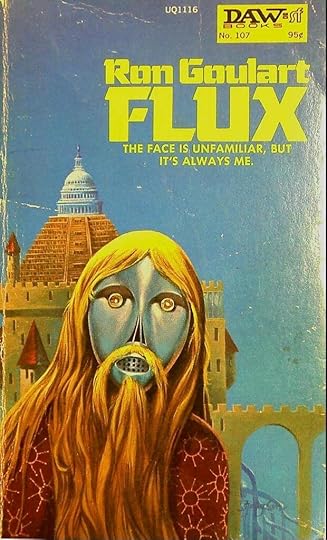
I guess this is what I get for picking up a book based upon the cover.
Note that this isn't the the cover of this book. That book is sadly out of print, so I will never learn the secret of the hippie robots. However, while searching for it on Amazon, I came across this by the same author, and the description said,
He was suddenly the leader of a movement to overthrow a vastly dangerous criminal — who happened to be the President of the United States!
And I thought, "This is relevant to my interests!"
Yeah, now that I think about it, maybe the book is prescient after all.
This is a re-read for me. I read and enjoyed a lot of Ron Goulart’s SF books when I was in high school and the military, but his many of his books are out of print and hard to find, so I haven't read him for years. Goulart is insanely prolific as a ghostwriter and pulp/comics historian, but he also wrote a lot of humorous SF novels that generally involve technological and societal decay, as well as comic-book plots. This standalone novel tells the tale of Ted Briar, who discovers he’s been leading a secret life as a govt agent with telekinetic powers, and is recruited by political activists to stop an evil plot by the President of the USA. Which sounds more serious than it is – as usual, Goulart tells it in a breezy comic style, though Goulart’s comedy is more about wry satire than belly laughs. Goulart tells his stories with fast-paced bare-bones economy, to include characterization. That probably won’t work for everyone, but he’s not writing the Great American Novel here – he’s essentially writing comic-book stories in a prose format. The story is entertaining enough, though I wouldn't say this is one of his classics. But then I’m really here for his writing style and the cadence of his dialogue, which has been a major influence on me. Reading this again, I remember why I liked reading him.
Written in Goulart's trademark style that easily mixes slapstic and ironic mirth Nemo isn't a bad book for a few hours diversion. In fact I thought that the dated, for the pre digital 70's typical style of a strangely mechanical future adds a lot of extra humour to the story.
I enjoyed reading it but would have wished for some more plot.
So while the copy I have of this book says it was published in 2013, the author was born in 1933, and it shows. In this futuristic America, only the black characters are described by their race and "Black Boston" is full of "Negroes". Despite that, it's a fun, well paced story with a somewhat naive protagonist and bumbling, oppressive government bureaucracy.
Quick, diverting, entertaining. Lot of veiled references to the 1970s political scene (Nixon, J. Edgar Hoover), plus a good helping of Goulart's trademark "technology-is-going-to-hell" style. I believe Philip Jose Farmer puts in a brief cameo.
A typical, and therefore enjoyable, Ron Goulart science fiction comedy. Hooked me immediately with its humour, interesting characters and intriguing storyline. Pity the ending felt a bit rushed. Overall another great book by Mr Goulart.