Another fascinating science fiction book of 21 short stories from Isaac Asimov: About Nothing A Perfect Fit Belief Death of a Foy Fair Exchange? For the Birds Found! Good Taste How it Happened Ideas Die Hard Ignition Point! It Is Coming The Last Answer The Last Shuttle Lest We Remember Nothing For Nothing One Night of Song The Smile That Loses Sure Thing To Tell at a Glance The Winds of Change
Works of prolific Russian-American writer Isaac Asimov include popular explanations of scientific principles, The Foundation Trilogy (1951-1953), and other volumes of fiction.
Isaac Asimov, a professor of biochemistry, wrote as a highly successful author, best known for his books.
Asimov, professor, generally considered of all time, edited more than five hundred books and ninety thousand letters and postcards. He published in nine of the ten major categories of the Dewey decimal classification but lacked only an entry in the category of philosophy (100).
People widely considered Asimov, a master of the genre alongside Robert Anson Heinlein and Arthur Charles Clarke as the "big three" during his lifetime. He later tied Galactic Empire and the Robot into the same universe as his most famous series to create a unified "future history" for his stories much like those that Heinlein pioneered and Cordwainer Smith and Poul Anderson previously produced. He penned "Nightfall," voted in 1964 as the best short story of all time; many persons still honor this title. He also produced well mysteries, fantasy, and a great quantity of nonfiction. Asimov used Paul French, the pen name, for the Lucky Starr, series of juvenile novels.
Most books of Asimov in a historical way go as far back to a time with possible question or concept at its simplest stage. He often provides and mentions well nationalities, birth, and death dates for persons and etymologies and pronunciation guides for technical terms. Guide to Science, the tripartite set Understanding Physics, and Chronology of Science and Discovery exemplify these books.
Asimov, a long-time member, reluctantly served as vice president of Mensa international and described some members of that organization as "brain-proud and aggressive about their IQs." He took more pleasure as president of the humanist association. The asteroid 5020 Asimov, the magazine Asimov's Science Fiction, an elementary school in Brooklyn in New York, and two different awards honor his name.
January 2nd is National Science Fiction Day. It became that due to it being the date the Isaac Asimov celebrated his birthday. He didn’t know when his birthday was and chose January 2nd in the third grade. In celebration, I decided to read “Winds of Change . . . and other stories”, a collection of 21 short stories, all previously published. Although one story “To Tell at a Glance” was previously published in a shorter form. The stories were originally published from 1953 – 1982 with most coming from the late 70’s and early 80’s. Four of the stories are very short, Asimov refers to them as vignettes.
I’ve read a great deal of Asimov, most in my youth and this might be a reread, as the title sounded familiar. However, I must admit, I didn’t recall a single story, so maybe this is my first read. I hate to say this on Asimov’s birthday and National Science Fiction day, but it’s not my favorite, in fact, it’s low on my list of Asimov’s short story collections.
Many of these stories were written for a specific purpose, to fit in a larger collection, or a requested theme by an editor. My uninformed theory is that stories that are crafted to meet a specific purpose are likely to be inferior to stories that emerge from a writer’s imagination without guardrails. Not to say that all the stories are weak (weak on an Asimov scale). A few of my favorites include “Belief” – An older page turner, and an example of his simple, yet elegant style. “Ideas Die Hard” – A setup for a solid twist, although it quickly became dated. “Nothing from Nothing” – A great idea that Asimov received from a colleague. “To Tell at a Glance” – An intriguing sci-fi mystery with a great lead character. “One Night of Song” – I found the protagonist hilarious and the story fun. “The Winds of Change” – Oddly written, but intriguing (although slightly political).
The rest felt lacking, at least as far as Asimov stories go. The vignettes were just setups for bad puns and others were stories that felt forced to fit a theme. Still, I don’t regret reading the collection, as Asimov’s worst is still better than many other’s best. I also enjoyed his introductions, although brief. An average sci-fi short story collection from one of the masters of Science Fiction.
This is a collection of Asimov's short science fiction stories, two from the 1950s that had escaped earlier collections and all of the rest from 1977-1982. They're idea stories, short with one-note themes and little characterization for the most part, but fun and slickly written and thought-provoking. Nothing memorable or profound like Nightfall or The Martian Way (I suspect a couple were published just for the value of his name), but fun. He provides interesting notes and introductions for each, and it's a pleasant entertainment.
Intelligent ideas, concisely developed. I took a break from Asimov (except as he showed up in misc. anthologies) for a few decades and am now going back and reading (rereading, probably, in most cases) the shelf of books that I own by him. And imo his stories hold up well. Still witty, still thought-provoking, still enjoyable, whether or not I remember them from before.
Most in this collection are too short to be fully memorable, at least to a rabid reader like me. But in this case that's a good thing, because every punch line/ pay-off/ twist ending/ irony had an impact on me... and therefore, even though the stories are simply told, I felt well-rewarded for reading each. The vignettes (short-shorts) are especially funny, especially if you like puns.
(Another reviewer says these were rejected for publication - only some, and only at first offer; she misunderstood.)
"The Winds of Change...and Other Stories" is a 1983 collection of Isaac Asimov's latter-day short pieces; just one of the 506 books he came out with during the course of his incredibly prolific career. The 21 stories in this collection were, with two exceptions, written between 1976 and 1982, and all display the clarity of thought, wit and erudition that are the hallmarks of all of Doc Ike's work. Four of the stories in this collection--"About Nothing," "Death of a Foy," How It Happened" and "Sure Thing"--are short shorts, or "vignettes," as Asimov calls them. Most of these are mere setups to terrible puns; puns that do leave a goofy grin on the reader's face, however.
"A Perfect Fit" presents us with a world in which computers are so ubiquitous that the poor individual who is computer illiterate is quite unable to function; a world, perhaps, not so distant from where we are today!
In "Belief" (1953), a college professor discovers that he has mysteriously acquired the ability to levitate. The problems that attend his newfound power make up the basis for this consistently amusing tale.
"Fair Exchange?" is a time-travel paradox story that shows off Asimov's love of the operettas of Gilbert & Sullivan. This compactly written story leads to a surprisingly tragic conclusion.
In "For the Birds," a fashion designer is asked to construct wings for the residents of a low-gravity space settlement. His design solution for the inhabitants of the orbiting colony is both delightful and surprising, culminating in a wonderful final line.
In "Found!," one of my favorite stories of the bunch, a man-and-woman team of computer technicians encounters an unknown space parasite whilst repairing the Earth-orbiting Computer-Two. This is a fairly creepy tale of first contact that ends on a distinct note of paranoia. Nice job, Doc Ike!
"Good Taste," another of my faves, presents us with the Lunar-orbiting space colony of Gammer, and deals with an annual contest that determines which resident has come up with the year's finest fungal delicacy. Asimov throws in much background detail to make his story fleshed out and believable.
"Ideas Die Hard" (1957) is a story that Asimov himself says (in his intro; he introduces ALL the stories in this book, incidentally) is dated. It concerns two astronauts who are making Earth's first voyage to the Moon, and the stresses, both physical and psychological, that they endure. Dated or not, I still enjoyed this one.
"Ignition Point!" gives us a company of the future whose computer can write speeches guaranteed to "ignite" any audience. But things work a little too well, in this well-done and cautionary tale.
"It Is Coming," another story of first contact, tells of an approaching alien ship, and how Earth's supercomputer, Multivac, assists in the looming crisis. It is a fairly suspenseful tale that also ends on an ominous note.
"The Last Answer" is one of the more unusual stories of the bunch. Not sci-fi, it describes one man's experience in the afterlife, and even goes so far as to suggest what God's main intent is with us. Pretty intriguing stuff.
"The Last Shuttle" is a very short tale, almost a mood piece, describing the feelings of the pilot of the last spaceship lifting off from an abandoned Earth. For what little it is, I suppose it's well done, but still, if fails to have much of an impact.
The book rebounds in a big way with "Lest We Remember," a terrific story about a man who's injected with an experimental memory drug. As in "Belief," however, newfound abilities bring nothing but problems....
In "Nothing for Nothing," some interstellar space traders land on Earth during the Ice Age of 15,000 B.C. and discover that our world, primitive as it may be, still has something to barter. That the aliens would not be familiar with the Earth commodity is a bit hard to swallow, but still, the story is entertaining enough.
The next two stories in the collection, "One Night of Song" and "The Smile That Loses," feature the inch-high spirit Azazel, whose further adventures Asimov detailed in the 1988 collection "Azazel." These are both highly amusing tales of the mischievous imp providing two Earthwomen with, respectively, the gift of superb voice and the present of a magical photograph. Fun stuff, indeed.
"To Tell at a Glance" takes us back to "Good Taste"'s world of Gammer. This time, a young female tour guide must discern which of five guests is a Terran saboteur on the eve of Earth's "Tricentennial" (that's Asimov's word; we all know it should be "Tercentennial," right?). This one is reminiscent of the author's 1957 story "I'm in Marsport Without Hilda," and is an excellent piece of sci-fi/action/mystery writing. Another bravura job from Mr. Asimov.
The collection concludes with the eponymous "The Winds of Change," the author's favorite of the bunch. It is, remarkably, basically a 14-page monologue in which a physics professor tells his two rivals how he has used time travel to exact a sort of revenge. It is an unusual story in both content and style, and ends on yet another note of warning.
All in all, then, still another fine collection from one of science fiction's masters, showing us that, even in his latter years, Asimov's ability to spin an entertaining yarn was completely undiminished.
This is another one of Asimov's many anthologies and as such there is always an element of repetition - that said this is still a strong collection. I will admit that they did vary a lot in readability (never sure if that is a real word or not) although the fact they varied greatly in subject matter might also have contributed to that.
It is quite a substantial anthology and I will admit that I have been dipping and out of it for some time as I think even the more ardent Asimov fan might find some a little hard going. I think Asimov had some incredible creative ideas (and some very famous ones in science fiction circles) however his style is rather recognisable which means when you are reading a series of short stories you do start to feel a sense of deja-vu
The stories cover a period of the early 50s to the mid 80s which is an impressive feat made even more so when you consider that the stories were written in a world different to ours. They are still sharp and compelling when they were in fact written in a period where we have seen so many scientific and political upheavals. Consider he wrote his early stories when we had no personal computers, the internet or even manned space flight. And that I think for me captures the love of Asimov - his stories are still readable and compelling today even when you consider when he wrote them the world was such a different place
A nice collection, showcasing Asimov's imaginative breadth and stylistic dexterity. Includes notes by the author about the previous publishing journeys, successful and otherwise, undertaken by each collected story - gratuitous as fan service, perhaps, but gives writerly types some insight into what Asimov's professional activities were like and what publishing was like during his career.
None of these stories really stunned me, but I enjoyed them all, and plan to retain the collection.
This is like a book of Asimov B sides. Stories that had a hard time finding a home in the ever-so-humble Asimov coterie of magazines. And of course, each story has a heavy back-patting intro by Asimov himself, explaining why so and so didn't publish it and isn't it great he can publish it now on his own (two of which are nearly as long as the tales for which they are attached). Like Ellison, Asimov liked the sound of his own typewriter.
But at the same time, while most of these stories are ho-hum, none of them are bad, and yes, a few are really good. The Last Shuttle I particularly liked. But they are all immensely readable and good for an enjoyable half-hour. Chekhov, they ain't. But painful they ain't either.
I usually don't care much for a collection of short stories, but Asimov is a different matter altogether. Especially enjoyable when he writes an introduction to each story.
My first reading of Asimov. A short story collection is a good way to get the measure of him. Nothing revolutionary here to my mind, but then I’m speaking with the benefit of hindsight, or should that actually be with the handicap of hindsight. There’s certainly a good imagination that is grounded occasionally by science. I have some more of his books so now I’ve taken the first step I’ll soon read the others.
How exciting, another Isaac Asimov short story collection. Asimov is a great novelist, but I’ve always found that I prefer his shorter fiction, perhaps because he tends to preface all of his stories with little essays about how they came about. These might be a little less interesting when you’re just a reader, but if you’re a writer as well then there’s a lot to love.
I’d actually read one or two of the stories in this collection before, but that was okay because Asimov isn’t one of those authors where I skip the stories when they’re repeated. In fact in many ways, if I could only read books by one author, I’d potentially pick Asimov, just because there’s so much diversity there.
I’m not going to go into detail on all of the individual stories because that would take me forever, but a few of the standouts for me were A Perfect Fit, Belief, Fair Exchange? and The Last Answer. There’s also a cracker of a story called How it Happened, which is just three pages long and which has a super simple premise.
Basically, that story started out as the concept for a novel, where Asimov planned to include a bunch of different scenes from throughout history and to use his stories to explain alternative reasons for why they happened. The problem was that he only had one idea, and so he wrote that up and then turned it into a short story instead.
You could technically call it a gag story because it’s basically just a little bit of setup with a punchline, something that Asimov did with a few of the entries in this collection. In it, someone decides to write down the story of creation, but they quickly realise that they don’t have enough papyrus. In fact, they can only afford enough papyrus to cover six days. Fun times.
Some good stories, some mediocre, and a few downright bad ones. I admit that Asimov's introductions to each story left a bad taste in my mouth; he comes across as incredibly arrogant in them, and I would probably have enjoyed the stories more without them. I adored Asimov as a kid, but either his work is aging badly or I am... Maybe that's not fair, I haven't reread his acknowledged best works in some time so perhaps they've held up fine.
Raccolta discreta, con alcune buone idee in netto anticipo sui tempi. Certi racconti però sono scritti maluccio, e la qualità media non è tanto alta. Ci sono certamente raccolte migliori, come ad esempio quelle dedicate ai robot.
racconti molto belli, leggeri e coinvolgenti: l'ideale per chi si approccia al mondo della fantascienza. Tranne l'ultimo racconto, che dà il titolo alla raccolta e di cui Asimov va più fiero: quello è invece terribilmente noioso, con una struttura diversa completamente, quasi un flusso di coscienza
Man könnte neidisch werden wegen der unglaublich vielen guten Ideen, die Isaak Asimov hier präsentiert. Aber gleichzeitig schüttelt es mich angesichts der genauso unglaublichen Eigenliebe, die der Autor in der den Geschichten voran gestellten Kommentaren beweist. Aber es war ein Vergnügen, dieses Buch zu lesen.
A collection of 21 of Asimov's science fiction short stories, with links to detailed reviews where available.
Introduction - 2⭐ In this 3 point self-deprecating introduction, Asimov defends himself saying he does STILL write science fiction! The collection is in alphabetical order with short introductions to each story. There, that's it! Who says I'm long winded?
🕳️✴💀 About Nothing - 3½⭐ Shortest story in this collection and a feghoot (one that ends with a pun). Professor Jerome Heironymous discovers a black hole that will end humanity, then comes up with such a witty pun that consequences have to follow.
👨⚖️💻🚫 A Perfect Fit - 3⭐ A man is unable to use computers because of a crime he previously committed, so in a world where everything depends on the usage of computers, he's basically a cripple. The reason for why he is thus afflicted is revealed at the end of the story.
☁️🤥🔬 Belief - 3⭐ Physics Professor Roger wakes up to find himself levitating! He wants to be studied but cannot persuade his wife or other skeptical scientists, that he is telling the truth, until a friend gives him a very good piece of advice.
I AM GROOT🌲💔💀 Death of a Foy - 3⭐ The Foys are tree-like creature with 5 hearts who are virtually immortal until they "give up" as this one is about to do, on Earth, due to an ill-starred love affair. This Feghoot story that builds up to a pun for its punchline requires specialized knowledge to understand, click on the link to my in depth review that explains it.
👩🏼🎤🎼🧑🎤 Fair Exchange? - 3½⭐ Asimov is a great fan and member of the Gilbert and Sullivan Society of New York, so he wrote this story referencing Thespis, the first of the G&S collaborations where almost all of the music is lost. Herb volunteers for experiments on Temporal Transference, where his mind can inhabit another's across time if both are in resonance. He ends up switching minds with Stockbroker Jeremy Bentford in 1971 London, attending Gilbert and Sullivan's Thespis so he could get the music and sing it to his equally enthusiastic wife! Unfortunately research experiments sometimes have unforeseen consequences.
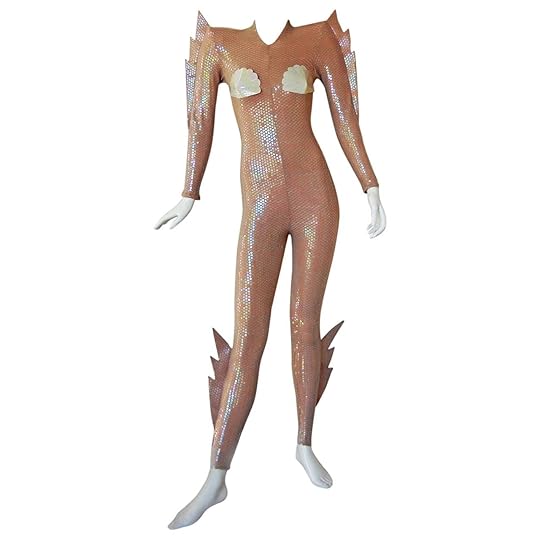
🐦🧚🏻🐬 For the Birds - 3⭐ Asimov wrote this science fiction story featuring a clothing designer for a French fashion magazine in 1978, but they changed their mind so it was instead published in Isaac Asimov's Science Fiction Magazine, May 1980 and reprinted here. Designer Charles Modine is invited to a space station on a commission to design wings! The purpose is to enable the settles to lower the station's rotation and get rid of the Coriolis effect so more people will want to settle. By seeing things as an artistic whole, he succeeds where technicians failed. Note: I wonder if the magazine story inspired the rare 1979 Thierry Mugler Galactic Siren Sequin Catsuit with Winged Fins?
🚬🛰️👽 Found! - 4⭐ First published in OMNI Magazine October 1978, Computer Two (of 4) is losing internal pressure so the protagonist and Joe have to head up to troubleshoot, something that has never happened as the computers are supposed to self diagnose and repair. While there, Computer Three starts losing pressure, if all 4 are disabled space flight grinds to a halt! Then the 2 technicians discover a tube that has bored a hole into Computer Two ... and more tubes inside ...
🍝🧄🤤 Good Taste - 4½⭐ Chawker Minor has returned home to his planet of Gourmets after the equivalent of a "gap year" traveling. He enters their planet, Gammer's Annual Finals a food competition where he wins with the most novel ingredient, but alas, local prejudice comes to the forefront when he reveals what the ingredient is.
📝✂📜 How It Happened - 4⭐ In ancient Egyptian times, a scribe persuades his brother to summarize his historical novel, told from the start, as they have limited funds and papyrus. The ending was fairly clever!
🚀🎬🌕 Ideas Die Hard - 3½⭐ Davis and Oldbury volunteer to be the first 2 men on a mission to the moon that requires manual intervention as the previous 3 unmanned craft have not returned. Unknown to them their conversations are being transmitted to Earth so mission control can study the effects of prolonged exposure to space on humans. Asimov admits this story has not "aged well" since mankind did get to the moon, but still, this story does reference that famous conspiracy theory!
🗣🔥🙌 Ignition Point! - 3⭐ Behind the scenes power hires a speech writer to help his political candidate reach the masses but gets more than he bargained for.
👨👨👦👦🖥️🛸 It Is Coming - 3⭐ An extra-solar object is on the way to Earth! As politicians are gridlocked, the woman in charge of Multivac has to take action, unilaterally, to modify Multivac and try establish some kind of protocol for first contact. Her husband aids her, and when the meeting does occur, only Multivac is able to make sure things don't go horrifically wrong. This is in essence, the smart thing to do, and reminiscent of what happened in the Godzilla movie clip here.
🤔🧏🏻😈 The Last Answer - 4⭐ After Atheist physicist Murray Templeton dies he is told by an all powerful being his job is to "think" for all eternity to amuse the being. Thus begins a battle of wits. This was pretty short, witty and clever, but not as good as The Last Question, for what else could an eternally existing being want?
🌍🚀🛰️ The Last Shuttle - 4⭐ A pilot is saddened to have to be the one that "pilots" the last shuttle away from a particular destination.
💊🧠🤷🏻 Lest We Remember - 4⭐ John Heath, an average man working for Quantum Pharmaceuticals volunteers to be a test subject for a drug that enables total memory recall. It works, he changes, consequences follow.
🏹🔁🖼️ Nothing for Nothing - 5⭐ Asimove wrote this after Alexander Marshak, Paleolithic archaeologist, suggested he do a story on Ice Age Art. An alien ship's Explorer thinks there's something on Earth, as it has managed to get the ship three consequtive Awards for Excellence (and its rewards) the Captain has to allow the Explorer the latitude to investigate. A trader is sent, discovers primitive earth folks do have something of value and ends up trading them something in return, WITHIN their rules, which will have long term repercussions. All I could think was this would never happen in Star Trek!
😈👩🏻🎶 One Night of Song - 3⭐ Collected in Azazel. George uses his 2 inch demon Azazel to help a friend get revenge on a mistress who cruelly dumped him - by giving her one night performing with a perfect voice. As with all deals with demons, this one has unforeseen after effects.
😈📸🤵 The Smile That Loses - 4⭐ Collected in Azazel. George, in an effort to get physical affections from Rosie O'Donnell, uses his 2 inch demon Azazel to capture her husband's radiantly happy smile in a photograph, after which, the husband turns into a complete grump ... Good story. Rosie is right, almost every spouse probably wishes they had that kind of picture of their significant other.
🪨🐍🏁💯 Sure Thing - 5⭐ Asimov says this 4th vignette is one of his favorite short shorts, and if we aren't groaning, snorting or making unfavorable noises when we've finished, he will be vastly disappointed. This Feghoot delivers and then some.
🌎👀⭕ To Tell at a Glance - 4⭐ Gamma's authorities have requested tour guide Elaine Metro's assistance to uncover a spy among the 5 tourists en route to their world. The spy is bent on sabotaging the station so the 13 outer world's bid for independence set to coincide with the American Tricentennial independence celebration will not pass. Decent mystery.
💨⏲✝️ The Winds of Change - 3⭐ Professor Dinsmore gives a very long explanation to 2 colleagues about how he's used the nature of physics that one of the two developed in order to gain an advantage through time travel. The ending is kinda ham-fisted, but it's always been true in any age.
Isaac Asimov (1920 – 1992) es un escritor que no necesita presentación. Novelista, cuentista, divulgador, bioquímico. Recordadísimo por su ciclo de las Fundaciones y por sus novelas y cuentos de robots positrónicos. Por lo visto, mantuvo una envidiable actividad literaria hasta avanzada edad, como lo prueban los cuentos de Los vientos del cambio, escritos incluso en la década de los ochenta del siglo XX. En dichos relatos, mantiene un chispeante sentido del humor – aunque con referencias un tanto incomprensibles para el lector no anglosajón – , incorpora extraterrestres a su narrativa, algo de fantasía y, lo mejor de todo, cobra por publicar. Como él mismo suele expresar en las deliciosas introducciones a cada uno de sus cuentos, “me pagaron muy bien” por cada relato. Así quisiera acabar mis días como escritor.
Los relatos incluídos en el volumen son:
– Acerca de nada (About Nothing), 1977 – Encajar perfectamente (A Perfect Fit), 1981 – Creencia (Belief), 1953 – Muerte de un foy (Death of a Foy), 1980 – ¿Intercambio justo? (Fair Exchange?), 1978 – Para los pájaros (For de Birds), 1980 – ¡Localizados! (Found!), 1978 – Buen gusto (Good Taste), 1976 – Cómo ocurrió (How It Happened), 1978 – A las ideas les cuesta morir (Ideas Die Hard), 1957 – ¡Punto de ignición! (Ignition Point!), 1981 – Se está acercando (It Is Coming), 1979 – La última respuesta (The Last Answer), 1979 – La última lanzadera (The Last Shuttle), 1981 – Por miedo de que recordemos (Lest We Remember), 1982 – Nada por nada (Nothing for Nothing) – Una noche de canto (One Night of Song), 1982 – La sonrisa que pierde (The Smile That Loses), 1982 – Absolutamente seguro (Sure Thing), 1977 – Decirlo de un vistazo (To Tell at a Glance), 1983 – Los vientos del cambio (The Winds of Change), 1982
De los cuales destaco Buen gusto (¿cómo serán las sociedades de las futuras colonias terrestres en el espacio? ¿cómo se abastecerán de alimentos?), La última lanzadera (¿qué pasará cuando el último ser humano abandone la Tierra?) y Los vientos del cambio (si un viajero retrocediera en el tiempo y cambiase la realidad, ¿nos daríamos cuenta?).
This is a 21 story collection of short stories written by Isaac Asimov largely between 1976 and 1982. The stories range in length from one to about 20 pages, give or take. It's a very, very uneven collection. Some of the stories are pretty good, some quite entertaining, some fairly bad, some you simply can't help asking what the hell was he thinking including in this book. Still, it's a short, fun read, for the most part. One thing I like about this collection is that Asimov writes a brief introduction before each story, which is pretty unique and cool. Another interesting thing is that he seems to be completely honest about these stories. He admits that probably more than half of them were rejected when submitted to various editors and magazines, and so these were ultimately published in his own magazine, Isaac Asimov's Science Fiction Magazine, whose editor, he asserts, was free to reject his submissions, and allegedly once did. Still, it's pretty much self published material that was considered not good enough to appear in other publications, so that tells you something about the quality of work in this book. Nonetheless, there are some good stories. In "Found," a two person male and female team of computer techs encounters an unknown space parasite while attempting to repair Computer Two, one of four computers/satellites orbiting the earth that control space travel and everything that has to do with it . It is a creepy story of a first contact that ends on a distinctly paranoid note. Not a bad story. The final story, "The Winds of Change," Asimov states is his favorite, and it's interesting because it's a complete monologue that takes a swipe at the newly formed Moral Majority. Interesting. So, some good stories in an uneven collection of somewhat decent pieces. Fun to read, but not essential Asimov. Borderline recommended.
This collection of Asimov stories seems primarily designed to prove that he continued to write science fiction (and fantasy) in the latter stages of his career. Most of these 21 tales have no connection to any of Asimov's earlier series (e.g. the Foundation, the robots, the Galactic Empire, etc.) although there is a single Multivac story in this volume. The stories range in length from less than a page to almost novella length and they vary in quality as well. Most are good to better, but a few are pretty lame. In addition, the stories here also give away some of the late Grandmaster's obsessions, including bad puns, academia, and Gilbert and Sullivan.
The best of the lot include four longer stories, where Asimov gets to explore one or more ideas at length. These include "Belief," a story of a college Physics professor who suddenly finds he can levitate (but knows that no one will believe him) and "Good Taste," a story about a cooking contest on an artificial world. Also pretty good are "Lest We Remember" which was apparently intended to be the pilot episode of a TV series and "To Tell at a Glance," which combines two of Asimov's favorite genres, science fiction and mystery.
The stories are arranged alphabetically, for reasons that are not sufficiently explained. That means the title story winds up in the clean-up spot. Fortunately, although not as long as the four entries noted above, it's still an apt closer. "The Winds of Change" short story reads like a mash-up of "A Sound of Thunder," The Handmaid's Tale and Asimov's own The End of Eternity. It's a creepy but effective ending.
There's probably nothing completely essential in this book, but it's not a waste of time either. If you have enjoyed Asimov's other short fiction, you'll probably like this one too.
This was a fun little anthology! I randomly discovered this book in Half-Price Books a few weeks ago and thought to myself, "A old paperback of Asimov stories that I've never read before? Sign me up!" As you may know (or not as the case may be), Asimov is one of my very favourite sci-fi authors and so I gleefully began reading this a few weeks back. 21 short stories contained therein, perfect for bedtime reading! Most of these were somewhat sci-fi themed, although I will say I was surprised by the somewhat grounded tone of many of them! Asimov's humor is definitely sometimes groan-inducing but I can't say I didn't enjoy reading every single one of these stories. For me(an Asimov and sci-fi lover!), this book was a definite success and I'm glad I got it. Will re-read at some point, I'm sure.
This is a collection of some of Asimov's short stories that were rejected for publication, and I tend to think that the editors did so for a reason. Most of these stories are pretty terrible, with only a couple of readable ones. Only the staunchest of Asimov fans would enjoy this collection, I think. I was somewhat of a fan of Asimov for a while, although my admiration has been trickling away over time due to the rather poor aging of his stories. These not only age badly, they were bad to begin with.
Quatrième de couverture: Onze nouvelles écrites de 1977 à 1982. Tantôt brèves, ou même ultra-brèves et reposant parfois sur des calembours dont Asimov lui-même a la grâce de rougir, tantôt très élaborées comme dans le texte qui donne son titre au recueil et où un physicien explique à ses collègues qu'il a exploité leurs propres théories afin de remonter dans le temps et de modifier la société pour les empêcher d'avoir la promotion qu'il convoite lui-même... Exemple particulièrement tordu de la logique très spéciale qu'Asimov, on le sait, pratique en expert.
I've been reading Isaac Asimov since I was a young child. The first book I read of his, The Gods Themselves, introduced me to Sci-Fi, and I never looked back. So as usual, I find his writing in this book, "The Winds of Change" entertaining and insightful. As always most of his stories have a little twist by the end, and are in general thought provoking.
For whatever reason though, I could not seem to get into this set of stories as much as I have some of his other writings, though I would still recommend it as a read as at its worst its a nice diversion.
Some books get 3 stars because they are good but flawed this one gets it because it is consistently alright. Nothing mind blowing, a few clever concepts, some funny vignettes (and one truly groan worthy one). You can marvel at the sheer variety of Asimov's target audiences and publication (his comment about science fiction suitable for young women amused me probably more than intended) but in many ways that is both a blessing and a curse. This is magazine science fiction and is therefore short format and inoffensive aimed at a wide audience.
,,Tu ești ușor de explicat, chiar și pentru tine însuți. Dacă vrei, poți să te numești un suflet, dar în realitate ești un nod de forțe electromagnetice, aranjate în așa fel încât să imite perfect toate conexiunile creierului tău, cel din perioada când făceai parte din universul palpabil. De aceea poți să gândești, să simți, să ai amintiri și să-ți păstrezi vechea personalitate. Încă mai ai senzația că ești tu.,,
Isaac Asimov had a long career, and in that time wrote many stories that saw little, if any, readers. the reasons vary, but the book "the winds of change" contains many of these stories.
The shortest of the stories is less then a page, and the longer ones are about ten pages more or less, each with a introduction from Isaac telling some about the stories creation. This collection is good for those who like Sci-fi and/or short stories.
এভারেজ আজিমভ। আমরা এর চে ভালো এবং এর চে খারাপ গল্প দেখেছি আজিমভের। সেহেতু এভারেজ। কিছু গল্প আলাদা করে বলার মত ভালো। লিস্ট দিতে ইচ্ছা হয় না। অনেক গল্পই আগে পড়া। আগে যখন পিসিতে পড়তাম, তখন। মাপজোক ছাড়া নীলক্ষেত কপি একটা, হাতে। কপিটা ভালো হয় নাই। তবে পেজ মিসিং ছিলো না। তিন চারটা গল্প আসলেই, খুবই, খুবই, ভালো। কমবয়সে আজিমভ এর চে ভালো ছিলেন বলে মনে হয় না। হয়ত এর চে কনসিস্টেন্ট ছিলেন।
Like most short story collections, even—maybe especially—those from a single author, this one ran hot and cold, from the excellent, period-perfect "orbital world" stories to the very punny short-shorts to the teeth-grindingly dull title story, which is literally a 15-page monologue. Still, if you're a fan of classic mid-century science fiction, or of Asimov in particular, it's definitely worth a read. A great nightstand book.
This collection by Asimov is similar to his Buy Jupiter in that the stories are preceded by an introduction by Asimov about the circumstances and incidentals for each one. They are definitely a welcome addition to this overall so-so collection.
The stories I consider 5-star:
"A Perfect Fit" "Belief" "How It Happened" "It Is Coming" "The Last Answer" "Lest We Remember" "Sure Thing"
I didn't enjoy these as much as Asimov's longer stories. These seemed trivial and too gimicky. I guess that's the harm of having stories that run 1-10 pages... not enough time to actually develop a complete & full atmosphere.