Poetry, fantasy, and Django Reinhardt are woven into a fairy tale about solitude and awakening the creative spirit in this graphic novel. Charlie is a mouse who enjoys his solitude, staying up late nights indoors to listen to records and play his guitar; he experiences the outside world only through the windows of his house. As Charlie begins to stumble with writer's block, a bluebird named Mr. Solitude arrives to encourage Charlie to search for inspiration outside of himself and his home. Told with a melancholic and heart-warming lyricism, this tender story combines pithy observations with whimsical illustrations to create a simple yet poignant tale for readers young and old.
This is kind of an odd little comic. I picked it up at a kid's book review council, but it really isn't for kids. Not that it's particularly inappropriate for kids (there is some drinking and smoking, but it's not excessive), but that the ideas in it are pretty deep and metaphorical. At first, I thought that the title referred to the names of characters, but they're actually a metaphorical statement and symbol about the nature of creativity and what it means to be an artist. In some ways, I was reminded of Page by Paige by Laura Lee Gulledge, but I thought this book treated the subject of creativity in a little bit more of an opaque, adult manner. It just wasn't really a kids' book. I can see upper high schoolers who want to be writers loving and identifying with Charlie the mouse's feelings about writer's block and the creative process, but this will be much too dense for younger kids. Not bad, but visual metaphor and relatable characters are treated much better in Gulledge's book. I'd read that one instead.
Once again Dillies art is so adorably cute but again the story is not for children. This is a very deep philosophical story about writer's block and not particular to my tastes as much as his other two I've read to date. I must say I preferred the art in this one though! Birds played the major role in the others, but he does such a cute, expressive mouse in this one that I just loved Charlie. The title is quite obscure and takes some thinking to grasp the meaning of, while perhaps thinking it could have had a better title. The book examines self-imposed solitude which becomes personified in a small, possibly imaginary, bird called "Mister Solitude". Charlie struggles with his writer's block, his solitude vs loneliness and learns that one can only write what one has experienced through the experience and participation in life. Good, but Betty Blues is my favourite, followed by Abelard.
A struggling writer mouse starts seeing a bird named Mr. Solitude when he gets lonely. It's all in his head... or is it?
Loved the way this evoked more than showed what was happening. It did show what was happening, but it was more than that. The narration, coloring, and especially facial expressions on Charlie worked really well together, and the tone was like the charming parts of a Jean-Pierre Jeunet film.
The French, they aren't like us. Which is a good thing. I ordered this for J GN thinking based on erroneous reviews it was a children's title. It is not. But still the art is wonderful and the story or a mouse author who thrives on solitude but learns this may not be the best for his art is lovely. Just not for 8-12 year olds.
Wonderful and sweet describes both the story and the artwork. A useful message that plays with existentialism but keeps it simple, and the drawings are charming and unique. Read it two or three times.
This is a "weekend tale" of Charlie the mouse's "spirit quest" for direction and inspiration while trapped in a writer's creative fugue. The "spirit" comes in the form a tiny, bent stove-top hatted, blue bird named Mr. Solitude who gives Charlie metaphors for his struggles and sends him on dreamscapes to help him free himself.
It has some great ruminations and correlations about the congruence of one's internal self and their unique perception of all that surrounds them (his has a splash of Cervantes) and the difficulties that arise in expressing ideas that congeal from that into words that others will appreciate.
I wanted more of the problem explored in more detail but I can relate to the vagueness that can be the nature of that kind of thought exposition.
I'm just silly about the art- That's what rounded it up to ****. His anthropomorphic characters and appropriately matching, original backgrounds are whimsical, adorable and unrestrained- it's all absolutely precious! But fear not dudes, it's not "childlike" or "feminine" in the least.
If you want to write but all you can think of is the menacing whiteness of the sheet of paper before you, read this cute little French comic. It will take you for a short ride on a ferris wheel and show you how a little mouse tries to overcome his loneliness and writer's block. Although not mindblowing, it is a fun read. I feel the story could have been a better well-rounded, as it feels as if the writer jumps from idea to idea, without establishing a connection.
Like the illustration style and the story telling, the sadness and solitude is very much to the point! It describes emotions that hardly can be described by words.
Live in the din of our dreams and feigning silence
This entire review has been hidden because of spoilers.
Bubbles and Gondola is the sleeper hit of the year in comics.
I discovered it purely by chance. While browsing around the library, I decided to check out Bubbles and Gondola based on the cover alone (I was attracted by how it vaguely resembled Krazy Kat). I hadn’t heard of it before, nor did I recognize the author or the publishing company NBM. I loved it. I haven’t felt so enthusiastic about a new comic in a long time. Then, a week or two later, I saw it was up for an Eisner award. Apparently, others had stumbled on it the same way I had.
At first glance, Bubbles and Gondola looks like it’s a comic for kids, but beyond the cute animals, it’s definitely one to be best enjoyed by adults. Granted, there’s little in it to make it unsuitable for children (unless you’re opposed to your kids seeing a cartoon mouse smoke a cigarette or later getting drunk). The content though will be most appreciated by adults who have experienced extended bouts of loneliness, or have wrestled with creative blocks.
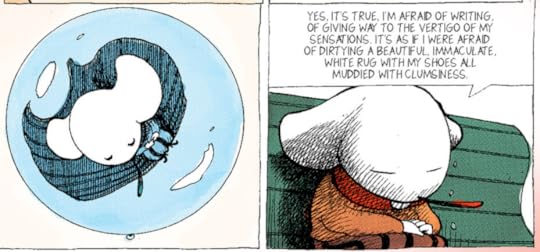
The story is about a mouse named Charlie who lives alone and longs to write a piece of what my college teachers liked to call “capital L literature.” He struggles to put his angst and anxiety into words, but instead falls into long periods of introspection, punctuated only by the appearance of a plucky bird who may or may not be imaginary. Thanks to the intervention of his new friend, Charlie is prompted to go off into his own flights of fancy.
The real attraction of the book is its art. I was often amazed by the amount of artistry put into every panel. Renaud Dillies does something only a few comic artists are good at: he purposefully uses a series of simplistic images only to surprise us when beautiful scenes show up all of a sudden. Chris Ware is a master at that, but Renaud Dillies brings in a vintage appeal that will fascinate anyone who likes old Disney cartoons or fine art. Bubbles and Gondola is one of the few comics I’ve ever found that came close to attaining the synthesis of high and low art that I haven’t seen since Jacques Tardi‘s comics from five decades ago.
The only thing close to a weakness in Bubbles and Gondola is the ending. As a fiction writer myself, I would’ve preferred the story to come full circle, or to reach what I would consider to be a real conclusion. Instead, it ends on a bittersweet note that might very well please most of the readers, but it left me wanting more.
Speaking of wanting more, hopefully the Eisner award nomination will influence Renaud Dillies to create more comics with the same level of artistry. At the very least, I’m hoping success abroad will influence the publishers to translate more of the work he has completed in the past.
Bubbles and Gondola can be read in half an hour, but it’s worth owning if you’re like me and you like to try and emulate other artists by staring at their work. I spent hours simply staring at Jacques Tardi’s The Adventures of Adele Blanc-Sec, and something tells me when I get around to ordering Bubbles and Gondola, I’ll do the same.
This is not a kid's book though it looks and acts like one in many ways. Only it is a bit trippy (not that kids books aren't trippy) and about a mouse who may be young but seems old, and who winds up in a proverbial rabbit hole after trying to hide from the world. A carnival comes through town, drawing him out of his hibernation and he experiences some strange hallucinatory things, and finally gets really really drunk and plays guitar with a band and has a great time (before waking up with a serious hangover).
I probably would have rated this a three but it is so refreshing to see our mouse has a family who actually seems to be happy about the fact that he's an artist. How often do we meet a cheerful family who takes it in stride to have a lonely, depressed and not terribly productive artist in their familial midst?
To be honest I really don't know quite what this book is. Maybe an allegory warning against artistic isolation? Or a training manual for families of starving artists. (Invite them to dinner and be nice to them!) Or? Maybe I don't need to know. Just enjoy the charming little adventures and remember to visit the world every now and again.
I liked it. The art is fetching--old-timey and charming, with nice clear lines. (I am borderline graphically illiterate, and I have a hard time with muddy lines.) Really, it is beautiful to look at. The conceit, that Solitude appears to the loner protagonist as a blue bird, is intriguing and interesting. I enjoyed it for that, and because I could identify with the poor little mouse who just wanted to be left alone to write. Sadly, as a story, it did what many stories in graphic format seem to do--it faded away at the end with no discernible meaning. What started off so strong and clear ended up ... well, if the pictures had done what the story itself did, the colors would have run together and the lines would have gotten all fuzzy. This is not a complaint about the book itself. I see that sort of thing in many recent books and I suspect that much of the problem lies with me.
I enjoyed the book and would highly recommend it to anybody who likes good art serving a good story. Perhaps you will be better adept at finding meaning in the ending that I.
Such a sweet little book, and beautifully drawn. About the little mouse Charlie with a writer's block who is visited by the bird Solitude. It's a bit hard to interpret the end, I guess it's part of the point. Being a softie at heart, I don't find it too hard to imagine that better things will start happening to Charlie now.
Favorite quote: "Do you know what you and the kid blowing bubbles over there have in common? That’s exactly what I cannot manage to do! You decorate the four corners of the city with hundreds of light strings, whereas he lets go a few soap bubbles that float for an instant wherever the wind blows. And all for what? If only for a moment, just to make things prettier… and ultimately, more bearable. I’d like to write life like that. My sentences would be light strings and my words bubbles… weaving the fabric of a translucent veil embroidered with dreams… hoisting my sensations on the highest mast of a paper boat… and letting the wind blow. Breathe."
Strange little comic about a mouse named Charlie who wants to be a writer. Charlie lives by himself, enjoying his solitude, until strangers begin to intrude and make him realize that maybe being alone all the time isn't so great. With no inspiration for his writing, he ventures outside of his home, getting caught up in the carnival taking place in town, and finally finding the inspiration he's been missing.
This is a quirky read that missed the mark with me. I found the character designs weird, and I failed to connect with Charlie's search for inspiration. Charlie realizes that fear has been holding him back from all of the wonderful experiences of life, and once he finally lets go of his fear, he can finally overcome the writers block that has plagued him. I never felt engaged in the story, so Charlie's triumph lacked satisfaction for me.
an exquisite little book that borrows from the visual language of children's picture books to tell a story that will resonate with kids of all ages. Plus, it's good to see someone use mice in a fresh way. Charlie is desperately trying to rationalize a love of his solitude and his writer's block when he is swept up in the carnival that comes to town. Charlie is by degrees brought out of his loneliness and is creative emptiness by rides, family gatherings, and the play of being at the carnival. the art is simply stunning, even when it mocks its rather conservative panel lay-outs. the whole thing has a strange magical dream-like quality to it one finds hanging around fairy tales.
A short, charming tale about a mouse named Charlie. He relishes his solitude, or at least he thinks he does, and he has complete and utter writer's block.
It's a short snippet into the life of Charlie as he slowly ventures outside in search of inspiration to cure him of his emptiness, both in writing and socially speaking.
High-falutin little mouse tale of writer's block. Maybe I am missing something in the frenchiness of it all? But it looks pretty doing it. I think I had built it up a bit too much in my mind.
Lovely illustrations and a simple story. Sort of feels like a children's book at times but isn't (although I'm sure kids would find a drunk mouse kind of funny...and the drunken-ness part would probably go over their heads anyway).
LOVED THIS! Romantic, interesting. Seems like it comes out of the European comics tradition. About solitude and friends. Message is great but also just love the story telling technique and the art. Really beautiful. Book SMELLS AMAZING TOO! :D
A mouse struggles with writer's block and muses on the meaning of existence and, more acutely, solitude. It's true this isn't a book aimed at kids, but there's nothing they'd find traumatic and the art is engaging and magical. Let them work out what it means on their own and in their own time.
Profondamente poetico. Per chi ama scrivere e leggere. Per chi vive quotidianamente "il blocco dello scrittore" da intendersi come blocco del "vivere" appieno la propria esistenza per paura delle vertigini che ogni nuova esperienza può dare.
Een muis overwint zijn writersblock door opnieuw te leren kijken zoals hij vroeger, als kind, deed. Poëtisch en zonder duidelijke verhaallijn, met tekeningen die uit een kinderboek lijken geplukt te zijn en die daardoor net de boodschap versterken. Dromerig zonder zweverig te worden.
picked this up since it's nominated for an Eisner award. a sweet exploration of solitude and the artist's life. great illustrations. ultimately there wasn't enough to the story to make me love it.