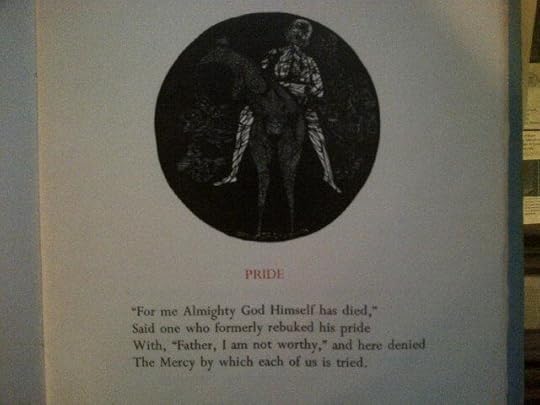
From the Poetry Foundation biography of Hecht: The Hard Hours (1967) broke with many of the mannerisms that marked The Summoning of Stones. According to Laurence Lieberman in the Yale Review: "In contrast with the ornate style of many of Hecht's earlier poems, the new work is characterized by starkly undecorative—and unpretentious—writing." Hecht’s mature style was evident in poems like “More Light! More Light!” one of his most famous poems and, some argue, the finest poem in English to address the Holocaust. The poem opens with the burning of a Christian heretic in the Tower of London, but swiftly moves to “outside a German wood,” recounting a horrific event of the Holocaust in an attempt to capture how “barbarism dehumanizes its victims,” according to poet Ed Hirsch. Also described as a depiction of the “end of Humanism,” Hecht’s poem is one of his most frequently anthologized and discussed. Other poems that treat the Holocaust and Jewish trauma, like “Rites and Ceremonies,” as well as lighter verses such as Hecht’s response to Matthew Arnold, “The Dover Bitch,” have become standards in the twentieth century canon. The Hard Hours won the Pulitzer Prize.
From the back cover: This collection includes a generous selection of poems from Mr. Hecht's famous first book, A Summoning of Stones, long out of print and impossible to find. It also features the seven brilliant woodcuts that Leonard Baskin made for the original limited edition of The Seven Deadly Sins.
Published in 1967, The Hard Hours (his second collection, after 1954's Summoning of Stones) turned out to be Hecht’s breakthrough collection. It’s easy to see why. Although known as a “formalist,” Hecht was no dusty antiquarian writing about the days of yore. Though history always has its place (since it’s never really absent from the present), these are primarily hard poems for a hard century. Images of horror abound. Death camps, eyeless corpses, feasting birds, a flayed Roman emperor whose skin is then stuffed (and mother of pearl eyes inserted), seedy post-Pruforck encounters and conversations in bars (with no mermaids singing), Hecht supplies a Job-like witness to Hell, but with the question to God of Why? left largely implicit. Oh, the question gets asked, but it’s largely rhetorical, as posed in the powerful Holocaust poem “Rites and Ceremonies”(“Was it a Judgment?”). The question is not so much aimed at God, but at the Catholic Church, and earlier in the poem Hecht asks the more strategic question:
Who now remembers the “Singing Horses of Buchenwald”? “Above all the saving of lives,” whispered the Pope.
With one word, “whispered,” Hecht delivers a devastating indictment, and then the dark catalogue:
But for years the screaming continued, night and day, And the little children were suffered to come along, too. At night, Father, in the dark, when I pray, I am there, I am there, I am pushed through With the others, to the strange roo Without windows; whitewashed walls, cement floor. Millions, Father, millions have come to pass, Which a great church has voted to “deplore.”
And Hecht speaks from experience, since as an infantryman in WW 2, he took part in the liberation of Flossenburg concentration camp. And as a Jew, he was more than there, as his repetition of “I am there” underscores. And the stanza’s closing word “deplore” works in devastating concert with the previous “whispered” to seal the sin of omission. (Though on a lower scale as far as evil goes, this current reader can’t help but hear an echo in the current world-wide tour of “apologies” regarding the pedophilia scandals.)
The collection closes The Hard Hours portion of the book with “It Out Herod’s Herod. Pray You Avoid It,” a more personal poem, since it’s Hecht the father speaking, observing his children watching television:
Tonight my children hunch Toward their Western, and are glad As, with a Sunday punch, The Good casts out the Bad.
But Hecht has seen too much, experienced too much, for like any good father, he worries:
All frequencies are loud With signals of despair; In flash and morse they crowd The rondure of the air.
For the wicked have grown strong, Their numbers mock at death, Their cow brings forth its young, Their bull engendereth.
And with such an overarching darkness, what father wouldn’t feel inadequate in his inability to protect his children, who view him as the hero, their “God,” their “Santa Claus,” especially when that father has seen the death camp ovens.
On a personal note, several years ago I had the opportunity to go to a reading by Anthony Hecht. He was the epitome of the Gentleman Poet. After the reading, we had the opportunity to ask questions. Around that time, Ecco Press was releasing its Essential Poets series. Mr. Hecht had been chosen to write the introduction for The Essential George Herbert. I asked him who he felt closer to, Herbert or Donne (since I felt Donne to be a major influence on Hecht’s poetry). Mr. Hecht replied that, (and I’m paraphrasing) it was true that Donne was a major influence, at least as far as tone, to his earlier poetry, he felt, as he was getting older, closer to Herbert – or at least he hoped that was the direction he was headed. Hecht’s poetry is a complex poet, but one who uses, for the most part, plain, straightforward language. His views toward God, History, Art, and Morality, I could not begin to breakdown or capture here. I’m just not equipped, and I’m pretty much flying by the seat of my pants on the above. There is a fine essay by David Yezzi on Hecht that appeared in the New Critereon (“The Morality of Anthony Hecht”). If you’re interested in Hecht, it’s available online:
I wonder if it bothered Anthony Hecht that he is best known for his poem in response to Arnold's "Dover Beach"? I'm pretty sure that is all I'd ever read of his till I picked up this volume. I thought I recognized one poem here, but that turned out to be by Baudelaire. All the poems I like best turned out to be translations of other poets, in fact. Hecht calls them poems "after" Baudelaire, de Alibray, Du Belley -- I had usually taken that to mean "in the style of" but these are as close as many things I have read presented as translations. I'll give an example, under spoiler tags for space consideration.
My point here is not accuse Hecht of plagiarism, but to say that I don't think he's a first rate poet. He is smart, and talented, and obviously well-read, especially in the classics. But he seems more interested in flourishing his erudition and his ability to construct complex verses than in either depth of meaning or overall aesthetic effect.
Hecht's friend Ted Hughes states in the blurb, His work was remarkable enough for its classical poise and elegance... this most fastidious and elegant of poets shed every artifice and began to write with raw simplicity and directness. I would agree with the first half of that description but not the second.
Hecht is at his most Kennedy-ish in "The Man Who Married Magdalene"
I have been in this bar For close to seven days. The dark girl over there, For a modest dollar, lays.
And you can get a blow-job Where other men have pissed In the little room that's sacred To the Evangelist--
If you're inclined that way. For myself, I drink and sleep. The floor is knotty cedar But the beer is flat and cheap.
And you can bet your life I'll be here another seven. Stranger, here's to my wife, Who died and went to heaven.
I was encouraged to be mediocre. When I was quite young, I developed a fierce interest in music and started to teach myself the piano; my mother then lost all interest in music, and quit playing. When my brother and I started to write poetry, she stopped reading poetry abruptly, and firmly declared she “couldn’t understand” anything written by either of us. At one point my parents exhibited such despondency and doubt about my ability to do anything whatsoever that they spent a large sum of money to have me tested at the Pratt Institute. The test took several days, and I hated it because it was just one more ordeal of scrutiny and evaluation that was likely to humiliate me. Finally it was over, and then the results came in. I was told nothing, and was tormented between a desire to know and a fear of knowing. At last, aware that a lot of money had been invested in this test, I forced myself to ask my mother about it, and was told in a tone of mild regret and resignation that the aptitude tests indicated that I had no aptitudes whatever. As the evidence continued to pile up on all sides it became increasingly difficult to attain any confidence in myself; and I wanted alternately to be dead or to be “old,” which meant to me, in either case, no longer under the scrutiny of authorities I was powerless to combat. So the “sadness” you speak of in the poems is the matured and mellowed residue of what in childhood had been a poisonous brew of fear, hatred, self-loathing, impotence, and deep discouragement.
A mixed bag of poetry, some amazing, especially when the poet used his own experiences. But he made some pretentious stabs at classic stories which left me cold.
“”If there were hushed To us the images of earth, it’s poles Hushed, and the waters of it, And hushed the tumult of flesh, even The voice intrinsic of our souls, Each tongue and token hushed and the long habit Of thought, if that first light, the given To us were hushed, So that the washed Object, fixed in the sun, were dumb And to the mind its brilliance Were from beyond itself, and the mind were clear As the unclouded dome Wherein all things diminish, in that silence Might we not confidently hear God as he wished?””
My thoughts waffled as I read this book of poems, enjoying the lyricism the flights of vision, and yet perplexed at the continual and obvious references back to older poems and poets. It seemed to me that the messages were often weighed down by the footnotes of history rather than appearing as multi-dimensional enough to slip through the annals time as effortlessly as the author intended.
Some stunningly lucid moments, so more a 3.5, but also I do feel like the natural flow is hindered by the strict adherence to forms. Great range of subjects though, and lovely to speak aloud.
Overall a mixed bag, but some of the poems in here (“A Hill,” “Adam,” “Rites and Ceremonies,” & “More Light! More Light!”) will stay with me for a very very long time.
The famous poem "Dover Bitch," which is Hecht's send-up of Matthew Arnold's shallow gravity, is much funnier on its own; amidst what is a very serious collection, it sticks out and seems merely juvenile.