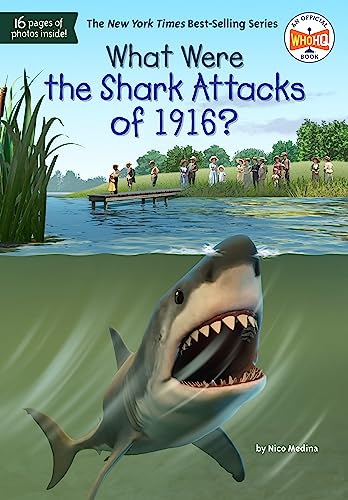
The panic-filled summer of 1916, when multiple deadly shark attacks shocked the nation, is chronicled in this gripping addition to the New York Times Best-Selling What Was? series.
On July 1, 1916, witnesses watched in horror as twenty-eight-year-old Charles Vansant was attacked and killed by a shark in shallow water off Beach Haven, New Jersey—the first recorded shark attack in American history. Scientists claimed a shark could not be responsible, but more deadly attacks soon followed along the Jersey Shore and up the freshwater Matawan Creek, setting off a nationwide panic that led the White House to declare a “War on Sharks.” In this illustrated book, which features 16 pages of black-and-white photographs, readers will learn about the likely culprit (or culprits) in the attacks—the great white shark and the bull shark—and how the bloody summer of 1916 would change how people viewed sharks forever.
Language: G Romance/Sex: G Violence: PG+ (shark attacks, blood, injuries, surgery, death) Appropriate Age: 8+ Triggers/Warnings: shark attacks, death
I've enjoyed many Who Was Series books, I was disappointed in this one. It read like a fiction, and really might have been in certain ways. While I didn't do as much research as the author (hopefully) did, I found several errors and/or suspicious tales, that I couldn't substantiate. And while some people might say that the bulk of the work was fine, the devil is in the details. I feel like it shows a lack of concern for children and for true education when "non-fiction" "educational" children's books take such liberties, if not actually making things up. Call it a historical fiction, but unless it's 100% accurate to your best knowledge then it's not non-fiction.
Here is the mess I sent to the publishers because I was bothered.
To whom it may concern,
I have read and enjoyed several Who Was Series books, I have been able to dig deeper into many subjects because of things mentioned in these books. I was particularly impressed with "What Do We Know About the Nazca Lines?" So much rich information to study further.
However, I just finished "What Were the Shark Attacks of 1916?" and I am so frustrated that I'm taking time to contact you. I'm concerned that details of this book have not been researched thoroughly or fact checked enough. Yes, the major events are accurate and written with some liberty for story form. And yes, tangential subjects seem accurate. But there are suspicious errors/lines that undermine the credibility of the book and therefore the series.
Mind you, I was reading this book for pleasure, not to critique it, and as of now, I've only done several hours of research myself (my family thinks I'm nuts,) but as an avid reader, a teacher, a homeschool teacher, and a parent I am passionate about and sensitive to non-fiction material presented to children. And I do enjoy rabbit holes and spontaneous research of fantastic claims.
Here are some of the items that concerned me:
Page 11- diagram of sharks with inaccurate/confusing labeling. The female shark is supposed to be the larger one, the numbers and the paragraph say so but the label for the larger shark is male.
P. 17 "Workers building the US naval base at Pearl Harbor discovered the remains of a four-acre underwater pen... hosted death matches... the sharks usually won." This event sounded interesting so I went to learn more and couldn't find a single mention of the event anywhere. There are related topics like the US naval base being built over fishing pens and being told about legendary guardian sharks that protected fishermen. There are legends of shark fighting. If anything there seems to be a single article from the Smithsonian that has a paragraph on "gladiator-style shark pens" but this article seems questionable too since it doesn't have any bibliography and there is no mention of this in any Hawaiian cultural sources. I have found multiple sources on ancient shark fishing that included hand-to-hand engagement.
In the book it used the term "is believed to have hosted" which I will concede is a term that includes legend, but having the following sentence be "The sharks usually won" implies factual knowledge.
P. 26 "One hotel restaurant ceiling was also the glass bottom of a sunlit aquarium!" Again, I thought this was interesting enough to look into. I simply can't find any records of any restaurant like this at all. Maybe the author is referring to the fantasea reef buffet, some 70 years later.
P. 49 while not strictly wrong, the image paired with the wording of the paragraph, feels easily misunderstood by kids, if not misleading. "he punched at them- and one by one, they swam away." All historical accounts say that he thrashed in the water and they were "scared" away. He didn't punch any or take them on one by one in some kind of fight, although he was a boxer himself.
P. 63 I can find no known records of a Bayonne policeman shooting an 8-ft shark in the head repeatedly in front of children, before the shark swam away. Where is the author getting these stories?
Overall, I would love to see this book revisited by thorough editors and fact-checkers, perhaps mentioning this book on your website with corrections and republished it. My hope for the future is that all Who Was Series books will be held to a high standard of accuracy in factual education, including thorough bibliographies like some of the Who Was Series already has. I would love to lean on this series for educating our next generation!
On July 1, 1916, witnesses watched in horror as twenty-eight-year-old Charles Vansant was attacked and killed by a shark in shallow water off Beach Haven, New Jersey—the first recorded shark attack in American history. Scientists claimed a shark could not be responsible, but more deadly attacks soon followed along the Jersey Shore and up the freshwater Matawan Creek, setting off a nationwide panic that led the White House to declare a “War on Sharks.” In this illustrated book, which features 16 pages of black-and-white photographs, readers will learn about the likely culprit (or culprits) in the attacks—the great white shark and the bull shark—and how the bloody summer of 1916 would change how people viewed sharks forever.
On July 1, 1916, witnesses watched in horror as twenty-three-year-old Charles Vansant was attacked and killed by a shark in shallow water at Beach Haven, New Jersey--the first recorded shark attack in American history. Scientists claimed a shark could not be responsible, but more deadly attacks soon followed along the Jersey Shore and up the freshwater Matawan Creek, setting off a nationwide panic that led the White House to declare a war on sharks."
I saw this book advertised in the children’s section of our library but was so interested I had to check it out. I enjoyed learning about these attacks and appreciated the historical context that was presented (polio sending folks out to the beaches, threats of uboats more worrisome than sharks, etc).
I felt my heart racing a little bit when reading this. And I had no idea there were some freshwater sharks as well. These books are always so well done!
A good report of an unknown series of events to me. I thought it was a bit too graphic for young readers. The deaths of several individuals, including a few children, were chronicled.
Okay, well, apparently I need history stories in kids' book format right now. Much better written than I had anticipated, and really neatly laid out the story.
This book taught me so much because before I read it, I didn’t know much about the Shark Attacks of 1916 and now, I can say I am an expert! Amazing Book!