A thrilling literary-historical novel with a modern twist, in the vein of Fingersmith by Sarah Waters and Fayne by Ann-Marie MacDonald.
Curiosities opens with a present-day amateur historian, Anne, who describes her unexpected discovery of five seventeenth-century manuscripts that, astonishingly, tell the same strange story from vastly different points of view. The five manuscripts spin this after the Plague descends upon a village in England, two small children, Joan and Thomasina, are the only survivors. They bond tightly with each other and with a woman living in the forest nearby, who discovers and cares for them. When people return, the woman, as the lone adult alive, is accused of witchcraft, and the children are separated. Joan is taken on as a maid in the local manor house, and through her intelligence and skill becomes a companion to the fascinating Lady Margaret Long. Thomasina, sent on a sea voyage to Virginia, adopts boy’s clothing and navigates life as a man named Tom.
Tom and Joan find each other as adults and fall in love, but are discovered together, naked, by a young clergyman. Shocked and horrified, he believes there is but one explanation for Tom’s Joan must be a witch. Desperate to save both himself and Joan, Tom runs as far away as he can, to the North Pole. And so it falls upon Anne, the contemporary historian, to piece together these interlocking stories, discover the fate of the lovers, and add her own layer of “truth” to a history and time period when there were no labels for who Tom and Joan might truly be.
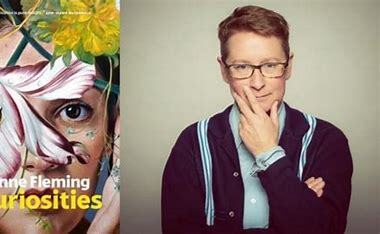
Anne Fleming is the author of five books: Pool-Hopping and Other Stories, shortlisted for the Ethel Wilson Fiction Prize, the Danuta Gleed Award and the Governor General’s Award; the critically acclaimed novel, Anomaly; Gay Dwarves of America, also shortlisted for the Ethel Wilson; poemw, a book of poems shortlisted for the BC Book Prizes’ Dorothy Livesay Poetry Prize; and The Goat, a novel for children. Her non-fiction has been published in a raft of anthologies, including Persistence: All Ways Butch and Femme, Great Expectations: Twenty-Four True Stories About Childbirth, and You Be Me.
Anne grew up in Toronto and lived in Kitchener, Ontario for a chunk of time before moving to Vancouver, where she received her MFA from UBC. Her fiction has won National Magazine Awards, been commissioned by CBC Radio, and widely published in magazines and anthologies.
A highly regarded teacher of creative writing, she has been on faculty at both UBC campuses, Emily Carr University of Art and Design, and the Banff Centre for the Arts. She now divides her time between Vancouver (unceded Coast Salish territory) and Kelowna (unceded Syilx territory), where she teaches at UBC’s Okanagan Campus. She likes to cross-country ski and play the ukulele, although not necessarily at the same time.
The Bronze Award Read of 2025 (third favorite read)
Warm thanx to Netgalley, Penguin Random House Canada and most importantly to the author for an ecopy. This was released April 2024 (also nominated for 2024 Giller Prize). I am providing an honest review.
Imagine a violet cauldron in a lavender room with deep purple flames underneath. There are three grand duchesses of literature there stirring the pot and chanting the songs of angels. Mizz Zadie (Smith) adds vials of astuteness and compassion (for all), the spirit of Dame Byatt adds classic and erudite wafers (yes wafers honey) that dissolve in the magenta brew and Jeanette Winterson adds beauty and sapphic allure in the forms of indigo dried roses. Let the stirring bubble up and create a most intriguing, breathtaking piece of literature.... OR (in our real world)
You could pick up Curiosities by Anne Fleming and delve into one the most alluring historical fictions that I have ever had the pleasure of reading or perhaps imbibing is a better word.
This is one of the most pleasurable, enjoyable and thought provoking novels that I have ever read. We are taken into 17th Century England, Germany and Hudson's Bay and learn about some of the most interesting times and people. We have plagues, sea faring, witch hunting, demonology, science, nature and varieties of lesbian love and gender expression. This book is intricate, detailed, deeply moving and a tribute to female queer experience. The more patience a reader has the deeper in love you will fall....
“For another week was our progress fitfull: We sayl thorow ice. We hit ice. The wind comes contrary. We anker. The wind comes faire. We way. We hit ice. James goes ashore. James sends the boate to check the tydes. Fog descends. The boate cannot find her way back. We sound a gun. We put in hooks and take no fish. We see no salvages, nor any beasts. We growe wearie of one another’s companie.”
I’m sorry to admit I hit ice a few times and made fitful progress, myself, though neither is this a story that missed its mark, nor will it ever be forgotten. For one thing, I grew tired of constant manifestations of the devil – the “divell” – but the author can hardly be blamed for that, in a novel that features seventeeth-century nonsense. Five stars for the research and ambition alone, as well as for colourful characters whom I mostly enjoyed following (with marked exceptions); quite simply, fewer stars to capture my overall enjoyment, in good part because of depictions of despair that lasted way too long and completely broke the story's progression more than once.
They say that being nominated for a prestigious literary prize can boost an author’s career - and book sales. It is certainly true that these lists bring books to my attention that I might otherwise have missed.
I don’t typically make a point of reading more than one or two longlisted books from any list, and when picking from this year’s Carol Shields Women’s Fiction award nominees, I wanted to pick a Canadian, not American, author. Which brought me to this clever, beautifully textured book.
The structure is a little complex, but not at all difficult to follow. A contemporary author (a stand-in for Anne Fleming herself) becomes intrigued when she stumbles on a 17th century manuscript. She is motivated to continue searching and eventually discovers documents written by five different people, but all related in some way to the same event. The author weaves these together into a tale that turned out to be irresistible to me.
What makes up this story? Wave after wave of plagues and other deadly illnesses (childbirth being high on the list). Social stratification based on wealth and family history. Transatlantic voyages. Witch hunts. Polar exploration. And assorted restrictions on women’s independence. Part of the tale rests on same sex relationships and cross-dressing, but in a non-graphic, subdued manner.
I was caught up in the story and not at all surprised that it was longlisted for the award. I suspect that a different book is likely to win the award (we will know in a few days), but this one definitely deserves a place on the list.
It's hard to express how much I appreciate this novel. It feels like one of those custom-made stories that I couldn't help but deeply love. There's also some literary merit though—so let's get into it.
The story of Curiosities is twofold: the story of documents and the story within documents. Framed by "Anne" (who we are to take as the titular author), who "discovers" three fragments of early 17th-century writers, we are taken on a journey spanning a plague, the high seas, and a witchcraft trial. Our players are Tom(asina)—a (tom)boy and sailor, Jane—his childhood friend and later lover, and Lady Margaret—a well-to-do scientist and creator of this small love triangle.
The story, as noted, is framed by the "documents" found by Anne. Each is given an introduction by the author, and each is copied for our reading "as-is." It took me far longer than I should admit to figure out that these major characters are made-up—and I hope I'm not ruining the fun for anyone by saying it here! I've worked in archives in some capacity since I was 19, spending the last year at the reference desk of an academic library. I'm pretty good at finding stuff, but even Fleming got the best of me at times. Various factual figures do make an appearance though, so watch out!
What follows then is a heartbreaking, harrowing, and deeply personal story of three individuals navigating their gender, sex, and desires amid a turbulent and unforgiving landscape. This is a historical world that is deeply foreign: people languish, people die, and fortunes turn ceaselessly at Fortuna's wheel. Just as all good historical fiction should accomplish, the small glimmers of joy sustain the usual bleakness and heartache of life. I don't cry reading, but I almost shed a tear or two. That's impressive.
What makes the conceit of veracity so tangible is the writing itself. Fleming has written her prose in an early-modern English style, with odd words, punctuation, and syntax to match. It reminded me at times of two of my other most favourite gay/transgender historical-fiction books: As Meat Loves Salt and Days Without End. Just as those two do, Curiosities utilizes the language of the period to make a startling unique contemporary piece that evokes the past in the clearest way possible. It is absolutely and utterly what I look for in historical fiction, moreso, I think than anything. Fleming isn't perfect though—I could tell a few pages in that it was not from a seventeenth-century hand—but I don't she was necessarily trying to fool anyone. It's subtle, but having read enough older texts, the weight of contemporary syntax, emotional consciousness, and punctuation is detectable.
Fleming has obviously drawn biographical styles from this period, emulating the sobriety of their words while softening them with her subtle contemporary flair. As I said, this is subtle: writing of the past is a tell, don't show affair. Writers of these centuries have an amazing command of language, with upstanding, ascension-prone prose that, to our ears, is quite stiff. Biographies, more than anything, were informed by classical rhetoric and meant to argue a solid point. Fleming turns it: with a more contemporary syntactical structure paired with an emphasis on the characters' internal emotions, the author has made it a modern story we can relate to. And man, can we relate to it!
My years in the archives have sent me through some particularly painful dead-end searches. I have utilized archives to understand difficult and sometimes contradictory aspects of my identities, and there really is nothing like "finding yourself" in the archive. Archival studies as an academic field is grappling with this new role too, in fact, and I can tell the author has had those same, omnipresent moments when we can see ourselves through the reflection of centuries past. I'm not trying to project, but as someone who lived two years as transgender man and left it to come back to "womanhood" still a bit confused, finding conceptions of masculine identities that validate the okayness you feel with your physical body is exceedingly hard to find. I've only ever felt normal when I see myself through crossdressing women in the past, and that, as a breed, is dying.
In all, Curiosities is a gem. I am so, so happy to have been gifted this as an ARC and to win a giveaway copy from Goodreads. I've been looking for that transgender historical-literary-fiction novel for half a decade now, and the existence of this tells me the next half-decade might treat us well. While I found some parts in the last third of the novel coming together a bit too cleanly for my taste, the amount of work I can tell went into it, and the sheer uniqueness of it, really trumps a lot of the criticisms. I also rate quite harshly, so a four-star is nothing to shake your head at.
Again, thank you NetGalley for an early copy in exchange for an honest review 🙏
This is remarkable!!!! What a feat. So creative and beautiful, I'm in awe. I saw an ad for this on Reddit and was like "ooo what a pretty book" and a few days later I was at the library picking up a different book when I saw this displayed. It felt serendipitous so I grabbed it and I'm so glad it did. Wasn't expecting to like it as much as I did. Congrats to Anne Fleming.
I really don’t know how to feel about this. I think I will settle on 3 stars for now, I may revisit this book again in the future—I think a re-read may make me like it more? I loved the concept and the characters but there were a few things that really took away from that (I’m looking at you, Toms perspective). Worth the read, but wasn’t obsessed
Tricky one to rate. At first I was kind of put out to realize that it was a completely fabricated story, laid out as real (in manner of Martin Guerre) "found" manuscripts etc. Then reading along, it is evident that without this artifice, the story would be so much weaker. The glaring anachronisms are tedious.
A truly compelling story told in five voices: Lady Margaret Long, an early seventeenth-century learned lady with a boundless curiosity about the natural world that helps her to survive her losses and griefs; Joan Palmer, orphaned in a plague that almost completely wipes out her village, intelligent and curious, who comes to Lady Margaret as servant and companion; Tom Willes, left to die in the same plague that wiped out the village where Joan also lived, who roams the world trying to find a place to be and trying also to get back to Joan; John Heard, a curate possessed by witch-mania; and Anne, an amateur historian who unearths and connects their stories. I found the Hudson Bay section a little long, but otherwise loved everything about this book.
A truly amazing work. Anne Fleming has written a beautiful story and creates characters whose lives intertwine to a perfect ending. A great read for those who enjoy a historical novel and captivating storylines.
A quirky historical ride through 17th C England that has me convinced I would have been burned at the stake as a witch. From local author, Anne Fleming (a prof at UBCO!). The structure is unique too, but I loved it.
I wouldn't have expected to love a novel about 17th century witchcraft but this novel was so original with fascinating characters and such a rich background.
This historical novel is exquisitely crafted and oh so compelling. I had to restrain myself from gulping it down. I particularly admired the authorial interjections: Anne, a present-day historian, discovers five 17th C. manuscripts which tell the same story from different perspectives. The history begins when a plague kills everyone in a small English village, except for two small children: Joan and Thomasina. They are raised and bond with an outcast woman who lives in the nearby forest until Joan’s cousin claims her. The forest woman is accused of being a witch and put into prison. “Tom’s” father comes to claim her and they set off for Virginia. Enroute, his father and stepmother die and Tom begins his life as a man. Joan meanwhile, becomes a maid for Lady Margaret Long who is impressed by her intelligence and so she becomes her companion. Tom eventually finds Joan and the two commit to their love, but are discovered together naked, by a young witch-hunter aka clergyman. Tom runs away on a voyage to the North Pole. Anne, our faithful narrator, is left to piece together their story through imaginary epistolary evidence. What a fantastic book and story: genre and gender-bending. Two thumbs up!
I especially liked this passage: Anne on her research: “What I had already was amazing. I could be satisfied with that…Mostly. Almost. Not quite. Or: I could accept being forever not-quite-satisfied. That is the truth of history, after all – whether private or public. We will never truly know it. It will always be partial, in both senses of the word. P 190
FYI: I spoke to the author after a reading here in Ottawa and she told me she was surprised the publisher allowed her personal narrative to stay in. She said she could have removed it; she needed it in order to tell the story, but once she had, it could be removed. Still, she said she was glad it stayed. For one, it allowed her woke consciousness around the presence of First Nations people in the far north that otherwise wouldn’t have been nuanced or explained.
I’m a bit torn on this one. The story itself is fascinating, exploring gender, the witch trials, and the harsh realities of life in the 1600s, including a gripping section at sea. All of that really drew me in. But the framing device—a fictional historian who supposedly discovers these letters and documents—threw me a little. It asks for a kind of buy-in, a willingness to believe this could be real. And part of me wants to believe it, because if these letters were real, it would be an astonishing discovery. But it also made me question: if the historian’s frame weren’t there, would the story itself still feel as compelling?
I think what kept me hooked was the idea that maybe, just maybe, something like this could have happened. The portrayal of women navigating expectations during the witch trials era felt believable and brutal. I did enjoy it. I’m just still not sure how I feel overall. It’s one of those books that lingers, even if I haven’t quite made up my mind about it.
I have a hard copy that I have been picking up, putting down, picking up, putting down… for over a week now. This is just not doing anything for me.
I was excited for this one - yep, again… hopes dashed… it’s a pattern!
I really really like the idea of this on so many levels - the story within the story, the archives, and the gender bending.
The problem though is the way in which it is written: in early English (not sure exactly how to describe it) with “old-fashioned” - indeed archaic - spelling conventions, grammar, syntax, sentence construction.
It’s all just so difficult to wade through. Reading this is way too much work. And, so far at least, there is little to no reward for the effort expended.
I am setting this aside - perhaps to return to and try again another day… when I have the luxury of more time to try to savour this?
This book took longer than necessary to read. The phonetic spellings that had to be sounded out, and the old English style writing made it a slog. It seemed like the only interesting parts happened at the very end of each entry, and then we're abandoned. The last third of the book about the Arctic expedition was a snore, and could (should) have been cut out. Then Joan died at the end? I thought there would be some kind of payoff for making it to the end, where Tom and Joan would FINALLY get to be together.
This entire review has been hidden because of spoilers.
I am glad I read this book and I am not sure if I would recommend it. I guess it depends if one is looking for a certain "I will love this book" read! Curiosities is a read I had to "work" for. the author does not spoon feed the reader the story!
I have a lot of respect for the effort Anne Flemming clearly put in to create such a story. A big "wow!".
If you love literature and reading books that aren't necessarily going to be the "A-side" on the vinyl, then read this book.
This book was terrific – engaging, surprising, well-written, and lives up to its name. This is historical fiction at its finest, with a few kernels of real history enveloped in an intense fictional tale. As the narrator says, the minor figures in history can be the most interesting, if only because we recognize ourselves in them: “…aren’t most of us minor characters?” While there was some similarity to the use of the character from the Franklin expedition in The Ministry of Time, I found this novel to be comparable to the works of Madeline Miller and Natalie Haynes, whose alternative perspectives and refreshed minor characters from Greek mythology are similarly engaging and realistic. However, Fleming’s work is truly original, creating characters and situations within a historic context that are believable and empathetic.
The novel begins with the set-up: while seeking information about a real historical figure (one John Aubrey), the narrator encounters some (fictional) misfiled papers that lead to the novel’s early 17th century story. These papers are journal entries and letters related to one Lady Margaret Long (modelled on another real person, Mary Sidney) and by extension to the story of Joan Palmer and Thomasina (or Tom) Barrows. Joan and Tom are survivors of a plague in their village. After a few years with a neighbour, Tom’s father returns to take her on his planned emigration to Virginia. A few years later, Joan goes into service with a local family, and eventually moves to being Lady Long’s assistant and companion; Lady Long is eccentric for her time, a widow who spends much time on nature and astronomy.
It is while on the journey to Virginia, after the deaths of his own father and family, Tom truly becomes Tom, changing identities with a boy who dies on route. After figuring out the physical disguises necessary, Tom successfully joins the ranks of the men onboard ship and in society. Eventually returning to England, Tom completes an education and training to be a doctor.
After re-encountering Joan at Lady Long’s home, Tom realizes his love for Joan and the complicated situation they now find themselves in. After a discovery and flight, Tom chooses to flee for a time, while Joan returns to Lady Long’s, only to be embroiled in a scandal of witchcraft. The ending is ultimately incomplete, reflecting the reality that, for minor characters, the story is often like that: untold, murky, and perplexing.
The other real historical figures in the novel is Thomas James, the captain of the 1630s expedition through Hudson’s Bay and into James Bay. This is ill-fated voyage to which Tom signs-on after rediscovering Joan, and his unsent letters to her, part of the fictional historian’s research findings, comprise several sections of the novel.
Fleming’s stated aim was to deemphasize Tom’s gender identity, which I think was highly successful. Most of the time, I forgot Tom was female; her camouflage was so effective in her world that even the reader was convinced. When revelations happen, the reader’s response is, “so what?”, and surprise that it matters to others. And ultimately the point is: what does it matter? Tom is able to live, work, learn, and contribute at many levels regardless, emphasizing that sex or gender are rarely relevant for whether someone can or should be able to do or try things.
Fleming was asked about how common “Toms” were in that period. she has said that because most of the few revelations in the historical record come from those who were “discovered”, there were likely many more people who lived undiscovered for their entire lives. Probably the most common would have been females-living-as-males, as the main benefits being sought were the social freedoms – education, mobility, career, money, and relationships (i.e., living with another woman).
The novel tests the reader’s tolerance for believing things that are true and things that are fictional. By incorporating real people and events, for me this made the story of Margaret, Joan, and Tom more believable, as they fit in perfectly with the context and times. I was reminded of last year’s read, The Maniac, and came to a similar conclusion: what’s true and what isn’t doesn’t really matter when the story and the writing are this good.
This entire review has been hidden because of spoilers.
Anne Fleming’s “genre-bending” novel, Curiosities, is an astounding work of imaginative reconstruction that takes the reader back to 17th-century Britain, a time when society was subject to and sometimes shaped by rampant outbreaks of disease and instances of mass hysteria. The novel is constructed as an assortment of documents from the 1600’s that, brought together from various sources, collectively and from several perspectives tell the story of a small and obscure, but remarkable group of characters. The novel is introduced by an historian named Anne Fleming, who explains that her research has serendipitously given her access to these papers and that, finding her interest stimulated, has taken it upon herself to reproduce them in book form. The meat of the story begins in the English hamlet of Wormshill in 1603 with an outbreak of plague that decimates the population. The two survivors, Joan Palmer and toddler Thomasina (who prefers to be called Tom), are first taken in by deaf recluse Barrows Mary, whom they call Old Nut, and then another family, remaining together until Tom’s father returns and takes Tom away. Joan grows into a young woman of great poise with an inquiring nature and sophisticated intelligence who ends up in the service of, and eventually as companion to, widowed noblewoman Margaret Long. Tom’s father takes his family on a ship heading to the colony of Virginia, a journey during which Tom’s entire family succumbs to disease and shipboard mishaps. As a matter of survival, Tom adopts a masculine persona and remains at sea, travelling around the world, eventually landing back in England with a medical degree. By chance, Joan and Thomasina, who’s still living as Tom, meet and their love is rekindled. But before they can declare themselves, they are discovered naked with one another by a young cleric, John Heard, an enthusiastic recruit in the cause of rooting out witchcraft and devil worship. Seeing Tom has no penis, Heard decides that Joan is a witch who has “unmanned” him, and sets out to have Joan arrested. Meanwhile, Tom, fearing exposure as a woman, leaves the country on board a ship bound for the north Atlantic in search of a passage to Asia.
Curiosities is a bit of a puzzle that asks the reader to piece together a story from several fragments, but the effort is more than worth the trouble. Fleming navigates her way through her material with ease, persuasively writing in the archaic voices of people who lived hundreds of years ago and spinning a pulsating narrative that never loses steam. Without exception, Fleming’s characters emerge as three-dimensional people, and a tempestuous era of scientific exploration and religious fanaticism comes vividly alive, with its fears and prejudices intact.
Anne Fleming’s elegant and skillfully crafted novel about lovers in a dangerous time is a gripping and fascinating triumph.
After being so impressed with Fleming’s last novel for adults, Anomaly, I was really happy to see she had finally written another one. I admit I was a little nervous about Curiosities because it was so different in topic and setting, but I ended up adoring it and cannot recommend it enough to anyone who likes historical fiction, particularly if you are looking for queer historical fiction. I listened to it as an audiobook—the narrators were fantastic and the story itself very compelling.
The conceit of the novel is that an amateur historian named Anne Fleming (yes) finds a treasure trove of 17th century correspondence among the personal papers of an English aristocrat, Lady Margaret Long. In these accounts and letters, Anne reads the amazing tale of two very young children who are the sole survivors in their village when the bubonic plague takes everyone else, including their families. These two children survive in large part thanks to an eccentric old woman who lives in the nearby forest. She is loving and caring and the children become very attached to her, but unfortunately the 1600s are not a safe time to be an eccentric old medicine woman living in the forest.
Curiosities takes us through the plague days and also the beginnings of the European witch hunts. Fleming has a lot to say about misogyny and the straitjacketing effects of gender norms. Lesbians, gay men, and trans people have always existed, and it is refreshing to see them not only featured, but centred, in a piece of historical fiction set so many hundreds of years ago. Highly recommended!
(A note: because the story is set in the 1600s, the print version features Random Capitalization and Archaic Spellynge. If that kind of thing isn’t your cup of tea, do try the audiobook—again, I can’t emphasize enough what an amazing job the narrators did of bringing the story to life.)
“If they had not done what we charged them with, they had done something, and must be rooted out and punished.” (The True Confession of John Heard)
I've got a lot of respect for this ambitious novel which definitely makes me want to read Melville again, in light of author Anne Fleming's olde time descryptions of maritime adventure (replete with intentionally archaic spellings). Fleming isn't looking to recreate a queerer "Moby Dick," however. Instead, she's got her own fresh take on the sea-faring adventure drama; hers includes the plague, witch-hunting, lesbian class-crossing love affairs, failed transatlantic journeys undermined by a harsh winter, religious hypocrisy, and 17th-century trans identity. It's all neatly tied together by a contemporary narrator who has chanced upon a series of papers, letters, and even shorthand transcriptions (discovered here and there) which she then pieces together to form her longer narrative. Fleming's a clever one for sure. Her pretend alter ego is so convincing, in fact, that I sometimes wondered, is this really a work of fiction or did Fleming really stumble upon a collection of writings as an amateur historian. Certain details give it away but I still feel like I got a rich look at LGBTQ+ representation from a much earlier era.
Curiosities was a slow burn for me - gradually casting a spell on my mind. Written like a history, Using old English spellings and spare style, with interjections by the author, we go back to 17th century England and Bavaria and meet two young children almost alone in a village due to plague. Joan and Thomasina/Tom stumble upon Barrows Mary or Old Nut, a deaf woman, some claim to be a witch. Old Nut cares for the children until society begins to return and families claim the children. Sadly, Old Nut is declared a witch and is imprisoned as she goes through investigation. Joan tries to help communicate with the beaten woman, but, alas, all is tragedy. We jump forward and meet a young divinity student, John Heard, and learn of his admiration for a young student named Tom Barrows. It is a story that digs into belief and superstition, of envy and how to tame 'wild women" through the brand of witch. We cross seas with surgeon Tom and travel to perilous and freezing Hudson Bay. We learn of deep love and we learn of hatred. It is well worth the read.
I cannot describe how much I loved this book/novel/collation of historical documents/scrapbook/patchwork quilt/curio cabinet. It has undoubtedly become one of my favourite books and I will be rereading it for years to come. Fleming uses curiosity as a structural and thematic conceit and to leverage the attention of the reader in weaving together the story of Joan and Tom, as told through historical documents. Fleming toys with truth and fiction to delightful and heartbreaking degrees: Were these people real? Did these documents ever contain the truth? Has Fleming’s weaving brought the story closer to or further from the truth? What ever was the truth? I am reminded of Rilke: “Try to love the questions themselves, like locked rooms and like books that are now written in a very foreign tongue.” The weight of curiosity increases with every page until by the end it’s something almost tangible. And indeed it was: I hugged this book when I finished it and held it tight!
This book left me confused and disappointed. I personally didn't enjoy the format and I found a lot of the sections long winded or unnecessary. I was constantly confused whether or not the book was actually a fiction novel because of the author's self inserts/commentaries throughout it explaining how she found these "manuscripts" in various archives coupled with the fact that the book referenced real people from the time period.
I wished this book focused more on a main character in present day searching for and finding these historical records and piecing the story together (as I wrongly thought it was going to be based on the synopsis). Instead, these manuscripts took up the majority of the book with little exploration/explanation of the archives side of things.