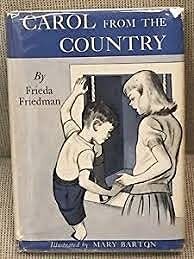
The day Carol moves to the city with her family is the unhappiest day of her life. The small, hot apartment in the noisy street seems more than she can bear.
Carol is so busy feeling sorry for herself that she can't see the fun and excitement of living in the city. Rudely, she turns away from the boys and girls in the neighborhood.
"You have no talent for friends," her mother says sadly, and Carol is frightened. Is it true? Is that why she is so lonely?
Then unexpectedly Carol must act quickly—and there is no time to think about herself.
Born in 1905, Frieda Friedman wrote affectionately for preteens. Her books were reprinted regularly through the 1970s. Her illustrators included Valeria Patterson and Carolyn Haywood. Friedman set her fiction in the City of New York, and focused primarily on the lives of young girls from loving, supportive working class families.
Subversively published by Scholastic Book Services in 1966, some 16 years after its original publication date, ‘Carol’ (Original title: ‘Carol From The Country’), by Frieda Freidman, is a searing, scathing, shocking novel melding equal parts of existential philosophy, Machiavellian theory of self-defined ethics of behavior, Freudian sexual intrigue and mid-century American social dread.
The plot is deceptively simple: the anti-heroine, the titular "Carol", has been abruptly relocated from her beloved, idyllic country house to a filthy, crowded, noisy, and (worst of all, for Carol) tastelessly accoutered tenement in New York City due to her father’s shoe store’s bankruptcy. Hence, the reader is immediately thrust into a bifurcated representation of the social theory of gemeinschaft vs. gesellschaft (which becomes, throughout the novel, a sort of ghostly non-physical character) paralleling the failure of Carol’s father (in a Freudian twist, never assigned a name and only referred to as “Daddy”, even by his wife) to maintain his social and economic independence with the failure of post-war America to retain it’s pastoral tradition. “Daddy”, once the proud owner of his own business as well as an idyllic country farmhouse, is reduced to moving his family into Manhattan and becoming a mere employee, literally kneeling at the feet of the customers who are no longer his own and include, to Carol’s horror, “foreign people”. In the kneeling of the father before unknown and unidentified male customers, author Friedman also slyly hints at the underground homosexual culture of the 1950s, a world subterranean world wherein and entire subset of the population made tentative steps (the very word “steps” another of the author’s unstated puns, “Daddy” working in a shoe store) toward ultimate liberation, if not entire societal acceptance.
Carol has a brother and a sister, a younger pair of twins named Johnny and Jinny (short for Virginia, representative of the mid-century American female reduction by the outside world to a mere diminished version of one’s self, and of course, a virgin) who appear as allegorical figures representing the youthful enthusiasm of a post-WWII world. It is Johnny and Virginia (I choose to identify this young woman by her full name instead of the disrespectful diminutive foisted upon her by an intellectually undeveloped public) who face the first subliminal sexual threat in the novel as their downstairs neighbor, the spinster Miss Tyler, bangs a broomstick on her ceiling directly under the piano seat on which the twins sit, also banging, but on the piano keys. This is another set-piece triumph of Freidman’s, illustrating the entire range of pre-war sexual repression with post-war sexual revolution in the vision of the virgin spinster yielding a phallic object at the new generation, her “banging” on the ceiling representative of another variety of banging obviously missing from her life.
Miss Tyler is worthy of serious dissertation of her own, but for the sake of brevity let’s make passing mention of the most important aspects of this barely drawn yet fully developed character. We know she is elderly; we know she has no friends or family; we know she lives alone in an apartment darkened with permanently closed blinds. Miss Tyler claims to get migraines due to light and noise sensitivity, but what is she really hiding from, or, more directly, what is she herself hiding? Of course author Friedman employs the character of Miss Tyler as a foreshadow warning to Carol of what Carol’s life could turn out to be, but a closer reading of the novel, focusing textually on the character of Miss Tyler, will be necessary to fully understand the author’s inclusion of her.
The most prominent “outsider” figure in the novel is Pat Daly (a boy, and yet another psycho-sexual complication of the author’s in naming this character with a moniker both male and female). His flaming red hair and invasive personality are representative of the threat of Communism in post-war America, and his frequently mentioned freckles a representation of the new populations Carol is exposed to in the city, each “spot” on Pat’s face a constant reminder of a new “sort” of person Carol must encounter. (Spoiler alert: Carol does, ultimately, reach a tentative if limited acceptance of her new neighbors, saying at one point of one “You can’t help admiring him, even if he is a foreigner”).
Sex looms large in the presence of Carol’s new friend Betsy, a pretty, popular, and well-dressed girl relocated to the city from, wink-wink, “down South”, who refers to her girlfriends as “Honey”. Carol’s fascination with Betsy, her physical perfection, poise, and popularity with boys offers a riveting illustration of nascent female sexuality. Though Carol never quite achieves the closeness with Betsy that she desires, Betsy does allow a bit of hand-holding and chaste good-bye kisses.
The clash of new tastes in art in the late 1950s is also featured in a white-knuckle episode featuring a painting contest presented by the library. Carol enters one of her praised, representational pastoral images and smugly imagines she will win the contest and not only achieve the popularity she feels she so deserves but also quash finally the more modern, abstracted cityscapes painted by the janitor’s daughter, Christine. One could complain about author Friedman introducing too many “other” elements in the character of Christine (descendent of a widowed janitor, an only child who lives in the basement) but the character succeeds. I’ll not reveal the outcome of this part of the novel; it is a shocker.
And, finally, what do we make of this “Carol”? The child who is told by her own mother “You do have talents; you just have no talent for friends”? Such is the complexity created by the author that at points throughout the novel we, as readers, think “Poor Carol, so many challenges so bravely met”, and mere paragraphs later revise our opinions to “Wow! That Carol is a real C-U-next-Tuesday!”
Though not for the frivolous reader, ‘Carol’ (Original title: ‘Carol From The Country’) is highly recommended to those interested in mid-century American mores, brilliantly developed, oblique plotting, and classic Existentialist philosophy. Miss/Mrs Friedman has, indeed, written a classic for the ages.
In this 1950 novel, Carol (who is 11, despite looking like a teenager on the cover), is miserably unhappy to have exchanged her family's comfortable home and garden in a small town for a cramped walk-up apartment in New York City. The family fortunes have changed because her father's shoe store went out of business, and he's had to take a position in a shoe store in the city (I find myself wondering if it was really so necessary for him to continue selling shoes). Carol finds the city unbearable noisy and is oppressed by the smell of garbage on the streets. Her younger siblings adapt to the change much more easily, and soon have many friends among the city kids of various (mostly) immigrant backgrounds who swarm around the neighborhood. Carol holds herself aloof, is snobbish, and becomes disliked, which makes the book not that much fun to read, even though she predictably learns a thing or two. I found the ending a tad unrealistic .
I've had an idea simmering for a while that it might be fun to make a little study of children's books from this era that portray "white flight" from the cities to the suburbs (two that particularly struck me as showcasing the sense of relief the characters feel to leave "rundown" cities are Binnie Latches On and A Boy for You, a Horse for Me). This one certainly bucks the trend, and it's hard to think of other examples of children having to adjust to city life after growing up in the suburbs. Is this the exception that proves the rule? There are plenty of mid-century books about kids in New York who haven't been transplanted from the suburbs, but they either seem to be more well off (like Harriet the Spy, or are recent immigrants (like the girl in The Hidden Garden). Author Frieda Friedman was born in Syracuse NY, but lived in NYC as an adult, and by the evidence of her books seems quite enthusiastic about it.
Blond, blue-eyed, stuck-up snob moves from the NJ countryside to NYC. She meets the Irish kid, the Jewish kid, and the Italian kid, but only wants to befriend the other WASP on the block. She learns her lesson soon enough, though, when she realizes that she's on her way to becoming the dried-up spinster who lives downstairs. Dated story? You bet. I'm giving it two stars for the great tenement details (hooray for dumbwaiters!) and the charming illustrations. "She could not picture herself writing to Helen and saying that her best friend in New York was the daughter of a man who had a shoe repair shop. But a doctor's daughter! That sounded very nice."
This vintage book was on my bookshelf and, because of its age, I assumed it was one of my mother-in-law's books. My husband noticed that it came from my grade school library. (I'm assuming I obtained it legally). Copyright 1950, it was trite, predictable, and moralizing, yet enjoyable. More enjoyable is the ludicrous review by Robert. Huzzah!