

What do you think?

Animal Man (1988-1995)
Animal Man, Vol. 6: Flesh and Blood
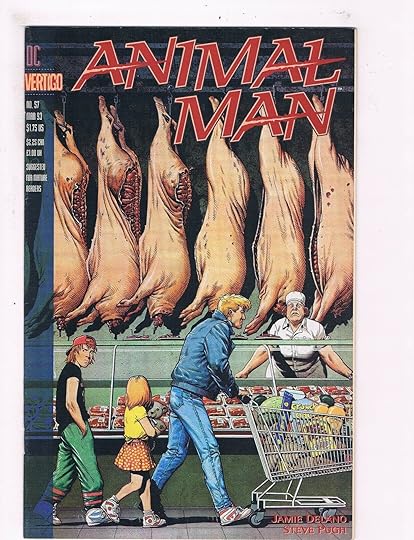
The sequel to Grant Morrison's genre-defining run on ANIMAL MAN, this volume features stories never before reprinted from writer Jamie Delano, best known for his run on HELLBLAZER.
After being killed in a car crash, Animal Man struggles to return to life by climbing the evolutionary ladder one step at a time. But can he reincarnate himself as a creature with any power in time to help his kidnapped son? Plus, a family friend accidentally awakens the leviathan, a mammoth creature from the ocean that could wipe out mankind.
Collects ANIMAL MAN #51-63.
After being killed in a car crash, Animal Man struggles to return to life by climbing the evolutionary ladder one step at a time. But can he reincarnate himself as a creature with any power in time to help his kidnapped son? Plus, a family friend accidentally awakens the leviathan, a mammoth creature from the ocean that could wipe out mankind.
Collects ANIMAL MAN #51-63.
368 pages, Paperback
First published July 15, 2014
About the author
Jamie Delano
465 books355 followersJamie Delano aka A. William James began writing comics professionally in the early 1980s. Latterly he has been writing prose fiction with "BOOK THIRTEEN" published by his own LEPUS BOOKS imprint (http://www.lepusbooks.co.uk) in 2012, "Leepus | DIZZY" in April 2014, and "Leepus | THE RIVER" in 2017.
Jamie lives in semi-rural Northamptonshire with his partner, Sue. They have three adult children and a considerable distraction of grandchildren.
Jamie lives in semi-rural Northamptonshire with his partner, Sue. They have three adult children and a considerable distraction of grandchildren.
Ratings & Reviews
Friends & Following
Create a free account to discover what your friends think of this book!
Community Reviews
Displaying 1 - 21 of 21 reviews

May 30, 2020
I read Jamie Delano's run on this book, by reading comic books Animal Man #51-67 and Animal Man Annual #1, covering this and Animal Man, Vol. 7: Red Plague Jamie Delano's weaves a wonderful and engrossing tale which very much helps vindicate the value of switching the comic book to the Vertigo brand. 7 out of 12
2017 read; 2013 read
2017 read; 2013 read

October 17, 2016
Flesh & Blood The series takes on a much darker tone ala Jamie Delano's run on Hellblazer. Buddy dies and must climb the Lifeweb to get back to his family. Meanwhile Cliff is kidnapped by his uncle who makes snuff films.
Wildlife Maxine takes a trip to the NYC of the 80's where everyone is an awful person and all your dreams go to die. Maxine must learn to hold her own in the big city.
Tooth & Claw The Bakers take a vacation to Cape Cod where they meet Lucy and her mother Annie. Animals begin to go mad and attack humans. Can the Bakers stop the madness before the leviathan is awaken.
Steve Pugh's art works perfectly with the darker, wilder tone of the series. The book definitely has that early 90's Vertigo vibe with lots of wordy, poetic exposition balloons.
Wildlife Maxine takes a trip to the NYC of the 80's where everyone is an awful person and all your dreams go to die. Maxine must learn to hold her own in the big city.
Tooth & Claw The Bakers take a vacation to Cape Cod where they meet Lucy and her mother Annie. Animals begin to go mad and attack humans. Can the Bakers stop the madness before the leviathan is awaken.
Steve Pugh's art works perfectly with the darker, wilder tone of the series. The book definitely has that early 90's Vertigo vibe with lots of wordy, poetic exposition balloons.

August 17, 2014
Flesh & Blood (51-56). A great new start for Animal Man. This is an evocative, shocking, and beautiful story that leaves behind the tropes of superhero comics and instead moves over to nature, horror, family, and the horrific brutality of human nature. It's an interesting new direction that's carried off well. We also see our first hints of The Red, replacing the more generic morphogenic field from Veitch's run. A great story and a groundbreaking one [8/10].
Wildlife (57-60). Delano does a rather impressive job of taking a fairly mundane story of running into problems in a rundown city and turning it into one of the many memorable arcs of his run. It's because of great characters and a feeling of ever-present danger. Superheroism is scarcely an issue! [7+/10]
Tooth & Claw (61-63). This last arc is fascinating for how it calls back to Delano's "Fear Machine" arc from Hellblazer, Vol. 3: The Fear Machine. We get reflections of characters (Marj & Mercury = Annie & Lucy) and even the situation of how the seaside leads to thoughts of extinction. It's also nice to see Buddy acting like a protagonist again, albeit in a more ecological way than ever [7+/10].
Overall, Delano brings Animal Man to its second height its his first volume. Great stuff!
Wildlife (57-60). Delano does a rather impressive job of taking a fairly mundane story of running into problems in a rundown city and turning it into one of the many memorable arcs of his run. It's because of great characters and a feeling of ever-present danger. Superheroism is scarcely an issue! [7+/10]
Tooth & Claw (61-63). This last arc is fascinating for how it calls back to Delano's "Fear Machine" arc from Hellblazer, Vol. 3: The Fear Machine. We get reflections of characters (Marj & Mercury = Annie & Lucy) and even the situation of how the seaside leads to thoughts of extinction. It's also nice to see Buddy acting like a protagonist again, albeit in a more ecological way than ever [7+/10].
Overall, Delano brings Animal Man to its second height its his first volume. Great stuff!

October 5, 2017
I want to be clear: this book of Animal Man is really three books of Animal Man, and I have very different feelings about each of those books, which, "star-rating" wise, kind of shakes out to a middling "it was ok." Blame the imperfection of our culture's obsession with rating things. It's not my fault the nuance gets eaten.
The main story here, "Flesh and Blood," is Jamie Delano's first on the Animal Man series, but also the last story published under the DC imprint, before switching to Vertigo (where all the cool books shifted in the early 90s). As such, it's the only Delano story that has anything close to the feel of the series that came before it, and I think it serves as a strong close to the overarching storyline from Grant Morrison's Animal Man #1 (although is has a lot more in common with Tom Veitch's less-celebrated run than it does Morrison's). The story also showcases Delano's excellent chops as a horror writer, and you can definitely see his Hellblazer roots snaking in and around these issues. But it's also-also a (fairly obvious) homage to Alan Moore's "Earth to Earth" storyline in Swamp Thing: in each of these stories, the titular character is flung to edge of existence and must rebuild himself by learning more about his powers.
Despite the fact that not much of this is very original to Delano (it's a pretty direct swipe), he still does a lot of creepy/gross/weird things with it -- the charm of Animal Man, in general, is that our hero, Buddy Baker, is an all-american goofball who is frequently thrown into terrible and disgusting scenarios without really breaking a sweat. Delano leans into this discordance with a final act that ends up being one of the ookiest things to happen in the comic thus far, and it's totally unsettling and great.
The second storyline, "Wild," is the first for the Vertigo imprint, and -- I mean, my God -- it's just fucking awful. It's one of those cityphobic lost-in-New-York stories that paints NYC as a sort of postapocalyptic warzone full of hookers, mobsters, feminists (!), and corrupt cops, and it's so hokey and ridiculous that I don't know how any editor who actually lived in New York actually allowed Delano to write it. It's easily, EASILY the worst Animal Man story ever written. It's barely a story at all. It's really just four issues of improbably, idiotically awful things happening to the characters because they dared step foot in the Big Apple. I have no idea how the series even made it through these issues without getting cancelled.
The third storyline, "Tooth and Claw," isn't terrible, but it is sort of a question mark. By this point, as per the 90s Vertigo sense of cool, Animal Man is resolutely no longer a superhero title (because superheroes are just soooo not Vertigo), leaving us (and Delano, probably) to wonder exactly what the hell the book was going to be instead. His first answer, apparently, is that Animal Man was going to become a sort of long, rambling diatribe about environmentalism, which was definitely a popular trope in the early 90s (back when we cared about things, I guess).
The fact that Delano chooses to plant Animal Man firmly in Vermont instead of its prior home of San Diego, and to have almost almost all of its text exist in narration or inner monologue, makes the book feel like a hamfisted ripoff of The Puma Blues, which at that point had been doing the whole "New England environmental scifi prose poem" thing for quite some time, and better, and more artfully (artist Steve Pugh is pretty great, for sure, but ain't no one gonna beat Michael Zulli, and don't even bother trying).
Anyway, "Tooth and Claw" isn't terrible, and Delano begins to show some skill in handling small family drama (even though it's clearly not his bag). But most of the time there is a sense that nothing is happening, which isn't something I ever think about with regard to a book like Puma Blues. Despite the fact that I wish I were more of a snob, I do think that Animal Man does, occasionally, just need a guy in a suit punching things, and without the suits and the punching (even occasional punching), I don't really know what I'm looking at.
It makes me sad, because I'd like to push through and finish the series (I'm so close!) but I'm not sure if I will. Eh. Or I will. Not like it's the 90s anymore; what else am I supposed to care about?
The main story here, "Flesh and Blood," is Jamie Delano's first on the Animal Man series, but also the last story published under the DC imprint, before switching to Vertigo (where all the cool books shifted in the early 90s). As such, it's the only Delano story that has anything close to the feel of the series that came before it, and I think it serves as a strong close to the overarching storyline from Grant Morrison's Animal Man #1 (although is has a lot more in common with Tom Veitch's less-celebrated run than it does Morrison's). The story also showcases Delano's excellent chops as a horror writer, and you can definitely see his Hellblazer roots snaking in and around these issues. But it's also-also a (fairly obvious) homage to Alan Moore's "Earth to Earth" storyline in Swamp Thing: in each of these stories, the titular character is flung to edge of existence and must rebuild himself by learning more about his powers.
Despite the fact that not much of this is very original to Delano (it's a pretty direct swipe), he still does a lot of creepy/gross/weird things with it -- the charm of Animal Man, in general, is that our hero, Buddy Baker, is an all-american goofball who is frequently thrown into terrible and disgusting scenarios without really breaking a sweat. Delano leans into this discordance with a final act that ends up being one of the ookiest things to happen in the comic thus far, and it's totally unsettling and great.
The second storyline, "Wild," is the first for the Vertigo imprint, and -- I mean, my God -- it's just fucking awful. It's one of those cityphobic lost-in-New-York stories that paints NYC as a sort of postapocalyptic warzone full of hookers, mobsters, feminists (!), and corrupt cops, and it's so hokey and ridiculous that I don't know how any editor who actually lived in New York actually allowed Delano to write it. It's easily, EASILY the worst Animal Man story ever written. It's barely a story at all. It's really just four issues of improbably, idiotically awful things happening to the characters because they dared step foot in the Big Apple. I have no idea how the series even made it through these issues without getting cancelled.
The third storyline, "Tooth and Claw," isn't terrible, but it is sort of a question mark. By this point, as per the 90s Vertigo sense of cool, Animal Man is resolutely no longer a superhero title (because superheroes are just soooo not Vertigo), leaving us (and Delano, probably) to wonder exactly what the hell the book was going to be instead. His first answer, apparently, is that Animal Man was going to become a sort of long, rambling diatribe about environmentalism, which was definitely a popular trope in the early 90s (back when we cared about things, I guess).
The fact that Delano chooses to plant Animal Man firmly in Vermont instead of its prior home of San Diego, and to have almost almost all of its text exist in narration or inner monologue, makes the book feel like a hamfisted ripoff of The Puma Blues, which at that point had been doing the whole "New England environmental scifi prose poem" thing for quite some time, and better, and more artfully (artist Steve Pugh is pretty great, for sure, but ain't no one gonna beat Michael Zulli, and don't even bother trying).
Anyway, "Tooth and Claw" isn't terrible, and Delano begins to show some skill in handling small family drama (even though it's clearly not his bag). But most of the time there is a sense that nothing is happening, which isn't something I ever think about with regard to a book like Puma Blues. Despite the fact that I wish I were more of a snob, I do think that Animal Man does, occasionally, just need a guy in a suit punching things, and without the suits and the punching (even occasional punching), I don't really know what I'm looking at.
It makes me sad, because I'd like to push through and finish the series (I'm so close!) but I'm not sure if I will. Eh. Or I will. Not like it's the 90s anymore; what else am I supposed to care about?

November 23, 2024
The series is being taken over by Jamie Delano, and for the better.
From a vague subplot of Veitch's run he launches the excellent Flesh and Blood, the main arc of the volume, where he instils the horrific elements that tend to characterise his style. Buddy is literally reborn, but the series takes a decidedly darker tone. It's very wordy, but a kind of poetic prose that's very gripping.
The underestimated Steve Pugh, with his realistic style that sometimes flirts with caricature, is perfect for illustrating the story.
The second arc is interesting in its theme - violence against women and Ellen's need to prove to herself that she can get out of a tight spot without Buddy- but rather weak in its execution and plot, with mediocre filler artists.
The last arc, which is very ecological at heart, is also very dark, even apocalyptic. Delano doesn't seem to have an overly optimistic view of humanity. And rightly so, when you consider that this was written over 30 years ago and that basically nothing has changed. Pugh is back to drawing; phew! We're saved!
From a vague subplot of Veitch's run he launches the excellent Flesh and Blood, the main arc of the volume, where he instils the horrific elements that tend to characterise his style. Buddy is literally reborn, but the series takes a decidedly darker tone. It's very wordy, but a kind of poetic prose that's very gripping.
The underestimated Steve Pugh, with his realistic style that sometimes flirts with caricature, is perfect for illustrating the story.
The second arc is interesting in its theme - violence against women and Ellen's need to prove to herself that she can get out of a tight spot without Buddy- but rather weak in its execution and plot, with mediocre filler artists.
The last arc, which is very ecological at heart, is also very dark, even apocalyptic. Delano doesn't seem to have an overly optimistic view of humanity. And rightly so, when you consider that this was written over 30 years ago and that basically nothing has changed. Pugh is back to drawing; phew! We're saved!

August 3, 2022
Mostly for the first storyline which was gorgeous yet a little hokey. This is when Animal Man shifts from DC to Vertigo territory. Tom Veitch started it, but it takes full-tilt into horror, here.
I really like the story of Animal Man going through the "The Red" which is coined in Delano's run. Grant had a more meta-angle with the Yellow Aliens, Tom Veitch made them more into shamans, and Delano made him more of an avatar similar to Swamp Thing with the Green.
I really like the story of Animal Man going through the "The Red" which is coined in Delano's run. Grant had a more meta-angle with the Yellow Aliens, Tom Veitch made them more into shamans, and Delano made him more of an avatar similar to Swamp Thing with the Green.

July 31, 2018
Jamie Delano's Hellraiser set a new the grounds for Vertigo's adult line but it was Delano's Animal Man that really launched Vertigo. This transition is crucial here because Delano has three clearly delineated arcs, but they are highly uneven.
Flesh & Blood moves Animal Man into a darker grounds and moving away from the more high concept and meta-fictive elements of Morrison's and Milligan's run, but it is also clearly before Vertigo's launch. Cliff's kidnapping by his death-obsessed, taxidermy and snuff film obsessed Uncle leads to Buddy's death and his resurrection by claiming through the life-web, which hints at Red, which Delano and in the New 52 Lemire would seize upon. The relationship dynamics between Eileen and Buddy is explored somewhat maturely as well as Maxine's unique connection to the Red and her father. Yet there are hints at edgy grimdark that isn't entirely earned. One can see Veitch's morphogenic field turn into the life-web and then the Red by Delano. The ick factor is played up here, but successfully and seems to lend a lot of promise.
Wildlife is the first run under Vertigo. The edginess is off-scale. The environmentalism of Animal Man is manifested in what amounts to an anti-urban screed. Vertigo moves the focus of Baker as Vertigo wanted to move away from purely superhero comics, and onto Eileen in the city. But we have an attempted rape plot in New York, which leads to moving the Bakers from San Diego to Vermont ultimately, but also leads to victim blaming, satires on feminism, focus on grime, etc. Even though this was a 1990s book, its New York is of the late 70s and early 80s. Steve Pugh's art here is inconsistent and sometimes intentionally ugly. While I do appreciate focusing more the family and giving Eileen some legitimate character development, ultimately this doesn't feel like an Animal Man comic and is laughably full of bad grindhouse tropes from exploitation movies but doesn't feel particularly smart or aware about it.
Tooth & Claw moves back to a more traditional Animal Man plot, where animals come to life and attack humans. Furthermore, Cliff's post-traumatic recovery from the damage done by his uncle has some real consequences here. The introduction of several new characters Annie and her daughter, who also is Cliff's girlfriend, works. Pugh's artwork starts to shine and the Vermont setting really pays off. It's a more conventional story, but Delano understands the family dynamic in a way where all the secondary characters seem to have developed personalities.
A highly uneven run.
Flesh & Blood moves Animal Man into a darker grounds and moving away from the more high concept and meta-fictive elements of Morrison's and Milligan's run, but it is also clearly before Vertigo's launch. Cliff's kidnapping by his death-obsessed, taxidermy and snuff film obsessed Uncle leads to Buddy's death and his resurrection by claiming through the life-web, which hints at Red, which Delano and in the New 52 Lemire would seize upon. The relationship dynamics between Eileen and Buddy is explored somewhat maturely as well as Maxine's unique connection to the Red and her father. Yet there are hints at edgy grimdark that isn't entirely earned. One can see Veitch's morphogenic field turn into the life-web and then the Red by Delano. The ick factor is played up here, but successfully and seems to lend a lot of promise.
Wildlife is the first run under Vertigo. The edginess is off-scale. The environmentalism of Animal Man is manifested in what amounts to an anti-urban screed. Vertigo moves the focus of Baker as Vertigo wanted to move away from purely superhero comics, and onto Eileen in the city. But we have an attempted rape plot in New York, which leads to moving the Bakers from San Diego to Vermont ultimately, but also leads to victim blaming, satires on feminism, focus on grime, etc. Even though this was a 1990s book, its New York is of the late 70s and early 80s. Steve Pugh's art here is inconsistent and sometimes intentionally ugly. While I do appreciate focusing more the family and giving Eileen some legitimate character development, ultimately this doesn't feel like an Animal Man comic and is laughably full of bad grindhouse tropes from exploitation movies but doesn't feel particularly smart or aware about it.
Tooth & Claw moves back to a more traditional Animal Man plot, where animals come to life and attack humans. Furthermore, Cliff's post-traumatic recovery from the damage done by his uncle has some real consequences here. The introduction of several new characters Annie and her daughter, who also is Cliff's girlfriend, works. Pugh's artwork starts to shine and the Vermont setting really pays off. It's a more conventional story, but Delano understands the family dynamic in a way where all the secondary characters seem to have developed personalities.
A highly uneven run.

July 21, 2016
Look. The art is good. The covers are great. The stories though? GRIMDARK. MISOGYNISTIC. VICTIM BLAMING. I'm so grateful tatjana wood colored this. The imagery in the opening pages and the animal art is good but it really is a slog. By far the worst volume of the series.

December 14, 2020
What a weird friggin book.
Picked this up because it was written by Jamie Delano, the first Hellblazer writers (and one of the better ones, too), and honestly, it's the same kind of strangeness that characterized that early Hellblazer stuff, for better or for worse. The first half of this is about Cliff, Animal Man's son, being kidnapped by a murderous relative. The guy is less a fully fleshed out character and a more an evil cartoon villain. It's nuts, and while I'd prefer a better written villain, he's still very goofy and dumb, which is fun sometimes. Animal Man is dead by the end of the first issue and spends several issues hopping across different animals' bodies, before birthing himself as a horrible conglomerate of beasts from a triceratops egg (yes, you read that correctly). It's absurd and I kinda love this part.
After this, Animal Man's wife goes into "the big city," and immediately gets robbed, almost raped multiple times, and thrown into jail, so she befriends a group of extremist lesbian crime stoppers who defeat the villain (rapist) by drugging him and making him have gay sex (again, you read that correctly).
While his wife in the "the big city," Animal Man goes to look for her and immediately is thrown into jail after sniffing a woman and trying to take her coat, which was stolen from his wife when she was mugged, sold to Goodwill, and purchased by an innocent woman. This is complete nonsense. Who thought this would be a good idea? Anyway, Animal Man is thrown in prison and put in a straight jacket. While they are transporting them, he makes the van smell like a skunk while the guard is looking at pornography, and then flies away, naked, all the way back home (four hour flight) after exposing himself to a group of office workers and borrowing their phone to call his family.
After that, there's some nonsense about how a painter lady paints a painting that makes lobsters kill a fisherman and also summons a great leviathan from the depths which is defeated which Animal Man's family convinces her that she can't be mad at the world.
Yeah dude, this book is nonsense. I liked the dumb parts, but also hated them too. I don't know. Oftentimes, "mature readers" books are pretty smart, but this one was not.
The art was by Steve Pugh. Like the writing, I have mixed feelings on the artwork. Pugh isn't a bad artist, but he's definitely not good. If you flip to a random page in this book, there's a chance that you will see a horribly drawn face. But all the animals and monsters look great. I think he has the Todd McFarlane problem: great at non-human creatures, but can't draw a non-mutant looking person half the time. Again, the art isn't the worst I've seen and isn't even the worst I've seen from him (I recognized his name on the book because I remembered him as being one of the worst Hellblazer artists, which is really saying something cause there are some awful ones). The covers by Brian Bolland are really excellent, but that's not a huge deal since you see one for ever twenty plus pages of actual story.
So yeah, weird stuff, might read the next book just because it was so crazy, but I might not because it really isn't what I would call "good." It's mostly enjoyable trash, the equivalent of a pop tart.
Picked this up because it was written by Jamie Delano, the first Hellblazer writers (and one of the better ones, too), and honestly, it's the same kind of strangeness that characterized that early Hellblazer stuff, for better or for worse. The first half of this is about Cliff, Animal Man's son, being kidnapped by a murderous relative. The guy is less a fully fleshed out character and a more an evil cartoon villain. It's nuts, and while I'd prefer a better written villain, he's still very goofy and dumb, which is fun sometimes. Animal Man is dead by the end of the first issue and spends several issues hopping across different animals' bodies, before birthing himself as a horrible conglomerate of beasts from a triceratops egg (yes, you read that correctly). It's absurd and I kinda love this part.
After this, Animal Man's wife goes into "the big city," and immediately gets robbed, almost raped multiple times, and thrown into jail, so she befriends a group of extremist lesbian crime stoppers who defeat the villain (rapist) by drugging him and making him have gay sex (again, you read that correctly).
While his wife in the "the big city," Animal Man goes to look for her and immediately is thrown into jail after sniffing a woman and trying to take her coat, which was stolen from his wife when she was mugged, sold to Goodwill, and purchased by an innocent woman. This is complete nonsense. Who thought this would be a good idea? Anyway, Animal Man is thrown in prison and put in a straight jacket. While they are transporting them, he makes the van smell like a skunk while the guard is looking at pornography, and then flies away, naked, all the way back home (four hour flight) after exposing himself to a group of office workers and borrowing their phone to call his family.
After that, there's some nonsense about how a painter lady paints a painting that makes lobsters kill a fisherman and also summons a great leviathan from the depths which is defeated which Animal Man's family convinces her that she can't be mad at the world.
Yeah dude, this book is nonsense. I liked the dumb parts, but also hated them too. I don't know. Oftentimes, "mature readers" books are pretty smart, but this one was not.
The art was by Steve Pugh. Like the writing, I have mixed feelings on the artwork. Pugh isn't a bad artist, but he's definitely not good. If you flip to a random page in this book, there's a chance that you will see a horribly drawn face. But all the animals and monsters look great. I think he has the Todd McFarlane problem: great at non-human creatures, but can't draw a non-mutant looking person half the time. Again, the art isn't the worst I've seen and isn't even the worst I've seen from him (I recognized his name on the book because I remembered him as being one of the worst Hellblazer artists, which is really saying something cause there are some awful ones). The covers by Brian Bolland are really excellent, but that's not a huge deal since you see one for ever twenty plus pages of actual story.
So yeah, weird stuff, might read the next book just because it was so crazy, but I might not because it really isn't what I would call "good." It's mostly enjoyable trash, the equivalent of a pop tart.
This entire review has been hidden because of spoilers.

August 31, 2023
A Panini se esmerou para trazer os antigos e clássicos títulos do selo Vertigo e, em novembro passado, fechou o segundo arco Pós-Morrison do Homem Animal pelas mãos do roteirista inglês Jamie Delano.
Delano, mais conhecido por seu trabalho na Hellblazer, publicou as histórias supracitadas durante os anos de 1992 até 1994. Obviamente, seu trabalho no selo Vertigo é carregado de referência socioculturais da época, e por isso mesmo, é alvo tanto de críticas quanto de elogios. Por quê?
Primeiramente, a saga é uma alusão ao messianismo, onde Buddy Baker vai aos poucos assumindo uma relação maior como Avatar do Vermelho (uma força primordial que conecta e permeia todos os animais no Universo DC) numa jornada de redenção da humanidade em relação ao ambiente. Dessa forma, o Homem Animal rompe de vez com o universo de super-heróis e integra o universo de quadrinhos ao estilo de sua contraparte, Monstro do Pântano (O Avatar do Verde – a força relacionado ao reino vegetal).
Buddy entra nesse arco, cujo cunho filosófico é a fragilidade do ecossistema disfarçado de Paixão de Cristo, e muitos leitores tiveram dificuldade em acompanhar essa nova linha. Vale lembrar que também nessa época, passávamos pelo que seria o ápice do movimento Nova Era e Delano faz uma crítica pesada ao envolvimento de adolescentes em suas seitas e grupos.
A tendência de criticar movimentos sociais daquele momento levou Delano a entulhar a trama de referências que, embora enriquecessem o texto, dificultaram sua absorção. Tal foi o caso com a história de Cliff, filho de Buddy, que junto a um tio psicopata, tem sua primeira experiência pseudo-religiosa que é atrativamente camuflada com referências a filmes trash. Esse artífice pode parecer exagero, mas a verdade é que casou com o clima de terror da história e fecha o primeiro volume de forma sensacional.
Delano, mais conhecido por seu trabalho na Hellblazer, publicou as histórias supracitadas durante os anos de 1992 até 1994. Obviamente, seu trabalho no selo Vertigo é carregado de referência socioculturais da época, e por isso mesmo, é alvo tanto de críticas quanto de elogios. Por quê?
Primeiramente, a saga é uma alusão ao messianismo, onde Buddy Baker vai aos poucos assumindo uma relação maior como Avatar do Vermelho (uma força primordial que conecta e permeia todos os animais no Universo DC) numa jornada de redenção da humanidade em relação ao ambiente. Dessa forma, o Homem Animal rompe de vez com o universo de super-heróis e integra o universo de quadrinhos ao estilo de sua contraparte, Monstro do Pântano (O Avatar do Verde – a força relacionado ao reino vegetal).
Buddy entra nesse arco, cujo cunho filosófico é a fragilidade do ecossistema disfarçado de Paixão de Cristo, e muitos leitores tiveram dificuldade em acompanhar essa nova linha. Vale lembrar que também nessa época, passávamos pelo que seria o ápice do movimento Nova Era e Delano faz uma crítica pesada ao envolvimento de adolescentes em suas seitas e grupos.
A tendência de criticar movimentos sociais daquele momento levou Delano a entulhar a trama de referências que, embora enriquecessem o texto, dificultaram sua absorção. Tal foi o caso com a história de Cliff, filho de Buddy, que junto a um tio psicopata, tem sua primeira experiência pseudo-religiosa que é atrativamente camuflada com referências a filmes trash. Esse artífice pode parecer exagero, mas a verdade é que casou com o clima de terror da história e fecha o primeiro volume de forma sensacional.
October 4, 2020
Just terrible. I couldn’t read any more — which is a sad statement for a comic book. In the first storyline, Animal Man is waylaid when a truck hits him — that’s right, the great opposition here is a truck hitting him — while his son has been shanghaied by an uncle in a thinly disguised metaphor for child molestation. In the second storyline, Animal Man’s wife falls afoul of a dangerous big city, sending us all the message that white fear of the urban core is justified and it’s always safer in the suburbs. It never occurs to her to call her bank or a credit card company to get some cash. Whatever happens happens on its own, and our “hero” isn’t important to most of the proceedings — even in a book of his own name.
September 16, 2026
The first arc, Flesh and Blood, was really good. Uncle Dudley was a really compelling character, and the art often bordered on body horror.
The second arc, Wildlife, I didn't particularly care for. I always struggle with the type of story where everything goes wrong, no one can catch a break, and pretty much everyone is evil. That's what happens to poor Ellen.
Finally, Tooth and Claw, was alright. A bit run of the mill. This volume was certainly carried by the strength of the first, what, 6? issues.
The second arc, Wildlife, I didn't particularly care for. I always struggle with the type of story where everything goes wrong, no one can catch a break, and pretty much everyone is evil. That's what happens to poor Ellen.
Finally, Tooth and Claw, was alright. A bit run of the mill. This volume was certainly carried by the strength of the first, what, 6? issues.

November 30, 2017
It started off as a great story, but got kind of dull. Great concepts in the first half of the collection. Worth reading for the big ideas about the way Animal Man is connected to the entire life ecosystem. It seems a little aimless in the second half of the collection.

February 8, 2021
Animal Man pivots from ecological superhero to ecological horror in a run still surprisingly striking by the lights of today*
*(uh, mostly. Issue #59 in particular has rather showed its age. Mainly a case of 'I get what you're trying to say, but, uh, the execution is still very lacking')
*(uh, mostly. Issue #59 in particular has rather showed its age. Mainly a case of 'I get what you're trying to say, but, uh, the execution is still very lacking')
June 27, 2025
It is almost impossible to follow runs like grant Morrisons on Animal Man. For me this run isn't as good as that, but it's the first comic following it that caught my interest so clearly. a Strong vision for what the comic can be and a intriguing setup for the run.

July 26, 2019
Such a mixed bag. Might deserve more. Might deserve less.

October 18, 2024
The first half reminded me a lot of Andrew Vachss. The second was too depressing as eco warfare
June 9, 2025
“Flesh And Blood” is one of the strangest and darkest storylines ever in mainstream (should Vertigo be considered mainstream?) comics. It will really put you in a mood.

April 29, 2026
Now we’re talking. A new creative team made this comic really weird(complimentary) again.

November 21, 2016
Off to a rousing dark start with a hunting Neandrothal uncle instructing a boy in the ways of death. Interesting examination of hero's psychedelic rebirth through nature's pathways. Finishing with some quirky one off type tales. Fairly entertaining though heavy handed in it's warnings of mankind destroying the planet. Wish there was a bit more subtlety in the message rather than dry unsexy political sorta tirade. Being preached at is uncool unless you are into that thing.

Read
July 31, 2025“I listen for his heartbeat with some inner-ear and hear it faintly match my own. He’s close — but so is death. My throat is dry, constricted. I bend for refreshment and lap the thin flavor of his blood. A salmon, I force against the torrent. A shark, I taste the diluted essence of my prey. A father, I plunge wildly into the subterranean darkness, in desperate pursuit of my son.”
Delano gives Animal Man an Alan Moore Swamp-Thing style spin, and it does not disappoint
Delano gives Animal Man an Alan Moore Swamp-Thing style spin, and it does not disappoint
Displaying 1 - 21 of 21 reviews