Hidden beneath the streets of London is a dark and dreadful establishment known as The Monster Club, where vampires indulge in a rather different kind of Bloody Mary and ghouls tear into their gruesome repasts. Here, along with the usual monsters - vampires, werewolves, ghouls, and some of Dr Frankenstein's more freakish creations - you'll find other, less familiar ones. You'll meet the frightening Fly-by-Night, the hideous shaddy, the horrible mock, and the dreaded shadmock, perhaps the most terrible of all. When Donald McCloud offers a starving man a meal, he unexpectedly discovers that the man is a vampire - and he's the main course! Accompanying the vampire, Eramus, to The Monster Club, Donald encounters a whole host of strange monsters, who, in a series of five linked stories, recount to Donald their monstrous exploits. But as Donald is regaled with these tales of monsters and their unfortunate human victims, it gradually dawns on him that as the only human in a club full of bloodthirsty monsters, he might be in a bit of a predicament. . . . First published as a paperback original in 1976, R. Chetwynd-Hayes's "The Monster Club" was adapted for a 1981 film starring Vincent Price, John Carradine and Donald Pleasence, and both book and film have gone on to become cult classics. Told in a wry, tongue-in-cheek style, the tales in "The Monster Club" are simultaneously horrific, comical, and curiously moving. This edition is the first in more than twenty years and features a new introduction by Stephen Jones and a reproduction of John Bolton's painting from the comic book adaptation of the film.
Ronald Henry Glynn Chetwynd-Hayes aka Angus Campbell.
Ronald Chetwynd-Hayes was an author, best known for his ghost stories. His first published work was the science fiction novel The Man From The Bomb in 1959. He went on to publish many collections and ten other novels including The Grange, The Haunted Grange, And Love Survived and The Curse of the Snake God. He also edited over 20 anthologies. Several of his short works were adapted into anthology style movies in the United Kingdom, including The Monster Club and From Beyond the Grave. Chetwynd-Hayes' book The Monster Club contains references to a film-maker called Vinke Rocnnor, an anagram of Kevin Connor, the director of From Beyond the Grave.
He won the Bram Stoker Award for Lifetime Achievement for 1988, and the British Fantasy Society Special Award in 1989.
A heart-breaking, goofy, charming, and dark book you should absolutely not read from the beginning.
I discovered R. Chetwynd-Hayes through the cornball but wonderfully fun Vincent Price adaptation of this book. I found the story "The Werewolf and the Vampire" in an anthology and absolutely loved the world-building, sorrow and tenderness in it.
Then I read it in this anthology, and wondered what the author was thinking, but we'll get to that.
The Monster Club is about Dennis (Chetwynd-Hayes himself in the movie!) who encounters a vampire and ends up "donating" somewhat voluntarily. In gratitude, the vampire takes him to a club for monsters, where, aside from vampires,
"...there's werewolves, snakemen, waspwomen, stranded hadel-monsters, ghouls, both common and king, a few of Baron Frankenstein's not-so-successful experiments, one fly-by-night that got grounded by a broken wing, a Jumpity-Jim that's been looking for a virginal bare back for the past twenty years, and a thing from outer space that got left behind from a reconnoitring party back in '57."
Taste that world-building. Roll it around on your tongue and savor it. You're in for much more.
The book uses Dennis' conversations with the club patrons as the framing device to present five stories named for their main creatures: "The Werewolf and the Vampire," "The Mock," "The Humgoo," "The Shadmock," and "The Fly-by-Night."
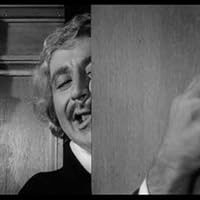
If the names look weird, that's because Monster Club has a genealogy. As Vincent Price can wonderfully explain...
...certain monsters are produced when vampires, werewolves, and ghouls start breeding with each other.
Now, back to that first story.
My issue is nothing to do with "The Werewolf and the Vampire." It's brilliant, and it inspired an entire tribute story out of me I'll link here as soon as it appears. The issue is with the introduction leading up to it. You see, the characters who are introducing the story SPOIL THE STORY.
It's an issue that nearly pokes its head in some of the other stories. Characters will comment on two that "Oh, this one has a good ending. Evil wins," but that's not too much for me. However, taking a brilliant story and having a character ruin the ending is something I have to hold back a star for. I mean, I'm sure Chetwynd-Hayes could have been more mysterious, and have the character at the end say the equivalent of "And that was my umbrella the whole time!"
So, here's my one caveat to this collection. The stories range from nearly silly to very dark, but they're all worth a read. The one thing I implore you to do is read "The Werewolf and the Vampire" first. Revel in it, let yourself be drawn away, pause for enjoyment, then turn to page one and start with Dennis and the Vampire.
This title and author may both sound very familiar to horror fans, though I know few who've read it, including myself. So this Spooktober, I decided this was a perfect Halloween-themed book for me to explore the season.
What makes it familiar is that many of us horror aficionados cut our teeth on the Fontana Books of ghost stories, of which Chetwynd-Hayes assumed editorship after the departure of Robert Aickman. Also, the stories in this book were made into the post-Amicus-style anthology film "The Monster Club," starring some of our favorite horror movie icons, namely Vincent Price, Donald Pleasence, and David Carradine. Carradine actually played a fictionalized version of the author Chetwynd-Hayes.
This is an early example of "meta" comedy-horror that has become so popular in modern fiction since "Scream" hit theaters and which was solidified in literature with David Wong's "John Dies at the End."
Evidently, modern life has just grown unsupportable for the monsters of old, so they are forced to organize. When a human tries to help a starving hobo on Charing Cross Road, he is surprised to discover that his charity case is actually a friendly but down-on-his-luck vampire, who repays his kindness by inviting him as an honorary guest to "The Monster Club."
While dining with his new friends, he listens to various stories told at the table, and also watches a movie. There are five tales in total that make up the bulk of the book, with little humorous interludes back at the Monster Club.
My favorite of the bunch was "The Humgoo," a genuinely scary but sweet tale about a village of ghouls. These ghouls are portrayed wonderfully in keeping with tradition, yet somehow were very believable and alien at the same time. The strange cadence to their speech was delightful, and they were delightfully funny as well as terrifying. And I learned to never get in a snowball fight with a ghoul! Overall, this made me realize just how underutilized the ghoul is in modern horror films and literature, and how well the folklore can translate to contemporary life.
All of the stories tend to have similar themes, likening the struggles of the classic monsters in society with discrimination due to racism or elitism. One monster is brutally spurned by a beautiful human girl simply because he is "ugly," but he learns just how ugly and monstrous she is beneath her veneer of perky breasts and perfect skin. Man is the most diabolical monster of all--you know, that kind of stuff.
Overall, this an absolute treat for lovers of Halloween, fans of classic monsters, and devourers of horror shorts. The humor does get a little childish at times, and the monster mayhem gets repetitive, but it is not overly long, so the whole thing is over before outlasting its welcome.
So you too are invited to the Monster Club. Sometimes you wanna go where everybody knows your name!
Donald McCloud could not let the man starve in the street. He stops and offers to bring the stranger home for a sup. Turns out the stranger is a vampire, and Donald is the main course.
To repay this kind 'donation' the stranger, now known as Eramus, offers to bring Donald down to 'the club'.
Soon Donald finds himself surrounded by all sorts of monsters. Vampires, werewolves, ghouls, mocks, and shadmocks, all lounging, drinking, and eating at The Monster Club. Seated at a table and introduced as a 'hume', Donald orders a Bloody Mary, and sits back amazed.
The monsters come forth and share their tales. Good old fashioned stories "of monsters and humans, where bad always triumphs and there's a miserable ending."
Told with humour and wit The Monster Club is a blast to read, and filled with wonderful lore. The short stories are suspenseful and each have such brilliant endings. My favourite was 'The Humgoo'. Absolutely chilling!
I would recommend this to anyone, but especially to fans of the old monster movies!
Another one of those situations where I noticed an interesting movie and decided to read the book first, because it looked good. What a pleasant surprise this was! In these stories that smell like a wet grave (also literally, because I got this from the darkest recesses of the library's storage room), monsters are monsters and the macabre shenanigans are often creepy and bloody. There's also some dry British humor, which honestly doesn't appeal to me very much, but sometimes (such as now) it works. The Humgoo is definitely the highlight of the collection. Simply because it's eerie, suspenseful, and has an amazing ending.
And what about the movie then? Anthologies are one of my favorite things and I tend to be less critical about them than regular movies (probably because there's always the one story that is decent). The Monster Club (1981) was produced by Milton Subotsky who was involved with Amicus Productions, so I wasn't too worried.
Well... The eponymous club of the frame story had been changed into a cringy nightclub filled with creatures that looked like they had been burdened with Party City costumes. At that point I wanted the earth to swallow me. The stories themselves were okay, but so different than what they are in the book. A classic case of why fix something that isn't broken. An okay movie to pass the time on a lazy Saturday evening, but it's way down in my ranking of anthology and Vincent Price movies.
This was a fun, quick read! A series of short stories, interwoven with a framing narrative. A vampire and a werewolf fall in love; a mock deals with rejection poorly; a man gets more than he bargained for in a small town in England; a shadmock only whistles; and a fly-by-night should be handled with care.
The movie adapts a couple of these (plus some other Chetwynd-Hayes) with the help of Vincent Price hamming up the screen most excellently.
Both movie and book are fun, tongue in cheek little anthologies!
This based on the classic Horror movie with Vincent Price it's funny but good luck finding a copy as rare book. Based on the short stories in the movie.This author is famous for his wonderful short stories with comical twist
Cheerfully droll collection of linked stories, usually Very British in telling--the vampire girl's parents, for instance, are homely rustics ("'Ee, love, me and yer dad were that worried. We thought you'd got caught in a sun-storm") who just want their daughter to find a nice werewolf and settle down. Some fun meta-touches nodding to the 70s monster craze, including a little boy who knows how to kill vampires and werewolves because he has a stash of horror comics, and a namecheck to the producer who made movies from an earlier set of Chetwynd-Hayes tales. (Feel like I saw this on the 4:30 Movie once upon a time.) The producer's semi-namesake sums up the whole enterprise well: "Monsters and humans, with bad triumphant and a miserable ending."
This is a tough one to review. The framing device and the stories themselves are quite clever, but it doesn't feel like it totally comes together; the individual parts are greater than the whole.
The 1981 movie, The Monster Club, does an admirable job of bringing to life the ghoulish and tongue-in-cheek novel of the same name, but Chetwynd-Hayes book is even more fun and entertaining than the film. If you're a fan of the movie, you'll be happily surprised that each of the five stories in the novel feels like a fresh take on familiar horror tropes and include never-before-seen monsters which are complete inventions of Chetwynd-Haynes.
While the film that had been developed on the basis of this book has acquired a ‘cult classic’ status, and hence is available for the enjoyment of connoisseurs of portmanteau films as well as all horror aficionados, the book had been out-of-print, rather unjustly. Thanks to the fine fellows at Valancourt Books, the book is available again, attired in a fetching cover, further refurbished with a new introduction from the one & only Stephen Jones. Therefore, as far as publishing is concerned, this effort gets all the five stars.
Now we come to the actual contents. For the uninitiated, this is all about a “normal” human being’s chance encounter with a vampire, who then introduces him to the club that lends its name to this book. Said club is frequented by monsters of all sorts, and they become rather ‘attached’ to our protagonist.
All the stories & incidents that unfurl during the night are captured in this book, as evident from the list of contents: Prologue The Werewolf and the Vampire Monster Club Interlude: 1 The Mock Monster Club Interlude: 2 The Humgoo Monster Club Interlude: 3 The Shadmock Monster Club Interlude: 4 The Fly-by-Night Epilogue
R. Chetwynd-Hayes has always evoked rather strong feelings in the readers’ mind, swinging between the extremes, and this book is a typical example. In those stories where he has deftly mixed humour & horror, all the while making fun of social mores and literary tropes, the results have been brilliant. Whenever he has eschewed such crackling exchanges, and has favoured pedantic (or film-style) longish dialogues, the stories (and I include the ‘interlude’-s, which tell rather neat stories on their own) have become insipid.
Nevertheless, if you have already read this book, you know what I mean. If you are yet to read this book, welcome to one of the finest works from an author whom we seem to have forgotten (which is dashed unfair, but so is life).
This book is corny, comic, dark, gothic, and often twisted. Not only do these stories feature some classic monsters, i.e. the vampire, the werewolf and the ghoul, they show us what can happen when they interbreed. Normal standards are inverted as the monsters become to some extent the good guys or even the tragic heroes, while humans, it is suggested, are the truly evil ones because of their ingenuity where self-destruction is concerned. While this may be true in many respects, the way Chetwynd-Hayes drives home the point is jarring.
This provided the inspiration for the 1981 film of the same title. The film, which became something of a cult classic, uses many of the same plot elements as the book, in some form at least. However, the campiness is overdone, and the stories in the film, with one exception, are not really faithful to the originals.
I'd seen the movie based on The Monster Club when I was younger, and read a few of Chetwynd-Hayes' stories. I'm pleased to note that the original stories are darker than the film (the Shadmock in particular), and sad I didn't seek them out earlier.
What a classic joy! Ronald Henry Glynn Chetwynd-Hayes' - henceforth to be known as "The Author" (sheesh!) - cult classic "The Monster Club" aka "the most exclusive club in the world" - is what I think you might get if you combined the sheer thrills provided by the original Scooby-Doo and the gang shows along with maybe Dr. Seuss (writing under his nom-de-plume of Dr. Seussenstein). These along of course with the plots of any number of "horror" films that were made to be more tongue-in-cheek than actually frightening! The book itself (sorry, I haven't seen the movie starring Vincent Price, John Carradine, and Donald Pleasence among others) is a clever anthology of short stories, even though with the "interludes" the author includes, the reader feels as if they are merely listening to various shared tales of adventure or even watching a selection of short feature films on a modestly-sized screen. Monsters and humans, with bad triumphant and a miserable ending.
Don't get me wrong: despite the almost whimsical undertones in parts, this still counts very much as a horror book. And not just because our one "hume" is given quite a shock after a vampire takes his kindness for granted and allows himself a quick snack. Certainly it's nothing like what most modern horror writers today would offer - there are no significant amounts of gore and what transpires usually does so in whatever passes in this world for good taste (even if most of the characters prefer folks that taste good). But the strength of these stories is in the varied looks at not "just" vampires or werewolves but instead the various combinations that known types of monsters would produce if nature is allowed to run her natural course. Funny thing, cross-breeding, you never know what to expect.
We're also led to believe that this isn't some exception to the rule, namely, this gathering of all things icky and bloodthirsty, but a statistically very obvious course of things. After all, we need to "realise that there (are) four monsters to every full bus"! At least that many! And with these tales taking place more or less in London, well, it's perhaps best not to mention the teeming masses of non-humans present particularly during rush hour. As the author says: "The amount of biting, nipping and sucking that goes on down there between the hours of five and seven, it’s a wonder anyone comes up in one piece." Now I love a good night out in London as much as the next anglophile but I will certainly be casting a much more discerning glance around me no matter what activities I choose. I wonder how many hang out in the pubs and curry shops? We don’t ask to be what we are. We keep more horror than we give away.
And if you keep your eyes wide open - a helpful tip for the reading public - you may even notice the occasional snippet of very naughty but subtly delivered innuendo. I had a proper guffaw when I came across this passage: "I fear he will only be able to lick. But my word, how he will lick." Now maybe I'm reading more into that than what was intended, but it isn't the only example to choose from. It seems Ronald aka "The Author" knew he was writing for a variety of audiences, some of whom would definitely appreciate the odd example or two of "nudge nudge, say no more!" So yes, while you're busy having your precious bodily fluids removed, you can at least enjoy a final laugh or two along the way! But do try not to drip all over the place. My father wishes to compliment you on your flesh, sir. He says it’s very tasty.
Another aspect that I must applaud here is that too often I have checked out a "classic" re-release only to find that somehow the publishers have either not made any corrections whatsoever or added a whole new slew of typos. Not in this case as this copy was immaculately executed and presented for its obviously eager audience. So if you're in the mood for some good old-fashioned horror with all manners of creatures, critters, and creepies included, do check out this wonderful tribute to the "Author"!
P.S. I give you… the bloodiest, the most murderous, the great-est monster of us all. MAN.
This book presents a highly entertaining world of monsters and their manifold hybrids. It's not just that werevamps (offspring of werewolves and vampires) and weregoos (get of werewolves and ghouls) beget toothless shaddies whose lick can scrape the flesh of your arm. Humans can also sire crossbreeds, like the humgoo and the humvamp. Also, in the way that vampiric prey eventually become bloodsuckers upon dying and a werewolf's bite turns its victim into a lycanthrope on the next full moon, a human exposed to a variety of monster attacks in a short time morphs into a hybrid himself, as happened to .
There's a clever bit of creative world-building here, and the strangely cozy atmosphere and good-natured humor make it a treat. Make no mistake about which side of the spiritual fence these monsters belong to - their swear words reference the Dark One and they most decidedly prey on humans. However, quite a few have become civilized enough that they no longer pose a deadly threat. Indeed some are quite amiable to humes, though of course rancor between the species is unavoidable.
The monsters here still suffer from their traditional weaknesses. Vampires and ghouls feel pain at the least sign of anything holy, and werewolves can still be obliterated by a silver bullet shot by someone who just thought of sin. But yes, while some of them have become more kind (but not more personable, alas!), as a general rule a hume should always be on guard when encountering them. As the book progresses, the stories grow darker, and the monsters, more vicious and sinister. The endings are neither particularly happy nor pleasant.
I've read many horror books, but I very rarely encounter honest-to-goodness ghouls in any of them so props to this one for including a right proper tale.
I wonder why Chetwynd-Hayes is not as popular as he should be. His tales are head and shoulders above bestselling authors of his ilk. Really, I only got to know about him due to the introductory tale here, which was much-anthologized in vampire collections, and which delighted me enough to send me a-hunting for his books. I'd definitely be looking for others.
I just saw this movie a month or so ago and thought that it was a lot of fun. I can imagine being a kid seeing it and just falling in love with it.
The book is a bit more adult, but not a lot. It's an anthology with a wrap-around story obviously inspired by the old Amicus films of the 60s and 70s. One of the characters is even named after Milton Subotsky, head of Amicus. (It's very fitting that Subotsky was the one to adapt the book into the more famous film.)
All of the stories are fun and dark in that Tim Burton sort of way, long before Burton had even gotten his first job at Disney. I got a little tired of the constant reference to the rules of monsterdom ("Vampires sup, Werewolves hunt, Ghouls tear, Shaddies lick," etc), but that's a small quibble for such a great collection of stories. I'm interested to read some of Chetwynd-Hayes other stories.
When Donald McCloud helps a down on his luck stranger in the street, he soon discovers that said stranger is a starving vampire. After "wetting his lips" on Donald, the vampire Erasmus takes him to an exclusive club -- The Monster Club -- a hangout for monsters of all kinds. In the course of the evening, Donald is exposed to stories about five different monsters. If you like horror with a wicked sense of humor, I highly recommend this book!
Hilarious, well written, charming, take on monsters. I loved it, and gave it 5 stars and put it on the best reads pile. If you love monsters, like I do, and like a dose of dark humor with your horror, like I sometimes do, then I think you will enjoy this unique collection of short stories; all tied together with one larger story.
After having seen the film starring the great Vincent Price and John Carradine (both greatly missed), I decided to read the book. I must say that it is so much better and so well written. But that is to be expected from such a master of classic horror who was way ahead of his time.
While helping a disheveled man who collapses in the street Donald is attacked by a vampire and as a thanks is introduced to the weird world of the Monster Club
This is the novel on which the Vincent Price film of the same name was based on. Although it it’s vastly different from the film with only one story being remotely similar, it’s still a good read
Another in a series of vintage pulp paperback I’ve been reading. This one has a very light premise of classic movie monsters living an among us. The taxonomy is detailed, but almost random in terms of how these monsters mix to create new hybrids But the stories are well written and mildly entertaining
Some fine stories in this collection. The tone varies but the humor is appreciated. I have never read R. Chetwynd-Hayes before, and this book has refreshed my curiosity. I was afraid he was like Brian Lumley, but there is no danger of confusing them at all.
Thoroughly enjoyed this from beginning to end. Such a vivid imagination and brought to life with equal amounts of humour and eeriness. Definitely going to check out more from this author.
A wonderful novel in which a man inadvertently assists a starving vampire, and - as a 'thank you' - finds himself invited to attend a club frequented by all manner of dark creatures, and where he is regaled by a series of tales explaining some of the more unusual aspects of these entities. Funny, tragic, and endlessly inventive, this book is a masterpiece of somewhat 'camp' horror that should entertain most readers.