

What do you think?
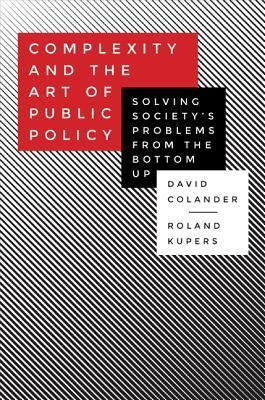
Complexity and the Art of Public Policy: Solving Society's Problems from the Bottom Up
As new book and as new dusk jacket. All our books are individually inspected, rated and described. Never EX-LIB unless specifically listed as such.
320 pages, Hardcover
First published January 1, 2014
About the author
David Colander
104 books17 followersDavid C. Colander is the Christian A. Johnson Distinguished Professor of Economics at Middlebury College.
Detailed resume available at:
http://community.middlebury.edu/~cola...
Detailed resume available at:
http://community.middlebury.edu/~cola...
Ratings & Reviews
Friends & Following
Create a free account to discover what your friends think of this book!
Community Reviews
Displaying 1 - 13 of 13 reviews

February 11, 2019
This book is a comprehensive yet accessible introduction to the political and economic ramifications of the science(s) of complexity. It does not advocate for any particular policy agenda, such as free markets or more government intervention, but a mixed and nuanced approach. Its two authors come from rather different ideological backgrounds: one of them is a quasi-Keynesian while the other is a quasi-Hayekian. Instead of ideological purity, it advocates for a new kind of "laissez-faire activist policy." This is an ambiguous position with unspecified and open-ended implications.
The authors start by laying out the interdisciplinary framework of complexity as developed my mathematicians and physicists in the past decades. They see the economy as a complex adaptive system not amenable to top-down prediction or control. They interpret the complexity frame as a natural continuation of the classical liberal political economy of people like Adam Smith and John Stuart Mill, mixed in with some contemporary insights from Hayek and Keynes.
The central insight is that the government should let people be free to interact in complex and socially beneficial ways - not just to pursue profits and material ends via the market mechanism, but also to pursue collective organization, social welfare, new kinds of social norms, etc... Instead of top-down mandates, the government should aim to create an evolving "ecostructure" that encourages bottom-up experimentation and sees strength in diversity. The complexity frame criticizes the assumptions of neoclassical economics and favours long-term resilience over short-term economic efficiency. It optimizes for long-term evolutionary dynamism. It sees human beings as fallible and boundedly rational, but also evolvable, transformable, and surprisingly creative.
The book is written for a lay audience and it is rather readable. It guides the reader by the hand, sometimes to the point of absurdity. But it works well for someone who is new to the subject. The flip side is a slight superficiality in its treatment of complex questions. Ironically, a book about complexity is seemingly enamored with simplicity, both in delivery and in policy framing. However, this simplicity serves the double function of popularizing science and summarizing lots of data. So, I cannot fault the book for being accessible for the general public, scientists, and policy makers.
The book has three major shortcomings, however: 1) The book is 100 pages too long due to excessive repetition. In any given chapter, the same idea is often repeated two or three times, in practically the exact same words. While the sentences themselves flow easily, the LP is stuck in a loop. 2) The constant refrain of how the complexity frame is so novel because it sees markets and governments as co-evolving is somewhat self-aggrandizing. And the attempt to be both pro-government and pro-market, while well-intentioned, runs into severe difficulties when put into practice. Therefore... 3) The policy recommendations are ambiguous and, in the few places where they are more concrete, only suggestive and therefore easy to ignore or shoot down. The ambiguous nature of the laissez-faire activist policy is presented as a commonsensical and obvious guide to policy making, but it is not clear what conclusions should flow from it. Appropriate public policy should flow from the practical wisdom of policy makers engaged in consultation with the public, which doesn't say much, especially given the range of political ideologies. Although the authors make some suggestive recommendations, like the development of for-benefit corporations, the precise policy implications are left to the reader to figure out. This, I dare say, is half of the fun.
The hesitation to provide clear guidelines is in line with the insights of complexity theory. But it does raise the question of what reason, if any, do policy makers have of adopting the complexity frame it its usefulness is so limited? However, I do not think that the failure to provide clear guidelines is a failure when the alternative is so much worse. It is much more important to learn to be modest and humble in political design than to overshoot for the stars. The complexity frame does a pretty good job at ELIMINATING many bad policies from the palette of available policy options. Most of top-down socialism and neoclassical economics is badly flawed.
Furthermore, aside from its negative impact, the complexity frame has a positive side. In articulating the broad outlines of a desirable evolutionary approach, it opens up a fruitful research program, both practical and theoretical, that explores ways in which bottom-up evolutionary dynamism can be fostered using government and market institutions.
The complexity frame is an important addition to the arsenal of policy making. Although it doesn't necessarily have unambiguous or immediate consequences for policy making (people will still have to fight over whether taxes on inheritance should be lower or higher), it provides a vital way to understand some of the most important challenges of a complex society that can carry public policy to new heights of resilience and creativity.
The authors start by laying out the interdisciplinary framework of complexity as developed my mathematicians and physicists in the past decades. They see the economy as a complex adaptive system not amenable to top-down prediction or control. They interpret the complexity frame as a natural continuation of the classical liberal political economy of people like Adam Smith and John Stuart Mill, mixed in with some contemporary insights from Hayek and Keynes.
The central insight is that the government should let people be free to interact in complex and socially beneficial ways - not just to pursue profits and material ends via the market mechanism, but also to pursue collective organization, social welfare, new kinds of social norms, etc... Instead of top-down mandates, the government should aim to create an evolving "ecostructure" that encourages bottom-up experimentation and sees strength in diversity. The complexity frame criticizes the assumptions of neoclassical economics and favours long-term resilience over short-term economic efficiency. It optimizes for long-term evolutionary dynamism. It sees human beings as fallible and boundedly rational, but also evolvable, transformable, and surprisingly creative.
The book is written for a lay audience and it is rather readable. It guides the reader by the hand, sometimes to the point of absurdity. But it works well for someone who is new to the subject. The flip side is a slight superficiality in its treatment of complex questions. Ironically, a book about complexity is seemingly enamored with simplicity, both in delivery and in policy framing. However, this simplicity serves the double function of popularizing science and summarizing lots of data. So, I cannot fault the book for being accessible for the general public, scientists, and policy makers.
The book has three major shortcomings, however: 1) The book is 100 pages too long due to excessive repetition. In any given chapter, the same idea is often repeated two or three times, in practically the exact same words. While the sentences themselves flow easily, the LP is stuck in a loop. 2) The constant refrain of how the complexity frame is so novel because it sees markets and governments as co-evolving is somewhat self-aggrandizing. And the attempt to be both pro-government and pro-market, while well-intentioned, runs into severe difficulties when put into practice. Therefore... 3) The policy recommendations are ambiguous and, in the few places where they are more concrete, only suggestive and therefore easy to ignore or shoot down. The ambiguous nature of the laissez-faire activist policy is presented as a commonsensical and obvious guide to policy making, but it is not clear what conclusions should flow from it. Appropriate public policy should flow from the practical wisdom of policy makers engaged in consultation with the public, which doesn't say much, especially given the range of political ideologies. Although the authors make some suggestive recommendations, like the development of for-benefit corporations, the precise policy implications are left to the reader to figure out. This, I dare say, is half of the fun.
The hesitation to provide clear guidelines is in line with the insights of complexity theory. But it does raise the question of what reason, if any, do policy makers have of adopting the complexity frame it its usefulness is so limited? However, I do not think that the failure to provide clear guidelines is a failure when the alternative is so much worse. It is much more important to learn to be modest and humble in political design than to overshoot for the stars. The complexity frame does a pretty good job at ELIMINATING many bad policies from the palette of available policy options. Most of top-down socialism and neoclassical economics is badly flawed.
Furthermore, aside from its negative impact, the complexity frame has a positive side. In articulating the broad outlines of a desirable evolutionary approach, it opens up a fruitful research program, both practical and theoretical, that explores ways in which bottom-up evolutionary dynamism can be fostered using government and market institutions.
The complexity frame is an important addition to the arsenal of policy making. Although it doesn't necessarily have unambiguous or immediate consequences for policy making (people will still have to fight over whether taxes on inheritance should be lower or higher), it provides a vital way to understand some of the most important challenges of a complex society that can carry public policy to new heights of resilience and creativity.

March 19, 2017
I read this for a reading group in my fellowship program and I have to say, as someone who enjoys philosophy, poli sci, and public policy, I found this book to be painful to read. Setting aside the fact that the authors simply repackaged a theory that has been around for sometime (see James Buchanan's article) except adding math to it to make it "complex"; the book was simply poorly conceived.
The authors state that their theory is complex more than they explain what it is. The authors, instead of addressing criticisms to their theory, address the opposition solely through strawman arguments claiming out of date and fringe beliefs for "market-fundamentalists" and 'those who support the traditional system'. They often claim that something is "bottom-up" or society driven while calling for a top-down government solution; theories and claims are rarely cited and their are multiple misspellings. While I read the book I was simply baffled that this made it to press and counted as an academic work.
I don't mean to dismiss the ideas that the authors presented off-hand, I would be interested to engage with their ideas, however, the way that they were presented is absolutely baffling -- Perhaps if they take the time to flesh out and explain their ideas in a clear and concise manner I can have the chance to engage with them.
The authors state that their theory is complex more than they explain what it is. The authors, instead of addressing criticisms to their theory, address the opposition solely through strawman arguments claiming out of date and fringe beliefs for "market-fundamentalists" and 'those who support the traditional system'. They often claim that something is "bottom-up" or society driven while calling for a top-down government solution; theories and claims are rarely cited and their are multiple misspellings. While I read the book I was simply baffled that this made it to press and counted as an academic work.
I don't mean to dismiss the ideas that the authors presented off-hand, I would be interested to engage with their ideas, however, the way that they were presented is absolutely baffling -- Perhaps if they take the time to flesh out and explain their ideas in a clear and concise manner I can have the chance to engage with them.

May 9, 2021
The laissez faire activism vs the old bureaucratic top down approaches are thoroughly evaluated in this book which has opened my eyes on many different blind spots of public policy.
Reinforced with many readings about complexity frameworks in social sciences I couldn't help but think of the numerous implications that this kind of thinking might entail.
Revising some serious metapolicy debates and reaching to legal frameworks...
I can't deliver a scientific and rather meticulous review here for obvious reasons, but I'd love to highlight the contribution of this book in reshaping public policy. It might be only an avant-goût to what could public policy look like or could at least provide for you a ground for debate.
It was a nice discovery.
Reinforced with many readings about complexity frameworks in social sciences I couldn't help but think of the numerous implications that this kind of thinking might entail.
Revising some serious metapolicy debates and reaching to legal frameworks...
I can't deliver a scientific and rather meticulous review here for obvious reasons, but I'd love to highlight the contribution of this book in reshaping public policy. It might be only an avant-goût to what could public policy look like or could at least provide for you a ground for debate.
It was a nice discovery.

October 4, 2014
Colander and Kupers have introduced the science of complexity to the fields of economics and public policy and laid down a path to the future.
They say if you ask 6 economists to predict what will happen, you will get 7 opinions. Both microeconomics and macroeconomics are broken because the fields take what we know to be a complex system, and attempt to analyze it using simplified models. Those simplified models can't and don't model the world well. The best evidence is provided by the 2007 financial crash, which was not predicted by economic models, not even after the fact with 20/20 hindsight. Since 2007 economists have been challenged to update their field, and one line of reasoning is to bring complexity science into use.
Economists have been trapped by way they frame the questions. Colander and Kupers examine the two dominant philosophical views: the bottom up lassez-faire free market fundamentalist view held typically by the American political right where the free market is considered the only way to achieve an efficient working society. The other view is the top-down government control fundamentalist view typically held by the American political left where government policy is the only way to achieve an effective society. These two views vie to give us a complete political spectrum, but they are both flawed ways to frame these economic and social questions. They show us that Adam Smith and John Stuart Mill never intended that government policy should be excluded from a lassez-faire model of the economy, and the current free market fundamentalists have taken such extremist positions that are not justified by the evidence or the theory. Similarly, they show that John Maynard Keynes never believed that government alone could simply control the world the way the control fundamentalists think it can. It seems that the founders of these theories had a lot more appreciation for the natural complexity the world.
Colander and Kupers then show how this appreciation for the complexity was lost from both microeconomics and macroeconomics because the math was too hard. Simplifying assumptions were made because there was no other way to end up with usable formulas. The problem with complex systems is that you can't simplify and still retain the general behavior of the system. People are not 'econs' who make purchases strictly by their assessment of the value of the utility of the good. There are fad, fashion, and path dependencies. There are lock-in effects. Economists have been crossing their fingers and hoping that these don't matter, but they do.
The suggestion is then to view the economy as a complex system that involves both a market and a government. Government does not run the market, but it can influence it. The market influences the government as well. This Complexity Frame can leverage recently developed mathematical techniques including agent based modeling which requires computing capability not available until recently. Our leaders should leverage the self-controlling behavior of complex systems when that works. Counter-intuitively, complex systems become more stable when you increase the variety within the system -- so our goal should never be to find the one right way, but instead a plurality of possibilities. Complex systems will gravitate toward equilibrium states which are not always predictable. Government policies can be used to tweak the system, shifting the point of equilibrium, but not replace the basic self regulation that occurs.
"A frame is a frame because people don't think about it."
The authors explore the complexity frame in quite a bit of detail, how the standard frames fail to account for factors, and how the complexity frame would allow for proper treatment. They spend a couple of chapters exploring how policies might be set to influence the system, but still allow the system to self regulate and address some of the current social problems. What policies might we set, what might work, and what traps to avoid. These are highly speculative and makes an entertaining reading, bordering on getting a bit dreamy.
The book is concluded with two powerful chapters: A specific recommendation on how to teach social science. Specifically we need to teach social science based on:
1) Statistics and Sociometrics Module
2) Modern Game Theory Module
3) Complexity and Modeling Module
4) Philosophical and Methodological Module
5) Humanist Module
The future relies on the students of today gaining the skills to use the tools of tomorrow. Finally, a summary of the ideas and what this might mean to the world.
This book makes sense. A lot of sense. I personally have been reading a lot about Santa Fe Institute and complexity science. It will happen, that these newer forms of mathematics, and newer understandings of how complex systems behave, will work their way into other fields. This is an excellent treatment, giving a lot of history of the field of economics, showing credible causes for influences that led economics to where it is today, and showing a path forward.
They say if you ask 6 economists to predict what will happen, you will get 7 opinions. Both microeconomics and macroeconomics are broken because the fields take what we know to be a complex system, and attempt to analyze it using simplified models. Those simplified models can't and don't model the world well. The best evidence is provided by the 2007 financial crash, which was not predicted by economic models, not even after the fact with 20/20 hindsight. Since 2007 economists have been challenged to update their field, and one line of reasoning is to bring complexity science into use.
Economists have been trapped by way they frame the questions. Colander and Kupers examine the two dominant philosophical views: the bottom up lassez-faire free market fundamentalist view held typically by the American political right where the free market is considered the only way to achieve an efficient working society. The other view is the top-down government control fundamentalist view typically held by the American political left where government policy is the only way to achieve an effective society. These two views vie to give us a complete political spectrum, but they are both flawed ways to frame these economic and social questions. They show us that Adam Smith and John Stuart Mill never intended that government policy should be excluded from a lassez-faire model of the economy, and the current free market fundamentalists have taken such extremist positions that are not justified by the evidence or the theory. Similarly, they show that John Maynard Keynes never believed that government alone could simply control the world the way the control fundamentalists think it can. It seems that the founders of these theories had a lot more appreciation for the natural complexity the world.
Colander and Kupers then show how this appreciation for the complexity was lost from both microeconomics and macroeconomics because the math was too hard. Simplifying assumptions were made because there was no other way to end up with usable formulas. The problem with complex systems is that you can't simplify and still retain the general behavior of the system. People are not 'econs' who make purchases strictly by their assessment of the value of the utility of the good. There are fad, fashion, and path dependencies. There are lock-in effects. Economists have been crossing their fingers and hoping that these don't matter, but they do.
The suggestion is then to view the economy as a complex system that involves both a market and a government. Government does not run the market, but it can influence it. The market influences the government as well. This Complexity Frame can leverage recently developed mathematical techniques including agent based modeling which requires computing capability not available until recently. Our leaders should leverage the self-controlling behavior of complex systems when that works. Counter-intuitively, complex systems become more stable when you increase the variety within the system -- so our goal should never be to find the one right way, but instead a plurality of possibilities. Complex systems will gravitate toward equilibrium states which are not always predictable. Government policies can be used to tweak the system, shifting the point of equilibrium, but not replace the basic self regulation that occurs.
"A frame is a frame because people don't think about it."
The authors explore the complexity frame in quite a bit of detail, how the standard frames fail to account for factors, and how the complexity frame would allow for proper treatment. They spend a couple of chapters exploring how policies might be set to influence the system, but still allow the system to self regulate and address some of the current social problems. What policies might we set, what might work, and what traps to avoid. These are highly speculative and makes an entertaining reading, bordering on getting a bit dreamy.
The book is concluded with two powerful chapters: A specific recommendation on how to teach social science. Specifically we need to teach social science based on:
1) Statistics and Sociometrics Module
2) Modern Game Theory Module
3) Complexity and Modeling Module
4) Philosophical and Methodological Module
5) Humanist Module
The future relies on the students of today gaining the skills to use the tools of tomorrow. Finally, a summary of the ideas and what this might mean to the world.
This book makes sense. A lot of sense. I personally have been reading a lot about Santa Fe Institute and complexity science. It will happen, that these newer forms of mathematics, and newer understandings of how complex systems behave, will work their way into other fields. This is an excellent treatment, giving a lot of history of the field of economics, showing credible causes for influences that led economics to where it is today, and showing a path forward.
March 4, 2025
Stumbled upon this book while researching for a class paper. This should be required reading for anyone in economics or policymaking.

March 13, 2015
Before talking about the central idea here I have to say I really appreciate this book providing in the middle chapters an ACTUAL critique of modern economics. Don't get me wrong - I've seen plenty of critiques of economics as a field. But almost without exception those critiques seem to have little idea of what modern economics actually is or does. Typically this takes the form of confusing economics for capitalism, focusing on one tiny problem and pretending it invalidates the entire field, or, most commonly, critiquing economics as it was 20 (30, 40, 70, 100) years ago and ignoring the fact that their complaints have been well-addressed in the meantime. But nope! This book knows exactly what goes on in modern economics and can identify an actual major systemic problem with the field relating to the simplicity of its modeling, the lack of attention to feedback mechanisms like endogenous tastes, and difficulty in dealing with more than one thing at a time. Plus the book provides a nice compact history of postwar economic approaches. I'd quibble with them trotting out the worn half-truth that economics only cares about material welfare, but you could really do worse for a short broad-scope survey of the field of academic economics.
So, then, complexity. This book focuses on an emerging complexity science that uses new tools to study people in ways that allow for complex interactions between different systems, path-dependence, and high levels of nonlinearity in analysis. Both of these are very difficult to account for in standard analysis. Despite the fact that everyone knows they're important, we sort of leave them as caveats to any results we come up with, or for "later work." Here's the later work! This sort of work allows for things like emergent behavior and lock-in equilibria. There's a lot to think about here, and the book managed to address things I've been thinking about for a long time. More than once I went into my "projects to work on someday" file to delete or edit project plans, finding out that they'd already been done!
This is really fascinating stuff, and I think it's not just a great idea but actually going to form the future of social science. Work is already heading in this direction in paying greater attention to these effects, even if the actual tools they talk about aren't always the way it's done. Definitely a worthy read if you want to think about social behavior on a deep and comprehensive level without falling into the trap of thinking that "it's complicated" is a conclusion rather than a starting point (looking at you, low-end sociology papers). There's no reason to be limited by the traditional approaches to these problems.
The book's not perfect, of course. I could have done with far more examples of this kind of research in action. Or examples of policies. The authors repeatedly talk about for-benefit (social enterprise) institutions as the complexity policy killer app but they don't make clear what exactly is holding them back from being a much bigger force than they are other than the social norm of profit-driven institutions (and how do you build a choice ecostructure to encourage that to change, exactly?), the long-run examples they come up with depressingly turned into for-profit over time (AT&T, hospitals), and the laser focus on the idea leads to the impression that there's a lack of good implementation ideas when you check inside the box which I suspect is not true. In general the book casts a very wide and optimistic net for what can change within the complexity frame. That may be the best rhetorical approach but sometimes it does get a little silly - I seriously doubt that a complexity frame will have much effect on confused or illogical political disputes, for example. Along those lines I'm not sure I buy the long laundry list of ideas and thinkers that get claimed by the "complexity frame" - Smith, Mill, Hayek, Keynes, Kahneman, etc. may have all been thinkers who allowed for complexity but it's hard to put them all in the same "frame" without pulling the teeth from the concept.
But that's just me being nitpicky. That's all about the text specifically; the ideas here are very solid and this is a book that can really make you think in new ways. A strong recommendation.
So, then, complexity. This book focuses on an emerging complexity science that uses new tools to study people in ways that allow for complex interactions between different systems, path-dependence, and high levels of nonlinearity in analysis. Both of these are very difficult to account for in standard analysis. Despite the fact that everyone knows they're important, we sort of leave them as caveats to any results we come up with, or for "later work." Here's the later work! This sort of work allows for things like emergent behavior and lock-in equilibria. There's a lot to think about here, and the book managed to address things I've been thinking about for a long time. More than once I went into my "projects to work on someday" file to delete or edit project plans, finding out that they'd already been done!
This is really fascinating stuff, and I think it's not just a great idea but actually going to form the future of social science. Work is already heading in this direction in paying greater attention to these effects, even if the actual tools they talk about aren't always the way it's done. Definitely a worthy read if you want to think about social behavior on a deep and comprehensive level without falling into the trap of thinking that "it's complicated" is a conclusion rather than a starting point (looking at you, low-end sociology papers). There's no reason to be limited by the traditional approaches to these problems.
The book's not perfect, of course. I could have done with far more examples of this kind of research in action. Or examples of policies. The authors repeatedly talk about for-benefit (social enterprise) institutions as the complexity policy killer app but they don't make clear what exactly is holding them back from being a much bigger force than they are other than the social norm of profit-driven institutions (and how do you build a choice ecostructure to encourage that to change, exactly?), the long-run examples they come up with depressingly turned into for-profit over time (AT&T, hospitals), and the laser focus on the idea leads to the impression that there's a lack of good implementation ideas when you check inside the box which I suspect is not true. In general the book casts a very wide and optimistic net for what can change within the complexity frame. That may be the best rhetorical approach but sometimes it does get a little silly - I seriously doubt that a complexity frame will have much effect on confused or illogical political disputes, for example. Along those lines I'm not sure I buy the long laundry list of ideas and thinkers that get claimed by the "complexity frame" - Smith, Mill, Hayek, Keynes, Kahneman, etc. may have all been thinkers who allowed for complexity but it's hard to put them all in the same "frame" without pulling the teeth from the concept.
But that's just me being nitpicky. That's all about the text specifically; the ideas here are very solid and this is a book that can really make you think in new ways. A strong recommendation.
January 4, 2015
This is an important book. If you are a politician or a senior civil servant making policy you absolutely must read it.
It says that our world is becoming an increasingly complex, highly-interconnected social system – one in which everything affects everything else. But the economic and other models on which government bases policy-making do not reflect this; and we are suffering as a consequence.
The book explains how complexity science – the study of complex adaptive systems – is being applied increasingly to good effect in the harder sciences but not much in the social ones. It particularly singles out economics as laggardly, with out-of-date simplistic models and entrenched industrial-age mindset.
Its discusses the ineffectiveness of direct policy action which is increasingly leading to unintended consequences and often expensive failure. They argue that governments needs to shift their focus towards creating healthy ecosystems that will enable society to solve its own problems and away from fixing those problems directly. Government must think of itself more as an influencer and less as a controller.
I notice discussions of “wicked problems” (another name for complex problems) cropping up in government circles more often nowadays and last year I even attended a seminar run by one of the departments. I was delighted to bump into a chap at the event who turned out to be the department’s permanent secretary. I quizzed him about how complexity thinking was affecting his policy-making. Sadly, I got a very blank look back.
David and Roland are quite right that complexity has little visibility at the policy level. Frustratingly, I’d say that the complex problems are the only ones worth fixing. I’ve written about this separately: the problems of the Universal Credit programme are much to do with a failure to understand the implications of complexity – see Universal Credit and the need to think more ‘Grow’ (and less ‘Build’) and Government doesn’t get complexity.
Complexity is such an important thing for government to get. Read the book.
It says that our world is becoming an increasingly complex, highly-interconnected social system – one in which everything affects everything else. But the economic and other models on which government bases policy-making do not reflect this; and we are suffering as a consequence.
The book explains how complexity science – the study of complex adaptive systems – is being applied increasingly to good effect in the harder sciences but not much in the social ones. It particularly singles out economics as laggardly, with out-of-date simplistic models and entrenched industrial-age mindset.
Its discusses the ineffectiveness of direct policy action which is increasingly leading to unintended consequences and often expensive failure. They argue that governments needs to shift their focus towards creating healthy ecosystems that will enable society to solve its own problems and away from fixing those problems directly. Government must think of itself more as an influencer and less as a controller.
I notice discussions of “wicked problems” (another name for complex problems) cropping up in government circles more often nowadays and last year I even attended a seminar run by one of the departments. I was delighted to bump into a chap at the event who turned out to be the department’s permanent secretary. I quizzed him about how complexity thinking was affecting his policy-making. Sadly, I got a very blank look back.
David and Roland are quite right that complexity has little visibility at the policy level. Frustratingly, I’d say that the complex problems are the only ones worth fixing. I’ve written about this separately: the problems of the Universal Credit programme are much to do with a failure to understand the implications of complexity – see Universal Credit and the need to think more ‘Grow’ (and less ‘Build’) and Government doesn’t get complexity.
Complexity is such an important thing for government to get. Read the book.
August 9, 2021
I really wanted to like this book, but ultimately found it more frustrating than enlightening. I was (and remain) enthusiastic that public policy could benefit from taking a more complexity-informed approach, and was interested in seeing what this could mean fleshed out in more detail. Unfortunately, the first 2/3 of the book felt like an extended exercise in just repeating 'complexity frame good, standard approach bad' over and over again. And when it finally got to what should have been the 'show, don't tell' section in Part 3, it felt more like a grab-bag of random ideas than a well-considered agenda. I would have loved to see a complexity framework for public policy developed and applied in more depth, but if they weren't going to do that, I think the existing content could easily have been covered in half the space or less. Given the chance again, I'd probably just read the final summary chapter, as it hits most of the key points in a clearer and less repetitive way, without actually losing much of the substance.
December 5, 2016
Good book that clearly outlines the pathway towards a major transformation across all parts of society. Highlights the need for coherent progress between material and spiritual or social progress; human welfare cannot be reduced to materialism alone. Fundamentally, a transformation requires a hopeful conception of human nature, that sees the individual as capable of innovation, collaboration, and brining about change from the bottom-up.

October 11, 2015
The authors created a policy framework using complexity theory that combines the free market/bottom up and the government/top-down policies into a holistic one. I think this is a very important book. The complex policy framework has the potential to change political debate from senseless left vs. right to constructive arguments.
October 9, 2015
Excellent tour de force on the makings of complexity theory.
O comprehensives view of complexity, highlights the shortcoming of standard economic theory, and offers a complete guide to understanding the challenge of building a modern society
O comprehensives view of complexity, highlights the shortcoming of standard economic theory, and offers a complete guide to understanding the challenge of building a modern society
September 12, 2014
More people should read it.

December 16, 2014
Some good points, but in spite of an effort not to, veers towards the utopian at points. Would be better if it incorporated a little public choice.
Displaying 1 - 13 of 13 reviews