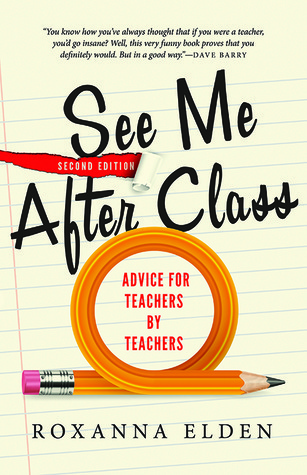
Oh god, this book. I got it from the library after a horrible experience subbing in an elementary school, and it was like a balm to my tired, bruised, slightly chewed-on (don't ask) soul.
One of the things that has always bothered me about teaching books is that they never mention when things go wrong. Somehow when the people writing these books arranged their students' desks in circles, they didn't have the kids start throwing pencils at each other. Their discussions never fell flat. The world in teaching-advice books (or in a lot of college classes, let's be honest) is full of magical, fluffy rainbow-puking Communist unicorns and one simple thing (I'm fixated on the desks-in-a-circle because that was what my college was fixated on) will solve all your classroom management issues, as well as student motivation and ability issues.
Roxanna Elden is not about that life. She readily admits that teaching is hard, that magic solutions don't work in every classroom or every context, and that after a particularly bad day, reading about "by a teacher who taught kids to play violin during lunch or took busloads of perfectly behaved fifth- graders on a tour of college campuses makes you want to beat your head against the wall until pieces of scalp and hair are all over the place." It's a book designed to help (new) teachers get through the rough times that are most certainly a-coming.
She doesn't try to sugar-coat anything, or make it seem like it should be easy. In her "classroom management" section, (20 pages of glory) every classic classroom management line (Make lessons interesting! Be consistent! Etc) is broken down into three sections: Why it works, Why it's easier said than done, and How to make it easier. She also doesn't believe in lost causes. "See Me After Class" features a myriad of (mostly horror) stories from real teachers, who are still teaching (as of publication) after the stomach-punching events that they describe.
And that's what I really appreciated about this book. Roxanna talks about the six-hour-till-Monday panic, the terrors of hitting rock bottom while teaching. "The worst part about hitting rock bottom is you don’t know you’ve hit rock bottom. You hate the sound of your alarm clock. You hate the fact that you didn’t just die in your sleep, and now you have to go in and face these kids." (pg 75) And then she talks about what to do to get back from that feeling. Reading that passage was so comforting for me, because I REMEMBER feeling that way. And embracing both that feeling, and the fact that teaching was still the only thing that I wanted to do with my life, was an impossible contradiction. Reading this book and experiencing the mirror of my feelings has been so helpful.
Basically, I love this book. I start my first long-call sub assignment in a few weeks, and I'm buying myself a copy of this book so that I can keep myself sane.