The Christmas tree of a poor peasant family leaves their cottage on Christmas Eve and goes into the forest in search of pretty things with which to decorate himself
What a heart-warming story! The Good Little Christmas Tree is an almost perfect Christmas tale for young children. It has magic, hope, goodness, generosity of spirit, selflessness - and a happy ending. Ursula Moray Williams wrote this story in 1942, but it has a timeless quality, and reads like a fable.
A poor peasant takes home a tiny Christmas tree for his children, and he and his wife hide it away in a sack behind the stove until Christmas day. They are sad that they have no money to decorate the tree, and worry that it will not seem very special. They go to bed hoping that the children will know they did their best.
"The little tree sighed, too, when the peasant and his wife were gone to bed, for they were an honest pair, and he liked their kind and simple hearts."
What the little Christmas tree does, in order to decorate himself, is simply magical. He meets many different characters on his travels, and we begin to recognise elements from traditional folk tales, and repeated little phrases which we begin to anticate and enjoy. We meet wolves, gnomes and goblins, a pedlar, an old man and a young girl, and some baby Angels. But the little Christmas tree is so intent on making a beautiful gift for other people, that he puts his own life in great danger. If you don't get a lump in your throat near the end, then you must have lost all your childhood sense of wonder. I myself was very worried indeed for the fate of this brave little tree.
When he meets Father Christmas, then I knew everything would work out alright. All the characters come together again, and although the ending is not explicit and played out, it is heavily implied, leaving the reader with a happy sense of anticipation,
"Oh quick! quick! get back into bed and pull the bedclothes over our heads as quick as we can, or we shall never get anything at all."
If you are the sort of person who loves O. Henry's "The Gift of the Magi", then this story inspires the same sort of reaction. Just beautiful.
In this particular edition from 1990, there are illustrations by Gillian Tyler on each double page spread. They are carefully drawn and naturalistically coloured. They are very fine, and enhance the story itself.
Edit:
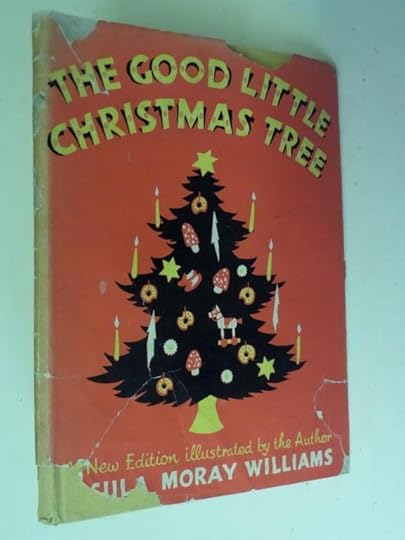
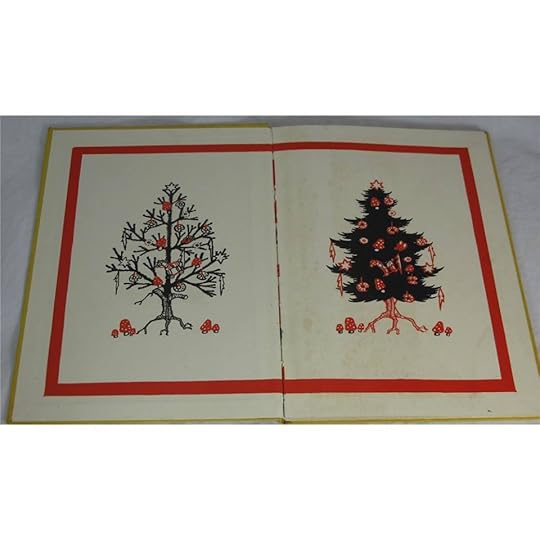
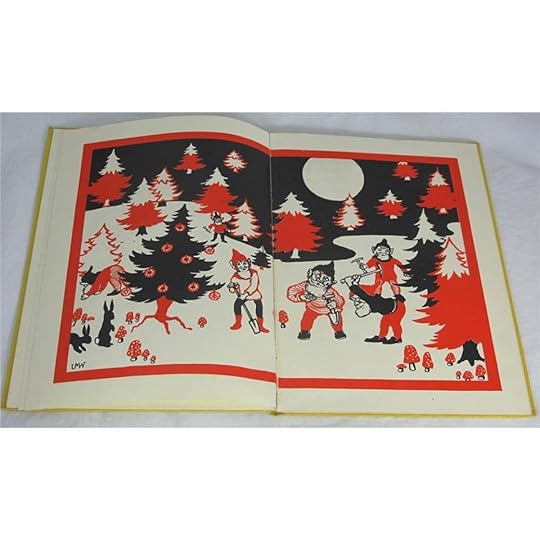
My copy of this book is the one I had as a child. It is "a new edition in two colours" (black and red) "with illustrations by the author from her original scissor-cuts". Originally published in 1942, it has a very different feel:
Originally printed in 1943, this new edition with magical, fairytale illustrations by Gillian Taylor tells the tale of a poor man who brings a little tree back from the forest as a present for his children. (You have to suspend belief for a moment here as the poor man rests this tree in a sack against the woodburner) Not what uprooted trees like best especially when they've ben brought in from the snow. However during the night the little tree begins to think what his branches should hold for the children on Christmas morning. There is a lovely illustration which shows the tree shaking it's little root feet out of the pot and sets off to find some fine gifts to adorn it's branches.
The story has a lovely fairytale feel, the illustrations are detailed and magical and of course there is a fairytale ending. A lovely story that will leave you feeling sorry for your Christmas tree.
I really enjoyed this Christmas picture book, which I read several weeks ago. Even better than the story were the illustrations, which were dear. I've always believed Christmas trees have personalities, and so this was the perfect read for me.
Thanks for the recommendation, Hilary! It wasn't Christmastime by the time the ILL copy came in, but still a very nice comfort read.
Originally published in 1943, with artwork by Ursula Moray Williams herself, and then reprinted in this 1990 edition, with new illustrations by Gillian Tyler, this sweet little holiday story follows the adventures of a small Christmas tree, and his efforts to give the poor peasant family, in whose home he finds himself, all the blessings he thinks they deserve. Wandering the snowy woods on Christmas Eve, the tree bargains away his own beauty, trading all his lovely little green needles for the beautiful decorations and gifts he wants to provide for his family. Finally, catching sight of himself in a clear pool, he is so ashamed of his denuded appearance, that he cannot bear the idea of returning home. Have all his efforts been in vain? Or will St. Nicholas, who is also in the woods this night, set all to rights...?
There's really not much doubt, as to the answer to that question - just look at the cover illustration here! - but The Good Little Christmas Tree is an engaging tale, all the same. Text heavy, for a picture-book - I'd say this was more of an illustrated short story - it includes numerous fantasy elements, from the tree's journey itself, to the gnomes and goblins, wolf-guarded toadstools, and dancing angels, that he encounters. Williams seems to have often made sentient animals and objects her protagonists - see Adventures of the Little Wooden Horse and Gobbolino The Witch's Cat - and here she continues the trend with a sentient tree. Although I wouldn't say that it was destined to become a personal holiday favorite, I did enjoy the story, and appreciated Gillian Tyler's illustrations, which reminded me a bit of Pauline Baynes' work. Recommended to all young readers who wonder about the Christmas magic going on, while they're asleep...
A poor peasant found the little tree in the woods, placed it in a bag and brought it home to his family. It was to be a surprise for his little girl and boy. He had no ornaments or gifts, but his wife had baked that day and strung up a few cookies. It was Christmas Eve and they went to bed hoping the sight of the tree would delight their children in the morning.
Long story short, the tree traveled into the night bartering items to improve its appearance using its green needles. Gnomes, wolves and baby angels were just a few that it traded with. By night’s end it had what it needed except the little tree was in rough shape. It appealed to St. Nick and with a little magic, the tree was beautiful once more
Some of the illustrations were very beautiful, but I felt the story lacked focus. I don't hold with tales that lump together saints and angels with goblins and gnomes and talking animals.
This is a very nicely written book about caring, compassion and what the true meaning of Christmas is all about. I could see this book be one you could read to your family during Christmas Eve-Day. A poor family doesn't have much to give their children but the dad brings home a very small tree. They set it up after the children go to bed; but they worry that it won't be 'good' enough because all they had to decorate it was homemade cookies the mother made. But they knew in their hearts that their children were kindhearted and know that the tree would be enough. But the tree heard the parents talking and that night the tree slips out of his pot and out the door. He encounters goblins, wolves, a stranger, baby angels, and St Nicholas in the woods and have to give all he has in exchange for things to put on himself for his children. In the end he looks ragged and embarrassed at himself for looking so poorly. He asks St Nicholas to take all the gifts off himself and put it on another tree to deliver that to his children. But St. Nicholas knowing what the tree did and felt touched him with his magic and made his needles all grow back and took him back to his family.
I read this story, originally written in 1943, on Christmas Eve, which was most appropriate. A small Christmas tree, belonging to a poor family who have only cookies to hang on its branches as gifts for the children, goes off on Christmas Eve in search of more decorations and gifts. The tree trades its needles and some of its branches in exchange for items from people and animals it meets along the way. The illustrations, by Gillian Tyler, are not the originals, but have the feel of being from the 1940s. The 2-page illustration on pages 7 and 8 gives a glimpse of all the encounters the tree will have that evening. I like the way the tree walks on its roots--looks like he's tiptoeing. The only part of the story I couldn't go along with was mushrooms growing in the snow--in a ring, no less. Don't they die during the winter? I'll have to look that up. It's so nice that this story has been reissued for more children to appreciate and enjoy. Recommended for a Christmas Eve read, preferably aloud.
Reread for Christmas season 2015. I still imagine myself as the little Christmas tree. Can I give that much of myself to bring happiness? The story makes me think. I especially like the scene with the angels.