The empire is on its knees, but a last hope lies beyond the eastern frontier . . .
377 AD: Emperor Valens has stripped the Persian frontier of its legions, sending every available man to Thracia in an effort to contain the rampaging Gothic hordes. Now, covetous eyes have fallen upon Rome’s trade-rich but sparsely defended desert provinces. Shapur II, Shahanshah of the Sassanid Empire and his many client kings have long believed Rome’s eastern holdings to be theirs by ancestral right, and those lands have never been more vulnerable. Thus, Valens must grasp at the slimmest of hopes that a Persian invasion can be staved off, not by the brute force of absent legions, but by the tenacity of a hardy few. For in the heart of enemy lands, something thought long lost might just offer salvation.
When Optio Numerius Vitellius Pavo and a select group of the XI Claudia are summoned to the Persian front, they leave Thracia behind, knowing little of what awaits them. They know only that they are to march into a burning land of strange gods. They whisper tales of the mighty Persian Savaran cavalry and pray to Mithras they will see their homes and families again. All too soon it becomes clear to them that this is no ordinary mission – indeed, the very fate of the empire might rest upon their efforts. But for Pavo the burden is weightier still, for he knows that the east also holds something even more precious to him . . . the truth about his father.
I'm a Scottish writer, addicted to reading and writing historical fiction.
My love of history was first kindled by visits to the misty Roman ruins of Britain and the sun-baked antiquities of Turkey and Greece. My expeditions since have taken me all over the world and back and forth through time (metaphorically, at least), allowing me to write tales of the later Roman Empire, Byzantium, Classical Greece and even the distant Bronze Age.
All of my novels are available from good online stores in paperback and eBook format.
Mr. Doherty is improving his storytelling, characterization, and writing style with every novel he writes. This was a solid, thrilling novel with well-rounded characters. Pavo and a vexillatio [detachment] from the XI Claudia are given the mission to infiltrate Persia and to return with a certain scroll, a copy of a treaty made by Emperor Jovian and Persia years before. This treaty may possibly save the Roman Empire from invasion. Pavo and his group enter Persia, undergoing hardships, trek across a hostile desert, skirmishes, treachery, slavery. After a remarkable escape from slavery, the men are poised to recover the scroll. Will it be as valuable as made out? And will the men return safely to Antioch and put it in the hands of Emperor Valens?
The Sassanid Persian setting gave a different flavor to the story. I enjoyed learning a bit about this culture and Zoroastrianism. I like that Pavo does note in one place: although there are evil people bent on destruction of the Romans, there are good, kind Persians he meets, also, to balance out. The archvillain does get his well-deserved comeuppance, and how! I was very impressed with the episode of the whole trek through the desert, with the vivid description of the sandstorm and of the privations the men suffered. The Persian adventures were really exciting. Description of life in the salt mine was well done. The escape from the salt mine was almost miraculous, but the later ones were a bit incredible. I enjoyed the vivid description of the Persian 'Blood Games'.
I wasn't able to put this book down once I started reading. Historical research was impeccable. One thing niggled at me somewhat. I felt choice of expressions sometimes were strange and repeated too often, e.g., someone downing his helmet; someone was grappled by his throat; someone spoke in jagged Greek.... Maybe these were British usage or colloquial in the area in the U.K. the author comes from and I'm not used to them. Perhaps the author could have consulted a thesaurus more often. Other than that, the novel is a fine addition to Roman military fiction in the later Empire.
The empire is on its knees, but a last hope lies beyond the eastern frontier . . .
377 AD: Emperor Valens has stripped the Persian frontier of its legions, sending every available man to Thracia in an effort to contain the rampaging Gothic hordes. Now, covetous eyes have fallen upon Rome’s trade-rich but sparsely defended desert provinces. Shapur II, Shahanshah of the Sassanid Empire and his many client kings have long believed Rome’s eastern holdings to be theirs by ancestral right, and those lands have never been more vulnerable. Thus, Valens must grasp at the slimmest of hopes that a Persian invasion can be staved off, not by the brute force of absent legions, but by the tenacity of a hardy few. For in the heart of enemy lands, something thought long lost might just offer salvation.
When Optio Numerius Vitellius Pavo and a select group of the XI Claudia are summoned to the Persian front, they leave Thracia behind, knowing little of what awaits them. They know only that they are to march into a burning land of strange gods. They whisper tales of the mighty Persian Savaran cavalry and pray to Mithras they will see their homes and families again. All too soon it becomes clear to them that this is no ordinary mission – indeed, the very fate of the empire might rest upon their efforts. But for Pavo the burden is weightier still, for he knows that the east also holds something even more precious to him . . . the truth about his father.
I was first drawn to Gordon Doherty's books because of the wonderful, striking covers. The first in this series I rated at four stars - it was his debut novel and you could tell the style had a little way to develop. It was a great read, but I knew better was to come and I'm glad to say Land of the Sacred Fire delivers the goods. I was lucky enough to win this in a Goodreads giveaway, kindly signed by the author and it takes pride of place beside my other signed Roman fiction by guys like Ben Kane and Anthony Riches. This is not in any way out of place in such illustrious company! The story is fast paced and action packed, with a lot less of the political stuff that tended to slow things down in the first book. There's also a lot less of the soldiers "chirping" and the dialogue flows a lot more realistically. Personally, I'd like the character's language to be a bit more earthy, with the odd curse-word thrown in, but many readers will surely disagree with that, so to each their own. As I won this, I felt I owed the author a review as soon as possible so I've not actually read the second book in the series and as a result I don't know what happened with Pavo's love interest. She barely gets a mention here though, which surprised me. Didn't affect the story in any major way though, so don't worry. There ARE a few very well-written, emotional scenes that provide a little respite from the relentless action, and I'd like to see this kind of thing explored more in Gordon's future work. If you enjoy boy's-own style action adventure stories with little let-up in the action this series is for you. And, with the first one now available as an audiobook you have plenty of ways to discover Pavo and his fellow Legionaries! Excellent, and highly recommended!
Steven A. McKay, author of Wolf's Head and The Wolf & the Raven.
This was quite a ride. Characters were reasonably developed, and the story was swift and smart (maybe with an exception of one or two very improbable escapes). Also, I really appreciate the cautious way the author deals with historical facts and details. Very nice addition to the series & looking forward to the next book!
“Shapur has taken control of Armenia. Ten thousand Persian riders now patrol those lands and puppet the fickle princes who once swore loyalty to Rome. Much hangs in the balance today; our mission, our lives . . . our empire. We are far from home, but Mithras watches over us, for in this burning land we find brothers to fight alongside. We call out to two gods for providence. But we stand or fall as one. For the empire,”
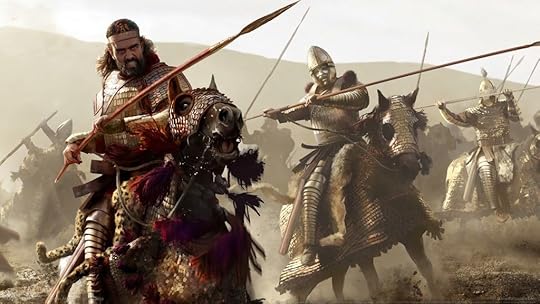
The mighty Persian Savaran cavalry in action
"Even without horse, coin or water, I would travel east alone to find out what happened to you. If Mithras wills it, I will find you or your bones out there, Father."
3rd in the Legionary series, the book tells the story of the thrilling adventure of Pavo, an Optio in the XI Claudia Legion in Persia. In 377 AD thank the last year's Gothic invasion in the west, that the desert provinces of the Eastern Roman empire have never been more vulnerable against a full-fledged Sassanid invasion who long believed Rome’s eastern holdings to be theirs by ancestral right. The only hope to avoid the invasion is a rumored scroll that is now lost with the time somewhere inside Persia. To find it Emperor Valens send the men of XI Claudia to a covert mission inside the burning heartland of Persia. As Pavo and his group enter Persia, trek across a hostile desert, undergo one hardship after another and faces sandstorms, skirmishes, treachery, and slavery, the very fate of the empire rest upon their efforts. But for Pavo, the burden is weightier since the east also holds the truth about his father. Will Pavo ever succeeds in finding the lost scroll and his father? or he himself gets lost in the Persian desert?
🆁🅴🆅🅸🅴🆆:
📜The cover of the book with the Persian desert littered with the Roman military accessories is eye-catching and the title apt to the story as it represents the holy fire of Ahura Mazda which had an important role to play in the story.
📜The plot of the book revolves around the quest of finding a rumored scroll, a copy of the signed treaty of emperor Jovian and Shahenshah Shapur which could possibly save the empire from an impending invasion. But you can't possibly guess from where the scroll will be found/ who will help in finding it. Besides this, there also runs a parallel quest of Pavo of finding his lost father, and both the quests are interconnected.
📜Gordon's writing style is improving with each book. In this fast-paced and action-packed book, I never feel bored. In every scene, a certain unexpected thing happens which hooked the reader's attention. His description of the scorching Persian desert, deadly sandstorms, dark salt mines of Dalaki, harsh condition of the slaves, bloody Persian Blood Games, the enormous Persian war elephants in action - everything is vivid and majestical.
📜Gordon had done a phenomenon research work in bringing to life the Sassanid empire of Persia in his writing. I enjoyed learning a bit about their culture, their religion (Zoroastrianism), their hierarchy in administration and army, and the geography of these burning land. All of these add a different flavor to the story. The detailed map, military diagram, author's note, and a glossary given in the book are very helpful in this regard.
📜I think with each book the characters are also growing and developing. Pavo's quest for his father, Gallus's haunting past, Carbo's search for redemption, and Falco's hope to meet his son - makes the reader connect with them. The most memorable characters in this book are Falco and Ramak, whom Gordon had given a befitting ending. The one person I missed in this book is Pavo's love interest, Filicia.
📜In the last few chapters so much happen that I just leave all hope of Pavo's returning back from Persia, but Gordon had surprised me again. How everything will be wrapped up in the end, will blow your mind. Further, the climax of this book where Pavo made a shocking discovery is equally surprising and staged the setting of the next book.
Overall Land of the Sacred Fire was a fascinating read for me. I'm already hooked for the next book. If you like Roman historical fiction with a thrilling story, strong characterization, and vivid descriptions then this book is a must-read for you. Highly recommend it.
Questo terzo volume della saga è stato per me davvero interessante, con una trama molto meglio intessuta rispetto alle due precedenti e uno stile piacevole e più scorrevole. L'autore qui ha scelto di raccontare una pagina di storia decisamente ignorata e su cui si sa effettivamente poco, anche per colpa delle cronache che ci sono arrivate, poche e molto di parte, ma ha fatto davvero un ottimo lavoro di ricostruzione e di studio delle fonti - che ha anche giustamente dovuto liberamente interpretare in alcuni punti, come ha spiegato nell'appendice al romanzo. Mi è piaciuto molto anche l'allaccio con le prime comunità cristiane, su cui l'autore non ha insistito troppo (dopotutto, è un romanzo che segue le avventure di un gruppo di legionari romani) ma che ci sono e sono a mio parere ben descritte nel loro duplice aspetto di devoti e guerrieri comunque fedeli all'impero romano. Anche Pavone è molto più maturo e meglio tratteggiato rispetto ai primi due libri della saga. Un altro aspetto che ho gradito è il racconto della parte ambientata nelle fittizie miniere di sale, un po' meno invece la parte nel deserto, a tratti noiosetta.
L'unica cosa che cambierei in questo libro, a parte un po' di labor limae sulle avventure nel deserto, è che a volte trovo fuori luogo l'atteggiamento un po' troppo goliardico dei legionari, oppure mi piacerebbe che le battute fossero più variegate. Alcuni personaggi (tipo Izodora) mi sono piaciuti ma sembrano un po' buttati lì, ma magari servono da spunto per i prossimi volumi della saga (almeno, spero). Per il resto davvero una lettura molto gradevole e che mi ha fatto venir voglia di conoscere di più su questo pezzo di storia di cui si parla davvero poco.
I was quite lucky in a way because the release of this novel virtually coincided with me recently finishing the second book. Clearly having thoroughly enjoyed the first two in the series, I was looking forward to this one and wondered if Gordon could create another great story. Needless to say, he has, and in my humble opinion has gone a little bit further as well.
Pavo's last adventure found him in frost, snow and ice but in book three, he's under a searing hot sun and for a period of time, elsewhere but I won't say where so as not to spoil the story. Needless to say there are a few surprises along the way as well as a welcome return for some of the characters. With descriptive, easily imagined scenes, wonderful characters and a great story, you can't go wrong in reading this one.
If you enjoyed Gordon's previous novels, this is not to be missed and I think is probably the best in the series so far. If for some reason you haven't read any of Gordon's work but you like historical novels with excitement, adventure, accuracy and real authenticity, then look no further. Very highly recommended, a great read and thoroughly enjoyable.
Excellent story. Gordon Doherty did it again! It ended far too soon. I will definitely be reading the next book in this series. I've read all three in this series and I can honestly say I was never in the least bit disappointed. Good job!
I am totally happy with this fine read...Gordon nicely managed to continue the stories of Pavo, Sura,Gallus et al...And now that I am finished with this story, I impatiently await the next chapter in this great epic adventure...nice job Gordon....
Wow! Mr Doherty has written a story that gripped me from the start all the way to the finish. I can't praise this book enough. it was such a good read. This is the third book in the series and they just get better and better.... I need more!!
I picked up Land of sacred Fire to read something fun in a year of heavy growth focused non fiction books.
Centered around the 4th century Eastern Roman Empire it was nice to return to the era I wrote my college senior thesis on. In this book Pavo travels to the east and faces the fearsome Sassanid Empire. As always Gordon does a great job adding color to this period making it feel tangible.
An easy read for anyone who likes historical fiction, Roman history, or just wants a solid read. I will pick up the forth book in the series at some point.
Historical fiction at its best in the Eastern Roman Empire. Pavo and his fearless but dwindling group legionaries travel to Persia and persevere in endless conflict. I feel like I’m on the march with them. Wonderful read especially if you enjoy historical fiction.
Persia always has the Eastern Roman Empire’s attention, especially when the ‘game of thrones’ is being played by one or both. Excellent story set in the 4th century two-front (so far) war the Romans are engaged in.
Roman legions are decimated while invading Persia and the emperor is killed in battle. His replacement signs a treaty ending further warfare. Years later as troubles build between the two empires and ambitious Persians seek to overthrow their leaders, a search for copies of the treaty have been destroyed or have disappeared. To try to avert war the Roman emperor sends a detachment into Persian territory to try to locate a rumored copy. The legionaries encounter all sorts of problems. This was a free advance reading copy.
While being a good read in general, the sudden split in the story (you will notice it while reading) made me feel like the author ran out of space and had to shoe-horn an ending to the book.
Which is a shame actually, because it really is rare to find a well-researched book about early Persia. On the other hand, I grew as weary of the name "pushtigban" as I did of "plumbatae" some things get repeated simply waaaaaay too often.
I like Gordon Doherty's books and this was good ... but just got a little too far-fetched in terms of the action scenes and all the crazy escapes from danger.