Prosegue con l’atteso numero dieci la pubblicazione del capolavoro horror/thriller realizzato dal maestro Naoki Urasawa con la collaborazione di Takashi Nagasaki. Per il fumettista nippo-americano Kevin Yamagata i misteri legati al personaggio dei comics da lui creato, Billy Bat, un pipistrello antropomorfo che di mestiere fa il detective, si infittiscono, e si ritrova così in un incubo a occhi aperti da cui è impossibile svegliarsi. Una serie che è già un cult, seguita da migliaia di fan in tutto il mondo che, trepidanti, attendono l’uscita di ogni nuovo tankobon. E finalmente anche quelli italiani saranno accontentati! Semplicemente imperdibile!
Urasawa Naoki (浦沢直樹) is a Japanese mangaka. He is perhaps best known for Monster (which drew praise from Junot Díaz, the 2008 Pulitzer Prize winner) and 20th Century Boys.
Urasawa's work often concentrates on intricate plotting, interweaving narratives, a deep focus on character development and psychological complexity. Urasawa has won the Shogakukan Manga Award, the Japan Media Arts Festival excellence award, the Kodansha Manga Award and the Tezuka Osamu Cultural Prize. In 2008 Urasawa accepted a guest teaching post at Nagoya Zokei University.
Series list (not including short stories collections): - Pineapple ARMY (パイナップルARMY) 1985-1988, written by Kazuya Kudo; - YAWARA! 1986-1993; - Master Keaton (MASTERキートン) 1988-1994, written by Hokusei Katsushika; - Happy! 1993-1999 - MONSTER 1994-2001 - 20th Century Boys (20世紀少年) 1999-2006 - 21st Century Boys (21世紀少年) 2007 - PLUTO 2003-2009, based on Tezuka Osamu's Tetsuwan Atom - BILLY BAT 2008-2016 - Master Keaton Remaster (MASTERキートン Reマスター) 2012-2014 - Mujirushi (夢印-MUJIRUSHI-) 2017-2018, collaboration with Musée du Louvre - Asadora! (連続漫画小説 あさドラ!) 2018-ongoing
This is the tome where we explore the past of Henry Charles Duvivier's family. As C.H. Duvivier holds hostage Zōfū, the group formed by Kevin Yamagata, Kevin Momochi and his daughter Jackie try to design a plan to thwart the villain's designs. This plan involves "the Master", an intimidating criminal Zōfū met in jail, who promised to help him in case of need, eliminating his agressor's parents before the agressor is born... (The plot complexifies as quickly as in a novel by Philip K. Dick or a game from the Bioshock series). "The Master" bears a bat tattoo and seems connected to the original bat graffiti in the Yoshiwara district of Tōkyō, and as such, he is by far the main inspiration behind Zōfū's Bat Boy manga. It's the third time in the last couple of weeks I'm confronted with this red-light district!
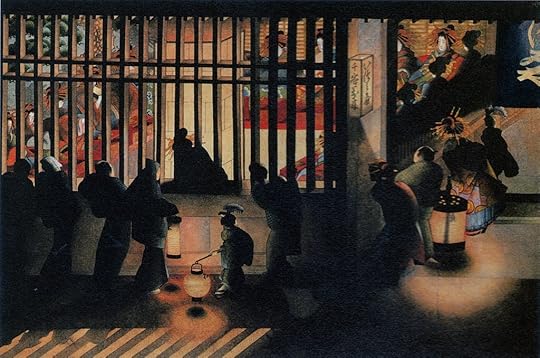
The first one while visiting the Hokusai exhibition in the Castle of the Dukedom of Brittany in Nantes, where I admired Katsushika Ōi's (Hokusai's daughter) painting:
Yoshiwara Night Scene(date unknown, Ōi painted in the first half of the 19th century).
Concerning H.C.'s parents: Gary Duvivier, a police lieutenant in Los Angeles, investigates on a series of atrocious murders targeting Japanese people. He meets a certain Sissy, a florist working near the entrance of the building where he lives. We understand they are C.H. Duvivier's parents at the time when he was not born yet. Ultimately, we find out the identity of the serial-killer, unveiled by Sissy...
Another memorable event in this opus: a sort of reenacting of The Night of the Living Dead... in the Kōmori village where Duvivier is let loose... A great take on the B-movie horror genre!
In short, a truly engaging installment of this series, adding a welcome complexity to the story!
This is getting more and more interesting!! It's very intriguing to discover the connections between the different timelines and how it can affect the storyline. The little plot twists here and there also make the story more engaging!
Urasawa al suo meglio. Non sarà un mago con i finali delle sue storie (ma neanche Stephen King lo è, se è per questo), ma il viaggio che percorriamo nelle sue storie è qualcosa di strepitoso e questo numero ne esemplifica l’essenza: una storia che si articola su più piani temporali senza mai vacillare un momento, personaggi scritti magnificamente e una sceneggiatura che ti tiene incollato alla tavola. Fenomenale, anche se il finale sarà “meh”, come per 20thCB, ne sarà comunque valsa la pena.
Se la storia continua a girare intorno al problema, aggiungendo altri personaggi alla difficile equazione che gravita sul mistero dei due pipistrelli, Urasawa mostra, in un numero più monolitico dei precedenti, di saper gestire i due filoni di storia, con un ritmo invidiabile e un'ottima caratterizzazione dei personaggi. Qui c'è una bella donna corteggiata da un agente di polizia, mentre nel quartiere giappo di los angeles i nikkeijin sono uccisi da un maniaco dotato di katana. La donna è seguita da un essere dall'aspetto poco rassicurante. Si scoprirà poi che l'essere altri non è che uno dei fumettisti che possono vedere il pipistrello, e la segue sostanzialmente per far pagare il giusto castigo a quello che diviene suo marito: il poliziotto nonchè serial killer di nikkeijin. Tutto questo nel passato, mentre nel presente i nostri eroi Kevin e Jackie si trovano, in piena ricerca del rotolo del maestro Zofu, ad affrontare un tipo deciso a far sopravvivere un solo pipistrello, quello di Chuck CUlkin. Comunque lo si guardi, nonostante i suoi difetti, BB rimane una lettura piacevolissima.
Rumbling along nicely ... to—I have no idea where, and that's ideal.
The 1924 detective story interposed in the main run of events is typically fantastic. It's not as contained and condensed as the narrative discursions in the earlier parts of the series, and I missed that at first, but in the long run it hardly matters.
The Master character, who makes his memorable entry in the previous volume, is powerfully developed here.
The "houbou" incident atop the train is an instance of grand Urasawa misdirection; he can introduce a completely new scene and (seemingly) completely new characters and make them feel awesome and gripping immediately: literally immediately, with the chapter's very first frame.
You've heard of bending the space-time continuum in sci-fi. Urasawa is an expert at bending the beginning and the end just so he can write a detailed mini-arc involving the villain's parents with twists you wouldn't expect. This reminds me of how Eiichiro Oda was my go-to storyteller/writer (overall) who does amazing backstory and context plotting in One Piece. But this is a different calibre altogether! Love it. Billy Bat is definitely one of his best works after Monster.
The plot thickens even more, now characters are even being intertwined through time. Urasawa is doing a good job so far at balancing time shenanigans without ruining things. Each volume leaves me excited to read more while at the same time makes me feel like I need to take a break and absorb what I just read
Nun habe ich schon 10 Bände durch und kann gar nicht sagen wie sehr mich diese Story fasziniert - so viele Verschwörungstheorien werden hier aufgegriffen und fantastisch in die Story rund um Billy Bat integriert. Die Story und auch die Zeichnungen sind einfach der Hammer.
A young Zofu met Kevin when he was a baby, like what happened during Kennedy's parade, that Kevin saved Kevin's life, his successor. I really loved that Shisho at the end saved Sissi. Man Gary being an assassin was a crazy turn. I'm really interested in it right now!
This entire review has been hidden because of spoilers.
El manga se toma un tiempo para contar una historia aparte, que no llega a interrumpir la trama principal pero creo que tampoco aportó demasiado, sin embargo creo que necesitaba sentirse más real, como bien le gusta a Urasawa. Por lo demás siento que el manga enfatiza más y más en su épica. En ese sentido me hace acordar a It, empieza como una historia de terror y progresivamente se convierte en una épica