In the wild and inhospitable European far north, in the land of Scandinavian myth and runic legend, Viking warriors discover a child in a space capsule. Leif Haraldson adopts him and gives him the names of his gods: Thorgal Aegirsson, son of Thor (god of lightning) and son of Aegir (master of the sea). Upon Leif’s death, the Viking chief Gandalf the Insane isolates Thorgal from others. Only the friendship of Aaricia, the daughter of Gandalf, brightens Thorgal’s solitary childhood. Their mutual affection quickly turns into true love.
This two-volume book includes "Child of the Stars" & “Aaricia”
"I met a blind god who transformed into a dragon, I made him a rainbow at the Morning Lake and then I came back here on a flying horse."..."We are indeed made for each other...We have the same kind of dreams."
Grzegorz Rosiński's Thorgal, Vol. 1: Child of the Stars is a wonderfully weird and trippy graphic novel about Vikings with both a supernatural and science fiction twist. There are several stories told in this volume. At first, they seem like discrete tales, but everything comes together amazingly well. I don't think there was anything special about the art of this graphic novel, but the stories were satisfying and I really enjoyed it! 4.25 stars
This volume focuses on the childhood of the protagonist of this series, Thorgal. I enjoyed this book because it manages to combine fantasy and sci-fi in a Viking-age setting. Just when you start to think that this is strictly historical fiction, something weird happens. That weirdness is appealing.
Good spirited, mystical, full of heart, speckled with sci-fi, this comic series should be foundational to any fan of sword and sorcery, vikings, and awesome art in the history of french comics. I loved the first volume of Thorgal. The writing was dense (modern comics have leaned away from using as much text) but not too dense. The story of Thorgal's origins and upbringing were interesting and believable in terms of the time period, apart from the mythological aspects. Although, those too were accurate to the pagan folklore of the time, and used in a playful way, though the story has serious moments where death is often shown as a possible outcome only seconds away. The heroes here are cleverer than their foes, and often outwit them or sway them from their false paths. I appreciate how fast the story moves and that it never lingers on any moment that is not otherwise necessary. Time moves quickly, too, as it moves from Thorgal's birth to his older boyhood. Aaricia is the standout character, though, who sees the world through eyes more hopeful and full of imagination than others of her clan who lust only for worldly power and riches. She seeks to protect others, attaches her heart to young Thorgal and the goodness of his conscience. She, like Thorgal, is connected to space and time and dreams, most likely due to coming in contact with strange objects that appeared mysteriously around Thorgal's earliest years. Are they from space? From another realm? The realm of the gods? I love the mixture of sci fi and mythology, and the overarching question that asks if the two are one and the same, or not. Fantasy nowadays tends to draw a fine line between Orcs and Lasers (I should write that book!) but early S&S like Kane steered headlong into it at times. But it was treated with mystery and respect. No one of that era would have a special knowledge of such complex technology and devices, so to them they would see it as odd rituals of color and lights, patterns foreign to their understanding. I think this fusion laced with confusion is the best way to play it off in fantasy. But it also needs to be subtle.
The one thing I haven't mentioned yet, at the fear of sounding cliche, I imagine I'm not the first person to say that this is basically a superman story mixed with Conan based in the time and location of vikings. An alien human from a far superior and advanced civilization escaping a catastrophe to find a better world and landing as a baby in a pod on earth. As for his powers, I can't say I know yet how that will play out, but I am hoping to see what happens next. There seem to be many volumes of this story and so far it is well told. I could easily see this as a movie franchise. Sword and sorcery like this needs to be remembered!
Issue of Thorgal - Child of the Star was one of my first comics in my young years. I loved it. It was fantasy, sci-fi and Northern mythology (which I had not soft spot back then, not yet...). That ragged comics issue was something beautiful. And even back then, I saw the quality of it - the art, story and sequential art at work. I didn't understand comics back then, not in McCloud's meaning. But something made me re-read this one all over again. Now, maybe almost 25 years later, I got back to it. I feared that it's only the nostalgy, but I was wrong. The art may be outdated, but it's still very good, the story is simple but well-written and I love the work with the panels. It pulls me into the story like some kind of Jumanji magic right away. Yes, there are better stories, better arts, but this still works, after a few decades, very well. And that's admirable. The second part, Aaricia, was unknown to me. But it was almost as good, so I will continue in Thorgal's journey, which started in my early school years.
Wonderfully written and beautifully drawn. This is the origin story of Thorgal. The writer is Belgian, the artist is Polish, and the character was introduced in a French language magazine in 1976. It all took off from there to span a mega comic series with several spin offs. English language versions were put out in the 80s, and several reprints and publishers continue to translate. Eighth Century Vikings find a child in a vessel which fell from the sky. Thorgal goes through a series of adventures as s child and finds his true love as a young man. No more of the plot will be revealed, because this is a must read.
This is a charming two-parter from Rosinski and Van Hamme's Thorgal series containing the stories of two children - Thorgal, Child of the Stars, and the Princess Aaricia, set in a magical Norseland.
There are science fiction elements and a nod to the legend of Superman but otherwise it is distinctively European (Belgian but with a Polish artist in this case), embedded in the legends of Asgard and the Sagas.
These are actually issues #7 and #14 of the original series 1980s re-packaged to tell the origin story as #1 of a 2007 Cinebook series of translations into English and their child-like and appealing quality may be very deceptive in the context of the total series.
Although the overall 'strategic' story line holds no surprises, the events and twists of the story do and the whole is highly imaginative at this 'tactical' level. Rosinski's artwork is superb - truly magical at times. Recommended.
The best sword and sorcery comic series I have read, very similar and superior to Conan the Barbarian. The setting is the Viking age, our hero’s journey start as a human child from an advance human civilization from space, Nordic mythology and magic are also mixed in for Fantasy as well as Sci-fi themed tales.
All the volumes are excellent, the storytelling’s well-paced and each volume got something fresh. The characterization superb, one of the interesting thing with the series is the strong female characterization. In all the stories Thorgal is strong, kind and gentle while it’s the woman characters who are cleaver, resourceful and the schemers.
The highlight of the series is the gorgeous illustrations, each and every one of the panels are a work of art.
I have read the English translation from volume 1 to 16, most of them are excellent arcs, very unique for such a long running series.
English (UK) Cinebook "1" from the French 7 & 14 07. L'enfant des étoiles (1984) 14. Aaricia (1989)
Cinebook obviously led with these because they are the childhoods of the Thorgal and his beloved but I would still recommend reading the series in it's true order if that's practical enough for you. It sure isn't for me!
Tento komiks bol pre mňa veľmi príjemným prekvapením. Napriek tomu, že som všade čítal samé ódy na kvality tohto príbehu, nejako som ho obchádzal. Keď som mu dal šancu, prečítal som ho prakticky na posedenie. Prvá časť príbehu ma prekvapila scifi aspektom, ktorý nebol nosný, ale veľmi zaujímavý. Následne bolo skvelé, ako tento element elegantne odpratali do úzadia a príbeh tak mohla byť opäť dobrodružná jazda plná mýtov a legiend. Nesmiem zabudnúť na kresbu, lebo tá bola luxusná. Na ďalšie príbehy sa určite pozriem.
This graphic novel is old school fantasy in the best way possible. From what I've read so far of Thorgal, this story has the most dealings with actual Norse mythology, while the rest of what I've read deals more with the less mythological, though no less magical, viking tales and stories of magic gone awry.
Interestingly, the book published in English contains the 7th and 14th stories that were originally published in their native Belgium. Since they are about the childhoods of Thorgal and Aaricia, respectively, they are meant to serve as prequels for loyal readers. However, they still work as the beginning of a much longer story, so I never felt like I was missing anything reading The Child of the Stars.
Though the story is magical in nature, it starts out as a sci-fi tale, with a group of doomed astronauts crash-landing on Earth, and one couple decides to save their son by placing him in an escape capsule, which is found by a group of vikings. This is rather odd, considering the more magical nature of the tale, but rather than getting in the way, it serves to add mystery to Thorgal. My theory is that by introducing science fiction elements into his past, it will enable future stories to contain science fiction elements without feeling out of place. One of the vikings, the chief, names the boy Thorgal and raises him as his son. Unfortunately, he dies, and the man who replaces him as chief is a xenophobe who hates Thorgal. Fortunately, circumstances occur that prevent him from killing or exiling the boy. That doesn't prevent the man from forcing the boy to live on the outside of the village, a constant reminder that he is an outsider. What's great about this is that there is a psychology here, and these events show how Thorgal would come to view himself as the outsider, which would guide his own morality through the Thorgal books. His story also has him aiding a nome in delivering an important metal to Nidhogg, the world serpent from Scandinavian mythology. It reads like an old fairy tale, so it's very fun to read. Another story has him meet a man who may know something about his past. Though the protagonist is only a child, the story never shies away from the darker side of storytelling. Much like in his adult life, Thorgal's childhood is fraught with mortal peril on more than one occasion. Even though we know he'll live in end, it doesn't make these moments any less tense. Also, he faces questions of his own existence, and it's not often that children in fiction face existential crises.
Aaricia's story is a day in the limelight. She and Thorgal are both still children, though the boy is relegated to the background for her tale. Compared to the first half of The Child of the Stars, this part of the tale feels like a breather. Rather than face her own difficulty, she must help a new character with his predicament. The man in question is a minor Norse god who had his eyes stolen. The setup is similar to the nome story, though it utilizes most of the latter half of the book to tell it. What happens is a tale of friendship, but I won't spoil the details.
I'm a bit new to European comics, especially Franco-Belgian comics. All the stories I've read have had nothing less than great artwork, but most of them had very mediocre storytelling. I would expect better from a country that considers comic books, or bandes dessinées, to be the "ninth" art (a term which meaning that in addition to what we traditionally call the arts, that being architecture, sculpture,painting, music, poetry, dance, theater/cinema, with photography added in the past couple centuries, comics are the ninth addition to that list), the writing can be surprisingly stifled. Fortunately with Thorgal, that is not the case. Jean Van Hamme proves he has the gift of storytelling. Accompanying him is Grzegorz Rosiński, whose work with the pencil looks like the detailed illustrations from classic literature. From what I've read so far of Franco-Belgian comics, Thorgal is my favorite, and the one that makes me want to continue reading each book the most.
Thorgal was first published in 1977, but you wouldn't know it. Unlike so many other bandes dessinées from that timeframe, the characters (girls included) feel timeless and real.
CHILD OF THE STARS collects the origin stories of Thorgal (#7) and Aaricia (#14). Set in a cold and brutal Viking North where gods still roam and monsters walk free, it tells the story of a boy who does not belong and a girl who loves him anyway.
Thorgal is an ordinary boy with an extraordinary backstory. As he grows up, everyone around him conspires to either: a) kill him or, b) keep him in his place. That is, except Aaricia.
Aaricia is the daughter of a half-mad Chief. Her father and brother are hell-bent on killing Thorgal once and for all, but she herself is determined to keep him alive.
Aloof from these human concerns, there are fables afoot and old debts that are due to collect:
Gorgeously rendered, this book has it all: Norse Gods, monsters, men, and men who are monstrous. Strongly recommended.
The first is a familiar tale of disaster at sea where mutiny breaks out among the crew. It’s ok but nothing great.
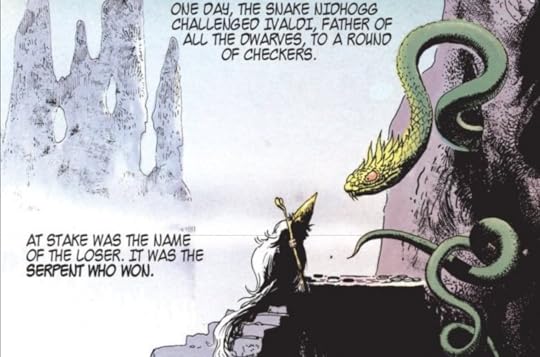
The second is a Norse myth/ fairy tale that is imaginative and exciting. This is the highlight, an epic fantasy quest to deliver a metal that does not exist to the king of the dwarves before the snake demon can steal his name. Captions efficiently lay the groundwork. The several combat encounters — a giant; flying serpents; and serpent-tails armed with blades — are also quick, with skillfuly economized layouts that ensure the story stays fresh. Many striking images such as the charging giant and a hall of dancing dwarves. Magic, wonder, and danger — it’s all here.
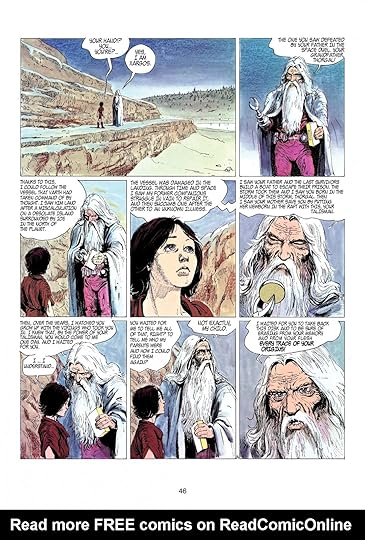
The third story is the worst, though it starts out well, with beautiful landscapes and largely wordless storytelling as Thorgal treks through the wilderness to seek out an oracle. Once he meets the oracle, however, the story takes a turn for the absurd — ham-fisted sci-fi nonsense with huge blocks of expository dialogue, not to mention plenty of moralizing and a ridiculous space duel. It’s godawful and almost unreadable.
So I can only hope that Thorgal follows the second path (of the 3 stories), though I suspect subsequent volumes are closer to the magical realism of the first.
Aaricia
4 more stories
The first is a delightful fairy tale with stunning art about trickster elves called nixes and their deadly games.
Then comes a family drama. It’s well done, but contains no fantasy elements.
Next, more family drama. Thorgal has to fight a duel against the treacherous Bjorn and is rescued by the quick-witted Aaricia. Reasonably well done, but without any fantasy elements it’s quite tedious.
In the last tale, Aaricia helps a blind minor god return to Asgard. Incredibly overwritten and tedious. Walls of turgid dialogue and little action.
In many ways, Thorgal is a humorless book. There are glimpses of creativity here and there, but most of it suffers from a stultifying realism and a dogged pedantry. Rosinski’s art, at times evocative, fails utterly when it comes to conveying emotion and character.
I didn’t expect to find Franco-Belgian graphic novels on Kindle Unlimited. But there you go.
This is an omnibus of volumes 7 and 14 in the original series, published together in English in 2007. Both of these volumes are omnibuses of short stories from the series protagonist’s youth. An origins comic, essentially.
The art is gorgeous, the stories dreamy and philosophical in a very non-Anglo-Saxon way, the dialogue witty and strong of character. A delight. Thorgal is not a series I knew during my years in France, but I will definitely look it up when I next go back.
An incredible hook into what seems to be a very fascinating series. Rosiński's and Van Hamme's Thorgal series begins as a Viking epic, but quickly incorporates some interesting sci-fi and fantasy elements. The young Thorgal Aegirsson is a precocious and courageous young Northman who seeks the truth behind his very Superman-esque mythology. The artwork is out of this world too, bringing some truly exciting panel layouts and lush colors to the book. The series is imaginative from the jump, and the artwork matches the ambitious take very well.
The first volume in the series includes a couple of stories on the origins of Thorgal, his childhood and how he came to be raised by the Vikings. The second part focuses on Aaricia, the Viking princess, and her relationship to the eponymous hero.
Interesting premise… as if Clark Kent had been discovered by Vikings instead of American farmers. Not sure if he has super powers, but neat tying together sci-Fi with Viking myths.
This first volume in Cinebook's English publishing of Belgian writer Jean Van Hamme and Polish artist Grzegorz Rosinski's Thorgal series ironically presents us with albums number 7 (The Child of the Stars; original title L'enfant des étoiles) and 14 (Aaricia) in translation by Luke Spear. While it may seem odd that the Cinebook has opted to start there publishing series a bit in and then move on to albums 3 and 4 in the next volume (albums 1 and 2 existing in an earlier English edition, albeit now out-of-print), it does make a certain sense, as the stories in this volume are the origin story of Thorgal and Aaricia.
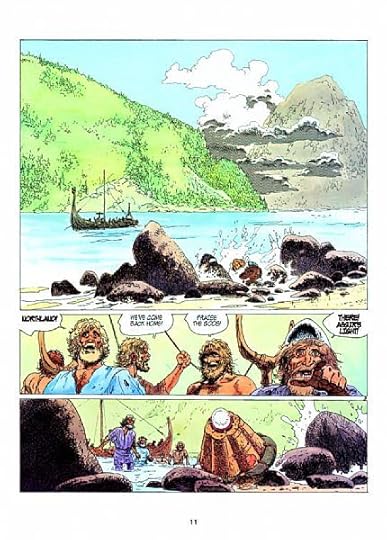
The first album, focusing on Thorgal, presents the reader with three stories. First out is "The Lost Drakkar", in which the reader is introduced to the Viking leader Leif Haraldson and how he became foster father to Thorgal. The second story is "The Metal that Didn't Exist", in which Ivaldi, the father of all dwarves, loses his name in a challenge from the serpent Nidhogg, but manages to convince the serpent to release his name if he can present the latter with a metal that does not exist in a thousand years' time. The dwarf Tjahzi goes on a quest, searching the world for such a thing, and on the way encounters the young child Thorgal. Finally, in "The Talisman", the young Thorgal goes on a journey to learn his own origin.
The second volume, as the name implies, focuses on Aaricia, a woman who grows up alongside Thorgal and who apparently is destined to be his better half (not having read the earlier albums, published in the later volumes, I am merely assuming this to be the actual case, based on the stories read here) and includes four stories. First out is "Odin's Mountain", in which the young Aaricia goes looking for her dead mother. In "First Snow", Thorgal's foster father Leif Haraldson passes and the new king, Gandalf-the-Mad positions Thorgal on the outskirts of the Viking community (much thanks to Aaricia's role in the matter). In "Holmganga", Gandalf-the-Mad's son Bjorn challenges Thorgal to single combat, although not necessarily honourable one. Once again, Aaricia meddles in affairs to the benefit Thorgal. And finally, in "Tjahzi's Tears", Aaricia has a fantastic adventure that echoes the events in "The Metal that Didn't Exist".
All in all, this first proper encounter with the series has left me wanting more, and I will definitely be getting more volumes in the near future.




![Grzegorz Rosinski leaves Thorgal (article includes an interview and the cover plus two pages of his final album) [French, translation in comments] : r/bandedessinee](https://i.gr-assets.com/images/S/compressed.photo.goodreads.com/hostedimages/1651970016i/32911431.jpg)