

What do you think?

Mesklin #2
Close to Critical
Crisis on Tenebra
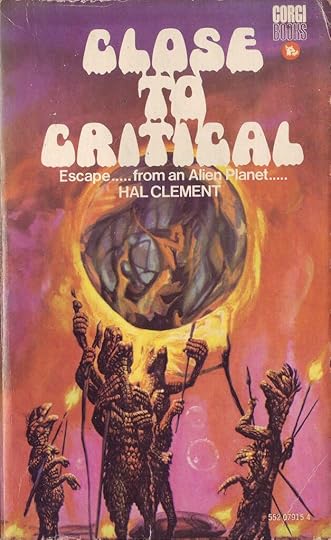
Shrouded in eternal gloom by its own thick atmosphere Tenebra was a hostile planet...a place of crushing gravity, 370-degree temperatures, a constantly shifting crust and giant drifting raindrops.
Unpromising - yet there was life, intelligent life on Tenebra. For more than 20 years, Earth scientists had studied the natives from an orbiting laboratory...and had even found a way to train and educate a few of them.
Then the unexpected happened! A young Earth girl and the son of a powerful, hot-tempered alien diplomat were marooned in a bathyscape, drifting toward the planet's deadly surface.
Only the primitive Tenebrans could rescue them!
Shrouded in eternal gloom by its own thick atmosphere Tenebra was a hostile planet...a place of crushing gravity, 370-degree temperatures, a constantly shifting crust and giant drifting raindrops.
Unpromising - yet there was life, intelligent life on Tenebra. For more than 20 years, Earth scientists had studied the natives from an orbiting laboratory...and had even found a way to train and educate a few of them.
Then the unexpected happened! A young Earth girl and the son of a powerful, hot-tempered alien diplomat were marooned in a bathyscape, drifting toward the planet's deadly surface.
Only the primitive Tenebrans could rescue them!
192 pages, Mass Market Paperback
First published January 1, 1958
About the author
Hal Clement
185 books117 followersHarry Clement Stubbs better known by the pen name
Hal Clement
, was an American science fiction writer and a leader of the hard science fiction subgenre.
Further details at Wikipedia.
Further details at Wikipedia.
Ratings & Reviews
Friends & Following
Create a free account to discover what your friends think of this book!
Community Reviews
Displaying 1 - 30 of 44 reviews

June 25, 2019
Tenebra - a heavy planet with intelligent life.
For sixteen years scientists could only circle Tenebra in their space station and talk via a land based robot.
Now they have a bathyscaphe that will descend to the planet and return.
It's all set to go when a twelve year old girl and her Drommian alien companion of four years accidentally land the bathyscaphe.
For sixteen years the scientists had "raised", from eggs stolen by the robot "Fagin", a group of locals and had taught them better life skills. Now they need their help if the two children are to rescued.
Alien contact
The creature, when they did see it, was big. It towered fully nine feet in height, and on that planet must have weighed well over a ton. It conformed to the local custom as regarded scales and number of limbs, but it walked erect on two of the appendages, seemed not to be using the next two, and used the upper four for prehension. That was the fact that betrayed its intelligence; two long and two shorter spears, each with a carefully chipped stone head, were being carried in obvious readiness for instant use.
Culture clash
Nick called the teacher by name as he came in sight.
"Fagin! We're in trouble! What do we have for weapons that you haven't shown us yet?"
As usual, there was a pause of a couple of seconds before an answer came back.
"Why, it's Nick. We had about given you up. What's all of this about weapons? Do you expect to have to fight someone?"
"I'm afraid so."
"Who?"
"Well, they seem to be people just like us; but they don't keep animals, and they don't use fire, and they use , different words for things than we do."
"Where did you run into these people, and why should we have to fight them?"
"It's a long story, I'm afraid. It will be better if I start at the beginning, I suppose; but we shouldn't waste any more time than we can help."
Tenerbra's gigantic size makes for flexible geography
"Tenebra is a rather strange planet. Diastrophism is like Earth's weather; the question is not whether it will rain tomorrow but whether your pasture will start to grow into a hill. There's a team of geophysicists champing at the proverbial bit, waiting for the bathyscaphe to go down so they can set up a really close working connection with Nick's group. The general cause we know—the atmosphere is mostly water near its critical temperature, and silicate rocks dissolve fairly rapidly under those circumstances. The place cools off just enough each night to let a little of the atmosphere turn liquid, so for the best part of two Earth days you have the crust washing down to the oceans like the Big Rock Candy Mountain. With three Earth gravities trying to make themselves felt, it's hardly surprising that the crust is readjusting all the time.
Touchdown on Tenebra
With the lights on, both children went over to the windows.
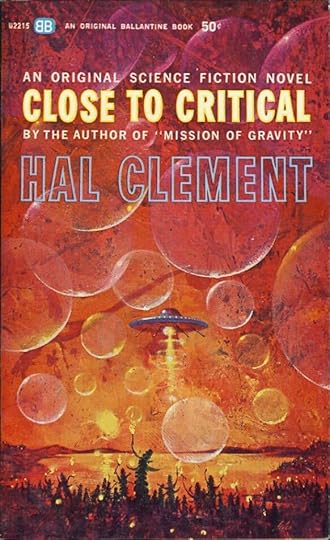
"There isn't much to see," called Easy. "We seem to have splashed into a lake or ocean. It's as smooth as glass; not a ripple. I'd think it was solid if the ship weren't partly under it. There are big foggy globes drifting down, yards and yards across, but they sort of fade out just before they touch, the surface. That's every bit I can see."
"It's raining," Raeker said simply. "The lake is probably sulphuric acid, I suppose fairly dilute by this time of night, and is enough warmer than the air so the water evaporates before it strikes. There wouldn't be any waves; there's no wind. Three knots is a wild hurricane on Tenebra with all that heat energy running around".
Hal Clement writes technically pure science fiction. He has detailed an alien world that we could never imagine with sulphuric seas, three gravities, a temperature of 380 degrees centigrade and land that changes shape all the time. The human and drommian children must survive until the Tenebran locals can come to their rescue.
Enjoy!
For sixteen years scientists could only circle Tenebra in their space station and talk via a land based robot.
Now they have a bathyscaphe that will descend to the planet and return.
It's all set to go when a twelve year old girl and her Drommian alien companion of four years accidentally land the bathyscaphe.
For sixteen years the scientists had "raised", from eggs stolen by the robot "Fagin", a group of locals and had taught them better life skills. Now they need their help if the two children are to rescued.
Alien contact
The creature, when they did see it, was big. It towered fully nine feet in height, and on that planet must have weighed well over a ton. It conformed to the local custom as regarded scales and number of limbs, but it walked erect on two of the appendages, seemed not to be using the next two, and used the upper four for prehension. That was the fact that betrayed its intelligence; two long and two shorter spears, each with a carefully chipped stone head, were being carried in obvious readiness for instant use.
Culture clash
Nick called the teacher by name as he came in sight.
"Fagin! We're in trouble! What do we have for weapons that you haven't shown us yet?"
As usual, there was a pause of a couple of seconds before an answer came back.
"Why, it's Nick. We had about given you up. What's all of this about weapons? Do you expect to have to fight someone?"
"I'm afraid so."
"Who?"
"Well, they seem to be people just like us; but they don't keep animals, and they don't use fire, and they use , different words for things than we do."
"Where did you run into these people, and why should we have to fight them?"
"It's a long story, I'm afraid. It will be better if I start at the beginning, I suppose; but we shouldn't waste any more time than we can help."
Tenerbra's gigantic size makes for flexible geography
"Tenebra is a rather strange planet. Diastrophism is like Earth's weather; the question is not whether it will rain tomorrow but whether your pasture will start to grow into a hill. There's a team of geophysicists champing at the proverbial bit, waiting for the bathyscaphe to go down so they can set up a really close working connection with Nick's group. The general cause we know—the atmosphere is mostly water near its critical temperature, and silicate rocks dissolve fairly rapidly under those circumstances. The place cools off just enough each night to let a little of the atmosphere turn liquid, so for the best part of two Earth days you have the crust washing down to the oceans like the Big Rock Candy Mountain. With three Earth gravities trying to make themselves felt, it's hardly surprising that the crust is readjusting all the time.
Touchdown on Tenebra
With the lights on, both children went over to the windows.
"There isn't much to see," called Easy. "We seem to have splashed into a lake or ocean. It's as smooth as glass; not a ripple. I'd think it was solid if the ship weren't partly under it. There are big foggy globes drifting down, yards and yards across, but they sort of fade out just before they touch, the surface. That's every bit I can see."
"It's raining," Raeker said simply. "The lake is probably sulphuric acid, I suppose fairly dilute by this time of night, and is enough warmer than the air so the water evaporates before it strikes. There wouldn't be any waves; there's no wind. Three knots is a wild hurricane on Tenebra with all that heat energy running around".
Hal Clement writes technically pure science fiction. He has detailed an alien world that we could never imagine with sulphuric seas, three gravities, a temperature of 380 degrees centigrade and land that changes shape all the time. The human and drommian children must survive until the Tenebran locals can come to their rescue.
Enjoy!

July 31, 2016
Well, considering how much I enjoyed the afterward on the previous one, I wanted to see what was improved or explored upon within this admittedly interesting world. Science, Ya'll! It's a world built with interesting applications of science! And we ought to have very interesting ramifications in the alien cultures and physiology!
Um...
"Should" does not equal "Will".
Frankly, I was bored out of my skull by the plot. Okay, look at all the stone-aged yokels gawking over the human's remote-controlled waldo. Wow. That's like, amazing, dude.
I mean, sure, it might have been interesting at one time if someone actually had to describe or be awed by the *idea* of a waldo. Or if there were really interesting things to be learned by the psychology of stone-aged aliens beyond the fact that they're using logic to figure out what is absolutely freaking plain to us. Or starting up a cargo cult, even, that doesn't make us think of some long-ass joke.
Sigh.
The only barely interesting things that happened in this book were the *other* aliens throwing a hissy over the human's perceived treatment of ... oh forget it, it's not that interesting, either.
Science. Science does not equal quality storytelling.
Did you know that I also got bored as fuck at the stone-aged antics at the beginning of the 2001 Space Odyssey movie? Yeah. Same as this. Only there was no murder. And no bone that becomes a space station, either. I feel CHEATED.
Well, okay, this was written in '64, so it's not like he was cribbing from Clarke or anything, and I seriously doubt that Clarke cared much for this book, either. Which is kinda beside the point, anyway, because both were boring.
*sigh*
So yeah, does anyone know if Clement's interesting world was picked up by any other competent writer to be given a spin? Anyone? Bueller?
Um...
"Should" does not equal "Will".
Frankly, I was bored out of my skull by the plot. Okay, look at all the stone-aged yokels gawking over the human's remote-controlled waldo. Wow. That's like, amazing, dude.
I mean, sure, it might have been interesting at one time if someone actually had to describe or be awed by the *idea* of a waldo. Or if there were really interesting things to be learned by the psychology of stone-aged aliens beyond the fact that they're using logic to figure out what is absolutely freaking plain to us. Or starting up a cargo cult, even, that doesn't make us think of some long-ass joke.
Sigh.
The only barely interesting things that happened in this book were the *other* aliens throwing a hissy over the human's perceived treatment of ... oh forget it, it's not that interesting, either.
Science. Science does not equal quality storytelling.
Did you know that I also got bored as fuck at the stone-aged antics at the beginning of the 2001 Space Odyssey movie? Yeah. Same as this. Only there was no murder. And no bone that becomes a space station, either. I feel CHEATED.
Well, okay, this was written in '64, so it's not like he was cribbing from Clarke or anything, and I seriously doubt that Clarke cared much for this book, either. Which is kinda beside the point, anyway, because both were boring.
*sigh*
So yeah, does anyone know if Clement's interesting world was picked up by any other competent writer to be given a spin? Anyone? Bueller?

May 2, 2012
Ingredients: physics (56%), weird aliens (24%), plot (13%), synthetic characters (6%), suspense, xanthan gum, John W. Campbell, emulsifier, stabiliser, permitted coloring and flavoring agents. Does not contain sex.

May 11, 2020
Close to Critical is a hard-sf story set on a planet with extremely hostile conditions that make it necessary to enlist the help of the stone-age natives in rescuing a stranded young human girl and an alien boy. Clement describes the setting with precision and does a very good job of building the suspense and tension while the clock is inexorably ticking. Clement wasn't interested in exploring his characters in any great depth, but rather in showing how puzzles and problems can be solved with the logical application of scientific and engineering knowledge. It's not as well known as Mission of Gravity or Needle, but it's an excellent science fiction novel with his intended emphasis on science.

March 18, 2016
A classic work by a master of "hard" science fiction. The plot: due to an accident in space, two children (a 12-year-old human girl and a younger alien) are marooned on an alien planet. They can't leave their vessel or survive on the surface; the temperature and air pressure and gravity are far greater than Earth's. A rescue mission can't reach them (the reasons are complicated). The only people who can help them are the planet's pre-civilization, pre-agricultural natives.
If you've read any of Clement's other books, all his usual hallmarks are here. The science and world-building (extrapolating what the surface conditions, including a number of non-obvious side effects, would be on a planet with very different characteristics from Earth) is first rate. There's an emphasis on cooperation over conflict, a wealth of intelligent problem-solving characters (of more than one race), and the difficulties of two races who can't live in the same environment attempting to communicate and work together.
As is also usual for Clement: the plot is very thin (with a very abrupt ending), and the characters are poorly developed and uninteresting. This is how little Clement cared about creating characters: roughly half the book is told from the point of view of Raeker, a human scientist who sits at computer screens on an orbiting space station and uses a robot on the planet's surface to communicate with the natives. By the end of the book, those are still the only things we know about Raeker.
In the end, Clement wasn't one of the more versatile, well-rounded science fiction writers. His books are strictly for aficionados; you wouldn't hand a Clement book to someone with just a lukewarm interest in sci-fi and say "Here, I think you'll really enjoy this!" But the things he did well, he did better than anyone.
If you've read any of Clement's other books, all his usual hallmarks are here. The science and world-building (extrapolating what the surface conditions, including a number of non-obvious side effects, would be on a planet with very different characteristics from Earth) is first rate. There's an emphasis on cooperation over conflict, a wealth of intelligent problem-solving characters (of more than one race), and the difficulties of two races who can't live in the same environment attempting to communicate and work together.
As is also usual for Clement: the plot is very thin (with a very abrupt ending), and the characters are poorly developed and uninteresting. This is how little Clement cared about creating characters: roughly half the book is told from the point of view of Raeker, a human scientist who sits at computer screens on an orbiting space station and uses a robot on the planet's surface to communicate with the natives. By the end of the book, those are still the only things we know about Raeker.
In the end, Clement wasn't one of the more versatile, well-rounded science fiction writers. His books are strictly for aficionados; you wouldn't hand a Clement book to someone with just a lukewarm interest in sci-fi and say "Here, I think you'll really enjoy this!" But the things he did well, he did better than anyone.

April 7, 2017
Storyline: 2/5
Characters: 2/5
Writing Style: 2/5
World: 3/5
Our inquisitive humans are back at it again, finding themselves in trouble, and enlisting the help of the natives to get out of their predicament. Superficially this is a sequel to Hal Clement's 1953 Mission of Gravity. It would be better described as being in the same universe, however. There are no overlapping characters, and it is a new location with unspecified temporal connection. Just another tale of adventurous humans researching an inhospitable planet and doing so without any guiding ethic of conservation or moral principle on natural trajectory.
Clement does here exactly what he did in Mission of Gravity: take an un-Earthlike planet, calculate its unique chemical, compositional, and gravitational properties, then proceeding on a educational, speculative fiction tour that details the expected life forms and unusual physical laws that would result. Clement is far too smart for me. The book was full of trouble-shooting and engineering puzzles that would have to be solved under these atypical physics conditions. I could see this being a lot of fun for people much better educated in the physical sciences than myself. Supposedly Clement's science is pretty good too. Somewhere in the decade between the original Mesklin book and this successor, someone must have offered Clement some advice on plot dynamism. To his credit, Clement attempted to tell a two-sided tale with their own independent dramas, but one of them was obviously perfunctory and a half-hearted stab at enlivening his simple narrative. The book was not worse off for the attempt, but it was not enough to push the author into the category of competent storytellers.
I like that the book was an honest attempt to extrapolate the real conditions on a far away yet conceivable planet. This could have been presented as a technical paper, but the hokey story made it more approachable and enjoyable.
Characters: 2/5
Writing Style: 2/5
World: 3/5
Our inquisitive humans are back at it again, finding themselves in trouble, and enlisting the help of the natives to get out of their predicament. Superficially this is a sequel to Hal Clement's 1953 Mission of Gravity. It would be better described as being in the same universe, however. There are no overlapping characters, and it is a new location with unspecified temporal connection. Just another tale of adventurous humans researching an inhospitable planet and doing so without any guiding ethic of conservation or moral principle on natural trajectory.
Clement does here exactly what he did in Mission of Gravity: take an un-Earthlike planet, calculate its unique chemical, compositional, and gravitational properties, then proceeding on a educational, speculative fiction tour that details the expected life forms and unusual physical laws that would result. Clement is far too smart for me. The book was full of trouble-shooting and engineering puzzles that would have to be solved under these atypical physics conditions. I could see this being a lot of fun for people much better educated in the physical sciences than myself. Supposedly Clement's science is pretty good too. Somewhere in the decade between the original Mesklin book and this successor, someone must have offered Clement some advice on plot dynamism. To his credit, Clement attempted to tell a two-sided tale with their own independent dramas, but one of them was obviously perfunctory and a half-hearted stab at enlivening his simple narrative. The book was not worse off for the attempt, but it was not enough to push the author into the category of competent storytellers.
I like that the book was an honest attempt to extrapolate the real conditions on a far away yet conceivable planet. This could have been presented as a technical paper, but the hokey story made it more approachable and enjoyable.

November 6, 2014
1977 grade A+
1995 grade A-
2019 grade A+
Wow. Hal Clement has to be the ultimate in very hard SciFi settings and in using alien characters extensively. From the human raised natives and natural natives on the alien planet, to the obnoxious alien diplomat on the human ship, all are believable. The physics and chemistry of the planet are excellent and delightful. The only other person I know who uses aliens characters extensively and this well is Romana Drew. Heinlein may be the grandfather of SciFi, but Clement is better at going to extremes. And it is a rousing good story. I had to make sure I had enough time to read to the next natural break before I stopped, which was not often.
The prologue and epilogue are used properly (parts of the story but time detached in this case). There is an unspecified long time break between the prologue and chapter one which can be a little confusing. But be sure to read them both and pay attention to the details in the prologue.
A RECOMMENDED hard SciFi novel.
1995 grade A-
2019 grade A+
Wow. Hal Clement has to be the ultimate in very hard SciFi settings and in using alien characters extensively. From the human raised natives and natural natives on the alien planet, to the obnoxious alien diplomat on the human ship, all are believable. The physics and chemistry of the planet are excellent and delightful. The only other person I know who uses aliens characters extensively and this well is Romana Drew. Heinlein may be the grandfather of SciFi, but Clement is better at going to extremes. And it is a rousing good story. I had to make sure I had enough time to read to the next natural break before I stopped, which was not often.
The prologue and epilogue are used properly (parts of the story but time detached in this case). There is an unspecified long time break between the prologue and chapter one which can be a little confusing. But be sure to read them both and pay attention to the details in the prologue.
A RECOMMENDED hard SciFi novel.

February 10, 2017
This is another exciting first-contact story by Clement, with the action grounded in real-world physics and, potentially, biology. In this case, a high-gravity planet whose surface gas composition changes between night and day.
Unlike his other books, in this one Clement skips over the initial jockeying for understanding and jumps from landing to, I think, about sixteen years later. The scientists have raised some natives by way of robot communications and are using them to investigate the planet. This has its interesting technical and moral dimensions; the scientists are about a light-second away from the planet, which means that communications between their stolen children and the robot have a two-second delay. This is normally not a problem, until, of course, it is. The robot can’t fight, for example.
Clement doesn’t really investigate the morality of stealing the kids, other than having the scientists name the robot teacher Fagin. This is more to do with the way Clement tells stories than with Clement not recognizing the problem is there. Besides the naming of the robot, the main scientist also warns the children not to take deadly revenge on other natives, for reasons he won’t explain. We know, of course: those are most likely their parents. It isn’t so much that Clement doesn’t deal with this issue, but that he doesn’t deal with it on the surface. There’s plenty of it just below the surface, especially toward the end.
The main thrust of Clement’s story, and he excels at it as usual, is about the technical issues of exploring a truly alien planet. It’s almost like reading one of those old travelers reports of visiting far-away lands.
Unlike his other books, in this one Clement skips over the initial jockeying for understanding and jumps from landing to, I think, about sixteen years later. The scientists have raised some natives by way of robot communications and are using them to investigate the planet. This has its interesting technical and moral dimensions; the scientists are about a light-second away from the planet, which means that communications between their stolen children and the robot have a two-second delay. This is normally not a problem, until, of course, it is. The robot can’t fight, for example.
Clement doesn’t really investigate the morality of stealing the kids, other than having the scientists name the robot teacher Fagin. This is more to do with the way Clement tells stories than with Clement not recognizing the problem is there. Besides the naming of the robot, the main scientist also warns the children not to take deadly revenge on other natives, for reasons he won’t explain. We know, of course: those are most likely their parents. It isn’t so much that Clement doesn’t deal with this issue, but that he doesn’t deal with it on the surface. There’s plenty of it just below the surface, especially toward the end.
The main thrust of Clement’s story, and he excels at it as usual, is about the technical issues of exploring a truly alien planet. It’s almost like reading one of those old travelers reports of visiting far-away lands.
March 13, 2024
*Close to Critical* is reportedly the middle book in Hal Clement's Mesklin trilogy, a triad spearheaded by his most popular work, *Mission of Gravity*, which I read just last month. I found its exploration of a high-gravity world and the aliens that evolved there relatively smooth and enjoyable, so I was excited to read something related to that; now that I've read it, though, I couldn't really tell you what canonically binds it to its predecessor except for the fact that they explore worlds of similarly speculative natures and the races which inhabit them. I enjoyed my time on Tenebra (*Close to Critical*'s setting), but at the end of the day, I didn't find it any more fulfilling than *Mission of Gravity* despite its considerably larger cast and political backdrop.
*Close to Critical* starts with a rather mysterious retelling of a remote-controlled robot's fall to Tenebra. Once it's fallen, it gathers some eggs which seem to have been laid by the planet's sentient yet primitive natives. We then flash forward sixteen years to see the creature inside one of those eggs, now named Nick, running away from a hostile rival group of natives. He makes it back to his family, a bunch of other young Tenebrans raised by Fagin, the remote-control egg-snatching robot who's primarily controlled by Dr. Raeder, a human scientist in an orbiting space station. Raeder's adoptive (and long-distance) children are soon threatened by the return of that hostile tribe and their chief, Swift. He's amazed by the sixteen year-olds' ability to ward off the all-consuming raindrops that fall from the sky every night (more on that in paragraph four) by lighting fires that evaporate the drops. Swift finds his way to Fagin's camp and tears Fagin away from his children in the resulting violence; shortly thereafter, Nick leads his townmates and their cattle on a mission to reclaim Fagin. As if that isn't enough headache for Dr. Raeder and co, these events coincide with the arrival of an otter-like ambassador whose son runs off into an incomplete bathyscaphe (a contraption to allow humans to fly down to Tenebra's surface) with Easy Rich, a human scientist's twelve-year-old daughter, which malfunctions and sends to two children to crashland somewhere in the vicinity of not only Nick and his friends, but Swift and his tribe...
Once .
The most interesting enjoyable part of this novel is definitely the setting of Tenebra. Its mass is twenty-seven-times as much as Earth's, its gravity is three times as strong as Earth's, and its atmosphere is eight-hundred-some times as dense as Earth, a dizzying statistic partially caused by its daytime surface temperature of around 374 degrees Celsius/705 degrees Fahrenheit. While I can't explain all of the science behind its atmospheric conditions, I understand enough to know that after every boiling-hot Tenebran day, the temperature cools during the night and leads to mass condensation in the form of thirty-to-fifty-feet wide raindrops every night. These raindrops fill all the nooks and crannies of the planet's surface with water which gets boiled away after the sun rises. Really cool stuff, even if Clement doesn't go into great detail about how life has evolved under such conditions, especially considered that these raindrops will knock any Tenebran who's hit by them unconscious. Another cool fact I found on the book's Wikipedia page: Tenebran's plants use chemosynthesis and get their nutrients from sulphur oxides instead of using photosynthesis because there's not very much light on the surface . The world is definitely the most well-thought out part of the book, and its geological quirks are revealed in a well-done and subtle way where the world's geographical and atmospheric conditions are revealed slowly and impactfully without infodumps. It feels like a much more literary writer than Clement wrote it at parts, which is a good thing.
That being said, a lot of this book plainly does feel like it was written by a scientist first and a writer second. The prose is competent, and it never induced an eyeroll, but it's pretty standard. The characters also feel pretty underdeveloped... Raeder isn't a bad character, but he never feels like a fully-realized, career-scientist either because he's just there, just like the angry alien ambassador and the naïve Tenebran "orphans" like Nick. There really aren't any surprises when it comes to any of them, and while I don't need crazy surprises, I prefer there to be... something. This book does have a lot more characters than *Mission of Gravity*, and while the larger cast and having actual political movements in the backdrop make the book seem better at a first glance, at the end of the day it makes this book seem thinner and cheaper than the other one because Clement's lacking characterization and coloring abilities are spread so thin that you actually start to notice it. The book is still good with some cool stuff I'll remember, but it never gave me that feeling that I had to read more or that it would end up in my internal canon. And for once, I didn't struggle with the rating; I could just feel what numerical value was right for this book.
Before I tell you just what that rating is, I'd like to compare-and-contrast *Close to Critical* with *Mission of Gravity.* First of all, these books are rather similar in structure; they're both about a group of human scientists orbiting and exploring a "hellworld" (a term for some of Clement's fictional and inhospitable planets, I guess) through remote contacting and influencing a group of natives who just happen to meet natives of their same species with a different language and outlook on life. I feel like the aliens in *Mission of Gravity* were given more depth - it probably comes down to the fact that the viewpoint Tenebrans were raised by humans while the viewpoint Mesklinites weren't - but I also feel like our human narrator in *MoG* was just more interesting than *CtC*'s, partly because we got to spend more time with him and weren't distracted by a bunch of other thin things going on. And *CtC* just doesn't have the same fun, adventuring spirit, and it was a bit hard to believe how the kids reacted to being stranded on a *hell*world. The first book just made me excited, and the second, while not too different but diverting in all the ways that should count, couldn't quite do that.
So I think a good rating for *Close to Critical* is the quintessential "good" Darnoc Leadburger rating: 7/10. I enjoyed it, and I am looking forward to *Star Light* (which reportedly brings together book one's aliens and a character (or characters) from *CtC*), which I should read next month. It's been fun to dive into the world of Hal Clement and will definitely dive further, but first I've got to check out William Gibson and Adam Roberts and Robert Reed and the like; stay tuned with all those updates on my profile page and have happy readings here, there, and everywhere...
*Close to Critical* starts with a rather mysterious retelling of a remote-controlled robot's fall to Tenebra. Once it's fallen, it gathers some eggs which seem to have been laid by the planet's sentient yet primitive natives. We then flash forward sixteen years to see the creature inside one of those eggs, now named Nick, running away from a hostile rival group of natives. He makes it back to his family, a bunch of other young Tenebrans raised by Fagin, the remote-control egg-snatching robot who's primarily controlled by Dr. Raeder, a human scientist in an orbiting space station. Raeder's adoptive (and long-distance) children are soon threatened by the return of that hostile tribe and their chief, Swift. He's amazed by the sixteen year-olds' ability to ward off the all-consuming raindrops that fall from the sky every night (more on that in paragraph four) by lighting fires that evaporate the drops. Swift finds his way to Fagin's camp and tears Fagin away from his children in the resulting violence; shortly thereafter, Nick leads his townmates and their cattle on a mission to reclaim Fagin. As if that isn't enough headache for Dr. Raeder and co, these events coincide with the arrival of an otter-like ambassador whose son runs off into an incomplete bathyscaphe (a contraption to allow humans to fly down to Tenebra's surface) with Easy Rich, a human scientist's twelve-year-old daughter, which malfunctions and sends to two children to crashland somewhere in the vicinity of not only Nick and his friends, but Swift and his tribe...
Once .
The most interesting enjoyable part of this novel is definitely the setting of Tenebra. Its mass is twenty-seven-times as much as Earth's, its gravity is three times as strong as Earth's, and its atmosphere is eight-hundred-some times as dense as Earth, a dizzying statistic partially caused by its daytime surface temperature of around 374 degrees Celsius/705 degrees Fahrenheit. While I can't explain all of the science behind its atmospheric conditions, I understand enough to know that after every boiling-hot Tenebran day, the temperature cools during the night and leads to mass condensation in the form of thirty-to-fifty-feet wide raindrops every night. These raindrops fill all the nooks and crannies of the planet's surface with water which gets boiled away after the sun rises. Really cool stuff, even if Clement doesn't go into great detail about how life has evolved under such conditions, especially considered that these raindrops will knock any Tenebran who's hit by them unconscious. Another cool fact I found on the book's Wikipedia page: Tenebran's plants use chemosynthesis and get their nutrients from sulphur oxides instead of using photosynthesis because there's not very much light on the surface . The world is definitely the most well-thought out part of the book, and its geological quirks are revealed in a well-done and subtle way where the world's geographical and atmospheric conditions are revealed slowly and impactfully without infodumps. It feels like a much more literary writer than Clement wrote it at parts, which is a good thing.
That being said, a lot of this book plainly does feel like it was written by a scientist first and a writer second. The prose is competent, and it never induced an eyeroll, but it's pretty standard. The characters also feel pretty underdeveloped... Raeder isn't a bad character, but he never feels like a fully-realized, career-scientist either because he's just there, just like the angry alien ambassador and the naïve Tenebran "orphans" like Nick. There really aren't any surprises when it comes to any of them, and while I don't need crazy surprises, I prefer there to be... something. This book does have a lot more characters than *Mission of Gravity*, and while the larger cast and having actual political movements in the backdrop make the book seem better at a first glance, at the end of the day it makes this book seem thinner and cheaper than the other one because Clement's lacking characterization and coloring abilities are spread so thin that you actually start to notice it. The book is still good with some cool stuff I'll remember, but it never gave me that feeling that I had to read more or that it would end up in my internal canon. And for once, I didn't struggle with the rating; I could just feel what numerical value was right for this book.
Before I tell you just what that rating is, I'd like to compare-and-contrast *Close to Critical* with *Mission of Gravity.* First of all, these books are rather similar in structure; they're both about a group of human scientists orbiting and exploring a "hellworld" (a term for some of Clement's fictional and inhospitable planets, I guess) through remote contacting and influencing a group of natives who just happen to meet natives of their same species with a different language and outlook on life. I feel like the aliens in *Mission of Gravity* were given more depth - it probably comes down to the fact that the viewpoint Tenebrans were raised by humans while the viewpoint Mesklinites weren't - but I also feel like our human narrator in *MoG* was just more interesting than *CtC*'s, partly because we got to spend more time with him and weren't distracted by a bunch of other thin things going on. And *CtC* just doesn't have the same fun, adventuring spirit, and it was a bit hard to believe how the kids reacted to being stranded on a *hell*world. The first book just made me excited, and the second, while not too different but diverting in all the ways that should count, couldn't quite do that.
So I think a good rating for *Close to Critical* is the quintessential "good" Darnoc Leadburger rating: 7/10. I enjoyed it, and I am looking forward to *Star Light* (which reportedly brings together book one's aliens and a character (or characters) from *CtC*), which I should read next month. It's been fun to dive into the world of Hal Clement and will definitely dive further, but first I've got to check out William Gibson and Adam Roberts and Robert Reed and the like; stay tuned with all those updates on my profile page and have happy readings here, there, and everywhere...

February 13, 2021
Average plot-driven science fiction. If there's any noteworthy idea in it, it's the twist of getting the decisive idea to resolve the plot from a bunch of stone-age natives and space age children while the scientists failed to properly understand the natives in 16 years of observation.
This book features the usual damning disconnect between being able to travel to distant planets while at the same time not having the technology for tasks that are easily solved with technology being available in real life today.
This book features the usual damning disconnect between being able to travel to distant planets while at the same time not having the technology for tasks that are easily solved with technology being available in real life today.

May 28, 2013
I really liked the setup of this book, but the plot arc was terrible. The creatures were really neat. Their planet, as I have come to expect from Hal Clement, was very novel in its properties. Basically, it's a super-Earth, with a dense, corrosive atmosphere. Human explorers send down a robot that collects some native eggs, to become their parent. Humans raising a clutch of aliens via telepresence is pretty clever.
But then there's some smart little girl who gets stranded on the planet, and saves the day by doing things the adults didn't think of. This isn't a bad plot arc, getting stranded, but the execution was really boring and the book started to drag on.
And she gets rescued in the end, with a minor reveal that was fun, but didn't justify all that buildup.
But then there's some smart little girl who gets stranded on the planet, and saves the day by doing things the adults didn't think of. This isn't a bad plot arc, getting stranded, but the execution was really boring and the book started to drag on.
And she gets rescued in the end, with a minor reveal that was fun, but didn't justify all that buildup.
May 27, 2016
This is one for the chemists/ physicists out there! I must admit the usual, keep them guessing about what is actually going on/ what races people are is getting a little old. Most of the book reads like a textbook on physical chemistry and adaptive geology. Whilst I enjoyed the bits I understood (some of the properties of olium etc) it was a bit technical even for me and the story was perhaps less promenant than some of the previous Clement novels I have read. Worth a read if you enjoy Clement but the weakest of the three in the anthology I have. Read a mission of gravcity or starlight for a better balance of chemistry and adventure.
May 18, 2018
Bit less inspired toward the end, slow going with MUCH more telling than showing so to speak and all the characters seem to talk about the same as the narrator. But many of the descriptions of the goings on on the planet were captivating. Still I have to say you might be as well reading the first half or so.. when you get bored.. well it didn't seem to get better. The weak characters wore through while the inspiration ran out towards a convenient finish. *shrug* It's the only thing I read by Hal Clement, trying to catch up on some historical pulp sci fi; I guess I got what I wanted out of it at that.

December 19, 2009
This is the 5th of Clements novels which I have been reading in publication order. It is the least enjoyable so far, not so much for the science in the fiction, but the characters and plot. I did not find the characters nor the story that interesting. And, I could not really identify with anyone in the story. The planet and its physics are fascinating, however.
March 14, 2014
This is the first Hal Clement book that I have read and I thoroughly enjoyed it, his descriptions and story development kept me reading and while I found one of the characters - Easy - quite annoying I was able to look past that due to the positive aspects of the other characters. While the story goes deep into scientific explanations it does not get bogged down with it so it is easy to grasp.

September 7, 2011
Definitely enjoy these 'hard sci-fi' books which manage to throw in a lot of science while keeping it all believable. A trip to Powell's was able to add a bunch more of his to my collection at like $2-3 each.

March 27, 2009
This is hard SF at its best. Intelligent reasonable characters doing interesting things in an exotic yet plausible setting. Also, the ending has a lovely twist.

April 1, 2012
This book was my introduction to Clement in 1970, and I have never ceased to enjoy his ability to explore truly alien environments.

July 27, 2012
A long long time. In high school? Like all of Clement's work well down, tech, a good read.

March 5, 2013
I liked this book from the viewpoint of beings though completly alien given a human viewpoint. Not as accomplished as Mission of Gravity.

July 2, 2017
The end is good. Somehow I'm finding a lot of resemblances between this guy's work and Asimov's. I will continue reading him.

September 24, 2020
A very satisfying hard sci-fi read with an AMAZING cover. Earth scientists have been studying the planet Tenebra for over a dozen years. The atmosphere was such that humans couldn't go down and look around in person, so instead they sent a robot to look around while they orbited the planet, controlling it from above. And to *really* help get some insider info, they stole some eggs from the planet's most intelligent inhabitants, raised them with the robot (named Fagin!), taught them English (along with the secret to making fire and raising herds of animals for food), and trained them to go around mapping and gathering data on their world. The scientists finally figured out a way to go down to the planet in person, using a bathyscape, but their plans took a detour when the 4 year old son of a hot-tempered alien diplomat and the 12 year old daughter of the Earthling diplomat who accompanied them to the ship, accidentally went down to the planet themselves. Because the 'scape wasn't quite ready to go, they can't get back up without the help of the trained aliens, and the biologist who has been talking to them through Fagin needs to figure out how to make that all happen before the alien diplomat blows his top or the band of non-trained aliens, who recently found the robot and his brood, causes trouble.
Clement is a pro at writing a convincing alien world and describing how the physics, geography, flora, and fauna all work. He also brings in a surprising amount of humor (the alien diplomat, for example, looks like a giant otter and no one knew his son was only 4 because he also looked like just as giant of an otter). There is definitely some paternalistic colonialism going on here, but, for the era, this one is relatively free of racism and sexism. The 12-year-old Earth girl is a fun and rich character, and the robot-raised Tenebreans get a lot of personality, especially Nick, their leader, who drives much of the action on the planet. There is a lot of action, and the book moves along quickly despite all the science and planetary descriptions, and the ending is satisfying. Very enjoyable!
(Thanks for passing this one along, pops!)
Clement is a pro at writing a convincing alien world and describing how the physics, geography, flora, and fauna all work. He also brings in a surprising amount of humor (the alien diplomat, for example, looks like a giant otter and no one knew his son was only 4 because he also looked like just as giant of an otter). There is definitely some paternalistic colonialism going on here, but, for the era, this one is relatively free of racism and sexism. The 12-year-old Earth girl is a fun and rich character, and the robot-raised Tenebreans get a lot of personality, especially Nick, their leader, who drives much of the action on the planet. There is a lot of action, and the book moves along quickly despite all the science and planetary descriptions, and the ending is satisfying. Very enjoyable!
(Thanks for passing this one along, pops!)

July 9, 2024
2/5
I will give Clement some due praise for his humanistic writing of not only women, but really anybody else other than adult men, something that was and continues to be sparse in genre fiction. One of the main protagonists of the novel, 'Lucky', is the daughter of a human diplomat that gets stuck inside the crashed life pod. Throughout this experience, Celment writes her with strength, capability, and determination through difficult situations. She outshines many of the adult scientists trying to save her, and consistently proves that she may very well be the brightest bulb on the three. Despite the hard science shell there is some notes of humanity here that Clement could've expanded upon should he have wanted to.
Outside of this surprising fact from a novel written in 1964, I was mostly bored and distracted by the deeply mediocre plot line, and characters that mostly just served to explore the weird world and explain how things might work with chemistry and biology subtext. Close to Critical tells the strange story of human explorers, who seemingly are already part of a galactic alliance of sorts, stealing, raising, and educating a group of scaled aliens. These aliens, all with Anglo names, are trained in math and science through the use of a robot guided by scientists out of orbit because the surface is immensely hot and atmospherically compressed. After these aliens are mature and struggling to maintain a herd of livestock to continue their education, the offspring of two diplomats crash to the surface in an experimental life pod. What little plot there is revolves around trying to rescue the children while also interacting with a group of 'native' aliens that don't speak the same language as the human raised group.
It's just simply not that good. It's dry and focuses on the science of this alien landscape to it's own detriment. Hard science is something that expected from Hal Clement, but it just wasn't strong enough to capture my attention. Perhaps it isn't my cup of tea, but I think there are better examples of the sub genre out there.
I will give Clement some due praise for his humanistic writing of not only women, but really anybody else other than adult men, something that was and continues to be sparse in genre fiction. One of the main protagonists of the novel, 'Lucky', is the daughter of a human diplomat that gets stuck inside the crashed life pod. Throughout this experience, Celment writes her with strength, capability, and determination through difficult situations. She outshines many of the adult scientists trying to save her, and consistently proves that she may very well be the brightest bulb on the three. Despite the hard science shell there is some notes of humanity here that Clement could've expanded upon should he have wanted to.
Outside of this surprising fact from a novel written in 1964, I was mostly bored and distracted by the deeply mediocre plot line, and characters that mostly just served to explore the weird world and explain how things might work with chemistry and biology subtext. Close to Critical tells the strange story of human explorers, who seemingly are already part of a galactic alliance of sorts, stealing, raising, and educating a group of scaled aliens. These aliens, all with Anglo names, are trained in math and science through the use of a robot guided by scientists out of orbit because the surface is immensely hot and atmospherically compressed. After these aliens are mature and struggling to maintain a herd of livestock to continue their education, the offspring of two diplomats crash to the surface in an experimental life pod. What little plot there is revolves around trying to rescue the children while also interacting with a group of 'native' aliens that don't speak the same language as the human raised group.
It's just simply not that good. It's dry and focuses on the science of this alien landscape to it's own detriment. Hard science is something that expected from Hal Clement, but it just wasn't strong enough to capture my attention. Perhaps it isn't my cup of tea, but I think there are better examples of the sub genre out there.

August 30, 2021
This is a solid example of old-school hard SF, with the focus on solving scientific problems in order to rescue a couple of kids (one human, one not) trapped on a planet with an extremely heavy atmosphere. The accident getting them there is dispensed with without much explanation, Clement wanting, I assume, just to get right to the drama. Humans have been circling Tenebra for 16 years, having (rather disturbingly, at least by 2021 standards) stolen a bunch of eggs of the sentient species there to raise them and teach them good ole human science and values. We're not asked to question this sort of extremely colonialist action, though the novel does address intercultural tensions mainly in the conflict between the humans and the vaguely weasel-like Drommians, who have very different social protocols. Perhaps unfortunately, the Drommians seem to be characterized largely by irascibility. The human child protagonist is a rather unbelievably level-headed and precocious twelve-year-old. Regardless, Clement tells an engaging tale of the various peoples ultimately working together against the inimical (to humans and Drommians, anyway) conditions on the planet surface to rescue the kids and to move, it would seem, towards greater interspecies cooperation.
April 1, 2022
Hal Clement specialises in creating, not always successfully, exotic inhabited planets, e.g. "Cycle of Fire". "Mission of Gravity" & "Close to Critical." The pattern was to tell the story through the technologically unsophisticated natives with the humans as advisors at a distance. Tenebra is the planet in this story with a temperature range 370-380 oC and a surface pressure of 800 Bar. The temperatures are either side of the point where H2O at that pressure becomes supercritical-hence the title. The problems are that at 800 Bar the atmosphere of whatever composition would be nearly as dense as at the bottom of the Mariana Trench and the natives would be swimming rather than walking. And despite the atmosphere, they are able to light fires.
There is a subplot concerning a human eleven year old girl, unfortunately nicknamed "Easy", and her alien companion being trapped on the surface, eventually to be rescued by the Tenebrans.
The worst part is that before the story opens the human observers had stolen ten Tenebran eggs and reared the offspring to understand human speech & given them some aspects of human science. No Prime Directive here!
There is a subplot concerning a human eleven year old girl, unfortunately nicknamed "Easy", and her alien companion being trapped on the surface, eventually to be rescued by the Tenebrans.
The worst part is that before the story opens the human observers had stolen ten Tenebran eggs and reared the offspring to understand human speech & given them some aspects of human science. No Prime Directive here!

February 3, 2024
The 2nd book in the Mesklin series. It didin't really remind of Mission of Gravity.
On a large planet with 3 times Earth's gravity, a robot (connected to an Earth ship in orbit) has taught a group of natives from a stone-age species. There is also a tribe of these being that has a leader who orders the others around. This tribe is viewed as a threat to the robot's group. Then, an accident occurs when a craft which is supposed to float in the atmosphere descends to the surface. Onboard are only a bright 12-year-old human girl and a younger alien boy. The ship in orbit was not yet prepared to sent this craft down and doesn't yet have another craft to bring it back up. The rescue effort is complicated by conflicts among the two native groups, atmospheric and geological activity of the planet, and the question of how to bring the stranded craft up.
There is portrayal of a different kind of planet, with different atmosphere, weather, geology, changing geography, lifeforms, etc. But the storyline wasn't as much my type.
On a large planet with 3 times Earth's gravity, a robot (connected to an Earth ship in orbit) has taught a group of natives from a stone-age species. There is also a tribe of these being that has a leader who orders the others around. This tribe is viewed as a threat to the robot's group. Then, an accident occurs when a craft which is supposed to float in the atmosphere descends to the surface. Onboard are only a bright 12-year-old human girl and a younger alien boy. The ship in orbit was not yet prepared to sent this craft down and doesn't yet have another craft to bring it back up. The rescue effort is complicated by conflicts among the two native groups, atmospheric and geological activity of the planet, and the question of how to bring the stranded craft up.
There is portrayal of a different kind of planet, with different atmosphere, weather, geology, changing geography, lifeforms, etc. But the storyline wasn't as much my type.

December 6, 2022
Close To Critical, is in a lot of respects the same story as Mission of Gravity. Humans are studying a planet with extreme temps and gravity that no human could step foot outside, so they recruit the native population to do their bidding. This entailed making a robot with the requisite tolerances to withstand the environment. The robot was able to steal enough of the eggs of the native people to start a mini colony and then began teaching the young. The environment of the planet is again almost placed as a character.
When an accident sends the shuttle down onto the surface it becomes necessary to enlist the natives to help rescue the two youngsters trapped. In the end, it is revealed that cooperation is the key between species.
When an accident sends the shuttle down onto the surface it becomes necessary to enlist the natives to help rescue the two youngsters trapped. In the end, it is revealed that cooperation is the key between species.
August 8, 2026
Really enjoyed this. It’s a harder sci fi, but still a good adventure and race against time/ rescue story. The characters are deep and nuanced, the plot moves at a constant pace, and while there is little action, all the events have a sense of purpose and urgency. The world and creatures here and amazingly detailed and thought out, and the ecological and physiological alien aspects of the novel are a huge bright spot. It’s one of those ones that you don’t always have to understand the science completely, because the context brings you along, which I appreciate. It’s a gripping tale with a very satisfying ending which I recommend to any sci fi fan.
April 10, 2026
It’s always interesting getting in to an older sci-fi and as you’re going you have to try to figure out if the science is dated or is the book being intentionally unclear. The latter was the case here (most of the time), and I ended up enjoying the book more than I expected.
October 19, 2019
A competent, old fashioned hard science fiction book. For the nerds only.
Displaying 1 - 30 of 44 reviews