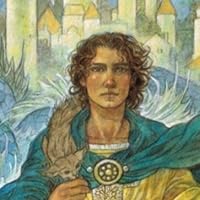
In the twenty-first century, a lawyer opposes a psychopathic judge and a powerful corporation in his fight to prove his client innocent of the capital crime of patent infringement
Also credited as Charles Harness. Charles Leonard Harness was born December 29, 1915 in Colorado City TX. After an abortive stint at Texas Christian University, studying to be a preacher, he moved on to George Washington University in Washington DC, where he received a B.S. degree in 1942, and a law degree in 1946. He married in 1938, and he and wife Nell have a daughter and a son. He worked as a mineral economist for the US Bureau of Mines, 1941-47, then became a patent attorney, first with American Cyanamid (1947-1953), then with W.R. Grace & Co. (1953-1981). His first story, ‘‘Time Trap’’, appeared in Astounding (8/48), and he went on to write a number of well-regarded SF stories, many involving future trials and patent attorneys. A series of patent office spoofs/stories (some co-written with Theodore L. Thomas) appeared under the pseudonym Leonard Lockhard, beginning with ‘‘Improbable Profession’’ (Astounding 9/52). His first published novel, Flight Into Yesterday (aka The Paradox Men), first appeared as a 1949 novella, and was expanded in 1953. The Rose, his most famous novella, appeared as a book in 1966. It was followed by Wagnerian space opera The Ring of Ritornel (1968), Wolfhead (1978), The Catalyst (1980), Firebird (1981), The Venetian Court (1982), Redworld (1986), Krono (1988), Lurid Dreams (1990), and Lunar Justice (1991). His short fiction has been collected in An Ornament to His Profession (1998), which includes not only ‘‘The Rose’’ but a new novella as well.
It seemed like another fairly straightforward and boring patent infringement case, but when the penalty for infringement is death it takes on a certain intensity. Ellen Welles, ailing owner of a small fabrication company, is being sued by the global invention conglomerate Universal Patents, of which most of their patents are issued by a computer, Faust. Faust’s designer has been illegally declared incompetent and held in seclusion but when certain ramifications of the case come to light the plaintiffs decide to get rid of him. The computer however has been busily working on some other things recently - miniaturizing matter, matter transmission, curing disease, telekinesis and precognition, and decides to take an interest. With a hand like this Charles Harness has stacked the deck in his favor substantially and while the book is a pleasurable enough read it is far too pat. Expanded from the 1981 Analog novella.
Interesting. I like that Harness was preaching against restrictive copyright and corporate legal and judicial abuse way back in '82. I'm not a huge fan of oedipal complexes in plots, but it didn't play too heavily and Harness doesn't go into any detail.