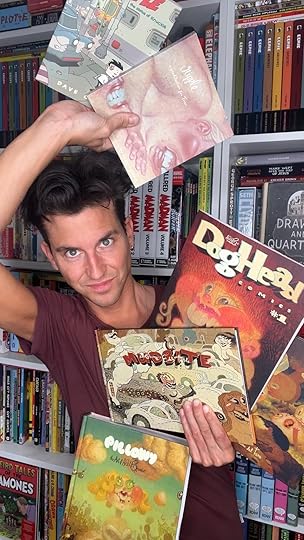
Špeh (orig. Ripple) je zadnja grafična novela iz triptiha SuckleCrumpleRipple, ki je nastajal sedem let. Špeh je bil prvotno izdan v petih delih v avtorjevi električni zbirki Weasel. Je Cooperjevo prelomno delo, ki za razliko izredno nadrealističnih in prav tako kritiško priznanih knjig Crumple in Suckle, prinaša tako vsebinsko kot likovno izredno realistično zgodbo. Album so ob izidu tako stripovski ustvarjalci kot založniki v eni sapi proglasili za knjigo leta. Špeh je ekspresivna zgodba o zakompleksanem slikarju, Martinu, ki se zaplete v obsesiven odnos s svojim modelom. Ta odnos ga pripelje do razmišljanja o lastnih pogledih na lepoto in spolnost. Špeh je večplastna zgodba o ljubezni, ki jo pretresajo tako čustva kot spolna privlačnost med Martinom in modelko Tino. Je dinamična zgodba, ki razkriva celovito paleto čustev glavnih likov ter njunih pogledov na ljubezen in privlačnost.
Dave Charles Cooper is a Canadian cartoonist, painter and animator. Cooper was born in Nova Scotia in 1967 and grew up in Ottawa, where he still lives. He began his career in underground comics in the early 90's . His most notable works are Weasel (2000, Fantagraphics), winner of an Ignatz Award and a Harvey Award in 2000, and Ripple (2003, Fantagraphics). A retrospective of his comic artwork took place in Angoulême and Paris in 2002. In the 2000's Dave moved to painting and animation. His oil paintings have been shown at galleries and museums in Los Angeles, New York, Paris, Madrid. In animation, Cooper has developed the tv shows Pig Boat Banana Cricket for Nickelodeon, The Bagel and Becky Show for Teletoon/BBC and the short adult film the Absence of Teddy Table.
For as long as he can remember, Martin has wanted to earn a living telling stories with words and pictures: stories as wonderful as the ones he grew up with. Unfortunately, there no longer seems to be a market for stories of that kind, and so Martin has been forced to churn out formulaic kiddie comics in order to make ends meet, an endeavor that has left him “consistently empty of original thought.”
Then one day, seemingly out of the blue, he receives a Canadian Bureau Arts Grant for a gallery show of “thought-provoking and erotic fine art.” He can hardly remember applying for the government grant but is determined to make the most of the unexpected opportunity. He quits his commercial work and starts looking for “wonderfully flawed” (rather than professional) models, aiming for what he calls The Eroticism of Homeliness. “The gallery crowd would eat that shit up,” he tells himself. It isn't long, however, before the eroticism of homeliness starts to eat up poor Martin instead, turning into a bizarre and all-consuming sexual obsession...
Dave Cooper’s Ripple from 2003 is a (forgotten?) masterpiece of alternative comics that reads like a cross between Robert Crumb and David Lynch, centered around the themes of fetishistic obsession (or is it love?) and identity confusion. Writing and artwork are perfectly matched, and the results are in turn engaging, grotesque, lovable, repulsive, and funny. Highly recommended, even if it takes some effort to track the book down!
What an unusual book..beautifully drawn and totally engaging, exploring themes of obsession and sexual fantasy that are both sordid and truly funny. Mike is a low functioning neurotic artist (there are lots of these types in graphic novels- I guess reflecting the kind of people who gravitate to this art form) but what brings it to life is the Tina's complex personality- insecure, aggressive, and abusive in turns - both child and temptress. This is a book where art and story work perfectly together and Dave Cooper does such a great job that you can completely feel and share Mike's passion for the grotesque Tina. I have no idea why this graphic novel is not better known because it is excellent.
maybe im missing something but like... I feel like readers are putting all this stuff on tina that might not even be there?? and it seems like the point is like here's this guy who is not seeing her, is incapable of seeing her. So maybe it's appropriate that cronenberg compares her to lolita, bc humbert was forever incapable of seeing through himself to her. also doubly appropriate bc cronenberg is like she's sexy she's earthy she's scary and I'm like... she's probably a kid. our protagonist realizes this and it doesn't really seem to bother him. I don't even know if thisis a spoiler bc you can see it coming. arriving.
in general I am very much over this whole weird freakout men seem to have about sex, as if they're the first to notice it's dirty or goofy or whatever. your thesis about how demeaning and surreal and disgusting it is doesn't make you an envelope pushing intellectual, it just makes you a nerd puritan. maybe you've been allowed to indulge too much and now you're bored, idk. inevitably you drag women into it bc we're the ones you want to fuck and the whole thing manages to become misogynistic on top of everything else.
I feel like I can't rate this bc I don't know where the authors coming from. does he sympathize with the protagonist? are the ironic things meant to be ironic? does he buy his own bullshit?
Weird and repulsive at times in a really captivating and exciting way. It draws you in and make you laugh and think and feel strange about what is attractive and connection and the point of art. I dunno much about comics but this seems like a special one, the art style is amazing and the pacing is spot on. A lot of people have used the word grotesque about this and I think they are right.
(Side note: I came across this book in a bizarre way. The author writes a lot of work for children, and I was reading one of these books to a friends kid when his Dad said there are adult comics by this author too do I wanna borrow them. With the warning that they are great but quite explicit. So that was kind of random but obviously I wanted to borrow it and enjoyed reading it. But my friend is friends with the author and this seems decently autobiographical so that added another layer of odd to my reading experience.)
I don't know where to start with this. The most obvious thing, maybe, to a reader who browses through this in the store would be the frank (read: pornographic) depiction of an odd relationship. And, in the latter half of the work, it threatens to overwhelm the narrative. But that could very well be the point, so it doesn't feel right to discuss that aspect negatively.
The trickiest thing, for me, though isn't the sex. It is the suggestion that Tina is underage that really bothers me. Nothing is definite, sure, but the possibility alone nearly taints the reading experience, especially since that part of the book is presented almost as a twist. I don't know. This is a tricky area in art, in general. Is a representation of something dark, or awful, or illegal, really immoral? How do we reconcile our moral judgment of the act with a representation of the act? There are no definite answers.
And I would say that it speaks to the skill with which this "graphic novel" was made that I've rated it rather highly.
This is a work in which a lonely, isolated man finds solace in someone who is everything that is not ideal in his world. She is overweight, she is "ugly" (Tina's illustration borders the grotesque), she is stupid, she is ignorant of art, and she is young (Martin, the narrator, is 38 and balding).
I would argue that all of this is metaphorical. Why do we idealize things? Is it because Martin is alone and unsuccessful and broke - that he represents everything that is not ideal - that he finds solace in someone like him? At first, he thinks Tina is his foil. But she isn't. Tina is Martin. And in a Persona-level identity swap, the latter half of the work finds Martin in Tina's latex suit, imagining himself crawling into her skin so that he can become her.
It is really Martin that is grotesque. It is his insecurities and his anxieties projected onto the girl that makes this work really powerful.
Power relations, art, sex, all of these things are discussed. And, oddly, unexpectedly, this story has a heart. It's just a dark heart.
During the late 1800s the African woman Saartjie Baartman- called 'the hottentot venus' was paraded around the world as part of a freak show because of her earthy body and huge butt. Are we any less disconnected from earthiness today? From nature, from our honest animal selves? From our sensuality? Has there been a full integration or are big butts still on display today? The effects of imperialism & hierarchy are apparent and on display in this incredibly drawn graphic novel. I could empathize with both characters. I've definitely been a Tina, and I've been a Martin to some degree. Due to the way we live, what happens between them & their dynamic happens all the time. Martin may have a higher position in our societal hierarchy, but when facing Tina and all she represents finds himself to be a hollow, souless man disconnected from his own humanity.
Dave Cooper proves that he is not only a unique writer but also has hauntingly captivating writing skills.
Dave writes again about what seems like his personal experience (through a character with a different name) about an artist who is looking for a voluptuous woman to model for his paintings.
He finds Tina, a dumpy and much younger woman (though it is implied she might be a minor?) than him who serves as his muse and model for his naked paintings. Gradually, he develops an unhealthy obsession with Tina when their relationship turns from professional to romantic.
Even though I felt zero attraction to the unappealing character of Tina, both visually and behaviourally, I was fascinated with the obsession the author developed. Dave really managed to keep me as a reader hooked to see how his affection to Tina grows and how actualizing his fantasies makes him act.
The art in the book is fantastic. The best way I can describe the aesthetic is "bubbly", which aligns well with the story. It's worth mentioning that there is a lot of explicit scenes in this one, which may not be very attractive, but do have beauty in their "ugly rawness" which is painted masterfully.
Martin makes comics for a living, though is unsatisfied by the committee-derived, highly commercialized kids comics that leaves him yearning for a greater creative output. Things look up for Martin when he receives a grant from a prestigious Canadian arts institute to put up a gallery containing "thought-provoking and erotic fine art". The challenge entices Martin immediately, and he begins to plan out his array of artwork. Obsessed with the flaws in appearances, Martin seeks out "normal looking" women as opposed to professional models to capture what he refers to as "the eroticism of homeliness". After handing out several business cards to random women he meets on the street, his call for an amateur model is met by Tina. Initially a little perturbed by Tina's overweight and homely appearance, Martin soon finds that he's more attracted to her than he would have expected. What ensues is an all-consuming obsession that leads Martin down some pretty bizarre places.
Ripple is a true achievement in comic storytelling. Dave Cooper's loose, expressive and kinetic artwork conveys the frenetic energy of the story with ease, but also adds an unexpected layer of eroticism. In a way, Cooper embodies the mindset of Martin when drawing Ripple as his take on Tina provides a way to capture both the inelegance of her appearance but her emanating sexuality as well. There's a very fleshy look to the artwork that is simultaneously off-putting but also kind of hot? It's masterful stuff.
The narrative itself is rich in texture as we slowly watch Cooper peel away at the layers behind Martin. He's a man who initially comes off as somewhat superficial, showing an air of superiority over Tina, with whom he feels like the superior specimen. But Tina's aloof confidence breaks down Martin's shell and we soon see a man who is desperate for attention and craves a level of subservience to a highly sexual woman. Bit by bit, Martin is reduced to his bare sexuality, completely enslaved by it. But at its core, we're following a man who is completely controlled by the same superficiality that he originally demonstrates when Tina first enters his studio. It's a fascinating examination of sexuality and relationships, and Cooper delivers the narrative in a way that is utterly unique.
I couldn't look away from this odd little story. The art is raw and unfiltered, and the characters are too. But both are also beautiful and knowable, presented powerfully and memorably--just pathetic enough that I was sympathetic. I liked it a whole lot!
There were brief moments of insight into the psyche, and the delivery of the panels and their content was clever and creative, seamlessly creating connection and emotion as the main character reminisced on a time earlier in his life when he briefly "loved" a crass, rough girl. so unlike his poetic, philosophizing (and now depressed) self.
Recommended for those who are into unusual short stories told in graphic narrative.
Why only three stars? It felt as if it was only just getting started, as if the author was just establishing the present day foundation that the story would flow from. I liked these awkward, maladjusted, unlikeable humans and wanted them to have some sort of self-actualization.
Fascinating, but disturbing story. I liked the unusual art style, and the exploration of sexuality. But I was uncomfortable with the idea that the main character was torn about being attracted to homeliness - tired of the pondering of beauty in the male gaze. And the idea of the female character being underage was disturbing and a tired trope.
(λέει κάπου ο Άλαν Μουρ, συμβουλεύοντας επίδοξους στόρι-τέλερς όταν χτίζουν χαρακτήρες να ψάχνουν βαθειά στις δικές τους εμπειρίες και μεταφέροντάς τις με πάθος, λεπτομέρεια και ρεαλισμό, "Αυτή είναι η μεγαλειώδης δύναμη της τέχνης και της συγγραφής: Αν πιστεύουμε ότι ότι είχαμε μια εμπειρία που ήταν αποκλειστικά δικιά μας, μοναδική, και μετά δούμε σε έναν πίνακα ή σε μια ταινία ή σε ένα μυθιστόρημα να εκφράζεται κάτι παρόμοιο με αυτήν μας την εμπειρία, τότε αισθανόμαστε λιγότερο μόνοι, και ενδεχομένως αυτός είναι ο σκοπός όλης της τέχνης και όλης της συγγραφής". Ε, τούτο 'δω μου άγγιξε μια τέτοια βαθιά θαμμένη χορδή)
Gdy sztuka miesza się erotycznymi pragnieniami i fascynacjami tak, że ciężko odróżnić, gdzie kończy się jedno, a zaczyna drugie i gdy pozornie niewinna sesja przeobraża się w wyuzdaną relację to wiedz, że David Cooper jest w formie.
Czytałem (czy raczej oglądałem) poprzednie komiksy autora i jego sposób narracja wydał mi się już nieco archaiczny, jednak "Falowanie" to inna bajka. Rzecz nie tylko perwersyjna, ale prowokująca do pytań na temat naszych preferencji, fascynacji, granic, ale też powiązań tego wszystkiego ze sztuką. Komiks rysowany "crumbowską" kreską i właśnie w takim prowokacyjnym, dusznym i operującym brzydotą klimacie. Zdecydowanie warto
será que há diferença entre amor e obsessão? não sei bem se este livro é sobre amor, talvez seja sobre desejo e corpos, pele, vergonha, o que duas pessoas podem fazer. Os desenhos são espetaculares, muito materiais, quase escultóricos, e Cooper trabalha de uma forma fantástica aquilo que escolhe materializar na página de BD e aquilo que fica por contar (por vergonha?), e o que deixa em esboço, numa composição de página diferente (sendo que o artista contido na história espelha Cooper, e é ele que nos narra o seu encontro com Tina). A Tina é fascinante e tão intensa que quando desaparece me deixa com coceira.
After the first read I wasn't into it, but after a few days with it still being present in my mind I realized I actually really loved it. The depiction of being and expressing our primal selves and desires without regard for societal norms/judgment is always refreshing, and the illustration style is pretty intoxicating as well. I love representation of sexual fat people!
As complicated and multilayered as the relationship it depicts. Who the narrator is and becomes (Martin, a comic book artist) changes as the story progresses. It has shades of Lolita as the report between Tina, a young, probably underage woman who agrees to model for Martin, unfolds from an awkward business arrangement into sexual obsession.
When desire, sadness and infatuation consume a man completely - what else are you left with other than an empty page and a distant memory?
This felt incredibly raw, and I relate so terribly with this artist (aside from entrapping a girl of unknown age 💀💀) I’m just another disgusting artist who wants to make beauty out of the worlds underdogs, because who else is gonna step up to the plate?
This entire review has been hidden because of spoilers.
Es la primera vez que leo algo de este autor. Relato sórdido entre la relación del ilustrador con una "musa" mucho más joven que él, la cual no entiende seguramente por esa diferencia de edad. Obsesión enfermiza y un poco de vergüenza ajena es lo que provoca leerlo, pero seguramente es la intención.
I love Cooper's art but the story here, especially in 2018, leaves a bit to be desired. Even if it is consensual, the age gap and focus on obsession make it difficult to really engage with the story as much as the author would've probably wanted me to.
Will read anything about shitty guys who believe that the women they put all of their desire into will save them only to be let down in the end because life isn't the fantasy they expect it to be. We Stan good representation of bad boys.
This entire review has been hidden because of spoilers.
I didn't want it to end. I was enjoying the book so much and every time I turned a page it felt frustrating to notice how little more there was left.
In a way, that's exactly what the protagonist was feeling too. Holding on and trying to get the best out of something that he knew all too well was doomed from the start.