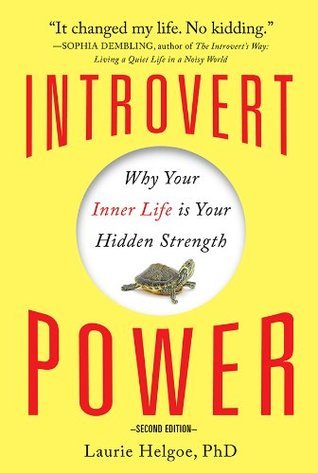
I honestly found this book to be disappointing, which is kinda funny considering tests say I'm about 80% introvert. Although some research was quoted, it seemed like a lot of the book was based on the author's perspective, and this book would probably be much better as a memoir.
The author seems to know what's she's talking about, but she makes way too many generalizations. To think that there would be no books if there were no introverts is silly. I'm sure there are extroverts who like to read, and there may be some introverts who like parties more than extroverts. I don't like the dichotomy that Helgoe depicts. She attempts to break it down in a later chapter, but her words aren't convincing to me.
Furthermore, there are multiple introverted types: ISFP, ISFJ, ISTP, ISTJ, INFP, INFJ, INTP, INTJ. I bet these introverts think a bit differently from one another. She already mentions Jung and Myer-Briggs, so why not go more in depth and give each type it's own section? I bet the author might be an INFJ.
Even though I'm an introvert, I can't see myself reflected in these pages. Every now and then something rings true, but my experience has generally been different. I find myself to be a mix of shadow dweller and socially accessible, but I feel like there's gotta be another word for it. I'm very happy being a shadow dweller and I'm also happy being socially accessible. I guess I could be called a shadow social dweller. I like to go in and out between categories, yet there doesn't seem to be a description for that.
This seems too personalized and metaphoric for me to connect with it. I don't think I've learned much from this, and sometimes the things that the author suggests seem passive-aggressive and unhelpful. The dialogue in which the introvert gives the silent treatment to the extrovert because he or she is annoyed is ineffective and passive-aggressive. Most people most likely wouldn't understand the silence. You'd have to use effective communication to clarify the problem. I find that when I remain silent, people somehow think I agree with them or hate them, depending on the context, and very little can convince them otherwise.
I don't like how this book has depicted extroverts, as adrenaline seeking, talking all the time, stupid kind of people. If introverts need a balance, then so do extroverts. I don't think it matters whether we're introverted or extroverted. I think it matters how we seek a balance between the two so that our needs are fulfilled (the author somewhat advocated for this position with her idea of yin and yang). Perhaps the author simply badmouths extroverts a bit because she's tired of people stereotyping introverts and trying to appease extroverts.
I just can't get behind most of her ideas of exploring introversion. I'm sorry to say this, but it reeks of privilege. It's practically impossible to find space for yourself if you don't have the time to do it. On top of that, if you don't have money, then good luck trying to personalize your space. The best you might be able to do is have a backyard or go to a public park somewhere. It'll never truly be yours and will always be shared. It might be yours for a moment. Retreats are also almost impossible for some people, due to time and money constraints. Maybe I'm biased because I live by myself, but I've always lived in the living rooms of my shared apartments and parents' house because my room felt too confining and it was never truly mine anyway, except when I slept. On top of that, I find social networks, like Facebook, OkCupid, and LinkedIn to be overstimulating and anxiety inducing. Social networks may not be good for all introverts. There are more people involved, so some extroverts might benefit more from them, especially with instant messaging and firing off ideas.
It would have been awesome if the author provided statistics proving that introversion doesn't necessarily correlate with mental illness, but instead she seems to suggest that it's natural for introverts to end up in therapy because we're self-reflective and reminisce a lot, which is the reason why some studies say people end up with depression--because they replay the negative past too much in their thoughts. I'm not convinced that this book even pushes the envelope on the subject open. Instead, it seems like the author wrote this book to convince herself of introversion.
I might've believed this book when I was 16, but it seems lacking based on my current experiences. Maybe I need to read it multiple times to get?
Also, she depicts Japan in way too bright a light. There's a high suicide rate there because one test in high school determines your career path. A good number of students kill themselves if they don't get the results they want or because their anxiety about taking the test is so high. On top of that, their society is very restrictive, especially to women. You're expected to drop out of the work force once you have children. It's all about going out with your friends, according to one of my friends who studied abroad in Japan. People never usually traveled alone unless they were on business. Japan isn't as great a place as she thinks it is. It might be quiet and respectful, but it has some drawbacks too.
Edit: I don't mean to say that this book is worthless. It's not, and I'm sure some introverts will find it very useful. However, I'm afraid only certain types of introverts will like it and connect with it. The biggest issues I have with this book are that there's not enough here, and the author only touches on an issue and then moves on without exploring its depths. I wish there was more information on introverts.
Also...birthdates. That just does not make sense. When someone is born, the person is just beginning his or her life journey, just starting to develop. Yet with deadlines, we are expected to turn in a final project. Therefore, what we turn in has stopped developing and is essentially "dead" and cannot be changed unless your supervisor agrees to let you work on it again. Especially with books, the manuscript is "dead" after you submit it, and you're usually not allowed to change much, except for spelling errors, since it costs a lot of money to make changes to proofs. Deadline makes more sense, given the nature of resource constraints. After the deadline comes the birth of a new edition, but the old edition is dead.