

What do you think?
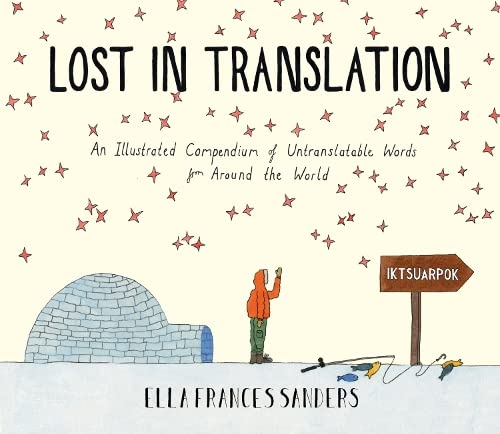
Untranslatables
An artistic collection of more than 50 drawings featuring unique, funny, and poignant foreign words that have no direct translation into English.
Did you know that the Japanese language has a word to express the way sunlight filters through the leaves of trees? Or that there’s a Finnish word for the distance a reindeer can travel before needing to rest?
Lost in Translation brings to life more than fifty words that don’t have direct English translations with charming illustrations of their tender, poignant, and humorous definitions. Often these words provide insight into the cultures they come from, such as the Brazilian Portuguese word for running your fingers through a lover’s hair, the Italian word for being moved to tears by a story, or the Swedish word for a third cup of coffee.
In this clever and beautifully rendered exploration of the subtleties of communication, you’ll find new ways to express yourself while getting lost in the artistry of imperfect translation.
Did you know that the Japanese language has a word to express the way sunlight filters through the leaves of trees? Or that there’s a Finnish word for the distance a reindeer can travel before needing to rest?
Lost in Translation brings to life more than fifty words that don’t have direct English translations with charming illustrations of their tender, poignant, and humorous definitions. Often these words provide insight into the cultures they come from, such as the Brazilian Portuguese word for running your fingers through a lover’s hair, the Italian word for being moved to tears by a story, or the Swedish word for a third cup of coffee.
In this clever and beautifully rendered exploration of the subtleties of communication, you’ll find new ways to express yourself while getting lost in the artistry of imperfect translation.
Kindle Edition
First published September 16, 2014
About the author
Ella Frances Sanders
12 books168 followersElla Frances Sanders is a New York Times and internationally-bestselling author, illustrator, artist, and designer living in the Highlands of Scotland. She has written and illustrated six books about language, science, and beauty.
Her latest book, Words to Love a Planet, is now out in the US, the UK, and Spain.
She is both a columnist for, and the designer of, Orion magazine, and can also be found writing The Sometimes Newsletter.
Her latest book, Words to Love a Planet, is now out in the US, the UK, and Spain.
She is both a columnist for, and the designer of, Orion magazine, and can also be found writing The Sometimes Newsletter.
Ratings & Reviews
Friends & Following
Create a free account to discover what your friends think of this book!
Community Reviews
Displaying 1 - 30 of 722 reviews

August 26, 2022
Updated May 2026 because I wanted to include some more words Especially this word, which I think is fabulous Futterneid Food Envy. How you feel when you go out for a meal and you look at your friends' plates and like their choices better than your own. I suffer from this so much, especially when it comes to dessert.
This is a great book for people who don't like reading - put it on your gift list for Christmas. There are only 57 words defined in this 'compendium' and each of them is defined twice. Once with graphics, and once with a bit of an explanation (but not too much). It is an extremely pretty book so will be welcomed as a gift anyway.
Having mentioned the brevity of the book, I have to say that some of the words chosen are really quite interesting. The ones I felt were most onomatopoeic and I could almost feel their meaning were:
Drachenfutter - Dragon-fodder. The gift a husband gives a wife when he's trying to make up for bad behaviour. German
Tiam - the twinkle in your eye when you first meet someone. Farsi
Akihi - Listening to directions and then walking off and promptly forgetting them, means you've gone Akihi. This is so me, someone explains where to go and then Iturn left when I should have turned right without noticing. I even do it in the apartment building I moved into last week, take the wrong corridor. No sense of direction is comorbid with prosopagnosia which I also have. Hawaiian
Wabi Sabi - finding beauty in the imperfections and acceptance of the cycle of life and death. Japanese
Kabelsalat - very tangled cables (ie all cables when two or three or more get together) German
Hiraeth - A homesickness, a nostalgia, a longing for somewhere you cannot or will not return to. Welsh. But it's more than that description, it's a longing to be Welsh in Wales again with its culture that is not English. But not going back. The weather.. and anyway have a better life elsewhere. But hearing the Stereophonics' As Long As We Beat the English or hearing that Wales did good at the rugby (always 'the rugby' not 'rugby', or the hymn Bread of Heaven and it's hiraeth in your heart.
Can you tell I'm Welsh? lol. But I've lived in the Caribbean most of my life, so I'm West Indian too. My favourite West Indian word is Broughtupsy, signifying that someone has manners, but most often used in the negative, saying someone rude has 'no broughtupsy'.
Trepverter - staircase words. What you should have said but it's only just occured to you, those great comebacks that come too late! German
Naz - the pride and assurance that comes from knowing you are loved unconditionally. Urdu
So it was a nice enjoyable little read, but defining 57 words hardly constitutes a book. I was given it, and won't be ordering it for the shop and I can see people standing there and reading the whole thing and not buying it. Perhaps it was designed as a gift?
__________
Reading Notes Every group or tribe of people wherever they are, even if they have been totally isolated and never had contact with any outside of their tribe, have two things in common - fire and language. There are no exceptions. Given that there are thousands of groups of people living in completely different geographical areas and circumstances it's no wonder that there must be words that are particular to that group and no other. I'm hoping this book, will bring some of them to light.
I'm wondering if the author will include Yiddish, a language that is particularly onomatopoeic and permeates New York slang and to a lesser extent, Cockney English from when (for both countries) the Jews immigrated and moved into the areas where the working class, as they were, lived. As an example, two actually, they go together, is 'fress' to be an absolute pig and stuff yourself, and 'schloff' the nap you need after having stuffed yourself so full your belly hurts. Being called a 'fresser' is not a compliment!
__________
3.5 stars
This is a great book for people who don't like reading - put it on your gift list for Christmas. There are only 57 words defined in this 'compendium' and each of them is defined twice. Once with graphics, and once with a bit of an explanation (but not too much). It is an extremely pretty book so will be welcomed as a gift anyway.
Having mentioned the brevity of the book, I have to say that some of the words chosen are really quite interesting. The ones I felt were most onomatopoeic and I could almost feel their meaning were:
Drachenfutter - Dragon-fodder. The gift a husband gives a wife when he's trying to make up for bad behaviour. German
Tiam - the twinkle in your eye when you first meet someone. Farsi
Akihi - Listening to directions and then walking off and promptly forgetting them, means you've gone Akihi. This is so me, someone explains where to go and then Iturn left when I should have turned right without noticing. I even do it in the apartment building I moved into last week, take the wrong corridor. No sense of direction is comorbid with prosopagnosia which I also have. Hawaiian
Wabi Sabi - finding beauty in the imperfections and acceptance of the cycle of life and death. Japanese
Kabelsalat - very tangled cables (ie all cables when two or three or more get together) German
Hiraeth - A homesickness, a nostalgia, a longing for somewhere you cannot or will not return to. Welsh. But it's more than that description, it's a longing to be Welsh in Wales again with its culture that is not English. But not going back. The weather.. and anyway have a better life elsewhere. But hearing the Stereophonics' As Long As We Beat the English or hearing that Wales did good at the rugby (always 'the rugby' not 'rugby', or the hymn Bread of Heaven and it's hiraeth in your heart.
Can you tell I'm Welsh? lol. But I've lived in the Caribbean most of my life, so I'm West Indian too. My favourite West Indian word is Broughtupsy, signifying that someone has manners, but most often used in the negative, saying someone rude has 'no broughtupsy'.
Trepverter - staircase words. What you should have said but it's only just occured to you, those great comebacks that come too late! German
Naz - the pride and assurance that comes from knowing you are loved unconditionally. Urdu
So it was a nice enjoyable little read, but defining 57 words hardly constitutes a book. I was given it, and won't be ordering it for the shop and I can see people standing there and reading the whole thing and not buying it. Perhaps it was designed as a gift?
__________
Reading Notes Every group or tribe of people wherever they are, even if they have been totally isolated and never had contact with any outside of their tribe, have two things in common - fire and language. There are no exceptions. Given that there are thousands of groups of people living in completely different geographical areas and circumstances it's no wonder that there must be words that are particular to that group and no other. I'm hoping this book, will bring some of them to light.
I'm wondering if the author will include Yiddish, a language that is particularly onomatopoeic and permeates New York slang and to a lesser extent, Cockney English from when (for both countries) the Jews immigrated and moved into the areas where the working class, as they were, lived. As an example, two actually, they go together, is 'fress' to be an absolute pig and stuff yourself, and 'schloff' the nap you need after having stuffed yourself so full your belly hurts. Being called a 'fresser' is not a compliment!
__________
3.5 stars

August 31, 2015
Luftmensch (Yiddish)... refers to someone who is a bit of a dreamer and literally means 'air person'. Or: your head is in the clouds and you are not coming down anytime soon!
For someone with a linguistic education background (me!), this is a very interesting and also fun book! I know all about the hardships of untranslatable words between languages. It's all about freely translating meanings and describing, finding the right words. This booklet is a collection of untranslatable words from various cultures and languages, combined with drawings to illustrate.
While reading it, I posted some examples in my progress. I described 'gezellig' (Dutch is my language) but there's another Dutch word in the book: Struisvogelpolitiek, 'Literally ostrich politics' or 'stick your head in the sand'. Acting like you don't notice when something bad happens and continuing on regardless, as you normally would....
Wonderfully wise book... highlight 2017!
For someone with a linguistic education background (me!), this is a very interesting and also fun book! I know all about the hardships of untranslatable words between languages. It's all about freely translating meanings and describing, finding the right words. This booklet is a collection of untranslatable words from various cultures and languages, combined with drawings to illustrate.
While reading it, I posted some examples in my progress. I described 'gezellig' (Dutch is my language) but there's another Dutch word in the book: Struisvogelpolitiek, 'Literally ostrich politics' or 'stick your head in the sand'. Acting like you don't notice when something bad happens and continuing on regardless, as you normally would....
Wonderfully wise book... highlight 2017!

July 5, 2016
GURFA (Arabic): The amount of water that can be held in one hand.

ah, the rich tapestry of language! i love the inspiration of compiling a book like this - it provides a fascinating, if superficial, look (let's call it a glance) at some of the values of different cultures and the experiences in life in distant lands - the things/feelings one part of the world has identified as necessary to communicate that other languages lack, the ineffable 'whatness' that makes up a zeitgeist. oh! like zeitgeist!
this book gives 52 examples of untranslatable words in languages like norwegian, swedish, dutch, greek, tagalog, hindi, icelandic, spanish, indonesian, yiddish, nguni bantu, farsi, korean, hawaiian, wagiman, urdu, hungarian, inuit, sanskrit, etc.
# of words i knew before reading this book = 1.
which means i just learned 51 things!
i enjoyed the artwork accompanying each word/definition, in some cases, actually preferring the illustration to the word, because - cats!

however, i think the impulse to supply the definitions in artistic cursive was a bad one, especially in those examples where the definition is superimposed on the image. between that and some of the color choices, it's sometimes hard to read, and even more so in these photos, so i will type the definitions out for you here, like a champ.
some of the examples are location-specific, and are 'untranslatable' because of the unlikelihood that certain regions would require an analogous word:
PORONKUSEMA (Finnish): The distance a reindeer can comfortably travel before taking a break.

the book assures us: this may seem like a very imprecise and rather unpredictable way to measure distance, but actually it's pretty widely acknowledged (in reindeer circles at least) that a poronkusema is around 4.7 miles/7.5 kilometers.
you have learned a fact!
but there are plenty of others that so perfectly capture universal human experiences, it's a shame that there's no english (for example) equivalent that also encapsulates the situation in a single word:
KOMOREBI (Japanese): The sunlight that filters through the leaves of the trees.

HIRAETH (Welsh): A homesickness for somewhere you cannot return to, the nostalgia and the grief for the lost places of your past, places that never were.

RAZLIUBIT (Russian): To fall out of love, a bittersweet feeling.

FEUILLEMORT (French): Having the color of a faded, dying leaf.

SAUDADE (Portuguese): A vague, constant desire for something that does not and probably cannot exist, a nostalgic longing for someone or something loved and then lost.

of course, the germans have the best ones because of their awesome legoland approach to language:
KUMMERSPECK: Literally meaning "grief-bacon," this word refers to the excess weight we can gain from emotional overeating.

DRACHENFUTTERL: literally, "dragon-fodder." the gift a husband gives his wife when he's trying to make up for bad behavior.

and i am DELIGHTED to learn that there are words out there in the world for things like:
PISAN ZAPRA (Malay): The time needed to eat a banana.
(and which is TWO words, cheater!)

and
KARELU (Tulu): The mark left on the skin by wearing something tight.

and for you booknerds:
COMMUOVERE (Italian): To be moved in a heartwarming way, usually relating to a story that moved you to tears.

but even more importantly:
TSUNDOKU (Japanese): Leaving a book unread after buying it, typically piled up together with other unread books.

that is such a perfect word, man. thanks, japan. for this and for all of your kit-kat flavors.
some other assorted favorites:
GLAS WEN (Welsh, and also two words):This literally means a "blue smile"; one that is sarcastic or mocking.

MAMIHLAPINATAPAI (Yaghan): A silent acknowledgement and understanding between two people, who are both wishing or thinking the same thing (and are both unwilling to initiate).

YA'ABURNEE (Arabic): Meaning "you bury me," a beautifully morbid declaration of one's hope that they will die before another person, as it would be too difficult living without them.

there are additional words for the following:
- the road-like reflection of the moon in the water.
-not being ready to spend time or money on a specific thing, despite being able to afford it.
-a joke so horrible and so unfunny that you cannot help but laugh.
-listening to directions and then walking off and promptly forgetting them.
-the act of searching for something in the water with only your feet.
-the indescribable euphoria experienced as you begin to fall in love.
-the peculiar itchiness that settles on the upper lip before taking a sip of whiskey. (scottish gaelic, natch)
and yet there's still no single word (that i'm aware of) for the act of staring into your closet hopefully, as though new and super-flattering clothes have magically appeared.
however, i swear i once knew a single french word that meant "to be about to collapse," but i can't for the life of me remember what it was, and it is not in this book, either. perhaps one of you cunning linguists know what i'm talking about?
at any rate - a fun book and a good prezzie for any word-nerds in your lives.
 come to my blog!

ah, the rich tapestry of language! i love the inspiration of compiling a book like this - it provides a fascinating, if superficial, look (let's call it a glance) at some of the values of different cultures and the experiences in life in distant lands - the things/feelings one part of the world has identified as necessary to communicate that other languages lack, the ineffable 'whatness' that makes up a zeitgeist. oh! like zeitgeist!
this book gives 52 examples of untranslatable words in languages like norwegian, swedish, dutch, greek, tagalog, hindi, icelandic, spanish, indonesian, yiddish, nguni bantu, farsi, korean, hawaiian, wagiman, urdu, hungarian, inuit, sanskrit, etc.
# of words i knew before reading this book = 1.
which means i just learned 51 things!
i enjoyed the artwork accompanying each word/definition, in some cases, actually preferring the illustration to the word, because - cats!

however, i think the impulse to supply the definitions in artistic cursive was a bad one, especially in those examples where the definition is superimposed on the image. between that and some of the color choices, it's sometimes hard to read, and even more so in these photos, so i will type the definitions out for you here, like a champ.
some of the examples are location-specific, and are 'untranslatable' because of the unlikelihood that certain regions would require an analogous word:
PORONKUSEMA (Finnish): The distance a reindeer can comfortably travel before taking a break.

the book assures us: this may seem like a very imprecise and rather unpredictable way to measure distance, but actually it's pretty widely acknowledged (in reindeer circles at least) that a poronkusema is around 4.7 miles/7.5 kilometers.
you have learned a fact!
but there are plenty of others that so perfectly capture universal human experiences, it's a shame that there's no english (for example) equivalent that also encapsulates the situation in a single word:
KOMOREBI (Japanese): The sunlight that filters through the leaves of the trees.

HIRAETH (Welsh): A homesickness for somewhere you cannot return to, the nostalgia and the grief for the lost places of your past, places that never were.

RAZLIUBIT (Russian): To fall out of love, a bittersweet feeling.

FEUILLEMORT (French): Having the color of a faded, dying leaf.

SAUDADE (Portuguese): A vague, constant desire for something that does not and probably cannot exist, a nostalgic longing for someone or something loved and then lost.

of course, the germans have the best ones because of their awesome legoland approach to language:
KUMMERSPECK: Literally meaning "grief-bacon," this word refers to the excess weight we can gain from emotional overeating.

DRACHENFUTTERL: literally, "dragon-fodder." the gift a husband gives his wife when he's trying to make up for bad behavior.

and i am DELIGHTED to learn that there are words out there in the world for things like:
PISAN ZAPRA (Malay): The time needed to eat a banana.
(and which is TWO words, cheater!)

and
KARELU (Tulu): The mark left on the skin by wearing something tight.

and for you booknerds:
COMMUOVERE (Italian): To be moved in a heartwarming way, usually relating to a story that moved you to tears.

but even more importantly:
TSUNDOKU (Japanese): Leaving a book unread after buying it, typically piled up together with other unread books.

that is such a perfect word, man. thanks, japan. for this and for all of your kit-kat flavors.
some other assorted favorites:
GLAS WEN (Welsh, and also two words):This literally means a "blue smile"; one that is sarcastic or mocking.

MAMIHLAPINATAPAI (Yaghan): A silent acknowledgement and understanding between two people, who are both wishing or thinking the same thing (and are both unwilling to initiate).

YA'ABURNEE (Arabic): Meaning "you bury me," a beautifully morbid declaration of one's hope that they will die before another person, as it would be too difficult living without them.

there are additional words for the following:
- the road-like reflection of the moon in the water.
-not being ready to spend time or money on a specific thing, despite being able to afford it.
-a joke so horrible and so unfunny that you cannot help but laugh.
-listening to directions and then walking off and promptly forgetting them.
-the act of searching for something in the water with only your feet.
-the indescribable euphoria experienced as you begin to fall in love.
-the peculiar itchiness that settles on the upper lip before taking a sip of whiskey. (scottish gaelic, natch)
and yet there's still no single word (that i'm aware of) for the act of staring into your closet hopefully, as though new and super-flattering clothes have magically appeared.
however, i swear i once knew a single french word that meant "to be about to collapse," but i can't for the life of me remember what it was, and it is not in this book, either. perhaps one of you cunning linguists know what i'm talking about?
at any rate - a fun book and a good prezzie for any word-nerds in your lives.
come to my blog!
February 25, 2016
Lost in Translation is a slim volume of doodles with accompanying definitions of untranslatable words from many languages around the globe. It's a treat.
There are words for feelings that I'm certain everyone has experienced... we just lacked the language to describe it appropriately.
This book showed me how universal emotions and perceptions can be and the difficulty of capturing the indescribable in words.
But we've certainly given it a good try.
I liked the words that described fleeting moments of beauty in nature the most. All of the following are from Lost in Translation but the pages are un-numbered so you'll just have to trust me that they're in there:
Komorebi: (Japanese noun) The sunlight that filters through the leaves of the trees.
Waldeninsamkeit: (German noun) The feeling of being alone in the woods, an easy solitude and a connectedness to nature.
Mangata: (Swedish noun) The road-like reflection of the moon in the water.
And, finally, a word that perfectly describes one of my vices:
Tsundoku: (Japanese noun) Leaving a book unread after buying it, typically piled up together with other unread books.
I didn't realize that was actually a thing.
Ah, the joys of reading and cluttering up my house with tsundoku. :)
There are words for feelings that I'm certain everyone has experienced... we just lacked the language to describe it appropriately.
This book showed me how universal emotions and perceptions can be and the difficulty of capturing the indescribable in words.
But we've certainly given it a good try.
I liked the words that described fleeting moments of beauty in nature the most. All of the following are from Lost in Translation but the pages are un-numbered so you'll just have to trust me that they're in there:
Komorebi: (Japanese noun) The sunlight that filters through the leaves of the trees.
Waldeninsamkeit: (German noun) The feeling of being alone in the woods, an easy solitude and a connectedness to nature.
Mangata: (Swedish noun) The road-like reflection of the moon in the water.
And, finally, a word that perfectly describes one of my vices:
Tsundoku: (Japanese noun) Leaving a book unread after buying it, typically piled up together with other unread books.
I didn't realize that was actually a thing.
Ah, the joys of reading and cluttering up my house with tsundoku. :)

December 5, 2017
Wonderful book about language and the words we invent to convey meaning. My favorite word in this book: 'Kabelsalat' - German for Cable Salad - the mass of wires that connect everything in our homes and offices. You will be sure to find many words that will amaze you! A great ice breaker for when you are at a party!

September 24, 2016
“The words in this book may be answers to questions you didn’t even know to ask, and perhaps some you did. They might pinpoint emotions and experiences that seemed elusive and indescribable, or they may cause you to remember a person you’d long forgotten.”
After having read and loved The Illustrated Book of Sayings earlier this month, I was beyond ecstatic to pick this book up.
Lost in Translation brings to life more than fifty words that don’t have direct English translations with charming illustrations of their tender, poignant, and humorous definitions.
This book helped me find parts of myself and old memories that I'd unfortunately forgotten. And for that I'm beyond grateful.
“There may be some small essential gaps in your mother tongue, but never fear: you can look to other languages to define what you’re feeling, and these pages are your starting point.”
As always, I picked out the expressions that managed to explain and capture a lot of the moments I've had in the past but couldn't put into words.
Italian:

“v. To be moved in a heartwarming way, usually relating to a story that moved you to tears.”
Swedish:

“n. The road - like reflection of the moon in the water.”
Dutch:

“adj. Describes much more than just coziness - a positive warm emotion or feeling rather than just something physical - and connotes time spent with loved ones, togetherness.”
Welsh:

“n. This literally means a “blue smile”; one that is sarcastic or mocking.”
Malay:

“n. The time needed to eat a banana.”
Welsh:

“n. A homesickness for somewhere you cannot return to, the nostalgia and the grief for the lost places of your past, places that never were.”
Icelandic:

“v. Not being ready to spend time or money on a specific thing, despite being able to afford ”
Russian:

“v. To fall out of love, a bittersweet feeling.”
Japanese:

“n. Gazing vacantly into the distance without really thinking about anything specific.”
Indonesian:

“n. This refers to a joke so terrible and so unfunny that you cannot help but laugh.”
The best kind of jokes!!
Yiddish:

“n. Someone who seems to have nothing but bad luck.”
This is one of my favorite words in Yiddish!! I try to use it daily.
Yiddish:

“n. A witty riposte or comeback you think of only when it is too late to use. Literally, “staircase words.”
Swedish:

“n. The restless beat of a traveler’s heart before the journey begins, a mixture of anxiety and anticipation.”
Farsi:

“n. The twinkle in your eye when you first meet someone.”
Wagiman:

“v. The act of searching for something in the water with only your feet.”
Hungarian:

“adj. When meeting someone for the first time, and your intuition tells you that they are a good person, you can refer to them as “szimpatikus.”
Inuit:

“n. The act of repeatedly going outside to keep checking if someone (anyone) is coming.”
YES! This was exactly what I’ve been looking for.
Yiddish:

“n. Refers to someone who is a bit of a dreamer and literally means “air person.”
Brazilian Portuguese:

“n. The act of tenderly running your fingers through the hair of somebody you love.”

Not only were the illustrations extremely gorgeous, but the expressions were exactly the ones I've been looking for. I'm so, so glad that books like this one exist.
“If you take something away from this book other than some brilliant conversation starters, let it be the realization (or affirmation) that you are human, that you are fundamentally, intrinsically bound to every single person on the planet with language and with feelings.”
And I'm really on the look-out for books similar to this one!!
*Note: I'm an Amazon Affiliate. If you're interested in buying Lost in Translation, just click on the image below to go through my link. I'll make a small commission!*


This review and more can be found on my blog.
After having read and loved The Illustrated Book of Sayings earlier this month, I was beyond ecstatic to pick this book up.
Lost in Translation brings to life more than fifty words that don’t have direct English translations with charming illustrations of their tender, poignant, and humorous definitions.
This book helped me find parts of myself and old memories that I'd unfortunately forgotten. And for that I'm beyond grateful.
“There may be some small essential gaps in your mother tongue, but never fear: you can look to other languages to define what you’re feeling, and these pages are your starting point.”
As always, I picked out the expressions that managed to explain and capture a lot of the moments I've had in the past but couldn't put into words.
Italian:
“v. To be moved in a heartwarming way, usually relating to a story that moved you to tears.”
Swedish:
“n. The road - like reflection of the moon in the water.”
Dutch:
“adj. Describes much more than just coziness - a positive warm emotion or feeling rather than just something physical - and connotes time spent with loved ones, togetherness.”
Welsh:
“n. This literally means a “blue smile”; one that is sarcastic or mocking.”
Malay:
“n. The time needed to eat a banana.”
Welsh:
“n. A homesickness for somewhere you cannot return to, the nostalgia and the grief for the lost places of your past, places that never were.”
Icelandic:
“v. Not being ready to spend time or money on a specific thing, despite being able to afford ”
Russian:
“v. To fall out of love, a bittersweet feeling.”
Japanese:
“n. Gazing vacantly into the distance without really thinking about anything specific.”
Indonesian:
“n. This refers to a joke so terrible and so unfunny that you cannot help but laugh.”
The best kind of jokes!!
Yiddish:
“n. Someone who seems to have nothing but bad luck.”
This is one of my favorite words in Yiddish!! I try to use it daily.
Yiddish:
“n. A witty riposte or comeback you think of only when it is too late to use. Literally, “staircase words.”
Swedish:
“n. The restless beat of a traveler’s heart before the journey begins, a mixture of anxiety and anticipation.”
Farsi:
“n. The twinkle in your eye when you first meet someone.”
Wagiman:
“v. The act of searching for something in the water with only your feet.”
Hungarian:
“adj. When meeting someone for the first time, and your intuition tells you that they are a good person, you can refer to them as “szimpatikus.”
Inuit:
“n. The act of repeatedly going outside to keep checking if someone (anyone) is coming.”
YES! This was exactly what I’ve been looking for.
Yiddish:
“n. Refers to someone who is a bit of a dreamer and literally means “air person.”
Brazilian Portuguese:
“n. The act of tenderly running your fingers through the hair of somebody you love.”
Not only were the illustrations extremely gorgeous, but the expressions were exactly the ones I've been looking for. I'm so, so glad that books like this one exist.
“If you take something away from this book other than some brilliant conversation starters, let it be the realization (or affirmation) that you are human, that you are fundamentally, intrinsically bound to every single person on the planet with language and with feelings.”
And I'm really on the look-out for books similar to this one!!
*Note: I'm an Amazon Affiliate. If you're interested in buying Lost in Translation, just click on the image below to go through my link. I'll make a small commission!*
This review and more can be found on my blog.

August 31, 2017
REVIEW OF THE KINDLE EDITION
So yes, while the general set-up of Ella Frances Sanders' 2014 Lost in Translation: An Illustrated Compendium of Untranslatable Words from Around the World is most definitely and certainly much easier to read and as such also considerably less of a strain on the eyes (or at least on my ageing eyes) and therefore already format-wise exponentially better and massively superior to her, to Sanders’ oh so personally frustrating and annoying for me The Illustrated Book of Sayings, and although this was indeed a rather entertaining and diverting way to spend a half hour or so, there are still far far too many niggling little issues for me to consider more than a low three star rating at best for Lost in Translation: An Illustrated Compendium of Untranslatable Words from Around the World (well, two and a half stars, actually).
Now I do not want to engage in a detailed linguistic analysis here (as this review space is not really the place for such an endeavour), but since Ella Frances Sanders always does indicate in Lost in Translation: An Illustrated Compendium of Untranslatable Words from Around the World whether each of the presented, supposedly untranslatable into English foreign language words are nouns, verbs, adjectives, adverbs etc., she really in my humble opinion should also be listing the specific etymologies of said terms, as the historical development of words will of course often also show how specific meanings likely arose in the first place (for instance, with the very first example featured in Lost in Translation: An Illustrated Compendium of Untranslatable Words from Around the World, with the Norwegian noun palegg, its etymology likely would suggest and indicated that it is based on the equally Norwegian verb legge, to lay, to place, as one as a rule lays, as one tends to place diverse foodstuffs on open-faced sandwiches, and I do thus rather majorly wish Ella Frances Sanders had indeed and in fact listed, had researched the specific linguistic and historical backgrounds of her inclusions, as these backgrounds are not only interesting in and of themselves, but that they will also often give much necessary information both linguistic and historical about words and their origins).
And furthermore, and finally, while for Lost in Translation: An Illustrated Compendium of Untranslatable Words from Around the World the absence of listed, of consulted, read sources is really not all that much of an academic issue for me, not as much of a serious personal problem as it has been for The Illustrated Book of Sayings (since Ella Frances Sanders does not really ever provide all that much if any specific historical and linguistic details in Lost in Translation: An Illustrated Compendium of Untranslatable Words from Around the World) I would nevertheless still most definitely have liked and wanted more than just the fifty untranslatable foreign language examples featured, and have actually found especially the presented supplemental explanatory details on many of the to and for me wholly unfamiliar words a bit frustratingly lacking on in scope and as such also a trifle too limited with regard to content and theme. Enjoyable, and most definitely much less annoyingly set up and presented than the author's, than Ella Frances Sanders’ The Illustrated Book of Sayings (as already mentioned above) but still more than a bit mundane and truly only scratching the proverbial linguistic and translation studies surface so to speak (and while indeed mildly recommended, Lost in Translation: An Illustrated Compendium of Untranslatable Words from Around the World is still in no way in depth enough, with even the very beautiful and imaginatively rendered accompanying illustrations providing a to and for me sweet but ultimately rather unnecessary, even rather distracting decorative trim).
So yes, while the general set-up of Ella Frances Sanders' 2014 Lost in Translation: An Illustrated Compendium of Untranslatable Words from Around the World is most definitely and certainly much easier to read and as such also considerably less of a strain on the eyes (or at least on my ageing eyes) and therefore already format-wise exponentially better and massively superior to her, to Sanders’ oh so personally frustrating and annoying for me The Illustrated Book of Sayings, and although this was indeed a rather entertaining and diverting way to spend a half hour or so, there are still far far too many niggling little issues for me to consider more than a low three star rating at best for Lost in Translation: An Illustrated Compendium of Untranslatable Words from Around the World (well, two and a half stars, actually).
Now I do not want to engage in a detailed linguistic analysis here (as this review space is not really the place for such an endeavour), but since Ella Frances Sanders always does indicate in Lost in Translation: An Illustrated Compendium of Untranslatable Words from Around the World whether each of the presented, supposedly untranslatable into English foreign language words are nouns, verbs, adjectives, adverbs etc., she really in my humble opinion should also be listing the specific etymologies of said terms, as the historical development of words will of course often also show how specific meanings likely arose in the first place (for instance, with the very first example featured in Lost in Translation: An Illustrated Compendium of Untranslatable Words from Around the World, with the Norwegian noun palegg, its etymology likely would suggest and indicated that it is based on the equally Norwegian verb legge, to lay, to place, as one as a rule lays, as one tends to place diverse foodstuffs on open-faced sandwiches, and I do thus rather majorly wish Ella Frances Sanders had indeed and in fact listed, had researched the specific linguistic and historical backgrounds of her inclusions, as these backgrounds are not only interesting in and of themselves, but that they will also often give much necessary information both linguistic and historical about words and their origins).
And furthermore, and finally, while for Lost in Translation: An Illustrated Compendium of Untranslatable Words from Around the World the absence of listed, of consulted, read sources is really not all that much of an academic issue for me, not as much of a serious personal problem as it has been for The Illustrated Book of Sayings (since Ella Frances Sanders does not really ever provide all that much if any specific historical and linguistic details in Lost in Translation: An Illustrated Compendium of Untranslatable Words from Around the World) I would nevertheless still most definitely have liked and wanted more than just the fifty untranslatable foreign language examples featured, and have actually found especially the presented supplemental explanatory details on many of the to and for me wholly unfamiliar words a bit frustratingly lacking on in scope and as such also a trifle too limited with regard to content and theme. Enjoyable, and most definitely much less annoyingly set up and presented than the author's, than Ella Frances Sanders’ The Illustrated Book of Sayings (as already mentioned above) but still more than a bit mundane and truly only scratching the proverbial linguistic and translation studies surface so to speak (and while indeed mildly recommended, Lost in Translation: An Illustrated Compendium of Untranslatable Words from Around the World is still in no way in depth enough, with even the very beautiful and imaginatively rendered accompanying illustrations providing a to and for me sweet but ultimately rather unnecessary, even rather distracting decorative trim).

December 26, 2018
In una sola parola
Un libro curioso, insolito, in cui vengono presentate 50 parole (illustrate dai disegni deliziosamente infantili dell’autrice) con cui nelle diverse lingue si esprimono – con un’unica parola – stati d’animo particolari, piccoli gesti quotidiani, o anche concetti che richiederebbero ampie descrizioni per essere comunicati.
La più famosa è SAUDADE (Portoghese): ”Desiderio vago, ma persistente di qualcosa che non c’è e probabilmente non esiste; nostalgia di qualcuno o qualcosa che si è amato e poi perduto”.

C’è una parola che ben descrive l’inizio della mia giornata, che incomincia ad ingranare solo dopo la terza tazzina di caffè, TRETÅR (Svedese): “Tår” è un caffè, “patår” il bis; con “tretår” s’intende un secondo bis, vale a dire un “tris di caffè”.
E ce n’è un’altra per comunicare una sensazione sempre più difficile da provare, WALDEINSAMKEIT (Tedesco): ”La sensazione di essere soli nel bosco, una piacevole solitudine a contatto con la natura”.
Un’altra ancora per esprimere qualcosa che io faccio forse troppo spesso, BOKETTO (Giapponese): ”Lasciar vagare lo sguardo in lontananza, senza pensare a niente”.
https://youtu.be/ISxskvJ9FwI
...e altre 46 parole, tutte da scoprire.
Dalla Prefazione:
Le parole di questo libro potrebbero rispondere a domande che non sapevate di voler porre, o magari ad alcune che avete già posto. Potrebbero identificare con precisione emozioni ed esperienze che apparivano vaghe e indescrivibili, o magari vi faranno ricordare una persona dimenticata da tempo. Se di questo libro vi rimarrà qualcosa in più, oltre ad alcuni spunti per una conversazione brillante, sarà la consapevolezza – o la conferma – che siete esseri umani, intrinsecamente legati a ogni singola persona sul pianeta attraverso la lingua e le emozioni.
Un libro curioso, insolito, in cui vengono presentate 50 parole (illustrate dai disegni deliziosamente infantili dell’autrice) con cui nelle diverse lingue si esprimono – con un’unica parola – stati d’animo particolari, piccoli gesti quotidiani, o anche concetti che richiederebbero ampie descrizioni per essere comunicati.
La più famosa è SAUDADE (Portoghese): ”Desiderio vago, ma persistente di qualcosa che non c’è e probabilmente non esiste; nostalgia di qualcuno o qualcosa che si è amato e poi perduto”.
C’è una parola che ben descrive l’inizio della mia giornata, che incomincia ad ingranare solo dopo la terza tazzina di caffè, TRETÅR (Svedese): “Tår” è un caffè, “patår” il bis; con “tretår” s’intende un secondo bis, vale a dire un “tris di caffè”.
E ce n’è un’altra per comunicare una sensazione sempre più difficile da provare, WALDEINSAMKEIT (Tedesco): ”La sensazione di essere soli nel bosco, una piacevole solitudine a contatto con la natura”.
Un’altra ancora per esprimere qualcosa che io faccio forse troppo spesso, BOKETTO (Giapponese): ”Lasciar vagare lo sguardo in lontananza, senza pensare a niente”.
https://youtu.be/ISxskvJ9FwI
...e altre 46 parole, tutte da scoprire.
Dalla Prefazione:
Le parole di questo libro potrebbero rispondere a domande che non sapevate di voler porre, o magari ad alcune che avete già posto. Potrebbero identificare con precisione emozioni ed esperienze che apparivano vaghe e indescrivibili, o magari vi faranno ricordare una persona dimenticata da tempo. Se di questo libro vi rimarrà qualcosa in più, oltre ad alcuni spunti per una conversazione brillante, sarà la consapevolezza – o la conferma – che siete esseri umani, intrinsecamente legati a ogni singola persona sul pianeta attraverso la lingua e le emozioni.

October 26, 2015
book #1 of 2016
Italian review @ frannie pan's dreamcatcher
I'll be honest: when I decided to buy and start this little book, I thought it was going to be a nice little something, a collection of weird and interesting words that I would have forgotten the minute after I read them but that it would have been fun to read, a pleasant and entertaining way to spend a couple of hours.
And it was. But it was also so much more.
I think my whole reading experience was influenced by a sentence the author wrote in her introduction to the compendium. If I hadn't... well, I would have probably dismissed this book as I was already doing when I first picked it up. Instead her words hit me straight in the chest and radically changed everything.
I mean.. can't you see it? It is SO goddamn true!
In our everyday life we're literally flooded with feelings and sensations or thoughts we cannot give a name to; and perhaps, in that moment, we're lead to believe that a word for that feeling/sensation/thought does not exist and if it doesn't exist it must mean we're the first ones who bumped into them. We're alone in our experience, there's nobody else who can understand us and whom we can talk to.
THAT'S A LIE.
It's a huge cruel illusion, because at the end of the day we're all humans and we're all made of the same stuff. Probably not every single person went through the same exact thing, but someone else out there has and they gave a name to it in their language and that can only mean we're not alone!
We're all connected to each other in ways that go beyond our limited understanding but words, languages, the ability itself of communicating are a complex but accessible tool that we were gifted and that should never stop astounding us.
This compendium is made of 52 words, in more known (Spanish, French..) as well as not so well known (arabian, swedish, ubuntu...) languages, that can't be translated into another language with just one word. It just isn't possible.
Each one is accompanied by a brief explanation of the context in which the word is used as well as a cute colorful drawing made by the author herself, which makes everything nicer and more pleasing to the eye.
I can already tell this is going to be one of the cutest and most particular books I'll read this year and I couldn't be happier about it!
Italian review @ frannie pan's dreamcatcher
I'll be honest: when I decided to buy and start this little book, I thought it was going to be a nice little something, a collection of weird and interesting words that I would have forgotten the minute after I read them but that it would have been fun to read, a pleasant and entertaining way to spend a couple of hours.
And it was. But it was also so much more.
I think my whole reading experience was influenced by a sentence the author wrote in her introduction to the compendium. If I hadn't... well, I would have probably dismissed this book as I was already doing when I first picked it up. Instead her words hit me straight in the chest and radically changed everything.
"If you take something from this book, other than some brilliant conversation starters, let it be the realization that you are human, that you are fundamentally, intrinsically bound to every single person on the planet with language and feelings. [...] As much as we like to differentiate ourselves, to feel like individuals and rave on expression and freedom and the experiences that are unique to each one of us, we're all made of the same stuff".
I mean.. can't you see it? It is SO goddamn true!
In our everyday life we're literally flooded with feelings and sensations or thoughts we cannot give a name to; and perhaps, in that moment, we're lead to believe that a word for that feeling/sensation/thought does not exist and if it doesn't exist it must mean we're the first ones who bumped into them. We're alone in our experience, there's nobody else who can understand us and whom we can talk to.
THAT'S A LIE.
It's a huge cruel illusion, because at the end of the day we're all humans and we're all made of the same stuff. Probably not every single person went through the same exact thing, but someone else out there has and they gave a name to it in their language and that can only mean we're not alone!
We're all connected to each other in ways that go beyond our limited understanding but words, languages, the ability itself of communicating are a complex but accessible tool that we were gifted and that should never stop astounding us.
This compendium is made of 52 words, in more known (Spanish, French..) as well as not so well known (arabian, swedish, ubuntu...) languages, that can't be translated into another language with just one word. It just isn't possible.
Each one is accompanied by a brief explanation of the context in which the word is used as well as a cute colorful drawing made by the author herself, which makes everything nicer and more pleasing to the eye.
I can already tell this is going to be one of the cutest and most particular books I'll read this year and I couldn't be happier about it!

June 23, 2015
Loved this, it was really fascinating. I wish it'd been longer though, I finished it in less than half an hour and was left wanting more. I'm sure there must be thousands of words in the world that are untranslatable in English, why only pick fifty?
The words that were showcased were interesting, some of them had rather beautiful and poignant meanings behind them, other words were a tad bonkers (like the word for how long it took to eat a banana, I kind of loved it though).
Loved the illustrations, they were funny and quirky.
Favourite words:
HIRAETH (noun, Welsh). A homesickness for somewhere you cannot return to, the nostalgia and the grief for the lost places of your past, places that never were.
KOMOREBI (noun, Japanese). The sunlight that filters through the leaves of the trees.
YA’ABURNEE (noun, Arabic). Meaning “you bury me” a beautifully morbid declaration of one’s hope that they will die before another person, as it would be too difficult living without them.
The words that were showcased were interesting, some of them had rather beautiful and poignant meanings behind them, other words were a tad bonkers (like the word for how long it took to eat a banana, I kind of loved it though).
Loved the illustrations, they were funny and quirky.
Favourite words:
HIRAETH (noun, Welsh). A homesickness for somewhere you cannot return to, the nostalgia and the grief for the lost places of your past, places that never were.
KOMOREBI (noun, Japanese). The sunlight that filters through the leaves of the trees.
YA’ABURNEE (noun, Arabic). Meaning “you bury me” a beautifully morbid declaration of one’s hope that they will die before another person, as it would be too difficult living without them.

February 1, 2019
Wunderschöne Idee, ganz viele tolle Wörter und richtig schöne Illustrationen.

February 10, 2017
I was lucky enough to be able to borrow Ella Frances Sanders' Lost in Translation, from my local library. I received a copy of Speaking in Tongues for Christmas, and loved it, so my hopes were high for her debut. (Yes, I clearly like reading books by this particular author out of their original publication order). Lost in Translation is a wonderful compendium of untranslateable words and phrases which have no equivalent in English.
Sanders' introduction to Lost in Translation is lovely; in thoughtful and well-written prose, the author highlights just how important different concepts are in cultures other than the British. She clearly has a passion for collecting rather obscure linguistic references, and is eager to share those important finds with her readers.
I would highly recommend Lost in Translation, as well as Speaking in Tongues. Whilst neither book is particularly literary, or very taxing, each entry, along with the wonderful illustrations which accompany it, is a real joy for the word nerds amongst us.
Below are a few of my favourite entries from Lost in Translation, which is undoubtedly a tome which I shall pick up many times in future.
- Gezellig (Dutch): essentially the Dutch version of hygge, a Danish trend which is everywhere at present.
- Pisan Zapra (Malay): the time needed to eat a banana.
- Hiraeth (Welsh): a homesickness for something or somewhere you cannot return to; the nostalgia for your past, or for something imagined.
- Boketto (Japanese): gazing vacantly into the distance without thinking of anything specific.
- Vacilando (Spanish): when the experience of travelling is more important than the destination.
- Tsundoku (Japanese): the act of leaving a book unread after buying it, and piling it up with other unread books.
- Naz (Urdu): the pride and assurance that comes from knowing that you are loved unconditionally.
- Cafone (Brazilian Portuguese): the act of running your fingers through the hair of somebody you love.
There have been glowing reviews about this gift book already, and I hardly need to add to them. Regardless, if you are looking for a thoughtful gift, or merely want to treat yourself, I would look no further.
Sanders' introduction to Lost in Translation is lovely; in thoughtful and well-written prose, the author highlights just how important different concepts are in cultures other than the British. She clearly has a passion for collecting rather obscure linguistic references, and is eager to share those important finds with her readers.
I would highly recommend Lost in Translation, as well as Speaking in Tongues. Whilst neither book is particularly literary, or very taxing, each entry, along with the wonderful illustrations which accompany it, is a real joy for the word nerds amongst us.
Below are a few of my favourite entries from Lost in Translation, which is undoubtedly a tome which I shall pick up many times in future.
- Gezellig (Dutch): essentially the Dutch version of hygge, a Danish trend which is everywhere at present.
- Pisan Zapra (Malay): the time needed to eat a banana.
- Hiraeth (Welsh): a homesickness for something or somewhere you cannot return to; the nostalgia for your past, or for something imagined.
- Boketto (Japanese): gazing vacantly into the distance without thinking of anything specific.
- Vacilando (Spanish): when the experience of travelling is more important than the destination.
- Tsundoku (Japanese): the act of leaving a book unread after buying it, and piling it up with other unread books.
- Naz (Urdu): the pride and assurance that comes from knowing that you are loved unconditionally.
- Cafone (Brazilian Portuguese): the act of running your fingers through the hair of somebody you love.
There have been glowing reviews about this gift book already, and I hardly need to add to them. Regardless, if you are looking for a thoughtful gift, or merely want to treat yourself, I would look no further.

October 2, 2016
A charming little book with some delightful words and wistful illustrations. It was tough to pick out my favorites, but here they are (only the last image in this review is actually from the book):
HIRAETH
Welsh noun meaning a homesickness for somewhere you cannot return to, the nostalgia and the grief for the lost places of your past, places that never were.
WABI-SABI
Japanese noun meaning finding beauty in the imperfections, an acceptance of the cycle of life and death.
YA'ABURNEE
Arabic noun meaning "you bury me", a beautifully morbid declaration of one's hope that they will die before another person, as it would be too difficult living without them.
TSUNDOKU
Japanese noun meaning leaving a book unread after buying it, typically piled up together with other unread books.


HIRAETH
Welsh noun meaning a homesickness for somewhere you cannot return to, the nostalgia and the grief for the lost places of your past, places that never were.
WABI-SABI
Japanese noun meaning finding beauty in the imperfections, an acceptance of the cycle of life and death.
YA'ABURNEE
Arabic noun meaning "you bury me", a beautifully morbid declaration of one's hope that they will die before another person, as it would be too difficult living without them.
TSUNDOKU
Japanese noun meaning leaving a book unread after buying it, typically piled up together with other unread books.

January 14, 2018
What a delight this book is, hitting all the right notes for the mind, emotions and eyes! Lovely watercolor illustrations of 53 words from languages around the world that do not have an equivalent word in English. Of course, we can communicate the meaning of the word in English, but not with just a single word. A few favorites:
MERAKI adj. Pouring yourself wholeheartedly into something, such as cooking, and doing so with soul, creativity and love. From Greek. It is not a surprise that Greeks have a word for this - a word to live by!
BOKETO n. Gazing vacantly into the distance without really thinking about anything specific. From Japanese, a culture that it is also not a surprise that they have a word for this. Something I love to do!
COMMUOVERE v. To be moved in a heartwarming way, usually relating to a story that moved you to tears. From Italian. Like what happened to me after listening to News of the World recently!
Lastly, here's one I know a few of you here on GR will relate to:
TSUNDOKU n. Leaving a book unread after buying it, typically piled up together with other unread books. Also Japanese. I laughed out loud when I saw this, wishing we had an English word for this! :)
This little gem made me want to look for a more comprehensive book of words that don't translate to English. It also made me wonder if we have words in English that don't translate to a single word in some other languages.
This would make a great gift for your word-loving friends.
MERAKI adj. Pouring yourself wholeheartedly into something, such as cooking, and doing so with soul, creativity and love. From Greek. It is not a surprise that Greeks have a word for this - a word to live by!
BOKETO n. Gazing vacantly into the distance without really thinking about anything specific. From Japanese, a culture that it is also not a surprise that they have a word for this. Something I love to do!
COMMUOVERE v. To be moved in a heartwarming way, usually relating to a story that moved you to tears. From Italian. Like what happened to me after listening to News of the World recently!
Lastly, here's one I know a few of you here on GR will relate to:
TSUNDOKU n. Leaving a book unread after buying it, typically piled up together with other unread books. Also Japanese. I laughed out loud when I saw this, wishing we had an English word for this! :)
This little gem made me want to look for a more comprehensive book of words that don't translate to English. It also made me wonder if we have words in English that don't translate to a single word in some other languages.
This would make a great gift for your word-loving friends.

August 27, 2014
I received a digital ARC for review.
I love this type of book. Between the covers of this book are words in other languages that are not easily translatable. Unlike most introductions, this one is poetic in and of itself and well worth the read. The illustrations are dreamlike and haunting in a way.
Just a couple of gripes:
1. I would have preferred the WORD first before the translation. In my digital copy, I had to read the definition and origin first, and then see the word. I'm guessing they are side by side in the book. However, I still would prefer the word above the definition in large font - even if it is repeated on the artwork page.
2. The font is a bit aggravating and difficult to read at times.
3. When the origin language is written, there were many times I had no idea where that language was from. It would have been great to have the language and some way of indicating WHERE the language was spoken - a map, a country name, etc.
4. I would love a pronunciation available so I can use the word sometimes for myself.
I would love to have this as a coffee table book for conversation or to peruse again and again.
I love this type of book. Between the covers of this book are words in other languages that are not easily translatable. Unlike most introductions, this one is poetic in and of itself and well worth the read. The illustrations are dreamlike and haunting in a way.
Just a couple of gripes:
1. I would have preferred the WORD first before the translation. In my digital copy, I had to read the definition and origin first, and then see the word. I'm guessing they are side by side in the book. However, I still would prefer the word above the definition in large font - even if it is repeated on the artwork page.
2. The font is a bit aggravating and difficult to read at times.
3. When the origin language is written, there were many times I had no idea where that language was from. It would have been great to have the language and some way of indicating WHERE the language was spoken - a map, a country name, etc.
4. I would love a pronunciation available so I can use the word sometimes for myself.
I would love to have this as a coffee table book for conversation or to peruse again and again.

October 29, 2015
I loved this one, I'd give it 4.5 stars.
Having studied languages, I thought it was so fascinating to read a small collection of words which are untranslatable in English (and in most of other languages too).
Some words were dreamy, others made me smile and other words gave me a warm feel.
I totally recommend this book to everyone who loves languages, beautiful illustrations and is just passionate about this subject. It would even made a very nice gift.
Some of my favorite words.
Gezellig: Dutch adj. Describes much more than just coziness - a positive warm emotion or feeling rather than just something physical - and connotes time spent with loved ones, togetherness.
Hiraeth: Welsh n. A homesickness for somewhere you cannot return to, the nostalgia and the grief for the lost places of your past, places that never were.
Goya: Urdu n. A transporting suspension of disbelief - an "as-if" that feels like reality - such as in good storytelling.
Having studied languages, I thought it was so fascinating to read a small collection of words which are untranslatable in English (and in most of other languages too).
Some words were dreamy, others made me smile and other words gave me a warm feel.
I totally recommend this book to everyone who loves languages, beautiful illustrations and is just passionate about this subject. It would even made a very nice gift.
Some of my favorite words.
Gezellig: Dutch adj. Describes much more than just coziness - a positive warm emotion or feeling rather than just something physical - and connotes time spent with loved ones, togetherness.
Hiraeth: Welsh n. A homesickness for somewhere you cannot return to, the nostalgia and the grief for the lost places of your past, places that never were.
Goya: Urdu n. A transporting suspension of disbelief - an "as-if" that feels like reality - such as in good storytelling.

May 22, 2014
This is a great book to gift to a person who loves words, and consequently, to book lovers. Actually, I see this book more as a souvenir than as a book someone would buy for themselves.
The graphic composition of the book is very pleasing to the eye. The illustrations are simple yet well-thought.
Throughout it there are words from a lot of different languages, words that I never imagined existed, both in concept and as a word itself.
What I didn’t like that much about it was the lack of organization. The words follow without any logical order – they aren’t categorized by language, theme or anything for that matter.
With that being said, I think this is the kind of book you offer someone who you don’t know well enough to be sure of their literary taste, but who you know will always like to receive a book.
A complete post can be found at my review blog at http://passarinhoreads.wordpress.com/...
The graphic composition of the book is very pleasing to the eye. The illustrations are simple yet well-thought.
Throughout it there are words from a lot of different languages, words that I never imagined existed, both in concept and as a word itself.
What I didn’t like that much about it was the lack of organization. The words follow without any logical order – they aren’t categorized by language, theme or anything for that matter.
With that being said, I think this is the kind of book you offer someone who you don’t know well enough to be sure of their literary taste, but who you know will always like to receive a book.
A complete post can be found at my review blog at http://passarinhoreads.wordpress.com/...

June 10, 2017
BEAUUUUTIFUL book! Only heart eye emojis can do justice to describe the illustrations for each of these words.
Also, my all time favourite word "Jugaad" made it to the list.
Here are my new favourites, which I might start using now. :3
BOKETTO (Noun, Japanese)
Gazing vacantly into the distance without really thinking about anything specific.
IKTSUARPOK (Noun, Inuit)
The act of repeatedly going outside to keep checking if someone (anyone) is coming.
WALDEINSAMKEIT (Noun, German)
The feeling of being alone in the woods, an easy solitude and a connected-ness to nature.
TREPVERTER (Noun, Yiddish)
A witty riposte or comeback you think of only when it is too late to use. Literally, “staircase words.”
Also, my all time favourite word "Jugaad" made it to the list.
Here are my new favourites, which I might start using now. :3
BOKETTO (Noun, Japanese)
Gazing vacantly into the distance without really thinking about anything specific.
IKTSUARPOK (Noun, Inuit)
The act of repeatedly going outside to keep checking if someone (anyone) is coming.
WALDEINSAMKEIT (Noun, German)
The feeling of being alone in the woods, an easy solitude and a connected-ness to nature.
TREPVERTER (Noun, Yiddish)
A witty riposte or comeback you think of only when it is too late to use. Literally, “staircase words.”

July 30, 2023
Voici un livre illustré très esthétique de mots intraduisibles en anglais. Chaque mot est expliqué et décrit avec de très jolies illustrations. Certains mots sont vraiment très poétiques dont ceux-ci sont mes préférés :
Kilig en tagalog signifie le fait d'avoir des papillons dans le ventre suite à des sentiments amoureux.
Fika en suédois est un verbe qui décrit l'action de se réunir en famille ou avec des amis pour boire un café et manger des pâtisseries.
Trepverter est un nom yiddish signifiant le fait de trouver une bonne réplique un peu trop tard.
Resfeber en suédois est le sentiment d'anxiété et d'anticipation au début d'un voyage.
Forelskelt est en norvégien le tout début du sentiment amoureux.
Saudade en portugais exprime la nostalgie pour une chose ou un être aimé à jamais perdu.
Le livre est un peu cher pour le nombre de mots compris toutefois cela ferait une belle idée de cadeau à un esthète voyageur.
Kilig en tagalog signifie le fait d'avoir des papillons dans le ventre suite à des sentiments amoureux.
Fika en suédois est un verbe qui décrit l'action de se réunir en famille ou avec des amis pour boire un café et manger des pâtisseries.
Trepverter est un nom yiddish signifiant le fait de trouver une bonne réplique un peu trop tard.
Resfeber en suédois est le sentiment d'anxiété et d'anticipation au début d'un voyage.
Forelskelt est en norvégien le tout début du sentiment amoureux.
Saudade en portugais exprime la nostalgie pour une chose ou un être aimé à jamais perdu.
Le livre est un peu cher pour le nombre de mots compris toutefois cela ferait une belle idée de cadeau à un esthète voyageur.

May 19, 2014
Simply fascinating! This book made me think about all the countries I want to visit and all the languages I want to learn. I recommend Lost in Translation: An Illustrated Compendium of Untranslatable Words from Around the World for those who love words and foreign cultures.
Some of my favorite discoveries:
Gezellig (Dutch)
Describes much more than just coziness – a positive warm emotion or feeling rather than just something physical – and connotes time spent with loved ones, togetherness.
Meraki (Greek)
Pouring yourself wholeheartedly into something, such as cooking, and doing so with soul, creativity and love.
Trepverter (Yiddish)
A witty riposte or comeback you think of only when it is too late to use. Literally, “staircase words.”
Wabi-Sabi (Japanese)
Finding beauty in the imperfections, an acceptance of the cycle of life and death.
*ARC provided by Ten Speed Press via NetGalley.*
Some of my favorite discoveries:
Gezellig (Dutch)
Describes much more than just coziness – a positive warm emotion or feeling rather than just something physical – and connotes time spent with loved ones, togetherness.
Meraki (Greek)
Pouring yourself wholeheartedly into something, such as cooking, and doing so with soul, creativity and love.
Trepverter (Yiddish)
A witty riposte or comeback you think of only when it is too late to use. Literally, “staircase words.”
Wabi-Sabi (Japanese)
Finding beauty in the imperfections, an acceptance of the cycle of life and death.
*ARC provided by Ten Speed Press via NetGalley.*

December 16, 2014
Lovely and charming. I always want more of these kinds of words in my life. The illustrations and hand-lettering are also really delightful.
Some favorites:
-Pizanzapra (Malay) n. The time needed to eat a banana.
-Tsundoku (Japanese) n. Leaving a book unread after buying it, typically piled up together with other unread books.
-Murr-ma (Wagiman) v. The act of searching for something in the water with only your feet.
-Tíma (Icelandic) v. Not being ready to spend time or money on a specific thing, despite being able to afford it.
-Gurfa (Arabic) n. The amount of water that can be held in one hand.
-Tretår (Swedish) n. On its own, "tår" means a cup of coffee and "patår" is the refill of said coffee. A "tretår" is therefore a second refill, or a "threefill."
Some favorites:
-Pizanzapra (Malay) n. The time needed to eat a banana.
-Tsundoku (Japanese) n. Leaving a book unread after buying it, typically piled up together with other unread books.
-Murr-ma (Wagiman) v. The act of searching for something in the water with only your feet.
-Tíma (Icelandic) v. Not being ready to spend time or money on a specific thing, despite being able to afford it.
-Gurfa (Arabic) n. The amount of water that can be held in one hand.
-Tretår (Swedish) n. On its own, "tår" means a cup of coffee and "patår" is the refill of said coffee. A "tretår" is therefore a second refill, or a "threefill."

August 15, 2018
Un libro interesante y curioso, perfecto para los amantes de las palabras, con una edición cuidada y bonita que estoy segura de que os cautivará tanto como a mí.
Reseña completa: http://paseandoentrepaginas.blogspot....
Reseña completa: http://paseandoentrepaginas.blogspot....

June 4, 2020
A beautiful compendium, and I'm glad it didn't make it to my Tsundoku :) This book felt like Komorebi in my personal collection, and it's definitely one that I will keep going back to, again and again. Fills me with Boketto!

November 24, 2016
Hmm, Good collection of words that made a hole in my wallet! Is there a word for it?

September 6, 2021
If you take something away from this book other than some brilliant conversation starters, let it be the realisation (or affirmation) that you are human, that you are fundamentally, intrinsically bound to every single person on the planet with language and feelings. — Ella Frances Sanders
The idea explored in Lost in Translation is one of my favourites. That in which English as dominant as it is has failings, it has feelings, moments that it cannot describe. Okay, English is actually a poor language despite everything. There are some beautifully poetic entries in here nearly all of them are positive on some level, or at least bittersweet. There are words like feminicidio, Bolivia (specifically LePaz) that means a homicide where a woman is targeted and killed for being a woman, usually by a partner, but nothing that negative will be included (I just like that word). The format is effective. The right-hand page is the word, the definition and associated artwork. The left-hand page is a sold colour with a short piece of commentary and the language of origin. The matching artworks are so pretty some are better than others, yes but they are wonderful and varied. All do fit their associated words well.
Some of my favourite entries
• Commuovere — Italian v. To be moved in a heartwarming way, usually relating to a story that moved you to tears.
• Hiraeth — Welsh n. A homesickness for somewhere you cannot return to the nostalgia and the grief for the lost places of your past, places that never were.
• Ya'Aburnee — Arabic n. Meaning "you bury me", a beautifully morbid declaration of one's hope that they will die before another person, as it would be too difficult living without them.
• Drachenfutter — German n. Literally, "dragon-fodder". The gift husband gives his wife when he's trying to make up for bad behaviour.
• Tsundoku — Japamese n. Leaving a book unread after being it, typically piled up together with other unread books.
• Kalpa — Sanskrit n. The passing of time on a grand cosmological scale.
If I have any criticism about this book it's the font and style used for the definitions. The definitions are on the same page as the artwork can be quite hard to read. It's slightly wobbly, almost cursive writing in white with a black outline it has poor contrast and not fantastic legibility. On some of the art, it is definitely more problematic than others and I do like the idea of the more natural font style over a formal or clearly typed one. I'm wondering if this could have been improved by the font being just a little bigger or the weight of the outline a little less.
Read for Autumn Readathon by Lilium 2021. Filling the prompt: "Warm Mug: a book you'd read in the mornings of autumn with your coffee and banana pancakes"
This is the perfect book to read in the morning, bright, colourful and easy to dip into and out of. I found it was a good way to wake up if language is your thing too because it is thought provoking. I might add another for this prompt later.
A representative gif:

September 7, 2017
The illustrations are sometimes charming but they're all of a similar style. To me, the main reason to visit this book is for the words. Almost all of them are nouns--very few adjectives or verbs, interestingly-- for which there is no equivalent in English.
Gurfa (noun), Arabic-- The amount of water that can be held in one hand.
Pisanzapra (noun), Malay-- The time needed to eat a banana.
Komorebi (noun), Japanese-- The sunlight that filters through the leaves of tree.
Poronkusema (noun), Finnish-- The distance a reindeer can comfortably travel before taking a break.
Murr-ma (verb), Wagiman (a nearly extinct Australian language)-- The act of searching for something in the water with only your feet.
Tretar (noun), Swedish-- Your third cup of coffee, or more precisely, your second refill.
Tsundoku (noun), Japanese-- Books obtained but never read, typically piled up together with other unread books.
Gurfa (noun), Arabic-- The amount of water that can be held in one hand.
Pisanzapra (noun), Malay-- The time needed to eat a banana.
Komorebi (noun), Japanese-- The sunlight that filters through the leaves of tree.
Poronkusema (noun), Finnish-- The distance a reindeer can comfortably travel before taking a break.
Murr-ma (verb), Wagiman (a nearly extinct Australian language)-- The act of searching for something in the water with only your feet.
Tretar (noun), Swedish-- Your third cup of coffee, or more precisely, your second refill.
Tsundoku (noun), Japanese-- Books obtained but never read, typically piled up together with other unread books.

August 10, 2015
I really liked the idea of this book. In actuality, though, I had a few complaints. The pages with the untranslatable word, its definition and illustration were just beautiful. However, on the facing page is this little paragraph that reminded me of coffee-table book drivel. It didn't really add to the translation most of the time, and sometimes even made a quip when the definition was about something mournful or quiet, something that could speak for itself. I thought they were unnecessary. Also, I would have greatly loved more actual information about the words: where the language is spoken, how to pronounce it, something about its origin... But instead, we were presented beautiful words with beautiful drawings and then given an paragraph by the author that added nothing to the experience. I'm really glad I read this, but I don't think I would own it as it wasn't perfect.

January 6, 2017
Otro libro que se va directo a la estantería de "libros-botiquín". La edición es muy muy bonita, de las que esperas que te duren toda la vida. El interior es aún mejor. Es curioso ver la cantidad de palabras que desconocemos y que inventamos para hablar de sensaciones, de acciones, de sentimientos. Palabras y definiciones que lees mientras piensas: sí, sé de lo que hablas...
Un libro que puedes retomar cuantas veces quieras y disfrutar como la primera vez.
Un libro que puedes retomar cuantas veces quieras y disfrutar como la primera vez.

March 11, 2015
This book is a rough and hopelessly flawed little gem that is ultimately worth the twenty minutes it takes to read and study the illustrations, because anyone interested in words is likely to find at least one or two to remember.
The illustrations are, by far, the strongest aspect of the book. Ella Frances Sanders (who is an illustrator) is much more successful in creating a picture to represent untranslatable words from other languages than she is when writing the little blurbs that come before each illustrated definition. In these blurbs, she tries to make a connection from English-speaking cultures to the concept the words capture, but often fails to communicate the subtleties inherent in the definition; for the most part, I found that her writing lacked a nuanced understanding of connotation and language-- ironic, given that the entire trope of the book is a compendium of words without direct English translations.
The root of the flaw is in the subtitle for Lost in Translation: An Illustrated Compendium of Untranslatable Words from Around the Word. The book is defined from the start as a compendium of words-- a dictionary, essentially--from around the world. And yet it is just over 100 pages and only about fifty words are illustrated. There are lots of infographics circulating the web at the moment which also list untranslatable words from many, many languages, yet the overwhelming majority here come from Japan, Sweden, and a handful of extremely isolated cultures and languages that are all but dead.
Which is not to say that these words aren't interesting or worth illustrating, but that the entire premise of the project-- to illustrate and make visible that which is difficult to translate into English-- doesn't fit the format of such a tiny book. It should have been an illustrated dictionary organized by mother tongue, and it should have been BIG. A coffee table book, at the very least, with multiple illustrators working to draw the sense of each word if Sanders's attention span could only manage fifty or so.
This would have solved the another galling aspect of the book as well--Lost in Translation is, at best, disorganized. The words aren't alphabetical, nor are they grouped by language, or any other controlling schema I could see. It's like flipping through someone's sketchbook, and not at all like finding words in a dictionary. Again: the format is unequal to the project of the book.
One illustration and one definition saved this book from a single-star rating for me:
Komorebi
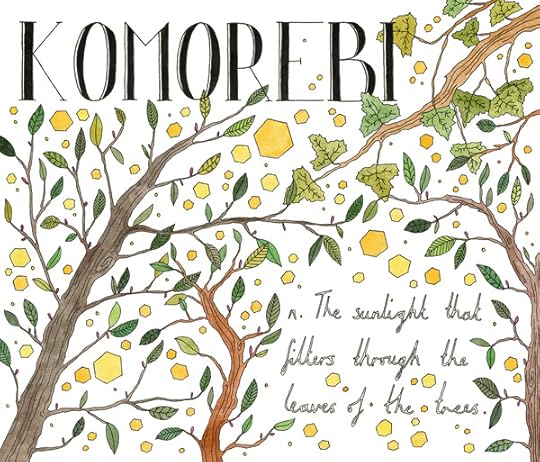
Ya'aburnee
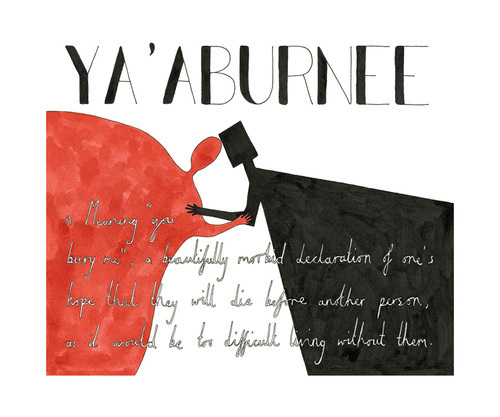
The illustrations are, by far, the strongest aspect of the book. Ella Frances Sanders (who is an illustrator) is much more successful in creating a picture to represent untranslatable words from other languages than she is when writing the little blurbs that come before each illustrated definition. In these blurbs, she tries to make a connection from English-speaking cultures to the concept the words capture, but often fails to communicate the subtleties inherent in the definition; for the most part, I found that her writing lacked a nuanced understanding of connotation and language-- ironic, given that the entire trope of the book is a compendium of words without direct English translations.
The root of the flaw is in the subtitle for Lost in Translation: An Illustrated Compendium of Untranslatable Words from Around the Word. The book is defined from the start as a compendium of words-- a dictionary, essentially--from around the world. And yet it is just over 100 pages and only about fifty words are illustrated. There are lots of infographics circulating the web at the moment which also list untranslatable words from many, many languages, yet the overwhelming majority here come from Japan, Sweden, and a handful of extremely isolated cultures and languages that are all but dead.
Which is not to say that these words aren't interesting or worth illustrating, but that the entire premise of the project-- to illustrate and make visible that which is difficult to translate into English-- doesn't fit the format of such a tiny book. It should have been an illustrated dictionary organized by mother tongue, and it should have been BIG. A coffee table book, at the very least, with multiple illustrators working to draw the sense of each word if Sanders's attention span could only manage fifty or so.
This would have solved the another galling aspect of the book as well--Lost in Translation is, at best, disorganized. The words aren't alphabetical, nor are they grouped by language, or any other controlling schema I could see. It's like flipping through someone's sketchbook, and not at all like finding words in a dictionary. Again: the format is unequal to the project of the book.
One illustration and one definition saved this book from a single-star rating for me:
Komorebi
Ya'aburnee
Displaying 1 - 30 of 722 reviews