A tale of two girls—one living in a parable, the other in Manhattan
Ani, journeying across a great distance accompanied by a stolen kitten, meets many people along her way, but her encounters only convince her that she is meant to keep searching. Annamae, journeying from childhood to young adulthood alongside her mother, older brother, and the denizens of her Manhattan neighborhood, never outgrows her yearning for a friend she cannot describe. From their different worlds, Ani and Annamae reach across the divide, perhaps to discover—or perhaps to create—each other. Told in two mirrored narratives that culminate in a new beginning, To & Fro unleashes the wonders and mysteries of childhood in a profound exploration of identity, spirituality, and community.
Leah Hager Cohen has written four non-fiction books, including Train Go Sorry and Glass, Paper, Beans, and four novels, including House Lights and The Grief of Others.
She serves as the Jenks Chair in Contemporary American Letters at the College of the Holy Cross, and teaches in the Low-Residency MFA Program in Creative Writing at Lesley University. She is a frequent contributor to the New York Times Book Review.
Two beginnings. You can start with “To” or you can start with “Fro.” Either end is a beginning. Two different stories that yet merge in vivid but elliptical ways. It's also beguiling and playful. I started with Fro (it was random). Now that I think of it, I’m speculating that most people will start with “To” because we are familiar with saying, “to and fro” and not “fro and to.” Either/or, To & Fro is a stunning book of narratives.
Annamae, in Fro, remains my best-loved character, this spunky, wily, and writerly young girl. I think she and her linguist mother enhanced or transcended the kabbalistic themes of Cohen’s story. That is, in Jewish culture (secular or not), letters and words aren’t simply letters and words (as we readers and reviewers can relate to, Jewish or not!). They are sacred, even the profane words.
Words have power, a holy meaning within, not just the definition, but Word. They have a life of their own. There’s a theory that the universe was created from the Hebrew alphabet, that letters are equivalent to atoms or molecules. You don't have to know a thing about Judaism to enjoy this book. I am giving this interpretation from my life experiences. However, Cohen penned this for all readers. You may observe other aspects, features, or analysis than I have done here. It's universal, her themes of maturing and evolving. And, in doing so, pondering the ways we reach out to our mirror selves.
Scholarly--or any readers--could make short shrift of my words, in trying to explain Cohen’s. But, since childhood, I have believed that letters and words have a mighty, colossal spiritual force. As I experienced the book, and the importance of words, letters, and books IN this book, I felt that To & Fro was a sort of “tikkun olam” --- Hebrew for repairing the brokenness of the world. There is a lot said about brokenness, as you shall see. “Who can say what’s beyond repair? They scare me, the broken bits, but I am curious about them, too.”
The ellipses of the Talmud---the debates by rabbis about the meaning of the Torah, comes to life here. There is even a rabbi in Cohen’s book, in the Fro story. She asked the right questions!
Annamae’s journal possesses an electric energy. She draws in it, too. What she includes is in the stars, the sky, the earth, the sea---everywhere. In her mind, her heart, her soul. She has a slice of mirror taped to the outside. Such an imaginary child. “One whole section was dedicated to the alphabet, page upon page where she recorded each letter and all its attributes: color, personality, age, hobbies, siblings, favorite food, gender. Some letters were very definitely girl or boy, some contained aspects of both, and some had no gender at all.”
“To” is also kabbalistic. It’s a Fool’s journey. A twelve-year-old girl, Ani, goes on a quest, walks far away and meets new people that live and experience life in ways she hadn’t known before. She was searching for the "Captain," who had cared for her for 5 years, and got off the path for him and onto a new one. She has with her a stolen kitten. Everyone in this book is learning, debating.
In the To side, I sw the overlaps in both stories. Some in words, some phrases, and certainly themes. Ani cannot initially read (this could have been a hundred years ago—Cohen did a superior job of not revealing the year, or referring to it, it could be ancient or contemporary). But she engages with a group that studies and debates the stories of our life. Talmudic meanings.
Cohen writes in clean, simple, but not reductive, prose. Don’t be deceived. Her themes and philosophies center on coming of age; individuals and communities interpreting the world around us; and translating the meaning of life—big themes done with sensitivity and precision. Even the ambiguities are meticulously portrayed. Cohen writes with care, with specificity of character. Her stories about storytelling are masterfully executed.
“I’m a breath held by a larger breath, held on a current of air, drifting around above this house…”
A big thank you to Bellevue for sending me an ARC for review. These are my own thoughts put into words.
“I invent you and you invent me and I invent you and you invent me…”
A book that contains two mirrored narratives and can be begun from “To” or flipped over and start from “Fro”? A gimmick, I thought. No one can pull that off effectively.
Well, silly me. Not only does Leah Hager Cohen execute her concept well, but she also creates a mesmerizing and thought-provoking novel that had me awestruck.
Head you win, tails you win. I began with Fro, which focuses on Annamae – one of the most original characters I’ve had the pleasure of reading. Annamae, a quixotic young girl, discovers early on that no one could really understand anybody and it’s all language’s fault – “people mistook language for solid ground, when really it was just a net.” When her teacher assigns the class a creative writing project, Annamae balks. She has no interest in making characters up if they aren’t going to be alive or possess free agency. To do so would be way too lonely.
This section of the novel is steeped in Talmudic lore – specifically, that the world came to be from the Hebrew alphabet – but you don’t need to be Jewish nor have any knowledge of the Talmud to appreciate what this author is accomplishing. All you need is an appreciation of philosophical discourse and rabbinical debates about life and existence, which are quite accessible and interesting to the reader.
Annamae is holding out for a soul mate who will think and feel exactly like herself. Replication, not relationship. She does not want to be the one making it all up; it has to be real. But what if she is unreal? What if someone is making her up?
Flip the book and turn to “To.” Young Ani is also on a quest. As a girl living in a parable, she travels long distances with a young stolen kitten to overtake “The Captain”, who for the past five years, has served as her way station, a lost and found. Through her journey, she will chance upon other way stations, reassess the stories she has told herself, begin to appreciate the unwritten stories that have yet to be lived, and eventually learn that all stories are intertwined.
This novel’s main theme is searching – how each of us searches for understanding to alleviate the human condition. As Annamae and Ani move toward each other, we reach our own understanding of the relevance of this search in modern times. Quoting Leah Hager Cohen, “I wound up with a book in which two children from impossibly separate worlds – one of them Jewish and one whose story echoes that of the cast-out Ishmael – are driven to reach out toward each other longing to connect with a presence they sense but cannot name.”
What a magnificent book! And how wonderful of Bellevue Literary Press to take a chance on a work so unconventional! I am proud to be an advance reader in exchange for an honest review.
Longlisted for the 2024 Republic of Consciousness Prize, United States and Canada
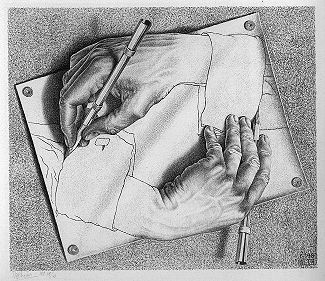
In bed that night, she pasted a new paper staircase into Coco and on it she made a rough sketch of the Escher drawing. She knew she did a terrible job of it (hands were so hard to draw!), but she told herself it didn't matter, because it wasn't about trying to make something beautiful (as Ms. Jules would say); it was about reaching for something. About search. Around the sketch (which wound up looking more like two ocean waves), she wrote in a circle (which took a long time; she had to keep turning the book around and around) these words: I invent you and you invent me and I invent you and you invent me ...
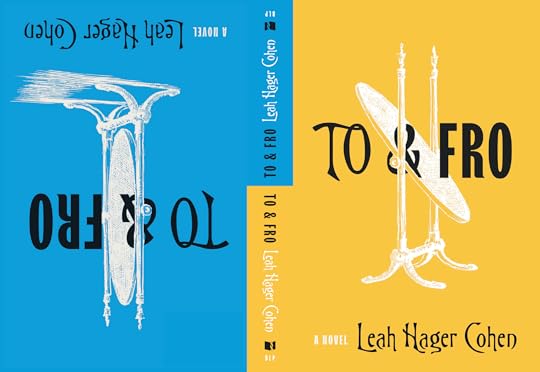
Published by Bellevue Literary Press (see below), To & Fro by Leah Hager Cohen consists of two separate, but mirrored, stories - and the novel is printed such that the read can turn the book over and start from either end - either with To, or with Fro, the stories literally meeting in the middle.
In terms of the specific format, this is similar to Carol Shields' Happenstance: Two Novels in One About a Marriage in Transition, which had the tale, or tales, of a marriage from the perspective of each of a husband and a wife. But stylistically it is much closer to Ali Smith's How to Be Both with its two stories of a connection across the centuries - one, "Eye" narrated by the 15th century painter Francescho (sic), and the other, "Camera", the tale of a 21st Century 16yo girl, George, whose encounters his work. How to be Both used a different approach - issued in two different print runs, half of the book with "Eye" first and half with "Camera" first.
Hager Cohen described Smith in the NY Times, reviewing Artful, as "a wordsmith to the very smithy of her soul, she is at once deeply playful and deeply serious", and the same could be said of this book.
And indeed, the 'Fro' section, set in modern Manhattan, felt in dialogue with Smith's work alongside the Talmud, told from the perspective of Annamae Galinsky, a preternaturally serious young girl, daughter of a linguist and friendly with a rabbi, Rav Harriett. She rejects the comforts of fiction, arguing that making up a story about someone she can control is abhorrent to her:
How could such people not understand that to use her power to put letters together to form words to form stories about imaginary characters who could never think for them-selves, never do anything on their own, never meet her, see her, challenge or surprise her, who had no freedom or power of their own and could never keep her company-how could such people not understand that to invent such figures would hurt? How could such people be surprised that Annamae Galinsky, serious to a fault ever since the crib, took the practice of creation seriously?
Instead she feels there is an absent person, a close friend (someone describes her as like someone lacking an identical twin) who she can sense but not reach.
Kafka's brief parable like story My Destination (often the title is translated as The Departure) is one of many stories told to Annamae by her mother, Rav Harriett and others, alongside those from the Talmud.
My Destination plays a more prominent role in 'To' which begins with a man, The Captain (but more of a messenger than a soldier) leaving his home, and that of many waifs and strays, in response to a bugle no one else can here, and echoing the exact words of the character in Kafka's story. Ani, a girl who has lived with The Captain for many years, after she and her mother were forced out from their home by her father's wife after she had a legitimate child of her own (a deliberate nod here to the story of Hagar and Ishmael), sets off after him.
This is a more fable like story, set in an indeterminant time and place, perhaps not of our world, and Ani undergoes a number of adventures trying to follow The Captain to Tewanfrough, again encountering Talmudic stories (although Ani, in sharp contrast to Annamae is illiterate) and again sensing she has a companion who she can not access:
It was just another leave-taking. What was one more, among so many? First I'd left my father's house, where I had never belonged. Then the cave, where my mother's head lay upon a stone. Then the Captain's, where I'd learned no one's not broken. Then the Other Side, where I'd found milk and honey. Then Something Happened Here, where I'd felt myself accompanied. Then the tunnel, where I'd made— it was true, why not admit it?—a friend. (Or-because that was not quite right-where I'd encountered someone who might have been a friend in another life, another world, another version of the story.) Now it was time to leave the study house, where a whole dear family had embraced me. But I was not done. That was the truth of it. I had farther to go.
Part of the novel's charm is spotting the recurrent echoes and motifs between the stories - most notably when a necklace is lost by Annamae, and then an identical one is given as a gift to Ani. A novel both delightful to read but profound in its joyous wisdom.
Bellevue Literary Press is devoted to publishing literary fiction and nonfiction at the intersection of the arts and sciences because we believe that science and the humanities are natural companions for understanding the human experience. We feature exceptional literature that explores the nature of consciousness, embodiment, and the underpinnings of the social contract. With each book we publish, our goal is to foster a rich, interdisciplinary dialogue that will forge new tools for thinking and engaging with the world.
Kafka's The Destination (Der Aufbruch) [I'm not sure of the translator]
I gave orders for my horse to be brought round from the stables. The servant did not understand me. I myself went to the stable, saddled my horse and mounted. In the distance I heard a bugle call, I asked him what this meant. He knew nothing and had heard nothing. At the gate he stopped me, asking: "Where are you riding to, master?" "I don't know," I said, "only away from here, away from here. Always away from here, only by doing so can I reach my destination." "And so you know your destination?" he asked. "Yes," I answered, "didn't I say so? Away-From-Here, that is my destination." "You have no provisions with you," he said. "I need none," I said, "the journey is so long that I must die of hunger if I don't get anything on the way. No provisions can save me. For it is, fortunately, a truly immense journey."
I threw “To and Fro”, by Leah Hager Cohen up in the air to decide which “side” of the novel to start with. This unique novel can be read from either end; you “flip” it midway. I was game for the gimmick, that proved not to feel gimmicky at all!
I started with the “To” side, which is a parable about a young girl named Ani, who with her mother was cast out by her father at the behest of his wife (think of Abraham and Ishmael).
Ani hastily embarks on a classic bildungsroman journey of spiritual self-discovery. Her exact age is never explicitly given, but I’d guess 10 to 12.
With a Fairy Tale quality of storytelling, we follow Ani (and the kitten that she brings along), as she travels after “The Captain”, a man who has protected and nurtured Ani for the past 5 years. (Enhanced reading experience if you are familiar with Kafka’s oeuvre.)
Ani often narrates glimpses into her past by starting: “In the story the plays in my head…” and on her journey she both confronts and comes to peace with her sad past. She also meets many strangers who help her to survive her unique odyssey - physically and spiritually.
On the “Fro” side of the story we find ourselves in modern day New York City following young Annamae who is being raised with her older brother Danny, by her widowed mother, Jo.
Immediately the reader notices overlapping details with Ani’s narrative. (I’m certain this happens “visa-versa” if you read Annamae’s story first.)
Annamae is lonely. She feels the pull of a presence, a “mirror” of herself, who is somewhere “on the other side”. Of course, it’s Ani.
Annamae has the guidance and counsel of her Rabbi, a woman who helps her form her worldview by asking questions, telling stories, and posing puzzles. I found their conversations to be fascinating!
Ultimately Ani and Annamae’s shared story of loss and searching for deep connection, drew me in and captivated my imagination. While we are told from the beginning there are no endings here, I nevertheless closed the novel feeling satisfied.
Many thanks to Bellevue Literary Press for an Advanced Reader’s Copy of this unique novel.
4.5 stars. To and Fro consists of two narratives that flip in the middle. You can start with either. I started with Fro, which I liked a lot - the young girl Annamae’s idiosyncratic thought processes, her precocious search for life’s meaning, the Manhattan setting, the intelligent sprinkling of linguistics and spiritual stories/lessons. Then I started To, in which the young girl Ani also was searching, but in an indeterminate time and place, more like a fairy tale, with correlations to and hints of Fro. Because I liked Fro more, I skimmed To, mainly looking for the clues to Fro. What would it have been like to read To first? Who knows, but that proves the cleverness of the concept. Not gimmicky, it definitely worked.
4.5 such an incredibly creative novel. It is divided into two halves. You can begin with either To or Fro. The parable of To shares significant and important concrete circumstances/ connections with Fro. It is almost as if Ani and Annamae become one
To & Fro is an apt name for this book, which somewhat meanders to and fro. There is a gimmick - the book is two separate stories and can be read from either end (flip it over for the other story) and the stories intertwine thematically in the middle. I read Fro first, the story of Annamae, a modern-age girl who is frustratingly trying to find someone who understands her. She has a few comfort objects - a journal which she can keep adding pages to and a necklace with a charm that is a tiny bottle with an enclosed message. I particularly liked the distinction that Annamae's story makes between a "question of agenda" and a "question of curiosity". The To story takes place in a past era and the main character, Ani, is also on a journey. Like Annamae, she doesn't quite know what she is seeking. So, both characters meander a bit to and fro. There are images and themes that are included in both stories, which were pleasing to run across. Net: I quite liked this book of curious seekings...
This review initially appeared on my blog BookishlyJewish check it out for Jewish book related content
As you might imagine, given my current role on this website, I read a lot. I also read more widely across genres than I used to, which has been a real gift to my personal growth as a writer. It's engaging and informative, and I wouldn't trade it for the world, but it also means I'm fairly hard to surprise when it comes to what a book can and cannot do. So I was delighted when To & Fro, a literary novel that is actually two separate stories, by Leah Hager Cohen, managed to subvert my expectations at every stage of the reading process.
This novel was mysterious from the get go. It appeared on my radar when someone filled out our Suggest A Book form, but unlike most forms which are filled out by either the author or their publicity and/or marketing teams, this form came from an unidentified fan who had seen early versions of the novel. May we all have critique partners and early readers who are so dedicated to our work. Or rather, may we all write such wonderful stories as to inspire the kind of devotion that has the reader going online and spending the time to fill out forms recommending the story to reviewers.
Then came the physical book itself. When I said earlier that To & Fro comprises two stories, I was not kidding. When I slid the book out of its packaging envelope I saw a lovely blue cover featuring a mirror. Then I flipped it over to read the back cover copy and instead found the exact same cover, only with a yellow background. What was going on? Turns out this is two mirrored narratives each starting from a different end of the book - you literally have to flip it over to read the next one - and they meet in the middle. There was also a little note explaining how the book came to be published, including a description of how Cohen tried to force the narratives to be interlocking in a bid to please traditional publishers, only to find her acceptance with an editor who gently suggested they be printed separately, as she had originally intended.
In one narrative, conveniently labelled "To," we follow a young girl named Ani who is living in circumstances that are obviously fictional. In fact, she is meant to be living inside Kafka's parable "My Destinaition," following the man on the horse who hears the bugles call. Ani's journey is full of what the reader recognizes as unusual kindness from strangers, but Ani's past is so full of unusual cruelty and misplaced guilt it takes her a while to get on the same page as the rest of us. She is not given any particular religion, nor are the people around her, but when she finds herself in a study house full of people debating and arguing an endless story, of which we are all part, the parallels to Judaism are unmistakable. As is the resemblance of Ani's past to a gender flipped biblical story of Ishmael.
By contrast, the other story, "Fro," follows Annamae, who is very obviously Jewish, and rapidly approaching puberty in Manhattan. Annamae is no less lonely or searching than Ani is, but she has both family and a community around her. When Annamae's struggles to express herself and be understood reach a critical level her mother finds that while medical professionals and school counselors are not helpful, a Rabbi is. Rabbi Harriet first met the family upon the occasion of Annamae's father's passing, and is exactly what Annamae needs. Not for spirituality per se, but because Annamae thinks about the world in ways which are most amenable to discussion with a gentle Rabbi who slurps her soup but has the best stories about creation and the Torah.
You can only read a book for the first time once, and by pure chance I started with the "To" narrative. I got a small thrill every time an artifact from "To" suddenly appeared in "Fro" and I found myself linking the stories together, finding how the narratives can be interlocked and interpreted - both separately and together. I was also inspired with so many different ways to write and treat narrative structure in my own work. However, I am deeply curious as to how this book would have felt had I read it the other way round.
That's not something I can experience on my own. And with that realization, my reading of the novel became communal. If I truly want to know what the experience is like starting from "Fro" I am going to have to find someone who read it in that order. (The cover copy is very clear that starting from either side is acceptable and encouraged). Perhaps that person and I will end up discussing the varying points in the two journeys. We might argue what the significance of say, the ferryman's wings, is. Indeed we could spend hours on this, much like the members of the study house Ani encounters. The beauty of this is not lost on me.
To & Fro is at its heart a story about loneliness and seeking. It features two girls, in the most vulnerable part of their lives, who are both seeking similar things, in similar ways, despite their dissimilar background and worlds. You can read almost anything you want into this story, but in doing so you join the narrative. It is a book about loneliness that ultimately forms a community from its readers. And that is a feat I have not seen before. I thoroughly enjoyed being surprised by it and look forward to debating it with other readers -perhaps even some of you!
Note: BookishlyJewish received a free arc of this book after requesting one from the publisher.
TO AND FRO is a luminous, charming, and utterly original novel filled with pleasures and provocations at every turn. Through some strange alchemy, Leah Hager Cohen has combined character-driven storytelling with brilliant philosophical forays into what it feels like to decipher the world, honor its mysteries, and stay open to its many aches and gifts.
Someone on Goodreads asked, "What is the point of this book?" I see that question applied to many a book like this that doesn't follow a straightforward storytelling path. Still, it's a good question to consider. I think the point of this book is to follow along experiencing the journeys both literal and figurative of two versions of the same girl.
Although, not quite the same. There's a point made that each girl has a sensation of the other while catching her reflection. This sensation becomes the motivation for a search for the "other" both varied and the same, within oneself. It's not a plot-driven novel but is compelling. I found myself wondering which section, the "To" or the "Fro" author Leah Hager Cohen wrote first. Or, did they develop organically?
I found the answer in an essay the author wrote. (LitHub. com for essay) The author started out writing the section with Ani and her stolen kitty and had to stop when she suddenly got a block. She picked it up later and started the other section with Annamae. The "Ani" section is written in the first person. The "Annamae" section is written in a close third person. These choices seem to fit but I can't say why.
I enjoyed the section with Ani and her stolen kitty more than the section with Annamae, her brother, and mother living in modern day Manhattan. To me, Ani felt more authentic even though she was living in a slightly mythical world in an undefined century. She was more appealing, more honest, and more independent. Annamae was a very young twelve-year-old which I suppose is honest and authentic. Not every child growing up in Manhattan is sophisticated. The part where Annamae refuses to do an English assignment because even God wouldn't control all movements of a person went on for too long. Her family dynamics, middle school friendships, and her relationship with Nona were absorbing enough to keep me reading.
The part where they join narratives briefly, one girl losing her necklace, the other girl losing the penny that got her to the river and then each girl gets the other item was a little bit twee, yet still it provided a handy conclusion to both stories.
This entire review has been hidden because of spoilers.
Maybe stories don’t make things happen, but maybe through stories we find we are not alone. from To & Fro by Leah Hager Cohen
Ani follows a man off “to and fro,” a journey in which she encounters different groups and new insights. Her first journey took place after she and her mother were exiled from their home in the middle of winter, during which Ani’s mother died.
Ani has a brown book, although she cannot read. A kitten she calls Company that she struggles to keep alive. A scroll in a bottle on a necklace.
Life is walking and arriving and leave-taking, each a place of learning and growth, each a place of gift receiving.
Turn the book around, and there is another story.
The psychologist diagnosed Oppositional defiant disorder. The psychotherapist mentioned executive function disorder. The neuropsychologist proclaimed Annamae had a “stellar brain.”
Annamae thought differently, deeply, and it made her lonely. She knew people could never understand each other, that words failed, language was a net through which words spilled “like pennies through the holes.” She would not do her creative writing assignment and was posed to fail the class. No one saw what she saw, the deadly seriousness of one’s complete control over the characters one created. She saw that letters had colors and personalities, and she recognized the stories that Rav Harriet told about alef-bet and the creation of the world.
She had a brown notebook called Company in which she wrote and drew, but lost it. She had a message in a bottle necklace, but it disappeared.
Fantasy or reality, each story is mesmerizing, taking one into an unforgettable and unique character’s deepest thoughts as she journeys through life. When you are finished reading both, you will want to turn the book again and keep reading, realizing how much more there is to discover.
Thank you to LibraryThing, the author and the publisher.
This is the second book I've read that's flippable and I've come to enjoy them giving me a different perspective of this author's writing even though I've read a few of her books which were totally different in plot.
Doesn't matter if you start with To or Fro since it's two separate stories but I'm assuming the two come together? I decided to start with “To.” Ani seemed to be on her own on a farm run by the “Captain” who really wasn't one, with no one except the people who lived there who came and went. There was no mother but she mentioned her so there must have been previously and I'm wondering how she and/or her mother got there in the first place. It delved into when she and her mother were leaving their father's house who's wife lived there? No idea what that was about.
That said, I had no idea where “To” was going at page 64 and got bored so flipped it to “Fro.” Least this one was in the modern age with laptops, etc. It was about a girl Anamarie and her mother and her brother. She was a inquisitive child. Again, I felt this side of the book was just rambling on even though the chapters were short and I could read them quickly I decided not to finish this book.
This book was going nowhere for me. What a disappointment since I enjoyed her earlier novels that to me were “normal.”
To & Fro is a book of two parallel stories, and either can be the starting point of the book, which is what drew me to it to begin with. Both stories are about “searching” for something - Ani is on an actual journey to find the Captain, and Annamae is on a more philosophical journey to find someone who understands her. Both stories touch on the meaning of stories and how they can make you feel less alone, the importance of debate and different perspectives in making you feel less lonely, and how you need to be lacking something to appreciate the pleasures in the world. There are a lot of references to the Talmud and Kafka here, but not being familiar with them did not detract from the book or the philosophical musings here. It’s a simple book without any major events taking place, but it’s thought-provoking and warm and fuzzy in its own right; meant for a cozy evening tucked into a corner when it’s raining outside.
the Press: Bellevue Literary Press is devoted to publishing literary fiction and nonfiction at the intersection of the arts and sciences because we believe that science and the humanities are natural companions for understanding the human experience. We feature exceptional literature that explores the nature of consciousness, embodiment, and the underpinnings of the social contract. With each book we publish, our goal is to foster a rich, interdisciplinary dialogue that will forge new tools for thinking and engaging with the world.
Our lives often take us in unexpected directions. Even those who firmly believe their path is set can realize that something is missing in their lives, even if they can’t define exactly what that is. Two recent novels – “To and Fro” by Leah Hager Cohen (Bellevue Literary Press) and “California Dreaming” by Noa Silver (She Writes Press) – offer characters searching for meaning in lives that have taken unexpected turns. See the rest of my review at https://www.thereportergroup.org/feat...
Loved this thoughtful, clever book. Read it in paperback to fully appreciate the novelty of reading from one side or the other, and seeing where the stories intertwine in the middle (two beginnings, no end). I read from the Fro side first; hard to say if that was "right," or not? If I had time, I'd read it from the Fro side again now that I've digested To, picking up what I missed. There are big themes here, and little "aha!"s, and everything is so well-crafted. Plus, there's a cat! Highly recommend.
Dang. What an awesome structure-driven book full of echoes and mirrors and connections. This is essentially two different books, and once you get to the “middle”, it’s actually the end of the first book, and you flip the book over and start the other story. It’s not the same story but there are elements—almost Easter eggs?—that I recognized from one half to the other. It technically doesn’t matter which side you start on, but I started on To (Ani’s story) and then read Fro (Annamae’s story). The two stories have journey/coming of age elements, but honestly the structure is the star. Loved it.
pretty good honestly. cohen pulled off the gimmick of this book really well, and i really liked all the parallels between sides. i started with to, and personally i'm glad i did because i liked fro a lot more and i got to end on a high note. i don't think it was anything revolutionary and it didn't have a lot to say, but that was the whole point, that the journey is just as important as where you end. a nice relaxing read, and good if you are a fellow enjoyer of unconventional novel structures.
i *loved* this. this is the literary equivalent of the escher hands drawing. i’ve never read anything like it.
i think i messed up the instructions tho because i read both parts concurrently, like i read a chunk of to and then the same size chunk of fro and so on. however i’m so glad i did it because it made the incredible mirrored details so much more apparent as both stories were unfolding. this was really incredible writing. i loved it.
While I enjoyed each of these stories, and even though the author tells the reader in advance: “Two worlds of one (f0r true searches blend) Herein two beginning with nary an end”, I had hoped for some clue as to why the incidents in each story reflect in the other.
I would have loved some inkling of how those unique events in each carried over to the other.
interesting concept (flippable books are fun!) but the story of “to” lost me & “fro” got a little too religious for my tastes (on me for not realizing it would be about spirituality!). this definitely felt more like YA than adult fiction, and i wish the stories connected slightly more besides just references to each other throughout.
Both young protagonists were wonderfully well written in this. You felt their angst and struggles without being exhausted or annoyed by them as with lesser-drawn child characters.
I really enjoyed how the two alternative narratives came together in the end(middle).
Plusses aside, I did not love this one with the same fervent as Strangers & Cousins, as much as I really did want to.
really odd, but interesting concept. i liked both girls and their separate but similar points of view. i think company (the kitten) was the best character, other than rav harriet. i appreciated how the penny and message in bottle necklace connected To and Fro at the end. definitely not my favorite, but kinda cool
One of the most unusual books I’ve ever read—and the only one I’ve ever read from the outside in. The way that small details float through both stories in parallel is masterfully done. Fascinating and mysterious.
ended up finding this book so interesting and fun to read- it was very unique which i loved. definitely very crucial how you choose to read it though (i feel)
“no provisions can save me. for it is, fortunately, a truly immense journey.” <3
Lovely telling of a child’s yearning to feel a full and honest connection with someone. The story is framed by loving communities, families, searches for spirituality and filled with a startling innocence and clarity that only youth can bring. The structure of the book took my breath away.