

What do you think?

La salita verso casa
Kaoru si ferma ai piedi della salita. La casa in cui è cresciuto sembra molto più piccola di quanto ricordasse. Ma quando Sakura gli corre incontro scodinzolando, il senso di smarrimento svanisce. Kaoru è a casa. Ed è arrivato il momento di affrontare la sua famiglia. Una volta, gli Hasegawa erano la famiglia perfetta. Papà e mamma erano sorridenti e pieni di amore. La sorella minore, Miki, era la ragazzina più coraggiosa che si fosse mai vista. Suo fratello, Hajime, sempre il primo in ogni cosa, irradiava il mondo di una bellezza rara. Di Kaoru non si può dire lo stesso. Non spiccava in niente di a scuola era bravo ma non il più bravo; alle ragazze piaceva ma mai davvero troppo. I suoi fratelli, invece, brillavano come le stelle più luminose del cielo. E a Kaoru non dispiaceva affatto di scaldarsi alla loro luce riflessa. Ma anche le famiglie più meravigliose possono andare in pezzi. La memoria del passato può disperdersi, indurirsi, cancellarsi. Per Kaoru è arrivato il momento di farsi avanti e di aiutare la famiglia a ritrovare la strada verso casa. Lui, che non è mai stato il più forte di tutti, adesso deve essere forte per tutti. Ma ha un’alleata la cagnolina Sakura. È lei che mostra che solo le salite possono diventare delle discese. Perché i luoghi e i ricordi hanno questo in sembrano sempre diversi quando vi si fa ritorno dopo tanto tempo.
Con le sue atmosfere nostalgiche, La salita verso casa è diventato un caso editoriale incredibile. Ha venduto mezzo milione di copie e in patria ne sono stati tratti un film e un manga. Kanako Nishi è stata segnalata da «Granta» come una promessa della letteratura mondiale e, con le sue opere, ha vinto i più importanti premi letterari giapponesi. Un romanzo in via di pubblicazione in tutto il mondo su un ritorno a casa e sul significato della parola famiglia. Un libro sui ricordi d’infanzia. Ma soprattutto un libro in cui ritrovare la magia delle prime volte.
Con le sue atmosfere nostalgiche, La salita verso casa è diventato un caso editoriale incredibile. Ha venduto mezzo milione di copie e in patria ne sono stati tratti un film e un manga. Kanako Nishi è stata segnalata da «Granta» come una promessa della letteratura mondiale e, con le sue opere, ha vinto i più importanti premi letterari giapponesi. Un romanzo in via di pubblicazione in tutto il mondo su un ritorno a casa e sul significato della parola famiglia. Un libro sui ricordi d’infanzia. Ma soprattutto un libro in cui ritrovare la magia delle prime volte.
235 pages, Kindle Edition
First published February 1, 2005
About the author
Kanako Nishi
53 books97 followersBorn in Tehran in 1977 and raised in Osaka Prefecture.
After graduating with a law degree from Kansai University, Nishi made her debut as a novelist with Aoi in 2004. Her sophomore novel Sakura became a best-seller next year. She is also known for her novels Tsutenkaku, Kofuku Midori no and Entaku.
After graduating with a law degree from Kansai University, Nishi made her debut as a novelist with Aoi in 2004. Her sophomore novel Sakura became a best-seller next year. She is also known for her novels Tsutenkaku, Kofuku Midori no and Entaku.
Ratings & Reviews
Friends & Following
Create a free account to discover what your friends think of this book!
Community Reviews
Displaying 1 - 30 of 226 reviews

June 6, 2026
3.5 ⭐
At its heart, this is a story about family, love, loss, and the bonds that remain through life's ups and downs.
What I liked most is how real the family feels. 😍
The characters are imperfect, make mistakes, and struggle to express their feelings, yet their love for one another never disappears.
Sakura, the family dog, is more than just a pet. She quietly connects with the family and becomes a symbol of loyalty and comfort.
A touching and bittersweet novel that reminds us that family relationships may be complicated, but they are often stronger than we realize.
Not because it is dramatic or full of twists, but because it captures the messy, imperfect nature of family life with warmth and honesty. 😶
At its heart, this is a story about family, love, loss, and the bonds that remain through life's ups and downs.
What I liked most is how real the family feels. 😍
The characters are imperfect, make mistakes, and struggle to express their feelings, yet their love for one another never disappears.
Sakura, the family dog, is more than just a pet. She quietly connects with the family and becomes a symbol of loyalty and comfort.
A touching and bittersweet novel that reminds us that family relationships may be complicated, but they are often stronger than we realize.
Not because it is dramatic or full of twists, but because it captures the messy, imperfect nature of family life with warmth and honesty. 😶

June 5, 2026
I am such a sucker for a good doggie story. While this was mostly a domestic drama, it had a really great doggie in it that added so much enjoyment to the story. As the book summary states, the family was a loving and doting one that basked in the happy lives of it’s members and the wonderful times they had as a family and amazing memories they were making as a family, including Sakura, the family dog. Sakura was adopted as a puppy, and she absolutely adored the time, attention and love that every member of the family bestowed on her.
Unfortunately, tragedy strikes the family, and a dark secret is revealed, and nothing is ever the same again. The family splinters with the father leaving for three years because he couldn’t bear to be there anymore, the mother drowning her sorrow and grief in food and alcohol and Kaoru leaving home. However, it’s Sakura who eventually becomes the catalyst, in a wild and crazy road trip to the vet, that helps the family begin to see the good in life again.
I thoroughly enjoyed this story! The character development of the family members was very well done. The pacing was pretty steady throughout the story; I read it in two sittings. The storyline was sweet and entertaining, and the writing well done. I’m looking at an overall rating of 4.4 that I will be rounding down to a 4star review.
Unfortunately, tragedy strikes the family, and a dark secret is revealed, and nothing is ever the same again. The family splinters with the father leaving for three years because he couldn’t bear to be there anymore, the mother drowning her sorrow and grief in food and alcohol and Kaoru leaving home. However, it’s Sakura who eventually becomes the catalyst, in a wild and crazy road trip to the vet, that helps the family begin to see the good in life again.
I thoroughly enjoyed this story! The character development of the family members was very well done. The pacing was pretty steady throughout the story; I read it in two sittings. The storyline was sweet and entertaining, and the writing well done. I’m looking at an overall rating of 4.4 that I will be rounding down to a 4star review.

June 28, 2024
Este libro me ha dejado un tanto tocada. Cuando lo compré me esperaba algo mas cozy y lo que he encontrado entre sus páginas me ha afectado más de lo que creía. La principal sensación que he tenido durante toda la lectura ha sido la de incomodidad: La voz narrativa del protagonista y la manera de describir a las personas (físicamente sobre todo) y los acontecimientos que transcurren, llegan al punto de ser desagradables de leer, y aunque quieres continuar con la lectura porque engancha, desearías que se hubiese formulado de otra manera.
La novela empieza en el presente, cuando Kaoru, el protagonista, vuelve a casa y nos transporta al pasado narrando todas las vivencias de él y su familia hasta llegar al punto en el que están ahora. Lo que en un principio era una familia feliz, se ha roto y no sabemos por qué. Poco a poco, desde la infancia hasta el presente, Kaoru nos narra con cuenta gotas lo que ha pasado con la familia Hasegawa. La sensación de nostalgia que transmite la autora en estos relatos del pasado del protagonista es brutal, y se te instala una angustia en el pecho que no te puedes sacudir porque incluso los recuerdos felices están manchados con el dolor del presente.
Los personajes no son agradables. Los pensamientos de Kaoru como narrador me parecían desagradables en muchas ocasiones, y a veces la dinámica familiar me resultaba un tanto repulsiva. Tanto el protagonista, como el hermano mayor y los padres no me han caído bien, y Miki, la hermana, que en un principio me parecía irritante, hacia el final del libro llega a un punto en el que su comportamiento llegó a perturbarme muchísimo. La única que se salva de la familia es Sakura, la perrita, que es el rayo de luz y la alegría de la familia.
Se tratan temas complejos y en ocasiones muy duros, como la sexualidad, el duelo, la salud mental y el suicidio, y no desde una perspectiva educativa. No es algo a tratar, solucionar y ni siquiera entender. Simplemente están allí y puede que como lector no te guste lo que ves, pero es una realidad que tampoco podemos ignorar (no todo el mundo aboga por la salud mental, ni tiene los conocimientos y herramientas para tratar estos temas bien, como es el caso de los personajes de esta novela).
Parecerá por lo que estoy contando que no me ha gustado, pero la realidad es que me ha hecho sentir tantas emociones que no puedo decir tal cosa. Puedo afirmar que la novela me ha cautivado, a pesar de remover tantas emociones negativas en mi interior (y otras tantas positivas, porque el final te deja un sabor de esperanza). Lo recomiendo, pero no a todo el mundo y tampoco si en estos momentos de tu vida te afectan las cosas demasiado.
La novela empieza en el presente, cuando Kaoru, el protagonista, vuelve a casa y nos transporta al pasado narrando todas las vivencias de él y su familia hasta llegar al punto en el que están ahora. Lo que en un principio era una familia feliz, se ha roto y no sabemos por qué. Poco a poco, desde la infancia hasta el presente, Kaoru nos narra con cuenta gotas lo que ha pasado con la familia Hasegawa. La sensación de nostalgia que transmite la autora en estos relatos del pasado del protagonista es brutal, y se te instala una angustia en el pecho que no te puedes sacudir porque incluso los recuerdos felices están manchados con el dolor del presente.
Los personajes no son agradables. Los pensamientos de Kaoru como narrador me parecían desagradables en muchas ocasiones, y a veces la dinámica familiar me resultaba un tanto repulsiva. Tanto el protagonista, como el hermano mayor y los padres no me han caído bien, y Miki, la hermana, que en un principio me parecía irritante, hacia el final del libro llega a un punto en el que su comportamiento llegó a perturbarme muchísimo. La única que se salva de la familia es Sakura, la perrita, que es el rayo de luz y la alegría de la familia.
Se tratan temas complejos y en ocasiones muy duros, como la sexualidad, el duelo, la salud mental y el suicidio, y no desde una perspectiva educativa. No es algo a tratar, solucionar y ni siquiera entender. Simplemente están allí y puede que como lector no te guste lo que ves, pero es una realidad que tampoco podemos ignorar (no todo el mundo aboga por la salud mental, ni tiene los conocimientos y herramientas para tratar estos temas bien, como es el caso de los personajes de esta novela).
Parecerá por lo que estoy contando que no me ha gustado, pero la realidad es que me ha hecho sentir tantas emociones que no puedo decir tal cosa. Puedo afirmar que la novela me ha cautivado, a pesar de remover tantas emociones negativas en mi interior (y otras tantas positivas, porque el final te deja un sabor de esperanza). Lo recomiendo, pero no a todo el mundo y tampoco si en estos momentos de tu vida te afectan las cosas demasiado.

April 16, 2026
3.5 Stars
This was a melancholy coming of age narrative about a young man from Japan. I thought it would be more centric around the dog but it's really a story about the people. I didn’t connect with the narrative as much as I hoped but I suspect young men who have had an similar experiences with relationships and grief will connect on a much deeper level.
Disclaimer I received a copy of this book from the publisher.
This was a melancholy coming of age narrative about a young man from Japan. I thought it would be more centric around the dog but it's really a story about the people. I didn’t connect with the narrative as much as I hoped but I suspect young men who have had an similar experiences with relationships and grief will connect on a much deeper level.
Disclaimer I received a copy of this book from the publisher.

May 21, 2026
I’m sitting here trying to rationalize why Sakura hit me this hard when it’s really “just” a super dysfunctional family and their scruffy Shiba Inu mutt stumbling through life together. This book was a fun little kick in the stomach. 😅
Bonus points for casual East Asian fat phobia, undiagnosed mental illness, jelly bean-filled gyoza and mercifully letting Sakura off the hook with only a bad case of grass-fueled doggy diarrhea instead of giving her the old Marley & Me.
Bonus points for casual East Asian fat phobia, undiagnosed mental illness, jelly bean-filled gyoza and mercifully letting Sakura off the hook with only a bad case of grass-fueled doggy diarrhea instead of giving her the old Marley & Me.

June 16, 2026
Sakura has been bearing the weight of the entire family's memories. Day after day, she wags her tail madly, yawns deeply, and peers at us through the window with concern. She pees bashfully, then grunts with satisfaction and wanders around, her black spots swaying. All these gestures symbolize our happiness.

August 13, 2026
I thought this story was going to be more about the dog, Sakura pictured on the cover but it was more about the experiences of her family and their lives from childhood to adulthood. Some of the descriptions of the characters were a little inappropriate to me (fat shaming) however, I did consider that maybe it was a cultural difference not being communicated well in translation. Overall, this was just an okay read for me.
**Thank you to NetGalley and the publisher for the opportunity to listen to this advance copy in exchange for my honest review.
**Thank you to NetGalley and the publisher for the opportunity to listen to this advance copy in exchange for my honest review.

March 1, 2026
2015 yılında, ‘Elveda’ başlıklı romanı ile edebi değer de taşıyan popüler romanlara verilen Naoki Edebiyat Ödülü’nü alan yazarın bu eseri 2005 yılında yayınlanmış ve 500.000 baskıdan fazla satılmış.
Çok sade bir dille yazılmış, akıcı bir metin. Modern dönem bir Japon ailesinin 20-25 yıllık bir dönemde karşı karşıya kaldıkları kırılma noktalarında yaşadıkları travmalar ve aile hayatının güvenli ortamının önemi ve nasıl çözümün en önemli anahtarı olduğu çok dokunaklı bir metinle romanlaştırılmış. Aile bireyleri ne kadar birbirlerine yabancılaşmış, birbirlerinden uzaklaşmış gibi görünseler de, eğer sıcak bir aile ortamında büyümüşlerse, bir gün yeniden aynı sıcak duygularla bir araya geleceklerdir.
Her ne kadar kitabın alt başlığında; ‘Aile Var Olan En Güzel Kusurdu’ denilse de, aile kurumunu yücelten bir roman olduğunu
Çok sade bir dille yazılmış, akıcı bir metin. Modern dönem bir Japon ailesinin 20-25 yıllık bir dönemde karşı karşıya kaldıkları kırılma noktalarında yaşadıkları travmalar ve aile hayatının güvenli ortamının önemi ve nasıl çözümün en önemli anahtarı olduğu çok dokunaklı bir metinle romanlaştırılmış. Aile bireyleri ne kadar birbirlerine yabancılaşmış, birbirlerinden uzaklaşmış gibi görünseler de, eğer sıcak bir aile ortamında büyümüşlerse, bir gün yeniden aynı sıcak duygularla bir araya geleceklerdir.
Her ne kadar kitabın alt başlığında; ‘Aile Var Olan En Güzel Kusurdu’ denilse de, aile kurumunu yücelten bir roman olduğunu

February 3, 2025
Quiero comenzar escribiendo que no me gustó en absoluto, no es el tipo de libro que me encante, sobre todo porque no estoy muy familiarizada con el género y me encontré con un libro más contemplativo, crudo y psicológico.
Fue maravilloso, lo mucho que no me gustó, “El arte impacta cuando nos incomoda o nos desafía”.
La narrativa de Kanako no busca generar emociones obvias desde mi perspectiva, sino una especie de impacto silencioso. No es un libro que en lo personal me haga llorar inmediatamente ni que me envuelva en una historia, o lo sienta emocionante, de hecho me dejo con una sensación rara, difícil de definir.
Es una novela que toca temas profundos sobre la identidad, la pérdida y la búsqueda del hogar en un sentido más amplio. Incluso, 100% sentí que no termine de leerlo completamente (aunque lo haya terminado físicamente), mi mente sabe que la historia tiene un significado más profundo que aún no he procesado del todo.
Me siento con un tipo de doble incomodidad con la descripción por ejemplo del físico de la madre de parte de karou, que horrible se expresa, pero lo entiendo y creo que es válida.
Nishi usa una narración cruda y sin filtros para hablar del cuerpo y la alimentación, lo cual puede parecer insensible o exagerado. Sin embargo, al final entiendo que hay un simbolismo en cómo la madre procesa el duelo a través de la comida y el alcohol, como si estuviera intentando llenar un vacío imposible de saciar. Su gordura no es solo un detalle físico, sino una forma de mostrar cómo el dolor y la pérdida pueden manifestarse físicamente, y Nishi no tiene reparo en hacer de esto una narración realista como la vida misma.
La parte de las bragas de la niña por ejemplo, me hacía sentir no sé cómo definir, como si se vislumbrara de un punto morboso, pero en realidad entiendo que está relacionado con el descubrimiento de la sexualidad y la confusión emocional de cada uno en la historia. Nishi se atreve a narrar cosas que pueden resultar perturbadoras, incómodas o tabú, pero que en realidad existen en la mente de las personas, aunque no siempre sean políticamente correctas. Me gusta que no intenta "suavizar" los pensamientos de los personajes, sino que los muestra en su forma más cruda y real. Expone muchas de nuestras contradicciones humanas, cómo las personas lidian con el duelo, el deseo, la culpa y la obsesión de formas que pueden parecer moralmente cuestionables. No busca justificar ni condenar, sino mostrar la complejidad de la mente, incluso cuando roza en lo inquietante.
Por momento la lectura se sintió tediosa y parecía que no avanza mucho, no íbamos a ningún lado en la historia. Sin duda no es un libro para todos, pero dentro de su género es una obra sólida que cumple con su propósito de mostrar la crudeza del duelo y la obsesión.
Me quedaré meditando un buen tiempo el verdadero significado de “El camino de regreso a casa”.
Fue maravilloso, lo mucho que no me gustó, “El arte impacta cuando nos incomoda o nos desafía”.
La narrativa de Kanako no busca generar emociones obvias desde mi perspectiva, sino una especie de impacto silencioso. No es un libro que en lo personal me haga llorar inmediatamente ni que me envuelva en una historia, o lo sienta emocionante, de hecho me dejo con una sensación rara, difícil de definir.
Es una novela que toca temas profundos sobre la identidad, la pérdida y la búsqueda del hogar en un sentido más amplio. Incluso, 100% sentí que no termine de leerlo completamente (aunque lo haya terminado físicamente), mi mente sabe que la historia tiene un significado más profundo que aún no he procesado del todo.
Me siento con un tipo de doble incomodidad con la descripción por ejemplo del físico de la madre de parte de karou, que horrible se expresa, pero lo entiendo y creo que es válida.
Nishi usa una narración cruda y sin filtros para hablar del cuerpo y la alimentación, lo cual puede parecer insensible o exagerado. Sin embargo, al final entiendo que hay un simbolismo en cómo la madre procesa el duelo a través de la comida y el alcohol, como si estuviera intentando llenar un vacío imposible de saciar. Su gordura no es solo un detalle físico, sino una forma de mostrar cómo el dolor y la pérdida pueden manifestarse físicamente, y Nishi no tiene reparo en hacer de esto una narración realista como la vida misma.
La parte de las bragas de la niña por ejemplo, me hacía sentir no sé cómo definir, como si se vislumbrara de un punto morboso, pero en realidad entiendo que está relacionado con el descubrimiento de la sexualidad y la confusión emocional de cada uno en la historia. Nishi se atreve a narrar cosas que pueden resultar perturbadoras, incómodas o tabú, pero que en realidad existen en la mente de las personas, aunque no siempre sean políticamente correctas. Me gusta que no intenta "suavizar" los pensamientos de los personajes, sino que los muestra en su forma más cruda y real. Expone muchas de nuestras contradicciones humanas, cómo las personas lidian con el duelo, el deseo, la culpa y la obsesión de formas que pueden parecer moralmente cuestionables. No busca justificar ni condenar, sino mostrar la complejidad de la mente, incluso cuando roza en lo inquietante.
Por momento la lectura se sintió tediosa y parecía que no avanza mucho, no íbamos a ningún lado en la historia. Sin duda no es un libro para todos, pero dentro de su género es una obra sólida que cumple con su propósito de mostrar la crudeza del duelo y la obsesión.
Me quedaré meditando un buen tiempo el verdadero significado de “El camino de regreso a casa”.

August 16, 2023
Avete presente quando si leggono dei libri aspettandosi determinate cose e invece succede che si trova tutt’altro?
Ecco, mi è appena successo con La Salita Verso Casa.
Kaoru ritorna a casa dopo un lungo periodo di assenza. Ed è lungo la salita che inizia a ricordare la sua infanzia, il periodo passato insieme ai fratelli, alla sua famiglia, e al cane Sakura, che è rimasto con loro per parecchi anni.
Ed è in quel momento che ricorda come quella famiglia perfetta, piena e colma di amore, esplode sotto degli eventi inenarrabili.
La Salita verso casa è capace di far riaffiorare la propria infanzia. Di farci sentire di nuovo piccoli e curiosi verso il mondo. Di farci sentire la gioia che si prova quando arriva il proprio fratello in famiglia. Di ricordarci l’arrivo del nostro compagno peloso.
E poi, il dolore inenarrabile quando ci si trova di fronte alla perdita.
È letteralmente un libro in salita, fatto di palle curve che a volte proprio non riusciamo a battere.
Ma non significa che dovremmo smettere di provarci. No?
Ecco, mi è appena successo con La Salita Verso Casa.
Kaoru ritorna a casa dopo un lungo periodo di assenza. Ed è lungo la salita che inizia a ricordare la sua infanzia, il periodo passato insieme ai fratelli, alla sua famiglia, e al cane Sakura, che è rimasto con loro per parecchi anni.
Ed è in quel momento che ricorda come quella famiglia perfetta, piena e colma di amore, esplode sotto degli eventi inenarrabili.
La Salita verso casa è capace di far riaffiorare la propria infanzia. Di farci sentire di nuovo piccoli e curiosi verso il mondo. Di farci sentire la gioia che si prova quando arriva il proprio fratello in famiglia. Di ricordarci l’arrivo del nostro compagno peloso.
E poi, il dolore inenarrabile quando ci si trova di fronte alla perdita.
È letteralmente un libro in salita, fatto di palle curve che a volte proprio non riusciamo a battere.
Ma non significa che dovremmo smettere di provarci. No?

August 3, 2026
“Everything in the world belongs to someone, yet everything in the world belongs to no one.”
If you come in this book expecting a story that is told from the perspective of a dog, I suggest to re-adjust your expectations, because going in this book, I genuinely thought it was a story that revolves ONLY around the dog / somewhat the perspective of the dog, but in a way, the story has a double entendre to the story and its the intention of the author - as the more I sit and think about how this book made me felt, the more I felt that Kanako Nishi is such a great storyteller. So yes, please readjust your expectations, and I felt that it will elevate your reading experience more.
Sakura or さくら in Japanese is translated for the flowers - cherry blossoms. And Kanako Nishi, for me, wrote splendidly about the the dynamics of families especially in Asian households. Asian households in particular are mostly (not all but most) known for their lack of expression in their love. These dynamics are explored in this book, and told from the perspective of Kaoru, the second child out of three siblings and how how their family survived a grief that had changed their families dynamics forever. And in the centre of it all is Sakura, their eccentric dog, in which became somewhat of the glue for the whole family.
In some ways, written through the story of them growing up, their connections as siblings, their family and the exploration of themselves as they grow up, felt almost nostalgic and it teared up so, so much. As someone who comes from a big family with so many siblings of my own, the fights, the shared secrets, the things that we took for granted because we felt that our siblings would always be there throughout our lives - this book was almost like a wake up call. Because, in one split second, everything can be changed and the family that we thought we once knew can turn to a whole new person.
Kanako Nishi portrayed grief in ways that showed subtly - not through the anger, but the small changes that affected every single person once a catastrophe hits any of your family members. Because, at the end of the day, love - even tho not said out loud - is shown through the actions that we do. The small acts of love and gestures that accumulates to become something whole. And Sakura, became the glue to the small changes to the family. In which an animal can hold and contain so much more emotions than we give them credit for.
Writing this through makes me teary all over again. The ending got me staring at the book for a few minutes and crying my heart out. For when I rethink about the story, the core of it all is the love that we have with our families are so fragile sometimes. It might be robbed due to time or just the process of growing up. But at the end, cherishing the small moments that we have, will create a greater bond for a family.
And with that rambling going on, I upped this book to 3.75 🌟 I wished the pacing was a bit better (maybe its due to the translation process) but overall, this book had left a dent in my heart and honestly, I will remember it for a very long time.
Recommended!
Thank you to Times Reads for this copy. I truly appreciate it.

January 17, 2024
Il libro è davvero buono e questo va sottolineato a fronte della quantità di titoli giapponesi discutibili che negli ultimi anni hanno invaso le librerie italiane, probabilmente spinti solo da quanto in alto arrivano nelle classifiche giapponesi.
Anche questo in patria ha venduto tanto, ma non è affatto un libro frivolo o da dimenticare il giorno dopo averlo letto. È la storia agrodolce di una famiglia giapponese dei decennî scorsi e della crescita dei suoi figli, con tutta la sua normalità e le sue particolarità, le sue tragedie grandi e piccole e qua e là momenti tra il comico e il grottesco.
Il libro non è certo un capolavoro ma resta una bella sorpresa che si colloca numerose spanne al di sopra di altri titoli nipponici che da noi hanno avuto sin troppo successo. C'è un gran bisogno in Italia di letteratura giapponese che sia anche di qualità, quindi non posso che auspicare che arrivi altro da noi di questa autrice.
Invece non si può dir bene dell'editore, Garzanti, che dopo aver fatto tradurre, negli ultimi anni, alcuni libri giapponesi passandoli dall'edizione inglese, ora ha affidato questo a una traduttrice dal giapponese che (forse perché alle prime armi?) ha optato per un'eccessiva aderenza alla lettera dell'originale. Leggendo il libro chi conosce la lingua può capire all'istante com'erano in giapponese molte frasi o espressioni, e questo non è mai un buon segno. Ma ci sono anche alcune scelte che rischiano persino di rendere difficoltosa al lettore italiano la comprensione di quel che si sta dicendo.
Faccio tre esempî:
- A un certo punto i protagonisti, ancora ragazzi, nel testo italiano nominano i "TV Game". È un evidente calco del giapponese "terebi gēmu" (テレビゲーム), che indica semplicemente i videogiochi delle console. Ma rendendo il termine con "TV game" questo il lettore italiano non può capirlo.
- Il protagonista, parlando dei club della scuola che frequenta, afferma di far parte del "club del 'torno a casa'". Altro calco del termine giapponese "kitakubu" (帰宅部). La traduzione sarebbe sì corretta, ma l'espressione indica gli studenti che non fanno parte di alcun club scolastico e per questo finite le lezioni vanno direttamente a casa. Il termine giapponese è estremamente corrente, quindi perché renderlo con un modo di dire che in italiano suona così particolare e soprattutto poco trasparente?
- A un certo punto si parla di scrittori in erba, e il testo italiano li definisce "un 'uovo' di scrittori". Certo, in giapponese i principianti si definiscono così, ma la traduzione italiana opta per l'ennesimo calco dal giapponese troppo particolare rispetto all'origine e sempre poco trasparente.
Garzanti, si può far di meglio!
Anche questo in patria ha venduto tanto, ma non è affatto un libro frivolo o da dimenticare il giorno dopo averlo letto. È la storia agrodolce di una famiglia giapponese dei decennî scorsi e della crescita dei suoi figli, con tutta la sua normalità e le sue particolarità, le sue tragedie grandi e piccole e qua e là momenti tra il comico e il grottesco.
Il libro non è certo un capolavoro ma resta una bella sorpresa che si colloca numerose spanne al di sopra di altri titoli nipponici che da noi hanno avuto sin troppo successo. C'è un gran bisogno in Italia di letteratura giapponese che sia anche di qualità, quindi non posso che auspicare che arrivi altro da noi di questa autrice.
Invece non si può dir bene dell'editore, Garzanti, che dopo aver fatto tradurre, negli ultimi anni, alcuni libri giapponesi passandoli dall'edizione inglese, ora ha affidato questo a una traduttrice dal giapponese che (forse perché alle prime armi?) ha optato per un'eccessiva aderenza alla lettera dell'originale. Leggendo il libro chi conosce la lingua può capire all'istante com'erano in giapponese molte frasi o espressioni, e questo non è mai un buon segno. Ma ci sono anche alcune scelte che rischiano persino di rendere difficoltosa al lettore italiano la comprensione di quel che si sta dicendo.
Faccio tre esempî:
- A un certo punto i protagonisti, ancora ragazzi, nel testo italiano nominano i "TV Game". È un evidente calco del giapponese "terebi gēmu" (テレビゲーム), che indica semplicemente i videogiochi delle console. Ma rendendo il termine con "TV game" questo il lettore italiano non può capirlo.
- Il protagonista, parlando dei club della scuola che frequenta, afferma di far parte del "club del 'torno a casa'". Altro calco del termine giapponese "kitakubu" (帰宅部). La traduzione sarebbe sì corretta, ma l'espressione indica gli studenti che non fanno parte di alcun club scolastico e per questo finite le lezioni vanno direttamente a casa. Il termine giapponese è estremamente corrente, quindi perché renderlo con un modo di dire che in italiano suona così particolare e soprattutto poco trasparente?
- A un certo punto si parla di scrittori in erba, e il testo italiano li definisce "un 'uovo' di scrittori". Certo, in giapponese i principianti si definiscono così, ma la traduzione italiana opta per l'ennesimo calco dal giapponese troppo particolare rispetto all'origine e sempre poco trasparente.
Garzanti, si può far di meglio!

February 24, 2026
I received this as an ALC on NetGalley.
*****
This… was… so weird?
I questioned a lot of the narrative choices. Specifically the weird focus on the MC’s mom’s body parts and how she gained weight, his parents’ sex life, his sister’s panties, the pervert vet, and the parade of mentally ill people he was scared of as a kid…
I had a hard time believing this was written by a woman TBH.
Like, when I got to the end, most of the family stuff ended up making sense in the context of the emotional growth and mental maturation everyone goes through, but the vet thing and the bullying of a mentally ill homeless man by elementary school kids were never really discussed in any constructive context IMO and felt like they were there for shock value.
That all being said: I ended up feeling mostly satisfied by the ending? I cried at multiple points and sat there open mouthed in shock at many others. The relationships between the family members and their personal journeys through grief felt relatable and realistic to me. The dog honestly could have contributed to more of the plot, given she is the titular character, but the thread of her existence was at least relevant and emotionally significant to the overall storyline.
It is particularly unique in its positive inclusion of transgender characters and discussions on homosexuality for a Japanese novel, I think.
If you’re looking for a weird slice of life that gets into kind of nitty gritty, private details of growing up and dealing with grief, this would be the story for you. If you can’t suspend disbelief on what bizarre things families will discuss with each other, maybe not… or maybe my family is made up of prudes, haha.
*****
This… was… so weird?
I questioned a lot of the narrative choices. Specifically the weird focus on the MC’s mom’s body parts and how she gained weight, his parents’ sex life, his sister’s panties, the pervert vet, and the parade of mentally ill people he was scared of as a kid…
I had a hard time believing this was written by a woman TBH.
Like, when I got to the end, most of the family stuff ended up making sense in the context of the emotional growth and mental maturation everyone goes through, but the vet thing and the bullying of a mentally ill homeless man by elementary school kids were never really discussed in any constructive context IMO and felt like they were there for shock value.
That all being said: I ended up feeling mostly satisfied by the ending? I cried at multiple points and sat there open mouthed in shock at many others. The relationships between the family members and their personal journeys through grief felt relatable and realistic to me. The dog honestly could have contributed to more of the plot, given she is the titular character, but the thread of her existence was at least relevant and emotionally significant to the overall storyline.
It is particularly unique in its positive inclusion of transgender characters and discussions on homosexuality for a Japanese novel, I think.
If you’re looking for a weird slice of life that gets into kind of nitty gritty, private details of growing up and dealing with grief, this would be the story for you. If you can’t suspend disbelief on what bizarre things families will discuss with each other, maybe not… or maybe my family is made up of prudes, haha.

March 4, 2026
Told from Kaoru, the middle child’s, perspective at 22 years old, as though this were his autobiographical story, Kaoru brings us back in time to follow the Hasegawa family’s transition to a working-class part of Osaka. In this coming-of-age tale, Kaoru navigates following the lead of his talented, charismatic, and attractive older brother, Hajime, and caring for his bold and inquisitive younger sister, Miki. With the addition of two loving parents, who provide for and take time to teach their children, and their Shiba Inu pup, Sakura, Nishi’s novel explores familial dynamics, gender, and growing up in elementary and secondary school. Late in the novel, when Hajime experiences his accident, Nishi introduces this event abruptly and with sparse detail. This hasty narration that leaves readers with unanswered questions towards the end will shorten the story’s ability to linger. However, the writing delivers an unexpectedness with cascading events (e.g., the mom’s grief [1]) that reflect real life.
I look forward to seeing what other works of Nishi’s will be made available through translation into English, especially because Sakura was her second novel, originally published in 2005 (trans. Powell).
I rate Sakura 2.5 stars.
[1] I have a question about East Asian authors’ practice of detailing a character’s weight.
I look forward to seeing what other works of Nishi’s will be made available through translation into English, especially because Sakura was her second novel, originally published in 2005 (trans. Powell).
I rate Sakura 2.5 stars.
[1] I have a question about East Asian authors’ practice of detailing a character’s weight.

June 29, 2026
Seversiniz ya da sevmezsiniz kitabı.
Adıyla örtüşen bir hikayesi var. Kurgu, 3 çocuklu bir ailenin etrafında şekillenmiş. Çocukların gözünden yaşamda karşılaştıklarının aktarımı diyebilirim. Yer yer hüzünlü bölümler olduğu gibi, beni rahatsız eden kısımlar vardı, yüzden 3 yıldız vermeyi tercih ettim.
Genel olarak hikayeyi sevdim. Çocukların saf dünyasının yaşadıkları karşısında değişimi, kayıpların ardından hayata bakışlarını okumak güzeldi. Ve Sakura… Bir canlının - hayvan demek istemedim- hayatımıza kattıklarının hatrına bile bu kitap bir şansı hakediyor.
Eyyorlamam bu kadar.
Adıyla örtüşen bir hikayesi var. Kurgu, 3 çocuklu bir ailenin etrafında şekillenmiş. Çocukların gözünden yaşamda karşılaştıklarının aktarımı diyebilirim. Yer yer hüzünlü bölümler olduğu gibi, beni rahatsız eden kısımlar vardı, yüzden 3 yıldız vermeyi tercih ettim.
Genel olarak hikayeyi sevdim. Çocukların saf dünyasının yaşadıkları karşısında değişimi, kayıpların ardından hayata bakışlarını okumak güzeldi. Ve Sakura… Bir canlının - hayvan demek istemedim- hayatımıza kattıklarının hatrına bile bu kitap bir şansı hakediyor.
Eyyorlamam bu kadar.

November 30, 2024
Escrita por la japonesa Kanako Nishi y publicada el año 2005, El camino de regreso a casa es una novela familiar que, por medio de un extenso racconto, nos permite conocer la infancia, adolescencia y juventud del narrador protagonista Karou, y por consecuencia, también la vida de los demás miembros de su grupo familiar con quienes comparte sus primeros años de vida.
Luego de años de ausencia de la residencia familiar, Karou, joven estudiante universitario, vuelve a su casa a enfrentar los efectos de una tragedia absurda que ha mellado la unidad de su hogar,. Un giro de eventos del pasado que impactó profundamente en cada uno de sus cercanos y que significó asumir cambios inesperados tanto a nivel personal como colectivo. Su llegada y la posibilidad de recordar mediante lo primero, suponen una pequeña oportunidad para él y su familia de resignificar la catástrofe que propició el derrumbe de las expectativas que cada uno mantenía en relación al otro en términos familiares.
Adecuada novela familiar, que no obstante mantiene dificultades en la representación del pasado por parte del protagonista, debido a que este conoce eventos, conversaciones y experiencias de otros personajes que, si uno atiende a la lógica ficcional que opera en la novela, no debiese haberse enterado. Se asume una suerte de figura omnisciente en una historia que no obedece a esa figura de narrador.
Luego de años de ausencia de la residencia familiar, Karou, joven estudiante universitario, vuelve a su casa a enfrentar los efectos de una tragedia absurda que ha mellado la unidad de su hogar,. Un giro de eventos del pasado que impactó profundamente en cada uno de sus cercanos y que significó asumir cambios inesperados tanto a nivel personal como colectivo. Su llegada y la posibilidad de recordar mediante lo primero, suponen una pequeña oportunidad para él y su familia de resignificar la catástrofe que propició el derrumbe de las expectativas que cada uno mantenía en relación al otro en términos familiares.
Adecuada novela familiar, que no obstante mantiene dificultades en la representación del pasado por parte del protagonista, debido a que este conoce eventos, conversaciones y experiencias de otros personajes que, si uno atiende a la lógica ficcional que opera en la novela, no debiese haberse enterado. Se asume una suerte de figura omnisciente en una historia que no obedece a esa figura de narrador.

June 14, 2026
4.5
. . .
"La familia es la imperfección más bella que existe".✨
. . .
Kaoru recibe un mensaje desde casa: ha vuelto tu padre.
No tenemos idea de lo que ha pasado, pero junto con él regresamos a su vieja casa, donde está su familia y su perrita Sakura.
En un principio nos sentimos perdidos, no entendemos que estamos presenciando. Eso es obvio, porque estamos empezando por el final, y para comprenderlo tenemos que regresar al inicio.
Cuando Kaoru y sus hermanos eran unos niños...
.
Mi experiencia con esta novela fue extraña. En términos modernos: me la pasé bien chicles bomba😌
Aunque en un inicio empiezas lento e inclusive a media novela no puedes evitar pensar: nada esta pasando, pero a la vez no puedes dejar de leer, ya sea porque las anécdotas de estos hermanos te divierten, te sorprenden y cuando menos te lo esperas llegan esas respuestas, llegan esos momentos en los que se te empieza a encoger el corazón y luego a reír en medio de las lágrimas.
Hajime, Kaoru y Miki se quedan conmigo🥹🫶🏼✨
(Aunque es bueno nombrar que no son personajes creados para agradar, no son aparadores, sino seres humanos)
.
Aunque la recomiendo, si diría que es una novela que se paladea, que no te esfuerces en leerla rápido (cosa que está de moda) y solo déjate llevar.
. . .
"La familia es la imperfección más bella que existe".✨
. . .
Kaoru recibe un mensaje desde casa: ha vuelto tu padre.
No tenemos idea de lo que ha pasado, pero junto con él regresamos a su vieja casa, donde está su familia y su perrita Sakura.
En un principio nos sentimos perdidos, no entendemos que estamos presenciando. Eso es obvio, porque estamos empezando por el final, y para comprenderlo tenemos que regresar al inicio.
Cuando Kaoru y sus hermanos eran unos niños...
.
Mi experiencia con esta novela fue extraña. En términos modernos: me la pasé bien chicles bomba😌
Aunque en un inicio empiezas lento e inclusive a media novela no puedes evitar pensar: nada esta pasando, pero a la vez no puedes dejar de leer, ya sea porque las anécdotas de estos hermanos te divierten, te sorprenden y cuando menos te lo esperas llegan esas respuestas, llegan esos momentos en los que se te empieza a encoger el corazón y luego a reír en medio de las lágrimas.
Hajime, Kaoru y Miki se quedan conmigo🥹🫶🏼✨
(Aunque es bueno nombrar que no son personajes creados para agradar, no son aparadores, sino seres humanos)
.
Aunque la recomiendo, si diría que es una novela que se paladea, que no te esfuerces en leerla rápido (cosa que está de moda) y solo déjate llevar.

May 12, 2024
C'è mancato poco che questo libro venisse abbandonato.
L'inizio non è stato dei migliori, non riuscivo a capire la storia e le reazioni dei vari personaggi agli avvenimenti e alle battute.
Ho avuto l'impressione che questo libro avesse bisogno di più attenzione di quella che in questo momento riuscissi a dargli io, lo stile non è semplice e l'ambientazione giapponese leggermente ostile. sono andata avanti e sono stata premiata. Lo stile rimane frammentario e a volte il significato delle frasi mi era poco chiaro ma ne sono rimasta comunque affascinata.
La storia in realtà è semplice: una famiglia come tante, un padre e una madre che si amano e tre figli ognuno eccezionale e unico nel loro peculiare genere. La tragedia irrompe sotto forma di un terribile incidente stradale che lascia tutti alle prese con un dolore troppo grande e incomprensibile da affrontare.
La famiglia, dapprima così affiatata si sfalda; l'occasione per ritrovarsi sarà un tragicomico viaggio in macchina nella deserta notte di Capodanno per portare la cagnolina Sakura, l'unica che custodisce ricordi di passata felicità, da un veterinario introvabile.
Bello, intenso e terribile. Va letto con calma e consapevolezza.
L'inizio non è stato dei migliori, non riuscivo a capire la storia e le reazioni dei vari personaggi agli avvenimenti e alle battute.
Ho avuto l'impressione che questo libro avesse bisogno di più attenzione di quella che in questo momento riuscissi a dargli io, lo stile non è semplice e l'ambientazione giapponese leggermente ostile. sono andata avanti e sono stata premiata. Lo stile rimane frammentario e a volte il significato delle frasi mi era poco chiaro ma ne sono rimasta comunque affascinata.
La storia in realtà è semplice: una famiglia come tante, un padre e una madre che si amano e tre figli ognuno eccezionale e unico nel loro peculiare genere. La tragedia irrompe sotto forma di un terribile incidente stradale che lascia tutti alle prese con un dolore troppo grande e incomprensibile da affrontare.
La famiglia, dapprima così affiatata si sfalda; l'occasione per ritrovarsi sarà un tragicomico viaggio in macchina nella deserta notte di Capodanno per portare la cagnolina Sakura, l'unica che custodisce ricordi di passata felicità, da un veterinario introvabile.
Bello, intenso e terribile. Va letto con calma e consapevolezza.

June 1, 2026
Una historia bonita que retrata la historia de una familia y cómo esta se va diluyendo a partir de la tragedia pero que se queda corta.
El principal problema es que la trama te presenta a Sakura, el perro de la familia, como el hilo conductor de la historia, cuando en realidad es uno de los hermanos quién va trazando la historia. Y este último punto es el meollo del asunto, muchas historias bien pensadas y armadas pero en una estructura mal diseñada.
El principal problema es que la trama te presenta a Sakura, el perro de la familia, como el hilo conductor de la historia, cuando en realidad es uno de los hermanos quién va trazando la historia. Y este último punto es el meollo del asunto, muchas historias bien pensadas y armadas pero en una estructura mal diseñada.

March 31, 2026
Kanako Nishi's Sakura told on familial love, a sort of coming of age tale from the perspective of the middle child Kaoru Hasegawa. Born as the second son of tge Hasegawa's family, he has an elder brother, the most popular and handsome Hajime and a younger sister, Miki whom beauty captured many as she got older. This family lived harmoniously with each other with loving parents anda dog named Sakura that they adopted when she was small. A story told in past and present of the ups and downs in the family from Kaoru's POV.
The dynamics between the siblings, the love they have for one another was something that drive the story forward so when a tragedy strikes the family, you can see how this sets their bond to crumbles slowly and breaking the family. While I appreciate the takes on gender topics, on sexuality, the commentary on youths and social issues, I found the story to be bland and dragging by halfway point. I adore Sakura, the dog as the beacon of hope, as a pet that ground the family together, she was innocent and pure, but the story doesn't feature her much but more of background character. There is something very off putting about Miki as a character, of her overwhelming love & behaviours & certainly an unforgivable act to me that I found her frustrating. Its possible that she may not be like a normal person as others but I dont want to comment much. Also, I found the descriptions of the mother's weight to be offensive & I do have qualms on the excessive point on that and also on female's body.
Overall, this was a slow read which I was hoping for more emotional depth but was left disappointed by the rushed & over the surface the whole tragedy of it which i think can be explored more by how big their loss was. its a shame when I feel like this could be better but the narrative was all over the place for me
Thank you to Times Reads for the review copy
The dynamics between the siblings, the love they have for one another was something that drive the story forward so when a tragedy strikes the family, you can see how this sets their bond to crumbles slowly and breaking the family. While I appreciate the takes on gender topics, on sexuality, the commentary on youths and social issues, I found the story to be bland and dragging by halfway point. I adore Sakura, the dog as the beacon of hope, as a pet that ground the family together, she was innocent and pure, but the story doesn't feature her much but more of background character. There is something very off putting about Miki as a character, of her overwhelming love & behaviours & certainly an unforgivable act to me that I found her frustrating. Its possible that she may not be like a normal person as others but I dont want to comment much. Also, I found the descriptions of the mother's weight to be offensive & I do have qualms on the excessive point on that and also on female's body.
Overall, this was a slow read which I was hoping for more emotional depth but was left disappointed by the rushed & over the surface the whole tragedy of it which i think can be explored more by how big their loss was. its a shame when I feel like this could be better but the narrative was all over the place for me
Thank you to Times Reads for the review copy
April 5, 2026
I chose this book because I expected it to be a cozy with a lovely dog. It isn’t, though Sakura is. However, this is an excellent book about a family love, which is translated into Engrlish from Japanese. The translator did a brilliant job.

July 10, 2024
Libro que me hizo sufrir como una desgraciada. Como casi siempre, compré este libro por impulso, ni la sinopsis leí. No me fue mal.
⭐⭐⭐⭐⭐/5
Los lugares y los recuerdos tienen algo en común: siempre parecen diferentes cuando uno regresa después de mucho tiempo.
Kaoru vuelve a casa, después de un tiempo de que su familia se desmoronara del todo. Él huyó así como lo hizo su papá tiempo antes, pero ahora que él regreso, no pudo evitar recordar a aquella perrita de su infancia que lo seguía esperando.
Así que más que por su familia, Kaoru vuelve a casa por Sakura, la perrita que siempre lo acompañó y que lo amó incondicionalmente.
El tema es que volver a casa tiene un precio tácito que debe afrontar. Él, el hijo del medio que nunca fue la gran cosa, que siempre vivió bajo la sombra de lo que fueron su hermano mayor y su hermana menor; ahora se verá ahogado en recuerdos del pasado, que le brindará el poder y fortaleza que nunca tuvo, para reunirlos a todos de nuevo.
Ahora, esta novela está enfocada, más que en el presente (el cual es poco) en el pasado y los recuerdos de Kaoru, quien luego de tanto tiempo de estar "viviendo en pausa" vuelve a despertar y a ver las cosas que ocurrieron con ojos más maduros.
Todas sus memorias están teñidas por el amor a su familia y la añoranza de tiempos mejores que ya no pueden volver.
Si bien hay expresiones que él usa que se me hicieron chocantes al inicio, para el final de la historia tienen lógica y peso.
La pluma de la autora es fantástica, fluida y toca varios nervios y emociones muy muy fuertes.
Los personajes, además, como los vemos desde los ojos de Kaoru desde su infancia al presente, son más que queribles. Me dolieron muchísimo al final porque por más de sus defectos y errores no pude odiarlos.
Al igual que Kaoru, una se sumergió en esa añoranza y ese cariño inconmensurable de nuestro herido narrador y no pude más que amarlos igual.
Y ese es el poder de la familia, ¿no? Al menos de la familia cuando se ama tanto pero luego se equivoca.
El amor puede más que esas equivocaciones. El amor puede más que el dolor. Y el amor, a la larga, te vuelve a unir si se lo permitís.
Es, por supuesto, una hermosa novela.
⭐⭐⭐⭐⭐/5
Los lugares y los recuerdos tienen algo en común: siempre parecen diferentes cuando uno regresa después de mucho tiempo.
Kaoru vuelve a casa, después de un tiempo de que su familia se desmoronara del todo. Él huyó así como lo hizo su papá tiempo antes, pero ahora que él regreso, no pudo evitar recordar a aquella perrita de su infancia que lo seguía esperando.
Así que más que por su familia, Kaoru vuelve a casa por Sakura, la perrita que siempre lo acompañó y que lo amó incondicionalmente.
El tema es que volver a casa tiene un precio tácito que debe afrontar. Él, el hijo del medio que nunca fue la gran cosa, que siempre vivió bajo la sombra de lo que fueron su hermano mayor y su hermana menor; ahora se verá ahogado en recuerdos del pasado, que le brindará el poder y fortaleza que nunca tuvo, para reunirlos a todos de nuevo.
Ahora, esta novela está enfocada, más que en el presente (el cual es poco) en el pasado y los recuerdos de Kaoru, quien luego de tanto tiempo de estar "viviendo en pausa" vuelve a despertar y a ver las cosas que ocurrieron con ojos más maduros.
Todas sus memorias están teñidas por el amor a su familia y la añoranza de tiempos mejores que ya no pueden volver.
Si bien hay expresiones que él usa que se me hicieron chocantes al inicio, para el final de la historia tienen lógica y peso.
La pluma de la autora es fantástica, fluida y toca varios nervios y emociones muy muy fuertes.
Los personajes, además, como los vemos desde los ojos de Kaoru desde su infancia al presente, son más que queribles. Me dolieron muchísimo al final porque por más de sus defectos y errores no pude odiarlos.
Al igual que Kaoru, una se sumergió en esa añoranza y ese cariño inconmensurable de nuestro herido narrador y no pude más que amarlos igual.
Y ese es el poder de la familia, ¿no? Al menos de la familia cuando se ama tanto pero luego se equivoca.
El amor puede más que esas equivocaciones. El amor puede más que el dolor. Y el amor, a la larga, te vuelve a unir si se lo permitís.
Es, por supuesto, una hermosa novela.
July 8, 2024
El libro cuenta la historia de una familia, compuesta por un matrimonio y 3 hijos; la misma es narrada por el 2do hijo, Kaoru. Él es quien se ocupa de relatar la historia de este nucleo familiar.
Mediante recuerdos, cuenta las muchas dificultades, experiencias y golpes que fue sufriendo su familia a lo largo de los años.
Particularmente, si bien el mensaje final de la autora está bien, a mi no me gustó el libro. Toca temas muy sensibles y por momentos no se entiende bien cual es el motivo por el cual algunos personajes actúan de tal o cual forma; o cuál es el fin último de tanto.
No voy a spoilear nada, ni decir mucho más porque entiendo que habrá quien disfrute este tipo de novelas y valoro el trabajo de su autora, que ha logrado a lo largo de todo el libro una descripción muy buena de todo lo que una familia puede atravesar, poniendo sobre la mesa muchísimas emociones para el lector.
Mi mirada es sumamente subjetiva y esta sujeta a mis gustos personales; pero esta historia, no fue lo que esperaba.
Mediante recuerdos, cuenta las muchas dificultades, experiencias y golpes que fue sufriendo su familia a lo largo de los años.
Particularmente, si bien el mensaje final de la autora está bien, a mi no me gustó el libro. Toca temas muy sensibles y por momentos no se entiende bien cual es el motivo por el cual algunos personajes actúan de tal o cual forma; o cuál es el fin último de tanto.
No voy a spoilear nada, ni decir mucho más porque entiendo que habrá quien disfrute este tipo de novelas y valoro el trabajo de su autora, que ha logrado a lo largo de todo el libro una descripción muy buena de todo lo que una familia puede atravesar, poniendo sobre la mesa muchísimas emociones para el lector.
Mi mirada es sumamente subjetiva y esta sujeta a mis gustos personales; pero esta historia, no fue lo que esperaba.

March 2, 2026
I really wanted to like this book but, it just was not for me. I could not connect to the characters and found that I was just kind of bored throughout the book. There were some weird character interactions and commentary that put me off and I was expecting more about the dog’s role within the family, since she was the titular character and on the cover… but oh well!

December 13, 2024
DNF 21%

March 23, 2026
Thank you TLC Tours and Harper Via for the gifted copy of this translated fiction. This work was originally published around 2004 in Japanese and has recently been translated to English. For the most part the translation is smooth. The writing is poetic at times with great imagery, but in other spots it doesn't seem to flow well and I assume it is from the translation.
This starts as a very awkward coming of age story. The main character is male (which I found interesting because the author is female) and we follow him from about 5 years old to around 24. There are alot of extremely awkward moments surrounding the coming of age of a young man (yes, self pleasure etc. the things young men focus on).
I did really appreciate the trans representation in this book. There are multiple characters reoccurring in the plot and represented well. This isn't something that would be common in Japanese culture in the early 2000's. However there are also problematic things represented such as fat phobia and ableism. Despite this, the overall theme of the book is of love, that it looks different for everyone, but despite this everyone deserves to have it.
The author develops the character and his relationships with his siblings well over the course of the first 70% of the book. At which point the story takes a tragic turn and this quirky coming of age tale becomes a heartfelt and much more meaningful story. I did not see it coming, and it was a pleasant surprise.
The journey was an interesting one, but I enjoyed the destination. I would recommend this one.
This starts as a very awkward coming of age story. The main character is male (which I found interesting because the author is female) and we follow him from about 5 years old to around 24. There are alot of extremely awkward moments surrounding the coming of age of a young man (yes, self pleasure etc. the things young men focus on).
I did really appreciate the trans representation in this book. There are multiple characters reoccurring in the plot and represented well. This isn't something that would be common in Japanese culture in the early 2000's. However there are also problematic things represented such as fat phobia and ableism. Despite this, the overall theme of the book is of love, that it looks different for everyone, but despite this everyone deserves to have it.
The author develops the character and his relationships with his siblings well over the course of the first 70% of the book. At which point the story takes a tragic turn and this quirky coming of age tale becomes a heartfelt and much more meaningful story. I did not see it coming, and it was a pleasant surprise.
The journey was an interesting one, but I enjoyed the destination. I would recommend this one.

May 8, 2026
Love After Rescue Has Missed Its Chance
Kanako Nishi’s “Sakura” finds family, grief, and mercy in dog hair, old letters, gyoza, and the stubborn body of a beloved pet.
By Demetris Papadimitropoulos | May 7th, 2026
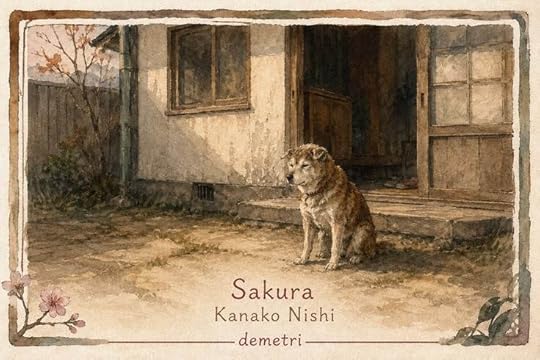
Sakura waits in the yard before the aging Hasegawa house, small but still central – the dog as witness, threshold, and last shared object of care in Kanako Nishi’s “Sakura.”
“Sakura” is about what love leaves behind when rescue arrives too late. Kanako Nishi’s generous, scuffed novel runs on the scraps left after salvation has already pulled away. A quick description might misfile it as the dog-as-bandage version of a broken-family story. It is warmer, stranger, and less house-trained than that. Care in these pages cannot prevent the accident, the lie, the suicide, the abandonment, or the evasions by which people fail the people at their own kitchen table. What remains is not grand. It is dog hair, gyoza, bad breath, faint handwriting, smudged pedicures, a garish leash, rain, a road atlas, and the old body of a family pet still somehow capable of making the living gather around her.
In Allison Markin Powell’s translation, “Sakura” is narrated by Kaoru Hasegawa, a young man in Tokyo who receives a furtive letter from his father, Akio, after years of estrangement. The message has been penciled onto the back of a flimsy store circular, as if even the father’s return has had to borrow space from coupon-colored noise. Akio says he will come home at the end of the year. Kaoru, who had planned to spend New Year’s with his girlfriend, abandons the plan and goes to the Osaka house that has been aging without him. His excuse is that he misses Sakura, the family dog. The excuse is half cowardice, half truth, which is to say the novel knows exactly what to do with it.
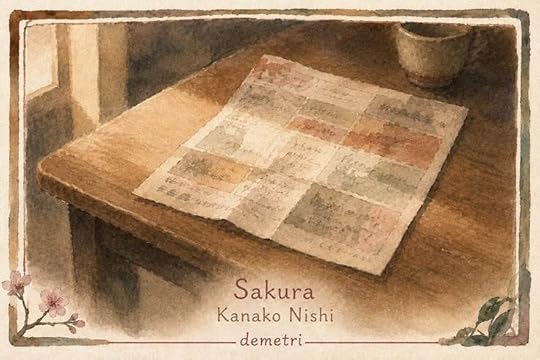
Akio’s faint penciled letter turns a cheap store circular into the first fragile evidence of return, apology, and unfinished family weather in “Sakura.”
When Kaoru arrives, the house has shrunk, or memory has been overestimating the square footage. His mother has grown large with grief and appetite. His sister Miki is still beautiful, blunt, and ungovernable, painting her toenails with a ceremony that makes nail polish feel like testimony. His father is thin, diminished, apologetic.
Sakura is old. Once the Hasegawas’ scrappy Shiba Inu mix, she is now nearly deaf, clouded with cataracts, and still able to recognize Kaoru by smell. The reunion dinner is nabé because Akio has requested the old meal-script, but the pot’s bubbling cannot disguise the stiff little ceremony of everyone being together. Then Sakura farts under the table, and the family laughs. That is Nishi’s most reliable comic nerve: catastrophe, and then a dog with poor timing restoring the household by being an animal.
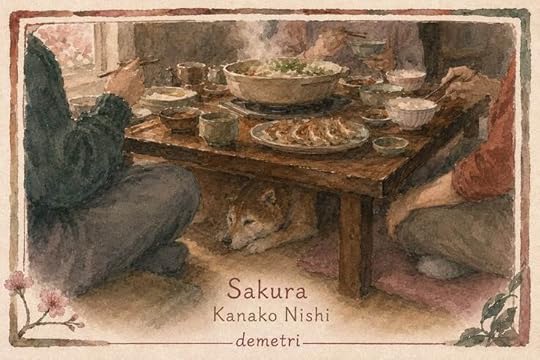
Around the family table, steam, bowls, awkward bodies, and Sakura underfoot hold the novel’s comic-sad truth: togetherness is sometimes only barely managed, but still real.
From that New Year’s return, the story opens backward into the years before the rooms learned to hold their breath. Hajime, Kaoru’s adored older brother, is beautiful, charismatic, almost overlit in the family imagination. Kaoru, Hajime, and Miki grow up around another heartbeat: the move to the larger house, Sakura’s timid arrival, the rituals that slowly teach everyone how to hear her. Adolescence arrives with acne, sex, gossip, letters, jealousy, and the awful discovery that devotion can be as vain as it is sincere. Kaoru fails Yukawa-san, the girl he likes until her severe acne unsettles his young vanity. Hajime falls in love with Yajima-san. Miki’s attachment to Hajime grows sharper and stranger. Sakiko-san, a transgender woman from Akio’s past, opens one of the novel’s richest side rooms, full of secrecy, mercy, performance, and adult generosity.
Then the floor gives. Hajime is hit by a taxi and comes home paralyzed, his face and body changed. Yajima-san’s letters have been intercepted by Miki, whose obsessive, forbidden attachment to Hajime curdles into sabotage. Hajime hangs himself from a tree in the People’s Forest using Sakura’s leash. Akio leaves. The mother collapses into appetite, alcohol, heat, and rage. Miki becomes both culprit and casualty. Kaoru leaves for Tokyo carrying the house inside him.
There is enough plot here to crowd the genkan, but “Sakura” files nothing neatly. It saves the apparently wrong things until they become load-bearing: the cheap circular, the old bicycles, New Year’s gyoza, Miki’s red randoseru, Sakura’s tawashi scrub brushes, a misheard song. Nishi keeps glancing at the ridiculous object near the edge of the scene, and gradually the reader learns to distrust the hierarchy between major and minor. In this novel, a suicide can destroy a family, but so can a stolen letter. Devotion can announce itself as a metaphysical force, but it is more likely to appear as someone sneaking the dog indoors on a cold night.
The sentences, too, refuse to put the shoes neatly away. Powell’s translation gives Kaoru a voice allergic to polite polish. He notices ugly colors, cheap textures, smells that should perhaps have been left alone, and physical facts that well-mannered narration might have patted briskly on the head and sent outside. The opening description of the circular establishes the method: feeling enters through unlovely surfaces. Nishi likes vomit, food, dog breath, sweat, toenails, shabby mailboxes, awkward sex, bruised pride, and appetite. Her rhythm moves from clipped comic fact to loose associative rush, as one perception unlocks another. The prose sprawls, but often usefully. Memory has taken every room; a minimalist tour would be false advertising.
That refusal to ennoble attachment is the novel’s sharpest mercy. Nishi does not need to say, at least not at first, that Sakura binds the Hasegawas together. She shows the dog sleeping in vegetable boxes, being brought inside against household rules, receiving touch from each member of the family, and recognizing Hajime after the accident when the humans are trapped between pity and horror.
Sakura is not one of fiction’s credentialed animals. She does not dispense wisdom. She is not a small professor in fur. She wants warmth, walks, attention, treats, and the people she loves. That is why she matters. She receives the family without converting them into lessons.
Love in “Sakura” is not a principle dusted for the mantel. It is a family tradition of making too many dumplings. It is a mother lying badly and loving fiercely. It is a father who knows roads better than emotions. It is Miki’s terrifying surplus of feeling, destructive and wounded. It is Kaoru’s late recognition of his own evasions. It is Hajime, before the accident, making the household cohere simply by being alive. And it is Sakura, aging and ordinary, the creature who keeps recognizing everyone.
The six-part design lets the sadness gather in reverse: first the damaged house, then the years when the house still knew how to laugh. Nishi begins in aftermath, when the Hasegawas have already become strange to themselves, then reconstructs the abundance that preceded the break. Because we know the domestic clutter first – the children choosing Sakura, Miki naming her after a flower petal that may not be a cherry blossom, the strange vet, the indoor-outdoor sleeping rituals, the old neighborhood, the gyoza, the jokes – Hajime’s death does not float free as melodrama. The grief has furniture in it.
Nishi withholds information the way families do: not cleanly, not strategically, but because no one can bear to name the thing yet. Miki’s obsession with Hajime is visible long before it is explained, though not so visible that the novel feels mechanical. Her jealousy, violence, beauty, and dependence sit uneasily in the narrative until the stolen letters disclose the shape of her desire and the scale of her harm. The revelation is devastating because it does not operate as a trapdoor twist. It reorganizes the family’s past.
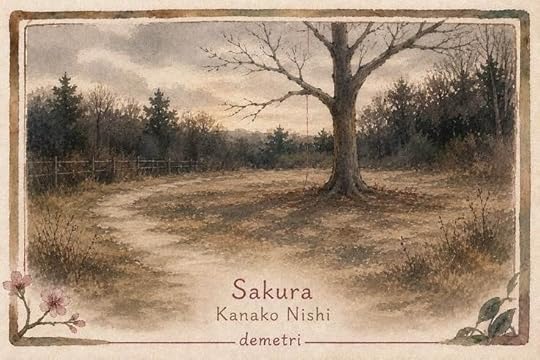
The empty tree in the People’s Forest carries the book’s most irreversible absence, rendered not as spectacle but as the quiet place grief keeps returning to.
Still, this is one of the novel’s dangerous bargains. Miki is so vivid that any single explanation risks making her smaller. Nishi mostly avoids that reduction, but the disclosure has enough pull to make some of Miki’s earlier strangeness feel too neatly lit. A girl who once seemed capable of anything – tenderness, cruelty, glamour, slapstick, devotion, ruin – suddenly risks being read backward from one wound. The book knows better than to solve her completely, but it does occasionally stand too close to the keyhole.
When “Sakura” falters, it usually does so by explaining after its rooms, meals, and dog have already testified. The late “wild pitches” image, first voiced by Hajime and later revised by Kaoru, is moving but not subtle. Hajime imagines suffering as God throwing impossible balls; Kaoru later sees the family as the ones hurling grief, guilt, rage, and love outward, toward something vast enough to catch them. The reversal is earned by accumulation. It also arrives with too many receipts tucked into it. A more restrained novel might have stopped earlier. Then again, a more restrained novel might not have given us Sakura’s fart at dinner, Miki’s magnificent wrongness, or the final drive through the night with quite this much pulse.
The mercy extends beyond the Hasegawas, though not everyone outside the household is granted the same depth of weather. Sakiko-san is one of its most memorable presences, and the “lie with love” material gives the novel a richer account of secrecy, gender, desire, and adult generosity than one might expect from a family story organized around a dog. Kaoru-san matters too, as Miki’s first deep friendship and as a figure through whom the story widens its imagination of love and identity. Yet both characters sometimes feel drawn toward what they reveal to the Hasegawas. They are affecting, but they are not always released into their own private weather.
Unevenness, though, is not failure. “Sakura” is a debut in the old gloriously hazardous sense: overfull, unguarded, occasionally too willing to underline itself, and quick in corners a tidier book might have swept clean. Its nearest neighbors on the shelf are only partial guides. It shares with Banana Yoshimoto’s “Kitchen” a tenderness for domestic grief, though Nishi is less cool and more crowded. It shares with Sigrid Nunez’s “The Friend” the sense that an animal can become grief’s custodian, though Nishi is more interested in the household than in literary solitude. It sometimes recalls the tragicomic sibling ache of Miriam Toews’s “All My Puny Sorrows,” though its humor is softer, more bodily, more likely to arrive with paw prints. The comparisons help locate the neighborhood; they do not build the house.
The novel does not chase the morning’s argument; it waits in older rooms, beside pets aging faster than their people can bear. Its pressures are stubbornly recognizable: the animal whose body becomes a family clock; the adult child returning to a house that no longer knows how to receive him; suicide as an event that does not end at the funeral but moves into appetite, silence, rage, avoidance, and rooms; letters sent, hidden, misread, or never answered in time. Nishi understands that mourning is not a mood. It is weather trapped indoors.
The ending lands because it refuses the one comfort that would cheapen it: healing. When Sakura collapses, panic gets the Hasegawas into the car. Akio, who has failed as a steady father, suddenly becomes useful in the one language he knows: roads. He drives through the night, guided by his old atlas, searching for a clinic. Miki speaks with the urgency of someone who has ruined and been ruined by love. Kaoru revises Hajime’s image. Sakura, absurdly, beautifully, “talks” again. None of this makes Miki innocent, Akio reliable, the mother whole, or Kaoru permanently brave. Hajime is still dead. The tree is still there. The stolen letters were still stolen. But the family is no longer arranged only around absence. They are moving together, badly and urgently, toward the breathing dog in front of them.
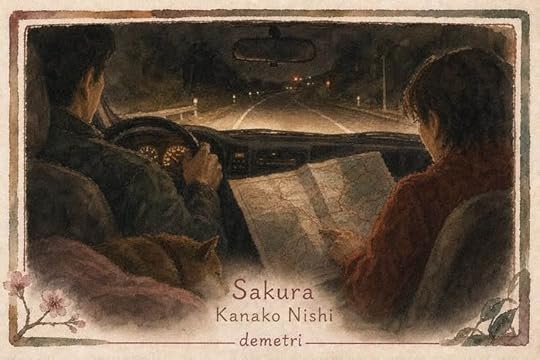
In the late-night drive for help, Akio’s atlas, the dark road, and Sakura’s frail body turn family paralysis into urgent, imperfect motion.
For me, “Sakura” lands at 84/100, which translates to 4/5 stars. That feels right for a novel whose feeling is unmistakable, even when its control comes in with paw prints on the floor. Its sentiment sometimes outruns its editing; its metaphors occasionally explain themselves too eagerly; its secondary characters can be pulled into the family’s orbit rather than fully released into their own. But its best scenes remain under the skin because they understand something unspectacular and serious: love is rarely most convincing when it sounds noble. More often it is faint pencil on cheap paper, a dog smuggled indoors, a family laughing at the wrong moment because the right one has become impossible.
At the end, Sakura is not a symbol standing neatly for love. She is older than symbolism, and more practical. She is a tired dog in a yard, still alive, still wanted, still able to make damaged people bend toward her. The new year does not arrive as absolution. It arrives as weather, as breath, as a name called into the cold.
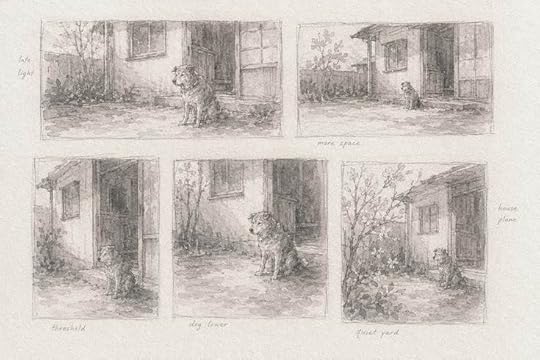
Thumbnail studies for the top watercolor, testing how Sakura, the house, the threshold, and negative space could hold the review’s central image of love after damage.
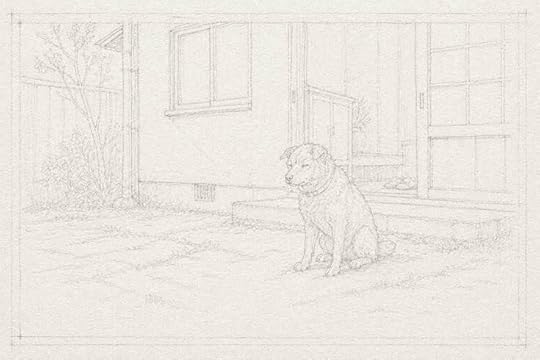
The faint pencil underdrawing establishes the quiet architecture of the final image: dog, yard, doorway, house planes, and the emptiness that lets the scene breathe.
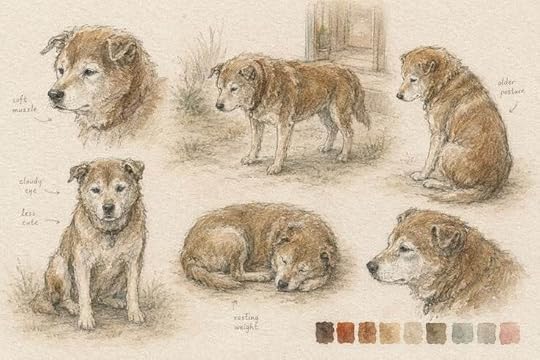
Aging Sakura studies refine the dog’s compact posture, tired dignity, fur pattern, and ordinary belovedness before she becomes the still center of the finished piece.
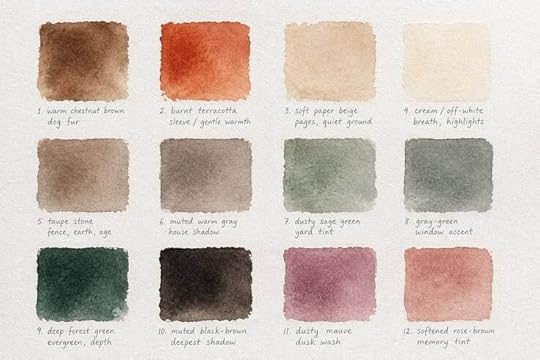
Cover-palette swatches test the muted browns, terracotta, paper beige, gray-green, near-black, and dusty rose tones that keep the watercolor tied to “Sakura.”
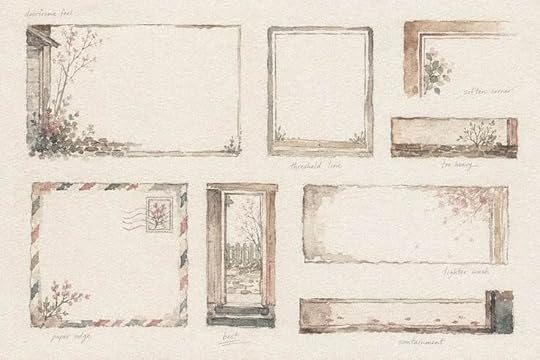
The border study explores how a hand-painted edge can echo threshold, letter paper, and domestic frame without turning the image into decoration.
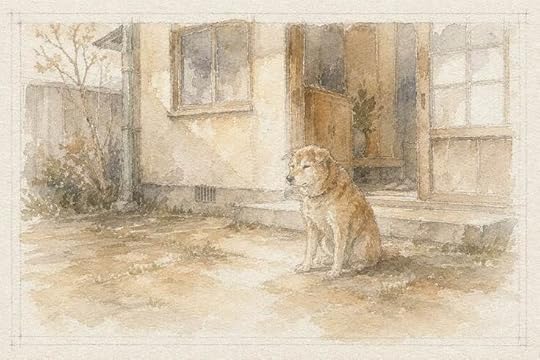
Pencil and first wash begin to soften the drawing into atmosphere, letting late light, paper texture, and Sakura’s small aging body emerge without closing the image too soon.
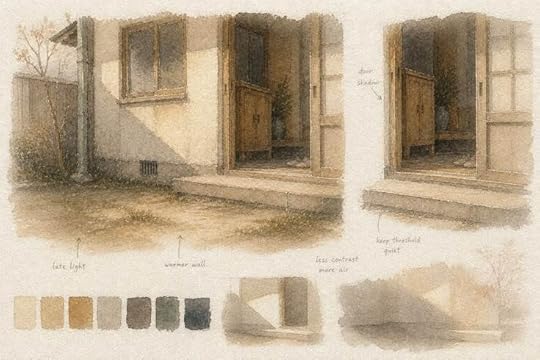
The threshold wash study tests the Hopper-inflected late light that makes the house feel inhabited by memory while leaving the family itself just out of view.
All watercolor illustrations by Demetris Papadimitropoulos.
Kanako Nishi’s “Sakura” finds family, grief, and mercy in dog hair, old letters, gyoza, and the stubborn body of a beloved pet.
By Demetris Papadimitropoulos | May 7th, 2026
Sakura waits in the yard before the aging Hasegawa house, small but still central – the dog as witness, threshold, and last shared object of care in Kanako Nishi’s “Sakura.”
“Sakura” is about what love leaves behind when rescue arrives too late. Kanako Nishi’s generous, scuffed novel runs on the scraps left after salvation has already pulled away. A quick description might misfile it as the dog-as-bandage version of a broken-family story. It is warmer, stranger, and less house-trained than that. Care in these pages cannot prevent the accident, the lie, the suicide, the abandonment, or the evasions by which people fail the people at their own kitchen table. What remains is not grand. It is dog hair, gyoza, bad breath, faint handwriting, smudged pedicures, a garish leash, rain, a road atlas, and the old body of a family pet still somehow capable of making the living gather around her.
In Allison Markin Powell’s translation, “Sakura” is narrated by Kaoru Hasegawa, a young man in Tokyo who receives a furtive letter from his father, Akio, after years of estrangement. The message has been penciled onto the back of a flimsy store circular, as if even the father’s return has had to borrow space from coupon-colored noise. Akio says he will come home at the end of the year. Kaoru, who had planned to spend New Year’s with his girlfriend, abandons the plan and goes to the Osaka house that has been aging without him. His excuse is that he misses Sakura, the family dog. The excuse is half cowardice, half truth, which is to say the novel knows exactly what to do with it.
Akio’s faint penciled letter turns a cheap store circular into the first fragile evidence of return, apology, and unfinished family weather in “Sakura.”
When Kaoru arrives, the house has shrunk, or memory has been overestimating the square footage. His mother has grown large with grief and appetite. His sister Miki is still beautiful, blunt, and ungovernable, painting her toenails with a ceremony that makes nail polish feel like testimony. His father is thin, diminished, apologetic.
Sakura is old. Once the Hasegawas’ scrappy Shiba Inu mix, she is now nearly deaf, clouded with cataracts, and still able to recognize Kaoru by smell. The reunion dinner is nabé because Akio has requested the old meal-script, but the pot’s bubbling cannot disguise the stiff little ceremony of everyone being together. Then Sakura farts under the table, and the family laughs. That is Nishi’s most reliable comic nerve: catastrophe, and then a dog with poor timing restoring the household by being an animal.
Around the family table, steam, bowls, awkward bodies, and Sakura underfoot hold the novel’s comic-sad truth: togetherness is sometimes only barely managed, but still real.
From that New Year’s return, the story opens backward into the years before the rooms learned to hold their breath. Hajime, Kaoru’s adored older brother, is beautiful, charismatic, almost overlit in the family imagination. Kaoru, Hajime, and Miki grow up around another heartbeat: the move to the larger house, Sakura’s timid arrival, the rituals that slowly teach everyone how to hear her. Adolescence arrives with acne, sex, gossip, letters, jealousy, and the awful discovery that devotion can be as vain as it is sincere. Kaoru fails Yukawa-san, the girl he likes until her severe acne unsettles his young vanity. Hajime falls in love with Yajima-san. Miki’s attachment to Hajime grows sharper and stranger. Sakiko-san, a transgender woman from Akio’s past, opens one of the novel’s richest side rooms, full of secrecy, mercy, performance, and adult generosity.
Then the floor gives. Hajime is hit by a taxi and comes home paralyzed, his face and body changed. Yajima-san’s letters have been intercepted by Miki, whose obsessive, forbidden attachment to Hajime curdles into sabotage. Hajime hangs himself from a tree in the People’s Forest using Sakura’s leash. Akio leaves. The mother collapses into appetite, alcohol, heat, and rage. Miki becomes both culprit and casualty. Kaoru leaves for Tokyo carrying the house inside him.
There is enough plot here to crowd the genkan, but “Sakura” files nothing neatly. It saves the apparently wrong things until they become load-bearing: the cheap circular, the old bicycles, New Year’s gyoza, Miki’s red randoseru, Sakura’s tawashi scrub brushes, a misheard song. Nishi keeps glancing at the ridiculous object near the edge of the scene, and gradually the reader learns to distrust the hierarchy between major and minor. In this novel, a suicide can destroy a family, but so can a stolen letter. Devotion can announce itself as a metaphysical force, but it is more likely to appear as someone sneaking the dog indoors on a cold night.
The sentences, too, refuse to put the shoes neatly away. Powell’s translation gives Kaoru a voice allergic to polite polish. He notices ugly colors, cheap textures, smells that should perhaps have been left alone, and physical facts that well-mannered narration might have patted briskly on the head and sent outside. The opening description of the circular establishes the method: feeling enters through unlovely surfaces. Nishi likes vomit, food, dog breath, sweat, toenails, shabby mailboxes, awkward sex, bruised pride, and appetite. Her rhythm moves from clipped comic fact to loose associative rush, as one perception unlocks another. The prose sprawls, but often usefully. Memory has taken every room; a minimalist tour would be false advertising.
That refusal to ennoble attachment is the novel’s sharpest mercy. Nishi does not need to say, at least not at first, that Sakura binds the Hasegawas together. She shows the dog sleeping in vegetable boxes, being brought inside against household rules, receiving touch from each member of the family, and recognizing Hajime after the accident when the humans are trapped between pity and horror.
Sakura is not one of fiction’s credentialed animals. She does not dispense wisdom. She is not a small professor in fur. She wants warmth, walks, attention, treats, and the people she loves. That is why she matters. She receives the family without converting them into lessons.
Love in “Sakura” is not a principle dusted for the mantel. It is a family tradition of making too many dumplings. It is a mother lying badly and loving fiercely. It is a father who knows roads better than emotions. It is Miki’s terrifying surplus of feeling, destructive and wounded. It is Kaoru’s late recognition of his own evasions. It is Hajime, before the accident, making the household cohere simply by being alive. And it is Sakura, aging and ordinary, the creature who keeps recognizing everyone.
The six-part design lets the sadness gather in reverse: first the damaged house, then the years when the house still knew how to laugh. Nishi begins in aftermath, when the Hasegawas have already become strange to themselves, then reconstructs the abundance that preceded the break. Because we know the domestic clutter first – the children choosing Sakura, Miki naming her after a flower petal that may not be a cherry blossom, the strange vet, the indoor-outdoor sleeping rituals, the old neighborhood, the gyoza, the jokes – Hajime’s death does not float free as melodrama. The grief has furniture in it.
Nishi withholds information the way families do: not cleanly, not strategically, but because no one can bear to name the thing yet. Miki’s obsession with Hajime is visible long before it is explained, though not so visible that the novel feels mechanical. Her jealousy, violence, beauty, and dependence sit uneasily in the narrative until the stolen letters disclose the shape of her desire and the scale of her harm. The revelation is devastating because it does not operate as a trapdoor twist. It reorganizes the family’s past.
The empty tree in the People’s Forest carries the book’s most irreversible absence, rendered not as spectacle but as the quiet place grief keeps returning to.
Still, this is one of the novel’s dangerous bargains. Miki is so vivid that any single explanation risks making her smaller. Nishi mostly avoids that reduction, but the disclosure has enough pull to make some of Miki’s earlier strangeness feel too neatly lit. A girl who once seemed capable of anything – tenderness, cruelty, glamour, slapstick, devotion, ruin – suddenly risks being read backward from one wound. The book knows better than to solve her completely, but it does occasionally stand too close to the keyhole.
When “Sakura” falters, it usually does so by explaining after its rooms, meals, and dog have already testified. The late “wild pitches” image, first voiced by Hajime and later revised by Kaoru, is moving but not subtle. Hajime imagines suffering as God throwing impossible balls; Kaoru later sees the family as the ones hurling grief, guilt, rage, and love outward, toward something vast enough to catch them. The reversal is earned by accumulation. It also arrives with too many receipts tucked into it. A more restrained novel might have stopped earlier. Then again, a more restrained novel might not have given us Sakura’s fart at dinner, Miki’s magnificent wrongness, or the final drive through the night with quite this much pulse.
The mercy extends beyond the Hasegawas, though not everyone outside the household is granted the same depth of weather. Sakiko-san is one of its most memorable presences, and the “lie with love” material gives the novel a richer account of secrecy, gender, desire, and adult generosity than one might expect from a family story organized around a dog. Kaoru-san matters too, as Miki’s first deep friendship and as a figure through whom the story widens its imagination of love and identity. Yet both characters sometimes feel drawn toward what they reveal to the Hasegawas. They are affecting, but they are not always released into their own private weather.
Unevenness, though, is not failure. “Sakura” is a debut in the old gloriously hazardous sense: overfull, unguarded, occasionally too willing to underline itself, and quick in corners a tidier book might have swept clean. Its nearest neighbors on the shelf are only partial guides. It shares with Banana Yoshimoto’s “Kitchen” a tenderness for domestic grief, though Nishi is less cool and more crowded. It shares with Sigrid Nunez’s “The Friend” the sense that an animal can become grief’s custodian, though Nishi is more interested in the household than in literary solitude. It sometimes recalls the tragicomic sibling ache of Miriam Toews’s “All My Puny Sorrows,” though its humor is softer, more bodily, more likely to arrive with paw prints. The comparisons help locate the neighborhood; they do not build the house.
The novel does not chase the morning’s argument; it waits in older rooms, beside pets aging faster than their people can bear. Its pressures are stubbornly recognizable: the animal whose body becomes a family clock; the adult child returning to a house that no longer knows how to receive him; suicide as an event that does not end at the funeral but moves into appetite, silence, rage, avoidance, and rooms; letters sent, hidden, misread, or never answered in time. Nishi understands that mourning is not a mood. It is weather trapped indoors.
The ending lands because it refuses the one comfort that would cheapen it: healing. When Sakura collapses, panic gets the Hasegawas into the car. Akio, who has failed as a steady father, suddenly becomes useful in the one language he knows: roads. He drives through the night, guided by his old atlas, searching for a clinic. Miki speaks with the urgency of someone who has ruined and been ruined by love. Kaoru revises Hajime’s image. Sakura, absurdly, beautifully, “talks” again. None of this makes Miki innocent, Akio reliable, the mother whole, or Kaoru permanently brave. Hajime is still dead. The tree is still there. The stolen letters were still stolen. But the family is no longer arranged only around absence. They are moving together, badly and urgently, toward the breathing dog in front of them.
In the late-night drive for help, Akio’s atlas, the dark road, and Sakura’s frail body turn family paralysis into urgent, imperfect motion.
For me, “Sakura” lands at 84/100, which translates to 4/5 stars. That feels right for a novel whose feeling is unmistakable, even when its control comes in with paw prints on the floor. Its sentiment sometimes outruns its editing; its metaphors occasionally explain themselves too eagerly; its secondary characters can be pulled into the family’s orbit rather than fully released into their own. But its best scenes remain under the skin because they understand something unspectacular and serious: love is rarely most convincing when it sounds noble. More often it is faint pencil on cheap paper, a dog smuggled indoors, a family laughing at the wrong moment because the right one has become impossible.
At the end, Sakura is not a symbol standing neatly for love. She is older than symbolism, and more practical. She is a tired dog in a yard, still alive, still wanted, still able to make damaged people bend toward her. The new year does not arrive as absolution. It arrives as weather, as breath, as a name called into the cold.
Thumbnail studies for the top watercolor, testing how Sakura, the house, the threshold, and negative space could hold the review’s central image of love after damage.
The faint pencil underdrawing establishes the quiet architecture of the final image: dog, yard, doorway, house planes, and the emptiness that lets the scene breathe.
Aging Sakura studies refine the dog’s compact posture, tired dignity, fur pattern, and ordinary belovedness before she becomes the still center of the finished piece.
Cover-palette swatches test the muted browns, terracotta, paper beige, gray-green, near-black, and dusty rose tones that keep the watercolor tied to “Sakura.”
The border study explores how a hand-painted edge can echo threshold, letter paper, and domestic frame without turning the image into decoration.
Pencil and first wash begin to soften the drawing into atmosphere, letting late light, paper texture, and Sakura’s small aging body emerge without closing the image too soon.
The threshold wash study tests the Hopper-inflected late light that makes the house feel inhabited by memory while leaving the family itself just out of view.
All watercolor illustrations by Demetris Papadimitropoulos.

November 11, 2019
ลองจินตนาการว่าถ้าโครงเรื่องประมาณนี้แล้วได้โยชิดะ ชูอิจิ มาเขียนนะคุณเอ้ยย
สปอยแรงว่าภาพรวมไม่ได้มุ่งเน้นที่สุนัขขนาดนั้น เป็นเรื่องราวยุ่งเหยิงดราม่าจุกๆ ของครอบครัวหนึ่งในโอซาก้า ที่พล็อตโหดมาก แต่ผู้เขียนกลับเลือกที่จะเล่าด้วยน้ำเสียงแบบทีเล่นทีจริง และผู้แปลก็ใช้ภาษาวัยรุ่นที่บางครั้งออกจะปรู๊ดปร๊าดตามไม่ทัน
ที่จริงเราว่า ถ้าพล็อตเข้มแล้วเล่าด้วยน้ำเสียงแบบนี้ อาจจะถือเป็นจุดแข็งอันเกิดจากความคอนฟลิกท์กันระหว่างสอง สนุกสนานมาเรื่อยๆ พอเรื่องเศร้า บวกกับ "give up" ก็น่าจะช็อคคนอ่านได้ไม่น้อย มากกว่าการที่จะเล่าวนไปมาจนอึดอัดเหมือนงานของโยชิดะ (คนเลว/พิโรธ)
แต่นี่กลายเป็นว่าเราเบื่อ จนอ่านแบบผ่านๆ พอมาถึงท้ายๆ ก็เสียดายจัง วรรคประมาณนี้อาจทำฉันหงอยเป็นหมาได้เลยนะเนี่ย ซึ่งมันก็น่าเสียดายที่มีหลายวรรคเสียด้วยสิ
ถ้าพล็อตอย่างเดียว เราชอบมากกว่าพวกหวือหวาแบบเล่ม "คำถามในคืนฝนตก" หรือ "สุข สาม วัน" เสียอีก แต่รวมข้อบกพร่องต่างๆ ด้วยก็ประมาณนี้
สปอยแรงว่าภาพรวมไม่ได้มุ่งเน้นที่สุนัขขนาดนั้น เป็นเรื่องราวยุ่งเหยิงดราม่าจุกๆ ของครอบครัวหนึ่งในโอซาก้า ที่พล็อตโหดมาก แต่ผู้เขียนกลับเลือกที่จะเล่าด้วยน้ำเสียงแบบทีเล่นทีจริง และผู้แปลก็ใช้ภาษาวัยรุ่นที่บางครั้งออกจะปรู๊ดปร๊าดตามไม่ทัน
ที่จริงเราว่า ถ้าพล็อตเข้มแล้วเล่าด้วยน้ำเสียงแบบนี้ อาจจะถือเป็นจุดแข็งอันเกิดจากความคอนฟลิกท์กันระหว่างสอง สนุกสนานมาเรื่อยๆ พอเรื่องเศร้า บวกกับ "give up" ก็น่าจะช็อคคนอ่านได้ไม่น้อย มากกว่าการที่จะเล่าวนไปมาจนอึดอัดเหมือนงานของโยชิดะ (คนเลว/พิโรธ)
แต่นี่กลายเป็นว่าเราเบื่อ จนอ่านแบบผ่านๆ พอมาถึงท้ายๆ ก็เสียดายจัง วรรคประมาณนี้อาจทำฉันหงอยเป็นหมาได้เลยนะเนี่ย ซึ่งมันก็น่าเสียดายที่มีหลายวรรคเสียด้วยสิ
ถ้าพล็อตอย่างเดียว เราชอบมากกว่าพวกหวือหวาแบบเล่ม "คำถามในคืนฝนตก" หรือ "สุข สาม วัน" เสียอีก แต่รวมข้อบกพร่องต่างๆ ด้วยก็ประมาณนี้

August 19, 2024
Supongo que es un buen representante de lo que esperaba que iba a ser la literatura japonesa para mí. Se trata de una historia pausada y sin grandes acontecimientos o giros de guion, sino más bien una historia reconfortante y humana, constituida como un mosaico por medio de un estilo muy cuidado y elegante. Cuando pase el tiempo, no recordaré muy bien qué pasaba entre los lomos de El camino de regreso a casa, más allá de un puñado de escenas que llegan a resultar conmovedoras, pero recordaré seguro la sensibilidad de Kaoru al describir con el ojo de un poeta lleno de ternura los momentos más importantes de su niñez y juventud, y cómo la vivió rodeado por el calor de su familia.

July 14, 2024
Una historia que trata sobre las decisiones que tomamos en la vida y de cómo afrontar acontecimientos inesperados. Una vuelta a casa, donde la palabra casa ya no existe como tal. Cuando uno se va del hogar y vuelve pasado un tiempo, nada ni nadie es exactamente igual a como lo dejaste. Aunque estos cambios son necesarios para avanzar en tu desarrollo como persona, es inevitable echar de menos lo que se deja atrás.
Displaying 1 - 30 of 226 reviews