Jump to ratings and reviews
Rate this book

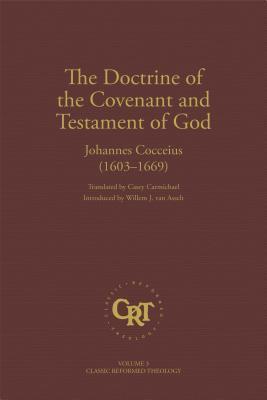
The Doctrine of the Covenant and Testament of God

Rate this book
Johannes Cocceius (1603-1669) was prominent Bible scholar who taught at the universities of Bremen, Franeker, and Leiden. As a gifted linguist, he produced a Hebrew lexicon, commentary related to every book of the Bible, and several theological treatises. Cocceius's contributions to covenant theology simultaneously sparked theological controversies and further fruitful dialogue for understanding the progressive nature of salvation history. The Doctrine of the Covenant and Testament of God describes the entire biblical history as a series of events by which an original covenant of works is gradually annulled, bringing new phases in the history of the covenant of grace. He shows that God's standard way of relating to mankind is through covenant, which, at its heart, is friendship with God. Casey Carmichael's translation of Cocceius's book is monumental, providing the first English edition of a work that helped shape Reformed theology for centuries. Historical theologians have long noted Cocceius's work as a crucial text in the development of federal theology, and now this translation will open access to a wider range of readers and is sure to spur further interest and research in Reformed expositions of covenantal thought. The introduction by Willem J. van Asselt, the world's leading scholar on Coccieus's life and theology, provides the historical context for understanding the importance of the book and a summary of the significant contributions it made to Reformed theology. Table of
Introduction by Willem J. van Asselt
1. The Covenant of God in General
2. The Covenant of Works
3. The First Abrogation of the Covenant of Works by Sin
4. The Second Abrogation of the Covenant of Works by the Covenant of Grace
5. A Fuller Explanation of What Was Set Out in Advance
6. The Application of the Testament and also the Sanction and Confirmation of the Covenant of Grace
7. The Ability to Receive in the Covenant of Grace and Its Inducement
8. The Constancy of the Covenant of Grace
9. The End of the Covenant of Grace
10. The Third Abrogation of the Covenant of Works by the Promulgation of the New Testament in the Type of the Old Economy
11. The Differences between the Former Period and the Later in the Economy of the Covenant of Grace
12. The Benefits of the New Testament
13. The Sacraments of the New Testament
14. The Office of Bishop under the New Testament and the Government of the Church
15. The Fourth Abrogation of the Covenant of Works by Death of the Body
16. The Fifth Abrogation of the Covenant of Works by the Resurrection of the Body

544 pages, Hardcover

First published April 30, 2014

35 people want to read

About the author

Johannes Cocceius

7 books1 follower

Ratings & Reviews

What do you think?
Rate this book

Friends & Following

Create a free account to discover what your friends think of this book!

Community Reviews

5 stars
1 (16%)
4 stars
2 (33%)
3 stars
3 (50%)
2 stars
0 (0%)
1 star
0 (0%)
Displaying 1 - 2 of 2 reviews
Profile Image for Jacob Aitken.
1,685 reviews420 followers
February 28, 2022

Cocceius, Johannes. The Covenant and Testament of God. trans. Casey Carmichael. Grand Rapids, MI: Reformation Heritage Books, 2016.

Although his teaching aroused some controversy, Johannes Cocceius (1603-1669) unified both rigorous scholastic methodology with a sensitivity to the biblical plotline. (Regarding his scholastic methodology, Cocceius outlines his Summa according to the following headers: §. This allows him to keep the topic clear even when he pursues tangents.) In one sense Cocceius wouldn’t have thought he was teaching anything new, yet later writers were forced to deal with his takes on the Sabbath and the multiple abrogations of the Covenant of Works. Positively stated, he offered a powerful presentation of the Pactum Salutis, the Covenant of Redemption.

Cocceius structures his covenant theology around five abrogations of the covenant of works. Willem J. van Asselt has a helpful introduction on this point (van Asselt xxxi). These five abrogations are:
The Fall
Establishment of the Covenant of Grace
Detachment and renunciation of the old man
Death
Resurrection from death

Like most writers on covenant theology, Cocceius begins with definitions: “God’s covenant is a divine declaration of the way of receiving his love” (Cocceius §5). It is one-sided (monopleuristic) regarding the way we receive his love. It is two-sided (dipleuristic) when man obligates himself.

Cocceius proves there was a law-covenant in the Garden because of the law or rectitude on man’s heart. If there is rectitude, then there is a corresponding standard (§8). Even without express Scriptural support, Cocceius provides the intellectual foundations to the Covenant of Works.

Cocceius’s defense of the covenant of works leads to an attack on the Socinians. As the Socinians believe death was natural, they are led to believe that man was cursed the moment he was created, since without doing anything he had already received the judgment for breaking God’s law. Of course, the Socinians don’t actually say that, but there it is. Like Barth, they come very close to seeing creation as a sort of Fall.

Against Rome and Bellarmine, “grace” can’t be rendered “making acceptable.” If God’s covenant with man had some sort of gracious element, and if man had to endure the testing, then he hadn’t yet been “acceptable;” therefore, grace can’t be “making acceptable” (§31).

If we are going to speak of merit in the garden, it isn’t condign merit, but merit according to the pact. Even if we never sinned, “we could not obligate God, because he receives nothing from us” (§41).

Cocceius and the Sabbath

Did Cocceius believe the Sabbath was abrogated after the Mosaic economy? Not exactly. He says the Mosaic sabbath “advanced the natural equity that binds the mind and soul to have time for God and His worship” (§13).

Second Abrogation of the Covenant of Works

It is abrogated in the sense that God’s mercy takes away condemnation in the reception of the covenant of grace (§75). The cause of this act is the “eudokia you thelematos tou theou” (§84).

The Pactum Salutis

Cocceius addresses the problem of whether the will of the Father and Son is the same. He affirms (§92). Rather, the single divine will is appropriated differently. This single passage removes any apparent difficulty in the Pactum Salutis. The fear had always been that such an intratrinitarian agreement necessitated three wills. Cocceius demonstrates that “appropriation” solves this problem.

Cocceius mightily rejects any eternal subordination of the Son to the Father. To do so, he notes in which respect the Son is economically subordinate (§94).
The Father is greater than the Son in relation to the Son’s humanity.
The Son’s role of mediator cannot imply any lesser status (§95).

Cocceius can even speak of Jesus’s condign merit, as his humiliation is proportionate to the rewards in his exaltation (§103). We establish the reality of Christ’s merit based on 1) the pactum salutis and 2) the rewards for his obedience (which also flows from the pact) (§107). Indeed, “he required merit by act, since he really furnished what he did for salvation.”

Section §108 deals with limited atonement. The argument is simple. Christ did not act as Surety for all men. Moreover, an acceptable sacrifice actually expiates sin (§116). When Scripture speaks of “dying for the world,” it refers to the universal promise made to Abraham (§123).

When we speak of Christ’s being a Surety, we mean that He stood forth for his people with their sins laid upon Him. The Father had given Him a seed, and this inheritance “responds from another part to the guarantee.” He took upon Himself the payment for our debts (§134, §155).

Furthermore, Christ is a sponsio in that he offered himself to the Father on our behalf (§350).

Faith in Christ justifies us because:
He makes his promise and gift fixed on the grounds of the covenant (Heb. 3:1)
It is the consummation of the heavenly marriage.
It is the first effect of the Spirit of the life of Christ in us.

We call the sanction of the Covenant of Grace “the oath of God” (§198).

The Third Abrogation of the Covenant of Works

The cutting off of Christ was the cause of the abolition of the Old Covenant (which, to be sure, is not identical with the Abrahamic covenant, §344).

On the Sacraments

Sacraments are seals, not moral causes, pace Rome. Seals are effects (§436). Indeed, as the cup is the testament in his blood, Jesus the Testator seals that on us.

Do not remove the Cup

Rome says that the bread, being transubstantiated, already has blood in it since it is a living body. But a living body is not offered to us, but a slain and sacrificial one. It is a body that is broken (§496). You cannot simultaneously say it is a living body and that blood has been shed (see also, §502ff).

Cocceius has another interesting rebuttal to the Mass. When Paul says we have koinonia in the body of Christ, it can’t mean eating. It is elsewhere contrasted with the koinonia of demons, yet no one suggests we eat demons (§520). Moreover, the Israelites were said (v.18) to have koinonia in the altar, yet they did not orally receive the altar.

Fourth Abrogation

The fourth abrogation is the death of the body.

Fifth Abrogation

The fifth abrogation is the resurrection from the dead.

Conclusion

It would be a stretch to say this is one of the best scholastic texts. That would be Francis Turretin. I wouldn’t say this is the most useful scholastic text on covenant theology. That would be Herman Witsius. Nonetheless, Cocceius engages the biblical text in ways that often surpass others. While he is not always the clearest writer, his formatting the texts by section markers separates him from others and prevents the reader from getting lost.. While this is an advanced text, it is required reading to understand how the Reformed view the covenants. One can no longer speak on Reformed covenant theology without seriously engaging Johannes Cocceius.
Profile Image for Aaron Kleinheksel.
286 reviews18 followers
April 14, 2025
This volume has been on my shelf waiting to be read for too long.

Known among theologians by its original Latin title Summa Doctrinae de Foedere et Testamento Dei (and I will use “SD” to refer to it in this review), this book is the 1st translation into English of one of the primary texts of classical Reformed Covenant Theology by one of its brightest (if virtually unknown today) lights. By modern understanding this book might be considered a blend of systematic and biblical theology, though those terms were not in use in 1660, when the 3rd Latin edition of this text was introduced and upon which this translation is based.

This book was worth the read just for the introduction by the late Willem J. van Asselt alone. He was responsible for a modern (1990) Dutch translation of the SD and was able to help Casey Carmichael with this most excellent translation, as well as contributing the introduction. He provides an excellent short biography of Cocceius and places him and his work in context with his time and in the stream of Covenantal thought, and includes this summary of the SD which I’ll just provide in lieu of any poorer one I might devise:

"The structure and shape of the Summa Doctrinae is decidedly determined by the doctrine of the annulment of the covenant of works, the so-called abrogation doctrine. It is the thread that runs throughout the entire volume. Chapters 2-4, 10, 15, and 16 provide this framework. This work describes all of biblical history after the fall as a series of events by which this original covenant of works was canceled and abrogated step by step. The events that were decisive for these abrogations of the covenant of works and that initiated a new phase in the history of the covenant of grace at every stage include the following: (1) the fall; (2) God’s decision to establish the covenant of grace and the promise of this new covenant, which runs through the entire Old Testament and is fulfilled in the New Testament; (3) the detachment from and the renunciation of the old humanity in the sanctification undergone by Christians; (4) physical death; and (5) the resurrection from death."


I’ll just admit right off the bat that I had trouble at times following some of the arguments of Cocceius. Partly this was due to the grammatical structure and vocabulary used, but mainly it was due to my IQ in relation to Cocceius’. Frankly I felt like a child at times. It is a reminder that Theology was then in Europe considered the “queen of the sciences,” and that it attracted many of the most brilliant minds, much as do STEM fields today. Cocceius was conversant in Hebrew, Greek, Latin, Dutch, and other biblical languages and wrote interchangeably with them depending on his aim. He studied under many of the greatest Protestant theologians of his day, but also under several of the greatest Jewish rabbis of the era, which positively (in my view) influenced his thinking on the Old Testament. The challenge rating of this text for laymen such as myself is high – but worth it.

Secondly, reading this prompted me to think that many of the theological arguments we endure in the English-speaking protestant church today are constrained by lack of awareness of much of our heritage. It’s not just that many of the arguments were already resolved (many were not), but rather that we’ve lost much theological history which might produce a bit more grace in the church (here I’m particularly referring to modern “Covenantal” theology vs. “Dispensational” theology, but it even applies to modern Covenantal thinking vs. earlier understandings). There is so much great material that 99% of the church just has no access to due to translation limitations. Here I want to give a word of thanks to Reformation Heritage Books for supporting the effort to make this material more widely available.

Related to the above, Cocceius’ Covenant theology in my view runs not against Dispensational thinking regarding the Biblical narrative and eschatology, but rather alongside it (with notable exceptions). Cocceius had what appears to be a “dispensational” view of the history of the “kingdom of God” which he divided into 7 periods based on the 2nd and 3rd chapters of Revelation – just as many dispensationalists would view it today. He placed this next to his concept of “covenant,” which related to the history of salvation and God’s dealings with humankind, concepts which as described any dispensationalists I know would also agree. I also think his exposure to Jewish thinking of the time influenced his views of ethnic Israel and its place in the plan of God. I’ve often been frustrated listening to Reformed covenantalists misstate much of dispensationalist thought for reasons I can’t quite understand. The deeper one digs, the more puzzling it becomes. Historical church thought is not what most people understand it to be, it seems to me. NOTE: For a non-Christian reading this review, none of the above issues have anything to do with the core doctrines of the church regarding the person of Jesus Christ and salvation, on which all agree (see the Apostle’s Creed).

Cocceius’ writing exhibits great grace and an overwhelming love and thankfulness to God, yet at the same time an energetic and aggressive militancy when confronting what he sees as attacks on foundational Biblical Truth. At different places in the SD, Cocceius deals decisively with the Remonstrants, the Roman Church, Arminian understandings of the merit of Christ’s work, Socianism, and other Pelagians and semi-pelagians contra works contributing in any way to salvation. He is zealous for God’s word and loves His church (in the larger sense of the word). The SD contains many excellent sub-commentaries, such as that on the Sabbath, the OT Law and on Sanctification (the 4th abrogation).

I highly recommend this to anyone, even if some of it goes over your head (as it did mine); what you get from it will far outweigh what you miss, and perhaps spur you on to greater study to sharpen your mind.
Displaying 1 - 2 of 2 reviews

Can't find what you're looking for?

Get help and learn more about the design.