Jump to ratings and reviews
Rate this book

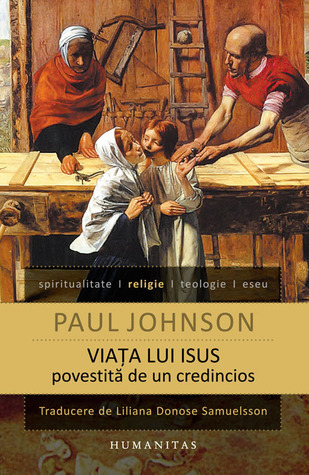
Viaţa lui Isus povestită de un credincios

Rate this book
Traducere: Liliana Donose Samuelsson

Paul Johnson ne vorbeşte în această carte despre viaţa şi învăţăturile lui Isus. O face cu siguranţa unui istoric, cu talentul unui scriitor şi cu pasiunea unui credincios, oferindu-ne biografia mişcătoare a unei personalităţi care a schimbat cursul istoriei şi a inspirat una din marile religii ale lumii.

„Johnson evaluează puţinele lucruri care se cunosc despre copilăria şi tinereţea lui Isus, şi explică de ce nu se spun mai multe despre acest subiect; discută sentimentele personale ale lui Isus; observă calităţile învăţăturilor lui, în special cele din pilde; subliniază rezervele acestuia faţă de minunile pe care le înfăptuieşte; şi analizează modul diferit în care li se adresează bărbaţilor, femeilor, copiilor şi bătrânilor. Autorul prezintă cele «zece noi porunci» pe care Isus le-a introdus în faptă şi vorbă, cu care voia să-şi pregătească ucenicii nu să schimbe lumea, ci să intre în împărăţia lui Dumnezeu. În sfârşit, Johnson examinează cu o credinţă inteligentă Patimile, Învierea şi perioada care a urmat până la Înălţare." (Ray OLSON, Booklist)

214 pages, Paperback

First published January 1, 2010

118 people are currently reading
657 people want to read

About the author

Paul Johnson

134 books827 followers
Paul Johnson works as a historian, journalist and author. He was educated at Stonyhurst School in Clitheroe, Lancashire and Magdalen College, Oxford, and first came to prominence in the 1950s as a journalist writing for, and later editing, the New Statesman magazine. He has also written for leading newspapers and magazines in Britain, the US and Europe.

Paul Johnson has published over 40 books including A History of Christianity (1979), A History of the English People (1987), Intellectuals (1988), The Birth of the Modern: World Society, 1815—1830 (1991), Modern Times: A History of the World from the 1920s to the Year 2000 (1999), A History of the American People (2000), A History of the Jews (2001) and Art: A New History (2003) as well as biographies of Elizabeth I (1974), Napoleon (2002), George Washington (2005) and Pope John Paul II (1982).

Ratings & Reviews

What do you think?
Rate this book

Friends & Following

Create a free account to discover what your friends think of this book!

Community Reviews

5 stars
249 (33%)
4 stars
254 (34%)
3 stars
181 (24%)
2 stars
36 (4%)
1 star
17 (2%)
Displaying 1 - 30 of 96 reviews
Profile Image for Henry.
865 reviews73 followers
May 5, 2023
Okay but somewhat disappointing. Certainly not because of the subject of the "biography" who has never disappointed, but from an author I have thoroughly respected. Johnson's "Modern Times" is one of my favorite books and his "History of Christianity" is a masterpiece. This book, however, is simply a narrative of the gospels which I have read many, many time and never disappoint. Perhaps this book will be revelatory to those not familiar with the gospels, but for those who are, it does not add much.
Profile Image for Jeffrey Zygmont.
Author 21 books6 followers
July 12, 2013
This may be a difficult book for some readers who are not Christians, because author Paul Johnson accepts the divinity of Christ (as he states unambiguously in the subtitle, A Biography From a Believer). But I recommend the book to any and all readers, because it gives a perspective of Christ that you don't find elsewhere, presenting him as a walking, talking, living and breathing historical figure -- and, let's face it, considering his impact, Jesus was one of the most significant figures in all of history.

Johnson is a very careful and refreshingly lucid historian and biographer. He uses the four gospels as source material (they are contemporaneously written historical documents, after all, written by Christ's companions and meant to record and memorialize his life), along with information he gleans from other historical records, to present Christ as compassionate, gregarious, charismatic, well respected, and overall a nice guy.

When setting up his tale in the book's introduction, Johnson tells us that within 20 after Christ's death, in about 50 AD (in an era when writing was rare and difficult),

". . . biographies of him written in the Aramaic tongue he normally spoke were circulating, but these have disappeared. Within half a century of his death, however, four biographies, written in Greek, had been published, and all have come down to us. By the end of century, forty-five authentic documents about him had appeared, and these have also survived.

. . . The problem of writing the life of Jesus the man is not so much the paucity of sources as their abundance.

. . . There is the further problem of presenting to readers, two millennia later, the personality of a man so extraordinary and protean, passionate yet deliberative, straightforward and subtle, full of authority and even, at times, stern, yet also infinitely kind, understanding, forgiving, and loving, so dazzling in his excellences that those close to him had no hesitation in accepting his divinity."

It is a problem that Paul Johnson overcomes splendidly, writing a very interesting, illuminating and inspiring biography of Jesus Christ. I recommended it to all.

Profile Image for Maria Roxana.
589 reviews
April 9, 2023
Anii trecuți mi-am "asortat" această perioadă- care precede Paștele- cu diverse lecturi care au abordat sau interpretat personaje din Biblie, așa i-am savurat pe Colm Toibin, Amos Oz, iar anul acesta pe Paul Johnson.

O biografie interesantă, lipsită de exaltare, care se parcurge ușor, dar care punctează exact detaliile de care avem nevoie pentru cultura noastră generală din acest domeniu al religiei.

Și da, sunt convinsă de faptul că Isus ar fi răstignit pentru a doua oară, pentru că trăim într-o lume crudă și nesăbuită, plină de cunoaștere, de mijloace de comunicare, expertiză, dar și de ură. "De două mii de ani ni se predică să ne iubim, iar noi ne sfâșiem."
Profile Image for Ben Denison.
518 reviews49 followers
December 8, 2022
So this was a biography of Jesus basically combining the four gospels with some additions about Jesus in other Scriptures.

I liked this. I thought it was well done, but when he got to Jesus’ teachings he went into a “New Ten Commandments” , nothing he said I necessarily disagreed with, but it was the first time I’d ever hear the term NEW Ten Commandments. Truth,Courage, Mercy, respect for
nature…. Hmmmm … a new Ten Commandments is not biblical and not sure i was on board with the concept of a new/revised “law”

Overall good. Just the one area I question.
Profile Image for Rick Elliott.
32 reviews
May 6, 2010
More than any other book - other than the Bible - Paul Johnson's "Jesus - A Biography From A Believer" helped me to understand the life, character, teachings, and context of the man whose life changed the course of human history. After reading this wonderfully precise and and moving work, my praise and worship for Jesus has been elevated to a whole new level. I highly recommend this book!
Profile Image for Karl Rove.
Author 11 books155 followers
Read
August 3, 2011
Within just a few months, two slim, brillant volumes from a great writer. "What did Jesus teach?...The only way to grasp his teaching is to read all the Gospels repeatedly, until permeates the mind." "The Christianity he bequeathed has not been tried and failed. As G.K. Chesterton once wrote, it has been found difficult and left untried."
Profile Image for Edoardo Albert.
Author 54 books155 followers
October 17, 2017
Here's an impious thought for the impious: surely there's something deeply wonderful that the most important man in human history was a carpenter, a poor man living in the first century equivalent of Walsall, rather than a conqueror or a king. Think of those other candidates for most important man in history, generally surnamed 'the great', such as Alexander or Cyrus or Napoleon: they arrived at their greatness by swimming across rivers of blood. What Paul Johnson does in this little book, and does marvellously, is show why that carpenter from Nazareth was:

so extraordinary and protean, passionate yet deliberative, straightforward and subtle, full of authority and even, at times, stern, yet also infinitely kind, understanding, forgiving, and loving, so dazzling in his excellences that those close to him had no hesitation in accepting his divinity.

There is a question that Jesus is related to have asked his disciples. "Who do people say I am?" And they answered, giving the speculations of the people as to who this extraordinary preacher and miracle worker might be. Then Jesus said, "But you, who do you say I am?"

The question is asked of each of us. It may be the most important question ever posed.
Profile Image for Phillip.
433 reviews10 followers
September 19, 2012
This was more or less a prose summary of the New Testament gospels. It was if someone was given a book review of the four gospels -- I didn't really learn anything I couldn't have known if I read them myself. This was basically the Cliff's Notes version on the NT. I was a bit put off when he began the book by saying "I do not cite my authorities, though I am prepared to defend all my assertions, if challenged, by documentation." This was very Jesus 101 ... there was a lack of critical reading of the gospels. I don't agree that you can combine all four gospels together to create one story because, in some ways, they are mutually exclusive. He takes for granted that John was written by one of the actual apostles, but that's just not historically correct. So, if you just want a basic restatement of the Gospels, this is for you. But if you are looking for anything deep and critical, find something else.
Profile Image for Glen.
592 reviews13 followers
January 11, 2024
The world’s greatest person as told by my favorite historian. Johnson penned a decisively restrictive historical narrative that is woven around the Gospel accounts (King James citations). There is limited extra-Biblical referencing and even less commentary. The book is a simple rendering in an essentially chronological fashion of Jesus’ remarkable life as the God-man redeemer. There is a confessional quality to this read that relates a factual rendering of the world’s (and heaven’s) greatest occupant.
Profile Image for Ryan.
308 reviews1 follower
September 8, 2023
5 // The Read Letters. “The gregarious, friendly figure of Jesus: always there, teaching, listening, sometimes just chatting at a well or when dining or supping with people of all kinds. Occasionally he was stern. Once or twice he showed righteous anger. But he was usually soft-spoken and genial; images from the fields and groves, or from animal life, were always on his lips. He was a fascinating, irresistible figure, radiating love, benevolent, forgiving, talking always of mercy, smiling often. He was a serious man nonetheless, one who spoke with authority; a man to respect, obey, follow; a man who seemed to, perhaps occasionally really did, emanate light—one of his favorite words—and dispel the dark side of life. He was clearly a man who, despite his meekness, challenged official authority, especially that of those who dealt in spiritual matters. So they had him watched. Always, at his elbow, were agents, spies, informers, and provokers, committing his words to memory so that they could be twisted when used in court. He was a man rarely alone. But when he was solitary, he prayed, kneeling. He prayed often, even on the cross: "Father, forgive them; for they know not what they do."

“We can assume that Jesus was self-taught in many respects. His words and concepts betray absolutely no sign of academic deformation or the impress of a system. He repudiated such things, just as he hated legalism in moral teaching. His was an imagination unsullied by the classroom or lecture hall.”

“What we do know, from the records of his sayings, is that he was a civilized, cultured, educated man who chose his words with great care and precision, with delicacy, accuracy, and tact—all indications of wide reading in secular as well as religious literature.”

“The aim of Jesus was not to change the world.
His aim was to fit its inhabitants for the Kingdom of God, which he insisted ‘is not of this world.’”

“I have tried to tell the story of Jesus of Nazareth, his life, death, Resurrection, and ascent into heaven, as simply and factually as possible. I have used primarily the four Gospel accounts which reached written form not long after the events they described, and which are essentially the memoirs of eyewitnesses to them. I have used throughout the authorized translation into English done in the early seventeenth century, known as the King James Version, because it combines better than any other a high degree of literal accuracy with archaic verbal elements which remind us we are dealing with events of two millennia ago. It is also a work of art.
This is important because the Gospels are literary as well as historical and spiritual documents. Brief, single-minded, direct, and purposeful, they constitute in combination one of the finest works to come down to us from antiquity. This is because they are short biographies, mutually reinforcing and correcting, of a man who was himself a poet and who used words with an astonishing gift for their meaning and resonance and delight. In his imagery and metaphors, in the way he told his stories and parables, in his constant invention of new ways of saying things, he was not merely a superb teacher but a great artist.” 39b23

Say hello on IG @jux.booksbinge or @nonfictionfervor
Profile Image for Appu.
226 reviews11 followers
September 2, 2021
Paul Johnson is a Conservative author whom I like reading. He writes elegantly. He has an opinion on most things which is the way it should be. I have read his History of the Jews which is one of his major works. This book is a quick read. Johnson has tried to write a biography of Jesus Christ based almost entirely on Gospel accounts. Quite surprisingly the results are very good. Johnson manages to draw a picture of Jesus that is often missed, that of a convivial ( a word that Johnson uses many times) warm person, who is well educated for his time, skilled in several trades (carpentry, farming) and who takes a close interest in nature. He gives historical backgrounds to the major events of Jesus' life. I found this book to be a very enjoyable and a profitable read.
Profile Image for Ryan.
996 reviews2 followers
July 12, 2017
This was a great review of the life of Christ with several great observations I've never considered. It seems that most books on Christ in the last few years have been angry rants trying to disprove His existence, so this was definitely refreshing
311 reviews12 followers
September 6, 2018
I did not love this book, and I don't consider it to be serious biography; rather, it's a condensation of stories from the four gospels, with some of the author's surmises (and biases) thrown in for good measure. I have to say that I started reading this book somewhat under false pretenses - I was looking for a historical take on the life of Jesus, not focusing on the claims of divinity or miracle-working. The book I wanted to read wasn't available from Overdrive, but this one, entitled Jesus: A 21st Century Biography, was. Only after I'd checked it out did I find that the alternate sub-title was A Biography, from a Believer.

So this wasn't exactly the book I'd been planning on reading. And the book is definitely from the perspective of the author, Paul Johnson, with no attempt to weigh the contrasting claims (even among believers) around Jesus's life and personality. In fact, he states at the beginning that the Bible, and specifically the gospels, provide the basis for all his writing - no external sources or analysis brought to bear here. Further, he uses what I can only think of as the "Scrabble Rule" of scholarly citation, stating in the introduction that "I do not cite my authorities, though I am prepared to defend all my assertions, if challenged, by documentation." So what the reader ends up with is a prose explanation of what Paul Johnson imagines Jesus was like, from his repeated close readings of the four gospels. Not useless, perhaps, but not what most people would think of as serious scholarship.

Johnson's decision not to seriously engage with the millennia of writing about the person of Jesus shows in many ways. He asserts among other things, the following:

- Jesus didn't have any schooling
- Judaism was "popular among serious, civilized people everywhere" (The ethnocentrism here is super-yucky, for the record.)
- That all early Christians probably "knew the names of the apostles, in order, by heart" (What basis is there for this conclusion?)
- The miracle at the Wedding in Cana is a reliable account because "where alcohol is concerned men rarely make statistical mistakes" (Tell that to all the drunk people who've ever tried to split a bar tab at the end of the night!)
- Regarding care for orphans, widows and other unfortunates, that Jews were "more conscientious in this respect than any other people (On what basis does he make this claim?)
- The religious leaders of the Jews "got on very well with Pontius Pilate, the Roman governor of Judaea, and Herod Antipas" (Tell that to the Romans, who put down literally dozens of riots, protests and other movements led by religious leaders during the hundred or so years around the life of Jesus! Seriously, Paul, try reading an actual history book about this!)

On top of that, several of his less-than-savory views seriously tarnished the book for me, including his Milton-esque fear of knowledge as sinful, portraying knowledge and science as a temptation to evil; his claim that pre-modern societies "were just emerging from savagery", that the West is the standard for civilization, and that the Judaic (and, by extension, Christian) tradition is somehow so much deeper, richer and more meaningful than other religious traditions; that "masculine characteristics" include reason and logical argumentation, while an appeal to emotions to make a point is feminine; that divorce is inevitably a bad thing for women and that prohibitions on divorce are there to protect women from being left alone in this hard, cruel world by their protector husbands; that sex not under the control of the church is "licentiousness"...the list goes on.

On top of that, Johnson would like to arrogate all, literally all of the good things that have happened in history since Jesus was born to the influence of Christianity, as the following quotation makes clear:
But if we sort out the salutary aspects from the deplorable, if we look at what is decent and valuable in our modern sensibilities—now, in the second decade of the twenty-first century—we see that all the genuine improvements in the way human beings live and behave toward one another spring from following the teaching and, above all, the example of Jesus.
It's just so absurdly parochial it's hard to know how to respond.

So anyway, I can't really recommend this book to anyone. If you're not a believer, you're likely to be confounded by an author who so obviously makes no effort to consider other viewpoints that he doesn't even really cohabit the same universe as you. I get that not every book, not even every historical book, needs to take an all-sides approach. But I think there's so little common ground here for non-believers that they're not likely to take much away.

For believers, there really isn't much new ground either, apart from a look into Johnson's personal views on the nature of Jesus's political and spiritual program. Maybe that's something you're interested in, but I didn't find it so much more enlightening than just going and listening to any random preacher talk about a story from the gospels on any given Sunday. There's no new material brought to light to expand your understanding of what's already in the Bible. Instead, it's just "what Paul Johnson" thinks about the stories contained therein.

Not my cup of tea.
Profile Image for Ali M.
621 reviews12 followers
December 21, 2017
Paul Johnson writes in his slim but thorough biography of Jesus “that all the genuine improvements in the way human beings live and behave toward one another spring from following the teaching and, above all, the example of Jesus.” Johnson gives us the details of the teaching and example of Christ in simple but eloquent prose. Johnson makes clear early in the book that he does not cite his authorities, which helps with the flow of the story. And while this assertion gave me pause at first, I have such tremendous respect for Johnson as an historian and knowing that he wrote “A History of the Jews,” I was quite content to rely on his statement that he could defend all his assertions with documentation if necessary.

This is a straightforward narrative of the life and beliefs of Jesus Christ, but Johnson makes it compelling with the passion of his belief and his synthesis of those beliefs such that they are relevant to the modern reader. A few things stood out to me in Johnson’s book. The first was that it had never really occurred to me that the people we read about in the New Testament were literate. But Mary, Joseph and Jesus were all very well educated and as practicing Jews read and prayed with great reliance on the scriptures, and indeed were guided in their daily lives by written laws.

The second thing was that the coming of Christ was of particular importance for women. Johnson devotes an entire chapter to Jesus’s encounters with his people with a particular emphasis on women, the aged and children. Johnson writes, “Jesus’s encounters with women had a particular significance. Women were almost invisible in the ancient Near East. They had little or no status unless they married rulers, and then their place was precarious… If they were poor and old, they were nothing. But not to Jesus.” The protection that Christianity gave to women was an entirely new thing and it makes me sad to think we are eschewing this protection today in favor of choice and all the temptations that modernity offers us. Human nature is constant and to deny that women need certain protections in society is to deny reality.

Finally, the time of Jesus seems so long ago to modern readers and it is easy to think of the people and their problems as primitive and to distance ourselves in our wealth, comfort and knowledge. For me, this book really brought home to me how little has changed in over two millennia. The faults of man are just as they were then; common, knowable and awful. It is against this fabric that Johnson describes the teachings of Christ and enables the reader to see more clearly what a gift to humanity his life and message are.

This book was first published in 2010, but Johnson could have been writing at any time in history. His closing remarks are both chilling and comforting in that they make clear that some things never change, that we never learn, but that there is a way forward. Johnson writes, “Palestine in the first century AD was a land crowded (just as our earth is crowded) with a multiracial, multi-religious population. The people believed themselves to be civilized, with ancient traditions of law, spiritual life, and government. But their tranquility was constantly disturbed by barbarous events and acts of savagery. There was a sense of impending catastrophe. Wild visions of a terrifying future were discussed. There were prophets of both doom and utopias. Government, both spiritual and temporal, was supposedly a blessing, being based, on the one hand, on the law of Moses and, on the other, on Roman law. There were codes, precedents, courts, parchments – and plenty of lawyers. In practice it was corrupt, mendacious, grossly inefficient, and spasmodically cruel. It did not dispense justice so much as whim. It was run by men who were plainly inadequate and sometimes monsters. Herod the Great was an evil man who murdered innocent children to protect his throne. Herod’s son Antipas was a spendthrift hedonist, not unlike some Arabian princes today, but he was also a man who mingled his frivolities with an occasional murder. Caiaphas, the high priest, was an evil man like Herod, with an added dimension of hypocrisy, spiritual pride, and a peculiar malice toward good men. Pontius Pilate was an archetype of the weaknesses with which we are daily familiar in our own political world: a pretense to uphold truth and justice and to heed public opinion, combined with indecision, cowardice and a final tendency to bow to pressure groups, even when knowing them to be wrong. Every aspect of bad government we experience toady finds its counterpart in first century Palestine, not least the listless mediocrity which was its usual characteristic.”

The truth of our world is sometimes hard to bear, but Johnson leaves us on a hopeful note, concluding, “The Christianity he bequeathed has not been tried and failed. As G.K. Chesterton once wrote, it has been found difficult and left untried. But it remains at our disposal. Its message, at its simplest, is: do as Jesus did. That is why his biography, in our terrifying twenty-first century, is so important. We must study it, and learn.” It is my fervent prayer that we do. This book is a good place to start.
Profile Image for Andrew Willis.
255 reviews
September 24, 2019
I'm a Paul Johnson fan. I love his insight and opinions in his books, but this one was lacking in both. Maybe he was timid of saying anything blasphemous, or maybe he realized he did not have the expertise to say anything beyond what was in the Gospels. It's a nice and well-written biography but one might as well read the Gospels of Matthew and John.
Profile Image for Honza Prchal.
190 reviews
August 29, 2025
There were some sections that were hard to follow (especially historical context, because while I know a lot of Roman, Jewish, and Greek history for a layman, I am just a layman and needed time to situate myself in the timeline he was so very comfortable with) while navigating dense urban Texas traffic, but this was phenomenal. Surely those parts difficult for me, or references to philosophy or sourcing difficult for normal people, or to the Old Testament that would flummox non-Christians, would be best read as a book ... but as is so often the case, that was not an option for me.
I recommended Johnson's biography to people I love even before I finished it.
The information on Biblical sourcing was often information I'd been unaware of without ever getting into the weeds or detracting from the general nature of the focus, so this is well worth the attentions even of people familiar with the subject. This would obviously be a perfect introduction to someone newly familiar with or unfamiliar with Christianity. For Christians, it really brings home how weird Christianity is compared to other religions - something we moderns and post-moderns forget to our detriment. I expect Jews would generally find it quite interesting, as a compact guide to the full life and sources. Conspiracy theorists would hate it (Johnson is quite right to challenge anyone who thinks Jesus was an Essene to read any Essene works whatsoever and compare the styles). Muslims looking to convert Christians may like the book so that they don't come of like raving quacks to the educated Christian, but for most it contradicts parts of the Quran, as does much of the Bible, so unless the Muslim is willing to bear that in the interested of being educated, this will not be welcome, and that's without the implied contrasts to the Christ's message and Muhammad's.
Finally, lovers of rhetoric and literature, both poetry and prose, will love this unless they've a hang-up with Christianity. The King James translation is brilliant, and wonderfully captures the poetry that so attracts Johnson. Further, in his treatment (as read by the talented Ralph Cosham), the language of the KJV is as natural to our ears as it was when it was written ... and not only because so many sections chosen for reading are those that have become cliches of English that people often don't even recognize come from the Bible. The economy of words and the poetry of Jesus' speech are remarkable, and therefore often unremarked. Johnson lives from writing and speaking, so he's well-placed to point those out. That Jesus words don't fit a formula or system, but rather a way of being makes that task so much the harder. That it worked and has worked for two thousand years makes us overlook the miracle of that achievement, too.
Profile Image for Brian.
78 reviews1 follower
August 3, 2022
“Jesus of Nazareth was in terms of his influence the most important human being in history. He is also the most written about and discussed.”

With these lines the prolific and renowned British author Paul Johnson begins his eloquent and insightful summary of the life and teachings of the Savior of the world. It’s a brief, sweeping 200 page survey, accessible and digestible for all who have interest in learning more about the life of Jesus Christ.

As a member of the Church of Jesus Christ of Latter-day Saints, I enjoy reading the works of fellow Christians from other denominations. I know and have read from Paul Johnson’s other secular writings (“Socrates”, ��Churchill”, “Brief Lives”) and have enjoyed his erudite style. This book is no different.

He presents the story of the life and teachings of Jesus Christ, which are very familiar to me, using language that is fresh and not as familiar, which I find richly rewarding as I hold up the Savior’s life to see it reflect a new, needed angle for my own discipleship. Aside from Johnson missing a few key doctrinal truths that I have believed and cherished throughout my life, I find his portrayal to be a faithful rendering, artful and compelling. It is also thought-provoking about what I can do better to be just a little bit more like Jesus.

His historical review was deftly placed in the broader geopolitical context of the times—multicultural lives, strong religious cultures, deep traditions of Jewish law and Roman law and rule. But what I found most interesting were the moments when he made commentary about the enduring meaning of Jesus’ life for us today, presenting him as worthy of our time and energy in a world not so different from the world in which he lived and taught. I love that message because I’ve found it to be true in my own life.

Not only was Christ the Son of God and the Savior of mankind, but he was also a man for all seasons. A friend of the dispossessed. Kind and sociable. A poet and master teacher. Unyielding about the teachings of his Father and yet the most merciful person who ever lived. He was God, but speaking of him as a man, he was and is a man worth knowing, and a man worth emulating. Because in the example of his life—in his words and especially in his deeds—we find the perfect model for how we can be towards those we love and those we encounter in every setting of our lives. That is the majesty of Christ. He gave us a blueprint for lasting joy and for what we may become if we will be more deliberate about knowing who and how he was, and thus who and how we can be, with his help.
970 reviews8 followers
July 5, 2019
Go-to book for a compact examination of the life of Jesus on earth. Johnson examines each phase of the life of Jesus, and though as a believer he admits his bias, he still does a fair job of outlining the major driving events that brought Jesus into being and into such importance during his life and after.

Johnson explores the remarkable of story not only of how Mary receives the news about being pregnant Jesus, but also how Joseph (though not married to Mary and suspicious at first) took her for his wife and remained a devoted husband.

He also explores how Jesus valued those who had faith inspired by belief vs. by miracle, notably the Roman centurion who asked Jesus to heal his servant, but said he was not worthy to have Jesus come under his roof and believed that just a word spoken by Jesus would be enough to heal the servant.

Johnson describes Jesus as being "true for all time" and "transfiguring history and geography, spreading everywhere and bridging the gulf between the universe God created and the infinite in which he had his being."

Johnson outlines Jesus's "New Ten Commandments":
- We all must develop a new personality based on his teachings
- Accept and abide by universality - the human race must be seen as a whole
- Respect that we are all equal in God's eyes
- Need for love in all human relationships
- Show mercy just as God shows it to us
- Show balance and control
- Cultivate an open mind
- Pursue the truth unstained by sectarian usage
- Exercise judicious use of power
- Show courage
213 reviews7 followers
November 15, 2013
I liked this book. I mean it was okay. It was basically a refresher of the Gospels and the life of Jesus from the time God told Mary she was pregnant until the time Jesus ascended. I liked Yancey's "The Jesus I Never Knew" better because when he gave personal opinion, it was from his personal experiences. This author (Johnson) would say some things and it really made me think okay I need to read the Bible again for myself. He did some paraphrasing without citing scriptures. I did not like his "New 10 commandments." How do you say Jesus left us with 1 commandment to love God and love our neighbor, then come up with 10 new commandments that are basicaly the same things? So ehh this book was good as a refresher for someone who already knows the life of Jesus or may haven't read about it since they were a kid but I would not recommend this to someone interested in becoming a christian. It can be complicated since the gospels give different accounts of some of the same stories and Johnson does not say much to address that.
Profile Image for MG.
1,104 reviews17 followers
May 16, 2022
Johnson's biography of Jesus serves as an erudite summary of a very traditional telling of Jesus's life and ministry, based mostly on an uncritical reading of the Gospels. "Uncritical" here does not mean unintelligent or unreasoned, but only that Johnson takes the Gospels as primarily eyewitness or directly reported accounts written 30 to 40 years after Jesus's death and not as literary works written 30 to 90 years after the crucifixion and so shaped deeply by the various authors' goals and purposes. Still, what I enjoyed best--and which I think many Christians will find valuable--is Johnson's summary as Jesus's 10 commandments (which serve as a summary of his teachings) and include some surprising points, such as everyone needing to develop one's personality (since Jesus calls us to know ourselves and develop according to who we are called to be); and a call to courage to be meek (and so run against the culture's counsel to strive to be on top).
Profile Image for Sally.
1,313 reviews
April 27, 2011
I picked this book up (actually BOUGHT it, rather than got it from the library!) because I love Paul Johnson's history books. I was intrigued by the subtitle "A Biography, from a Believer". Nothing new or exciting in the first few chapters, but he did present the setting of Christ's birth and life in a helpful factual way. But when I got to the chapter about Jesus's "new" commandments, I became distressed. Johnson talks about how we are to be like Jesus and if we come close enough to his example of goodness, honesty, morality, etc, then we can go to heaven. There was no mention of our indwelling sin nature or our utter inability to be like Christ without the Holy Spirit. No mention of the Atonement. It was good works all the way. So sad.
83 reviews1 follower
December 24, 2019
I was turned onto this by Ryan Holiday, though I had read a bunch of Paul Johnson stuff before. While the four gospels are the authoritative (and only real necessary) story of Jesus, Johnson's approach is surprisingly novel. Approaching the heart of the best selling book of all time as a biographer, he stitches the gospels together into one story (KJV references, of course), producing a character study. You know, like a biography. It's hard to articulate why this new approach works, but it was refreshing for me. He digs into historical context and asks a lot of questions, like "what was Jesus doing between ages 12 and 30?", attempting to answer them as best he can. This is really good, if for no other reason than it makes an old, old, story new again.
Profile Image for Samuel.
322 reviews4 followers
April 6, 2021
As a fellow believer this was a case of preaching to the choir, but don't stop reading because of that. Paul Johnson's biography of Jesus doesn't add a lot that isn't already found in the four gospels, but he does do the reader the favour of organizing these stories giving an overview of what is found in each and what each is trying to tell us.

He is light on analysis, but does include some, gives some speculation on motives of those who tried Jesus, they don't come off well, as well as Judas, who Johnson leaves judgement of to the readers.

All together this is a good companion to the gospels not a replacement for them. I don't think it will convince those who are not believers, but that is not what it was designed for.
219 reviews9 followers
May 9, 2025
This was a very interesting book where Johnson takes the gospels and recreates a bibliographic arc of Jesus. No surprise - he was successful and intertwining the four books into a singular piece of work I found to be immensely helpful. Also interesting the details some bring to the table that others leave out.

That said, the best part of this book was the context around Israel at the time Jesus was alive. The brutality, the culture, the way certain classes of people were treated. It was incredibly helpful context and further helped my understanding.

Enjoyed this short biography. For those deep in the world, the context will be helpful. For those new to Jesus and Christianity I think you will find this book illuminating and helpful.
Profile Image for عدنان العبار.
496 reviews126 followers
October 15, 2021
I LOVED this book! Absolutely enjoyed every bit of it. It is not just an account of Jesus' life, but also of his character and his philosophy. As anyone can see, I am deeply interested in Catholicism and Jesus, and this book is the perfect book for me. There is so much to learn here, and the analysis of the characters in Jesus' life are very helpful in understanding the situation he was in.

I really recommend the book to everyone: Even to Muslims, Jews, Atheists, Agnostics, and all of those whom I have excluded. The life of Jesus, perhaps the most influential human in the history of man, is a life everyone must read about.
Profile Image for Radu P.
110 reviews3 followers
February 24, 2017
Așa cum și autorul mărturisește, această care nu se vrea a fi una de profunda exegeză spirituală, ci mai degeaba o descriere succintă a vieții lui Iisus, făcută de un istoric(crestin).Cu toate acestea,cartea iti starneste interesul pt cunoastere,intelegere si imbogatire spirituala-asa cum o fac multe din cartile crestine.Dupa,nu ne mai ramane decat să punem în practică cele citite și învățate,multiplicand astfel talantii primiti prin cunoastere.
Profile Image for Trent.
18 reviews1 follower
May 11, 2019
I would say 20% 5 star book, otherwise 3 stars because he's just summarizing what the gospels already say. Paul Johnson is a tremendous author, and I would recommend his other books above this one. Especially Modern Times, which I thought was a Phenomenal history book! Basically this book is good when he's talking about the times in which Jesus lived rather than Jesus himself, because Paul Johnson is an outstanding historian.
Profile Image for Laura.
1,509 reviews39 followers
June 20, 2022
1.5 ⭐️

A very straightforward telling of the story of Jesus - no new insights, no new interpretation of era - just the chronological details laid out in the Gospels.
Profile Image for Kenneth.
1,141 reviews64 followers
April 5, 2023
This is an excellent one-volume life of Jesus, drawing from all four of the canonical gospels in the New Testament. It does not have footnotes or endnotes but does have a short bibliography for "Further Reading". In the book, Johnson discusses Jesus in the context of his times - the setting in the Roman Empire, King Herod and Herod's descendants who were ruling as the Romans' puppet kings. The Jerusalem priesthood which controlled the Jewish Temple. The socioeconomic situation of the common people. Anyone looking for a book that downplays Christianity will not find it here. The book ends with the events celebrated by Christians in Holy Week - Jesus Last Supper, his arrest, trials before the Jerusalem priests and Pontius Pilate, the Roman governor of Judea, his Crucifixion, death and burial. The last chapter covers Jesus' resurrection and the birth of Christianity.
Displaying 1 - 30 of 96 reviews

Can't find what you're looking for?

Get help and learn more about the design.