The untold story of a quirky and important subculture: The world of 78rpm records and the insular community that celebrates them—by acclaimed music critic and author Amanda Petrusich, who contributes regularly to Pitchfork, The Oxford American, and The New York Times.
Before MP3s, CDs, and cassette tapes, even before LPs or 45s, the world listened to music on 78rpm records—those fragile, 10-inch shellac discs. While vinyl records have enjoyed a renaissance in recent years, good 78s are exponentially harder to come by and play. A recent eBay auction for the only known copy of a particular record topped out at $37,100. Do Not Sell at Any Price explores the rarified world of the 78rpm record—from the format’s heyday to its near extinction—and how collectors and archivists are working frantically to preserve the music before it’s lost forever.
Through fascinating historical research and beguiling visits with the most prominent 78 preservers, Amanda Petrusich offers both a singular glimpse of the world of 78 collecting and the lost backwoods blues artists whose 78s from the 1920s and 1930s have yet to be found or heard by modern ears. We follow the author’s descent into the oddball fraternity of collectors—including adventures with Joe Bussard, Chris King, John Tefteller, Pete Whelan, and more—who create and follow their own rules, vocabulary, and economics and explore the elemental genres of blues, folk, jazz, and gospel that gave seed to the rock, pop, country, and hip-hop we hear today. From Thomas Edison to Jack White, Do Not Sell at Any Price is an untold, intriguing story of preservation, loss, obsession, art, and the evolution of the recording formats that have changed the ways we listen to (and create) music.
Amanda Petrusich is the author of “Do Not Sell At Any Price: The Wild, Obsessive Hunt for the World’s Rarest 78rpm Records” (Scribner; 2014), “It Still Moves: Lost Songs, Lost Highways, and the Search for the Next American Music” (Faber and Faber; 2008), and “Pink Moon,” an installment in Continuum/Bloomsbury’s acclaimed 33 1/3 series. She is a contributing writer for Pitchfork and a contributing editor at The Oxford American, and her music and culture writing has appeared in The New York Times, The Atlantic, Spin, BuzzFeed, and elsewhere. She has an M.F.A. in nonfiction writing from Columbia University and teaches writing and criticism at NYU’s Gallatin School. She lives in Brooklyn.
Suck All The Blossoms And He Leave You An Empty Square
But There’s Another Part Of Me That Finds It Kind Of Disgusting
Thanks Amanda, a great subject done wonderfully well. A meditation on many things including fetishization, obsessive compulsive disorder and learning scuba diving. (She does this so she can scour the bed of the Milwaukee River for 78s which were hurled into the river in the 1930s by embittered Paramount Records employees when they heard the factory was closing.)
One thing this book is about is music. And music, as we know, is not one thing.
If you say you like old music, people think you mean the 1990s. If you say, no, further back than that, they say oh, like the 60s. Well, yes, the 60s was a very good decade, but I mean the 20s. At that point you may as well say your hobby is collecting Tuareg saddle decorations. Most people don’t want to watch movies in black and white or read books from before the 20th century or hear records with surface noise on them. Actual surface noise, not deliberately dubbed on surface noise to grunge up your track. That’s okay, it’s not a crime.
There are three worlds of music – classical (academic), popular (commercial) and folk (none of the above). You can tell them apart quite easily. In the 1920s record companies in America started recording the folk. This had never occurred to anyone before. Because why would the folk buy records by themselves? Didn’t sound like any kind of sense. Surely they would only buy records by Gene Autry or Enrico Caruso? Well, it turned out that the folk loved the folk. Black people bought Blind Lemon Jefferson, white people bought the Skillet Lickers.
After a few years, the folk who were making these records were absorbed by the pop music industry, and why not, they wanted careers. So hillbilly music became country, and blues became R&B. No one was now wandering into a recording studio in their overalls. So there was this magical period from around 1925 to 1935 and that’s where all the obsessive behaviour described in this book is focussed on.
For my money, Skip James’ weird Hard Time Killing Floor is worth any five of Scarlatti’s harpsichord sonatas which all sound the same. Hard Time Killing Floor doesn’t sound like anything else.
The magical decade of recording in America was shut down by the Depression and just when things were starting up again, World War Two came along and drafted all the musicians and requisitioned all the shellac. By the time anything like a recording biz got back on its feet, the music had all changed. No one wanted to sound like Blind Lemon Jefferson or the Skillet Lickers because no one likes listening to old music, and in the late 40s, the 20s was like old, a long time ago. So all these great records were junked.
In the 50s a few white geek types discovered this old stuff and began frantically collecting it, sometimes canvassing from door to door in the black areas of Southern towns, which was quite a dodgy thing to do.
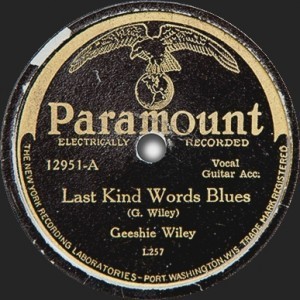
We can now benefit from this crazed geekiness. We can listen to Geeshie Wiley singing Last Kind Words in two clicks on Youtube; but there are only three copies of this record known. It was unlikely for this woman to have become a singer and guitarist in the first place; unlikely that Paramount records issued three singles by her; unlikely that any copies survived, only a few hundred were pressed; unlikely that a collector found one; the whole thing dangled on a fraying string. But this three minutes from this life we get to hear.
"The question that never gets answered, or maybe that doesn't even get asked, is what is it about being human that makes us desire this thing that is so ephemeral?" - 78 collector Chris King
"Do Not Sell at Any Price" is a love letter to wanting. To wishing. To white-knuckle envy and ache that keeps you up nights. You might not collect 78s. Maybe you collect Faberge eggs, or stamps, or baseball cards of disgraced baseball players. You have a thing you want, and then your brain structures your life around finding that thing, and every single piece of that thing.
Petrusich, a music writer of many years, didn't start as a 78 fanatic, but she certainly ended as one. She got the spook. She does a bit of the A.J. Jacobs thing here and gets on the trail. She meets collectors, who in turn take her to record fairs, play their collection, but at one point, she also learns to scuba dive after being told that the employees of the Paramount Records company would, in moments of boredom, frisbee copies of factory overstock records or stampers into the Milwaukee River.
But it's not all stunts and first-person accounts. In fact, it's a lot more philosophical and psychological than I ever expected or even had a right to hope for. Petrusich intuitively gets that there's something here that goes beyond simple acquisitiveness or, god help us, hoarding. To be sure, some of the most legendary 78 record collectors did not live in impeccable homes or keep a tidy appearance, but there was something primal about their search. They were, in a sense, creating their own history. When Evan Parker said "My life's history is in my record collection," he was channeling an impulse that ran through Harry Smith and James McKune and John Tefteller and up to folks carving out new swaths of inquiry like Ian Nagoski, who eschews the well-trod field of pre-War blues in favor of musics from Eastern European immigrants in America. As he jarringly (but I think truthfully) points out, a lot of what we know about the history of blues in this country is colored through the eyes of the fanatic collector. People like Skip James and Blind Willie Johnson were in no way the predominant voice of blues at the time; they were the Velvet Underground of blues, exalted posthumously through scarcity and perceived mystery.
The book is seeded with little pops of insight like that. It's about so much more than showing off the wares, comparing the scarcity of collections. It gets to the heart of what it really means to be a collector, and, as much as the term is watered down to mush these days, a curator. Harry Smith and James McKune were curators -- they collected deeply and specifically, with exacting aims. Smith's "Anthology of American Folk Music" isn't just a bunch of rural blues and gospel; it's a magic incantation with deadly sequencing, meant not to tell the history of American music, but the history of Harry Smith's intuitively generated magic system. It's also not numeric -- some of the collectors with the biggest collections collected what would now primarily be considered junk, and lots of it. And, most of all, almost none of these people had a real contingency plan for what would happen to the collection when they died. If you're lucky and you're connected, your collection goes to the Smithsonian, which is so overpacked with stuff and so critically understaffed, ensures that it'll never be seen, heard, or enjoyed by anyone ever again. The worst case scenario is that your life's work goes into a dumpster at the hands of your kids, who would rather not deal with dad's weird old crap.
The mid-point, of course, is that these curated collections get carved up piecemeal and enter the bloodstream of other collectors. Like any such pursuit with a half-century of history, the bulk of the jewels exist in the collections of a select few master-collectors, and tend to stay there. More than most other record collecting forms, these 78s are not only in finite quantities, they are also mostly being traded between collectors, either for other records or exorbitant sums of cash. On the rare, odd day that a truly new record appears (either a significantly better copy or a song that was only documented but hasn't been heard by the community at large), it's like finding a new continent. And it's not like this music stays hidden; most of the master-collectors also run record labels dedicating to creating CD pressings of this crucial material.
But ultimately, Petrusich and the collectors agree on one thing -- the experience of listening to a 78 in person, on a vintage record player, is another experience entirely. Even with imperfections and noise, the immediacy of the recording, the vibrations very directly translating from the cone over the performer's head into your living room is a personal experience that the layers of electrical mastering equipment can only push you away from. It's this personal connection that drives the heart of the 78 collector. And that would be fine for any book aimed only at fellow travelers. What made me want to give this book five stars even though I don't care to start collecting 78s is that she takes great care to document both the thrill of the hunt, but also the core roots of the obsession. It's about more than the music, the artifact, the window through time. It's about want. It's about scarcity. It's about creating order in a jumbled universe. It's about building patterns and creating relationships with objects when you can't do the same so well with other humans. It's also about the lure of the collection, a personal museum of sort, that not only explains the world, but also the curator. In that way, it pairs nicely with "Mr. Wilson's Cabinet of Wonder," another book dedicated to to eccentric collections. As my own collector's urges lean toward less cool but equally distressing needs (noise/experimental music, '70s female singer-songwriters), I still understood the essential spirit that drove these people, even if we technically wouldn't have any more to talk about than I would with a dedicated beer aficionado. If we went beyond talking about our most recent scores, we might have a lot to say to each other. We want different things, but we all want. And we all hope that our combination of records will bring perfect order into chaos. The thing we like shall be the thing the world lamented not loving enough. But best of all, we'll still just get to sit in our room, alone or with friends, and hear that essential spook in the record, that thing that sounds like no other. And it's mine now. I fought for it, and I get to keep it.
I've tried and failed to review this book several times since I finished it back in May of last year; the more words I spill trying to explain why I loved it, the farther I seem to get from my actual feelings.
So instead of a comprehensive review, I'll simply say that it's the best book I've ever read on the production of 78 rpm records, the importance of physical materials in the recording of music, the gender, race, and class connotations of collecting, the joys of crate-diving, records as literal occult objects, white mythmaking about Black musicians, music criticism, "the old, weird America," the pros and cons of public archives, hipsters of all ages, the Great Mississippi Flood of 1927, the Greenwich Village folk scene, the Brooklyn indie scene, Ghost World (film), the physical cost of obsession, being a woman in the music world, the Wisconsin Chair Company, "Stagger Lee" (song), "Devil Got My Woman" (song), Skip James, Robert Johnson, Charley Patton, Geeshie Wiley, Mamie Smith, Blind Uncle Gaspard, Blind Lemon Jefferson, Blind Joe Death, The Anthology of American Folk Music (1952), and scuba diving.
Petrusich is a thoughtful writer who knows and loves music, and this just hit all my reading pleasure centers.
Here's a great playlist (not mine) of most of the individual songs Petrusich discusses. Spotify isn't the same as shellac, but it's close enough for me.
The question is where music interest comes from. Name a musical trend, and it spans fashion, color, style, mood—just one summer, maybe, or an entire era’s zeitgeist, if anyone’s listening. And they are listening. In niche enthusiast circles, and internet blogosphere environs, the interest level is often intense, generally in equal proportion to rarity, and often in infinitesimal user-group numbers. But in sprawling and immense categories and diversity.
The world of record collecting seems to nurture the bizarre and idiosyncratic; yesterday’s micro-culture may today be memorialized as a wall of vinyl or shellac. What were once moon-y, june-y Sinatra fans in bobby socks, gospel-choir swayers, or raucus punk moshpit-divers-- seem now willing to relegate their passion to the recordings, and their off-hours to accumulating a collection that best illustrates their preferred slice of the culture.
To every era, an array of flavors-- why was there an upswing in interest in Tuvan throat singers in the nineties? Were cowboy songs an antecedent to rockabilly? What did happen to that English ‘New Romantic’ movement, and Adam And The Ants? What was rock before it was electric and what did it sound like? How about reggae? Did Bob Dylan try both Judeo and Christian stabs at holiday music? Was Ellington really better before he was famous?
If you have given any consideration to ‘jungle’ or ‘skiffle’ or ‘ska’ or ‘western swing’ or ‘punkabilly’ – you are obviously infected and probably know too much already. (And yes, presumably Dylan will cover all topics, faiths and holidays, before he is done expanding his brand.) But the “collectable” light is on, for any of the numerous variations of what the twentieth century called “Records”.
DNSAAP finds its topic by brushing away the flagrantly poppish, and the fluff, like a patient archaeologist whisking the dust away from precious potsherds at a dig. Not only will the fanatics concerned here be focussed only on thick shellac 78 rpm records, but even more wonkishly, with early, proto-blues records.
Not even forties era race, jump, or rhythm records will be considered, though sensational veins of their own-- what we’re after in this most hallowed search is the early rural blues, once a thin segment of a much larger market, now ultra rare. Delta blues. Guitars with strange tunings. Variations on chain-gang work song or prison laments. No-good woman and no-count men, crooked deals and broken hearts. Murder ballads, sung low. The indescribable sound that Regret makes in the small hours of the morning. Small labels, doomed to financial uncertainty. The rarest, maybe, but certainly the arterial bloodline of American music; the Grail.
There is something of a conflict here-- there is the love of the music as music, but there is also the researcher drilling back into time for the ultimate ‘source’ of sources, the innermost pulse that became jazz, r&b, dance, rock and all future variants. Rarity becomes its own aesthetic, edging out perhaps more primary considerations.
Seventy Eights were miraculous, though, and come from the era of wind-up victrola players with large horns, something to enliven the church social, the saturday dance or even the country picnic. Portable and remarkable to behold in the early century, you could have a piano sonata in the garden, or crooners mock-whispering love songs in bedroom hideaways, or a heartrending rendition of Lili Marlene, re-enacted in the actual wartime trenches of France.
Or bluesmen like Skip James, Robert Johnson or Son House. Four stars here for the documentary aspects.
Not only is this book about the history of 78' record collectors, but later in the book Amanda Petrusich explores the possibilities and implications of this obsessive hunt to the history of music and blues especially. An excellent study of this group of collectors and the effect on music today.
I picked up Amanda Petrusich’s Do Not Sell At Any Price primarily because I live in Port Washington, WI, a couple miles away from the site of what’s apparently one of the most important blues labels in American history. More on that in a minute. Ms. Petrusich redeems herself pretty well with this book, but it’s not perfect. While she puts in yeoman’s labor in research and interviews, Do Not Sell At Any Price should have either been bigger or smaller. It doesn’t feel the right size. You’ve either got a long magazine article or a more scholarly book here, in my eyes, and Ms. P. can’t seem to make up her mind if she’s in the chatty personal narrative business or something more formal.
Okay, let’s get this out of the way first. Like I said, I live near where Paramount Records, a historically important blues label, huge with 78rpm collectors, stood. Ms. P. visited this area as part of her research. She’s a bit too, ahem, happily engaged in stereotypes about midwesterners. Right back at you with Brooklynites, Amanda. We’re even. But who told you Grafton was, as you state in the book, in central Wisconsin? It’s adjacent to Lake Michigan. Okay, I’ll write that off as a typo. Anyway, yes, as a near twenty-year resident of this area, I agree with Ms. P.’s assertion that most of the locals (including myself) aren’t quite sure what to make of our connection to Paramount Records. I mean, we think it’s cool and all, but we’re as confused as you as to how Paramount landed in buttfuck Wisconsin. That doesn’t mean we’re all hicks and medication-polite or whatever. But thank you for saying so. I hope you liked scuba diving in our river. I’ve driven past that spot thousands of time and never stopped. I will soon, if only to read the historical marker. Thanks for illuminating local history to a local. I mean that. You did a good job.
Do Not Sell At Any Price works best when the author interacts with the collectors. She doesn’t go out of her way to make them sound, ahem, singular; they manage to sound fairly bonkers all by themselves. I kept Spotify near while I read and looked tracks as they were mentioned. That was cool. The book introduced me to a shitload of cool music, and I agree with Ms. P.’s assertions about the songs’ vital, straight-to-the-heart nature. She’s shakier, especially toward the end, when she half-analyzes the role of gender in collecting and seems to gather a few loose ends to round out the book. Still, the author put a shitload of time into this book when she probably could have half-assed interviews, etc., and produced the text quicker. Do Not Sell At Any Price is a cool, quick read that struggles a bit with what kind of book it wants to be. That doesn’t make it bad. It makes it human. Decent if you’re into this sort of thing.
Okay, I feel that I have to start this review with some personal background. I am, among other things, a 78 RPM record collector. For years, I would come home with jazz LPs, and my wife would roll her eyes. I would say, "At least I don't collect 78s - those people are crazy."
But then I became obsessed with the jazz saxophonist Boyce Brown, who recorded about a dozen times in the 1930s and 40s. I decided that I had to have all of his recordings, but soon discovered that one of his sessions existed only on a 78; it had never been reissued in any form. I found a copy on Ebay and bought it. Before the record arrived, I had bought a vintage Miracord turntable that would play 78s, and a stack of other 78s. In the five years since, that stack has grown to, well, I don't really know how many records. But it's a lot.
I am now thoroughly hooked on these fragile records. I will never have a collection like Chris King or Joe Bussard, two of the major 78 collectors Petrusich spends time with - I started much too late. But I've got some nice records on my shelves.
Anyway, Amanda Petrusich's book really resonated with me. Her visceral reaction to hearing a 78 "in the flesh" for the first time mirrored my own experience; despite the surface noise inherent in the medium, a 78 in good condition heard on good equipment has an immediacy, a presence, that is usually not there when the music has been transferred and filtered and issued in digital form. Petrusich gets that.
By the end of the book, she has come to identify with those weird collectors so much that she is offended by hipster dilettantism as it is started to show up regarding old records. Good for her.
I like this book a lot. I get it if other folks are less enthralled.
This book took me a peculiarly long time to get through, given that its subject (78 RPM record collecting) is one that has personal resonance for me (I have fond memories of summer days spent trawling antique marts of rural Virgina in the company of a friend who was an avid hunter of vintage recordings, although not in the same league as the ones described in this book). Maybe I found the book easy to put down and hard to pick back up again because Petrusich's approach is frustratingly scattershot -- she jumps about wildly: from educating us about recording technology of the 20s and 30s, to the personalities of oddball record collectors, to the barely documented lives of blues singers, to quirky details of her own personal journey, from having an interest in 78s as a music journalist to becoming an oddball record collector herself. Most of these things are interesting, but somehow they don't always cohere. Also, the amount of time spent chronicling her scuba diving (non)adventure in the Missouri River downstream from the former location of a small scale (but musically significant) recording studio (legend has it that disgruntled employees regularly tossed records into the river) would have been worthwhile if she'd found something. Given that she didn't, it seems like the point of writing at length about the endeavor was to pat herself on the back for being kooky (I can understand the temptation). However, I kind of love this book, despite its flaws. Petrusich captures something about the hold these recordings can have on those of us who have been seduced by them. Describing her first experience listening to a 78 RPM record being played (on a phonograph, as opposed to a 78 recording transferred to other formats) she writes, "my reaction...felt wild and disproportionate even as it was happening. I like to think I was reacting to the song, and that the record was just a conduit...But I suspect I was also seduced by the ritual - by the sense of of being made privy to something exclusive, something rare." Yes, exactly. The book also left me hungry to seek out many of the intriguing CD compilations she mentions (many of them edited by the collectors she visits and interviews). And also to dig out my own gramophone and records, untouched for years. And to hunt for more.
This book kind of unexpectedly blew me away. Simply remarkable.
I went into this expecting something similar to Wordfreak, Stefan Fatsis's treatment of competitive Scrabble players. There are definitely similarities, and towards the end of the book author Amanda Petrusich even quotes directly from it. Do Not Sell at Any Price is about 78 rpm record collecting. I know what you're thinking: is this subject really worthy of an entire book? It is. Do Not Sell at Any Price starts with the collectors. It introduces you to the small group of voracious 78 collectors, mostly men, who have dedicated their lives to the pursuit. But then it expands into something much more: the music they are fighting to preserve.
When I started this book, I didn't really "get" 78s, assuming that they're just a variation on the standard LP. Turns out, they're a predecessor to the LP that was played on a phonograph, most often made out of shellac, an organic resin that made them extremely fragile. The bulk of the book follows collectors' hunts for the rarest of rare 78 records, mostly backwoods and Delta blues. The rarity of many of these records is rather heart-stopping, particularly considering how important they ended up being in musical history. Thanks to the lack of surviving masters, we're talking anywhere from a few hundred to only one or two known copies in existence. Almost nothing is known about many of individuals who recorded these songs. Most of them were poor African Americans from the rural South who recorded a handful of sessions and then largely vanished without a trace. Very little is known about their lives, yet these artists were discovered via 78 records in the 1950s and 60s and went on to play an integral role in the folk revival and the creation of British blues and rock and roll.
For the majority of my life, I listened almost exclusive to music created between 1955 and 1975. I hadn't heard of a single one of the blues artists discussed in this book. That is a travesty.
I think that's why I had such a strong reaction to so much of this book. The men involved in this collecting are doing such important work. Without their efforts, an integral part of American musical and cultural history would be lost. This is what kicked the collectors in this book up a notch from the guys memorizing high scoring Scrabble words in Wordfreak - what they're doing matters. After spending a few work days using 1920s and 1930s Delta blues as background music while working, I felt a palpable panic at the thought of these songs being lost. They are masterpieces.
Another big point in Do Not Sell at Any Price's favor is that Petrusich refuses to shy away from the racial and gender dimensions of 78 rpm collecting. The majority of the collectors are white men, and the majority of the records they're collecting are by indigent African Americans. Here's a snippet of the book's discussion of this point:
"'Oh there's music all over the world that's equally as rare,' Ward said. 'Let's not say more rare, because those [blues] records are incredible, they're rare, and they represent a very interesting piece of Americana in a very finite period of time. But that same thing exists in many other places. It's just: does it captivate white dudes?'"
By doing the collecting and getting to decide what's valuable, these collectors are getting to drive a conversation about what is valuable in American musical history. Why not gospel? Or more conventional music of the time period? Much of the music that is now held up as a pinnacle of the Delta blues genre wasn't remotely popular when it was recorded. Charley Patton, Son House, Geeshie Wiley, Blind Lemon Jefferson, Skip James - all of these people were nobodies in their day. Petrusich and other historians argue that the social alienation felt by many of the men collecting records led them to value these outcasts from a previous time. It's hard to disagree that it didn't play a part.
The music is truly incredible, though. One of my new goals in life is to hear a 78 play in person. Amanda Petrusich does a truly amazing job of capturing the emotions and depth that exist in these old recordings, though I suppose as a music critic she has a fair amount of practice in doing so. I also appreciated her ability to transmit to the reader the magic she felt as she became increasingly taken by this music and the act of collecting. For the most part, every chapter felt like an integral part of the whole, with the exception of the couple of chapters involving an attempt to scuba dive in the Milwaukee* River to see if she could find any 78s that had been cast off by the 78 factory that used to exist on its shores. Apparently employees used to goof off by frisbeeing extra records into the water. These chapters felt like they belonged in a different, A.J. Jacobs-esque book. I didn't need the hijinks, just keep teaching me the mindblowing musical history.
The thing I keep coming back to, the thing that struck me about this book is the idea that these 78 records are physical objects that allow us to hear people who we know almost nothing about, who are long dead. We can hear their voices and know their pain and relate to them despite the distance between us in time and space. Sometimes because people just happened to not throw them away and a single person just happened to rescue them, these incredibly rare pieces of shellac. When I think about the odds and pure luck involved and the physicality of the whole thing, my heart skips a beat. It was an emotional reaction that was completely unexpected but weirdly profound.
I would have bet my house that this was going to be a standard 3-star book. I couldn't have been more wrong.
* An aside: The Warmth of Other Suns is the gift that keeps on giving. Thanks to it, I got to have the "aha!" moment of why Delta blues were so often recorded in Milwaukee: because Mississippi to Wisconsin was one of the primary Great Migration routes. It wasn't ever mentioned in this book, but thanks to Isabel Wilkerson, I got to have a bit more context for the geography of 78 blues records. So. cool.
An intelligent, honest book in which a female music critic explores the mostly male world of 78 record collectors.
If you have ever seen the film, GHOST WORLD, then you know this Collector--he was portrayed accurately by actor Steve Buscemi as the middle-aged, socially-challenged fellow scrupulously tending and protecting his collection of old 78 country blues records.
Petrusich leads us through her train of thought in this quest: at first viscerally attracted by the emotional rawness of the music but maintaining her detachment as she begins to see the pattern of obsession inseparable from the process of seeking and collecting raw recordings. As she empathizes with the passion of these collectors, she begins to get sucked into the desire for owning these rare artifacts herself, and in her very accessible detached way, she points this out to the reader.
The high (or perhaps low) part of this story is when the author takes scuba diving lessons in order to excavate the mud at the bottom of the Milwaukee River in an attempt to find discarded 78s hurled there by employees of the Wisconsin Chair Company, where many recordings were made for the Paramount Record label. This is a skinny Brooklyn city girl in her late 20s who has never dived before and who is claustrophobic to boot. Such dedication! Such passion inspired by this quest for old 78 records!
What I like the most about Angela Petrusich is the dignity and detachment she is able to maintain in her account of how this music affected her emotionally. How she could empathize with the feelings that motivated these collectors while simultaneously laying bare her analysis of their compulsion and social awkwardness, as well as ingratiating herself with this nearly all-male sub-population in the most sincere and respectful way.
She is somewhere between Studs Terkel (WORKING) and Susan Orlean (remember THE ORCHID THIEF?)
I have owned a copy of Harry Smith's ANTHOLOGY OF AMERICAN FOLK MUSIC for quite a few years, but have never really given it my complete attention. Petrusich's story has illuminated the significance of its composition for me and I am ready to give it another listen, inspired by her example of how to interact with music so far-removed from the context we find ourselves in today.
Do Not Sell At Any Price: The Wild, Obsessive Hunt for the World's Rarest 78rpm Records is a mixed bag, but essential reading for record collectors and those interested in the history and evolution of the recording, preservation, cataloging and categorizing of what we now call "roots music".
Petrusich brings an outsider approach to the subject and interviews most of the important living 78 collectors and historians: John Tefteller, Joe Bussard, John Heneghan, Chris King and others. It's a partly autobiographical book which encompasses Petrusich's musical-listening history, her gradual interest in the 78 collecting community, asides on the history of specific labels, artists, collectors and magazines, and even a part silly, part adventurous dive into a river looking for tossed Paramounts.
Do Not Sell At Any Price is compelling stuff, especially when it takes the reader places they're not likely to be able to go (Bussard's basement, for example). Petrusich unfortunately brings a patronizing tone to the enterprise, judging and cataloging the collectors like they're specimens in a zoo; by the end of the book, she's devoting half a chapter to the possibility that hard core record collectors are mentally ill, for the spurious reason that many of them are eccentric. Hey, everyone is eccentric in their own way. If a man infiltrated and reported on a female subculture the way Petrusich does here, he'd be raked over online coals.
Speaking of which, the lack of in-depth reviews of this book online speaks to the current state of literary criticism. The top review in a Google search is a pathetic little toss-off from Entertainment Weekly which states Petrusich's writing about men who collect "vinyls". I doubt if the reviewer read the book, which makes clear 78s are made of shellac.
This was a terrific book. Petrusich, a music critic, sets out to explore the genuinely odd world of 78 rpm record collectors, a subculture probably completely unknown to any outsider who hasn't glimpsed it in the documentary Crumb or as represented in the movie Ghost World (and I assume the comics as well, though I've never read those). What's wonderful about her as a writer is that she never condescends, and never indulges in voyeurism (indeed, she gets caught up in their pursuits). Instead, she offers a fair and frank look at this collecting subculture, which gives her a chance to provide meditations on gender (why is record collecting and music fetishism almost exclusively male?), the nature of the authentic in a digital age, whether the impulse to collect and catalog is actually a kind of mental disorder, and of course what Greil Marcus famously called "the old, weird America" of prewar country, folk, and blues music. Through it all runs her own deeply-felt (and beautifully-articulated) love of music -- a love whose power, she speculates convincingly, may be the very thing collectors are trying to tame if not repress in themselves. It's a heady mix that only suffers from feeling rushed to press; it could easily have been longer, deeper, and indulged many more digressions (I kept expecting an appearance by Walter Benjamin, who never showed but should have). Really delightful; I look forward to reading more of her work.
Started the book this afternoon and didn't put it down until I finished. Maybe it's because I'm a collector at heart; maybe it's because decades of life in the South have imbued me with a love of the blues and bluegrass, but this was a deeply fascinating and engrossing read. I was actually getting annoyed by my needing to stop and highlight/annotate parts in the book. Amanda's voice is funny, tremendously self-deprecating, and laced with wry bemusement at how she went from reporting the story to being the story.
Before you start reading, queue up any of the "Do Not Sell At Any Price" playlists on Spotify. You're welcome.
Do Not Sell At Any Price is a pretty neat book about people who collect 78 RPM records. Abundance brings fleeting satisfaction, as Barry Schwartz notes in The Paradox of Choice, and Petrusich's journey begins when CDs, youtube videos, and Spotify no longer offer a convincing experience of music. Although these 78s, so rare and so specific in what they offer, are like a mainline to the aesthetic moment, I will note that I found Harry Smith's Anthology of American Folk Music on Spotify. Much of the book explores what it means to collect things and what it means to be a person who collects things. Baudrillard's notion that collectors are collecting themselves is suggested, but Petrusich also considers that the drive may be biological, almost a form of OCD (or OCPD, which I had not heard of until reading this book). Every collector interviewed here is male and recognizably idiosyncratic (think vests and brimmed hats). At times, the book drags, as one might expect given its obscure subject, and I found the attempt to retrieve 78s by diving in a river a bit contrived, a particular irony given the collector's obsession with authenticity. On the whole, however, Do Not Sell At Any Price has a sort of personality that comes from the esoteric nature of these 78 RPMs and the people who collect them. I recommend it and expect I'll talk to people about it quite often.
an exhaustively reported narrative about a colorful subculture of collectors that I simply could not find it in my heart to care that much about. sorry
Really, really enjoyed this book. The author has strikes just the right balance between jumping into the subject she's covering (the obssessives who hunt for and lust after incredibly rare 78 records from the '20s to '40s) and retaining an arms-length jadedness on the whole thing. Would that her subjects were able to keep the same dual perspective!
I have opinions about music, and music collecting, and the relationship of white guys to old forms of African American music, and many of the other issues that Petrusich raises in this book. I would have liked her to jump a little more deeply into these issues instead of just indicating them at various places throughout the book, but I get that this book was more aimed at painting pictures of the people who do this stuff than diving deeply into the philosophy behind collecting old blues shellacs.
I grew up going to blues concerts with all the same middle-aged white guys that show up in this book, the kinds of guys that will get into an actual argument with hurt feelings at the end over whether Robert Johnson or Big Bill Broonzy really deserve more credit for influencing blues guitarists like Jimmy Page and Eric Clapton. These are the guys (all guys, all white, all 50 or older) that got hooked on blues via rock and roll in the '60s, then followed the music back to its source. As Petrusich describes various man-caves I could have sworn I'd spent time in them myself.
I still love the blues myself, but I do think it's a little problematic that a largely white audience has claimed ownership (sometimes, as in the case of these records, in a very literal sense) of a significant chunk of pre-1950's black music while rejecting the possibility that actual black musicians making music right now could have something to add to the musical conversation. In general, I take someone's musical opinions seriously to the extent that they demonstrate their commitment to the idea that there is no single magically "correct" way to create music and no arbitrary boundary to what makes a given song, or band, or genre, "real" or not. People who say blues after 1935 is worthless, or rock after '74, or jazz after '49, or '62, or '77, or whatever, just aren't listening hard enough as far as I can tell.
Petrusich does go into some depth on the characteristics of collectors (love of control/order; knowledge, especially of arcana, as a way to exercise control, fixation on things that have been "forgotten" by the masses), and it's pretty enlightening. I have to say they're not really my people. And she writes eloquently about the experience of listening to 78s, which I can understand though I don't think, as many of the collectors maintain steadfastly, that the physical experience is SO different from listening to LPs - same physicality, same direct engagement with the music versus just searching up zeros and ones on a computer. I felt funny reading this book, like I can deeply understand these peoples' perspectives and also reject significant portions of them.
I did feel at times that Petrusich over-dramatized things just a little bit. Things that Petrusich invested with seemingly life-or-death levels of narrative drama included - a trip to a flea market, a drive up a foggy mountain road, and taking a scuba diving class at a local pool. I mean, maybe she just feels a lot more anxiety than I do, but it got a little tiresome at times. As did her insistence on describing in detail every meal she ate with her interviewees, regardless of whether it added to the texture of the story or not. I feel like she had a set formula for each encounter that varied very little - describe the person's physical appearance, relate some humorous anecdotes about our interaction, describe every meal we ate together, invest some relatively insiginficant event with a little too much emotional drama, and call it a day. Given that she's a journalist who probably does these kinds of pieces one at a time in various periodicals, the format totally makes sense to me, but it got just a bit repetitive by the end of the book.
Nevertheless, the book was really enjoyable overall, and one I'd heartily recommend to others. The author's insights into the collector's mind are pretty profound, (she becomes a bit of a collector herself along the way, and freely owns up to the craziness that entails) and the book is so full of interesting asides about music history that you never turn a page without learning something new. Certainly for anyone interested in rock n' roll or the blues, the price of admission is well worth the ride.
A fascinating look into the lives of 78 record collectors and the music they live for. After reading through the book once, I will eventually scour YouTube for clippings of all the blues, folk, world, and jazz records referenced throughout. If you love music and history, this is a must. If that ain’t your cup of tea, perhaps find something else to read
Few topics are as evergreen as that of the cantankerous, obsessed, divorced-from-his-age 78rpm record collector. There are the thrilling narratives of the porch-combing northern whites who canvassed door-to-door in the late 50s and early 60s to line their own pockets, give seed to the “blues revival”, and in turn, bring figures like Mississippi John Hurt and Skip James back from the figurative dead. Then there’s the guys who’re still doing it today. Since most of the old delta blues and early country records have been found – though some with catalog numbers remain at large – some collectors, whether for reasons of ego, obsession or pure love of music, have moved on to the world music 78s that can still be found in flea market stalls from Ankara to Zambia.
The theory behind this book by Amanda Petrusich, who is a writer at Pitchfork, is that we’ll meet both the old and the new breed of collector, and get a deep insight into their neuroses and maybe learn a thing or two about the records themselves along the way. By and large, this is achieved. That said, we really meet Amanda more than we do anyone else. My chief complaint about the book is just how deeply she embeds herself into the narrative, like a blog post that went totally off the rails. She resorts to cheap gimmicks that you can imagine were conjured up with her publicist in pursuit of the book deal, like a completely fruitless scuba dive into the river waters of Grafton, Wisconsin in search of stacks of old Paramount 78s that were possibly thrown out in the 30s. Careening from explorations of Charley Patton’s mystique to humdrum descriptions of how Amanda and her boyfriend were getting along and where they ate as they took diving classes is jarring and tremendously annoying in a near narrative-destroying way.
I’m also put off my how unbelievably mawkish this thing is. Petrusich wastes no times telling you how easily moved to tears she is by so much of this music, and makes it seem as though so many of us who love old blues and ethnic 78s are routinely sobbing when we listen to them. The supposedly true scene of her and and ethnic music expert Christopher King (his Angry Mom/Long Gone Sound imprint has put out some fantastically odd Albanian and Greek folk 78s LPs in recent years) with tears streaming down their cheeks as they listen to Alexis Zoumbas in the car has the whiff of manufactured drama.
So it’s really the subject matter and the characters Petrusich chooses to engage with that makes this book readable and ultimately additive to the Great 78rpm Curators story. No 78rpm book would be complete without a visit to the Maryland record lair of Joe Bussard, and her full-fledged, warts-and-all description of her interactions with him make him seem both the cultural treasure he is and simultaneously one of the worst human beings on the planet. She also has a nice couple of sit-downs with Ian Nagoski and Jonathan Ward, two younger men not from the original 50s/60s excavator crew who’ve been doing the same sort of ground-breaking research and dissemination of ethnic/world 78s as the Spotswoods and Bussards did – this time with the comparative advantages of internet right at their fingertips. She even grapples with the nature of collecting and of shellac in general in many fine passages – before inserting herself into the narrative again and making me wonder who this book’s really about, even if she’s as admittedly confused about herself as she is her subjects. Conditionally recommended, if you think you can power through this sort of self-flattery.
It took a while for me to come back and finish this book because it sort of tested the outer limits of my (merely passing, I admit) interest in record collectors and 78 rpm blues recordings, but I knew it would. I also already knew the tropes and stereotypes of this world, courtesy "Ghost World," R. Crumb, the Anthology of American Music, etc. I was drawn to the book because of an interview with the author on public radio, in which Amanda Petrusich did a very good job of discussing the feelings she stirred up in herself and her subjects.
As a writer and reader of booklength nonfiction, I enjoyed following along as Petrusich writes her way out of some of the book's central dilemmas (how to describe obsession; how to share the obsession) and make something that's not desperately interesting (to most people) seem interesting. There's a very nice vibe of casual inquisitiveness to this book and a strong sense of economy. She chooses what's important to know rather than trying to be encyclopedic. The book doesn't always succeed; I found the scuba-diving chapters to be more like an attempt to add a flavor of adventure or pad out the project (with very little payoff). I also wonder what particular significance there is in all the eating that takes place in this book? Is it an attempt to see food as salient detail? Is it the whole idea of "breaking bread" with sources as an equalizing exchange of nourishing information? I get that, as a fellow reporter; sharing a meal with a subject can be just another way in. Here are the things I remember, offhand, that Petrusich ate with people (or by herself) in this book: Tater tots, Swedish fish, Vietnamese pho, scrambled eggs and kale, salads ... the list goes on. Is there some symbolic meaning to all these calories that I missed?
After reading some of John Jeremiah Sullivan's stuff that touches on 78 collectors -- parts of Pulphead and that wonderful NYT Magazine piece on Geechie Wiley earlier this year -- I was pretty excited about this Amanda Petrusich book, and it didn't disappoint. There were a couple sections that dragged just a bit, I thought, but overall this was a fantastic book about a strange subculture.
Having just read David Kinney's The Dylanologists, I didn't really intend to read this sort-of-similar book so soon after, but Petrusich's book made clearer my quibbles with Kinney's. Do Not Sell At Any Price has an arc that I think Kinney's book lacks, and her personal investment in the subject seems greater. It's also easier for me to understand some of the impulses of the 78 collectors than those of the Dylan fanatics. What the collectors do does, in many cases, seem to have more cultural purpose and value, and although their obsessive focus on details can seem just as bizarre and misguided as the Dylan people's, there does seem to be more investment in the music itself rather than any kind of hero-worship stuff going on.
I picked up Petrusich's It Still Moves a few months ago for a buck, figuring I'd get around to reading it eventually, but something tells me I'll be reading it sooner rather than later. Do Not Sell is going to have some kind of impact on this year's Christmas list, too.
The author, a music critic and devotee in her own right of the 78 experience, does a deep dive into the world of collectors of rare blues and Americana 78s. (Literally a deep dive – she even takes SCUBA diving lessons to search, fruitlessly it turns out, for discarded 78s in the Milwaukee River.) She introduces us to collectors from the idiosyncratic (Joe Bussard) to the charming (Chris King); she waxes rhapsodic over Geeshie Wiley's "Last Kind Word Blues" and other standout sides; she attempts to track down Harry Smith's collection; and much more.
This is an eminently readable book, researched down to the last detail (aside from the diving in brackish water and driving through blinding fog and snow to maybe find a record, Petrusich has read and listened to everything). It's also written in a warm, engaging, bracingly open style. Some parts are laugh-out-loud funny, as her description of Harry Smith ("he looks about ten thousand years old"), and some somber and introspective. The book also explores big questions such as what drives a collector, how much a collector's perspective has skewed our sense of this era ("Skip James does not represent prewar blues. Barbecue Bob does"), why a white male loner perspective tends to fetishize the rare and obscure, and so on. It's a tremendous book, full of the joy of discovering music and love for even the crankiest of oddball collectors.
This book is a fascinating look into the world of 78RPM record collecting and the often obsessive, sometimes seriously bizarre people who live there. By turns it is a quest for the rarest of the rare (focusing usually on 1920s American rural blues), a history (of the music, the musicians, the record companies), and an often laugh-out-loud travel narrative (in style and tone, this work reminds very much of Sarah Vowell's "Assassination Vacation"). As a compliment, I would also recommend Rick Kennedy's history of Gennett Records, "Jelly Roll, Bix, and Hoagy."
This is another in a long line of curious-author-goes-native books (such as Word Freak, about Scrabble, or Skyjack, about the search for D.B. Cooper) whose trajectory is oh so familiar, but whose journey is oh so fun. The cast of characters isn't quite as memorable or as quirky as the folks profiled in those other books, but their ascetic devotion to traveling the country for the whiff of a super-rare 78 rpm record is both awe-inspiring and crazy.
By the end, though, I was salivating at the chance of sitting in Chris King's meticulously-ordered listening room to take in the only known surviving copy of one of these songs, even though they're all available for purchase on iTunes for a buck.
I checked this out right after finishing Hari Kunzru's terrific White Tears, which deals with contemporary white fetishization of old "authentic" black music, and Petrusich's book gives some helpful context to Kunzru's novel.
As a librarian, the part that most appealed to me is where Petrusich gets into the consequences of those first-guard collectors/compilers who first found this old music and contextualized it. One chapter is given to a rhapsodic survey of The Anthology of American Folk Music, a legendary compilation that has, for better or worse (but mostly better), helped frame the conversation about what authentic blues music is. But Harry Smith, and other collectors, made decisions about what not to include into the official canon, decisions that have political and cultural ramifications. The library world is dealing with this very issue, how classifications created decades ago inherently limit the scope and audience of a given work.
Petrusich as an author has some tics I could live without (she describes every meal she has with whomever she's speaking), and the Great Scuba Diving adventure could have been trimmed in half. Other than that, she's inquisitive, sympathetic, and has a great ear for capturing the essence of this music, especially if you were following along on YouTube.
Do you want to read a book about music so obscure that in some cases the singer's own life stories, even dates of birth and death, are mysteries? More, do you want to read a book which isn't really about those lives (although they get a good airing) but the lives of the men who hunt down the 78rpm records which contain decaying and barely listenable versions of that music?
This book goes into the world of collectors of ancient shellac records, most of whom seem to regard the advent of the 1930s as the point music started to get bad, and who would probably die of shock/rage if you exposed them to Donna Summer's 'I Feel Love'.
This is a really good read, including unexpected diversions into how to qualify as a scuba diver in America, and some very evocative descriptions of antique fairs and dead men's homes which nearly set off my dust allergies just reading about them. I also, as is normal for me and music books, listened along to some of the records on Spotify which has probably completely bamboozled the algorithm and will lead to it recommending me a lot of ancient laments covered in scratchy hiss for some time.
My only gripe is the chapter on the mindset of serious/obsessive collectors which managed to contain a number of paragraphs about autism which were probably teetering on out-of-date when this book came out, and are certainly inaccurate and clumsy here in 2021. It's not offensive to me, but it is a reminder that knowledge of ASD isn't universal amongst neurotypicals, and many still think women like me can't be ASD.
This is an exploration of the history, significant figures, meaning, current state, the gender bias and physical and genetic properties of the art of 78 r.p.m. record collecting. 78's: those 10" shellac discs with one approximately 3-minute song on each side were, after wax cylinders, the primary form of distributing recorded music from around the turn of the twentieth century into the late 1950's and early 60's, when they were supplanted by 45's, 33 & 1/3 long-playing albums and, eventually, cd's, and mp3's. The early collectors of these discs pretty much defined the manner in which we perceive the history of acoustic blues today and many other musical trends. Amanda Petrusich, a 21st century non-fiction writer and reporter, takes us on a strange and interesting tour of this world, its eccentricities, the people who inhabit it and tries to distill from it an idea of why it exists. Along the way, she hits on many insights which should jolt the expectations and commonly held beliefs of many music fans and which this music fan and critic found disturbing about his own proclivities, even though 78's were a madness I never succumbed to. A profoundly interesting and jolting book. - BH.
This book was written in 2014 but I just came across it. Being a record collector I thought it would be interesting to read about the people who collect 78’s. Yes I have them and just started collecting them just over the last few years. Mainly first because relatives were giving them to me, but also because of the history behind them. They are fragile and I do need to keep up with condition, but they are hard to find. The ones that are being disgust in this book are extremely rare and I have also found that a lot of blues records are like that. The people that the author interviews are fantastic personalities, and they are not only interested in collecting but also the history of recorded music before LP’s, Cd's, and now MP's. I also found the chapter of her going scuba diving in Wisconsin looking for lost records hoping to find some from the 1940’s a very fun story. It went perfect with the rest of the book and with how you can get caught up with wanting to find the one record. Overall for me this was a very good book and full of fun and interesting people. I wish more people knew the history of music and had the passion of the author and the people she wrote about. To all still searching good luck. I gave this book 5 stars. Follow us at www.1rad-readerreviews.com
Despite working at a record store near the blue ridge mountains, I did not know much about the folk music that came out of this area in the 1920/30s. And even more so, how many rare 78rpm records were “discovered” here in the decades following. Pretty cool stuff. Amanda put together a thoughtfully researched book that has me thinking about my own vinyl collection and how my curating choices reflect who I am in some profound way ~adjusts monocle~
Also thinking about what’s gonna happen to my precious collection after I’m long and gone. I think the ancient Egyptians got it right, bury me with my stuff!
I'm not sure how this book would play to readers who aren't already interested in the subject, but as a reader who will drop anything to hear the tale of the latest 78 RPM discovery, I found it to be mostly a page-turner. On a related note, I would like to find a copy of Charley Patton's "High Water Everywhere, Part I" for sale in a junk shop for $1. That would be the best thing ever.
What a delight. Amanda Petrusich is a very funny, highly entertaining writer and I feel like she took real pleasure in writing this book. You know when a writer's sensibilities/sense of humor match yours almost exactly? Reading this was like that (in the best way). I was also super jealous of what is basically a ploy to get her invited into collectors' basements to hear some of the rarest 78s ever produced, and bummed I didn't think of it first. And I honestly can't believe that she learned to scuba dive in order to search for records in a river - ! Wild.