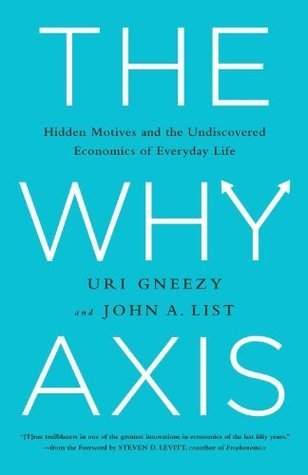
Two superstars revolutionizing economics?indeed all social science? provide breakthrough ideas for taking on big, complicated problems, using colorful stories from their travels and experiments around the world Based on groundbreaking original research, "The Why Axis" is a colorful examination of why people do what they do?observed through the lens of incentives that can spur people to achieve. Uri Gneezy and John List are like the anthropologists who spend months in the field studying the people in their native habitats. But in their case they embed themselves in our messy world to try and solve big, difficult problems, such as the gap between rich and poor students and the violence plaguing inner city schools; the real reasons people discriminate; whether women are really less competitive than men; and how to correctly price products and services. Their field experiments in the factories, communities, and shops where real people live, work, and play show how economic incentives can change outcomes. Their results will change the way we both think about and take action on big and little problems, and force us to rely no longer on assumptions, but upon the evidence of what really works.
I had chanced upon this book during one of my book hunting trips. The name of the book attracted my attention and the logline “Hidden Motives and the Undiscovered Economics of Everyday Life” made me buy it.
The book has been authored by two behavioral economists Uri Gnezy and John List. They are advocates of conducting field experiments to understand motives behind human actions and how the correct incentives can alter our behavior.
The authors have presented some of their experiments and findings as they sought to understand if women were less competitive than men; how to make American “at risk” students catch up with their rich peers, and reduce gun violence in schools; why do individuals discriminate; how to inculcate healthy habits; how could charities generate more donations; and how businesses can use field experiments to be more innovative.
Most of the experiments were carried out in the US, but the authors did visit Africa, India and China to carry out their studies.
The book is very well-written and easy to read. I learnt quite a few things and it was fun to see how incentives could influence human behavior and the effects of minor tweaks to the incentives. I am not going to discuss the experiments and findings in detail but would like to talk about some of the findings in brief.
One interesting study focused on understanding if women were less competitive than men by nature or by nurture. They studied gender roles in the US, the highly patriarchal Masai of Africa and the matrilineal Khasi people of India. And, guess what!! It’s all influenced by culture and nurture.
Next would be their experiments in the public schools of Chicago. The authors wanted to understand how to improve test scores. Personally I am still not sure if students should be provided monetary incentives to study – they themselves must realize the value of education. However, for some students, especially those from disadvantaged background, if such incentives can help improve or even save a few lives, then I think it is worth it.
I found the chapters on discrimination quite insightful. Most people would consider discrimination to be a result of prejudice or bigotry. But, discrimination is not always animus-based, it can be driven by economics or in simple terms profit. The authors claim that while animus-based discrimination is on the decline, economic discrimination is on the rise, as evident in policies of insurance companies, job offers etc.
The experiments on how charities could increase donations were amazing. While some of the findings were common knowledge, some of the innovative techniques applied to increase donations were so simple and yet so effective.
I enjoyed the business case studies at the end. I was surprised by the Netflix fiasco. I do agree with the author’s claims that running field experiments to test decisions can really save reputation and probably millions of dollars.
This was a very interesting book. Understanding what incentives can bring about the desired change in behavior can be helpful to governments, schools, charities and businesses. I understand that everybody might not find this book interesting. But those who would like to have a go, I would urge you to go ahead.
This easy-to-read book has two main themes. The first theme is that many of our behaviors are rooted in economics. For example, the authors claim that often, apparent prejudices against certain groups of people are not due to racial hatred, but are due to economics and self-interest. The second theme is that in order to maximize efficiency, productivity, or profits, it is useful to assess all of one's assumptions, and to perform "field experiments". These experiments will entail some costs in the short run, but in the long run will pay dividends.
I enjoyed this book mostly because the two authors, Gneezy and List, are practicing economists. The field that they promote in this book is called "behavioral economics". I have read a number of "pop psychology" books in the past, where all sorts of experiments elucidating human behavior are described. Well, these are the two guys who performed many of these very clever experiments.
As an example, the authors wondered why, in the United States, women seem to be less competitive than men. They performed a masterful experiment, in which they showed that competitiveness is a learned, cultural characteristic. They conducted one phase of their experiments in a region of India, where a matriarchal society raised women to be much more competitive than men.
The two authors conducted a large set of experiments in the public schools of Chicago, in areas where virtually all the children come from desperately poor--and often dysfunctional--families. Gneezy and List explored a wide range of--how can is say it otherwise, they used bribes--to students, to parents, and to mentors. They explored a variety of bribes, some with immediate gratification, others with delayed gratification, some positive, some negative. They were able to establish what types of inducements can help children in school. There is much controversy over whether extrinsic motivation (like a bribe) should be used, and whether intrinsic motivation is better. The authors explain that in such a setting, where 50% of children drop out of school before graduating, they have no intrinsic motivation.
This book is quite entertaining, and goes into just the right level of detail in describing each set of experiments. The book explores a wide range of human behavior, and often attacks our deeply-held assumptions and beliefs. The authors helped establish the field of behavioral economics, which was pretty much ignored before they began their careers. This helps to give the book an air of authority, which made it all the more enjoyable for me.
The main argument: Until quite recently, the field of economics was dominated mainly by theory-making. Specifically, economists applied their intellects to the human world, and developed abstract models to explain (and predict) the unfolding of economic events. At the heart of all this theory-making stood homo economicus—a narrowly self-interested individual who responded to incentives and disincentives in a perfectly rational way.
In the past half century, though, various economists have added new wrinkles to the field’s repertoire. To begin with, pioneering economists such as Amos Tversky and Daniel Kahneman introduced controlled lab experiments (among other things) into the fold. And these experiments succeeded in adding nuance to our understanding of economic-man (he’s not quite as one dimensional and rational as he was once taken to be), as well as texture and complexity to our understanding of economic phenomenon.
More recently, economists such as Uri Gneezy and John A. List have stepped in and showed that controlled field experiments also have a place in economics. For Gneezy and List, the world is their laboratory: the two go about slyly manipulating the natural environment in a controlled way (often fiddling with incentives and disincentives of all types) to see how we humans respond to the tweaks. Gneezy and List have been practicing this approach for upwards of 20 years now, and in this time they have helped shed light on everything from how to decrease crime rates; to how to improve school success; to how to encourage more charitable giving; to how to promote healthy living and decrease obesity; to how to set prices on products (so as to maximize profits); to how to understand (and limit) discrimination (to name but a few lines of research of theirs). And in their new book The Why Axis: Hidden Motives and the Undiscovered Economics of Everyday Life the two catch us up on their experiments and their results (while also touching on the experiments of other like-minded practitioners).
Take education, to begin with. Gneezy and List have gained a fair bit of attention recently for showing how monetary incentives can be used to help improve grades and graduation rates (particularly with at-risk students)—and even curb school violence; and here we are apprized of the ins and outs of the experiments that were used in this research. What is less well-known is that the authors have also recently become involved in a massive longitudinal study that is designed to test the effectiveness of different approaches to pre-kindergarten education. Though still in its infancy, the study has already yielded some very interesting results; and given that the researchers intend to follow their experimental subjects throughout their lives, the study should help shed a great deal of light on just what approach to early childhood education is most effective.
When it comes to charitable giving, Gneezy and List’s experiments have worked wonders in showing just how to encourage as much charity as possible—and have challenged many of the industry’s long-held beliefs in the process. The authors cover everything from how much seed-money is needed for a project to maximize donations; to how to approach follow-up requests made to established donors; to how to leverage raffles, lotteries and tontines for best success.
On the topic of business, Gneezy and List remind us how a failure to use an experimental approach can lead to business disaster (as illustrated by Netflix’ 2011 decision to modify its business model without experimental research—a decision that drove hordes of customers away, sent the company’s stock plummeting, and nearly sank the business outright). The lesson: business tweaks (including changes in pricing) should be tested in a controlled way in a small market (say a given city) before being adopted across the board (an approach that has been utilized to great effect by such companies as Intuit and Humana).
When it comes to discrimination, Gneezy and List have been able to use their experiments to reveal that much of the discrimination that happens nowadays is motivated less by hatred (or animus) as it is by plain old self-interest. Though perhaps not as threatening as outright hatred, discrimination practiced out of self-interest (known as economic discrimination) is problematic in its own right, and Gneezy and List also explore what strategies are best to curb it (this work is more important now than ever, as the internet [combined with data-driven analysis] has made economic discrimination very easy to practice--and hide).
The book is a very fun and interesting read, and Gneezy and List clearly have a knack for telling about their research in a highly entertaining way. The only issue I had with the book is that the authors occasionally exaggerate and over-state just what we can conclude from their experiments. Still, there is much of interest to be learned here, and the book is well-worth the read (just make sure you take it with a grain of salt). A full executive summary of the book is available here: http://newbooksinbrief.com/2013/11/05... A podcast discussion of the book will be available soon.
So... I've given this book three stars because there *are* some fascinating insights in here, and I've been inspired enough by reading it to make some adjustments to my own life, which is a rarity. But oh! Messrs Gneezy & List, how close you came to a career-jeopardising two-star catastrophe!
'The Why Axis' is pop-economics book in the same vein as 'Freakonomics' - it even has a quote by Levitt on the front cover - with the premise that the authors have run a series of real-life, real-time economic experiments on people all over the world to discover what makes us tick. What *really* incentivises us? What's *really* behind the gender pay gap? How can all of this information be used to fix an education crisis, or help charities thrive, or increase productivity in companies? And... it's fascinating. Absolutely fascinating.
Some of the experiments are truly remarkable. The one in particular that stood out to me are the construction of an entirely new school near Chicago to test different educational systems on children. It's brilliant, and nothing short of astonishing. Other experiments are less expensive but no less interesting, and are extremely revealing out human nature, especially western nature; although the authors do conduct a few experiments in India, Israel, Africa and China, the majority of their studies are limited to the US. But, to be honest, that was expected, and I wasn't disappointed by that.
What I was disappointed by - hugely, frustratingly disappointed by - was the weird lack of scientific rigour in the writing of this book. I'm all for easy-to-read prose in my non-fiction, and I have no problem with personal anecdotes for the purposes of illustration, but so often I was jarred out of reading by sentences that had no place in a book about economics.
Take the following example: "There is a productive place for everyone in our vibrant world economy." Now... sure. Maybe. I'd like that to be true. But, in a book about economics, I would like a broad, sweeping statement like that to be backed up by some sort of evidence. Messrs Gneezy & List do not provide this, and so the sentence comes across as sweet, naive and absolutely out-of-place. Elsewhere, in a section discussing the use of big data, they provide an anecdote about a man with a diabetic friend who subsequently started to receive advertisements for diabetic treatment. The authors conclude that "this is scary stuff". Is it? I mean, I don't even really disagree, but that's a value judgement, being presented as fact.
These may seem like minor issues, but they really undermine the validity of the arguments being put forward. For a book that is basically about the collection and application of data, making value declarations in the absence of data seems just daft; worse, it's lazy writing. And the general sense of naïveté is compounded by comments like "We were surprised to learn that [charity] donors more frequently open an envelope when the kid on it looks like them". Really? That surprised you? I mean, I'm no scientist, and have only a layman's understanding of either sociology or genetics, but that is not at all surprising to me.
All in all, this is an interesting book - really, truly it is. I've learned a lot from it, and I'll probably be quoting elements to my friends for months to come. Messrs Gneezy & List should be proud of the experiments they've run, and I hope they continue to perform more such experiments in the future. The world needs them. I just also hope that, when they come to write the next batch of experiments up, they are able to apply the same standards to their writing as they do to their science.
Há tempos na minha fila de leitura e me arrependo de não ter lido antes.
Uri Gneezi e John List, autores do livro, aparecem com frequência em outras obras quando se trata de ciências sociais e comportamentais. Ambos economistas, eles falam da importância de se realizar experimentos de campo para observar como as pessoas reagem aos estímulos, ao invés de pressupor algo. Achei interessante como as punições e incentivos (financeiros principalmente) não geram o comportamento esperado. Outro ponto alto fica por conta dos experimentos sobre machismo e preconceito racial. Dá pra se tirar excelentes insights dos experimentos realizados, que mostram que as mulheres são sim tão produtivas e capazes de conduzir um negócio quanto um homem, e muitas vezes até melhor.
A proposta do livro é entender que os seres humanos reagem, muitas vezes, de forma completamente diferente do que é esperado, contrariando a sabedoria popular e à teoria econômica também.
Os dois últimos capítulos são fenomenais, com exemplos e experimentos no mundo dos negócios. Recomendo para quem gosta de Economia Comportamental (para estes, é leitura obrigatória na verdade), e para quem quer entender como a Economia Experimental funciona.
Well. This one was interesting. I often have trouble with behavioral-ec books as the authors seem to have totally tossed out the whole idea of preferences. They test us, decide that some of us are risk-averse, for example, and fail to maximize our monetary gains, and therefore are irrational. Totally leaving out that some of us might PREFER to minimize risk even at some loss of gain. Gneezy and List do avoid this problem; they understand that we all have preferences and differing motivations. (Yay!) However, they go to work on our motivations, and the results turn out a bit creepy. The authors do point out that many of the incentives we try to set up work like blunt instruments and do not get the results we wish for, since a better way to find out peoples' motivation is to TEST it. And I agree---it's good to see the results of our theorizing in the real world. But I am not as crazy about their insistence that the tests are paramount and THEN we try to make up a reason to explain the results. Anyway. The experiments they run were interesting. BUT, in the real world, do we REALLY want to pay kids to perform better on standardized tests? True, it worked, but how exactly do we plan to CONTINUE this? The authors take on the "glass ceiling" and study a matriarchal society, decide that women CAN be as competitive as men in such a society, and then posit that we should become more like that. Um, ok, but how exactly are we supposed to make our society more matriarchal? Would doing this improve our society? What would it do to women, to families, if EVERYONE were cutthroat competitive about careers? And are we sure that throwing things into pots is a good analog for career competitiveness? The authors really aren't following their conclusions very far down the road, it seems to me. They also aren't examining their own assumptions, even though they criticize others for the same problem. They pretty much just adopt the ruling liberal elite assumptions. And some of them it may not matter. Who doesn't want inner city kids to get a better education? But do we really all agree that women must be as competitive as men? That having men pay more for auto insurance is discrimination (in the legal, this-is-bad sense, not simple-differentiation sense). I found this sentence at the end of the book particularly chilling: "And imagine what would happen if, armed with this knowledge, governments around the world could make broad policy changes based on solid empirical tests." Now, if by this the authors mean we could get rid of government policies that don't work or that have perverse incentives, I'm all for it! (We'd have an awful lot less government!!!) But, I'm afraid the authors really mean "Just think how much better governments could nudge, bribe, and manipulate us into fitting into THEIR schemes for us!" and this, I find terrifying. This presupposes that governments, that smart Ph.D.'s, all know better than we do what is better for us, and they are proposing using science to manipulate our behavior until it fits with THEIR plans. Yikes.
For those who are not familiar with the economics literature on field experiments, this book will give you a sense of how economist carry out their tasks. The more interesting chapters are on the differences in the competitiveness between men and women and how this is (to a large degree) a product of the societies in which people live. The authors untangle the thorny issues by running experiments with the Masai tribespeople (a heavily male-dominated society) and a matrilineal (female=dominated) society in India. The penultimate chapter on experimentation in business was quite interesting, the authors make a strong pitch for utilizing experimentation (along with telling interesting anecdotes of experiments that businesses do run). I found the chapters on "economic discrimination" to be the most convoluted, mainly because what they call "economic discrimination" every other economist refers to it as price discrimination. The point of these chapters is to convince you that salespeople negotiate differently with different people (white men vs. black men, able-bodied men vs. handicapped men). A piece of advice that they give is to signal your willingness to shop around, so tell the mechanic that you are getting three other quotes on your car troubles.
The most disappointing chapters were those on education. Being familiar with this literature, the authors oversell their own results, and at the end of one of the chapters, they seem to endorse a few programs without having seen the results (essentially falling prey to one of their main criticisms of policy makers). For example, when they say the Chicago PD's transition to electronic reports led to the drop in crime, they give zero evidence for this claim. I found the chapters on charitable giving uninteresting.
Overall, they make the point that incentives are complicated, but if I were to recommend a popular economics book, I would still go with something from Tim Harford or Tyler Cowen.
Thing I liked least: the authors describe an experiment in the price discrimination chapters that can only give economist a reputation for stating the obvious. They have a white man, a white woman, a black man, and a black woman approach strangers and ask for directions to Willis Tower (formerly the Sears Tower). Lo and behold, people help the women more than they do the men, but people really don't help the black man (30% response rate vs. around 60% for the women). Then they describe how if the black man dons a suit, people will help him as much as the others. These findings should shock no one and that this experiment was even run says more about the economists than the results say about the people of Chicago.
Thing I liked most: while I am extremely critical of the price discrimination chapters, the authors do a good job in describing the complexity of economic interactions and how merchants and salespeople respond to signals about customers.
A particularly harrowing book after reading Anand Giridharadas' book "Winners Take All", which helped me see through some of the many nasty assumptions in this book. Maybe I should have just put the book down but I was ***incentivized*** to finish it so I could put it on my Goodreads (if this seems profound you may like the book...) Some highlights:
Claiming to have discovered the root cause of racism, sexism, educational inequality, etc. (throughout the book)
Only searching for "win-win" solutions because those are the "ones that stick" (230). Or maybe those are the only one's that Kenneth C. Griffin and various companies will pay for...?
Suggesting that you should experiment with tipping hotel maids to see what gets you the best service (243).
When justifying a heavily incentive based worker compensation system arguing that although this is difficult for employees, "someone has to bear losses". No mention of the company's profits to be found...(236)
The "Kenneth C. Griffin Distinguished Service Professor of Economics" lustfully praising "The Griffin Gift" and his philanthropic tendencies (79). Seems a bit like a conflict of interest and buttering up of a guy with a pretty checkered past (see during the 2009 recession)
Telling people to experiment constantly in their daily lives without mentioning the types of things that can be experimented on (last chapter). For example, say someone would like to experiment with upper bracket marginal tax rates. Seems a bit harder to implement than playing around with how factory workers in China are paid...
I believe it's time to put an end to Economic Behaviorism. What used to be fun and interesting has devolved into big government/academic plots to manipulate the masses.
The authors don't even hide their love affair with the Chicago school system and how their heroes like Arne Duncan reduced school violence (Bet you didn't know that happened). They claim to be objective, but classify anyone that thinks differently from them as having a problem that must be corrected through penalties and rewards.
Over the last decade or so, we have seen a long list of excellent books making economics more accessible to a general audience and showing how its insights can be applied in unexpected ways in policy and in daily life. Some of the authors (Tim Harford, Dan Ariely, Steven Levitt, to name just a few) have almost reached superstar status. One can thus wonder what Gneezy and List could possibly add to this list. A lot, it turns out. Gneezy and List provide us with a highly accessible survey of their own work, which is, in many ways, revolutionary - they are pioneers in the applications of Randomized Controlled Trials (RCTs) in economics. Just in the case you don't usually discuss RCTs during breakfast, let me explain in a few words what they are and why their application to economics is so revolutionary. For a long time, empirical economics had to rely on data that were collected anyway by the government: gross domestic product, public debt, unemployment, inflation, changes in the legal context (for instance, changes in unemployment benefits or in minimum wages, trade treaties) etc. This had a very unpleasant consequence: whenever an economist tried to examine the impact of a policy change (say, for instance, the introduction of minimum wages) on a variable of interest (unemployment), he could never be sure that the observed effect was indeed due to the policy variable of interest. For instance, if a minimum wage is introduced around the same time as a reduction in tariffs, it may well be that the higher unemployment of low-skilled workers is due to cheap imports of products manufactured by low-skilled labour abroad. Or, conversely, if the introduction of the minimum wage goes hand in hand with a large fiscals stimulus, unemployment could actually decrease (even though it may have increased without the stimulus). Econometricians have developed a lot of extremely clever tricks to disentangle these issues. To give just one example: sometimes there is a variable that is not under the control of anyone involved, and that does allow you to identify clear causal links. For instance, in a classic paper that would have repercussions far outside academia, Steven Levitt showed how the timing of changes in abortion laws in different US states could serve as an indicator of the number of unwanted children that would not be borne, and that this would be a good predictor of crime rates two decades later. (In this case, the causal link is that unwanted children are more likely to commit crimes later in life). However, such natural experiments are not not always available for the questions that have the highest policy relevance. As a result, the fundamental problem remained that many economic variables change simultaneously, and that it is very hard to attribute causal links. When economists had to explain these issues to other scientists such as, for instance, biologists or chemists, they would typically answer: "What do you want us to do, we cannot set up laboratory experiments like you guys?" Except that you can. This was the revolutionary contribution of Daniel Kahneman and Amos Tversky on the one hand, and Vernon Lomax Smith on the other hand: they would recruit some people (usually students) willing to participate in an experiment that would simulate some real world setting of interest to economists. This approach has led to new insights, some of which have led economists to question some of the received wisdom of their profession. However, the laboratory approach is not without problems of its own. One central issue is the artificiality of the setting: people know that they are part of an experiment, and that they are being observed. And this can create a new class of problems. For instance, some experiments showed that people tended to be much more generous than economists would assumed, even if (in the setting of the experiment) they could get away with purely selfish behaviour. What researchers oversaw, was the possibility that the participants behaved as they thought the experimenters wanted them to behave. In other words, the volunteers behaved altruistically in order to please the researchers rather than the participants. This new insight can be attributed to John List, one of the authors of this book. In short, what Gneezy and List propose, is to continue performing experiments, but in the field. In their research, they would typically split a sample of people in groups (a reference group and one or more treatment groups), but without telling them that they are subject to an experiment (exactly as what happens when new medical treatments are being tested). The treatment groups would then be subject to specific incentive schemes in a natural experiment, where the stakes are real. The book gives an overview of some of the questions that were tackled by Gneezy and List, some of them in areas that you would not expect in an economics textbook: how do you make sure that parents will be in time to fetch their children at daycare, what are the determinants of discrimination, to what extent are differences between male and female behaviour due to nurture rather than nature, is there any proven way to help very young children from vulnerable family backgrounds, is it even possible to save teenagers living in poor and violent neighborhoods, how can we motivate people to donate more, etc. Of course, I will not tell the answers here. Go and read the book. It will not disappoint you, and, if you are a policy maker , a manager or a social worker, you will find ideas that you may want to apply.
A childishly written book, with frequent personal anecdotes by the authors to make larger economic points. They constantly prate on about "field experiments"; what other kinds are there? They also toe the liberal line from A to Z when they are supposed to be running scientific experiments. Not recommended.
Behavioral economics at its best - from the guys who really ignited the field and made it what it is today. It's a very entertaining read - with fun, economic experiments at every turn. These guys explore incentives much like Dubner and Levitt do in Freakonomics, but with more depth and analysis - particularly for business and public policy solutions. I highly recommend it.
Disappointed in this book as I felt it was a rehash of several other older books. I did enjoy the chapters on the difference in competition based on gender. The conclusion was this is more the effect of nurture as opposed to nature.
In Nederlands gelezen; "Alles is economie". Vind ik niet zo'n goede titel, want hele uitgangspunt van boek is juist om veldexperimenten te gaan doen. En die natuurwetenschappelijke methode van randomized controlled trials wordt pas relatief kort binnen de economie gebruikt.
Gneezy en List geven mooie (wel bekende) voorbeelden. Gneezy was co-auteur van het mooie onderzoek bij Isrealische crèches, waar een boete averrechts werkte om ouders op tijd hun kinderen op te laten halen.
Uit veldexperimenten rond discriminiatie: gehandicapten werd gemiddeld 30% meer in rekening gebracht (voor auto-reparatie) dan niet-gehandicapten. Hogere prijs valt te niet te doen door te melden: "ik wil vandaag drie verschillende offertes opvragen." [https://core.ac.uk/download/pdf/67410... Toward an Understanding of Why People Discriminate: Evidence from a Series of Natural Field Experiments, Gneezy/List/Price]
En vooral onverdraagzaamheid/discriminatie als de discriminerende persoon meent dat de gediscrimineerde persoon iets te kiezen heeft (zoals homoseksualiteit vs huidskleur).
p255: Koers Netflix stort in na Qwikster debacle: "maakt duidelijk hoe kostbaar het kan zijn om geen experimenten te doen"(Netflix had eerst in kleine pilot/deelmarkt experiment moeten doen)
p279: Waarom experimenteren bedrijven niet vaker? Managers houden graag machtpositie, bureaucratie, men denkt zelf antwoord al te hebben.
Naar experimenteer-cultuur is niet makkelijk; nodig is "gedurfd leiderschap, training en praktische ervaring"
First, it serves basically as a long marketing promo for the authors’ commercial services in designing and evaluating field experiments. While ostensibly offering several examples of how people think/behave based on real-world controlled experiments, what they all have in common is that the authors can conduct field experiments in a variety of sectors (“hire us just like X and Y did and you’ll see results!”).
Second, though I am a fan of the spate of books on behavioral economics, this one pales by comparison to Predictably Irrational by Dan Ariely, Drive by Daniel Pink, Switch by Chip & Dan Heath, Sway by Ori Branfman, Blink by Malcolm Gladwell, or Freakonomics by Steven Levitt (who wrote an intro for this book). Any one of those is a far more interesting and insightful read, with fewer flaws in logic or exposition. They each taught me something, while The Why Factor only revealed that the authors are really adept at really impressive field experiments....see first point!
Finally, I found the not so subtle racism offensive. In chapters about discrimination, they differentiate between discrimination based on “animus” (i.e., “I don’t like people who are ____”) which is supposedly very rare vs. economically based discrimination (“I’m gonna charge ____ people more because I’ll make more money”). That distinction seems academic and, in the post-Trump world, dangerous. Even worse was the cringe-worthy recounting of one of the authors’ house visits in oh-so-scary neighborhoods of Black and Latinx Chicagoans.
I read this book because I teach economics and I will be teaching a media literacy class next year. I hoped this book might give me some material to work with. I guess I was a little disappointed, but it wasn't a bad book. The author's thesis is that people should do field experiments to help them answer economic questions, or almost any question at all. The book is filled with examples of these experiments and how they were helpful. For instance, the author worked with a winery to help the owner decide on the best price for a bottle of wine. Every day the price was changed - $10 one day, $20 on the second day, and $40 on the third day. The experiment revealed not only maximum profit at $20, but the winery even sold more bottles when the wine was marked at $20 than they sold when the very same wine was marked at $10. These kinds of experiments can be used for almost any problem. When I was working on a masters in education, we called these experiments action research, and they can certainly be used in the classroom. This book wasn't earth-shattering, but it was easy to read and it used multiple examples to help the reader understand its basic idea.
This book was written very simplistically, making it approachable for a non-economics person (which, I think, was their purpose). I think that in many cases, they oversimplified a lot of issues, making it seem like their experiments all led to easy and straightforward conclusions. For example, the issue of early childhood education is a lot more nuanced than how they describe it. However, it still brought up a lot of interesting ideas, and drove home their point (very repetitively) that economists should do more experiments in the real-world. It would be a good foray into economics for someone with no prior knowledge of it (sort of like Freakonomics).
A few things I learned/thought about because of this: * using money as an incentive can backfire (ex: late childcare pickups, recycling cans) * girls are naturally less competitive bc of the culture they were raised in * paying students improves their grades -- the achievement gap is due to motivation * there is a difference between economic and racial discrimination (the difference between refusing a loan bc of credit vs bc of race)
Another book in my reading on behavioral economics. This book’s aim is to promote the use of field experiments to find ways to “substantially alter the lives of people around the world.” ( p243) A noble thought!
The author tells about how we need to just NOT accept assumptions. Doing things the same old way is not often best.
There are chapters that talk about different kinds of field experiments that have been done by this author or by others subscribing to this rejection of status quo, in the fields of business, education, entertainment, charity, and more.
I was particularly interested in how advertising joined up with behavioral economics to find out how charitable solicitations could be made more productive. A pretty face doing the asking! A same-race sad face! An immediate vs a delayed gratification or thank you!
There were also too-close-to-home discussions of females not negotiating competitively for salary, or how males are more likely to be financial risk takers.
While not a perfect study, it's a great overview of how and why experimental studies can and should be done, and how the concepts used in economics can apply to other fields. I do wish they'd been more clear in the section on education, because they only had short-term results to discuss, but the overall book was well worth reading. Some readers have criticized the book for stating "the obvious," but the point that I think the authors were making is that we should question WHY these things are "the obvious," and take a look at the effects. If you're charging people "not like you" more money for things, or giving them incorrect information in order to get rid of them, that has consequences. If you're charging someone in a wheelchair more for car repairs, that has consequences. If you're assuming that a child has career or educational limits which are largely based on your own nurturing, that has consequences. So, because it asks a lot of good questions and answers at least a few, it's worth four stars.
Clever exploration of which incentives work. It is however focused on extrinsic motivators except for the tapping of intrinsic motivation only. A couple of questions arose: how would their advice work in low trust environments? Elsewhere it’s been discovered that similar techniques flop in corporate cultures where management communication and decisions are viewed suspiciously. Another question is whether you tell a white lie with regards to the current status of funds in a charitable campaign. Though it’s briefly addressed, how much of the “loss avoidance” messaging should be used I.e negative messaging, the stick versus positive, desired outcome type messaging? Example: “Watch the ball all the way into your hands and you’ll keep the bonus” versus “Don’t drop the ball or else you’ll lose the bonus”. Perhaps this is part of future experiments. However I think the key is which messaging would affirm the family, charity or corporate values. Do you want to have an environment of loss of esteem or an environment of mutual support and belonging?
This book discussed many field experiments with the purpose of understanding what incentivizes people to act in certain ways. These economists explored whether women are less competitive than men (and if by nature or nurture), how to help at risk students catch up with their rich peers, why individuals discriminate, how to encourage healthy habits, how could charities generate more donations, and how businesses can use field experiments to be more innovative.
While I did not agree with everything they did, such as using monetary incentives to encourage students to better in school, most of their findings were very insightful, such as how to get people to save more for retirement and how to get people to donate more to your cause.
Overall, I learned a lot from this book and it was easy to read.
I was honestly quite smitten with this book, reading it thoroughly and taking notes on every chapter. Being somewhat familiar with behavioural economics and psychology, there were a few phenomenons I was familiar with, but there were also a lot of interesting new takes - things that make a lot of sense, but I would not have thought about. Ex: disabilities & price/economic discrimination, tontine method for charitable giving, etc. I thoroughly enjoyed the book and thinking, but I think the formatting could use some work. The chapters are separated weirdly, and there were a few concepts (ex: loss aversion) that popped up many times throughout the book, but was only addressed in one of the last few chapters.
Overall, really great read, and has inspired me to do some more reading on behavioural econ & economic experiments in real life.
The Why Axis: Thoughts by Uri Gneezy and John List
This book takes on a journey to illustrate that economics is not just numbers and formulae; charts and hypothesis. To understand economics, we need to attempt to understand the driver of economic decisions and that is people. You and me and the communities in which we live. If we can understand human motivation society would be better able to incentives to not only better motivate us as individuals but to provide solutions and betterment for society. The full title of the book hints at what the authors are attempting to achieve, “The Why Axis: Hidden Motives and The Undiscovered Economics of Everyday Life.” To me, the sign of true genius is the ability to see things that are completely obvious but to which everyone else is blind. ~ Steven Levitt https://linomatteo.wordpress.com/2022...
Favorite book of the year so far: "The Why Axis" delivers the goods on one of my favor topics of study, behavioral economics, revealing how subtle changes in incentives can significantly alter human behavior.
While they use a multitude of real-world experiments to demonstrate their points, one of my favorite examples revolves around how different types of incentives affect teachers' performances in schools. They show that the promise of a bonus led to a significant improvement in student test scores, thereby illustrating the power of economic incentives in real-world scenarios.
My fave, however, was their research on why different groups (race, ethnicity, gender, etc.) get quoted different prices at car dealerships. Totally—and conclusively—turned what I thought I knew on its head.
Good. Quite good. Written by two economists, this is informative for the general audience and especially inspiring for the aspiring economic researcher. Gneezy and List work well to blend anecdotes and personal experiences with economic issues (on education, healthcare, charitable giving, discrimination, and more) for an engaging and relatively entertaining read. It leaves the reader wondering what clever little field experiments are there that have yet to be conducted and more acutely observant of the unexplainable.
"John: But how do you know that's the case? What's the evidence for that? I haven't been able to find any research on this... Him: (a little exasperated) I know because I learned it from my former boss, who was in fundraising for a long time himself. This is what we always do. Trust me. John: (equally exasperated) But how did ~he~ know?"
Very interesting discussion of experimental economics.
This book is decent. Some chapters were more interesting than others, and it really feels more like a collection of essays than a cohesive book.
I appreciate the fact that the authors are not directly prescriptive other than to say one should experiment before big decisions. Too often in “pop” econ books the author lets his/her political views dictate the economics (looking at you, George Mason economists) rather than letting the economic theory speak for itself.
I’m interested in seeing how some of the longer term work described in the book turns out, and would honestly enjoy seeing the chapters on discrimination rewritten to better reflect the current political environment.
The name of the book has nothing to do with the content in my opinion. It could've been called " how economists design and conduct field experiments". That's exactly what is in this book- a little too much detailing about setting up field experiments, a little too less of the insights it promises. I'd read a summary of the book unless you are interested in the exact topics of experiments conducted mostly on Americans (except a couple of examples from Israel and China). This book was released globally, but the content never cautions about the inherent bias or that experiment results might be different for a different ethnicity, cultural context etc. There are much better books on behavioral economics out there.
I was excited to hear about this book because it has a great concept and a field I’m particularly interested in. But this book is terrible. More precisely, the writing is terrible. Slow, almost painful. And the authors don’t really give any bold results from experiments - despite their promise and the premise of the intro that this is groundbreaking work. Maybe their academic papers are groundbreaking, but this book was snooze enduring.
I also felt like they made a lot of unfounded statements or misconstrued statements of fact or stated hypothesis as true without testing them. Which was weird for experimentalists.