

What do you think?
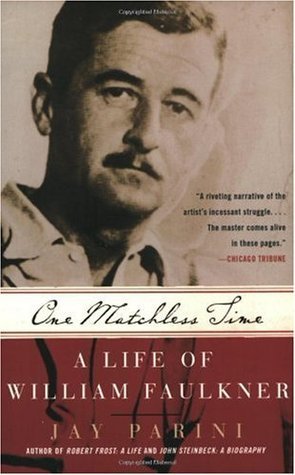
One Matchless Time: A Life of William Faulkner
“Nothing less than spellbinding . . . It’s an eye-opener. Anecdotal without being tawdry, analytical without being academic, it captures the essence of Faulkner’s life with the narrative drive of a novel.” — Houston Chronicle “A splendid life of William Faulkner . . . Not only readable but downright enthralling.” — Seattle Times William Faulkner was a literary genius, and one of America's most important and influential writers. Drawing on previously unavailable sources--including letters, memoirs, and interviews with Faulkner's daughter and lovers--Jay Parini has crafted a biography that delves into the mystery of this gifted and troubled writer. His Faulkner is an extremely talented, obsessive artist plagued by alcoholism and a bad marriage who somehow transcends his limitations. Parini weaves the tragedies and triumphs of Faulkner's life in with his novels, serving up a biography that's as engaging as it is insightful.
528 pages, Paperback
First published January 1, 2004
About the author
Jay Parini
187 books159 followersJay Parini (born 1948) is an American writer and academic. He is known for novels and poetry, biography and criticism.
Ratings & Reviews
Friends & Following
Create a free account to discover what your friends think of this book!
Community Reviews
Displaying 1 - 30 of 53 reviews

November 20, 2025
Great authors who come out of nowhere : the Brontes, D H Lawrence, Janet Frame, Truman Capote. And maybe the poster boy is William Faulkner, “a shy boy from a small town in Mississippi, the poorest state in the country” who dropped out of school at age 16.
He had a few low paid jobs but mostly didn’t, his parents at some point gave up on him. World War One came around and he thought well, I’ll join the Royal Air Force, that will be glamourous and exciting. So he made it up to Toronto and spun them a lot of stories and even though he was short (5 foot five) it was spring 1918 and at that point they were taking anyone they could find. So he got up to the point where he was allowed to do that thing where they start the plane by pulling down the big propeller, and then the war stopped.
He came home and spun a whole lot of tall tales about flying planes and barnstorming and looping the loop, none of it was true. At that point he reminded me of Bob Dylan who came to New York to be a folk singer and told everyone who listened that he’d run away to join a carnival when he was 13 and he was an orphan. That was a pack of lies too.
But Bob started writing his songs and Faulkner started writing his books and nothing would stop them. In Singin’ in the Rain Gene Kelly’s character keeps crashing into Broadway agents’ offices yelling “Gotta sing! Gotta dance!” With Faulkner it would have been “Gotta write difficult novels! Gotta write more difficult novels!”
He never quit, he never decided to get a proper job and write in his spare time, he never got discouraged. They all laughed, but look what happened! Nobel Prize for Literature! Stick that in your pipe and smoke it! (Note to all other people who decide all they want to do is write obscure difficult novels : it doesn’t always work out like that.)
The early novels didn’t sell and made no money. After three fairly normal ones he suddenly came up with The Sound and the Fury and As I Lay Dying – boom, just like that! Two masterpieces! Still no sales, no money. So he thought he’d write a trashy bestseller, which was the notorious Sanctuary, and he was right, that one sold.
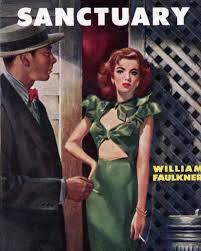
Did he see the light? Nope, he went straight back to writing another obscure difficult one.
By now it was 1931 and he discovered that short stories made way way more money than novels IF you could get them into somewhere like the Saturday Evening Post. One story there got you $750! ($16,000 in today’s money). Well now, that was something.
By 1931 he had bought a big old house in Oxford, his hometown, which he never left. And by now he had a wife and a retinue of servants – cook, maids, gardeners, etc – but this was a very Southern setup, none of these black servants were paid! Instead Faulkner gave them food, clothes and lodging and picked up all their medical bills. It was okay by them. This went on for years.
He loved horses, riding on horses, and fox hunting on horses. He liked fixing up his old big house.
THE CRITICS
One critic on Light in August (1932) : “there cannot be the slightest doubt of his meaning and sympathies. He is engaged in the not very popular task of criticizing the fundamental assumptions of his own people
The Oxford Eagle (the local paper) said : Faulkner, with an excellent mechanical turn, makes airplane models complete in every detail; he is an excellent artist. If ever his writing ability should fail him, he could make a living as a sign-painter.
HOLLYWOOD SAVED HIS BACON
In 1934 Howard Hawks called and offered one thousand dollars per week for an undetermined period to write scripts for the moving pictures. Faulkner thought for a minute and said yes.
Faulkner had a very long and lucrative Hollywood career but really didn’t achieve too much. He helped write dozens of scripts but hardly ever ended up with a screen credit. (That was true for most screenwriters.) The big pictures he had a credit for were To Have and Have Not (1944) and The Big Sleep (1946).
OBSCURE AND DIFFICULT? SAY IT ISN'T SO!
Our author Jay Parini on Absalom! Absalom!
Another masterpiece, and one in which the Faulknerian language reaches its baroque apogee, a kind of strange magniloquence, almost a metalanguage or counterspirit, running parallel to the known world of signifying but also beyond it, a distant harmonic.
Another view from Malcolm Cowley : WF writes in a
strained, involved, ecstatic style in which colloquialisms and deliberate grammatical errors and mingles with words too pretentious even for Henry James
And in Time magazine :
the strangest, longest, least readable, most infuriating and yet in some respects the most impressive novel that William Faulkner has written
(And Absalom! Absalom! is the next one I want to read!)
SOME OTHER OPINIONS
Earle Birney :
Two writers have been struggling with each other for a long time inside the skin of WF. One of them is a stylized and morbid mystic attempting a sequence of novels on the scale of an epic. The other is a sharp and brilliant narrator of short stories.
Alfred Kazin : Faulkner wrote like
a wilful sullen child in some gaseous world of his own, pouting in polysyllabics, stringing truncated paragraphs together like a dirty wash, howling, stumbling, losing himself in verbal muck.
Come on Alfred, tell us what you really think – no more beating around the bush!
EVENTUALLY THEY REALISED HE WAS AN AUTHENTIC AMERICAN GENIUS
By 1945 “all his books except Sanctuary were out of print” – five years later he was awarded the Nobel Prize for Literature. After that tourists come flocking to Oxford, Mississippi
They did their best to get a glimpse of the great man, often waiting in his driveway with cameras. Once a small gaggle of tourists arrived just as Faulkner had gone out to sweep the driveway with a broom. He was wearing a straw hat and overalls… “Have you seen Mr Faulkner?” one of the tourists asked. “Nope. Ain’t seen ‘im. Been here sweepin’ all day an’ I ain’t seen him a-tall.”
FAULKNER IN LATER LIFE
He was an almighty alcoholic all his life and it just got worse and worse, to the point where it became a kind of gruesome comedy. Because as well as needing half a bottle of whisky every morning just to get going, he was also quite obsessed with fox hunting (it’s not just an English thing it seems). It therefore is not so surprising that he began to fall off his horse quite a lot. So between the dipsomaniac collapses requiring hospitalization and the cracked skulls and clavicles requiring hospitalization he was a well-known frequent flyer at all local hospitals.
A BEAUTIFUL SUMMARY BY JAY PARINI
So how did William Faulkner manage to transform his little “postage stamp” of a county into an imaginative space where he could roam happily over several decades, creating a vast anthology of human experience from limited materials?
Well, that is what his compelling compassionate book tries to explain. He goes on :
Faulkner took huge risks in his fiction, reaching far and wide for effects, daring incoherence itself, believing that he could and would snatch pieces of order from the general chaos of experience too. Faulkner demands a readerly patience, a willingness to turn a blind eye to absurdities and periodic confusions, a tolerance for writing that occasionally fails to reach a minimal standard of clarity and cohesion.
Oh dear! With friends like this who needs enemies? But don’t despair….
The confusions of the text almost always dissolve after several readings.
That’s okay then.
RECOMMENDED
This was just what I wanted from a Faulkner biography. It has inspired me to plough on through some more of these slightly terrifying novels. But apparently the short stories are a stroll in the park so I think I’ll start with those.
He had a few low paid jobs but mostly didn’t, his parents at some point gave up on him. World War One came around and he thought well, I’ll join the Royal Air Force, that will be glamourous and exciting. So he made it up to Toronto and spun them a lot of stories and even though he was short (5 foot five) it was spring 1918 and at that point they were taking anyone they could find. So he got up to the point where he was allowed to do that thing where they start the plane by pulling down the big propeller, and then the war stopped.
He came home and spun a whole lot of tall tales about flying planes and barnstorming and looping the loop, none of it was true. At that point he reminded me of Bob Dylan who came to New York to be a folk singer and told everyone who listened that he’d run away to join a carnival when he was 13 and he was an orphan. That was a pack of lies too.
But Bob started writing his songs and Faulkner started writing his books and nothing would stop them. In Singin’ in the Rain Gene Kelly’s character keeps crashing into Broadway agents’ offices yelling “Gotta sing! Gotta dance!” With Faulkner it would have been “Gotta write difficult novels! Gotta write more difficult novels!”
He never quit, he never decided to get a proper job and write in his spare time, he never got discouraged. They all laughed, but look what happened! Nobel Prize for Literature! Stick that in your pipe and smoke it! (Note to all other people who decide all they want to do is write obscure difficult novels : it doesn’t always work out like that.)
The early novels didn’t sell and made no money. After three fairly normal ones he suddenly came up with The Sound and the Fury and As I Lay Dying – boom, just like that! Two masterpieces! Still no sales, no money. So he thought he’d write a trashy bestseller, which was the notorious Sanctuary, and he was right, that one sold.
Did he see the light? Nope, he went straight back to writing another obscure difficult one.
By now it was 1931 and he discovered that short stories made way way more money than novels IF you could get them into somewhere like the Saturday Evening Post. One story there got you $750! ($16,000 in today’s money). Well now, that was something.
By 1931 he had bought a big old house in Oxford, his hometown, which he never left. And by now he had a wife and a retinue of servants – cook, maids, gardeners, etc – but this was a very Southern setup, none of these black servants were paid! Instead Faulkner gave them food, clothes and lodging and picked up all their medical bills. It was okay by them. This went on for years.
He loved horses, riding on horses, and fox hunting on horses. He liked fixing up his old big house.
THE CRITICS
One critic on Light in August (1932) : “there cannot be the slightest doubt of his meaning and sympathies. He is engaged in the not very popular task of criticizing the fundamental assumptions of his own people
The Oxford Eagle (the local paper) said : Faulkner, with an excellent mechanical turn, makes airplane models complete in every detail; he is an excellent artist. If ever his writing ability should fail him, he could make a living as a sign-painter.
HOLLYWOOD SAVED HIS BACON
In 1934 Howard Hawks called and offered one thousand dollars per week for an undetermined period to write scripts for the moving pictures. Faulkner thought for a minute and said yes.
Faulkner had a very long and lucrative Hollywood career but really didn’t achieve too much. He helped write dozens of scripts but hardly ever ended up with a screen credit. (That was true for most screenwriters.) The big pictures he had a credit for were To Have and Have Not (1944) and The Big Sleep (1946).
OBSCURE AND DIFFICULT? SAY IT ISN'T SO!
Our author Jay Parini on Absalom! Absalom!
Another masterpiece, and one in which the Faulknerian language reaches its baroque apogee, a kind of strange magniloquence, almost a metalanguage or counterspirit, running parallel to the known world of signifying but also beyond it, a distant harmonic.
Another view from Malcolm Cowley : WF writes in a
strained, involved, ecstatic style in which colloquialisms and deliberate grammatical errors and mingles with words too pretentious even for Henry James
And in Time magazine :
the strangest, longest, least readable, most infuriating and yet in some respects the most impressive novel that William Faulkner has written
(And Absalom! Absalom! is the next one I want to read!)
SOME OTHER OPINIONS
Earle Birney :
Two writers have been struggling with each other for a long time inside the skin of WF. One of them is a stylized and morbid mystic attempting a sequence of novels on the scale of an epic. The other is a sharp and brilliant narrator of short stories.
Alfred Kazin : Faulkner wrote like
a wilful sullen child in some gaseous world of his own, pouting in polysyllabics, stringing truncated paragraphs together like a dirty wash, howling, stumbling, losing himself in verbal muck.
Come on Alfred, tell us what you really think – no more beating around the bush!
EVENTUALLY THEY REALISED HE WAS AN AUTHENTIC AMERICAN GENIUS
By 1945 “all his books except Sanctuary were out of print” – five years later he was awarded the Nobel Prize for Literature. After that tourists come flocking to Oxford, Mississippi
They did their best to get a glimpse of the great man, often waiting in his driveway with cameras. Once a small gaggle of tourists arrived just as Faulkner had gone out to sweep the driveway with a broom. He was wearing a straw hat and overalls… “Have you seen Mr Faulkner?” one of the tourists asked. “Nope. Ain’t seen ‘im. Been here sweepin’ all day an’ I ain’t seen him a-tall.”
FAULKNER IN LATER LIFE
He was an almighty alcoholic all his life and it just got worse and worse, to the point where it became a kind of gruesome comedy. Because as well as needing half a bottle of whisky every morning just to get going, he was also quite obsessed with fox hunting (it’s not just an English thing it seems). It therefore is not so surprising that he began to fall off his horse quite a lot. So between the dipsomaniac collapses requiring hospitalization and the cracked skulls and clavicles requiring hospitalization he was a well-known frequent flyer at all local hospitals.
A BEAUTIFUL SUMMARY BY JAY PARINI
So how did William Faulkner manage to transform his little “postage stamp” of a county into an imaginative space where he could roam happily over several decades, creating a vast anthology of human experience from limited materials?
Well, that is what his compelling compassionate book tries to explain. He goes on :
Faulkner took huge risks in his fiction, reaching far and wide for effects, daring incoherence itself, believing that he could and would snatch pieces of order from the general chaos of experience too. Faulkner demands a readerly patience, a willingness to turn a blind eye to absurdities and periodic confusions, a tolerance for writing that occasionally fails to reach a minimal standard of clarity and cohesion.
Oh dear! With friends like this who needs enemies? But don’t despair….
The confusions of the text almost always dissolve after several readings.
That’s okay then.
RECOMMENDED
This was just what I wanted from a Faulkner biography. It has inspired me to plough on through some more of these slightly terrifying novels. But apparently the short stories are a stroll in the park so I think I’ll start with those.
June 19, 2019
As a by-the-numbers biography, this is totally fine. Having recently read everything Falky ever wrote, I was interested in learning about his life. Parini does his job well in that respect. You learn Falky as he was: the inveterate liar, youthful outsider, raging alcoholic, inveterate adulterer and horse-faller-offer. In fact, by the last chunk of the book and Falky's life, he is falling off horses so goddamn much that it's ridiculous and you can't wait for him to die. Anyway, he was a complex guy and obviously had some issues. The other part of this work is tying Falky's literary output which Parini also does pretty well. You'll learn some interesting things about the novels, especially the "core" middle ones like "Fury" and, best of all, since literary interpretation is largely dumb without the author's input, you get a lot of Falky's views on what he wrote and how and why. Those are the best bits. Where Parini falters is the humdrum assessment of everything Faulkner wrote after, say, "Intruder". All the later works are dismissed wholesale in a kind of aping of the critical views of the time. Whatever. Those books are all great, too, and I think warrant closer inspection especially given Falky's mounting personal and psychological issues during those waning years. My only quibble. That and the sudden ending that missed a chance for some good discussion.
January 28, 2024
An excellent introduction to the life and times of Faulkner. A great help leading into a broad range of Faulkner reading. Good survey of his family history and the background of Northern Mississippi from Civil War to WW2. The reader will come away with a better appreciation for the criticality of time and place for Faulkner, that "little postage stamp" of earth, Yoknapatawpha County, the world that he created and populated with hundreds of fascinating characters over the span of four decades. Recommended.

May 31, 2019
“I discovered that my own little postage stamp of native soil was worth writing about and that I would never live long enough to exhaust it, and that by sublimating the actual into the apocryphal I would have the complete liberty to use whatever talent I might have to its absolute top.”
“It is my ambition to be, as a private individual, abolished and voided from history, leaving it markless, no refuse save the printed books.”
“In Faulkner, the grotesque typically emerges in terms of the horrific. He presents a wide array of twisted old spinsters, compulsive sadists, eccentric lovers of beasts, incestuous brothers and fathers, unfeeling mothers, and toothless wonders who revel in the base forms of human behavior.”
In this outstanding biography, the author mentions that one does not read Faulkner, but rereads him. I think that is an excellent observation and it is one that highlights my failing, in regards to this difficult southern author. Yes, I have read and enjoyed several of his classic novels, but I have only taken a peek, a mere glimpse at what, this writer is trying to convey, so my appreciation is limited. I better get busy, catching up with his "must-read" books, plus the inevitable "rereading".
I knew very little about Faulkner's life, which was the reason I wanted to read this bio and I can't imagine another biographer doing a better job, casting an intense spotlight on this man's history, which is endlessly fascinating. Parini is also an excellent writer, in his own right, so the narrative hums along like a song:
“In the end, however, William Faulkner stands alone, a master of tragic farce, a wild-eyed comedian, a raconteur of the highest order, still sitting around the campfire in the Big Woods, still talking in the thousands of pages that remain his legacy.”
“It is my ambition to be, as a private individual, abolished and voided from history, leaving it markless, no refuse save the printed books.”
“In Faulkner, the grotesque typically emerges in terms of the horrific. He presents a wide array of twisted old spinsters, compulsive sadists, eccentric lovers of beasts, incestuous brothers and fathers, unfeeling mothers, and toothless wonders who revel in the base forms of human behavior.”
In this outstanding biography, the author mentions that one does not read Faulkner, but rereads him. I think that is an excellent observation and it is one that highlights my failing, in regards to this difficult southern author. Yes, I have read and enjoyed several of his classic novels, but I have only taken a peek, a mere glimpse at what, this writer is trying to convey, so my appreciation is limited. I better get busy, catching up with his "must-read" books, plus the inevitable "rereading".
I knew very little about Faulkner's life, which was the reason I wanted to read this bio and I can't imagine another biographer doing a better job, casting an intense spotlight on this man's history, which is endlessly fascinating. Parini is also an excellent writer, in his own right, so the narrative hums along like a song:
“In the end, however, William Faulkner stands alone, a master of tragic farce, a wild-eyed comedian, a raconteur of the highest order, still sitting around the campfire in the Big Woods, still talking in the thousands of pages that remain his legacy.”

November 26, 2017
"If my book is successfull, it will bring readers where they belong, to Yoknapatawpha County"
Esta é a frase que encerra esta bem estruturada e interessante biografia, cujo ângulo definidor é a obra do biografado, procurando perceber como a vida deste determinou, influenciou e configurou aquilo pelo qual o próprio pretendia em exclusivo ser conhecido, reconhecido e lembrado: pelos livros que lhe sobreviveriam.
Não é assim um exercício de voyeurismo, de interesse exclusivo, mais ou menos assumido, no percurso de vida de William Faulkner desligado da sua arte e do que deixou para a humanidade, só para gáudio das curiosidades e intenções menos nobres. É um estudo da sua obra, dedicando-se com relativa profundidade a cada um dos romances que a integram, partindo do homem, das suas contingências pessoais e envolvência geográfica, sociológica e histórica, das tensões criadas entre o que pretendia ser e o que foi efectivamente, do saudosismo por um tempo, por um modo de vida que nunca existiu mas que sempre almejou alcançar, do conservadorismo inerente polvilhado de um pendor humanista que de algum modo conflituava com a imagem que projectava como ideal.
De tudo isto, de todo o sofrimento, de todos grilhões que o detiveram de uma existência eventualmente mais feliz, nasceu o génio literário, que deixou para todos nós, firmada e perpetuada numa bela escrita, nem sempre clara, nem sequer gramaticalmente correcta, sempre exigente, uma cristalização da angústia universal da existência humana.
E só por ter sido a fonte, a inspiração e o impulso para a criação artística que o atormentou, é que a vida pessoal de Faulkner passa a ser relevante.
Mas por isso mesmo, diria eu, eventualmente à excepção de obrigações académicas e/ou profissionais que poderão determinar a sua leitura, só quem já "esteve, gostou de estar e pretende regressar "a Yoknapatawpha County é que se deterá, se interessará e despenderá tempo a ler esta biografia.
E quem o fizer, não dará seguramente o seu tempo por perdido.
Esta é a frase que encerra esta bem estruturada e interessante biografia, cujo ângulo definidor é a obra do biografado, procurando perceber como a vida deste determinou, influenciou e configurou aquilo pelo qual o próprio pretendia em exclusivo ser conhecido, reconhecido e lembrado: pelos livros que lhe sobreviveriam.
Não é assim um exercício de voyeurismo, de interesse exclusivo, mais ou menos assumido, no percurso de vida de William Faulkner desligado da sua arte e do que deixou para a humanidade, só para gáudio das curiosidades e intenções menos nobres. É um estudo da sua obra, dedicando-se com relativa profundidade a cada um dos romances que a integram, partindo do homem, das suas contingências pessoais e envolvência geográfica, sociológica e histórica, das tensões criadas entre o que pretendia ser e o que foi efectivamente, do saudosismo por um tempo, por um modo de vida que nunca existiu mas que sempre almejou alcançar, do conservadorismo inerente polvilhado de um pendor humanista que de algum modo conflituava com a imagem que projectava como ideal.
De tudo isto, de todo o sofrimento, de todos grilhões que o detiveram de uma existência eventualmente mais feliz, nasceu o génio literário, que deixou para todos nós, firmada e perpetuada numa bela escrita, nem sempre clara, nem sequer gramaticalmente correcta, sempre exigente, uma cristalização da angústia universal da existência humana.
E só por ter sido a fonte, a inspiração e o impulso para a criação artística que o atormentou, é que a vida pessoal de Faulkner passa a ser relevante.
Mas por isso mesmo, diria eu, eventualmente à excepção de obrigações académicas e/ou profissionais que poderão determinar a sua leitura, só quem já "esteve, gostou de estar e pretende regressar "a Yoknapatawpha County é que se deterá, se interessará e despenderá tempo a ler esta biografia.
E quem o fizer, não dará seguramente o seu tempo por perdido.

September 19, 2022
I enjoyed Parini’s biography of John Steinbeck; this one not so much. Didn’t convince me that Faulkner’s overwrought, obsessive fiction merits a re-read.

September 23, 2008
I really liked this book
I approached it with jaded eyes because I didn't particlarly care for Jay Parini's biography of John Steinbeck. That book wasn't bad; it just didn't do a whole lot that was original except it its interpretations of some of Steinbeck's texts. I didn't learn much from Parini's Steinbeck that I hadn't already learned from Jackson J. Benson's biography, published a number of years earlier.
Such was not the case with Parini's 'One Matchless Time," his Faulkner biography. Parini was much more thorough than some other biographies I have read--detailed without being too detailed, giving a sense of the author, his world, and the times in which he lived. His analyses of the novels were good, too, presenting major critical opinions, and weaving his own interpretations, interpreting them as a biographer.
I came away with a better understanding of Faulkner at a number of levels. I recommend this book to anyone who admires Faulkner and to anyone who enjoys reading biography.
I approached it with jaded eyes because I didn't particlarly care for Jay Parini's biography of John Steinbeck. That book wasn't bad; it just didn't do a whole lot that was original except it its interpretations of some of Steinbeck's texts. I didn't learn much from Parini's Steinbeck that I hadn't already learned from Jackson J. Benson's biography, published a number of years earlier.
Such was not the case with Parini's 'One Matchless Time," his Faulkner biography. Parini was much more thorough than some other biographies I have read--detailed without being too detailed, giving a sense of the author, his world, and the times in which he lived. His analyses of the novels were good, too, presenting major critical opinions, and weaving his own interpretations, interpreting them as a biographer.
I came away with a better understanding of Faulkner at a number of levels. I recommend this book to anyone who admires Faulkner and to anyone who enjoys reading biography.

July 23, 2011
I just finished this wonderful biography and want to recommend it to anyone who has an interest in Faulkner. The book reviews each book that he wrote, some in more detail than others, but all of them are covered. It also covers his life in detail - including his hospitalizations due to drinking and his personal struggles - yet it is not an exposé. I have read seven of Faulkers novels and this book has increased my interest in reading all the Mississippi novels, if not ""A Fable,"" ""Pylon,"" and ""Mosquitos."

January 19, 2026
William Faulkner was one of the literary idols of my youth—late high school and college years. I think it was the difficult yet highly rewarding prose that caused my fascination with Faulkner, particularly with one of his major novels, Absalom, Absalom! There also was probably a component of self-conceit in it—pride of being able to appreciate complex prose. Anyway, over fifty years later, I read Jay Parini's One Matchless Time—an exhaustive, full of minute details, and well-referenced (over 50 pages of notes) biography of William Faulkner.
In addition to documenting all major and minor events of Faulkner's life, the author includes detailed literary analyses of all his novels and many short stories. It is far beyond my competencies to comment on these, so I will mainly use the author's words. There are several main motifs of this monumental biography. First, the author shows the various personas that William Faulkner was creating and cultivating for himself. "He became a war hero in his own mind, creating a uniform and story to fit this need and acquiring a limp. He became many other things as well: an outcast, a bohemian poet, a drunk, a rogue, a postmaster, a husband, a lover, a hunter, and horseman and so forth. These were all masks put on for the occasion, the life-phase, the person in front of him, the immediate need; he could discard them easily [...] " And some more masks: "the Nobel Prize-winning man-of-letters, and the cultural ambassador, the professorial writer in residence, the benevolent grandfather—just to name a few."
Faulkner's novels and stories, more than any other major author's, show his acute sense of place (rural Mississippi) and sense of the past. Parini writes in Chapter 1, "His sense of the present was profoundly shaped by his sense of the past, and the past brought a peculiar pressure to bear on the present in his life and work."
Parini points out another characteristic of William Faulkner's storytelling, which he calls "layering subjectivities." He writes, "Faulkner was not the first author to use the technique of layering subjectivities [...] modern authors such as Joyce, Woolf, and Conrad [...] turned to similar strategies of narration. But Faulkner's mastery of so many different points of view—with each being a version of the same story and each filtering the data at hand in ways that become vivid distortions or misreadings—conveys an overwhelming sense of epistemological slip and slide. In the end his novel is all performance, a play with different voices, a blistering and darkly comic summoning of decay."
Parini writes vividly and ornately about Absalom, Absalom! "[a] masterpiece, [...] in which the Faulknerian language reaches its baroque apogee, a kind of strange magniloquence, almost a metalanguage or counterspirit, running parallel to the known world of signifying, but also beyond it, a distant harmonic." And somewhat later, "The novel becomes, in effect, a grammar of narrative, one of those rare novels that opens up the hood of fiction to show what's inside. Absalom is, for me, a study in radical subjectivity, as each version of the Sutpen story changes the story itself, much as the physicist Werner Heisenberg suggested that an observer will have a physical effect on the thing observed in a physics experiment."
In the penultimate paragraph of the book, Parini summarizes, "William Faulkner stands alone, a master of tragic farce, a wild-eyed comedian, a raconteur of the highest order, still sitting around the campfire in the Big Woods, still talking in the thousands of pages that remain his legacy."
For readers less familiar with Faulkner's literary work, his famous, deeply inspiring Nobel Prize acceptance speech is highly recommended. It can be found, for instance, at https://www.nobelprize.org/prizes/lit....
In addition to documenting all major and minor events of Faulkner's life, the author includes detailed literary analyses of all his novels and many short stories. It is far beyond my competencies to comment on these, so I will mainly use the author's words. There are several main motifs of this monumental biography. First, the author shows the various personas that William Faulkner was creating and cultivating for himself. "He became a war hero in his own mind, creating a uniform and story to fit this need and acquiring a limp. He became many other things as well: an outcast, a bohemian poet, a drunk, a rogue, a postmaster, a husband, a lover, a hunter, and horseman and so forth. These were all masks put on for the occasion, the life-phase, the person in front of him, the immediate need; he could discard them easily [...] " And some more masks: "the Nobel Prize-winning man-of-letters, and the cultural ambassador, the professorial writer in residence, the benevolent grandfather—just to name a few."
Faulkner's novels and stories, more than any other major author's, show his acute sense of place (rural Mississippi) and sense of the past. Parini writes in Chapter 1, "His sense of the present was profoundly shaped by his sense of the past, and the past brought a peculiar pressure to bear on the present in his life and work."
Parini points out another characteristic of William Faulkner's storytelling, which he calls "layering subjectivities." He writes, "Faulkner was not the first author to use the technique of layering subjectivities [...] modern authors such as Joyce, Woolf, and Conrad [...] turned to similar strategies of narration. But Faulkner's mastery of so many different points of view—with each being a version of the same story and each filtering the data at hand in ways that become vivid distortions or misreadings—conveys an overwhelming sense of epistemological slip and slide. In the end his novel is all performance, a play with different voices, a blistering and darkly comic summoning of decay."
Parini writes vividly and ornately about Absalom, Absalom! "[a] masterpiece, [...] in which the Faulknerian language reaches its baroque apogee, a kind of strange magniloquence, almost a metalanguage or counterspirit, running parallel to the known world of signifying, but also beyond it, a distant harmonic." And somewhat later, "The novel becomes, in effect, a grammar of narrative, one of those rare novels that opens up the hood of fiction to show what's inside. Absalom is, for me, a study in radical subjectivity, as each version of the Sutpen story changes the story itself, much as the physicist Werner Heisenberg suggested that an observer will have a physical effect on the thing observed in a physics experiment."
In the penultimate paragraph of the book, Parini summarizes, "William Faulkner stands alone, a master of tragic farce, a wild-eyed comedian, a raconteur of the highest order, still sitting around the campfire in the Big Woods, still talking in the thousands of pages that remain his legacy."
For readers less familiar with Faulkner's literary work, his famous, deeply inspiring Nobel Prize acceptance speech is highly recommended. It can be found, for instance, at https://www.nobelprize.org/prizes/lit....

May 12, 2021
Une excellente introduction à l'univers très particulier de William Faulkner. Parini fait une analyse assez exhaustive de l'oeuvre entière, parution après parution dans un ordre chronologique. Chacune des oeuvres fait l'objet d'un compte rendu des principaux commentaires critiques, bien documentés avec des extraits provenant des plus importants critiques littéraires des États-Unis au moment de la publication. Il met en évidence toute la structure de l'univers faulknérien autour de cette région imaginaire qui ressemble à s'y méprendre à sa région natale et à la petite ville d'Oxford où il y passera la plus grande partie de sa vie. Mais surtout, il nous donne des clés pour comprendre cette écriture complexe et si mal accueillie pendant de nombreuses années. One Matchless Time: A Life of William Faulkner est une lecture très instructive qui va me permettre d'aborder l'auteur avec plus d'assurance et mieux informée des défis qui m'attendent avec certains romans tel Absolom Absolom et The sound and the Fury.
L'insertion d'anecdotes, parfois un peu superficielles, tout au long de cette biographie est la partie la moins intéressante, truffée qu'elle est des interminables problèmes d'argent et de consommation de l'auteur. Tout le monde sait que Faulkner était un alcoolique incurable. Ce qui lui a causé des ennuis de santé importants tout au long de sa vie. Sa relation avec les femmes est par contre éclairante par rapport à sa façon d'introduire des personnages féminins dans ses oeuvres. Les péripéties de Faulkner, que ce soit en Nouvelle-Orléans, à New York ou à Paris, ses incursions dans l'univers du cinéma Hollywoodien et ses relations amicales dans le monde du livre mettent dans l'ambiance des années 20 à 50 avec beaucoup de justesse.
L'insertion d'anecdotes, parfois un peu superficielles, tout au long de cette biographie est la partie la moins intéressante, truffée qu'elle est des interminables problèmes d'argent et de consommation de l'auteur. Tout le monde sait que Faulkner était un alcoolique incurable. Ce qui lui a causé des ennuis de santé importants tout au long de sa vie. Sa relation avec les femmes est par contre éclairante par rapport à sa façon d'introduire des personnages féminins dans ses oeuvres. Les péripéties de Faulkner, que ce soit en Nouvelle-Orléans, à New York ou à Paris, ses incursions dans l'univers du cinéma Hollywoodien et ses relations amicales dans le monde du livre mettent dans l'ambiance des années 20 à 50 avec beaucoup de justesse.

June 6, 2023
"The rewards in his fiction for the reader are immense, but they are expensive, too. Faulkner demands a readerly patience, a willingness to turn a blind eye to absurdities and periodic confusions, a tolerance for writing that occasionally fails to reach a minimal standard are clarity and cohesion. [But] the confusions of the text almost always dissolve after several readings."
That's exactly it! That's what makes Faulkner so fascinating!
I really enjoyed this biography, much more than I planned to (was doubtful that I'd actually finish it when I checked it out from the library), due equally to Dr. Parini's amazing textual analysis of Faulkner's major works and the clear love with which he worked on the project. I had to skip a few of the analyses because I have yet to read all his stories, but his words on The Sound and the Fury and Absalom, Absalom were spectacular.
I would have liked to see a deeper addressment of Faulkner's genuine social faults, if at all possible - he was working with a plethora of hilariously minute sources. There was a lot of apology going on. But that's where the love comes in, even if it's a little blinding. Overall, this book makes me so excited for the chance to learn and write more about Faulkner and I feel even more fortunate to have been exposed to his brilliance a few years ago. Also, somebody should have kept him off horses.
That's exactly it! That's what makes Faulkner so fascinating!
I really enjoyed this biography, much more than I planned to (was doubtful that I'd actually finish it when I checked it out from the library), due equally to Dr. Parini's amazing textual analysis of Faulkner's major works and the clear love with which he worked on the project. I had to skip a few of the analyses because I have yet to read all his stories, but his words on The Sound and the Fury and Absalom, Absalom were spectacular.
I would have liked to see a deeper addressment of Faulkner's genuine social faults, if at all possible - he was working with a plethora of hilariously minute sources. There was a lot of apology going on. But that's where the love comes in, even if it's a little blinding. Overall, this book makes me so excited for the chance to learn and write more about Faulkner and I feel even more fortunate to have been exposed to his brilliance a few years ago. Also, somebody should have kept him off horses.

August 9, 2008
a whirlwind tour of faulkner's life...not a lot of depth or detail...for that i guess you need to read blotner...
in spite of this i still really enjoyed this book...parini is very reverent to faulkner and his work, which i appreciated, and treats both subjects with obvious tenderness and grace...faulkner's failings as a husband, as a son, as an artist, and as a human being are not paraded before the reader as gleeful schadenfreude...one comes away from both faulkner's triumphs and failures with equanimity and an understanding that they are both emotional productions of the same complex and deeply sensitive man...
however i have two major complaints...
one...
parini is guilty of the strange contemporary compulsion to find homoeroticism in places where it clearly does not exist...
two...
SPOILERS!!!!!!...holy crap!!...
if you haven't already read the entirety of faulkner's literary output be prepared to skip a goodish portion of this text...parini, while neglecting to provide potentially crucial biographical details, thoroughly outlines the plot and narrative strength of every single novel and almost every short story...BOO!...
this is absolutely unnecessary...but there it is...
in spite of this i still really enjoyed this book...parini is very reverent to faulkner and his work, which i appreciated, and treats both subjects with obvious tenderness and grace...faulkner's failings as a husband, as a son, as an artist, and as a human being are not paraded before the reader as gleeful schadenfreude...one comes away from both faulkner's triumphs and failures with equanimity and an understanding that they are both emotional productions of the same complex and deeply sensitive man...
however i have two major complaints...
one...
parini is guilty of the strange contemporary compulsion to find homoeroticism in places where it clearly does not exist...
two...
SPOILERS!!!!!!...holy crap!!...
if you haven't already read the entirety of faulkner's literary output be prepared to skip a goodish portion of this text...parini, while neglecting to provide potentially crucial biographical details, thoroughly outlines the plot and narrative strength of every single novel and almost every short story...BOO!...
this is absolutely unnecessary...but there it is...

March 31, 2021
I doubt anyone would seriously argue against the significance of Faulkner's influence on American and World literature, but he looks very different depending upon the lens and the distance through which we read him. I love his work while I hate his misogyny and racism. Parisi's contribution to our view of Faulkner's life and work is highly readable, and instructive in the ways even a 2004 lens feels out of date. It would be wonderful for him to update this work for the 2020s. The book greatly deepened my understanding of Faulkner's life and art, and caused me to see the importance of viewing the work as a whole, rather than reading each book on its own. This book has most definitely triggered a Faulkner binge on my part.
August 13, 2007
Parini's hero worship isn't very useful--emphasis on hyper-individuality an (author) origin-ality taking precedent over larger social frameworks. In the conclusion he states, "In a very real sense, Faulkner fathered himself, having seen fatherhood diluted as it passed down" (428) (this conceit of Faulkner as god of Yoknapatawpha is periodically asserted). Creation myths--something out of nothing? Diluted blood? Seems lazy and old fashioned for a biographer. Beyond that, the book was compelling and I'm drinking much more now.

October 10, 2025
Jay Pirini writes that William Faulkner cannot be read, he can only be re-read. The confusions in his novels almost always dissolve after several readings. And no one Faulkner book can be fully understood in isolation. The characters evolve and move from narrative to narrative. The novels and short stories can certainly be appreciated in isolation but make more sense when seen in the whole context of Faulkner's fictional Yoknapatawpha County. Today, authors create universes so that they can have countless series following the imaginative myth making of JRR Tolkien. But Faulkner's fictional world was different both because it was so ordinary, and because it spoke to so many people in so many different cultures. His was a small rural landscape, a town and a county growing out of a courthouse, plantations houses, cotton fields and the wild forested regions surrounding them. Faulkner creates a world out of nothing and yet infused it with the whole history of the South and the complexity of fallen humanity. How someone from a small town in Mississippi with almost no education, a man who often fabricated his own story, have achieved such a literary feat is the focus of Jay Parini's book. I deeply appreciated this biography because it focuses equally on the author and the works themselves. There are distinct summations and critiques of all the fiction with a particular focus on the "One Matchless Time" from 1925 to 1941 when Faulkner's greatest works erupted from him with amazing speed. Faulkner's own story informs his fiction and for that reason the biography is fascinating. Parini would not claim to be exhaustive but his account is informed and insightful. It is also honest, even handed, and very readable. It is filled with evaluations and put Faulkner's into his time and place, but is not bogged down by arcane literary theory. I found it rich and it helped me appreciate both the man and the corpus of work he created.

August 19, 2019
The name William Faulkner evokes a great deal of respect (and perhaps fear) from readers. He is known for long sentences that span more than one page. He is inescapably deep – an abyss. He sees into the Southern American male experience as no other and draws out truths that apply to all of humanity. His allure extends from the South into New England, across the Atlantic to France and down the isthmus to Latin America.
To be successful, a biographer of Faulkner has to be utterly in-touch with himself/herself. Parini seems up to the task, though even he self-consciously doubts his portrait in the conclusion. He tries to tie together Faulkner’s life and writings into one coherent unit. He succeeds in my measure even though I still get lost in the depthlessness of the characters in Yoknapatawpha County, Mississippi.
Parini delineates with relative objectivity “Bill” Faulkner’s failed marriage, his affairs, the adoration of his daughter Jill, and Bill’s ever-expanding mastery of his financial and economic situation. Parini tackles Faulkner’s brilliant speech in Stockholm to accept the Nobel Prize with an equanimity worth of the moment. As with any good biography, I leave with the feeling that I have known Faulkner and that I have known the author.
To be successful, a biographer of Faulkner has to be utterly in-touch with himself/herself. Parini seems up to the task, though even he self-consciously doubts his portrait in the conclusion. He tries to tie together Faulkner’s life and writings into one coherent unit. He succeeds in my measure even though I still get lost in the depthlessness of the characters in Yoknapatawpha County, Mississippi.
Parini delineates with relative objectivity “Bill” Faulkner’s failed marriage, his affairs, the adoration of his daughter Jill, and Bill’s ever-expanding mastery of his financial and economic situation. Parini tackles Faulkner’s brilliant speech in Stockholm to accept the Nobel Prize with an equanimity worth of the moment. As with any good biography, I leave with the feeling that I have known Faulkner and that I have known the author.

Want to Read
February 21, 2021****************************
*The Last Station: A Novel of Tolstoy's Last Year 3 stars
*Borges and Me TBR
*Empire of Self: A Life of Gore Vidal TBR
*Robert Frost: A Life TBR
*One Matchless Time: A Life of William Faulkner TBR
*The Last Station: A Novel of Tolstoy's Last Year 3 stars
*Borges and Me TBR
*Empire of Self: A Life of Gore Vidal TBR
*Robert Frost: A Life TBR
*One Matchless Time: A Life of William Faulkner TBR

December 22, 2018
Read this book along with Sound and Fury - simultaneously - came away with two things: one, Faulkner did suffer from the 'curse of the south' and it was burden . . . . and two, his rambunctious writing did break new ground psychologically and structurally, but underneath it feels like 'writing while high' -- so effusive and ramble-back and forth. But beautiful in the way the characters interact almost in 'real time' - feels always alive and as Parini says, not packed with meaning every single sentence, word, paragraph. . . . . . feel sorry for Wm. Faulkner almost as much as Tennessee Williams . . . . a pained existence.

February 14, 2026
I've been reading biographies of writers first and plan to tackle their work next. That's an awkward strategy with this book. (Probably with most authors, but I'm more curious about their lives, than their fiction.) Parini intersperse Faulkner's life in this biography with literary analysis. So some reading of Faulkner's fiction before getting into Parini is perquisite. You'll ponder teetotalism as you get to know Faulkner too. My head ached thinking about Faulkner writing through these hangovers.

June 27, 2022
Always happy to read about the GOAT, though I would say that Parini's writing here is a bit uneven, dragging in places and tending towards the evidence end of the biographical spectrum (as opposed to analysis). I also skipped several sections which would spoil the works I haven't read yet (the Snopes trilogy, Absalom, Absalom, The Bear etc). Very cosy book to read in the winter and makes an excellent companion to Red Dead Redemption 2. This fucker loved falling off horses!

November 18, 2022
This is an interesting and mostly successful book, presenting Faulkner as a feverish artist and a sad, overwhelmed, often conflicted man. The book is an analysis of his books as much as his life, not always to its credit

September 14, 2017
Great biography on W. Faulkner
October 2, 2019
makes me want to go back and re-read Faulkner.
January 15, 2023
I’m not much of a reader of biographies, but I enjoyed this one. An endearing consideration of maybe our country’s greatest writer.

August 1, 2013
Faulkner makes the reader “go to work,” Conrad Aiken once wrote; that likely sums up one’s own attitude towards Faulkner—one either feels rewarded by putting in “the work” demanded by a Faulkner novel or frustrated by a waste of energy in deciphering and analyzing. I was in the former group in my twenties when an English professor guided me through one of William Faulkner’s most challenging novels, “The Sound and the Fury.” That book and others by Faulkner that I eagerly read helped open up the possibilities of literature to me. Oddly enough, I didn’t spend a lot of time wondering about the writer himself at the time. Jay Parini’s “One Matchless Time” finally fills in the gaps. Both as biography and critical analysis of Faulkner’s body of work, Parini does a creditable job of a difficult task. Faulkner has been the subject of exhaustive biographies and countless critical studies, so it often feels that Parini’s main job is honing down and summarizing the earlier works of others while adding the insight of interviews Parini had with Faulkner’s literary friends over the years. One leaves this biography amazed at how Faulkner managed to be as productive and daring in his writing given his life-long failure at sobriety, struggles with depression and anxieties over finances. So much of his work seemed to pour out of him not only for artistic reasons but practical financial ones, yet the majority of his output holds up very well today as Parini attests. Parini’s useful summaries of Faulkner’s books along with their critical receptions are most welcome and will no doubt inspire further re-reading of William Faukner’s novels and short stories. Faulkner wanted to be widely read but despised any revelation of personal details (“It is my ambition to be, as a private individual, abolished and voided from history, leaving it markless, no refuse save the printed books.”), so he probably would not have cared for “One Matchless Time.” But, as revealed in Jay Parini’s fine biography, it was too remarkable a life to remain hidden. Recommended.
January 3, 2016
I read 50 books in 2015, ending on New Year's Eve with this very satisfying biography of William Faulkner. I've always admired Faulkner's work having read The Sound and the Fury, Light in August, and others at a much earlier age. Jay Parini's excellent biography has reawakened and deepened my interest in Faulkner. I'm currently rereading The Sound and the Fury and plan to read a number of his short stories in 2016. Before reading Parini, I was not so familiar with Faulkner's reputation as a writer of short stories and believe I've discovered a new genre to fill happy hours in 2016. I've also learned of what an excellent biographer Mr. Parini is and was pleased to read he has written a biography of another of my favorite writers, Leo Tolstoy. That book will be on my wish list for 2016.
My fascination with Mr. Faulkner was awakened early in my life not only by his genius at detail and description, but because I too am from the old south with family history and stories that date back for generations. I learned with this biography, he is of the generation of my grandparents and much of his dialogue is recognizable to me from my memory of the talk between my grandparents and their friends. On my first reading of Faulkner back in the 1960s I can remember wondering how people who did not grow up in the small town or rural south understood the conversations between his characters. Sometimes it is tough plowing but worth the effort to read Faulkner. Jay Parini's depiction of this very sensitive and brilliant man is appreciative of his excellent character traits such as endless loyalty to friends and family and he withholds judgement of his faults such as his alcoholism.
I strongly recommend this book to anyone who enjoys biographies and especially to aspiring writers.
My fascination with Mr. Faulkner was awakened early in my life not only by his genius at detail and description, but because I too am from the old south with family history and stories that date back for generations. I learned with this biography, he is of the generation of my grandparents and much of his dialogue is recognizable to me from my memory of the talk between my grandparents and their friends. On my first reading of Faulkner back in the 1960s I can remember wondering how people who did not grow up in the small town or rural south understood the conversations between his characters. Sometimes it is tough plowing but worth the effort to read Faulkner. Jay Parini's depiction of this very sensitive and brilliant man is appreciative of his excellent character traits such as endless loyalty to friends and family and he withholds judgement of his faults such as his alcoholism.
I strongly recommend this book to anyone who enjoys biographies and especially to aspiring writers.

August 23, 2011
For the second time in my life, I'm going to stop reading a book without finishing it. While I realize biographies are written to provide factual information, I'm disappointed with how dry this text has been in the first sixty pages. The only time Parini shows any animation is when he discusses Faulkner's boyhood poetry, coming alive as he illuminates enjambments and rhythm. Otherwise the biography is stale. I'm even more interested in reading The Last Station now, curious as to whether Parini achieves a more successful biography by fictionalizing a life rather than adhering to the documented facts.
"Since a life has to begin with birth and to continue through the years these facts must be introduced in order. But have they anything to do with him [the subject of the biography]? That is where doubt begins; the pen trembles; the biography swells into the familiar fungoid growth... Facts have their importance... But that is where the biography comes to grief. The biographer cannot extract the atom. He gives us the husk. Therefore and things are, the best ethod would be to separate the two kinds of truth. Let the biographer print fully completely, accurately, the known facts without comment; Then let him write the life as fiction." -Virginia Woolf, from her Notebooks
"Since a life has to begin with birth and to continue through the years these facts must be introduced in order. But have they anything to do with him [the subject of the biography]? That is where doubt begins; the pen trembles; the biography swells into the familiar fungoid growth... Facts have their importance... But that is where the biography comes to grief. The biographer cannot extract the atom. He gives us the husk. Therefore and things are, the best ethod would be to separate the two kinds of truth. Let the biographer print fully completely, accurately, the known facts without comment; Then let him write the life as fiction." -Virginia Woolf, from her Notebooks

Read
February 5, 2009Faulkner must hold an irresistible allure for biographers, but Joseph Blotner's colossal 1974 biography of the author and the shortage of much new information beyond Blotner's work make all but the most devoted writers move forward. Parini, novelist, poet, and biographer of Robert Frost and John Steinbeck, takes a pragmatic approach, opting for concision and a smattering of new interviews with Faulkner's friends and family. The book weaves Faulkner's story in with chronological analyses of his books, a structure that provides context for his novels and a clean narrative line. Though Parini uncovers nothing new (unless you count the whispers about homosexuality that critics dismiss as feeble at best) One Matchless Time is a fine introduction to the life and works of one of America's great writers.
This is an excerpt from a review published in Bookmarks magazine.

September 30, 2015
I was introduced to William Faulkner in college by way of his story "A Rose For Emily". Shortly after reading that story I read "the Barn Burning". At that point I was hooked on William Faulkner. Being a southerner I came to appreciate him, as well as Flannery O'Connor and a number of other southern writers. I've read most of William Faulkner's novels and many of his short stories. But until "One Matchless Time" I'd never read an in depth biography about Faulkner.
I'm so glad I read this book. I learned so much about Faulkner's life. This biography, which tells the bad as well as the good about the man, served to increase my appreciation for Faulkner's writings.
An added feature of this biography is the synopsis and review of each of Faulkner's works with excerpts from reviews given at the time each work was initially released.
If you have ever read anything by William Faulkner, be sure and read this great book about William Faulkner.
I'm so glad I read this book. I learned so much about Faulkner's life. This biography, which tells the bad as well as the good about the man, served to increase my appreciation for Faulkner's writings.
An added feature of this biography is the synopsis and review of each of Faulkner's works with excerpts from reviews given at the time each work was initially released.
If you have ever read anything by William Faulkner, be sure and read this great book about William Faulkner.

January 1, 2011
I grew up in Faulkner country and received an English degree from Ole Miss but failed to become enraptured with "Count No-Count," as the locals called Faulkner in his youth. This book popped off the library shelf, and I thought it time to rectify this oversight. Parini intersperses a chapter of biography with a chapter about Faulkner's writings at that time. While it could be dizzying in the hands of some writers, in this case it is merely dazzling. I came to appreciate Bill F. and share his love for Oxford, Mississippi. Once I completed the book, I quite understood why the family protested the Faulkner statue that now sits on the Oxford Square. I doubt we will ever see a Faulkner line of furniture or anything else but his astounding books. That's enough.
Displaying 1 - 30 of 53 reviews