

What do you think?
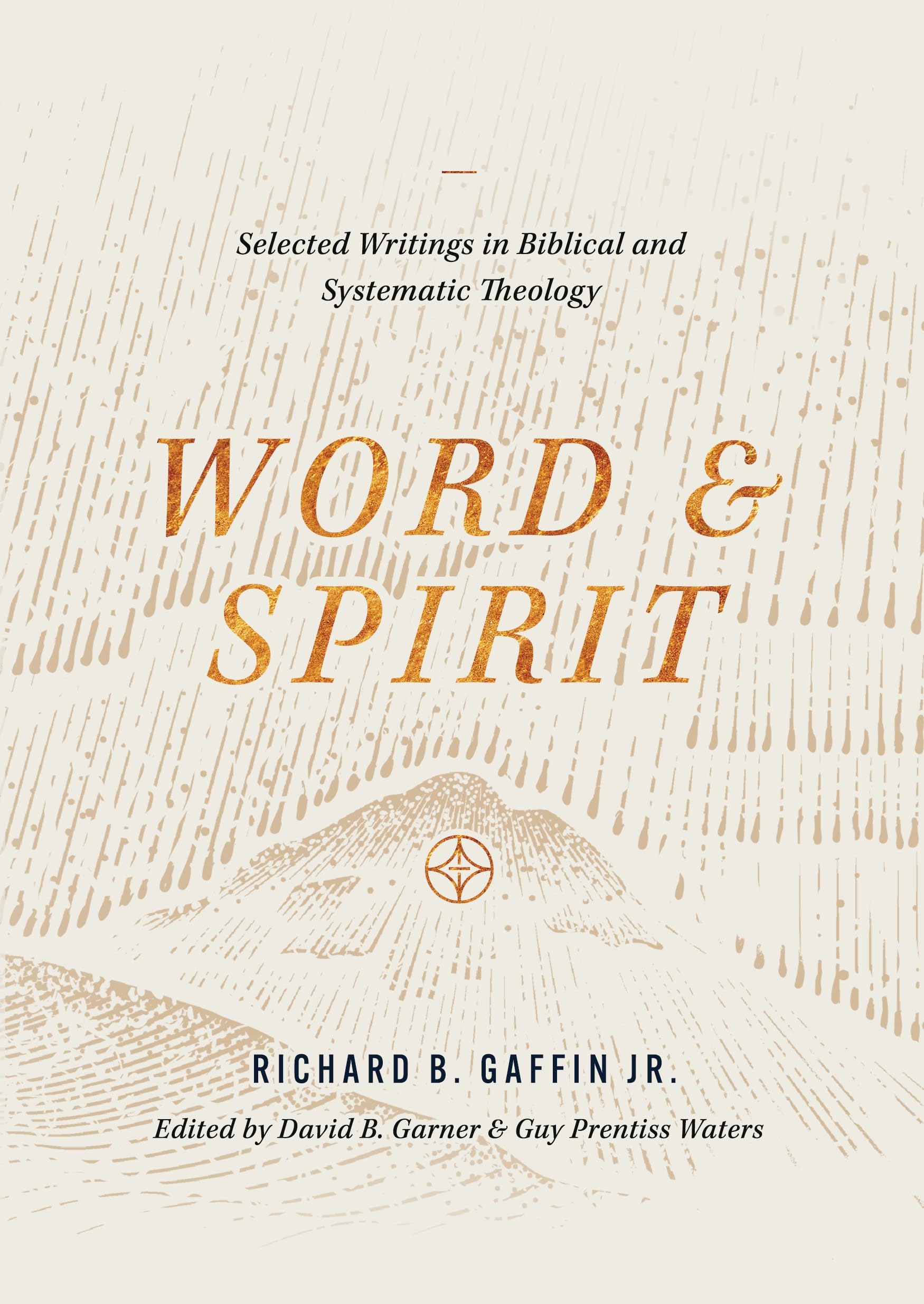
Word and Spirit: Selected Writings in Biblical and Systematic Theology
Few Reformed theologians have exerted the influence in both the church and the academy that Richard B. Gaffin, Jr. has, shaping the theology and spiritual formation of generations of pastors and teachers. Until now, his most significant published works have been inaccessible to most theological readers, published in academic journals, denominational newsletters, and out of print festschrifts and essay collections. A decade in the making, Word & Spirit gathers Gaffin’s finest works of biblical and systematic theology and arranges them in a singular, organic whole that presents Gaffin’s thought and work as comprehensively and clearly as it ever has been. More than 40 essays, articles, and tracts have been compiled, including “The Usefulness of the Cross”, No Adam, No Gospel, “A Cessationist View,” and “The Work of Christ Applied”. This collection is a must-have for any student of theology.
- GenresTheology
800 pages, Hardcover
Published December 1, 2023
About the author
Richard B. Gaffin Jr.
33 books25 followersRichard B. Gaffin, Jr. is a Calvinist theologian, Presbyterian minister, and was the Charles Krahe Professor of Biblical and Systematic Theology at Westminster Theological Seminary in Philadelphia, Pennsylvania from 1999 to 2008. He became the Professor Emeritus, Biblical and Systematic Theology in 2008.
Ratings & Reviews
Friends & Following
Create a free account to discover what your friends think of this book!
Community Reviews
Displaying 1 - 4 of 4 reviews

November 20, 2025
I shouldn’t have waited so long to read Gaffin. 10/10. Clear writing and arguable some of the best reformed and critical contemporary theology I’ve read.
84 - “There is no partial union with Christ, no sharing in only some of his benefits.”
123 - “… we could accent the antithetic stance required within the broader contemporary religious and theological environment. Ours is an era dominated by postmodern pretensions, aggressively pluralistic, rife with deconstructive confusion, and celebrating doctrinal disunity and contradiction in the name of permissible, even healthy, "diversity," to note several characteristic trends.”
140 - “The divine origin and perfections of Scripture, the canon and its closedness, apostolicity-all of these are not ahistorical abstractions but derive from and are intrinsically qualified by a covenant-historical matrix.”
302 - “In his role as a type Melchizedek is "made like (aphõmoiõmenos) the Son of God" (v. 3). The verbal force of the perfect passive participle ("made like"), veiled in the ESV ("resembling") and NIV ("like"), should be maintained. A key for understanding is to recognize that here "the Son of God" is not a reference to the incarnate Christ, to Christ in his appearance in history. The writer is quite clear: the historical Christ is "according to the order of Melchizedek"; Christ incarnate is "made like" Melchizedek, not the reverse. Rather, here "the Son of God" designates his eternal and divine existence (cf. 1:2b-3, 6-12).”
518 - “If the Spirit of God, the Spirit of truth and order, is really restoring these prophetic gifts to the church today in a widespread way, would there be, as there in fact is, such widespread ambiguity and confusion, not to mention division, about continuationists? Does the Spirit, who gives gifts to unify and edify, work in this ambivalent and uncertain way? These questions prompt a final observation about our contemporary situation. At work here as much as anything, I suspect—especially in the context of the church in the West, where the secularized exercise of reason and the deistic autonomy of the Enlightenment have held baleful sway for so long—is the desire for a compensating experience of the supernatural that accents the intuitive and nonrational capacities of our humanity?”
685 - “Salvation is not solely about atonement for sin but about the removal of the results of sin. And that removal not only has in view the results of sin in Christians but also is such that the last vestige of sin will also need to disappear from the creation of God."
721 n21 - “My surmise is that, for many, a significant factor disposing them toward either a premil or a postmil position stems from etherealized, even insipid, less-than-biblical understandings of the eternal state. Such rarefied, colorless conceptions give rise to the conviction—compounded by a missing or inadequate awareness of the realized eschatology taught in Scripture-that eventually God must somehow "get in his licks" and "settle things" in history, as distinct from eternity. But what is the eternal order other than the consummation of history, the historical process come to its final fruition? The new heavens and earth, inaugurated at Christ's return, will be the climactic vindication of God's covenant and, so, his final historical triumph, the ultimate realization of his purposes for the original creation, forfeited by the first Adam and secured by the last. Inherent in both a postmil and a premil outlook, it seems, is the tendency, at least, toward an unbiblical, certainly un-Reformed separation or even polarization of creation and redemption/eschatology.”
737 - “Appealing to Abraham Kuyper and Herman Bavinck, Gaffin argued that the form and content of Scripture are both truly divine and truly human and, as such, are indivisible. This is because the Holy Spirit, the primary author, was ultimately accountable for the form and content of Scripture. But, Scripture's theanthropic character—all divine and all human—does not involve something like a hypostatic union between the divine and human. Rather, Scripture has its servant-form because the incarnate Christ walked this earth in an estate of humiliation, and the correlate to the sinlessness of Christ is that Scripture is without error.”
And. Really, really helpful footnotes. Many could’ve reasonably been placed in the main text. Gem upon gem.
84 - “There is no partial union with Christ, no sharing in only some of his benefits.”
123 - “… we could accent the antithetic stance required within the broader contemporary religious and theological environment. Ours is an era dominated by postmodern pretensions, aggressively pluralistic, rife with deconstructive confusion, and celebrating doctrinal disunity and contradiction in the name of permissible, even healthy, "diversity," to note several characteristic trends.”
140 - “The divine origin and perfections of Scripture, the canon and its closedness, apostolicity-all of these are not ahistorical abstractions but derive from and are intrinsically qualified by a covenant-historical matrix.”
302 - “In his role as a type Melchizedek is "made like (aphõmoiõmenos) the Son of God" (v. 3). The verbal force of the perfect passive participle ("made like"), veiled in the ESV ("resembling") and NIV ("like"), should be maintained. A key for understanding is to recognize that here "the Son of God" is not a reference to the incarnate Christ, to Christ in his appearance in history. The writer is quite clear: the historical Christ is "according to the order of Melchizedek"; Christ incarnate is "made like" Melchizedek, not the reverse. Rather, here "the Son of God" designates his eternal and divine existence (cf. 1:2b-3, 6-12).”
518 - “If the Spirit of God, the Spirit of truth and order, is really restoring these prophetic gifts to the church today in a widespread way, would there be, as there in fact is, such widespread ambiguity and confusion, not to mention division, about continuationists? Does the Spirit, who gives gifts to unify and edify, work in this ambivalent and uncertain way? These questions prompt a final observation about our contemporary situation. At work here as much as anything, I suspect—especially in the context of the church in the West, where the secularized exercise of reason and the deistic autonomy of the Enlightenment have held baleful sway for so long—is the desire for a compensating experience of the supernatural that accents the intuitive and nonrational capacities of our humanity?”
685 - “Salvation is not solely about atonement for sin but about the removal of the results of sin. And that removal not only has in view the results of sin in Christians but also is such that the last vestige of sin will also need to disappear from the creation of God."
721 n21 - “My surmise is that, for many, a significant factor disposing them toward either a premil or a postmil position stems from etherealized, even insipid, less-than-biblical understandings of the eternal state. Such rarefied, colorless conceptions give rise to the conviction—compounded by a missing or inadequate awareness of the realized eschatology taught in Scripture-that eventually God must somehow "get in his licks" and "settle things" in history, as distinct from eternity. But what is the eternal order other than the consummation of history, the historical process come to its final fruition? The new heavens and earth, inaugurated at Christ's return, will be the climactic vindication of God's covenant and, so, his final historical triumph, the ultimate realization of his purposes for the original creation, forfeited by the first Adam and secured by the last. Inherent in both a postmil and a premil outlook, it seems, is the tendency, at least, toward an unbiblical, certainly un-Reformed separation or even polarization of creation and redemption/eschatology.”
737 - “Appealing to Abraham Kuyper and Herman Bavinck, Gaffin argued that the form and content of Scripture are both truly divine and truly human and, as such, are indivisible. This is because the Holy Spirit, the primary author, was ultimately accountable for the form and content of Scripture. But, Scripture's theanthropic character—all divine and all human—does not involve something like a hypostatic union between the divine and human. Rather, Scripture has its servant-form because the incarnate Christ walked this earth in an estate of humiliation, and the correlate to the sinlessness of Christ is that Scripture is without error.”
And. Really, really helpful footnotes. Many could’ve reasonably been placed in the main text. Gem upon gem.

December 3, 2024
This originally appeared at The Irresponsible Reader.
---
I can't put this one off any longer—if I could, I promise you I would (I've delayed it a few weeks already). I'm out of my league here, but I've got nothing else to write about. And I really need to write something about this.
WHAT'S WORD AND SPIRIT ABOUT?
According to the Publisher,
There's really not much else to say. It's broken down into five sections, and I'd be tempted to say that each section was the most valuable/useful (well, at least 2-5, but maybe if I spent some time re-reading part 1, I'd reconsider that). Let's take a quick look at each:
HERMENEUTICS, BIBLICAL THEOLOGY, AND SYSTEMATIC THEOLOGY
This is ten articles spread out over 170+ pages, covering the basics of Biblical Theology, how it can and should interact with Systematic Theology (and vice versa).
There's some repetition of ideas (this will be a common thread throughout each section), which makes sense as these were written as individual pieces, not as part of a book, and Gaffin's position and ideas about these things have remained static/build on each other.
It's vital to understand him and his work—and just good to have a handle on these ideas regardless.
THEOLOGY OF HEBREWS AND PAUL
Most of these seven articles encapsulate (and expand on) the ideas from In the Fullness of Time: An Introduction to the Biblical Theology of Acts and Paul , a book I raved about a couple of years ago. But there are teachings and texts he didn't address there, that he does here.
This section was so rich, so helpful—the chapters "'The Obedience of Faith': Some Reflections on the Rationale for Romans," "Atonement in the Pauline Corpus: 'The Scandal of the Cross,'" "and "The Priesthood of Christ: A Servant in the Sanctuary"—were good enough that I almost re-read them immediately (and I probably should've).
The first article in this section, The Usefulness of the Cross is available as a PDF Free Chapter Download from the publisher, take advantage of this.
SCRIPTURE, EPISTEMOLOGY, AND ANTHROPOLOGY
The first three of these six chapters might have been the most mind-stretching for me (they won't be for everyone), and were very rewarding.
The final three were the easiest for me—and the most repetitive in the book. They focus on Biblical anthropology (as in teaching on the nature of man), focusing on the historicity and nature of Adam. I've read at least "No Adam, No Gospel" before—it was published as a booklet a few years ago, and I think I read the previous chapter, the Translator's Foreword to Adam in the New Testament as well. And I didn't mind one bit re-reading it/them. Still helpful.
PNEUMATOLOGY
These seven chapters could be (should be, if you ask me) be reworked into one book. Gaffin shines in these studies—and going back to his By Faith, Not By Sight and Resurrection and Redemption, these teachings are where he's historically helped me the most. And that streak continues here.
Reformed theologians often (and wrongly) get the reputation for not talking about the Spirit as much as other traditions, and—even worse—are considered to ignore Him. Gaffin makes it clear that everything about Reformed Theology is based on the work of the Spirit in believers' lives and helps us understand just what that means—both theologically and practically.
THE LAW OF GOD, SOTERIOLOGY, AND ESCHATOLOGY
This section pretty much covers "everything that couldn't fit above." Again, I've read a few of these before in other publications/stand-alone works. But I don't care.
The chapters on eschatology are gold.
The chapters on Justification and Calvin are even better—the way he talks about Calvin's view of the relationship of Sanctification and Justification (and the way he presents the two in The Instittues even in the organization of them) is so important for us all to heed. Particularly as he roots them both in Union in Christ—as is every benefit that the believer enjoys in this life and in the resurrection.
SO, WHAT DID I THINK ABOUT WORD AND SPIRIT?
Outside of the Foreword, Introduction, and Brief Biography (Appendix A), none of this is particularly easy reading. Nor quick. But all of it is accessible—for the depth he gets into at points, this is much more approachable than On Classical Trinitarianism (to mention a recent example).
This is probably the most personally beneficial read I've had in the last couple of years—sitting down with Gaffin for 30-50 minutes every week has been a great discipline and a great boon.
I should probably have more to say than that, but I can't think of what else to say that's not just a restatement of this: this is a fantastic book—with insights, teachings, and reminders of the things that are vital for every believer.
Highly recommended.
---
I can't put this one off any longer—if I could, I promise you I would (I've delayed it a few weeks already). I'm out of my league here, but I've got nothing else to write about. And I really need to write something about this.
The word atonement does not occur in Paul’s writings.’ But no concern is more central for him than the meaning of the death of Christ, the church's perennial concern in its doctrine of the atonement. What does Christ's death achieve? How is it effective for the salvation of sinners? This chapter considers Paul’s answers to such questions with an eye to the issue of continuity between Paul's teaching and later church doctrine. How faithful to the apostle is subsequent Christian understanding of the atonement?
Contemporary Pauline scholarship is marked by a fairly widespread consensus that in its dominant and most influential expressions, traditional atonement theology departs from Paul in at least two substantial ways. First, it fails to recognize, or at least do justice to, the Christus Victor theme in Paul, that Christ's death destroys actual slavery to sin and its consequences in the sinner. Second, its notion of the cross as penal substitution, particularly as it has been developed beginning with the Reformation, is foreign to Paul.? In my view, the first of these critiques contains some measure of truth; however, the second is wrong. As a fair generalization, historic Christianity, including Protestant orthodoxy, is weak in not recognizing adequately Paul's teaching that the cross destroys sin in the sinner as a corrupting and enslaving power, but modern historical-critical scholarship is defective for not dealing adequately with his teaching that the cross removes the guilt and just punishment of sin.
WHAT'S WORD AND SPIRIT ABOUT?
According to the Publisher,
Few Reformed theologians have exerted the influence in both the church and the academy that Richard B. Gaffin, Jr. has, shaping the theology and spiritual formation of generations of pastors and teachers. Until now, his most significant published works have been inaccessible to most theological readers, published in academic journals, denominational newsletters, and out of print festschrifts and essay collections. A decade in the making, Word & Spirit gathers Gaffin’s finest works of biblical and systematic theology and arranges them in a singular, organic whole that presents Gaffin’s thought and work as comprehensively and clearly as it ever has been. More than 40 essays, articles, and tracts have been compiled, including “The Usefulness of the Cross”, No Adam, No Gospel, “A Cessationist View,” and “The Work of Christ Applied”. This collection is a must-have for any student of theology.
There's really not much else to say. It's broken down into five sections, and I'd be tempted to say that each section was the most valuable/useful (well, at least 2-5, but maybe if I spent some time re-reading part 1, I'd reconsider that). Let's take a quick look at each:
HERMENEUTICS, BIBLICAL THEOLOGY, AND SYSTEMATIC THEOLOGY
This is ten articles spread out over 170+ pages, covering the basics of Biblical Theology, how it can and should interact with Systematic Theology (and vice versa).
There's some repetition of ideas (this will be a common thread throughout each section), which makes sense as these were written as individual pieces, not as part of a book, and Gaffin's position and ideas about these things have remained static/build on each other.
It's vital to understand him and his work—and just good to have a handle on these ideas regardless.
THEOLOGY OF HEBREWS AND PAUL
Most of these seven articles encapsulate (and expand on) the ideas from In the Fullness of Time: An Introduction to the Biblical Theology of Acts and Paul , a book I raved about a couple of years ago. But there are teachings and texts he didn't address there, that he does here.
This section was so rich, so helpful—the chapters "'The Obedience of Faith': Some Reflections on the Rationale for Romans," "Atonement in the Pauline Corpus: 'The Scandal of the Cross,'" "and "The Priesthood of Christ: A Servant in the Sanctuary"—were good enough that I almost re-read them immediately (and I probably should've).
The first article in this section, The Usefulness of the Cross is available as a PDF Free Chapter Download from the publisher, take advantage of this.
SCRIPTURE, EPISTEMOLOGY, AND ANTHROPOLOGY
The first three of these six chapters might have been the most mind-stretching for me (they won't be for everyone), and were very rewarding.
The final three were the easiest for me—and the most repetitive in the book. They focus on Biblical anthropology (as in teaching on the nature of man), focusing on the historicity and nature of Adam. I've read at least "No Adam, No Gospel" before—it was published as a booklet a few years ago, and I think I read the previous chapter, the Translator's Foreword to Adam in the New Testament as well. And I didn't mind one bit re-reading it/them. Still helpful.
PNEUMATOLOGY
These seven chapters could be (should be, if you ask me) be reworked into one book. Gaffin shines in these studies—and going back to his By Faith, Not By Sight and Resurrection and Redemption, these teachings are where he's historically helped me the most. And that streak continues here.
Reformed theologians often (and wrongly) get the reputation for not talking about the Spirit as much as other traditions, and—even worse—are considered to ignore Him. Gaffin makes it clear that everything about Reformed Theology is based on the work of the Spirit in believers' lives and helps us understand just what that means—both theologically and practically.
THE LAW OF GOD, SOTERIOLOGY, AND ESCHATOLOGY
This section pretty much covers "everything that couldn't fit above." Again, I've read a few of these before in other publications/stand-alone works. But I don't care.
The chapters on eschatology are gold.
The chapters on Justification and Calvin are even better—the way he talks about Calvin's view of the relationship of Sanctification and Justification (and the way he presents the two in The Instittues even in the organization of them) is so important for us all to heed. Particularly as he roots them both in Union in Christ—as is every benefit that the believer enjoys in this life and in the resurrection.
SO, WHAT DID I THINK ABOUT WORD AND SPIRIT?
The justification of God's elect is unshakably secure because, in a sentence, Jesus Christ is “the same yesterday, today and forever” (Heb. 13:8). Despite the way it is often read, this is not, at least in the first place, a proof text for Christ's divine immutability, that as God he is unchanging, though that attribute is surely in the background (see, for instance, 1:10—12).” Rather, it is most likely an affirmation of his unwavering fidelity, his abiding reliability as high priest—in his once-for-all sacrifice in the past on earth and in his ongoing present and future (cf. 7:25) intercession in heaven. That is as good a note as any to bring these reflections to a close. “Jesus Christ—the same yesterday, today and forever.” This, first and finally, is what Christians need to know about their justification when they consider Christ as their priest, not only in his state of humiliation but also in his state of exaltation.
Outside of the Foreword, Introduction, and Brief Biography (Appendix A), none of this is particularly easy reading. Nor quick. But all of it is accessible—for the depth he gets into at points, this is much more approachable than On Classical Trinitarianism (to mention a recent example).
This is probably the most personally beneficial read I've had in the last couple of years—sitting down with Gaffin for 30-50 minutes every week has been a great discipline and a great boon.
I should probably have more to say than that, but I can't think of what else to say that's not just a restatement of this: this is a fantastic book—with insights, teachings, and reminders of the things that are vital for every believer.
Highly recommended.
December 6, 2025
“To open the pages of Word and Spirit is to find oneself in a treasure trove of biblical and theological riches that will delight scholars, pastors, and all serious students of the New Testament.” Sinclair Ferguson
I would say for anyone interested in this book, tackle it. Make no mistake though, this offering by Dr. Gaffin is indeed a treasure trove of riches, however, I would say it is best suited for someone with advanced theological knowledge or academic training in the discipline. There are nuggets for the less theologically advanced in this book (such as myself), but for the most part it is a more difficult read for those with less training.
“Take Up and Read” - Saint Augustine
I would say for anyone interested in this book, tackle it. Make no mistake though, this offering by Dr. Gaffin is indeed a treasure trove of riches, however, I would say it is best suited for someone with advanced theological knowledge or academic training in the discipline. There are nuggets for the less theologically advanced in this book (such as myself), but for the most part it is a more difficult read for those with less training.
“Take Up and Read” - Saint Augustine

Read
March 23, 2025Partial
Displaying 1 - 4 of 4 reviews