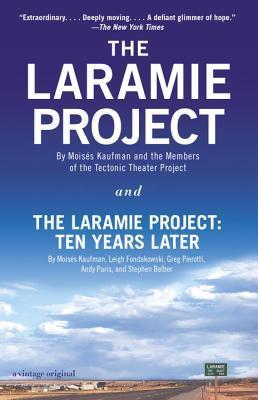
On October 7, 1998, a young gay man was discovered bound to a fence outside Laramie, Wyoming, savagely beaten and left to die in an act of brutality and hate that shocked the nation. Matthew Shepard’s death became a national symbol of intolerance, but for the people of the town, the event was deeply personal. In the aftermath, Moisés Kaufman and members of the Tectonic Theater Project went to Laramie and conducted more than 200 interviews with its people. From the transcripts, the playwrights constructed an extraordinary chronicle of life in the town after the murder. Since its premiere, The Laramie Project has become a modern classic and one of the most-performed theater pieces in America. Now, in this expanded edition, The Laramie Project: Ten Years Later adds an essential sequel to the original work. Revisiting the town a decade after the tragedy, the troupe finds a community grappling with its legacy and its place in history. The two plays together comprise an epic and deeply moving theatrical cycle that explores the life of an American town over the course a decade.
Moisés Kaufman (born November 21, 1963) is a playwright, director and founder of Tectonic Theater Project. He is best known for writing The Laramie Project with other members of Tectonic Theater Project. He is also the author of Gross Indecency: The Three Trials of Oscar Wilde and 33 Variations. He was born and raised in Caracas, Venezuela and moved to New York City in 1987.
Kaufman is of Romanian and Ukrainian Jewish descent. He described himself in an interview by saying "I am Venezuelan, I am Jewish, I am gay, I live in New York. I am the sum of all my cultures. I couldn’t write anything that didn’t incorporate all that I am."
Kaufman was awarded a Guggenheim Fellowship in 2002. He made his Broadway directing debut in the 2004 production of I Am My Own Wife by Doug Wright, for which he received a Tony Award nomination for Best Direction of a Play.
a confronting but essential verbatim play composed of interviews with more than 200 citizens of laramie, wyoming, who reflect on the tragic death of matthew shepard in 1998- a brutal hate crime which shocked america.
‘the laramie project’ brilliantly blends history and theatre in a way that honours mathew’s life as well as the stories and perspectives of the entire community. it has a careful compassion that encompasses all the rawness and messiness of opinion, and there is so much diversity & humanity in this portrait of community which is filled with anger, heartbreak and hope. deeply moving & powerful.
I was not emotionally ready. After rereading Laramie Project, then watching the Laramie film, I forgot my plan to read something light to make me feel better and instead read Ten Years Later. Now it's almost eighteen years later and most people, including me, wouldn't know anything about Matthew Shepard if it weren't for this play and I'm emotional and sad.
3.5/5 stars I haven't read a play in this format before but I really liked it. I was surprised by how interesting and fast paced it was. I like how they included the interviews ten years after the death. It was nice to see how Laramie and its community changed and how it didn't. I remember hearing about Matthew Shepard when I was younger but I never knew the details of his death until now. I recommend this book for everyone and especially if you like reading nonfiction with LGBTQ+ themes and topics.
i guess i feel obligated to write this review considering that there was a random woman outside my high school protesting the fact that the students in english 10 are reading this script rn.
i was in the winter blackbox play at my school, and we did the laramie project. all members of the cast played different characters (which is the way that the script is set up), and i was able to have the honor of playing characters like father roger schmit and rulon stacey. and let me tell you: i don’t think i’ve ever felt more connected to two random, old white men.
the laramie project is a must-read play. i think we all need to try to hear the words of the laramie residents following matthew shepard’s murder at least once in our miserable lives. the information is presented in an emotional, intense way that shapes the town of laramie into a character itself.
the play does feature people with some pretty deplorable opinions, but everyone is written into the play compassionately. as a queer person reading the play, characters that may not “support the lifestyle” of the lgbt community are still shown as real people who mainly only think those kinds of things as a result of living in the small, widely christian town of laramie.
schools need to do plays like the laramie project. matthew shepard’s death was a hate crime and deserves to be treated as such. it’s a difficult play to digest, but it deserves to stay in the curriculum, it deserves to stay as an option for our school plays, and matt’s story deserves to be heard.
"Go home, give your kids a hug, and don't let a day go by without telling them that you love them."
On October 6, 1998, Matthew Shepherd, a gay student at the University of Wyoming, left a bar with two men: Aaron McKinney and Russell Henderson. Eighteen hours later, he was discovered at the edge of town, tied to a fence post, brutally beaten, robbed, and close to death. Six days later, Matthew died.
The Laramie Project, and its companion piece The Laramie Project: Ten Years Later, chronicles how a community comes to terms with hate.
Passing into Wyoming from the northern border of Colorado, the Wyoming welcome sign reads, "WYOMING - LIKE NO PLACE ON EARTH." It does not say "Wyoming - like no place ELSE on Earth." Make no mistake, Laramie is real place, the murder of Matthew Shepherd was a real crime, and real hatred can live just about anywhere - even in the town we call home.
Wyoming is cowboy country. Many in its community will tell you that Laramie is "live and let live," that most in town don't give a damn about how others live their lives so long as it doesn't disrupt their own. So, when a man is murdered because he's a homosexual, the community grapples with the communal position that "we're not that kind of town," when something so heinous can, and did, happen within its bounds.
An act of hatred does not define a community. What defines it is how they talk about it, what they learn from it, and what actions they take to prevent it from happening again.
For Laramie, it's a pretty mixed bag.
Ten years later, its residents question whether it was a hate crime at all (fact check: it was) or whether it should be whitewashed by rumor or folklorian takes of it being drug-related or a burglary gone awry. Others don't want to talk about it any longer and, instead, move on. There are even subscribers to the local newspaper that ask the paper to hold the week's edition which reports on the anniversary of Shepherd's murder - shutting their eyes, closing their ears, and willing it to simply go away.
Ten years later, the following also happened: (1) The first openly gay representative was elected to Wyoming's legislature. (2) The University of Wyoming enacted benefits for domestic partners. (3) A proposed amendment to Wyoming's Constitution defining marriage as being exclusively between a man and a woman failed 35-to-25, with several conservative Republicans voting against it. (4) The "Matthew Shepherd and James Byrd, Jr. Hate Crimes Prevention Act" was signed into federal law.
The Laramie Project is a profound and powerful read. In many ways, it is the In Cold Blood of our times, and it's required reading.
Cayla: I agree—I think that the “10 Years Later” part of this book is really impactful and I’m glad I read it. A very powerful story. I’m also glad that this is a required English book for Kent: it’s a story that needs to be heard. I might add some more thoughts later… just digesting it all right now.
A really real look into hate crimes in America and the slow pace of change (and too often, no change). Loved the ethnographic quotes that preserved the dignity, opinions, and reality of Wyoming citizens. Would love to see a response another 10 years down the line. Book 15 of quarantine.
The Laramie Project is a play created by the Tectonic Theater Project based on their interviews of over 200 Laramie citizens after the murder of Matthew Shepard in 1998. The play is performed by a small cast who use small props to help define their switch in characters. The stage design is meant to be a simple performance space. This minimalist design puts all the focus on the words being spoken which are all direct quotes taken from the interviews (as well as the reflections of the Tectonic members during their time in Laramie).
The second play The Laramie Project: Ten Years Later follows the same performance format and is based on the interviews the group conducted when they returned to Laramie 10 years after Shepard's murder. The crime was detailed extensively in national media and became the foundation for federal legislation against hate crimes. It's shocking then that the interviews revealed a very different legacy in Laramie. Rumors and reactions to a 20/20 episode led to many Laramie residents and transplants viewing Shepard's murder as a drug-induced robbery gone wrong rather than a hate crime against a gay man. The theater members were quite stunned how many people remained ignorant to or ignored the facts of the crime that were presented and made public during the trail of the two murders. The second play also includes interviews with the convicted killers at a prison in Virginia.
Reading the tow plays together is both moving and frustrating. It's encouraging to see the individuals whose lives have been changed for the better over the decade between the plays, but many people's ignorance and faith in the media is especially infuriating. I appreciate the effort of the Tectonic Theater Group in conducting all these interviews and then putting them in a format for others to hear. The plays do paint a portrait of a small American town while also raising issues relevant to the whole country (well, and world). I would definitely use this text in reading and conversation classes with teens. There are many complex opinions to unpack and discuss.
very compelling anthropological analysis of a hate crime that approaches the tragedy with care and delicacy. the ten years later interviews with both perpetrators were chilling and also just as sad. definitely a thinkpiece.
My star rating is an average of the two plays, which seemed only fair because they’re separate works presented jointly.
The Laramie Project itself is a devastatingly beautiful piece that I needed to put down several times because my heart was clenched and tears were in my eyes. Because the dialogue is all direct quotes, it’s stark and simple but still contains multitudes. I would love to see this piece performed live. 5 stars, easily.
10 Years Later, in contrast, doesn’t inspire such a visceral reaction. As a concept, returning to Laramie and seeing how things have changed is wonderful but it falls flat in execution. Life doesn’t always create perfect narratives. People want to excuse Matthew Shepard’s murder, policy change is promised but falls flat, the new generation is apathetic if best. The only reason I finished 10 Years Later is because I enjoyed its predecessor so much. 2 stars, generously.
I only read the first play it was what was assigned for a class. It was very emotional to read how two guys would do that to a gay man, the guy went to far with his self defense. This play had a lot of emotions from different characters towards the situation with Matthew. There were different perspectives. There were different themes in this first play that were tolerance, acceptance, justice, mercy and homophobia. Laramie was a town that was religious and the many different perspectives come from it. I would towards the second play because I'm intrigued on how perspectives have change or how people see the town is as a symbol like every other place or as a unique place?
Brandon's Review: I first saw the Laramie Project performed many years ago, and it has stuck with me ever since. This June, I was putting together a Pride Month Display for my library and remembered this play. We didn’t have it in our collection at the time, so I recommended it and then put it down as a ‘to be read’ book. Now, a few months later, I have been riveted and shaken by this powerful play yet again.
The format of the play is incredibly striking, a collection of snapshots taken from the town of Laramie in the aftermath of Matt Shephard’s murder. It can be a bit disorienting at first, as there are so many characters and so much info being thrown at you. However, soon you will find a groove and the play begins to flow.
There’s a lot to be gained from this play. You get a glimpse into the mind of rural America, as the small town of Laramie grapples with homophobia, hate, and healing. With the addition of the “10 Years Later” you also get to see how Laramie has dealt with their history, how they’ve attempted to rewrite history to alleviate their pain and guilt.
While it does not hit as hard as a live performance, the book is still incredibly heart-wrenching and a uniquely beautiful experience.
Although I only read the first part of the book, which was mainly about the background of the town and the inciden, I am really intrigued in the book. I am certainly going to continue reading it. I certainly like how you can see the different perspectives between the different people who were interviewed.
heartbreaking. the fact that I did not know about any of this before reading the book shows the importance of keeping the story alive across generations. everyone I highly recommend reading the 10 years later. 😭💔
Reading this was a whole lot in every single way. It made me real emotional in ways I both expected and didn't, but it was masterfully done. I'd love to see it in actual play version at some point in my life. I'm glad I read the 10 years later version too, because that was revelatory. Especially in the folklore sense of how rumors about terrible small town events morph and change over the years.
*
If that's where you want to live, do it. I mean, imagine if more gay people stayed in small towns.
Unitarians are by and large humanists, many of whom are atheists. I mean - we're, you know, we're not even sure we're a religion.
Like people say things to me like "Why do you wear that thing on your head? Like when I go to the grocery store, I'm not looking to give people Islam 101, you know what I mean? So I'll be like, We'll it's a part of my religion and they'll be like - this is the worst part 'cause they're like, "I know it's part of your religion, but why?" And it's - how am I supposed to go into the whole doctrine of physical modesty and my own spiritual relationship with the Lord, standing there with my pop and chips? You know what I mean?
My secret hope was that they were from somewhere else that then of course you can create that distance. We don't grow children like that here. Well, it's pretty clear that we do grow children like that here.
"When we got to the Albany Country Courthouse, Fred Phelps was already there." "But so was Romaine Peterson."
Yeah, this twenty one year old little lesbian is ready to walk the line with him.
Aaron McKinney: He is gonna die for sure? Rob Debree: There is no doubt that Mr. Shepard is going to die.
May you live a long life, and may you thank Matthew every day for it.
Greg Pierotti: Well, Aaron, you brutally murdered her son. Aaron McKinney: (Conceding) Yeah, I know.
I don't want to comment too much on this play, considering it is based on actual events and real interviews.
I found this play moving and appalling at the same time. It was great to see that some people learned a lesson from such a tragic circumstance, yet the way the story has changed over the years and became more about a drug deal. Also, the people saying that Matthew pretty much deserved it because he hit on the guys. Some people just don't get it. So, while some of the quotes are hard to digest, when reading this play the thing to remember is that this is based on actual interviews and some people are just that bigoted. It was hard for me to get past that at first but then I came to the realization that this idea was what the play was pretty much trying to get across.
Anyway, I suggest reading this play! It'll give you a new insight into things.
This is a devastating story. I read this play for my current English course and I really enjoyed our discussions about it in class. This rating is not for the story itself of course but the writing and the play. I do have to say that the quasi-documentary style was quite interesting to read, but weve discussed how though the lines of the "characters" are exact, there was editing put into it at the end of the day, making it not fullllllyyyy nonfiction. Also, the way the "Ten Years Later" play portion focused more on the perpetrators than victim and his family is interesting. We spoke a lot about the intentions of the playwrights and about how the intentions for the first half could have differed from the second half. Overall, this was informative and the tragedy this play is about is truly devastating.
I remember hearing parts of this play performed as a duo at speech competitions in high school, but it wasn't until now that I read the entirety of the two plays. Absolutely a powerful read. It will be fascinating to see how my first year college students react to this text. It's about so much more than a hate crime...it's about how communities identify themselves and how they react in conjunction with a tragedy. A very interesting portrait of an American community.
This is a set of 2 really well written plays; both different to anything I've read before or what I was expecting. It reads like a documentary actually, with quasi-interviews from the people involved, but it still feels connected to the people (characters, if you can call them that) and it made me genuinely emotional when reading. Such a terrible crime but handled with incredible tact and respect for those involved.
I had the absolute privilege to stage manage this production over the summer and it really opened my heart and eyes. I was only 15 when Matthew Shephard died, so i really didn't understand the seriousness of what happened, until now. My heart goes out to everyone in the LGBTQ community whose lives are threatened every day and I hope one day we can learn to love instead of hate.
I had the pleasure of watching The Laramie Project for the first time two years ago. It was an experience that has, and will continue to, stick with me for the rest of my life.
The fact that this is a verbatim play absolutely wrecked my heart. The absolute rawness that you can feel with some of the lines creates such a unique theatrical experience. It is a devastating play.
4.5 one of the few genuine works in true crime i have seen. tries to actively listen to different perspectives and piece together how something like this happens and keeps happening to others.
just going to copy and paste the unnecessary essay I wrote bc it has to do something
The Laramie Project details the horrific true story about the murder of Matthew Shepard. Fueled by hate, two Wyoming natives beat him to a pulp, tied him to a fence, and left him there to die. This tragic story is told through the lens of outsiders who traveled from New York City to Wyoming for the sole purpose of interviewing those who lived in Laramie at the time. Members of the Tectonic Theater Project wanted to investigate the story of Matthew and the murder while creating a play conveying everyone who lives in Laramie’s story and their perspective on the events that unfolded. They interviewed a variety of people asking their opinions on it, and the results were a mixed bag. When asked, most people responded in a homophobic manner, commenting on how they would not want it to be “forced upon them” or just outright that all homosexuals were going to hell. However, this tragedy ended up causing national outrage and support for Matthew, even while his fate hung in the air. This brought the town of Laramie, Wyoming into a new era of being known as the town where a heinous hate crime against Matthew Shepard was committed, and they were not prepared for the aftermath. This play shows the effect of Matthew’s death not only in Laramie, but all across America.
I cannot say that this play was a joy to read. In fact, it was a heartbreaking play that made me terribly sad. In this play, they described the crime so vividly with the injuries and the story that it was just awful to read and it was made worse by the fact that we know that this was a real event. The Tectonic Theater Project is a real company. Matthew Shepard was a person who had his life ended just because of the way he was. It’s terrible. At the same time, I read the whole thing in one sitting. It was not a joy to read, but it was intriguing, hearing the perspectives of all of the residents and the people’s opinions on how the trial ended and why this would occur in Laramie. I was moved by this play, but also horrified. A lot of emotions came from watching this. However, I feel like it should not have been a play, but rather an actual documentary. Hearing about The Laramie Project was the first time I’d ever heard of documentary theater, but this is such a delicate subject matter that I feel should have been recorded from the actual people instead of people acting as those who were close to Matthew, or at least knew of him. Nevertheless, it was a great play and invoked emotions of anger and melancholy for the tragedy that occurred in Laramie like it was meant to. And most of all, it told Matthew’s journey.