La indústria automobilística ha abandonat Vacca Vale, Indiana, i també ha deixat enrere els seus habitants. Als afores, en un bloc de pisos tronat conegut com la Conillera, hi viu la jove Blandine, que comparteix pis amb tres nois als quals no entén ni aprecia, però que la fascinen estranyament. Tots venen de famílies desestructurades i lluiten per trobar el seu lloc al món. ¿Com arribar a ser adult en aquesta ciutat en ruïnes, en aquest món al qual no li serveix de res la fragilitat de la joventut? Una instantània implacable i mordaç de la societat contemporània, una història plena d’humor sobre la solitud, la nostàlgia i la llibertat. Tess Gunty (South Bend, Indiana, 1993) és llicenciada en Anglès amb una especialització en Escriptura Creativa per la Universitat de Notre Dame. També disposa d’un màster en Escriptura Creativa per la Universitat de Nova York. Els seus escrits s’han publicat a The Iowa Review, Granta, LitHub, Los Angeles Review of Books, entre d’altres. Gunty va créixer a Indiana i actualment viu a Los Angeles. La seva primera novel·la, La Conillera, ha estat premiada amb el National Book Award 2022. «Tess Gunty té un talent magistral i un ull extraordinari per a tot allò poètic, commovedor i absurdament sublim... Un tour de force.» LAUREN WILKINSON, autora d’American Spy
Well, that was a curious reading experience! I’ve run into yet another case where the prose itself sparkled more than the story as a whole. The main problem I had here was that this seemed to lack a bit of cohesiveness. There were some good parts, but there wasn’t enough glue to hold it all together. The characterizations are interesting, to say the least. Eccentric, and in some cases downright freakish, would be better adjectives here. There were a lot of characters – mainly those residents that inhabited a rundown, affordable housing complex called The Rabbit Hutch. Some others drift into the story as well, including a schoolteacher, a television star, a mental health blogger (who has mental health problems of his own), and a priest. I suppose you could name the central character as the eighteen-year-old, otherworldly Blandine. She’s a high school dropout but probably the most intelligent of the entire bunch. At times I actually questioned her voice – I still haven’t decided if it felt wholly realistic or not. Likely there are young women out there that talk and think as she does, though I’ve yet to meet one personally. She’s obsessed with Hildegard of Bingen, “prophet, composer, botanist, abbess, theologian, doctor, preacher, philosopher, writer, saint, Doctor of the Church. A veritable polymath.”
Blandine lives in an apartment of The Rabbit Hutch with three young men that, like her, were recent wards of the foster care system. I had a bit of difficulty distinguishing one guy from the next. One of them was presented to us in a first person narration while the others were written from the third. Naturally, they all fall for the ghostly, aloof Blandine. Once this happens, all hell breaks loose, as you can imagine. What happens next really spirals out of control. How these guys get out their frustrations is a lot different from what I expect would be the usual – fist fights and that sort of thing.
This leads me to another point. The novel is set in the dying town of Vacca Vale, Indiana, after the automobile industry has dried up and disappeared. A familiar story across the United States and elsewhere, no doubt. I couldn’t help but think of The Last Picture Show by Larry McMurtry, a book I read and greatly admired just one month ago. There we were firmly planted in the decaying town of Thalia, Texas, right along with its desperate and lonely characters. The characters in The Rabbit Hutch were just as hopeless, struggling to find connections. But somehow I believed in them quite a bit more in McMurtry’s book than in this one. Maybe it was because here the author, despite her skill with words, tried to do a bit too much. Too many characters, too bizarre, and more disjointed. Some storylines fizzled out, while the main one reached a crescendo that I did actually find “rewarding” though very disturbing. And the last section did reveal to me that Tess Gunty is onto something very intuitive here. I would love another story with a smaller cast of characters and one that heavily features Joan, the mousy, insecure, middle-aged resident of the apartment complex that I found super intriguing – and genuinely written!
“Miraculous. Joan recalls the existence of dogs, craft stores, painkillers, the public library. Cream ribboning through coffee. The scent of the lilacs near her childhood home. Brown sugar on a summer strawberry. Her father’s recovery from the tyranny of multigenerational alcoholism… The euphoria of the first warmth after winter, the first easy breath after a cold, the return of one’s appetite after an anxiety attack… These thoughts – how she can force herself to have them. Miraculous.”
2.5 stars rounded up because I feel bad rounding down even though I kind of want to.
This started off so well. I was immediately intrigued by Blandine, I loved the initial world-building Gunty was doing and the bizarre cast of characters she was introducing, and I had very high hopes. Unfortunately, the further I got into the book, the more they evaporated and I ended up ultimately underwhelmed and pretty disappointed.
I've noticed many other reviews mentioning that this book was just too weird for them, but it wasn't for me. It was a book that was trying to be weird, that seemed desperate to be quirky and "out there" in an attempt to seem more interesting and literary without much real purpose. In that way, I think Gunty has a bit of maturing to do as a writer, though there's clearly enough skill and voice there that I do think by book two or three, that self-conscious, try-hard approach to fiction could be sorta wrung out of her so that she could hone in on something a bit more genuine. Because she's not quite there yet, this seemed to really lack nuance and finesse and reminded me of the kind of work you'd see in a college creative writing workshop.
On the flip side of the obtusely weird, there was the eye rollingly cliche. Blandine, in many ways, was a manic pixie dream girl x 10,000. Gunty handed this character all the damage one could imagine as well as a preternatural intelligence and obsession with the mystic. You know the kind of character I mean and how exhausting it can be. I don't think I need to say anything else in that regard.
The secondary characters ended up being way less interesting than I first thought as well, with most being completely unnecessary and their presence a bit confusing. I feel like Gunty used them as a distraction from the rickety nature of the main narrative and I was just... not feeling it.
I wish I could say the ending was surprising, dramatic, meaningful, or anything at all, but by that point, I was so desperate for the whole thing to be over that any effect it could have had was well gone.
Again, this review really pains me - there are definitely glimmers of something special in Gunty's writing, hence the generous rounding up of my rating, but it ended up being a very big miss in the end. That being said, I would definitely read another book from her in the future - Google tells me she signed a two-book deal, so I'm sure I'll get that chance.
Set in the fictional Midwestern town of Vacca Vale, Indiana, The Rabbit Hutch revolves around the residents of a run-down apartment building, once ambitiously bestowed the French name, La Lapinière Affordable Housing Complex, by the philanthropist who funded its development. But now after the Zorn Automobile factories are long gone, the city is one of boarded storefronts and abandoned buildings- one of the many “dying cities” in America, the apartment building is more commonly referred to by its English translation “The Rabbit Hutch”.
The story begins with what we can make out is an act of violence being committed in apartment C4. The narrative takes us through the preceding week and the events in the days leading up to that fateful night. The story predominantly centers around eighteen-year-old Blandine Watkins, recently aged out of the foster care system, a high school dropout and employed in a local diner, presently sharing apartment C4 with three young men, all of whom were once in the foster care system. Blandine once had a promising academic record and was expected to attend college on scholarship but dropped out of high school after an inappropriate relationship with a teacher shattered her already fragile sense of self-worth. She is fascinated with the lives of Christian female mystics, hoping to someday enjoy the experience of Transverberation of the Heart as described by the mystics she frequently reads about. Blandine has not had an easy life and it seems that she is caught up in a vicious cycle of despair and disappointment and her fixation with the lives of the mystics seems not only to be cathartic for her but also lends her a purpose in life. She loves her hometown despite its current state of economic decline and actively opposes the modernization initiatives proposed by local developers.
Other residents of the building include a new mother who is having difficulty adjusting to her new role and finds comfort in watching reruns of an old sitcom, an elderly couple who carry on with their regular squabbles, television and cigarettes, an aspiring influencer, a man who spends time on dating sites frequently checking on the ratings he has been given by women he has met and a woman who works for an online obituary portal and is the target of the wrath of a fifty-three-year-old man whose negative comments on his celebrity mother’s obituary were deleted by her, following company norms. We move back and forth between past and present, exploring the backstories of some of the characters, while others play a blink-and-miss role in the bigger picture.
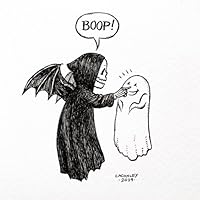
While I was enthralled by parts of the novel, I found the digressions a bit distracting and inconsequential for the most part and the uneven treatment of the characters ( in terms of how well fleshed out the secondary characters are ) was a tad disappointing. While I admired the depth in the writing in certain parts of the novel, I felt that a few critical themes were explored superficially. More importantly, though I did feel sympathy for Blandine, I found it hard to connect with the overarching narrative or with the characters. This is an intriguing novel - one that is hard to describe in a review and that needs to be read with time and patience. The author touches upon many important themes – vulnerability, loneliness, mental health, community, family and faith among others. The dark and depressing tones in this novel are balanced by moments of wisdom and humor. The illustrations featured in this novel (done by the author’s brother, Nicholas Gunty) are worth special mention as they complement the text very well. Overall, I believe that Tess Gunty’s The Rabbit Hutch is an ambitious debut that many will find more appealing than I did. Tess Gunty is a talented writer. I look forward to more from this author in the future.
The blurb calls it a stunning debut and I agree. It's stunning, profound, smart, and mesmerizing and I was shocked that this is a debut novel.
I added it to my tbr because I was intrigued by the cover, the prison yard tattoo look of it. Maybe that's not the best reason to read a book but I'll admit I judge books by their covers and, at least with this one, it paid off.
The Rabbit Hutch is one of those books that you dread having to put down. It couldn't have been harder to do had the Kindle been superglued to my hands.
It's a character-driven novel centered around people whose lives are every bit as broken and desperate as the fictional city in Indiana in which it is set. Most of the characters aren't very likable and yet you can't help but like them, or at least be allured by them, by their thoughts and insecurities, dreams and hopelessness.
I'm not sure what it says about me that I identified so much with some of these characters, with middle-age Joan and her misophonia, for instance, and Blandine with her addiction "to learning because it distracts her from the hostility of her consciousness; she has one of those brains that attacks itself unless it’s completing a difficult task."
Perhaps that is always the case with well-defined characters - we can't help but see something of ourselves in them.
CW: There is some not-very-graphic killing of animals which will be disturbing to some readers. It says a LOT about how well-written and addicting this book is that I continued to read in spite of it. I can end up hating a book just because there's a half sentence saying someone spotted a dead turtle on the side of the road - and yet this book remains five solid stars.
I cannot possibly convey how much I loved it, how much I hated to have it end. This is a book and these are characters that will remain with me for a long, long time.
The Rabbit Hutch is absolutely brilliant with a quality of writing that is rarer and rarer to find. I'd give it 100 stars if I could.
I want to start this review by acknowledging that Tess Gunty is clearly an incredibly skilled writer and an intelligent young woman. However, I don’t think she (or her editing team) have quite mastered the art of figuring out what should stay in the finished draft of a novel and what should go.
My main problem with The Rabbit Hutch was that a significant portion of it seemed unnecessary and largely unrelated to the larger plot. Very few of the many perspectives are essential to the main story being told. For instance, what was the purpose of the mother’s sections? We spend significant time with her, but her story scarcely overlaps with the other characters’. To be fair, I read this book primarily for enjoyment rather than analysis, so it is possible that I missed a few of the connections, but as a casual reader, I finished this book wondering what the point was of including certain sections. This was even the case for the primary perspectives. For instance, one character receives a message on his mental health blog from a man who keeps finding weapons from the game Clue around his house and doesn’t know where they are coming from. We spend an entire chapter on this man’s story, and as far as I can tell, it never comes up again. It just seemed like Gunty had a fun idea for a psychological thriller she never intended to write and didn’t want it to go to waste.
I didn’t find myself connecting with any of the characters, even (and especially) Blandine, and much of the dialogue did not seem realistic to me. For instance, Blandine’s final confrontation with James does not sound like how a real teenager would talk! Often, it seemed as if the author had a personal interest in a certain topic, such as moral philosophy, and shoehorned it into a conversation where it wouldn’t otherwise be relevant.
Additionally, while I have no personal experience with the foster care system, I’m not sure I cared for its portrayal in the novel. While I recognize that many children in the system come from troubled backgrounds, I disagree with the universal characterization of these children as maladjusted. I doubt this was the author’s intention, but every character we meet who comes from foster care is deeply troubled and prone to violence. We know about Blandine’s background but we do not know about the boys’, so what drives them all to engage in such violence? Only one unifying factor is given.
I truly believe Tess Gunty has a way with words and has the potential to write a really powerful novel. I will certainly check out Honeydew when it is released. However, I think she needs a team who is willing to take a closer look at her drafts and really parse out what is and isn’t essential to the story being told.
Thank you to Knopf for providing an advanced galley of The Rabbit Hutch for review.
UPDATE — just announced- winner of the National Book Award - for Fiction.
Audiobook….read by Tess Gunty, Scott Brick, Suzanne Toren, Kirby Heyborne, Kyla Garcia …..11 hours and 52 minutes
Tess Gunty has written a creative-debut-novel that is both taxing and complicated. … reminding us that life is messy.
The realm of imagination and exploration in these stories made me think of David Foster Wallace — whose dense work included a look at the darkness of American culture. Wallace was incredibly brilliant, artistic, an almost ‘once-in-a-lifetime’ talent, clinically depressed, and a sad loss when he took his life.
So … now comes new-comer, Tess Gunty, who received an MFA in creative writing from NYU. Themes include mental illness, poverty, sexuality, youth, suicide, pre-mature death, drug use, religion, motherhood, depression thoughts about God and Ghosts - boredom, racism, addiction, anxieties, beauty, pride, relationships, connections, sacrifice, …. and like Wallace, “A look at darkness in American culture”.
Her writing displays opposite and contrasting virtuous ideas through her characters, the setting, and varied opinions. Its not a plot-driven novel … (somewhat a coming-of-age novel)…but rather it creates an environment that makes us think about ideas.
Parts are humorous—parts are creepy-realistic-frightening… ….the fictional characters are unique —grumpy- obsessed -pessimistic - vulnerable - violent- extreme- flawed -lonely - isolated - powerful - powerless …..deeply struggling - These stories are heartbreaking…. ….the characters were so real —it was almost hard to read — as they represent all of us…
The theme of everyone leaving the world-[death]- is brutally explored.
A door opens in very first line of “The Rabbit Hutch” … taking us down a rabbit hole (symbolically)…. “On a hot night in Apartment C4, Blandine Watkins exits her body. She is only 18 years old, but she has spent most of her life wishing for this to happen”.
Gunty holds our hand through the rest of her storytelling…. ….all taking place in a fictional town — in a run-down complex in Vacca Vale, Indiana…..where we contemplate the meaning of life.
A hugely wise, stylist robust, compassionate written debut.
If you crossed Jennifer Egan, Rachel Kushner and Ottessa Moshfegh you would get Tess Gunty. I am always looking for fiction with blood in its veins, books with an undeniable pulse. I got all the tingles reading this. It’s esoteric and weird and certainly won’t be for everyone but bless @htembyblooms and @tylergoodson for knowing it would be for me.
I loved this book: haunting, funny, astute (SO damn astute). It has some of the wildest and most wrenching characters I met between hard covers the last year. As a novelist, I was awed; as a reader, I was grateful. And Blandine? Blandine? We all need Blandine tee shirts!
Winner of the National Book Award 2022 No no no, Tess Gunty is NOT the new David Foster Wallace, and the whole comparison makes no sense, and why do the ads even claim that, and why does a young female writer have to be compared to a dead male one if she decides to write over-the-top fiction, as if she needs to have her whole operation legitimized by some dead dude? (I love DFW, but please, make the nonsense stop). The title-giving "Rabbit Hutch" is a crumbling housing complex in Vacca Vale, a fictional town in Indiana. The Rust Belt dwellings inhabit the typical problems one expects, like poverty, unemployment, and a general air of resignation. As the text jumps from one inhabitant to the next, we learn how different tenants live in these surroundings, while the shadowy equivalent of a protagonist is 18-year-old Blandine, a young woman who, in sentence numero uno, exits her body - you're asking what that even means? This questions drives the story.
So Gunty certainly has a heart for the American Midwest (much like your humble reviewer, a Minnesota aficionada) and intends to investigate how people deal with gentrification, alienation, and the decline of traditional industries (here, the car company is called Zorn, which, fyi, is the German word for wrath / rage). While books that revolve around the topics mentioned usually operate with social realism and heavy moral implications, this text focuses on playfulness and boldly experiments with aesthetic choices, throwing all kinds of narrative ideas and images at us - I highly respect the drive and daring nature between Gunty's writing. She works with different text forms and uses the isolation between the characters as a stylistic means, and it all builds up to one gigantic extravaganza of over-construction.
She also offers some diverse and quirky characters, but for me, the assemblage of various destinies did not quite come together, and I wasn't invested in any of them. POVs change between multiple characters, overwriting is never far away, and the whole thing relentlessly attacks readers with ... all kinds of stuff (which, again, is at the same time rather admirable).
So all in all, I do not feel like this is a bad book, it's just not for me: Too meandering, too broadly scoped for my taste. It's frequently charming, but intentionally rambling everything-but-the-kitchen-sink writing, and I can't deal with it. I've first read the book some months ago, and frankly, I have already forgotten the vast majority of the plot.
WINNER OF THE 2022 NATIONAL BOOK AWARD FOR FICTION 2.5, rounded up. Tess Gunty is an undeniably talented prose writer, reminiscent of David Foster Wallace in her extended arias of hyper-articulate pseudo-philosophical inner monologues, which had occasional moments of brilliance. But the ultra-self-conscious quirkiness became tiresome over 300 pages, and despite the shifts in perspective from one resident of a depressing Rust Belt apartment building to another (the Foster-Wallacey "La Lapinière Affordable Housing Complex"), most of these inner voices felt depressingly similar in their monomaniacal archness and hyper-articulate self-loathing.
Beyond its forced kookiness, what really bothered me about this novel was the general hackneyed-ness of the narrative elements, and especially Gunty's general coastal-elite contempt for her struggling characters and Midwestern setting. Vacca Vale is a parody of a gutted postindustrial Indiana city, hollowed out by the collapse of the auto industry and poisoned with toxic waste, inhabited by the hopeless poor, who are cross-addicted to convenience store junk food, opioids, and social media, and lorded over by a shadowy cabal of corrupt politicians and relentless tech-bro developers hell-bent on building a neoliberal utopia for corporate douchebags. Anyone who's currently experiencing the American berserk would learn absolutely nothing from this, because we're already living in this imitation of a parody.
Blandine Watkins, our plucky heroine, is the very embodiment of a Manic Pixie Dream Girl (thanks to my GR friend Jennifer's review for doing a huge public service in being the first to point this out), a brilliant high-school dropout obsessed with the medieval mystic Hildegarde von Bingen, seeking to be released from her body and experience divine union, waging a performance-art war with voodoo dolls and animal dung to preserve a park from encroaching development. Her backstory as a 17-year-old seduced by her 40-something drama teacher was a lazy recapitulation of a hoary cliché. And who knew that Hollywood stars from the golden age of TV could have been criminally negligent, drug-addicted parents, and that their kids could end up psychologically wrecked for life? Or that late-teenaged dudes who grew up in foster care would goad each other into increasingly horrific animal abuse?
Gunty has loads of talent to burn, but nothing new to say.
I found my audiobook copy of THE RABBIT HUTCH by Tess Gunty on the Libby app. Check for your local library on the app and read great books for free!📚
Blandine is a free spirit, a rebel in a small dying Midwestern town, who's seen more sh-t than have the three twerp guys she takes up with, who've taken up a progressingly violent game. The story escalates and escalates, with Blandine's involvement with the young men, and the young men's obsession with their game, gaining more complication and significance as the book progresses. THE RABBIT HUTCH is a slow burn, no thriller, this one. I think the inventive form helps keep it moving, but also emphasizes how contrived the plot is.
This is a story about violence. On the surface, gendered violence and the violence of inhumane treatment of animals. Deeper, it's about the violence of capitalism against civilization's satellite communities. Even deeper, it's about the violence of fiction, of writing, how a privileged perspective from a privileged coastal community that reaps all the benefits of capitalism can write a whole entire book about the violence inherent to a poverty-stricken once-stable manufacturing town in the Great Lakes region, and in the end, the most important figure in her story is—a goat. Here is my trigger warning for violence against women, children, and animals, SA, and poverty.
The form is really interesting. The book begins with the main character Blandine, referencing some point in the future when she would "leave her body," but without further explanation. The countdown continues throughout the narrative. It's clever, and shores up what would otherwise be a flaccid plot. But this book is trying to do way too much; it all seems like it's trying to distract from itself.
A smart book that also somehow manages to be somewhat convoluted.
Rating: 🐐🐐🐐.25 / 5 goats Recommend? Yes! Finished: April 7 2023 Read this if you like: 🪶 Literary fiction 🪢 Experimental form 💪 Strong female characters 🏘 Small town stories ⚔️ Violence as a theme
I made a terrible mistake thinking I wanted to read this book about foster children all living together in an apartment complex they call the rabbit hutch. I've been in foster care, and I love reading about foster kids who make it in this world. I've even written articles about foster care. But in no way could I relate to this book.
I could not relate to it in one single way. I wanted to stab myself in the eye so as to not read it anymore or feel. Of course, I do want to read again every day. So instead of stabbing myself in the eye. I did the adult thing and slammed the book shut and took it back to its rightful owner (the library). Where someone with insensitive brain or desensitized to animal abuse, child abuse, and violence to read.
Kudos to the Authors brother, who drew the illustrations in the book. He did a good job.
As I read this I was thinking to myself, this is good but not great. Nearing the end, though, I recognized that I had been captured by the story, the characters and particularly the prose. I realized that despite some flaws, four stars was not where this novel belonged, and I gave it five (my fourth five-star read in a row; that has never happened to me). Why did I change my mind? There was so much to enjoy. The structure of the novel, which focused on the residents in an affordable housing complex named The Rabbit Hutch (the name is in French, so it sounds more upscale), fit the story well. We meet the residents of various apartments and follow some of them consistently while others disappear until the end of the story, which frustrated me.
The central focus of the story is Blandine, formerly named Tiffany, a very intelligent 18-year-old high school dropout. I really liked Blandine. I was attracted to her struggle to find meaning in life, her willingness to search in many directions, her unwillingness to accept easy answers and the peace she occasionally found in nature and the outdoors. I struggled at times as to whether Blandine was an 18-year-old I could believe existed, given her opinions and how she expressed them. I have never met an 18-year-old that bright and articulate, but then I thought that just because someone doesn’t fit within what I consider a normal range of intelligence doesn’t mean they don’t exist—at least I hope not.
I felt this was a story about a lot of broken people. Broken in different ways. But ultimately this was a hopeful story. Not in an explicit, tying things up with a nice bow type of hopeful. Instead, you see little changes in individuals moving in a better direction, reaching out to others, taking responsibility for their actions, finding something good inside themselves that they didn’t think was there. Of course, these positive actions don’t jump out at you, and in some cases you see regression or simply false pretensions that left me cursing one character in particular. I did find that some storylines and characters were just left hanging. That was disappointing. But this was a debut novel. When was the last time I found so much brilliance in a debut novel? I do know I will be waiting eagerly to see what Tess Gunty does with her next effort.
I’m not sure how to rate this book. I kept asking myself, Do I like this? Should I keep listening to it? I kept listening, but it was a chore.
I saw this book advertised in an issue of Book Page magazine that I picked up from the library. The blurb caught my attention, especially when it mentioned that it was “a tale of loneliness and community, entrapment and freedom”. I love novels that explore these themes.
It’s an interesting story concept that was poorly executed and narrated by someone with a monotone voice, and that didn’t help the story at all. It was too easy for me to zone out. There were interesting moments in between a lot of boring ones. I just didn't care about the characters and the narrator almost put me to sleep.
This book is meant for a particular kind of reader and I’m just not one of them.
The Rabbit Hutch is one of the most ambitious, creative, and thought provoking works of fiction I’ve read this year and I will always remember the experience. Tess Gunty seamlessly blends together every voice, element, theme, and motif of this polyphonic novel.
A dying rustbelt city, a dying planet, our dying humanity. Our chaotic and frenzied attempts to survive, maintain joy, and construct meaning in the world.
It begs the reader to reflect on a deeper understanding of their own human nature and philosophy. What is our place in this modern era? How do we treat other people?
A novel of incredible complexity, depth, and vision.
I couldn’t finish it. Over halfway through the book and still waiting for something to happen. Too many characters. Too many words. Too much weirdness.
4.5 | This was all over the place…and I was here for it. Baffling, dazzling, smart, frustrating, witty, ambitious, inventive, twisty, sprawling. provocative, wild. One of those books you need to sit with; Take a breather.
It is impossible to isolate a single element that makes Tess Gunty’s The Rabbit Hutch so amazing; it is a virtuoso performance, a stunning debut that runs like clockwork, meticulously planned and reasoned, and simultaneously so smooth and compelling that one flies through its 400-odd pages. It is a novel about lonely people; it is a novel about outcasts; it is a novel about a dying city; it is a novel about wanting to transcend all of these things. It is funny, it is devastating, it is beautiful.
The novel is set over only three days in July in the fictional city of Vacca Vale, Indiana: a wasteland, willed into existence by a now-defunct automobile manufacturer and its empty factories that still blight the landscape. It is one of America’s top ten dying cities; it is prone to flooding; it is a place as real as any I have been. The titular Rabbit Hutch is La Lapinière Affordable Housing Complex, an apartment building where most of the characters reside.
“I think we should all take each other a little more seriously,” Blandine Watkins, the novel’s protagonist, says. She is speaking to a neighbor she has just met for the first time, in the laundromat, after assaulting her with apocryphal stories about young mystics who sweat blood and claimed to be engaged to Jesus Christ. Blandine is a force: eighteen years old, bleached-white hair and more intelligence than she knows what to do with, fresh out of the foster care system and living with three boys a year older than she is. She dreams of revolution, she reads Hildegard von Bingen, she makes voodoo dolls. She longs to escape from her body because of the way it has been treated, because of the things she has been subjected to because of it; the idea of finding pleasure in the body is foreign and unattainable to her, sometimes dangled over her like a carrot only to be snatched away.
Other central characters are Joan Kowalski, forty years old, alone, and moderating online comments for obituaries; Blandine’s roommates, Jack, Malik, and Todd, simmering with testosterone and adrenaline; and a visitor to the city, Moses Robert Blitz: the eccentric son of a recently-deceased actress, now in his fifties and jaded by Hollywood and his late mother’s extravagance.
The personality of her characters is vibrant and seems to radiate from the page; better yet, because of the shifting perspective, every major character is examined from multiple angles. Blandine finds herself repulsive; every other character finds her otherworldly and beautiful. This is a novel about damaged people, alienated people, people who do not trust easily, and it presents them with empathy. It is a wild creature, jagged and sometimes ferocious—filled with conviction and unquestionably capable of standing on its own—but at its heart is a deeply-felt tenderness.
How is it possible for us to become so alienated from people so physically close to us, the novel asks? Blandine is palpably isolated; her relationship with her roommates is dysfunctional at best, and she has no close friends. She hardly knows any of her neighbors. It’s a testament to Gunty’s ability that a novel about so many unhappy characters doesn’t read as bleak; even though every one of the main characters is lonely, the brief connections between them are so rich and full of life. The revelations happen in those intersections. The novel is brimming with the lifeblood of the everyday, alive with the frustrations and the exaltations of it; maybe more than any other book I have read, every single point of contact between two people has some kind of meaning.
Recently I had the pleasure of taking a seminar on style—what it is, how to talk about it, how to improve it—with Garth Greenwell, one of my heroes. When analyzing the style of another writer or our own, he asked us to reflect on its limits. What forms does this prose accommodate—essays, sermons, book reviews, manifestos, philosophical tangents? What languages, or dialects, are allowed to speak in the work—the voice of a parent talking to a child, the voice of academic discipline, the voice of religious devotion? It’s hard to imagine language Gunty couldn’t adopt. She casts a wide net, switching between viewpoints easily, from character to newspaper article to the aforementioned online comments sections and so on; it’s a display of her flexibility, both in prose and in form.
Much of the novel is locally non-chronological (though the overarching structure is chronological and linear), and there is a breadth of perspective. In this sense it’s reminiscent of the polyphony in novels like Jennifer Egan’s Welcome to the Goon Squad or The Candy House—where it can at times feel superfluous—but here, the multiplicity of voices is tightly spun and carefully controlled, structurally effective to the extreme. In a passage that is mind-boggling in its competence, the narrative is presented as overheard gossip interwoven with standardized test questions, the two dancing around each other and interacting in brilliant ways; there is one brief section that might be categorized as a kind of abstract graphic novel. The form is perfect for the story being told: it is controlled chaos, a portrait that emerges, gradually and beautifully, from the overlapping trajectories of so many lives. However disparate, everything inevitably fits in this book, somehow so dense it should be bursting and yet so well-contained.
Some of the most touching scenes take place in the storm’s eye; notable is “The Flood,” a chapter at the center of the book that recounts a young married couple’s blissful stasis, their overnight stay in a motel. The way Gunty writes about sex is gorgeous and erotic, full of heart and feeling and beautiful language. After they sleep together, the woman muses: “It was the familiarity of conjugal sex that moved [her]. To her, it proved that the ordinary could transform you, too.”
The style is nothing short of miraculous: in her writing, the ravings of internet trolls are voiced with as much conviction as typo-strewn messages from well-meaning relatives. A teenager’s analogy between capitalism and an exploitative relationship is not only welcome but triumphant. One of the novel’s greatest achievements, the chapter “Variables,” is an account of what a high-school student first thinks of as an affair, but what is really her exploitation; it was originally a short story Gunty published in The Iowa Review. The details have been significantly changed, and it has been greatly expanded and improved. Reading it, one feels the omniscient third-person narrative voice as a presence of its own: so clever with its repetition and wry commentary that it’s dizzying. I am reminded of something Roxane Gay said in her review of Elif Batuman’s The Idiot: “Man, this is a writer just showing off just how well she can write.”
The key to it all is how effortless it feels. There is no struggle to tie everything together. The writing is confident, assured, whatever you want to call it: it invites you inside and then grips you, dares you to go along with it.
The Rabbit Hutch asks us to break out of our solitude: to reach across the gap. To be transformed by the ordinary. To take each other just a little bit more seriously.
(3.5) I wish I could find a better way to say what I want to say about The Rabbit Hutch, which is something like: there was actually a lot about this book that really wasn’t for me; but I loved and admired just as much about it. It utilises some tropes that I truly hate (~ethereal~ precocious teenage girl who everyone’s in love with, teacher/student relationship), and if I’d known they would play such a big part in the plot, I might not have wanted to read it at all. But the writing, the form, the style, the way the dying urban setting is portrayed, the feeling it’s all just a little to the left of reality... all wonderful. (Exemplified by this extract published in Granta, which is what made me want to get the book, and get it immediately.) It reminded me of Gina Apostol, Ali Smith and Nicola Barker. It reminded me of how I felt about Joanna Kavenna’s Zed, a book I appreciated in parts while not particularly liking the whole. (But I think this was kind of the opposite?)
tl;dr: I didn’t love this book, but I am really glad it exists.
It is almost always a red flag for me when an author wins a major book award for a debut novel. The Rabbit Hutch is such a debut novel and follows the mold of the many, many pseudo-autobiographical debut novels on the market right now. These books that are "inspired" by an author's hometown or time the author spent doing x leave the author with very little to contribute beyond their debut work.
The Rabbit Hutch is a reel of modern-day anxieties which results in a frankly bonkers climax that doesn't seem to have much to do with any of the narrator's lecturing. It's not shocking, it's just baffling. Gunty possesses a good technical writing skill and is clearly intelligent, but many of her choices simply don't land. Most glaringly, every character speaks like a Liberal Arts major and over-analyzes every single situation. It's exhausting. The nail in the coffin for me was a 15-page argument between two of the main characters where our protagonist was paralleling their relationship with capitalism. The eyeroll nearly gave me an aneurism. Much of the prose falls into this trap of Inclusion Bingo and the author could really benefit from showing and not telling. This can't be the same award society that boldly honored Gravity's Rainbow in 1974.
No reason for this to win National Book Award....dreadful slog through first 50 pages and then I remembered all the other books on my To Read List and cheerfully tossed it back to the public library
"On a hot night in Apartment C4, Blandine Watkins exits her body. She is only eighteen years old. But she has spent most of her life waiting for this to happen." 😵
What an opening! From the get go we know this is not going to end well… 👀
This was an incredibly weird, disjointed read, yet strangely compelling 🤨 Savage and razor-sharp, ‘The Rabbit Hutch’ revolves around a peculiar assortment of characters living in a crumbling apartment block. From an online obituary writer to a struggling new mother, this building has it ALL. But none more notable than Blandine herself - an intelligent, fiercely opionated young woman. WELCOME TO THE RABBIT HUTCH 🐰 How far will one go to escape the confines of loneliness and entrapment?
I gotta say: I’m a little lost for words 🫢
This book is both incredibly wide-reaching and intricately detailed. It is a bunch of scattered, unhinged thoughts, and a broad exploration of human nature. Bizarre and philosophical.
My mind is boggled 😵💫
Gunty’s writing takes on a life of its own in this book. It is captivating and poignant. Each sentence demands your attention - no matter how bizarre it may seem. But what really strikes me about this book is the immense amount of imagination that was required to write it. The story was totally original and the characters were all unique and highly complex.
I see this book as a clever portrayal of important issues in modern life. It covers quite a wide range of themes but particularly touches on religion, spirituality, poverty, the education system, sexism, and abuse. In simple terms, in incapsulates what it is to be human, and the challenges we face daily. Despite its wackiness, Gunty provides important life lessons (see page 42) which ring true to us all.
Overall, this was a profound, albeit messy book about life. It is bold, random, and thought-provoking. It’s not the kind of book everyone will enjoy but I challenge you not to take something away from it. Very brave debut 👏🏽