What do you think?
Rate this book


301 pages, Paperback
First published January 1, 2006


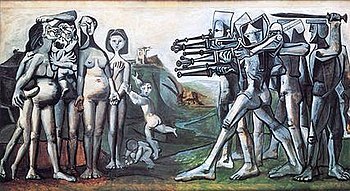
In a solitary, crumbling tower, a retired war photographer sits for the last time by the river of death and oblivion. From the far shore of the battle mural he is painting, he is watched by everyone whose final hour passed through his lens. He is watched by the entire history of human warfare since Troy.
This is a book about responsibility. And, in part, about memory. About grief and guilt. About cruelty. About meaning that isn't a mathematical theorem. About art, featuring some of the most beautiful landscapes in literature in a long time—born from the canvases of the Prado, the Uffizi, or simply the dying sun over Venetian lagoons.
It is also about the geometry of chaos, which is merely the twin of the symmetry of living matter. The laws of life and death are often the same. This, of course, is no consolation, let alone a justification for war and atrocity.
This is Pérez-Reverte’s most piercing and profound work.
Because he couldn’t find, through the lens, “the definitive image; the both fleeting and eternal moment that would explain all things,” “the hidden rule that made order out of the implacable geometry of chaos.”
“I can’t just kill you,” he explains. “I need for us to talk first; I need to know you better, to be sure that you realize certain things. I want you to learn and understand. ... After that, I’ll be able to kill you.”
”It's here, under our skin,....In our genes. Only the artificial rules, culture, the varnish of successive civilizations keep man within bounds. Social conventions, laws. Fear of punishment.”