There turned out to be plenty of ideas, after all. An opinion was ventured that Mr. Lloyd George served the nation, not for money but from public spirit; a conservative insisted that ability should be rewarded and rewarded well; whereupon ensued one of the most enlightening discussions, not only as a revelation of intelligence, but of complexes and obsessions pervading many of the minds in whose power lies the ultimate control of democracies.
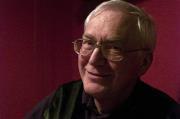
This is not the British Prime Minister, Sir Winston Spencer Churchill. This is the American novelist, Winston Churchill.
Churchill was born in St. Louis, Missouri, the son of Edward Spalding and Emma Bell (Blaine) Churchill. He attended Smith Academy in Missouri and the United States Naval Academy, where he graduated in 1894 and became an editor of the Army and Navy Journal. He resigned from the navy to pursue a writing career. While he would be most successful as a novelist, he was also a published poet and essayist.
His first novel was The Celebrity (1898). (Mr. Keegan's Elopement was published in 1896 within a magazine. In 1903 it was republished as an illustrated hardback book.) Churchill's next novel—Richard Carvel (1899)—was a phenomenon, selling as many as two million copies in a nation of only 76 million, and made Churchill rich. His next two novels, The Crisis (1901) and The Crossing (1904), were also very successful.
Churchill's early novels were historical but his later works were set in contemporary America. He often sought to include his political ideas into his novels. Churchill wrote in the naturalist style of literature, and some have called him the most influential of the American naturalists.
In 1899, Churchill moved to Cornish, New Hampshire. He became involved in politics and was elected to the state legislature in 1903 and 1905. He unsuccessfully sought the Republican nomination for governor in 1906. In 1912, he was nominated as the Progressive candidate for governor but did not win the election. He did not again seek office. In 1917, he toured the battlefields of World War I and wrote about what he saw, his first non-fiction work.
Sometime after this move, he took up watercolors, and also became known for his landscapes. Some of his works are in the collections of Cornish Colony Museum in Windsor, Vermont, Hood Museum of Art (part of Hopkins Center for the Arts Dartmouth College) in Hanover, New Hampshire, and Saint-Gaudens National Historic Site in Cornish, New Hampshire.
In 1919, Churchill decided to stop writing and withdrew from public life. As a result of this he was gradually forgotten by the public. In 1940, The Uncharted Way, his first book in 20 years, was published. The book examined Churchill's thoughts on religion. He did not seek to publicize the book and it received little attention. Shortly before his death he said, "It is very difficult now for me to think of myself as a writer of novels, as all that seems to belong to another life."
Churchill died in Winter Park, Florida in 1947. He is the great-grandfather of Albany, New York, journalist Chris Churchill.
I will not be the only one to have started this under the impression the author was his more famous namesake and then been puzzled by the repeated references to his American nationality.
Having got over that, the book can be read on its own merits. In these days of fake news it is good to be reminded that propaganda is nothing new. Churchill's accounts of happy and healthy soldiers in the trenches of WWI are not only an insult to the mem and women who endured such appalling conditions there, but if they succeeded in their aim of recruiting American volunteers to add to the carnage, verging on criminal.
Its jingoism makes it dated, and simple seems part of much of the nationalism and flag-waving that led so many people to charge blindly into the bloodshed of WWI. Its largely a celebration of the British from the perspective of an American, talking about the vile Germans and the affront the present to civilization everywhere.
This is series of Churchill's articles concerning his observations while traveling as journalist, soldier in WW1 it runs 2:32:47 He was a journalist of great renown before he was Prime Minister, Way before. His wit and perceptive eye for nuance and details are apparent in this book of articles, put to words thru Librivox.org Quite interesting.