

What do you think?

A House and Its Head
A radical thinker, one of the rare modern heretics, said Mary McCarthy of Ivy Compton-Burnett, in whose austere, savage, and bitingly funny novels anything can happen and no one will ever escape. The long, endlessly surprising conversational duels at the center of Compton-Burnett's works are confrontations between the unspoken and the unspeakable, and in them the dynamics of power and desire are dramatized as nowhere else. New York Review Books is reissuing two of the finest novels of this singular modern genius—works that look forward to the blacky comic inventions of Muriel Spark as much as they do back to the drawing rooms of Jane Austen.
A House and Its Head is Ivy Compton-Burnett's subversive look at the politics of family life, and perhaps the most unsparing of her novels. No sooner has Duncan Edgeworth's wife died than he takes a new, much younger bride whose willful ways provoke a series of transgressions that begins with adultery and ends, much to everyone's relief, in murder.
A House and Its Head is Ivy Compton-Burnett's subversive look at the politics of family life, and perhaps the most unsparing of her novels. No sooner has Duncan Edgeworth's wife died than he takes a new, much younger bride whose willful ways provoke a series of transgressions that begins with adultery and ends, much to everyone's relief, in murder.
291 pages, Paperback
First published January 1, 1935
About the author
Ivy Compton-Burnett
23 books136 followersDame Ivy Compton-Burnett, DBE was an English novelist, published (in the original hardback editions) as I. Compton-Burnett. Her works consist mainly of dialogue and focus on family life among the late Victorian or Edwardian upper middle class. She was awarded the 1955 James Tait Black Memorial Prize for her novel Mother and Son.
Ratings & Reviews
Friends & Following
Create a free account to discover what your friends think of this book!
Community Reviews
Displaying 1 - 30 of 146 reviews

December 28, 2021
Sharp, cutting and brain-alteringly unique. Took many attempts for me to click with her work, but once I did, i adored every damn second.

February 18, 2022
I came to Ivy Compton-Burnett (ICB) through the biography of Barbara The Adventures of Miss Barbara Pym. Pym’s friend Robert Liddell had “discovered” her and both friends were so fascinated by ICB’s style – narrating mostly through dialogue – that they wrote to each other letters imitating the style of their admired writer.
And indeed, the great bulk of this novel unfolds through a complex dialogue. The reader could easily wonder how well this would transpose into a script for a film or play – at least in a condensed form. But contrary to expectations, the prevalence of dialogue does not make it easy to read, for after all this is formal dialogue, very Victorian, with some very disconcerting and modern dissonances. The ambiguities – at times it is not clear who is talking – and the “sous-entendres” demand a close attention from the reader. At the beginning of my reading, I focused on how much information was conveyed through this direct speech, and what was needed to be completed or clarified by descriptive prose, but eventually I dropped this literary game and just let the interchange of voices lead my mind. In this acerbic dialogue what is most striking is its lacerating nature. At times it seems to the reader that he/she is witnessing a sword battle, with additional knives hidden in the sleeves. Expectedly, the various characters differ from each other in their relative degree of their uttered mordancy. Language is after all one of the media for exerting power in a society, be it large or as small as that of a family.
Humour certainly there is, and at times I almost laughed out loud, but it is a thin veneer over a grounded pessimistic view of human nature. The plot takes turns and turns with elements that fit a tragedy or a thriller, but the plot is a mechanism that helps exploring broader themes such as family-relations, religion, money, dependency, class-differences.
One of the characters, Duncan – the Head of its House, is the target for the reader’s dislike, and in this it reminded me of the figure of the Father in The Poisonwood Bible But in this other novel, I rebelled against the author, since I felt that the author had cheated by not giving her literary scapegoat a voice (when all the other characters, all the women, had theirs). ICB is much more subtle since Duncan makes himself both hateful and pitiful through his own discourse.
I have one more book by ICB on my pile, Manservant and Maidservant. I would like to explore her style further.
My edition comes with a powerful introduction by Hilary Mantel.

Read
February 15, 2022I spent the last five weeks reading five novels by Ivy Compton-Burnett.
It was a period when reading time was in short supply so I needed books that I could read small amounts of every so often yet not feel lost when I picked them up later.
Ivy Compton-Burnett suited perfectly because her books contain no descriptive writing, no meditative passages, in fact very little that is not in dialogue form.
The dialogues don't have many 'he said, she said' tags, and the few non-dialogue lines sound like stage directions so reading these books feels like being at the theatre—there's a small cast of characters, often related to each other, and the action tends to take place in one location, eg., the main character's dining-room or drawing-room.
Compton-Burnett's books are all set among upper middle-class English people in the late nineteenth or early twentieth centuries, a time when such people could live in comfortable seclusion from the problems beyond the walls of their landed properties.
War or unemployment or poverty are never mentioned although two of the characters in Mother and Son (published in 1933) have reduced income and are obliged to become gentlewomen companions. The Middleton family in The Mighty And Their Fall (published in 1961) also face curbing their comfortable lifestyle but are saved by a timely inheritance.
Quite a few 'timely' things occur in Compton-Burnett's novels—wills are lost, letters are found, characters overhear what they shouldn't, secrets get revealed, people thought to be dead turn up—melodrama of every type in other words. As a character in one of the books says, 'What a day it has been! There is material for an epic. The fall of Lavinia; the return of Ransom; the uplift of Ninian; the tragedy of Ransom; the escape of Lavinia; the lament of Selina. I hope there will be no more.'
I don't often read melodrama so how did I manage to read five books full of it?
Well, the first one I picked up, A Father and His Fate (published in 1957), in spite of having an absurd plot, impressed me because of the characters' barbed speech, full of double meanings and innuendos. Reading a single page of such exchanges is a brain workout for the entire day!
'Miss Gibbon is perhaps hardly educated enough for a governess.'
'Well, if she was, she would not be one. That is why governesses are not educated. Sometimes I almost wonder why Mother engaged her.'
'She was suitable for us when we were young. And then she could not be got rid of without being dismissed.'
'Father would not have that. And we should think less of him, if he would.'
'And he does not think education necessary for daughters. He has said he did not intend us for governesses.”
'I am sure any element of dishonesty on Miss Gibbon’s part has been unconscious.'
'Well, dishonesty may be that. It is honesty that never is. I suppose it takes too much effort. It is too unnatural.'
'It is made easy for most of us,' said Audrey. 'But I should yield to temptation.'
'People always do,' said Ursula. 'If they resist it, it is something else.'
'I do not agree,' said Constance. 'I am sure there are many instances of heroic resistance of it.'
'If you are thinking of martyrs, I hardly believe they were tempted. If they had not been martyrs, they would have been nothing. And that tempts no one.'
Some of the lines reminded me of Oscar Wilde's aphorisms mixed with the wittiest bits out of Jane Austen's novels, eg.:
'It is less embarrassing to lose a parent than to gain one.'
Or this:
'Mother is not here to console him for her death. It will be his last grievance against her.
Or again:
'May I congratulate you on a charming speech?'
'I was afraid you were going to congratulate me on my marriage, and opinions differ so much more on speeches. I am sorry for the hint of effort about mine; I had no time to make it spontaneous.'
But underneath all the wit lies a morass of manipulation and hypocrisy unlike anything I've ever found in Wilde or Austen. The family groups Compton-Burnett sets before us are invariably dominated by one tyrannical figure, usually the father, and his children, even when grown up, are as powerless as servants. They defend themselves with the only weapons they possess, their sharp tongues, and often speak in asides to each other which the tyrant figure always manages to overhear. Incidentally, people never fully leave a room in an Ivy Compton-Burnett book, they linger in the doorway on the off chance of hearing something they can pounce on and twist to their own purposes—though they don't always succeed, as in this scene from More Women Than Men (published in 1933):
'And what are you wagging your tongues about so busily? I hope, as the children say, it was not about me, or I shall perforce interrupt your colloquy.'
'I have no respect for people who cannot have their colloquies interrupted,' said Felix. 'We were not talking about you, but of course we might often do so. I should never suggest anything else to a person who thought he was being talked about.'
Visitors to the characters' houses sometimes find such exchanges a bit unusual, as in this scene from A House and Its Head (published in 1935):
'No one can speak in this house without meaning too much.'
'Oh, nonsense. You are not used to meaning anything. And so you are struck by the difference.'
It goes without saying that the 'meaning' of words is one of the things the characters love to pin down. Any casual phrases, such as the one I just used, 'it goes without saying', are challenged—in a constant search for the truth behind what is being said.
'We need not say that our time is yours, it goes without saying.'
'It does not do that. But I will remember it.'
Or
'We are here to prove we are your friends through thick and thin.'
'Which is this?' said Nance
Or
'He said all was fair in love and war. I have always thought it an immoral saying.'
'It means the opposite of what it says. But why say all is unfair in love and war? We all know it.'
Or
'What should we do without our daughter?' said Mr Bode, right that they would do differently.
Truth can even be turned inside out in these books as happens when a bullying husband, after his wife has died, comes to see himself as having been a model one—though the reversal cannot happen without him bullying someone else.
Duncan drew his daughter from the room, and led her to the library. It was an hour before she emerged and followed the others. 'I feel I have lost both my parents. Mother has not vanished more completely than Father. In his stead there is a man, who has been an almost monotonously amiable husband. I dread he will begin to repent of the monotony.'
'Has he been telling you?' said Sibyl.
'I have been telling him. He inclined himself, as you know, to the opposite view. It is fortunate I am not a person who cannot tell a lie. I hardly remember the difference between truth and falsehood; and he is not in any way concerned with it.'
'Poor Father! It is the least we can do for him.'
'It was the most I could do. You don’t know how much virtue has gone out of me. The virtue was Father’s, but I had to produce it.'
Some of the characters, the daughters in particular, reminded me of the people in Nathalie Sarraute's Tropismes, victims as a result of having to live at close quarters to hugely selfish others, becoming diminished at every contact—and eventually as hard-hearted as the people who bully them.
'Is Father all right alone?'
‘Not if appearances are deceitful,’ said Nance. ‘But we do not consider remedying his condition.'
No one ever remedies anyone's condition in Compton-Burnett's books. Characters may marry in the course of the melodramatic plots but there's no hint of real affection in sight. Unrestrained feelings such as love don't feature—everyone is too busy trying to better their own position or else settling for the lesser of two evils. Bleak House might have been a good title for any of the five novels I read—and that reminds me of an apt line to finish on:
'Your grandmother was a great woman. I should like to be Dickens, so that I could be unrestrained about her.'
It was a period when reading time was in short supply so I needed books that I could read small amounts of every so often yet not feel lost when I picked them up later.
Ivy Compton-Burnett suited perfectly because her books contain no descriptive writing, no meditative passages, in fact very little that is not in dialogue form.
The dialogues don't have many 'he said, she said' tags, and the few non-dialogue lines sound like stage directions so reading these books feels like being at the theatre—there's a small cast of characters, often related to each other, and the action tends to take place in one location, eg., the main character's dining-room or drawing-room.
Compton-Burnett's books are all set among upper middle-class English people in the late nineteenth or early twentieth centuries, a time when such people could live in comfortable seclusion from the problems beyond the walls of their landed properties.
War or unemployment or poverty are never mentioned although two of the characters in Mother and Son (published in 1933) have reduced income and are obliged to become gentlewomen companions. The Middleton family in The Mighty And Their Fall (published in 1961) also face curbing their comfortable lifestyle but are saved by a timely inheritance.
Quite a few 'timely' things occur in Compton-Burnett's novels—wills are lost, letters are found, characters overhear what they shouldn't, secrets get revealed, people thought to be dead turn up—melodrama of every type in other words. As a character in one of the books says, 'What a day it has been! There is material for an epic. The fall of Lavinia; the return of Ransom; the uplift of Ninian; the tragedy of Ransom; the escape of Lavinia; the lament of Selina. I hope there will be no more.'
I don't often read melodrama so how did I manage to read five books full of it?
Well, the first one I picked up, A Father and His Fate (published in 1957), in spite of having an absurd plot, impressed me because of the characters' barbed speech, full of double meanings and innuendos. Reading a single page of such exchanges is a brain workout for the entire day!
'Miss Gibbon is perhaps hardly educated enough for a governess.'
'Well, if she was, she would not be one. That is why governesses are not educated. Sometimes I almost wonder why Mother engaged her.'
'She was suitable for us when we were young. And then she could not be got rid of without being dismissed.'
'Father would not have that. And we should think less of him, if he would.'
'And he does not think education necessary for daughters. He has said he did not intend us for governesses.”
'I am sure any element of dishonesty on Miss Gibbon’s part has been unconscious.'
'Well, dishonesty may be that. It is honesty that never is. I suppose it takes too much effort. It is too unnatural.'
'It is made easy for most of us,' said Audrey. 'But I should yield to temptation.'
'People always do,' said Ursula. 'If they resist it, it is something else.'
'I do not agree,' said Constance. 'I am sure there are many instances of heroic resistance of it.'
'If you are thinking of martyrs, I hardly believe they were tempted. If they had not been martyrs, they would have been nothing. And that tempts no one.'
Some of the lines reminded me of Oscar Wilde's aphorisms mixed with the wittiest bits out of Jane Austen's novels, eg.:
'It is less embarrassing to lose a parent than to gain one.'
Or this:
'Mother is not here to console him for her death. It will be his last grievance against her.
Or again:
'May I congratulate you on a charming speech?'
'I was afraid you were going to congratulate me on my marriage, and opinions differ so much more on speeches. I am sorry for the hint of effort about mine; I had no time to make it spontaneous.'
But underneath all the wit lies a morass of manipulation and hypocrisy unlike anything I've ever found in Wilde or Austen. The family groups Compton-Burnett sets before us are invariably dominated by one tyrannical figure, usually the father, and his children, even when grown up, are as powerless as servants. They defend themselves with the only weapons they possess, their sharp tongues, and often speak in asides to each other which the tyrant figure always manages to overhear. Incidentally, people never fully leave a room in an Ivy Compton-Burnett book, they linger in the doorway on the off chance of hearing something they can pounce on and twist to their own purposes—though they don't always succeed, as in this scene from More Women Than Men (published in 1933):
'And what are you wagging your tongues about so busily? I hope, as the children say, it was not about me, or I shall perforce interrupt your colloquy.'
'I have no respect for people who cannot have their colloquies interrupted,' said Felix. 'We were not talking about you, but of course we might often do so. I should never suggest anything else to a person who thought he was being talked about.'
Visitors to the characters' houses sometimes find such exchanges a bit unusual, as in this scene from A House and Its Head (published in 1935):
'No one can speak in this house without meaning too much.'
'Oh, nonsense. You are not used to meaning anything. And so you are struck by the difference.'
It goes without saying that the 'meaning' of words is one of the things the characters love to pin down. Any casual phrases, such as the one I just used, 'it goes without saying', are challenged—in a constant search for the truth behind what is being said.
'We need not say that our time is yours, it goes without saying.'
'It does not do that. But I will remember it.'
Or
'We are here to prove we are your friends through thick and thin.'
'Which is this?' said Nance
Or
'He said all was fair in love and war. I have always thought it an immoral saying.'
'It means the opposite of what it says. But why say all is unfair in love and war? We all know it.'
Or
'What should we do without our daughter?' said Mr Bode, right that they would do differently.
Truth can even be turned inside out in these books as happens when a bullying husband, after his wife has died, comes to see himself as having been a model one—though the reversal cannot happen without him bullying someone else.
Duncan drew his daughter from the room, and led her to the library. It was an hour before she emerged and followed the others. 'I feel I have lost both my parents. Mother has not vanished more completely than Father. In his stead there is a man, who has been an almost monotonously amiable husband. I dread he will begin to repent of the monotony.'
'Has he been telling you?' said Sibyl.
'I have been telling him. He inclined himself, as you know, to the opposite view. It is fortunate I am not a person who cannot tell a lie. I hardly remember the difference between truth and falsehood; and he is not in any way concerned with it.'
'Poor Father! It is the least we can do for him.'
'It was the most I could do. You don’t know how much virtue has gone out of me. The virtue was Father’s, but I had to produce it.'
Some of the characters, the daughters in particular, reminded me of the people in Nathalie Sarraute's Tropismes, victims as a result of having to live at close quarters to hugely selfish others, becoming diminished at every contact—and eventually as hard-hearted as the people who bully them.
'Is Father all right alone?'
‘Not if appearances are deceitful,’ said Nance. ‘But we do not consider remedying his condition.'
No one ever remedies anyone's condition in Compton-Burnett's books. Characters may marry in the course of the melodramatic plots but there's no hint of real affection in sight. Unrestrained feelings such as love don't feature—everyone is too busy trying to better their own position or else settling for the lesser of two evils. Bleak House might have been a good title for any of the five novels I read—and that reminds me of an apt line to finish on:
'Your grandmother was a great woman. I should like to be Dickens, so that I could be unrestrained about her.'

July 27, 2020
Duncan Edgeworth è "il capofamiglia" indiscusso di questa famiglia inglese di fine Ottocento. È lui che detta le regole e tutto ruota attorno alla sua figura. "Lui non seguirebbe la regola perché, come mi ha spiegato una volta, detta lui le sue regole."
Un padre anaffettivo, un uomo che nonostante questo, riesce a sposarsi tre volte.
Quando perde la prima moglie sembra che debba chiudersi per sempre nel suo dolore e invece, non fa in tempo a seppellirla, che ha già pronta la sostituta, coetanea delle due figlie Sybil e Nance.
Un romanzo che denuncia la sottomissione delle donne e che rivendica la pari dignità tra l'uomo e la donna. Un romanzo d'avanguardia, se si pensa a quando è stato scritto.
Ivy Compton-Burnett, scrittrice molto amata da Natalia Ginzburg, servendosi di un'ironia pungente e di dialoghi serrati, mette in scena le vicende famigliari degli Edgeworth, che riescono a ingollare tutti i rospi e insabbiare tutti gli scandali, pur di non infangare il buon nome della famiglia.
Tra Nance e Sybil, la mia preferita è Nance: un carattere forte che sa ribellarsi all'egemonia paterna. Una donna schietta, ironica, trasparente, che riesce a conquistarsi il posto di "preferita" tra i suoi familiari.
"Mio padre può avere entrambe le cose. Può essere vedovo inconsolabile e marito felice allo stesso tempo. Ed è sempre un martire e un tiranno."
"Tutti siamo in grado di commettere cose che vanno contro il nostro istinto, che suscitano in noi ripulsa. Tutti tranne nostro padre, s'intende. Ecco perché lui è al di sopra degli altri. Il suo posto è quello."
Un padre anaffettivo, un uomo che nonostante questo, riesce a sposarsi tre volte.
Quando perde la prima moglie sembra che debba chiudersi per sempre nel suo dolore e invece, non fa in tempo a seppellirla, che ha già pronta la sostituta, coetanea delle due figlie Sybil e Nance.
Un romanzo che denuncia la sottomissione delle donne e che rivendica la pari dignità tra l'uomo e la donna. Un romanzo d'avanguardia, se si pensa a quando è stato scritto.
Ivy Compton-Burnett, scrittrice molto amata da Natalia Ginzburg, servendosi di un'ironia pungente e di dialoghi serrati, mette in scena le vicende famigliari degli Edgeworth, che riescono a ingollare tutti i rospi e insabbiare tutti gli scandali, pur di non infangare il buon nome della famiglia.
Tra Nance e Sybil, la mia preferita è Nance: un carattere forte che sa ribellarsi all'egemonia paterna. Una donna schietta, ironica, trasparente, che riesce a conquistarsi il posto di "preferita" tra i suoi familiari.
"Mio padre può avere entrambe le cose. Può essere vedovo inconsolabile e marito felice allo stesso tempo. Ed è sempre un martire e un tiranno."
"Tutti siamo in grado di commettere cose che vanno contro il nostro istinto, che suscitano in noi ripulsa. Tutti tranne nostro padre, s'intende. Ecco perché lui è al di sopra degli altri. Il suo posto è quello."

March 4, 2011
Compton-Burnett (abbreviated as CB hereafter) is one of the truly remarkable modernist writers, with a span of resonant fiction that she wrote from the 1920s through to the 1960s.
CB is reminiscent of other modernists through her principal and powerful focus on dialogue in her fiction as a way to dramatise her characters' individual personalities, tensions, complexities, resentments, repressions and sometimes savage irony (she herself is a savage, i.e., a wonderful Swiftian ironist/satirist, scalpel-sharp).
In particular you are reminded of William Gaddis (The Recognitions, Carpenter's Gothic, and JR), Henry Green (Loving, Living, Party Going, Nothing, Doting, Blindness), the dialogue from the early plays of Harold Pinter (The Birthday Party, The Room, The Dumb Waiter) and sometimes Samuel Beckett.
As with her other fiction, she has a set of themes she returns to time and again - you could call them obsessions, in a way. From the Edwardian/Victorian repressive household settings, to the patriarchal, remote, powerfully domineering father/husband of the household, to the anaesthetised (dream-like state) wives, and the often fearful, sometimes subtly insubordinate - or otherwise self-serving, monstrously deceptive - children.
In the Edgeworth family in A House and its Head, published in 1935, you therefore have the archetypally representative CB family. The author often referred to it as one of the two of her most favourite works (the other being Manservant and Maidservant.
It opens with a conversation between husband and wife that is disconnected, disjointed, alienated and reminds you of Pinter's early work (The Room, The Birthday Party). While Duncan Edgeworth, the father, is without doubt a tyrant, dictating all terms to his family, there's a snake in the grass in the apparently-servile daughter, Sybil, who is more monstrous in other ways than him).
As with Gaddis' fiction, it can sometimes be difficult to identify the speaker of the dialogue, as CB rarely identifies the person; you come to recognise them through their individual natures and thereby the content of what they say. This is what makes her so identifiably such a modernist, and she remains a radical and remarkable one at that.
While challenging and radical in its use of conversation, the satire and precise, paper-cut language and characterisation make this and all her other fiction well worth the effort (never a painful effort, by the way; it just requires a participating, not passive, energy on the part of the reader). Moreover, as with her other novels, it leaves you intellectually and emotionally rewarded, and astonished by her brilliance.
For those who are keen to learn more about CB, I highly recommend three excellent sources:
1. A dedicated, very helpful website on CB, her work and her critics (https://brightlightsfilm.com/ivy/)
2. In this edition there is a superb afterword by Francine Prose, the National Book Award-nominated novelist: https://brightlightsfilm.com/ivy/ivy_.... In it, she characterises CB's fiction rather wonderfully as '[...] less like conventional fictions than like the laboratory notes of a meticulous and rather mad scientist.'
3. Hilary Spurling's masterful biography, Ivy: The Life of Ivy Compton Burnett.
CB is reminiscent of other modernists through her principal and powerful focus on dialogue in her fiction as a way to dramatise her characters' individual personalities, tensions, complexities, resentments, repressions and sometimes savage irony (she herself is a savage, i.e., a wonderful Swiftian ironist/satirist, scalpel-sharp).
In particular you are reminded of William Gaddis (The Recognitions, Carpenter's Gothic, and JR), Henry Green (Loving, Living, Party Going, Nothing, Doting, Blindness), the dialogue from the early plays of Harold Pinter (The Birthday Party, The Room, The Dumb Waiter) and sometimes Samuel Beckett.
As with her other fiction, she has a set of themes she returns to time and again - you could call them obsessions, in a way. From the Edwardian/Victorian repressive household settings, to the patriarchal, remote, powerfully domineering father/husband of the household, to the anaesthetised (dream-like state) wives, and the often fearful, sometimes subtly insubordinate - or otherwise self-serving, monstrously deceptive - children.
In the Edgeworth family in A House and its Head, published in 1935, you therefore have the archetypally representative CB family. The author often referred to it as one of the two of her most favourite works (the other being Manservant and Maidservant.
It opens with a conversation between husband and wife that is disconnected, disjointed, alienated and reminds you of Pinter's early work (The Room, The Birthday Party). While Duncan Edgeworth, the father, is without doubt a tyrant, dictating all terms to his family, there's a snake in the grass in the apparently-servile daughter, Sybil, who is more monstrous in other ways than him).
As with Gaddis' fiction, it can sometimes be difficult to identify the speaker of the dialogue, as CB rarely identifies the person; you come to recognise them through their individual natures and thereby the content of what they say. This is what makes her so identifiably such a modernist, and she remains a radical and remarkable one at that.
While challenging and radical in its use of conversation, the satire and precise, paper-cut language and characterisation make this and all her other fiction well worth the effort (never a painful effort, by the way; it just requires a participating, not passive, energy on the part of the reader). Moreover, as with her other novels, it leaves you intellectually and emotionally rewarded, and astonished by her brilliance.
For those who are keen to learn more about CB, I highly recommend three excellent sources:
1. A dedicated, very helpful website on CB, her work and her critics (https://brightlightsfilm.com/ivy/)
2. In this edition there is a superb afterword by Francine Prose, the National Book Award-nominated novelist: https://brightlightsfilm.com/ivy/ivy_.... In it, she characterises CB's fiction rather wonderfully as '[...] less like conventional fictions than like the laboratory notes of a meticulous and rather mad scientist.'
3. Hilary Spurling's masterful biography, Ivy: The Life of Ivy Compton Burnett.

January 28, 2012
A very strange book. I hardly know what to think. It invites comparison with Meredith with respect to the sheer difficulty of following what's happening. People say things (practically the whole book is dialogue) but half the time, I just don't follow the conversation. This tendency is not helped by (perhaps is wholly owing to) the absence of clues as to when things are said sotto voce, or in a side conversation not involving all present, and so on. (I suppose there must be theatrical adaptations of the novels. Perhaps that is the best way to experience them.) But the characters do also speak elusively.
And the relationships can be hard to fathom too. Duncan, the eponymous head of the house, is a tyrant, capable of great sadism, yet there is a levity in the way the younger generation treats him (well, mostly Nance and Grant) that suggests that for them, the tyranny is not real. I found it very hard to get my bearings.
Formally, it's quite clever (Francine Prose explains this in her afterword).
I feel if only I could latch on to the right rhythm, or blocking, or accent, or something, it would all fall into place and it would be my favorite book ever. But I can't quite seem to find that key. I guess, as with Meredith, I have to say that I am barely adequate, if that, to this book.
And the relationships can be hard to fathom too. Duncan, the eponymous head of the house, is a tyrant, capable of great sadism, yet there is a levity in the way the younger generation treats him (well, mostly Nance and Grant) that suggests that for them, the tyranny is not real. I found it very hard to get my bearings.
Formally, it's quite clever (Francine Prose explains this in her afterword).
I feel if only I could latch on to the right rhythm, or blocking, or accent, or something, it would all fall into place and it would be my favorite book ever. But I can't quite seem to find that key. I guess, as with Meredith, I have to say that I am barely adequate, if that, to this book.

January 15, 2022
(4.5)
June 17, 2020
“ Si dice che il dolore riavvicini le famiglie”, disse Nance. “Ma a quanto pare per noi non funziona. Vi dirò che i lati positivi del dolore continuano a sfuggirmi”
☆ 4/5 | La famiglia Edgeworth è in grado di sfornare novità discutibili in maniera repentina e la cerchia delle amicizie così legata ai componenti lo sa per certo, nonostante continui a stupirsi.
E’ il 1885, siamo in Inghilterra e la famiglia Edgeworth è richiamata a sistemarsi attorno la tavola per l'imminente colazione natalizia, pronti a citare ciò di cui si è lieti durante questa grande ed importante festività.
Sin da subito, tra i componenti, nasce una conversazione apparentemente pacifica, ma che mal cela acredini e frasi buttate fuori per circostanza o per pungolare con irriverenza.
Tra la famiglia si innalza con austerità, severità e compostezza la figura di Duncan Edgeworth, capostipite e padre non avvezzo a smancerie, incapace di esprimere a parole i propri sentimenti. Una persona di grande valore su cui attorno gravitano Ellen, la moglie remissiva. Nance, la primogenita che con sarcasmo tiene testa alle imposizioni del padre. L’affettuosa Sibyl, e Grant, il nipote che il signor Edgeworth ha spinto sotto la sua ala dopo la morte del fratello. A lui sarà concesso il privilegio di ereditare la tenuta ed ogni bene. Forse.
Sin da subito, tra la profusione di dialoghi che caratterizzano il libro, notiamo come Duncan Edgeworth sia influente dentro la sua famiglia ed anche fuori. Un’immagine difficile da piegare e sicuramente molto sicuro di sé e delle sue scelte, tanto da non accettare risposte avverse o consigli sollecitanti. Capace di impuntare colpevolezza sugli altri con lo sguardo e atteggiamento impettito invece che su se stesso.
“Lui si è comportato come un dio in terra, e noi come tale lo abbiamo trattato. Ecco cosa succede quando nessuno critica le tue azioni. Gli dèi vogliono solo essere idolatrati e ci riescono; è così che si assicurano il monopolio sulla saggezza.”
E’ un imminente quanto sconcertante e imprevedibile lutto che mette in ginocchio la famiglia Edgeworth, spingendola di fronte alla difficoltà a mantenere ancora su di sé gli abiti di compostezza e decoro.
L’evento cambia ogni più piccola loro convinzione, lascia scoperti i visi e le orecchie, pronte ad ascoltare ogni diceria sul loro conto quando gli errori vengono compiuti e lasciati trapelare.
Ma qualunque cosa accada, l’importante è coprire tutto, lasciare che le maschere continuino ad ingannare la gente.
•••
“Il capofamiglia” è un libro che va letto con massima attenzione e scrupolosità. E’ difficile districarsi tra i continui dialoghi, perché la narrazione avviene del tutto priva di caratterizzazioni dello spazio in cui i personaggi si muovono. E’ compito del lettore riuscire ad interpretare gli spostamenti, a sollecitare la propria immaginazione per un quadro più completo.
Può risultare difficile, lo ammetto, lo è stato anche per me all’inizio, ma poi il libro riesce comunque a far scivolare facilmente dentro la storia. Dentro una narrazione corale.
Perché tutto inizia con gli Edgeworth, ma con la regalità dello stile dell’Ottocento, attorno la famiglia si presentano gli amici e le loro storie.
Oltre ad una ben chiara rappresentazione del patriarcato, ho trovato predominante la figura della donna, quale servile fino all’estremo in certi casi, matura e sarcastica in altri ed anche capace di azioni vendicative ben lungi da accettare.
Ringrazio Fazi Editore e Cristina per l’invio della copia in cambio di un’onesta recensione🌻
Recensione del 17/06/2020
Blog: www.lalibreriadiale.altervista.org
☆ 4/5 | La famiglia Edgeworth è in grado di sfornare novità discutibili in maniera repentina e la cerchia delle amicizie così legata ai componenti lo sa per certo, nonostante continui a stupirsi.
E’ il 1885, siamo in Inghilterra e la famiglia Edgeworth è richiamata a sistemarsi attorno la tavola per l'imminente colazione natalizia, pronti a citare ciò di cui si è lieti durante questa grande ed importante festività.
Sin da subito, tra i componenti, nasce una conversazione apparentemente pacifica, ma che mal cela acredini e frasi buttate fuori per circostanza o per pungolare con irriverenza.
Tra la famiglia si innalza con austerità, severità e compostezza la figura di Duncan Edgeworth, capostipite e padre non avvezzo a smancerie, incapace di esprimere a parole i propri sentimenti. Una persona di grande valore su cui attorno gravitano Ellen, la moglie remissiva. Nance, la primogenita che con sarcasmo tiene testa alle imposizioni del padre. L’affettuosa Sibyl, e Grant, il nipote che il signor Edgeworth ha spinto sotto la sua ala dopo la morte del fratello. A lui sarà concesso il privilegio di ereditare la tenuta ed ogni bene. Forse.
Sin da subito, tra la profusione di dialoghi che caratterizzano il libro, notiamo come Duncan Edgeworth sia influente dentro la sua famiglia ed anche fuori. Un’immagine difficile da piegare e sicuramente molto sicuro di sé e delle sue scelte, tanto da non accettare risposte avverse o consigli sollecitanti. Capace di impuntare colpevolezza sugli altri con lo sguardo e atteggiamento impettito invece che su se stesso.
“Lui si è comportato come un dio in terra, e noi come tale lo abbiamo trattato. Ecco cosa succede quando nessuno critica le tue azioni. Gli dèi vogliono solo essere idolatrati e ci riescono; è così che si assicurano il monopolio sulla saggezza.”
E’ un imminente quanto sconcertante e imprevedibile lutto che mette in ginocchio la famiglia Edgeworth, spingendola di fronte alla difficoltà a mantenere ancora su di sé gli abiti di compostezza e decoro.
L’evento cambia ogni più piccola loro convinzione, lascia scoperti i visi e le orecchie, pronte ad ascoltare ogni diceria sul loro conto quando gli errori vengono compiuti e lasciati trapelare.
Ma qualunque cosa accada, l’importante è coprire tutto, lasciare che le maschere continuino ad ingannare la gente.
•••
“Il capofamiglia” è un libro che va letto con massima attenzione e scrupolosità. E’ difficile districarsi tra i continui dialoghi, perché la narrazione avviene del tutto priva di caratterizzazioni dello spazio in cui i personaggi si muovono. E’ compito del lettore riuscire ad interpretare gli spostamenti, a sollecitare la propria immaginazione per un quadro più completo.
Può risultare difficile, lo ammetto, lo è stato anche per me all’inizio, ma poi il libro riesce comunque a far scivolare facilmente dentro la storia. Dentro una narrazione corale.
Perché tutto inizia con gli Edgeworth, ma con la regalità dello stile dell’Ottocento, attorno la famiglia si presentano gli amici e le loro storie.
Oltre ad una ben chiara rappresentazione del patriarcato, ho trovato predominante la figura della donna, quale servile fino all’estremo in certi casi, matura e sarcastica in altri ed anche capace di azioni vendicative ben lungi da accettare.
Ringrazio Fazi Editore e Cristina per l’invio della copia in cambio di un’onesta recensione🌻
Recensione del 17/06/2020
Blog: www.lalibreriadiale.altervista.org

October 31, 2020
A menudo se compara a Ivy Compton-Burnett con Jane Austen. Jane Austen on bad drugs, dice Francine Prose en su prólogo para la edición de NYRB. Una Jane Austen muy fumada, traduciríamos en esta España nuestra si fuese el título de una película.
Mi aportación a la comparativa: con los planos de Jane Austen para una casa señorial de campo, va Ivy Compton-Burnett y te hace un panteón románico.
De Austen tenemos todo ese mundo de familias pudientes, y no tan pudientes, de la campiña inglesa. Médicos, damas solteras y clérigos que se hacen visitas, se devuelven las visitas, conversan sobre la mejor manera de ajustarse a las convenciones sociales, calculan matrimonios, rentas y herencias, se hacen los virtuosos, cotillean. En definitiva: hablan. Hablan mucho y con un estilo muy pero que muy formal.
Una diferencia básica: Compton-Burnett no sigue el esquema de heroína imperfecta que al final gana un premio (sabiduría, un marido).
La novela se compone de un 99% por cierto de diálogos en estilo directo y un 1% de indicaciones del narrador sobre el aspecto de los personajes y el espacio en el que se encuentran al empezar cada conversación. Ese 1% es tan escueto que la sensación predominante es la de estar asistiendo a una representación teatral con los ojos vendados.
El lector tiene que poner bastante de su parte para entender la situación. En ocasiones resulta difícil saber si un personaje está
(1) hablando en voz alta para todo el grupo,
(2) hablando en voz baja solo para un personaje del grupo, o
(3) hablando para sí mismo.
Por lo que he dicho hasta ahora quizás no lo parezca, pero se trata de una novela bastante divertida. Hay giros inesperados. Un pequeño caso criminal. Sordidez (siempre fuera de escena). Villanos en la sombra. Dúos cómicos. Al menos la mitad de los personajes tienen un punto humorístico. Sarcásticos. Metepatas. Ridículos que se ponen en evidencia. Eso sí, hablamos de un humor de media sonrisa circunscrito por la formalidad dominante.
Una cita que me guardo para mi vida cotidiana:
—Qué pesadez que la excepción confirme la regla.
Mi aportación a la comparativa: con los planos de Jane Austen para una casa señorial de campo, va Ivy Compton-Burnett y te hace un panteón románico.
De Austen tenemos todo ese mundo de familias pudientes, y no tan pudientes, de la campiña inglesa. Médicos, damas solteras y clérigos que se hacen visitas, se devuelven las visitas, conversan sobre la mejor manera de ajustarse a las convenciones sociales, calculan matrimonios, rentas y herencias, se hacen los virtuosos, cotillean. En definitiva: hablan. Hablan mucho y con un estilo muy pero que muy formal.
Una diferencia básica: Compton-Burnett no sigue el esquema de heroína imperfecta que al final gana un premio (sabiduría, un marido).
La novela se compone de un 99% por cierto de diálogos en estilo directo y un 1% de indicaciones del narrador sobre el aspecto de los personajes y el espacio en el que se encuentran al empezar cada conversación. Ese 1% es tan escueto que la sensación predominante es la de estar asistiendo a una representación teatral con los ojos vendados.
El lector tiene que poner bastante de su parte para entender la situación. En ocasiones resulta difícil saber si un personaje está
(1) hablando en voz alta para todo el grupo,
(2) hablando en voz baja solo para un personaje del grupo, o
(3) hablando para sí mismo.
Por lo que he dicho hasta ahora quizás no lo parezca, pero se trata de una novela bastante divertida. Hay giros inesperados. Un pequeño caso criminal. Sordidez (siempre fuera de escena). Villanos en la sombra. Dúos cómicos. Al menos la mitad de los personajes tienen un punto humorístico. Sarcásticos. Metepatas. Ridículos que se ponen en evidencia. Eso sí, hablamos de un humor de media sonrisa circunscrito por la formalidad dominante.
Una cita que me guardo para mi vida cotidiana:
—Qué pesadez que la excepción confirme la regla.

September 1, 2021
Original, idiosyncratic, radical. She’s been called these things by writers in the game over the decades, and I can only repeat them. I haven’t read anything like it. It was challenging but I was glued to it, I found myself thinking about it all the time when I wasn’t. It’s a dark comedy that looks at the power dynamics and struggles within a family with a domineering patriarch at the helm. It’s set mostly in people’s homes, in drawing rooms. She’s been called by Francine Prose ‘Jane Austen on bad drugs’, and it seemed before I began reading like a silly thing to say, but when I got into it it made absolute sense – it’s spot on. It was the kind of first time reading of an author that sent me to Google to look up who this neglected woman was who wrote so sharply and brilliantly, in such a singular voice, in the early decades of the twentieth century. Published in 1935, it feels fresh and new. It’s a work of realism but you’re in a different world. It’s made up almost entirely of dialogue, and the characters all speak in a highly stylized and absurdly formal diction. There are swift, abrupt changes that required my alertness at all times. I was watching the sentences like a hawk as I was reading them. And I often reread them. It moves fast and it’s so easy to miss the subtleties that litter every page. A person who was just in the middle of the room, a participant in the general conversation, all of a sudden gets talked about, and you realize he’s moved away or left the room. There are hints and glimmers of meaning – little is explained. The writing is easily among the tersest I’ve ever read. This story is a battle of wits between the father of the family, Duncan, and his daughters and nephew, and their neighborhood and parish friends who watch on and gossip. The banter is super entertaining. I said when I started it that I was looking forward to savagery, and I got it. It’s cutting, sly, offbeat and extremely witty. I was held, fascinated.

May 30, 2008
Lots of very mannered, self-consciously clever dialogue - almost like reading a Wildean play script. Superb descriptions of people's tone of voice, mannerisms, emotions, motivation, inner fears, hidden agendas etc. Not something one can skim. Although lots of dialogue, it is not always immediately obvious who is saying what. Most characters are cold and detached, with not much plot happening and nothing resolved at the end.
The repercussions of death and betrayal in a family of almost adult offspring. A surprisingly scandalous tale, though the characters are typically blasé about events.
The repercussions of death and betrayal in a family of almost adult offspring. A surprisingly scandalous tale, though the characters are typically blasé about events.

August 19, 2026
Not a book for me. 😅

February 6, 2026
3,75/5
Współcześnie można by to określić patologią, to rodzinne bagno, ale czyta się niesamowicie dobrze.
Współcześnie można by to określić patologią, to rodzinne bagno, ale czyta się niesamowicie dobrze.

July 8, 2015
At The Fidelity Fiduciary Bank.
A case is ready to be made that Mary Poppins is the fists-clenched existential tale of one man's struggle to the bottom: one George Banks, formerly of the Bank Of London. Uptight father of a motherless family in staunchly proper Edwardian society, Banks is the only one in the story with a character arc. After all, everybody else just does what they do: Poppins flies around on her umbrella bringing delight, the children love games, hate school, hate medicine, love sweets; even Bert the chimney sweep-- so loves doing his regular thing, he can barely be tempted to skive off. So unlikely as it may seem, besides Banks, no one goes on a radical journey of self-discovery. He is the fulcrum.
As we know, the Edwardians were conspicuous medicine, schoolwork, and any-convention-at-all fanciers, people who did conventional things, for the sake of doing them again and again. They were lovers of the stiffly starched collar, preferably one size too high and one size too tight. At least we know this from the Poppins version, which is many things to many people, but cannot, of course, be questioned.
Let's Go Fly A Kite.
Historical eras seem to have distinct characteristics, and often are solidified into stereotypes by galvanizing works of theater or literature. That they couldn't possibly qualify for their time-honored attributes day in and day out--seems to be generally less important than 'getting a handle' on a historical setting, via a group of clichés. In A House And Its Head there is no such deference to clearing the air. Author Ivy Compton-Burnett is, if anything, interested in hammering the last nail into the coffin of Edwardianism with her naked antipathy toward the denizens. Whether clever and snippy, or ditzy and blustery, all the pronouncements here, in dialogue, cover another little slight or affront, another breach in the social fabric straining to burst:
Now, Mother dear, lift up your head and your heart. Mr. Edgeworth has not roused himself from his own shock and sorrow--yes, the shame; for it must be almost that--to point us our direction, without looking for a touch of resilience and response. We can best repay him by throwing up our heads, facing the four winds squarely, and putting our best foot foremost out of the morass, and also out of his house.
What broadens into an indictment of the entire milieu begins at the breakfast table at the manor house, with Father --the stuffy, ferocious George Banks of this small, vicious world-- verbally shredding the family, the servants, the village, in a matter-of-fact way that leads the reader to believe this is every morning, rain or shine. Whereas in Mary Poppins the Father will have a eureka moment and reconsider everything, there will be no such revision in Compton-Burnett's version.
The Perfect Nanny.
The author is, in fact, mounting something of a Hieronymous Bosch cosmology- where every last little creature, down to the scullery maids and chimney sweeps-- are all beasts of some kind, up to some peculiar anomie, some distrustful, busybody activity. We get faint praise concealing distaste, diplomatic insult and backstabbing compliments. Generally offered as polite discourse amongst the well-wishers, do-gooders and church ladies --who pander and stroke in all the wrong directions. And much of it, as it happens, working to undermine the boastfully blowhard Father figure.
Jolly Holiday.
Since all of this is such easy game for the author, presumably, she's added one experimental touch to the mix. This novel is 99% dialogue, very often hosting jarring transitions, difficult entries and exits, little microdramas where the speaker, staging, or even location cues may go unidentified. With upwards of twenty or more characters, all of whom may change from addressing each other as "Mrs. Edgeworth" to "cousin" or "darling" when they mean the same person, or may perhaps refer to one of the deceased or divorced Mrs. Edgeworths, this gets a little trying. For a little salt in the wound, Compton-Burnett more than a few times has her guess-who characters saying, "the answer goes without saying". To which another will add, "and so does the question". It is not reader-friendly territory.
A Spoonful Of Sugar.
In the end, we have a vitriolic send-up of miserably shallow people at every level of society, where the aspects of fortune, marriage and inheritance are super-scrutinized and parsed for profit. A brutal parlor game where Social Darwinism is the sport. Our stiffly starched Father figure here does not evolve; he verges on coming undone, but then uses his patriarchal position to recover and offend another day. Somehow, rather than dripping with delicious satire and humor, the novel falters on points; too many points to calculate, and atrocious behavior becomes somehow mirthless, missing the snap and spark that was surely intended in this setting.
A case is ready to be made that Mary Poppins is the fists-clenched existential tale of one man's struggle to the bottom: one George Banks, formerly of the Bank Of London. Uptight father of a motherless family in staunchly proper Edwardian society, Banks is the only one in the story with a character arc. After all, everybody else just does what they do: Poppins flies around on her umbrella bringing delight, the children love games, hate school, hate medicine, love sweets; even Bert the chimney sweep-- so loves doing his regular thing, he can barely be tempted to skive off. So unlikely as it may seem, besides Banks, no one goes on a radical journey of self-discovery. He is the fulcrum.
As we know, the Edwardians were conspicuous medicine, schoolwork, and any-convention-at-all fanciers, people who did conventional things, for the sake of doing them again and again. They were lovers of the stiffly starched collar, preferably one size too high and one size too tight. At least we know this from the Poppins version, which is many things to many people, but cannot, of course, be questioned.
Let's Go Fly A Kite.
Historical eras seem to have distinct characteristics, and often are solidified into stereotypes by galvanizing works of theater or literature. That they couldn't possibly qualify for their time-honored attributes day in and day out--seems to be generally less important than 'getting a handle' on a historical setting, via a group of clichés. In A House And Its Head there is no such deference to clearing the air. Author Ivy Compton-Burnett is, if anything, interested in hammering the last nail into the coffin of Edwardianism with her naked antipathy toward the denizens. Whether clever and snippy, or ditzy and blustery, all the pronouncements here, in dialogue, cover another little slight or affront, another breach in the social fabric straining to burst:
Now, Mother dear, lift up your head and your heart. Mr. Edgeworth has not roused himself from his own shock and sorrow--yes, the shame; for it must be almost that--to point us our direction, without looking for a touch of resilience and response. We can best repay him by throwing up our heads, facing the four winds squarely, and putting our best foot foremost out of the morass, and also out of his house.
What broadens into an indictment of the entire milieu begins at the breakfast table at the manor house, with Father --the stuffy, ferocious George Banks of this small, vicious world-- verbally shredding the family, the servants, the village, in a matter-of-fact way that leads the reader to believe this is every morning, rain or shine. Whereas in Mary Poppins the Father will have a eureka moment and reconsider everything, there will be no such revision in Compton-Burnett's version.
The Perfect Nanny.
The author is, in fact, mounting something of a Hieronymous Bosch cosmology- where every last little creature, down to the scullery maids and chimney sweeps-- are all beasts of some kind, up to some peculiar anomie, some distrustful, busybody activity. We get faint praise concealing distaste, diplomatic insult and backstabbing compliments. Generally offered as polite discourse amongst the well-wishers, do-gooders and church ladies --who pander and stroke in all the wrong directions. And much of it, as it happens, working to undermine the boastfully blowhard Father figure.
Jolly Holiday.
Since all of this is such easy game for the author, presumably, she's added one experimental touch to the mix. This novel is 99% dialogue, very often hosting jarring transitions, difficult entries and exits, little microdramas where the speaker, staging, or even location cues may go unidentified. With upwards of twenty or more characters, all of whom may change from addressing each other as "Mrs. Edgeworth" to "cousin" or "darling" when they mean the same person, or may perhaps refer to one of the deceased or divorced Mrs. Edgeworths, this gets a little trying. For a little salt in the wound, Compton-Burnett more than a few times has her guess-who characters saying, "the answer goes without saying". To which another will add, "and so does the question". It is not reader-friendly territory.
A Spoonful Of Sugar.
In the end, we have a vitriolic send-up of miserably shallow people at every level of society, where the aspects of fortune, marriage and inheritance are super-scrutinized and parsed for profit. A brutal parlor game where Social Darwinism is the sport. Our stiffly starched Father figure here does not evolve; he verges on coming undone, but then uses his patriarchal position to recover and offend another day. Somehow, rather than dripping with delicious satire and humor, the novel falters on points; too many points to calculate, and atrocious behavior becomes somehow mirthless, missing the snap and spark that was surely intended in this setting.

January 23, 2020
I don't know what I was expecting with this--maybe a tidy Victorian family drama. Instead what I got was a strange, dark, acerbic dialogue-heavy novel that reads like a play about the savagery of domestic life and family relations. On one level the language felt Shakespearian; on another level it read like some vicious Jacobean tragedy. I can't quite define this and I'm enthralled by the author's unorthodox mind.
And it gave me lowkey #spinsterlit vibes. Something about how the author is appalled by the bourgeois family and its ensuing heteropatriarchy. There's a blurb by Mary McCarthy that describes her as "one of the rare modern heretics" that I think kind of sums up the spirit of this book, as well.
And it gave me lowkey #spinsterlit vibes. Something about how the author is appalled by the bourgeois family and its ensuing heteropatriarchy. There's a blurb by Mary McCarthy that describes her as "one of the rare modern heretics" that I think kind of sums up the spirit of this book, as well.

September 4, 2022
How do I write words that convey the chills I got from reading this book. Brrrrrrrr??? Screech??? Ugh???
But…damn this book is terrific. ICP’s words, her dialogue is creepy, dismissive, sometimes abusive but always funny. I loved reading this. And I would love to read more by Ivy Compton-Burnett. Highly recommended.
But…damn this book is terrific. ICP’s words, her dialogue is creepy, dismissive, sometimes abusive but always funny. I loved reading this. And I would love to read more by Ivy Compton-Burnett. Highly recommended.

December 20, 2024
Edgeworth
Im Jahr 1885 bestimmt der Hausherr Duncan wie die Familie Weihnachten zu verbringen hat. Seine Frau Ellen und seine Kinder werden rumkommandiert. Andere Menschen vor den Kopf zu stoßen fällt Duncan leicht und er merkt noch nicht mal etwas davon. Als seine Frau Ellen erkrankt und nur wenig später stirbt, ist Duncan zunächst wie der reuige Sünder. Doch nur wenig später bringt er eine neue Frau heim, ohne auch nur die geringste Rücksicht auch seine Kinder zu nehmen, die kaum jünger sind als ihre neue Stiefmutter. Die Neue versucht sich mit allen Familienmitgliedern gut zu stellen. Und die Höflichkeit gebietet, so zu tun als ob.
Im viktorianischen England tickten die Uhren noch anders. Der Herr hatte im Haus das Sagen und egal wie verletzend er auftrat, recht hatte er trotzdem. Ob seine Frau so darunter litt, dass sie es nicht mal wagte, von ihrer angegriffenen Gesundheit zu berichten. Hätte sie noch länger leben können, wenn sie früher in Behandlung gewesen wäre? Wahrscheinlich ist das etwas, das die Kinder sich fragen. Oder der wegen des nicht vorhandenen Stammhalters designierte Erbe, der einfach abserviert wird als die um Freundlichkeit bemühte junge Frau einen echten Erben zur Welt bringt.
Bei diesem Hörbuch bringt der Vortragende Sebastian Walch mit den stimmlichen Nuancen, die er anwendet, den aus heutiger Sicht niedrigen Charakter Duncans, seine Blasiertheit, seine Bornierheit ausgesprochen gut zur Geltung. Mit dieser viktorianischen Zeit möchte man nicht tauschen. Das Getuschel im Dorf, die falschen Schmeicheleien. Meist wird im Roman geredet, was dem Hörbuch und seinem einfühlsamen Sprecher natürlich sehr entgegenkommt. Bereits im Jahr 1935 ist dieser Roman erstmals erschienen. Und doch empfindet man die Lektüre nicht als altertümlich oder altmodisch. Schon manche Geschichten von Goethe könnten durchaus als aktuell angesehen werden und so ist es auch hier. Die Erzählung über die Familienbande zwischen den Edgeworths und über die Beziehungen zu ihren Verwandten und Nachbarn könnte auch in der Gegenwart angesiedelt sein. Gewisse Charakterstudien scheinen zeitlos zu sein. Die Menschen werden halt nicht besser.
Die Farben des Covers sind sehr schön gestaltet. Wie in eine Kristallkugel scheint man ins Leben der Edgeworths zu blicken.
3,5 Sterne
Im Jahr 1885 bestimmt der Hausherr Duncan wie die Familie Weihnachten zu verbringen hat. Seine Frau Ellen und seine Kinder werden rumkommandiert. Andere Menschen vor den Kopf zu stoßen fällt Duncan leicht und er merkt noch nicht mal etwas davon. Als seine Frau Ellen erkrankt und nur wenig später stirbt, ist Duncan zunächst wie der reuige Sünder. Doch nur wenig später bringt er eine neue Frau heim, ohne auch nur die geringste Rücksicht auch seine Kinder zu nehmen, die kaum jünger sind als ihre neue Stiefmutter. Die Neue versucht sich mit allen Familienmitgliedern gut zu stellen. Und die Höflichkeit gebietet, so zu tun als ob.
Im viktorianischen England tickten die Uhren noch anders. Der Herr hatte im Haus das Sagen und egal wie verletzend er auftrat, recht hatte er trotzdem. Ob seine Frau so darunter litt, dass sie es nicht mal wagte, von ihrer angegriffenen Gesundheit zu berichten. Hätte sie noch länger leben können, wenn sie früher in Behandlung gewesen wäre? Wahrscheinlich ist das etwas, das die Kinder sich fragen. Oder der wegen des nicht vorhandenen Stammhalters designierte Erbe, der einfach abserviert wird als die um Freundlichkeit bemühte junge Frau einen echten Erben zur Welt bringt.
Bei diesem Hörbuch bringt der Vortragende Sebastian Walch mit den stimmlichen Nuancen, die er anwendet, den aus heutiger Sicht niedrigen Charakter Duncans, seine Blasiertheit, seine Bornierheit ausgesprochen gut zur Geltung. Mit dieser viktorianischen Zeit möchte man nicht tauschen. Das Getuschel im Dorf, die falschen Schmeicheleien. Meist wird im Roman geredet, was dem Hörbuch und seinem einfühlsamen Sprecher natürlich sehr entgegenkommt. Bereits im Jahr 1935 ist dieser Roman erstmals erschienen. Und doch empfindet man die Lektüre nicht als altertümlich oder altmodisch. Schon manche Geschichten von Goethe könnten durchaus als aktuell angesehen werden und so ist es auch hier. Die Erzählung über die Familienbande zwischen den Edgeworths und über die Beziehungen zu ihren Verwandten und Nachbarn könnte auch in der Gegenwart angesiedelt sein. Gewisse Charakterstudien scheinen zeitlos zu sein. Die Menschen werden halt nicht besser.
Die Farben des Covers sind sehr schön gestaltet. Wie in eine Kristallkugel scheint man ins Leben der Edgeworths zu blicken.
3,5 Sterne

February 28, 2012
This was my first foray into Compton-Burnett and I wasn't disappointed. I was so affected by this book at times that I started to doubt my own use of language, perhaps when I was talking to people many subconscious thoughts were being released too--they may not be recognized by others, but that doesn't make it any better. This is basically what is going on in this book, that has so little third-person narration (forgive me James Woods if I am wrong on this) that the reader has to make all judgements based on dialogue, and this dialogue can be very intense and subtle in its meaning. This is hard to do, as we are very used to being told what to think about characters and their actions (or speech), but is rewarding because as a reader you have to work hard to make your own opinion up about the action and characters, and perhaps that was why I looked at my own speech in reality.
Plus the content of these speeches are really fucking intense: killing a baby, sleeping with your uncle and protector's new wife, marrying your cousin, realizing that your cousin is a murderer but sticking it out with them, and lots and lots of vicious gossip. It almost reads like a Greek play, especially with chorus like dialogue of the "friends" and neighbors. But really is about the strange and awful interactions of a family. Some of the characters grow up and somehow accept their lives, and others die. Francine Prose's afterword is excellent, may be the best of the NYRB Classics series that I have read, and there is a lot more to say about this book, but I don't think Goodreads is really the place. Still, if you are interested in literature and experiments with it--I'm thinking of the later Henry James's book with so much dialogue--this is a book for you. If you're squeamish about family life, don't read it; it makes Jonathan Franzen look like a writer for Sesame Street.
Plus the content of these speeches are really fucking intense: killing a baby, sleeping with your uncle and protector's new wife, marrying your cousin, realizing that your cousin is a murderer but sticking it out with them, and lots and lots of vicious gossip. It almost reads like a Greek play, especially with chorus like dialogue of the "friends" and neighbors. But really is about the strange and awful interactions of a family. Some of the characters grow up and somehow accept their lives, and others die. Francine Prose's afterword is excellent, may be the best of the NYRB Classics series that I have read, and there is a lot more to say about this book, but I don't think Goodreads is really the place. Still, if you are interested in literature and experiments with it--I'm thinking of the later Henry James's book with so much dialogue--this is a book for you. If you're squeamish about family life, don't read it; it makes Jonathan Franzen look like a writer for Sesame Street.
This entire review has been hidden because of spoilers.

July 9, 2013
Ever been in a room with two people who know each other really well and almost have a second language between them that you feel you are missing out on? They have lots of inside jokes, etc. That's how I felt reading this book. Maybe C-B is just too sly for me? Or maybe she lacks the simply ability to write clearly? I prefer to think it's the latter of the two for obvious reasons. I don't lack intelligence; she lacks talent.
But, I DID like this book and there were so many twists in the plot that I did NOT anticipate. (Which is always a good thing). You think you are reading something safe and Jane Austen-y, but this is like Jane Austen holding a knife to your back. It gets quite quite wicked, well, as wicked as English country life in a book about pastors and inheritances and marriages can get. Maybe she decided to play around with our expectations.
I couldn't quite get a handle on the characters like you can in most books of this type. I mean, you'd decide to hate someone, like the head of the house, and then he'd show his humanity in some way. And then people you think you can trust turn out to be very very duplicitous. And even when you finish the thing, you're really not sure what your conclusions should be. To put it in crass way, things went down, bad things--but who's to blame and for what? I wasn't quite certain. Again, is this because C-B wants it that way, or was I just an obtuse reader?
I have many more questions than I have answers at this point. But C-B has an arid, very sort of distant and removed way of treating her characters so you never do feel much affection for any of them. And she lacks emotion and so you don't get very emotional about them, either. The thing is this plot was GOOD. But the execution of it left something to be desired.
But, I DID like this book and there were so many twists in the plot that I did NOT anticipate. (Which is always a good thing). You think you are reading something safe and Jane Austen-y, but this is like Jane Austen holding a knife to your back. It gets quite quite wicked, well, as wicked as English country life in a book about pastors and inheritances and marriages can get. Maybe she decided to play around with our expectations.
I couldn't quite get a handle on the characters like you can in most books of this type. I mean, you'd decide to hate someone, like the head of the house, and then he'd show his humanity in some way. And then people you think you can trust turn out to be very very duplicitous. And even when you finish the thing, you're really not sure what your conclusions should be. To put it in crass way, things went down, bad things--but who's to blame and for what? I wasn't quite certain. Again, is this because C-B wants it that way, or was I just an obtuse reader?
I have many more questions than I have answers at this point. But C-B has an arid, very sort of distant and removed way of treating her characters so you never do feel much affection for any of them. And she lacks emotion and so you don't get very emotional about them, either. The thing is this plot was GOOD. But the execution of it left something to be desired.
September 22, 2020
Severamente vietato spoilerare
La trama è “ uno “dei tanti punti di forza di questo libro
Colpi di scena uno dopo l’altro
La trama è “ uno “dei tanti punti di forza di questo libro
Colpi di scena uno dopo l’altro

August 6, 2009
The wrong is never the only thing a wrong-doer has done. (p. 265)
In Manservant and Maidservant, Ivy Compton-Burnett (ICB) takes us into the lives of the Lamb family and their servants. The absurdities of late Victorian family life are held up to scathing but genteel criticism. When Harold Lamb's sons send him off on the path where he nearly meets his death, they do it out of thoughtlessness and, when they realize what they've done, instantly repent. There is no malice in their actions. And the novel finishes on a positive note - The family remains firmly ensconced in their culture but there remains genuine affection between them and they appear reasonably happy.
In A House and Its Head, ICB drops any pretense of affection or prospects of happiness to ruthlessly skewer the vicious hypocrisy and twisted morality of Victorian families.
The story revolves around the Edgeworth family: Initially, Duncan, the patriarch; Ellen, his first wife; Nance and Sibyll, their daughters; and Grant, Duncan's nephew, son of his dead brother. From page one, ICB establishes Duncan's character:
He is cold, formal, cynical & intolerant, and - it turns out - far more concerned with maintaining the social niceties even to the point of condoning infanticide.
Not perfect but tolerable, the Edgeworths' lives begin to spiral out of control when Ellen falls ill and dies. Shattered by the unexpected depth of his feelings, Duncan spends time with his invalid sister and returns with a new bride half his age - Alison. Alison and Grant have an affair, and a child, and then Alison runs away with Almeric Bode, the son of neighbors and another lover. Richard, the illegitimate child, is accepted by Duncan as his son and heir (thus disinheriting Grant). After a short interval, Duncan remarries yet again. This time his choice is far better, not blinkered by grief and passion - Cassandra (Cassie) Jekyll, the long-time governess, who has lived with the family since the girls were babes. Matters don't settle down, alas, as little Richard is found dead one morning, suffocated by gas. Considered an accident at first, it turns out that it was contrived by Sibyll (though not carried out by her). "Innocent" Sibyll, who first appears to the reader as "daddy's little girl" and hardly capable of dressing herself much less capable of spreading vicious rumors about Duncan and Cassie's roles in the child's death or orchestrating the murder - which is, of course, exactly what she's done.
The novel ends with Sibyll accepted back into the family and a new son - this time legitimate - for Duncan but it's certainly not a happy denouement.
This is not the entire plot. I've neglected to mention the coterie of friends who surround the Edgeworths and contribute their own observations and actions to the drama - Dulcia, Sibyll's closest friend; Oscar & Gretchen Jekyll, brother and mother to Cassie, respectively; Beatrice & Rosamund, evangelical cousins; or Fabian Smollett, the Edgeworths' doctor, among others.
It's hard to imagine that ICB felt much affection for any of these characters in this book; I didn't (with the exception of Nance) but I'd still recommend the novel because it's wickedly funny and its dissection (vivisection?) of repressive/oppressive family life rings true.
In Manservant and Maidservant, Ivy Compton-Burnett (ICB) takes us into the lives of the Lamb family and their servants. The absurdities of late Victorian family life are held up to scathing but genteel criticism. When Harold Lamb's sons send him off on the path where he nearly meets his death, they do it out of thoughtlessness and, when they realize what they've done, instantly repent. There is no malice in their actions. And the novel finishes on a positive note - The family remains firmly ensconced in their culture but there remains genuine affection between them and they appear reasonably happy.
In A House and Its Head, ICB drops any pretense of affection or prospects of happiness to ruthlessly skewer the vicious hypocrisy and twisted morality of Victorian families.
The story revolves around the Edgeworth family: Initially, Duncan, the patriarch; Ellen, his first wife; Nance and Sibyll, their daughters; and Grant, Duncan's nephew, son of his dead brother. From page one, ICB establishes Duncan's character:
"`So the children are not down yet?' said Ellen Edgeworth.
Her husband gave her a glance, and turned his eyes towards the window.
`So the children are not down yet?' she said on a note of question.
Mr. Edgeworth put his finger down his collar, and settled his neck.
`So you are down first, Duncan?' said his wife, as though putting her observation in a more acceptable form.
Duncan returned his hand to his collar with a frown....
`So you are down first of all, Duncan,' said Ellen, employing a note of propitiation, as if it would serve its purpose.
Her husband implied by lifting his shoulders that he could hardly deny it.
`The children are late, are they not?' said Ellen, to whom speech clearly ranked above silence.
Duncan indicated by the same movement that his attitude was the same.
`I think there are more presents than usual. Oh, I wish they would all come down.'
`Why do you wish it?'
`Well, it is not a day when we want them to be late, is it?'
`Do we want them to be late on any day? Oh, of course, it is Christmas Day. I saw the things on the table.' (pp. 7-8)
He is cold, formal, cynical & intolerant, and - it turns out - far more concerned with maintaining the social niceties even to the point of condoning infanticide.
Not perfect but tolerable, the Edgeworths' lives begin to spiral out of control when Ellen falls ill and dies. Shattered by the unexpected depth of his feelings, Duncan spends time with his invalid sister and returns with a new bride half his age - Alison. Alison and Grant have an affair, and a child, and then Alison runs away with Almeric Bode, the son of neighbors and another lover. Richard, the illegitimate child, is accepted by Duncan as his son and heir (thus disinheriting Grant). After a short interval, Duncan remarries yet again. This time his choice is far better, not blinkered by grief and passion - Cassandra (Cassie) Jekyll, the long-time governess, who has lived with the family since the girls were babes. Matters don't settle down, alas, as little Richard is found dead one morning, suffocated by gas. Considered an accident at first, it turns out that it was contrived by Sibyll (though not carried out by her). "Innocent" Sibyll, who first appears to the reader as "daddy's little girl" and hardly capable of dressing herself much less capable of spreading vicious rumors about Duncan and Cassie's roles in the child's death or orchestrating the murder - which is, of course, exactly what she's done.
The novel ends with Sibyll accepted back into the family and a new son - this time legitimate - for Duncan but it's certainly not a happy denouement.
This is not the entire plot. I've neglected to mention the coterie of friends who surround the Edgeworths and contribute their own observations and actions to the drama - Dulcia, Sibyll's closest friend; Oscar & Gretchen Jekyll, brother and mother to Cassie, respectively; Beatrice & Rosamund, evangelical cousins; or Fabian Smollett, the Edgeworths' doctor, among others.
It's hard to imagine that ICB felt much affection for any of these characters in this book; I didn't (with the exception of Nance) but I'd still recommend the novel because it's wickedly funny and its dissection (vivisection?) of repressive/oppressive family life rings true.
This entire review has been hidden because of spoilers.

July 20, 2020
Natalia Ginzburg scrisse di lei: «cercai tutti i suoi romanzi...a un tratto capii che li amavo in modo furioso; che ne avevo gioia e consolazione; vi regnava una chiarezza allucinante, nuda e inesorabile». Ed è proprio così, con parole taglienti, dialoghi netti, decisi e che non lasciano spazio all'equivoco, che Ivy Compton Burnett critica duramente il patriarcato che caratterizza la società inglese dei primi decenni del Novecento. Duncan Edgeworth è la reincarnazione perfetta del prototipo del padre padrone, anaffettivo e dispotico, per eccellenza, e la Burnett non ha pietà di lui: la storia saprà restituirgli il favore.

October 14, 2007
A novel constructed almost entirely from brittle, spiteful dialog between awful upper-middle class Victorian English family members - sort of funny and sort of too close to the bone for comfort in some ways. If indeed "every unhappy family is unhappy in its own way", I suppose we ought to try to take in a cross-section of the many varieties.
Finished this and have to say (as the improbably named Francine Prose notes in her afterword) it is "hilarious" and "harrowing" - lots of rather melodramatic plot twists keep things moving rapidly and the relentless awfulness of the characters does become funny at times. Prose reiterates my "Victorian" characterization, though the book itself was published in 1935 and one of younger, 20-something, characters refers to an elderly great-aunt's Victorian characteristics as if they are a holdover, not reflecting the current mores.
Finally, I have to say I liked having an Afterword, since I (and I wonder if this isn't true of most people) always read the Foreword of a book that has one at the end anyway, since it is likely to give away key plot elements.
Finished this and have to say (as the improbably named Francine Prose notes in her afterword) it is "hilarious" and "harrowing" - lots of rather melodramatic plot twists keep things moving rapidly and the relentless awfulness of the characters does become funny at times. Prose reiterates my "Victorian" characterization, though the book itself was published in 1935 and one of younger, 20-something, characters refers to an elderly great-aunt's Victorian characteristics as if they are a holdover, not reflecting the current mores.
Finally, I have to say I liked having an Afterword, since I (and I wonder if this isn't true of most people) always read the Foreword of a book that has one at the end anyway, since it is likely to give away key plot elements.

March 25, 2009
Three stars because there's so much going on here, on the surface and underneath it, but nonetheless I strongly disliked the book. I've read two of her novels because I already owned them, but I can't imagine reading any more. Torture, pretty much.
March 31, 2016
This is Downton Abbey for the vicious. The story passes so much in dialogue that it can be hard to be sure of where the characters are or even who speaks, but on balance the information is there to reward the patient reader. Once it's easy to keep track of who is who, it's a funny, biting novel.

October 2, 2014
Was confused at first but finished it more than a bit in love with ICB's mind.

May 5, 2020
Il capofamiglia di Ivy Compton-Burnett(Fazi editore) è la storia della famiglia Edgewort guidata appunto dal capofamiglia Duncan, un uomo dispotico e indecifrabile. Questo è il primo libro che leggo di questa autrice e nnon mi aspettavo una scrittura così teatrale e così particolare.
La storia all'apparenza è semplicissima: la storia di una famiglia alle prese con la quotidianità e un grave lutto. Il capofamiglia si apre con la colazione della mattina di Natale. Marito e moglie aspettano che i figli scendano per scartare i regali. Dovrebbe essere una scena rilassante eppure qualcosa stride con quel quadretto familiare: la voce del capofamiglia. Ironia e sarcasmo sono gli ingredienti principali delle battute di Duncan, un uomo dai capelli e dagli occhi grigi. Diversissima la moglie, bassa, smunta e... sottomessa. Ci sono poi le figlie Nance e Sibyl, anche loro diversissime l'una dall'altra. Con loro vive anche Grant, il figlio del fratello di Ducan. I battibecchi tra i due sono spiritosi e irritanti allo stesso tempo, la loro competizione vivacizza il racconto e così che si tratti di una cena o una passeggiata, le battaglie tra i membri della famiglia si svolgono tutte sottoforma di conversazioni condite da uno spirito molto british.
La storia prende una piega diversa quando viene a mancare Ellen. Figlie e nipote sono stati duramente colpiti dal lutto, così come l'insenbile Duncan che a un certo punto si trova spaesato e senza certezze.
La scelta più naturale sarebbe quella di sposarsi di nuovo per avere qualcuno da tiranneggiare e sottomettere. Presto fatto, a pochi mesi dalla morte di Ellen Duncan decide di risposarsi creando scompiglio e malumore in famiglia.
RECENSIONE COMPLETA: www.lalettricecontrocorrente.it
La storia all'apparenza è semplicissima: la storia di una famiglia alle prese con la quotidianità e un grave lutto. Il capofamiglia si apre con la colazione della mattina di Natale. Marito e moglie aspettano che i figli scendano per scartare i regali. Dovrebbe essere una scena rilassante eppure qualcosa stride con quel quadretto familiare: la voce del capofamiglia. Ironia e sarcasmo sono gli ingredienti principali delle battute di Duncan, un uomo dai capelli e dagli occhi grigi. Diversissima la moglie, bassa, smunta e... sottomessa. Ci sono poi le figlie Nance e Sibyl, anche loro diversissime l'una dall'altra. Con loro vive anche Grant, il figlio del fratello di Ducan. I battibecchi tra i due sono spiritosi e irritanti allo stesso tempo, la loro competizione vivacizza il racconto e così che si tratti di una cena o una passeggiata, le battaglie tra i membri della famiglia si svolgono tutte sottoforma di conversazioni condite da uno spirito molto british.
La storia prende una piega diversa quando viene a mancare Ellen. Figlie e nipote sono stati duramente colpiti dal lutto, così come l'insenbile Duncan che a un certo punto si trova spaesato e senza certezze.
La scelta più naturale sarebbe quella di sposarsi di nuovo per avere qualcuno da tiranneggiare e sottomettere. Presto fatto, a pochi mesi dalla morte di Ellen Duncan decide di risposarsi creando scompiglio e malumore in famiglia.
RECENSIONE COMPLETA: www.lalettricecontrocorrente.it

August 5, 2026
Nunca había leído a Ivy Compton-Burnett, pero debido a las descripciones sobre su estilo (novelas mordaces y crueles prácticamente escritas en su totalidad en forma de dialogo, que exponen la hipocresía y brutalidad de la sociedad victori-eduardiana) tenía expectativas muy altas. Desafortunadamente, aunque la novela hace exactamente eso, me ha gustado mucho menos de lo que esperaba. Esta gira concretamente en torno a una casa señorial en la Inglaterra rural, y el efecto en las vidas de familiares y vecinos del prototipo de padre tiránico por excelencia. Creo que la distancia cultural es demasiada como para apreciar muchos de los matices insinuados en las conversaciones y al prescindir por completo de narración, es difícil para mí, en la España del siglo XXI, inferir las motivaciones de los actos de algunos personajes y entender sus personalidades. Más de trescientas páginas de gente siendo subliminalmente horrible se hacen un poco tediosas en ocasiones. Con un fondo similar de crítica al formato familiar victoriano y oscuro y finísimo humor inglés, disfruté mucho más de “La anciana señora Webster” de Caroline Blackwood. Y mi novela preferida en torno a la figura de un padre dictador sigue siendo “Mejillones para cenar” de Birgit Vanderbeke, que es cortito y buenísimo y siempre lo recomiendo.

February 20, 2015
There is a book burning in the first chapter of A House and Its Head. Only a single volume, “a scientific work, inimical the faith of the day” is incinerated, and the destruction takes place at the family hearth, not in a public square, but the action, placed by the author in 1885, resonates with international events in the year of publication, 1935. Later in the book there is an even more horrifying and brutal event that anticipates actions taken in Nazi Germany by several years. If the first incident indicates that Compton-Burnett was conscious of the domestic tyrannies in her novels being miniature versions of the dictatorships arising in Europe, the second one gives the parallel an almost prophetic power.
Aside from the incidents that resonate with events contemporary and of the near future, the novel is firmly set in the world Compton-Burnett has made her own: a family in a small village during the late Victorian era, engaging in horrendous behavior while maintaining a socially respectable and flawlessly genteel appearance. There are, however, two elements which seem foreign to the author’s art, at least as she has practiced it in her career thus far.
At one point in the narrative there is a scene in which detection methods are used to uncover a crime, immediately following which the criminal is confronted with the evidence in the presence of witnesses. It seems very much a scene lifted from an Agatha Christie plot, no doubt intentionally. However, the revelation of the criminal is not followed by arrest and imprisonment, but by a general consensus that knowledge of the crime and the guilty party should kept limited to those present and not made known beyond the immediate family. Indeed, eventually, as an indirect result of the crime’s revelation, the guilty person comes in for a sizeable inheritance, reinforcing one of the novel’s themes, that justice is a purely abstract concept, seldom attempted and perhaps never achieved in practice.
The second departure from Compton-Burnett’s usual practice seems to me less intentional, perhaps “inimical” to the perfect control of her art she otherwise displays. For the first time that I recall in any work of Compton-Burnett, we are given a brief look into the thoughts of one of her characters. The passages that do this are all centered on the attitude of Duncan Edgeworth, the patriarch of the central family in the novel, towards his nephew Grant, in particular his reliance on him for masculine companionship in an otherwise all-female household. This is a rare instance in which Compton-Burnett seems to feel that she is unable to adequately “show” an important character trait and has to fall back on “telling”, a method she otherwise never employs.
Synopsis:
We are introduced to the Edgeworth family on Christmas Day, 1885. Duncan is the tyrannical head of the household, consisting of his wife Ellen, daughters Nance, 24, and Sybil, 18, and his orphaned nephew Grant, 26, his heir due to an entail. Cassandra Jekyll, the sister of the local rector, is an additional member of the household, having served as governess and now informally as housekeeper and companion.
Previous: More Women Than Men
Next: Daughters And Sons
Aside from the incidents that resonate with events contemporary and of the near future, the novel is firmly set in the world Compton-Burnett has made her own: a family in a small village during the late Victorian era, engaging in horrendous behavior while maintaining a socially respectable and flawlessly genteel appearance. There are, however, two elements which seem foreign to the author’s art, at least as she has practiced it in her career thus far.
At one point in the narrative there is a scene in which detection methods are used to uncover a crime, immediately following which the criminal is confronted with the evidence in the presence of witnesses. It seems very much a scene lifted from an Agatha Christie plot, no doubt intentionally. However, the revelation of the criminal is not followed by arrest and imprisonment, but by a general consensus that knowledge of the crime and the guilty party should kept limited to those present and not made known beyond the immediate family. Indeed, eventually, as an indirect result of the crime’s revelation, the guilty person comes in for a sizeable inheritance, reinforcing one of the novel’s themes, that justice is a purely abstract concept, seldom attempted and perhaps never achieved in practice.
The second departure from Compton-Burnett’s usual practice seems to me less intentional, perhaps “inimical” to the perfect control of her art she otherwise displays. For the first time that I recall in any work of Compton-Burnett, we are given a brief look into the thoughts of one of her characters. The passages that do this are all centered on the attitude of Duncan Edgeworth, the patriarch of the central family in the novel, towards his nephew Grant, in particular his reliance on him for masculine companionship in an otherwise all-female household. This is a rare instance in which Compton-Burnett seems to feel that she is unable to adequately “show” an important character trait and has to fall back on “telling”, a method she otherwise never employs.
Synopsis:
We are introduced to the Edgeworth family on Christmas Day, 1885. Duncan is the tyrannical head of the household, consisting of his wife Ellen, daughters Nance, 24, and Sybil, 18, and his orphaned nephew Grant, 26, his heir due to an entail. Cassandra Jekyll, the sister of the local rector, is an additional member of the household, having served as governess and now informally as housekeeper and companion.
Previous: More Women Than Men
Next: Daughters And Sons

maybe
June 5, 2019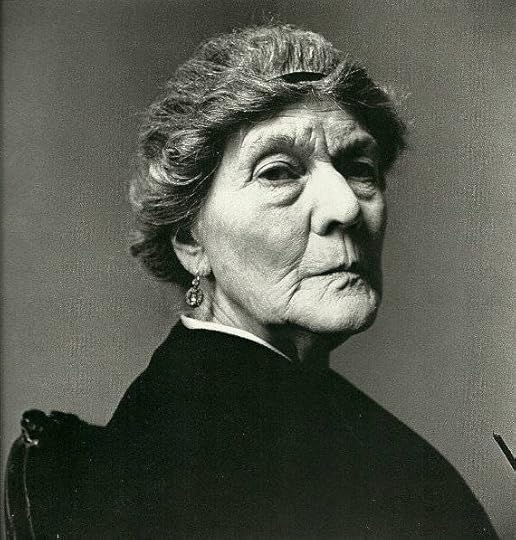
English novelist, Ivy Compton-Burnett was born #OnThisDay in 1884 #ReadMoreWomen
[psst - I have heard her writing is as daunting as this profile piccie, however, under the 'don't knock it lest you tried it' school of thought, I'll have a mooch around for some free downloads]
Displaying 1 - 30 of 146 reviews