

What do you think?

Doom Patrol Omnibus #3
The Doom Patrol Omnibus
The new Doom Patrol puts itself back together after nearly being destroyed, and things start to get a lot weirder for everybody. The Chief leads Robotman, the recently formed Rebis and new member Crazy Jane against the Scissormen, part of a dangerous philosophical location that has escaped into our world and is threatening to engulf reality itself.
Collecting Grant Morrison's definitive run, which launched his career as one of the comic industry's most innovative and creative writers!
Collects Doom Patrol #19-63 and Doom Force Special #1.
Collecting Grant Morrison's definitive run, which launched his career as one of the comic industry's most innovative and creative writers!
Collects Doom Patrol #19-63 and Doom Force Special #1.
1288 pages, Hardcover
First published August 5, 2014
About the author
Grant Morrison
1,812 books4,675 followersGrant Morrison has been working with DC Comics for twenty five years, after beginning his American comics career with acclaimed runs on ANIMAL MAN and DOOM PATROL. Since then he has written such best-selling series as JLA, BATMAN and New X-Men, as well as such creator-owned works as THE INVISIBLES, SEAGUY, THE FILTH, WE3 and JOE THE BARBARIAN. In addition to expanding the DC Universe through titles ranging from the Eisner Award-winning SEVEN SOLDIERS and ALL-STAR SUPERMAN to the reality-shattering epic of FINAL CRISIS, he has also reinvented the worlds of the Dark Knight Detective in BATMAN AND ROBIN and BATMAN, INCORPORATED and the Man of Steel in The New 52 ACTION COMICS.
In his secret identity, Morrison is a "counterculture" spokesperson, a musician, an award-winning playwright and a chaos magician. He is also the author of the New York Times bestseller Supergods, a groundbreaking psycho-historic mapping of the superhero as a cultural organism. He divides his time between their homes in Los Angeles and Scotland.
In his secret identity, Morrison is a "counterculture" spokesperson, a musician, an award-winning playwright and a chaos magician. He is also the author of the New York Times bestseller Supergods, a groundbreaking psycho-historic mapping of the superhero as a cultural organism. He divides his time between their homes in Los Angeles and Scotland.
Ratings & Reviews
Friends & Following
Create a free account to discover what your friends think of this book!
Community Reviews
Displaying 1 - 30 of 108 reviews

May 30, 2020
I read the comic books Doom Patrol volume 2 - #19-39 in which Morrison revolutionises the series with his allegorical, metaphorical and satire laden surreal fest! 6 out of 12

I then read the comic books Doom Patrol volume 2 - #40-63 & the Special … the final year/run on this book is one of the best pieces of work in an ongoing series (as good as New X-Men also by Grant Morrison a genuine masterpiece! 9 out of 12.
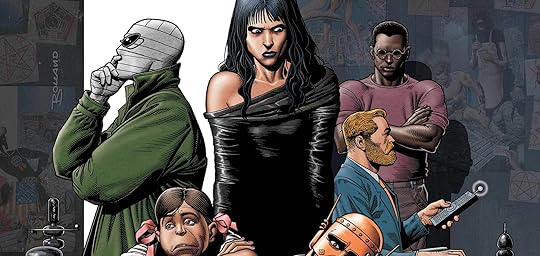
I can see why and how this series put Morrison on the map! It should be noted that Doom Patrol no longer being submitted for approval by the Comics Code Authority was key to this work being created. 8 out of 12 Four Stars overall.

2013 read
I then read the comic books Doom Patrol volume 2 - #40-63 & the Special … the final year/run on this book is one of the best pieces of work in an ongoing series (as good as New X-Men also by Grant Morrison a genuine masterpiece! 9 out of 12.
I can see why and how this series put Morrison on the map! It should be noted that Doom Patrol no longer being submitted for approval by the Comics Code Authority was key to this work being created. 8 out of 12 Four Stars overall.
2013 read

May 18, 2017

"I simply refuse to bear any more of this hideousness without some booze."
Let's go back to the brain of Grant Morrison in 1989. Art history, fantasy, science-fiction, meta fiction, psychedelia, humor, horror, and surrealism can all be found in Doom Patrol, weirder even than Invisibles. And what a "barrel of chittering chimps" it is!
Totally ape shit crazy and fun, the best and most impressionable series ever. But I would almost definitely say that you should be a diehard Morrison fan to enjoy this. It has a wandering narrative, not non-linear, but casual yet usually on track. The characters are so weird yet fascinating and lovable, like Cliff Steele, Crazy Jane, Danny the Street, and Rebis. And the world is ending literally every other page. It's a commentary on the ridiculousness of superhero comics. And it's great!
While the gargantuan story can be a hyperbolic romp, it makes a lot of serious points about art, philosophy, and psychology. It asks questions like: What is real? What is art? What is life? What is sanity? What is humanity? What is gender? What is pain? So while it's fun and zany, it's also incredibly dark and deep.

"I'm warning you--I have a boiled egg and know how to use it. I think you all know what I mean."
Interestingly, Morrison gives us incredible insight into his process and literary philosophy, basically his method of and reason for writing this, as seen from these Crazy Jane quotes:
"It's a kind of divination, like casting the runes or reading the flight of birds. Only with words."
"Well, the whole book is a kind of metafiction; a self-referring text. Basically, it tells the story of a group of philosophers who decide to create a book which will radically alter human thought... ...they propose to fill the book with parasite ideas which will enter human consciousness and transform it."
The artwork is fantastic and impressive but varies immensely by illustrator. I prefer Richard Case, who fortunately does the most. But it's awesome. It somehow fits Morrison's enjoyable insanity and takes you to impossible depths of other realities. And for being nearly thirty years old it can be downright impressive!
Notes on the Omnibus...
This thing is fucking huge and a legitimate logistical challenge to read. But about two hundred pages in it stayed open and a pillow underneath saved my arms, which are now stronger having read this. And it's absolutely wonderfully put together. A crazy durable cover which actually withstood getting accidentally wet. The pages are doubly thick semi-gloss. And the sewn binding is superb. The extras are a bit short but that's okay after 1200 pages of story. Also, the bonus issue Doom Force was very stupid. Buy this!
September 23, 2014
This book is absolutely massive and it ends up being a hindrance, because the story should have ended a lot earlier.
The best thing about the Doom Patrol are the characters. You have...
Robot man - a man who's brain was implanted into a robot body to prevent him from dying. He whines a lot! Verdict - He's absolutely useless.
Crazy Jane - she's probably my favourite. She has countless different personalities and each personality has its own power, whether that be spitting fire, being a wolverine type person, solving puzzles, being super nice, a prostitute, intangible or some other whacky power. She always ends up saving the world pretty much on her own. She loves robot man like a father because her own father abused her, hence the multiple personality disorder. Verdict - Awesome.
Rebis/Larry/Eleanor/negative man - this dude has issues. He's a hermaphrodite, so he's both male and female and he can leave his body as the negative man and fly. He can also have sex with himself. He's super intelligent and helps crazy Jane save the day a few times. Verdict - Very useful. Bit weird though.
Dorothy - Dorothy has epic powers. Her downfall is that she's think's she is ugly, she kind of looks like an ape, but she's lovely and dresses like Dorothy from 'The wizard of oz'. Her power is that her sub conscious, i.e. Her thoughts can become real, but she can't control it. So when she's having a conversation she might accidentally think about a giant clawed dragon and it would appear behind her and it would start wreaking havoc. Verdict - Could be useful but she does fuck all but sit in her room and cry.
Josh - Some dude that does nothing but try and help Dorothy. Verdict - Still not as useless as robot man.
Danny the street - so this is a living street that is a transvestite. Try and get your head around that! Verdict - cool as fuck. I want Danny as my friend.
The chief/Prof. Caulder - the leader of the doom patrol. He's basically professor X, but with hair and he's not psychic. Verdict - he's an absolute arsehole.
I won't even go into the enemies, because they are way too mental to even mention....oh go on then....
Firstly there are the scissor men - They cut you out of existence into a 1 dimensional world.
Mr. Nobody - when you look at him it looks like you are looking at him out of the corner of your eye. He wants to encourage abnormaility.
Satan - he has a beer tap on his head and that's about it for him.
The N.O.W.H.E.R.E MEN - everything they say makes a acrostic words that spell NOWHERE.
The beard hunter - does what it says on the tin. A bit like the punisher but for beards.
Exclamation man - prepare to be unsurprised.
The stories are crazy out there, but my favourite story was the painting that ate Paris. Brilliant idea and fantastically mental. The idea of a 5th horseman of the apocalypse was excellent.
This book could of been a masterpiece in my eyes, but as per usual when the going gets going with Morrison he takes more acid and LSD and buggers it right up. I mean I know it's supposed to be weird, but it's difficult to enjoy that much weirdness unless you yourself are high. It could probably be put it in the Tate modern as a work of art, it would look at home there or maybe in the Louvre.
All in all it loses its 4 star rating due to too much weirdness and not enough good use of the characters.
The best thing about the Doom Patrol are the characters. You have...
Robot man - a man who's brain was implanted into a robot body to prevent him from dying. He whines a lot! Verdict - He's absolutely useless.
Crazy Jane - she's probably my favourite. She has countless different personalities and each personality has its own power, whether that be spitting fire, being a wolverine type person, solving puzzles, being super nice, a prostitute, intangible or some other whacky power. She always ends up saving the world pretty much on her own. She loves robot man like a father because her own father abused her, hence the multiple personality disorder. Verdict - Awesome.
Rebis/Larry/Eleanor/negative man - this dude has issues. He's a hermaphrodite, so he's both male and female and he can leave his body as the negative man and fly. He can also have sex with himself. He's super intelligent and helps crazy Jane save the day a few times. Verdict - Very useful. Bit weird though.
Dorothy - Dorothy has epic powers. Her downfall is that she's think's she is ugly, she kind of looks like an ape, but she's lovely and dresses like Dorothy from 'The wizard of oz'. Her power is that her sub conscious, i.e. Her thoughts can become real, but she can't control it. So when she's having a conversation she might accidentally think about a giant clawed dragon and it would appear behind her and it would start wreaking havoc. Verdict - Could be useful but she does fuck all but sit in her room and cry.
Josh - Some dude that does nothing but try and help Dorothy. Verdict - Still not as useless as robot man.
Danny the street - so this is a living street that is a transvestite. Try and get your head around that! Verdict - cool as fuck. I want Danny as my friend.
The chief/Prof. Caulder - the leader of the doom patrol. He's basically professor X, but with hair and he's not psychic. Verdict - he's an absolute arsehole.
I won't even go into the enemies, because they are way too mental to even mention....oh go on then....
Firstly there are the scissor men - They cut you out of existence into a 1 dimensional world.
Mr. Nobody - when you look at him it looks like you are looking at him out of the corner of your eye. He wants to encourage abnormaility.
Satan - he has a beer tap on his head and that's about it for him.
The N.O.W.H.E.R.E MEN - everything they say makes a acrostic words that spell NOWHERE.
The beard hunter - does what it says on the tin. A bit like the punisher but for beards.
Exclamation man - prepare to be unsurprised.
The stories are crazy out there, but my favourite story was the painting that ate Paris. Brilliant idea and fantastically mental. The idea of a 5th horseman of the apocalypse was excellent.
This book could of been a masterpiece in my eyes, but as per usual when the going gets going with Morrison he takes more acid and LSD and buggers it right up. I mean I know it's supposed to be weird, but it's difficult to enjoy that much weirdness unless you yourself are high. It could probably be put it in the Tate modern as a work of art, it would look at home there or maybe in the Louvre.
All in all it loses its 4 star rating due to too much weirdness and not enough good use of the characters.

November 9, 2019
I first read this in floppies almost 30 years ago and I'm happy to say it still holds up for me today. However, it's not for everyone. This is peak, oddball Grant Morrison. The stories are strange and absurd in the best ways but some of it may be too out there for some readers, especially if your previous exposure to Morrison is from one of his straight up superhero runs like JLA, X-Men, Batman, or Superman. Where I think he excels is his character work.
Robotman- Part of the original Doom Patrol, Cliff Steele was a race car driver who died in a crash and had his brain implanted into a robot. He's the heart and soul of the team, yearning for his humanity while being a father figure to Crazy Jane and the the muscle of the team.
Rebis - Rebis was Larry Trainer, a pilot who was exposed to the Negative Force in the original Doom Patrol. Now he's merged with a woman becoming a weird hermaphrodite with the same negative spirit that can be projected from their body.
Dr. Niles Cauldor - The "Professor X" of the original Doom Patrol and a real ass. His only powers are he's smart and capable of being a huge dick.
Crazy Jane - Jane suffered some severe trauma and her personality split into 64 distinct personalities all with their own super power. She's sort of a much more likable Legion from the X-Men. Her relationship with Cliff is a highlight of the book.
Dorothy - An ape-faced, young girl with reality warping powers.
Joshua Clay (Tempest) - Left over from the 70's incarnation of Doom Patrol, he can generate force blasts, but mainly sticks around as a doctor for the team and a caretaker for Dorothy.
Danny the Street - A sentient, transvestite street who can transport themself into any city in the world. One of the best creations in comics. Danny is the best.
Morrison's villains other than Mr. Nobody can take on a sameness. (They're out to destroy the world while spouting nonsense with random shit pasted to their heads and the Doom Patrol must stop them.) I love the intentional surrealism of the Brotherhood of Dada. I do like the sense of horror Morrison often invokes.
Richard Case is the main artist on the book. His art isn't traditionally super-heroesque. It's blocky and chunky but it works really well for a book like this. He also does a great job with the many horror elements of the book.
Robotman- Part of the original Doom Patrol, Cliff Steele was a race car driver who died in a crash and had his brain implanted into a robot. He's the heart and soul of the team, yearning for his humanity while being a father figure to Crazy Jane and the the muscle of the team.
Rebis - Rebis was Larry Trainer, a pilot who was exposed to the Negative Force in the original Doom Patrol. Now he's merged with a woman becoming a weird hermaphrodite with the same negative spirit that can be projected from their body.
Dr. Niles Cauldor - The "Professor X" of the original Doom Patrol and a real ass. His only powers are he's smart and capable of being a huge dick.
Crazy Jane - Jane suffered some severe trauma and her personality split into 64 distinct personalities all with their own super power. She's sort of a much more likable Legion from the X-Men. Her relationship with Cliff is a highlight of the book.
Dorothy - An ape-faced, young girl with reality warping powers.
Joshua Clay (Tempest) - Left over from the 70's incarnation of Doom Patrol, he can generate force blasts, but mainly sticks around as a doctor for the team and a caretaker for Dorothy.
Danny the Street - A sentient, transvestite street who can transport themself into any city in the world. One of the best creations in comics. Danny is the best.
Morrison's villains other than Mr. Nobody can take on a sameness. (They're out to destroy the world while spouting nonsense with random shit pasted to their heads and the Doom Patrol must stop them.) I love the intentional surrealism of the Brotherhood of Dada. I do like the sense of horror Morrison often invokes.
Richard Case is the main artist on the book. His art isn't traditionally super-heroesque. It's blocky and chunky but it works really well for a book like this. He also does a great job with the many horror elements of the book.

September 23, 2020
Finally, after years of being a Morrison fan, I have finished one of their most famous big runs. I’m happy to say that Doom Patrol ended up being everything I wanted and expected it to be — smart, funny, at times absolutely wild, at times quietly devastating. For being the original Weird Morrison Comic it’s also surprisingly approachable and easy to understand and follow, going a bit too far with its crazy concepts and narrative in only a couple of instances. I was also pleasantly surprised by Richard Case’s artwork — it definitely looks of its time but not at all in a bad way, and fits the tone of the story exceptionally well. Doom Patrol is a classic for a reason, and I’m very happy to have finally read it.

February 3, 2016
Well this was... interesting...
Heard mixed things on this. Some people lauding it as one of the greats, others saying they struggled to make it half way.
I'm sure it was great when it came out in the late 80s/90s from that new Scottish writer who wrote Arkham Asylum and is a little weird.
It's not your classic superhero team book, which is fine, but it's also not very coherent at times and is a little hard to follow.
I think l like having read it more than I did actually reading it, if that makes any sense at all...
Heard mixed things on this. Some people lauding it as one of the greats, others saying they struggled to make it half way.
I'm sure it was great when it came out in the late 80s/90s from that new Scottish writer who wrote Arkham Asylum and is a little weird.
It's not your classic superhero team book, which is fine, but it's also not very coherent at times and is a little hard to follow.
I think l like having read it more than I did actually reading it, if that makes any sense at all...

February 10, 2019
It is my opinion that if we had to appoint someone to do massive amounts of hallucinogens and produce art, Grant Morrison would be a fine candidate. Filled to the brim with mind-bending, nonsensical, and the palpably weird, Doom Patrol is a classic of the weird comic genre that lives up to its quite impressive hype.
The motley crew that makes up the Doom Patrol features the following misfit superheroes:
*A man and woman fused together by a negative spirit!
*A robot with a man's brain!
*A normal superhero scientist who refuses to use his superpowers!
*A woman with dissociative identity disorder with each personality having a different superpower!
*An ape-like girl whose thoughts are made physical!
*Their home base located on the sentient, transgender, teleporting street, Danny the Street!
Together, these loons fight the world-ending and consciousness-disrupting forces too weird for the Justice League. They do combat with the Scissormen, the Brotherhood of Dada, their own worst fears, and...the Pentagon? Truly this is a whacked-out comic that just about defies description. It is obviously heavily influenced by a mind familiar to chemical alteration. Just see the return of villain Nobody in the second leg of the run: the villain runs for president in a psychedelically decked-out bus that causes mass LSD trips, naturally, because it has Albert Hofmann's bike embedded in its engine.
I think most people who have read Grant Morrison develop strong feelings about his writing. It can be truly revelatory (All-Star Superman! New X-Men! Animal Man!) or painfully obscure and more than a little strange. Doom Patrol easily sits beside Morrison's weirder output, and it might not have the narrative thrust of those works mentioned above, but it gets tons of points in my book for being some of the strangest shit I've ever read.
If you have yet to dive into this series, I recommend it highly! As long as you go in expecting the truly strange, you'll be well and truly pleased.
The motley crew that makes up the Doom Patrol features the following misfit superheroes:
*A man and woman fused together by a negative spirit!
*A robot with a man's brain!
*A normal superhero scientist who refuses to use his superpowers!
*A woman with dissociative identity disorder with each personality having a different superpower!
*An ape-like girl whose thoughts are made physical!
*Their home base located on the sentient, transgender, teleporting street, Danny the Street!
Together, these loons fight the world-ending and consciousness-disrupting forces too weird for the Justice League. They do combat with the Scissormen, the Brotherhood of Dada, their own worst fears, and...the Pentagon? Truly this is a whacked-out comic that just about defies description. It is obviously heavily influenced by a mind familiar to chemical alteration. Just see the return of villain Nobody in the second leg of the run: the villain runs for president in a psychedelically decked-out bus that causes mass LSD trips, naturally, because it has Albert Hofmann's bike embedded in its engine.
I think most people who have read Grant Morrison develop strong feelings about his writing. It can be truly revelatory (All-Star Superman! New X-Men! Animal Man!) or painfully obscure and more than a little strange. Doom Patrol easily sits beside Morrison's weirder output, and it might not have the narrative thrust of those works mentioned above, but it gets tons of points in my book for being some of the strangest shit I've ever read.
If you have yet to dive into this series, I recommend it highly! As long as you go in expecting the truly strange, you'll be well and truly pleased.

November 11, 2016
Instant. Favorite.
So this series is part of the "UK writers reviving dying DC series" like Alan Moore on Swamp Thing and Morrison on Animal Man. It suffers from the same issue of it basically starting sort of in the middle but just like most of the revival series, you don't need any prior knowledge of Doom Patrol to start or enjoy this series. All you need to know is one thing.
It gets weirder.
I don't want to spoil anything in this series. I believe that Morrison's writing is so insanely absurd that to tell you anything here is to take away from future readers joy when they get to it, read it, and go "Seriously? What in the actual fuck am I reading?" so I'll try and keep this spoiler free.
Doom Patrol is a superhero team like no other. Freaks and rejects that hate themselves, but somehow save the world from things weirder than themselves. How weird are these superheroes? The team in Morrisons run consists of:
Cliff: a human brain in a robot body
Rebis: a hermamphrodite ghost/alien
Crazy Jane: a woman with 70+ personalities. Some of them have superpowers.
Dorothy: a little girl with a face like an ape, also has psychic powers.
Josh: Black guy
Niles Caulder: wheelbound supergenius (The original Doom Patrol preceded the X-Men FYI)
And that's the heroes. The side characters and villains are even weirder. Its a lot of fun.
The entire run as a whole is very strong. It has a lull towards the final arc but the ending was fantastic. Its rare to maintain the such quality over 50+ issues but I felt the same sense of wonder and awe reading the first few issues as I did reading the last few issues.
If you like absurdism, surrealism, art, parodies, fun, or good things, you'll love this series. Highly highly recommended.
So this series is part of the "UK writers reviving dying DC series" like Alan Moore on Swamp Thing and Morrison on Animal Man. It suffers from the same issue of it basically starting sort of in the middle but just like most of the revival series, you don't need any prior knowledge of Doom Patrol to start or enjoy this series. All you need to know is one thing.
It gets weirder.
I don't want to spoil anything in this series. I believe that Morrison's writing is so insanely absurd that to tell you anything here is to take away from future readers joy when they get to it, read it, and go "Seriously? What in the actual fuck am I reading?" so I'll try and keep this spoiler free.
Doom Patrol is a superhero team like no other. Freaks and rejects that hate themselves, but somehow save the world from things weirder than themselves. How weird are these superheroes? The team in Morrisons run consists of:
Cliff: a human brain in a robot body
Rebis: a hermamphrodite ghost/alien
Crazy Jane: a woman with 70+ personalities. Some of them have superpowers.
Dorothy: a little girl with a face like an ape, also has psychic powers.
Josh: Black guy
Niles Caulder: wheelbound supergenius (The original Doom Patrol preceded the X-Men FYI)
And that's the heroes. The side characters and villains are even weirder. Its a lot of fun.
The entire run as a whole is very strong. It has a lull towards the final arc but the ending was fantastic. Its rare to maintain the such quality over 50+ issues but I felt the same sense of wonder and awe reading the first few issues as I did reading the last few issues.
If you like absurdism, surrealism, art, parodies, fun, or good things, you'll love this series. Highly highly recommended.

March 26, 2015
So patchy. I loved the series the first time I read it just because it was completely out there. Where else would you see a character that is a transvestite talking street? Or a supervillain group called the Brotherhood of Dada (as in the art movement)? The story arc called The Painting That Ate Paris is worth the price of admission alone, with the characters trapped in a painting that has different "zones", each representing a different art style.
10 years later, it feels like Morrison threw every literary reference that he could at the wall to see what sticks. Some of it does. Most feel Pretentious and in-your-face. Some of it is entertaining beyond belief - like the one-off featuring Monsieur Mallah and the Brain, a villainous duo comprising a talking ape quoting Descartes wearing a beret, and - well - a brain, encased in a glass case.
One of the few comics where a different artist may have made more of an impact. Richard Case (and later, Mike Dringenberg) try hard, but bringing concepts like a Kaleidoscape (correct spelling) or an AntiGod that is a giant eye to the page would work better with someone completely out there, like Frank Quitely or JH Williams III. But Case worked in the confines of a monthly series, and some of his work is phenomenal, despite looking rushed.
Still belongs on the bookshelf as a definitive 80s series, though.
10 years later, it feels like Morrison threw every literary reference that he could at the wall to see what sticks. Some of it does. Most feel Pretentious and in-your-face. Some of it is entertaining beyond belief - like the one-off featuring Monsieur Mallah and the Brain, a villainous duo comprising a talking ape quoting Descartes wearing a beret, and - well - a brain, encased in a glass case.
One of the few comics where a different artist may have made more of an impact. Richard Case (and later, Mike Dringenberg) try hard, but bringing concepts like a Kaleidoscape (correct spelling) or an AntiGod that is a giant eye to the page would work better with someone completely out there, like Frank Quitely or JH Williams III. But Case worked in the confines of a monthly series, and some of his work is phenomenal, despite looking rushed.
Still belongs on the bookshelf as a definitive 80s series, though.

January 27, 2017
Maybe my favorite comic by Morrison I've read yet, only Flex Mentallo can compete with it. I really like the stories from this run. They were really creative, unique, and enjoyable to read. The characters were the same, Rebis, Crazy Jane, and Mr Nobody being my favorites. The art was weird, but not difficult to follow. It so cool to see how this run continues to influence the team even in the most current run.

April 21, 2016
I don't know anything about the guy, but, reading Doom Patrol, one gets the sense that Grant Morrison is one weird dude. Probably a lot of fun at parties, but weird.
This is an older run of comics collected in one massive tome heavy enough to brain a panda with, certainly. I mostly know the Doom Patrol as "that DC group that is always compared to the X-Men." I can understand why that comparison comes up, but the differences between them seem more significant here than the similarities.
This is definitely an interesting read. There are times where it feels like the page is overwhelmed by the sheer number of bizarre concepts Morrison is throwing at it, which leaves some of the story arcs feeling a little patchwork, but, overall, this was a pretty cool run that explores some interesting spaces. It also has some of the most memorable antagonists I've seen in a comic book. There are a few sections in the middle that go so far out into uncharted territory that I'm still not sure what actually happened, but when the book hits the mark--which is does, often--it's really something to see.
All in all, I'd say this is flawed, but groovy.

This is an older run of comics collected in one massive tome heavy enough to brain a panda with, certainly. I mostly know the Doom Patrol as "that DC group that is always compared to the X-Men." I can understand why that comparison comes up, but the differences between them seem more significant here than the similarities.
This is definitely an interesting read. There are times where it feels like the page is overwhelmed by the sheer number of bizarre concepts Morrison is throwing at it, which leaves some of the story arcs feeling a little patchwork, but, overall, this was a pretty cool run that explores some interesting spaces. It also has some of the most memorable antagonists I've seen in a comic book. There are a few sections in the middle that go so far out into uncharted territory that I'm still not sure what actually happened, but when the book hits the mark--which is does, often--it's really something to see.
All in all, I'd say this is flawed, but groovy.

July 8, 2017
In my review of Boris Groys's In the Flow, I somehow failed to note the thesis in art history for which Groys became famous: his main claim was that, as the avant-garde's dream before the Russian Revolution was the total transformation, along artistic lines, of their entire society, then the "official" Socialist Realist art of Soviet Russia was in fact the legitimate successor and fulfillment of the avant-garde since it inherited the function of aesthetically recomposing the social. The avant-garde totalizes art to the level of the polis, whereas realistic or romantic art before the avant-garde just decorated or illustrated a polis otherwise designed by priests, aristocrats, or money-men. (This is why the avant-garde had to discredit the characteristic artwork of the modern period before the twentieth century—the figurative painting, the realist novel, the expressive lyric—in all its monadic powerlessness, its timid refusal of the crucial becoming-Stalin task of the total artwork.) Artists in the avant-garde utopia replace priests, aristocrats, and money-men and become important social authorities in turn. Like much supposed anarchism, then, avant-gardism may be a fascism in disguise—there being but a few short psychological steps from "I should be able to do anything I want" to "Everyone should do anything I want."
So much for Stalin's Russia, but what about the avant-garde in western capitalist society? It is well known by now that at midcentury avant-garde art, most notoriously Abstract Expressionism (which Nelson Rockefeller called "free enterprise painting"), was in part a front for US/UK intelligence services meant to work as propaganda against Communism and for apolitical art and American individualism. But this rather lurid-seeming fact, which is probably no more or less significant than Michelangelo's having painted that ceiling for the Pope and Shakespeare's having written those plays for the Queen, can distract from the bigger picture: in capitalist society it is popular culture, not government propaganda, that takes up the avant-garde ambition and function of the aesthetic reorganization of the polis. Fashion, design, and architecture are the obvious examples: the MacBook Air on which I now type owes its sleek minimalism to Bauhaus and related aesthetics while the Starbucks in which I now type boasts some kind of Frank Lloyd Wright atmosphere (faux artisanal—medievalist, localist, etc.—resistance to mass production is the original avant-garde style going back to the Pre-Raphaelites).
All of which brings me around at last to Grant Morrison's classic run on DC Comics's Doom Patrol from 1989-1993. The Doom Patrol was created by Arnold Drake and his collaborators; a Silver Age superhero team of "super-powered misfits, whose 'gifts' caused them alienation and trauma," to quote Wikipedia, they may have illicitly inspired Stan Lee in the creation of the X-Men. By the late '80s, the X-Men under writer Chris Claremont were the super-hero team, and Claremont's approach set the generic standard: a liberal political allegory (mutants as oppressed minorities, primarily queer) wedded to soap operatic plotting and a passionately (or painfully) earnest literary style. Grant Morrison, a working-class Glaswegian punk magus from a left-wing family who began work with DC as part of comics's celebrated British Invasion, sought to explode all that (along with primary series artist Richard Case and a host of inkers and fill-in artists).
Admitting he wanted to overturn Claremont's aesthetic, Morrison not only pushed the outsiderdom of his heroes past the bounds of Reagan-era liberal respectability (two of his heroes, Rebis and Danny the Street, are gender nonconforming; another one, Kay Challis AKA Crazy Jane, is a childhood abuse survivor living with dissociative identity disorder) but confronted them with villains like The Brotherhood of Dada, who wish to "let unreason reign" (whom most of the team eventually does not even want to fight); and the Shadowy Mr. Evans, who releases a sexual apocalypse until he is stopped by the Sex Men, a repressive parody of conventional superheroes. This vein of genre parody runs through the whole series, from Morrison's first-page allusion to the opening of Frank Miller's Dark Knight Returns to episodes mocking Alan Moore, Rob Liefeld, and Stan Lee and Jack Kirby—as if to highlight the inherent absurdity of superheroes "in the name of Duchamp and Tzara and Breton," to quote Mr. Nobody, leader of The Brotherhood of Dada.
The drift of the series is toward the undoing of the superhero's normalizing function, the liberation of the suppressed energy abjected by mainstream society as madness. This is shown most clearly in the series's most memorable character, Crazy Jane, whom Morrison based on Truddi Chase, author of the bestseller When Rabbit Howls, wherein she claims to have multiple personalities as a result of dissociation brought on by childhood sexual abuse. I've never read Chase's book, but it was ubiquitous in its time—I remember it around the house when I was a child—and I certainly saw her on Oprah; her story and the Crazy Jane character coincide with the wave of repressed memories as well as the allegations of Satanic ritual abuse that were prevalent in the '80s. Which is not to say at all that Chase was lying, only that Morrison, with his extraordinary eye for trends, was cashing in on one. The Jane character is underdeveloped, though, and Morrison does not always handle her situation very sensitively, tricking it out with heavy-handed metaphors and obvious Sylvia Plath allusions. She is given Morrison's concluding chapter, and her rescue from a repressive and abusive male psychologist, narrated through the eyes of a lesbian psychologist beginning to believe Jane/Kay's stories about the Doom Patrol, provides one of the most moving conclusions to a superhero story I've ever read.
In his essay "On the Superiority of Anglo-American Literature," Gilles Deleuze praises writers who create "a true break," "the line of flight…(even if one has to become animal, to become Negro or woman)." Doom Patrol can be seen as joining Deleuze in seeing female or black (or queer or trans) identity as identical to animality, as the abjected underside of western reason, functioning not so much as a metaphor but as a synecdoche for all that is repressed in the construction of the rational subject of the modern polity. But their seeming advocacy will almost certainly now read as offensive, if it was not so read then (see here): as women or black people or queer people rise to claim their rights as subjects and their share of reason within the same polity, this synechdochic function of their identity, Deleuze's or Morrison's equating femaleness etc. with the irrational, seems absurd, patronizing, and dehumanizing. It is meant to be dehumanizing in the sense that the straight white male writer is trying to overthrow a monitory concept of "the human" by siding with all that was left out in its construction. To those who did not want to be left out in the first place, this gesture is downright threatening, and I am sure a lot of young people encountering Crazy Jane, Rebis, and Danny the Street today will take it as such. On the other hand, a charitable reading might say that Morrison's or Deleuze's indubitably "problematic" deployment of the trope of marginality may be a necessary stage in the becoming-subject of the marginalized, insofar as it brings the margin itself to a valorized position of cultural visibility it was not previously allowed. On the politics of these tropes, readers will understandably come to different conclusions.
From politics to aesthetics: one paradox the literary avant-garde has never quite solved, and which explains its pragmatic usurpation by Hollywood and pop culture, is that nothing more emancipates audiences from mundane reality than an absorbing linear narrative about relatable or likable characters, a reliably immersive and anti-quotidian cognitive enhancement; whereas the avant-garde's destruction of story and sense, its Surrealist automatic writing or Futurist words-in-freedom or Burroughsian cut-ups, tend to bounce off retina and tympanum, to leave one stranded in the workaday world, staring out the window in search of superior entertainment. Too much of Morrison's Doom Patrol fails to avoid this pitfall; a stream of clever nonsense, lacking in characterization (this latter frequently supplied by tediously symbolic dream sequences and hallucinations), the series is to my mind often unmemorable from page to page or after multiple readings.

The best parts tend to come in the poetry of single panels—but then, I find this true of all Morrison's work, including such crowd-pleasers as All-Star Superman . I have often thought that Morrison is a lyric writer more than a narrative one.
But he works in narrative modes, and, after Doom Patrol, often in the very popular and populist narrative modes that he construes as egregores or hypersigils, because of his traditionally avant-garde commitment, as expressed in his famous 2000 Disinfo speech, to aesthetically reorganizing western culture:
Groys could not have put the aspiration of avant-garde art better: "We want everybody to be cool." But if revolutionary terror is the result of forcing people to be free, per Rousseau, then the avant-garde—whether in the statist form Groys discusses or in today's commercial culture—may be guilty of forcing people to be cool. It is to Morrison's credit that his vision is complex enough to encompass this possibility throughout Doom Patrol.
Hasn't the avant-garde become just what it despised—tradition? Doesn't Penguin Classics now publish Deleuze? Isn't Doom Patrol itself hailed as a classic, its author garlanded with a Member of the Order of the British Empire? Cultural revolution becomes cultural tradition in the end: conservatives dislike this truth because it means that revolutions can be necessary to a living culture, while radicals dislike because it means that there is no ultimate subversion and that every successful revolution installs a new regime.
This paradox is allegorized in Doom Patrol during the team's first fight against The Brotherhood of Dada, when the avantist villains swallow all of Paris into a painting that contains all modernist styles. But the painting also harbors inside it "the fifth Horseman," a Norse-helmeted Wagnerian figure evocative of fascist art (in In the Flow, Groys offers Wagner's theory of the Gesamtkunstwerk as one of the first avant-garde ambitions). The team ends up destroying the fascist horseman when Crazy Jane guides him into the Dada zone of the painting: "The rider requires ideas and meaning to give it power, but Dada is the anti-idea! Dada destroys meaning!" And so dissolves fascism. Yet the experience re-traumatizes Crazy Jane, and we understand why when we see her tormented by the word "Dada," playing on the alternate meaning of "dada" or "daddy" or "dad" and evoking her father's sexual abuse. This slippage between artistic anarchy and paternal authority in a single word shows the potential for the seemingly emancipatory signifier "Dada" to flip back over into the patriarchal force that had harmed Jane—the potential, that is, for anarchism to become fascism, because when all restraint is removed it is no longer possible to explain why might is not right. (I owe the point about the pun on "Dada" in this sequence to an essay I read on the Internet in about 1998, which I can no longer find and which probably no longer exists.)
Morrison's warning is writ large in the overall arc of his Doom Patrol narrative when it is revealed that the team leader, Niles Caulder (a kind of Professor X figure), actually engineered the horrible and grotesque accidents that led most of the team to become superheroes:
He creates life by creating catastrophe, better to make the world more interesting:
Like Morrison—like Breton and Marinetti—Caulder wants everyone to be cool, and it makes him a murderous villain.
Doom Patrol, then, is more ambivalent about is own vision than it appears at first; it is honest about the trauma and the coercion that underlie its liberatory values at the other end of the avant-garde century. That vision and those values triumph at the conclusion, though, when the trans street Danny becomes a world (no fear of a queer planet here) and Kay Challis is reclaimed at the end for the heroism of saving weirdness. The series's final words (unwittingly echoing the nearly contemporaneous anti-capitalist Zapatista slogan) say it best, and here I'll end too:
So much for Stalin's Russia, but what about the avant-garde in western capitalist society? It is well known by now that at midcentury avant-garde art, most notoriously Abstract Expressionism (which Nelson Rockefeller called "free enterprise painting"), was in part a front for US/UK intelligence services meant to work as propaganda against Communism and for apolitical art and American individualism. But this rather lurid-seeming fact, which is probably no more or less significant than Michelangelo's having painted that ceiling for the Pope and Shakespeare's having written those plays for the Queen, can distract from the bigger picture: in capitalist society it is popular culture, not government propaganda, that takes up the avant-garde ambition and function of the aesthetic reorganization of the polis. Fashion, design, and architecture are the obvious examples: the MacBook Air on which I now type owes its sleek minimalism to Bauhaus and related aesthetics while the Starbucks in which I now type boasts some kind of Frank Lloyd Wright atmosphere (faux artisanal—medievalist, localist, etc.—resistance to mass production is the original avant-garde style going back to the Pre-Raphaelites).
All of which brings me around at last to Grant Morrison's classic run on DC Comics's Doom Patrol from 1989-1993. The Doom Patrol was created by Arnold Drake and his collaborators; a Silver Age superhero team of "super-powered misfits, whose 'gifts' caused them alienation and trauma," to quote Wikipedia, they may have illicitly inspired Stan Lee in the creation of the X-Men. By the late '80s, the X-Men under writer Chris Claremont were the super-hero team, and Claremont's approach set the generic standard: a liberal political allegory (mutants as oppressed minorities, primarily queer) wedded to soap operatic plotting and a passionately (or painfully) earnest literary style. Grant Morrison, a working-class Glaswegian punk magus from a left-wing family who began work with DC as part of comics's celebrated British Invasion, sought to explode all that (along with primary series artist Richard Case and a host of inkers and fill-in artists).
Admitting he wanted to overturn Claremont's aesthetic, Morrison not only pushed the outsiderdom of his heroes past the bounds of Reagan-era liberal respectability (two of his heroes, Rebis and Danny the Street, are gender nonconforming; another one, Kay Challis AKA Crazy Jane, is a childhood abuse survivor living with dissociative identity disorder) but confronted them with villains like The Brotherhood of Dada, who wish to "let unreason reign" (whom most of the team eventually does not even want to fight); and the Shadowy Mr. Evans, who releases a sexual apocalypse until he is stopped by the Sex Men, a repressive parody of conventional superheroes. This vein of genre parody runs through the whole series, from Morrison's first-page allusion to the opening of Frank Miller's Dark Knight Returns to episodes mocking Alan Moore, Rob Liefeld, and Stan Lee and Jack Kirby—as if to highlight the inherent absurdity of superheroes "in the name of Duchamp and Tzara and Breton," to quote Mr. Nobody, leader of The Brotherhood of Dada.
The drift of the series is toward the undoing of the superhero's normalizing function, the liberation of the suppressed energy abjected by mainstream society as madness. This is shown most clearly in the series's most memorable character, Crazy Jane, whom Morrison based on Truddi Chase, author of the bestseller When Rabbit Howls, wherein she claims to have multiple personalities as a result of dissociation brought on by childhood sexual abuse. I've never read Chase's book, but it was ubiquitous in its time—I remember it around the house when I was a child—and I certainly saw her on Oprah; her story and the Crazy Jane character coincide with the wave of repressed memories as well as the allegations of Satanic ritual abuse that were prevalent in the '80s. Which is not to say at all that Chase was lying, only that Morrison, with his extraordinary eye for trends, was cashing in on one. The Jane character is underdeveloped, though, and Morrison does not always handle her situation very sensitively, tricking it out with heavy-handed metaphors and obvious Sylvia Plath allusions.
She is given Morrison's concluding chapter, and her rescue from a repressive and abusive male psychologist, narrated through the eyes of a lesbian psychologist beginning to believe Jane/Kay's stories about the Doom Patrol, provides one of the most moving conclusions to a superhero story I've ever read.In his essay "On the Superiority of Anglo-American Literature," Gilles Deleuze praises writers who create "a true break," "the line of flight…(even if one has to become animal, to become Negro or woman)." Doom Patrol can be seen as joining Deleuze in seeing female or black (or queer or trans) identity as identical to animality, as the abjected underside of western reason, functioning not so much as a metaphor but as a synecdoche for all that is repressed in the construction of the rational subject of the modern polity. But their seeming advocacy will almost certainly now read as offensive, if it was not so read then (see here): as women or black people or queer people rise to claim their rights as subjects and their share of reason within the same polity, this synechdochic function of their identity, Deleuze's or Morrison's equating femaleness etc. with the irrational, seems absurd, patronizing, and dehumanizing. It is meant to be dehumanizing in the sense that the straight white male writer is trying to overthrow a monitory concept of "the human" by siding with all that was left out in its construction. To those who did not want to be left out in the first place, this gesture is downright threatening, and I am sure a lot of young people encountering Crazy Jane, Rebis, and Danny the Street today will take it as such. On the other hand, a charitable reading might say that Morrison's or Deleuze's indubitably "problematic" deployment of the trope of marginality may be a necessary stage in the becoming-subject of the marginalized, insofar as it brings the margin itself to a valorized position of cultural visibility it was not previously allowed. On the politics of these tropes, readers will understandably come to different conclusions.
From politics to aesthetics: one paradox the literary avant-garde has never quite solved, and which explains its pragmatic usurpation by Hollywood and pop culture, is that nothing more emancipates audiences from mundane reality than an absorbing linear narrative about relatable or likable characters, a reliably immersive and anti-quotidian cognitive enhancement; whereas the avant-garde's destruction of story and sense, its Surrealist automatic writing or Futurist words-in-freedom or Burroughsian cut-ups, tend to bounce off retina and tympanum, to leave one stranded in the workaday world, staring out the window in search of superior entertainment. Too much of Morrison's Doom Patrol fails to avoid this pitfall; a stream of clever nonsense, lacking in characterization (this latter frequently supplied by tediously symbolic dream sequences and hallucinations), the series is to my mind often unmemorable from page to page or after multiple readings.
The best parts tend to come in the poetry of single panels—but then, I find this true of all Morrison's work, including such crowd-pleasers as All-Star Superman . I have often thought that Morrison is a lyric writer more than a narrative one.
But he works in narrative modes, and, after Doom Patrol, often in the very popular and populist narrative modes that he construes as egregores or hypersigils, because of his traditionally avant-garde commitment, as expressed in his famous 2000 Disinfo speech, to aesthetically reorganizing western culture:
Let’s go in there and give them something they cannot digest. Something they cannot process. Something so toxic, so dangerous, so powerful…that it will breed, and destroy them utterly. Not destroy them—turn them into us. Because that’s what we want. We want everybody to be cool.
Groys could not have put the aspiration of avant-garde art better: "We want everybody to be cool." But if revolutionary terror is the result of forcing people to be free, per Rousseau, then the avant-garde—whether in the statist form Groys discusses or in today's commercial culture—may be guilty of forcing people to be cool. It is to Morrison's credit that his vision is complex enough to encompass this possibility throughout Doom Patrol.
Hasn't the avant-garde become just what it despised—tradition? Doesn't Penguin Classics now publish Deleuze? Isn't Doom Patrol itself hailed as a classic, its author garlanded with a Member of the Order of the British Empire? Cultural revolution becomes cultural tradition in the end: conservatives dislike this truth because it means that revolutions can be necessary to a living culture, while radicals dislike because it means that there is no ultimate subversion and that every successful revolution installs a new regime.
This paradox is allegorized in Doom Patrol during the team's first fight against The Brotherhood of Dada, when the avantist villains swallow all of Paris into a painting that contains all modernist styles. But the painting also harbors inside it "the fifth Horseman," a Norse-helmeted Wagnerian figure evocative of fascist art (in In the Flow, Groys offers Wagner's theory of the Gesamtkunstwerk as one of the first avant-garde ambitions). The team ends up destroying the fascist horseman when Crazy Jane guides him into the Dada zone of the painting: "The rider requires ideas and meaning to give it power, but Dada is the anti-idea! Dada destroys meaning!" And so dissolves fascism. Yet the experience re-traumatizes Crazy Jane, and we understand why when we see her tormented by the word "Dada," playing on the alternate meaning of "dada" or "daddy" or "dad" and evoking her father's sexual abuse. This slippage between artistic anarchy and paternal authority in a single word shows the potential for the seemingly emancipatory signifier "Dada" to flip back over into the patriarchal force that had harmed Jane—the potential, that is, for anarchism to become fascism, because when all restraint is removed it is no longer possible to explain why might is not right. (I owe the point about the pun on "Dada" in this sequence to an essay I read on the Internet in about 1998, which I can no longer find and which probably no longer exists.)
Morrison's warning is writ large in the overall arc of his Doom Patrol narrative when it is revealed that the team leader, Niles Caulder (a kind of Professor X figure), actually engineered the horrible and grotesque accidents that led most of the team to become superheroes:
You see, Cliff, ever since I was young, I have been driven by one blazing ambition. To create life. I remember watching old Frankenstein movies on television and, strangely, identifying not with the tragic monster but with his creator.
He creates life by creating catastrophe, better to make the world more interesting:
We need shocks in our lives. We need radical change and the new understanding it brings. Catastrophe forces us to think in new ways.
Like Morrison—like Breton and Marinetti—Caulder wants everyone to be cool, and it makes him a murderous villain.
Doom Patrol, then, is more ambivalent about is own vision than it appears at first; it is honest about the trauma and the coercion that underlie its liberatory values at the other end of the avant-garde century. That vision and those values triumph at the conclusion, though, when the trans street Danny becomes a world (no fear of a queer planet here) and Kay Challis is reclaimed at the end for the heroism of saving weirdness. The series's final words (unwittingly echoing the nearly contemporaneous anti-capitalist Zapatista slogan) say it best, and here I'll end too:
There is another world. There is a better world. Well…there must be.
November 10, 2023
Sadly this just wasn't for me. The first few arcs were solid but got worse and worse, way too weird for me, to the point I had to close this book and put it up for sale immediately.

December 14, 2016
"There's a better world. There has to be."

April 15, 2020
Grant Morrison's Doom Patrol is one of the modern masterpieces of the comic industry. It's Vertigo before there was Vertigo, taking "normal"(ish) DC Heroes and transforming them into something weird and surreal.
At its best, Doom Patrol doesn't just question authority, it questions reality, and stories like "Crawling from the Wreckage" (#19-22) and two different stories where the protagonist isn't sure what is real (#58, #63) are some of the highlights of the run. But, the surrealism is also wonderful with characters like the scissor-men and the candlemaker being truly scary. (And the actual Brotherhood of Dada being super-weird.)
At its worst, Doom Patrol is not just nonsensical but also repetitive. (Also: repetitive.) The many characters who speak nonsense speak for themselves, and even one of Jane's therapists comments that all of the villains are either authority figures or daddy figures. (Though she's not quite right: if anything, Mr. Nobody is an anti-authority figure).
Doom Patrol was groundbreaking and its best arcs remain highly memorable. This is still a must-read, decades later. The only other Doom Patrol series that I'm aware of that comes up to this same standard is Gerard Way's v6, and it builds heavily on this foundation.
At its best, Doom Patrol doesn't just question authority, it questions reality, and stories like "Crawling from the Wreckage" (#19-22) and two different stories where the protagonist isn't sure what is real (#58, #63) are some of the highlights of the run. But, the surrealism is also wonderful with characters like the scissor-men and the candlemaker being truly scary. (And the actual Brotherhood of Dada being super-weird.)
At its worst, Doom Patrol is not just nonsensical but also repetitive. (Also: repetitive.) The many characters who speak nonsense speak for themselves, and even one of Jane's therapists comments that all of the villains are either authority figures or daddy figures. (Though she's not quite right: if anything, Mr. Nobody is an anti-authority figure).
Doom Patrol was groundbreaking and its best arcs remain highly memorable. This is still a must-read, decades later. The only other Doom Patrol series that I'm aware of that comes up to this same standard is Gerard Way's v6, and it builds heavily on this foundation.

September 3, 2020
1200-stranová nálož Morrisonovho manierizmu, tripov a čierneho humoru. Väčší vývoj postáv však nečakajte, o Doom patrol sa tu dozviete len veľmi málo. Nachádzať tie temné obálky v comic shopoch na pomedzí 80. a 90. rokov muselo byť riadne edgy.

February 16, 2025
I wanted weird and that’s exactly what I got lol

December 22, 2020
Here's a fun challenge: Review this book without using the words "weird" or "strange." Now I feel tempted to start my review with the word "bizarre." But we're all clear on this, right? You understand going in that this is an intentionally, even aggressively bizarre comic, yes?
I love good surrealism. There is, unfortunately, very little of it. We have Lynch's films, Kafka (especially The Castle), Jim Woodring's Frank comics, and maybe a few others. There is, however, lots of bad surrealism, the stuff that's just a stream of random shit, done with the idea that "random shit" equals "arty." It does not.
Grant Morrison's Doom Patrol is good surrealism. This is at least partly because the surrealistic elements are genuinely imaginative and unnerving (as opposed to being just random shit). It's also because the storytelling at the core of the work is solid (again, as opposed to just being random). The characterization is rich and intriguing, the dialogue is witty, and it encompasses a variety of moods and tones: There's legitimately hilarious satire,* disturbing horror, and the ending is incredibly moving.** I was in a rapture for at least half the time I was reading this. Also, it's fun to count the Smiths/Morrissey references. There's a lot.
Let's also talk about Richard Case. Like Chas Truog on Morrison's Animal Man, his art on the first couple of issues is bland. But unlike Truog, Morrison's increasingly outré ideas seem to unlock something in Case, and his images become increasingly surreal in a way that nicely complements the scripts.
* Don't worry, the omnibus includes the Doom Force special. If you ever see me in a bad mood, just remind me that the Doom Force special exists and I'll immediately start feeling better.
** I cried reading the last page of the last issue. It started as that slightly misty-eyed feeling you get when you read something sad, and then you pat yourself on the back for being moved by mere fiction. It didn't stop. It turned into sobs. It took me a good ten minutes to collect myself.
Why? I first read Morrison's run about fifteen years ago and I recall being moved by the ending but not having a reaction anywhere near as strong. My best guess is that, recently, I spent about a year working at an inpatient psychiatric hospital. When Jane confronts the Candlemaker, she disappears and the Candlemaker informs Cliff that he's sent her to hell. We see her a few issues later, and she's in a psychiatric hospital in the real world. That's right, Morrison's image of hell is the real world. She's locked in a place where her visions of a world of whimsy and wonder are evidence of her psychosis. She's brutalized by the system and about to kill herself when Cliff appears, proof that her memories were real and not delusions, and brings her back to her band of misfits and freaks, the only place where she can be happy.
I met a lot of Crazy Janes working at the psych hospital; people who were lost and were probably never going to get better. I wanted so badly to see them get better. Mostly I saw them get worse, and often because they were brutalized by a broken system. I felt so guilty at being part of that system, and still do to some extent. The ending was what I wanted for all the people I worked with, and which I never got to see.
I love good surrealism. There is, unfortunately, very little of it. We have Lynch's films, Kafka (especially The Castle), Jim Woodring's Frank comics, and maybe a few others. There is, however, lots of bad surrealism, the stuff that's just a stream of random shit, done with the idea that "random shit" equals "arty." It does not.
Grant Morrison's Doom Patrol is good surrealism. This is at least partly because the surrealistic elements are genuinely imaginative and unnerving (as opposed to being just random shit). It's also because the storytelling at the core of the work is solid (again, as opposed to just being random). The characterization is rich and intriguing, the dialogue is witty, and it encompasses a variety of moods and tones: There's legitimately hilarious satire,* disturbing horror, and the ending is incredibly moving.** I was in a rapture for at least half the time I was reading this. Also, it's fun to count the Smiths/Morrissey references. There's a lot.
Let's also talk about Richard Case. Like Chas Truog on Morrison's Animal Man, his art on the first couple of issues is bland. But unlike Truog, Morrison's increasingly outré ideas seem to unlock something in Case, and his images become increasingly surreal in a way that nicely complements the scripts.
* Don't worry, the omnibus includes the Doom Force special. If you ever see me in a bad mood, just remind me that the Doom Force special exists and I'll immediately start feeling better.
** I cried reading the last page of the last issue. It started as that slightly misty-eyed feeling you get when you read something sad, and then you pat yourself on the back for being moved by mere fiction. It didn't stop. It turned into sobs. It took me a good ten minutes to collect myself.
Why? I first read Morrison's run about fifteen years ago and I recall being moved by the ending but not having a reaction anywhere near as strong. My best guess is that, recently, I spent about a year working at an inpatient psychiatric hospital. When Jane confronts the Candlemaker, she disappears and the Candlemaker informs Cliff that he's sent her to hell. We see her a few issues later, and she's in a psychiatric hospital in the real world. That's right, Morrison's image of hell is the real world. She's locked in a place where her visions of a world of whimsy and wonder are evidence of her psychosis. She's brutalized by the system and about to kill herself when Cliff appears, proof that her memories were real and not delusions, and brings her back to her band of misfits and freaks, the only place where she can be happy.
I met a lot of Crazy Janes working at the psych hospital; people who were lost and were probably never going to get better. I wanted so badly to see them get better. Mostly I saw them get worse, and often because they were brutalized by a broken system. I felt so guilty at being part of that system, and still do to some extent. The ending was what I wanted for all the people I worked with, and which I never got to see.

May 27, 2020
Took me more than two years to get through this because there are more ideas in a single panel of it than most superhero comics have in their entire runs and sometimes you need a break from that. Every page there's a weird three-legged dog with a fork for a head running up to our heroes out of the shadows and telling them that the Diamond Of Langreene is overcharged and must be returned to The Subspace of Reality (which, the book will tell you, was initially conceptualized by Freud on his first LSD trip) or some shit, and there isn't anything you can do but begrudgingly accept it. This is the same reaction our main POV character, Robotman, has to this information, which is good, because most of the other Doom Patrol members are off hallucinating their imaginary friends into physical being or having sex with themselves to give birth to a new version of themself which hatches from an egg. There is just A Lot Going On, and it gives the proceedings an anarchic glee which is simultaneously chaotic, hilarious, and, often, horrific. It's a run that commits to its own weirdness, that's interested in investigating what it means to be weird, gross, and ugly in a world that demands the sanded-off edges of conformity - and that, eventually, finds a twisted, sweet beauty in it all.
This entire review has been hidden because of spoilers.

July 26, 2020
It’s Grant Morrison’s take on a team of misfit heroes on the outskirts of the DC Universe. Some of the stories go way out but that’s to be expected from Morrison. This probably isn’t a book for readers who are new to comics. But those well versed in the medium will likely love it. It’s brilliantly weird and weirdly brilliant.

July 31, 2017
This is easily in my Top 5 favorite comics of all time, and quite possibly the best thing from either Marvel or DC. So great. Heartwarming, heart breaking, hilarious, scary, and just plain weird. Grant Morrison pulls no stops here. Definitely a comic that's better experienced than explained.

March 22, 2020
I've had a lot of extra free time for some reason the last few weeks, so I decided to use part of it to re-read this massive, 1200+ page tome that serves as the Platonic ideal of a Grant Morrison series. And, I gotta say, I loved it all over again. It's rare that a comic comes along that is this purely imaginative and genre-breaking. Sure, it happens from time to time, but this book feels like reading a living creative brain, coming up with new ideas as quickly as its synapses fire, and you're just doing your best to keep up.
And yet, it's thoroughly readable. With some series, Morrison can really go off the deep end with his imaginative insanity, going so far down a "dream logic" hole that the "logic" part fully melts away. But for the most part, every bonkers idea in this book is grounded in some level of its own reality. I mean, don't get me wrong, it's not grounded in our reality, but it's grounded in a reality, which is all I can ask for.
For instance, the Brotherhood of Dada (one of my favorite creations from this series). It's a "Legion of Doom" knockoff that, instead of attempting to sow evil around the world, exists solely to upend the idea of normality and always be "as interesting as possible." So, their whole goal is to just be weird. This should really not work as a storytelling device. At most it should be a parody of villain cabals in comics, where the villains are just silly idiots instead of evil geniuses.
But, Morrison really plays around with the fundamental concept of Dadaism in this. He understands it, and deconstructs it by making it a force for ill in the world and not simply a boundary-less creative movement that seeks to rob the art world of meaning. Instead, the Brotherhood is attempting to rob the entire world of meaning, and by making the stakes of this heightened Dadaism global, Morrison's really highlighting how dangerous the idea of society abandoning agreed upon realities can be. It feels insanely prescient in our modern times, with "fake news" and people never agreeing on what "truth" is. It feels like we're stuck in Mr. Nobody's magic, world-gobbling painting. The fact that he actively runs for president with the hope of upending the American political system, just for a laugh, really hammers home how relevant these characters have become.
There are some moments of pure WTF Morrison stuff in here that are kind of hard to square, though. A storyline involving top-secret Pentagon programs that seek to prevent the world from "having quirks" never quite makes any sense. The Pentagon in the story is itself so insane and quirky that it feels hypocritical of them to be seeking to "normalize" the world, but it never quite feels like the hypocrisy is intended as part of the story. It just feels like everything in the story is weird for weird's sake.
But, by and large, this entire saga reads like an extremely fun, mind-opening drug trip. It plays around with big ideas of reality while still giving us a great cast of characters to root for. Not to mention Morrison's tricky, detailed plotting, as he sprinkles hints about what's to come very early and then allows stories to grow in the background. Even in one-off stories, it feels like there's a growing momentum all the way until the end.
Basically, Doom Patrol is well worth looking into if you've never read it, and it's worth a second look if you have.
And yet, it's thoroughly readable. With some series, Morrison can really go off the deep end with his imaginative insanity, going so far down a "dream logic" hole that the "logic" part fully melts away. But for the most part, every bonkers idea in this book is grounded in some level of its own reality. I mean, don't get me wrong, it's not grounded in our reality, but it's grounded in a reality, which is all I can ask for.
For instance, the Brotherhood of Dada (one of my favorite creations from this series). It's a "Legion of Doom" knockoff that, instead of attempting to sow evil around the world, exists solely to upend the idea of normality and always be "as interesting as possible." So, their whole goal is to just be weird. This should really not work as a storytelling device. At most it should be a parody of villain cabals in comics, where the villains are just silly idiots instead of evil geniuses.
But, Morrison really plays around with the fundamental concept of Dadaism in this. He understands it, and deconstructs it by making it a force for ill in the world and not simply a boundary-less creative movement that seeks to rob the art world of meaning. Instead, the Brotherhood is attempting to rob the entire world of meaning, and by making the stakes of this heightened Dadaism global, Morrison's really highlighting how dangerous the idea of society abandoning agreed upon realities can be. It feels insanely prescient in our modern times, with "fake news" and people never agreeing on what "truth" is. It feels like we're stuck in Mr. Nobody's magic, world-gobbling painting. The fact that he actively runs for president with the hope of upending the American political system, just for a laugh, really hammers home how relevant these characters have become.
There are some moments of pure WTF Morrison stuff in here that are kind of hard to square, though. A storyline involving top-secret Pentagon programs that seek to prevent the world from "having quirks" never quite makes any sense. The Pentagon in the story is itself so insane and quirky that it feels hypocritical of them to be seeking to "normalize" the world, but it never quite feels like the hypocrisy is intended as part of the story. It just feels like everything in the story is weird for weird's sake.
But, by and large, this entire saga reads like an extremely fun, mind-opening drug trip. It plays around with big ideas of reality while still giving us a great cast of characters to root for. Not to mention Morrison's tricky, detailed plotting, as he sprinkles hints about what's to come very early and then allows stories to grow in the background. Even in one-off stories, it feels like there's a growing momentum all the way until the end.
Basically, Doom Patrol is well worth looking into if you've never read it, and it's worth a second look if you have.
January 30, 2023
(Zero spoiler review) 3.75/5
On more than one occasion, I've started a review by mentioning how conflicted I am by the story, or the score I've had to give it. Well, I think I can safely say that never has that statement been more true than it is here. For Morrison's run on Doom Patrol has to be one of the most rewarding, exhilarating and beautifully crafted runs, yet continuously falling down the usual Morrison 'weirdness' rabbit hole. Inviting endless confusion and frustration.
The most important thing first: Despite Morrison's frequent brilliance here, the true plaudits need to go to Richard Case, whose art is some of the most sublime, imaginative and downright exquisite I've ever seen. This late 80's early 90's Vertigo era clearly was the halcyon period when it comes to art and artistic expression, at least in my opinion. The true Woodstock for the comic book industry. The designs, the line work, the colours... so bloody good. This man does all but 2 issues here, and the results are truly phenomenal. Quite how he managed to bring Morrison's wacky and wonderful vision to life is beyond me.
So, back to Morrison. If the man could just dial it back a little bit here and there, this would have been a run to rival any in the industries history. When he is firing on all cylinders, which happens frequently, it is a thing of near perfection, as the strange, absurd and astonishing seamlessly blend into something that an acid trip of unbridled creativity. Sadly, when it doesn't work., which is all too frequently, too, it comes across like alphabet spaghetti thrown at the wall. In short, absolute gibberish. Panels don't run together. Narration is a random conglomeration of words that have no business being next to each other. Stories come across like the disjointed ramblings of a toddler, whose vocabulary isn't up to the task his furious little mind requires. No, wait. The toddler actually makes a great deal more sense than Morrison when he goes off reservation. Cut a third of the issues out here, and you have one of the greatest runs ever. Leave them in, and you have a guaranteed recipe for a headache and a severe case of 'what could have been'.
That said, Morrison ended it achingly well, even if it may have gone one issue too long. Inviting in those wistful hints of nostalgia and sadness as something pretty special (and annoying) comes to a nice little end. Not many comics have dragged these feelings out of me when it was all said and done. The final arc showing epitomising Morrison's extraordinary talent, when he is focused on telling a mostly cohesive narrative.
If you can suffer through the nonsense, the beautiful moments and Richard Case's magnificent artwork make this something to behold. 3.75/5
OmniBen.
On more than one occasion, I've started a review by mentioning how conflicted I am by the story, or the score I've had to give it. Well, I think I can safely say that never has that statement been more true than it is here. For Morrison's run on Doom Patrol has to be one of the most rewarding, exhilarating and beautifully crafted runs, yet continuously falling down the usual Morrison 'weirdness' rabbit hole. Inviting endless confusion and frustration.
The most important thing first: Despite Morrison's frequent brilliance here, the true plaudits need to go to Richard Case, whose art is some of the most sublime, imaginative and downright exquisite I've ever seen. This late 80's early 90's Vertigo era clearly was the halcyon period when it comes to art and artistic expression, at least in my opinion. The true Woodstock for the comic book industry. The designs, the line work, the colours... so bloody good. This man does all but 2 issues here, and the results are truly phenomenal. Quite how he managed to bring Morrison's wacky and wonderful vision to life is beyond me.
So, back to Morrison. If the man could just dial it back a little bit here and there, this would have been a run to rival any in the industries history. When he is firing on all cylinders, which happens frequently, it is a thing of near perfection, as the strange, absurd and astonishing seamlessly blend into something that an acid trip of unbridled creativity. Sadly, when it doesn't work., which is all too frequently, too, it comes across like alphabet spaghetti thrown at the wall. In short, absolute gibberish. Panels don't run together. Narration is a random conglomeration of words that have no business being next to each other. Stories come across like the disjointed ramblings of a toddler, whose vocabulary isn't up to the task his furious little mind requires. No, wait. The toddler actually makes a great deal more sense than Morrison when he goes off reservation. Cut a third of the issues out here, and you have one of the greatest runs ever. Leave them in, and you have a guaranteed recipe for a headache and a severe case of 'what could have been'.
That said, Morrison ended it achingly well, even if it may have gone one issue too long. Inviting in those wistful hints of nostalgia and sadness as something pretty special (and annoying) comes to a nice little end. Not many comics have dragged these feelings out of me when it was all said and done. The final arc showing epitomising Morrison's extraordinary talent, when he is focused on telling a mostly cohesive narrative.
If you can suffer through the nonsense, the beautiful moments and Richard Case's magnificent artwork make this something to behold. 3.75/5
OmniBen.

July 27, 2018
Todos los cómics que he leído desde hace 5 años (el momento en el que dejé de leer solo Marvel y "expandí mis horizontes") se ha tratado de repetir la sensación, la emoción que me provocó Watchmen. Esa fascinación, esa sorpresa, esas preguntas, esas platicas, esas reflexiones de horas sobre lo que Moore plasma en su obra, esas horas releyéndola para captar más detalles y más simbolismo, y la sensación cuando encuentras cosas que refuerzan lo que piensas que Moore te quiere decir, cuando todas esas horas de búsqueda en la obra llevan una recompensa.
Dos veces más, con dos obras muy diferentes a Watchmen he podido volver a sentir eso. La segunda vez que sentí eso fue hace 3 años cuando leí el tie-in de Grayson para Futures End de DC, un cómic escrito por Tom King y que seguramente no aspiraba a gran cosa pero logró algo realmente asombroso.
La tercera vez fue con Doom Patrol de Morrison. Esta pesada obra de más 1200 páginas la compré el año pasado y mi idea era leerla antes de ir a la SDCC, pero al ser muy pesada y larga y sentir que no avanzaba la iba intercalando con otras obras. Lo último que leí la noche anterior al viaje fue esta obra, pero me quedé en la página 948 y tras regresar no lo volví a retomar hasta hace una semana. Pero al haber pasado tanto tiempo, decidí volver a comenzarlo, de corrido y acabarla sin más demoras de ser posible. Una semana después lo logré y me alegré mucho de volver a comenzarlo porque había muchas cosas muy interesantes que no había apreciado la primera vez y que la segunda lectura me reveló un plan maestro detrás de cada número de esta serie. Además que había olvidado detalles sobre los personajes y sobre sus enemigos.
Hay demasiadas cosas buenas en Doom Patrol por Grant Morrison, y creo que aunque no es mi estructura normal de una reseña, por esta obra tan extensa vale la pena jugar un poco y listar aquellos detalles que creo podrían serte útiles mientras lees esta obra o si estás pensando en leerla.
1.- Disfrutarás más la obra si te dejas ir y dejas de buscar explicaciones lógicas a muchas de las cosas que verás. La mayoría de las cosas que suceden tendrán una explicación y normalmente es muy filosófica así que hay que reflexionar sobre ella para poder entender cómo es que Doom Patrol vencieron al villano. Lo que si no tiene explicación son las cosas asombrosas que les sucederán, se enfrentarán a mundos imaginarios tratando de devorar el mundo real, la mala suerte tiene una personificación física, existen policías que tratan de reprimir la sexualidad humana, etc, etc. Habrá cosas tan extrañas que te preguntarás cómo se les ocurrió, o de dónde vienen, o por qué ese personaje se volvió así, pero Morrison no nos da una explicación para eso y creo que así está mejor. Así que acepta que no tendrás una explicación lógica de todo y abraza lo peculiar que es el mundo de Doom Patrol y al igual que nosotros, muchas cosas extraordinarias pasan y las llamamos milagros.
2.- Doom Patrol tiene los villanos más coloridos e interesantes de cualquier cómic moderno. Aquí se enfrentarán contra paradojas, anarquía, conspiraciones ultra secretas, divisiones del FBI encargadas de exterminar lo extraordinario, anagramas, Dioses que deforman el universo, personificaciones de la maldad y de la sexualidad, etc. Realmente una cartelera de villanos impresionantes y que al leerlos no podía más que envidiar la imaginación del maestro Morrison.
3.-Los dos arcos protagonizados por Mr. Nobody fueron un deleite total. Quizá mi villano favorito de la serie y una gran bocanada de aire fresco para la industria de los súper héroes y del arte. Cuando todo se trata de seguir métodos y reglas, llega Mr. Nobody para descartar todo lo establecido y desatar una anarquía generalizada.
4.- El equipo de Doom Patrol, muy variado, e interesante. Los 3 miembros principales: Rebis, Robot Man y Crazy Jane rompen el arquetipo de héroe mostrándonos una deconstrucción del concepto que no habíamos visto antes. Todos tienen personalidades heroicas y quieren hacer el bien; lo diferente de los personajes es lo jodido que sus mentes y sus poderes están. Aquí no tenemos al arquetipo gallardo de héroe bien parecido que tiene sus poderes en control todo el tiempo, aquí tenemos un hermafrodita poseído por un espíritu de una dimensión negativa que tiene que aceptar su hermafroditismo, un robot que sólo tiene cerebro humano y que tiene enfrentar el hecho de que no siente absolutamente nada, y una mujer con trastorno de personalidades múltiples con 64 personalidades y cada una con un poder distinto. Son héroes rotos, extraordinarios, que enfrentan los aspectos más extraordinarios de la vida.
5.- Los últimos 10 números, son una joya completa. Desde el descenso de Jane al infierno, las cosas empiezan a complicarse y tomar un giro muy interesante. Los villanos empiezan a mostrar sus verdaderos rostros y todo lo que creíamos entender sobre la Doom Patrol y lo que hacían, da un giro completo, como era de esperarse de una historia sobre unos personajes dementes.
6.- El aspecto filosófico es impresionante. Morrison hace muchas preguntas sutiles sobre existencia, ego, vida, muerte, etc. Y todo es personificado o abordado de una manera tan caótica y extraordinaria que no queda más que alabar la creatividad y la maestría narrativa de Morrison.
7.- La manera en que los números se conectan también es increíble. Todo posee un ritmo tan preciso que una historia mientras se desarrolla, sienta las bases para la historia que sigue y así sucesivamente. No existen arcos argumentales aquí. Los 50 números son un sólo arco que con una cadencia sutil te llevan de un lugar a otro completamente diferente. Los últimos números colocan las piedras finales en la súper estructura que Morrison creó desde el primer número.
8.- El aspecto psicológico de los personajes y de los lectores también es muy importante. Esta es la primera vez que verás a súper héroes tener terapia grupal, hundirse en la psique de otro personaje para ayudarlo a superar sus traumas, cuestionarse sobre sus compulsiones, etc. Nunca había leído unos personajes tan verdaderos.
No me queda nada más que recomendar ampliamente esta serie. No es un cómic sencillo, y muchas veces querrás detenerte y reflexionar sobre lo que acabas de leer, pero llega hasta el final y dale un giro a todo lo que leíste. Doom Patrol no se parece en nada a lo que hayas leído antes y eso es muy bueno. Para mí, esta es la obra definitiva de Morrison (y eso que al leer Pax Americana me hizo mentar madres y reconocerlo como uno de los narradores gráficos más impresionantes que ha habido, pero con Doom Patrol revienta esa línea).
Dos veces más, con dos obras muy diferentes a Watchmen he podido volver a sentir eso. La segunda vez que sentí eso fue hace 3 años cuando leí el tie-in de Grayson para Futures End de DC, un cómic escrito por Tom King y que seguramente no aspiraba a gran cosa pero logró algo realmente asombroso.
La tercera vez fue con Doom Patrol de Morrison. Esta pesada obra de más 1200 páginas la compré el año pasado y mi idea era leerla antes de ir a la SDCC, pero al ser muy pesada y larga y sentir que no avanzaba la iba intercalando con otras obras. Lo último que leí la noche anterior al viaje fue esta obra, pero me quedé en la página 948 y tras regresar no lo volví a retomar hasta hace una semana. Pero al haber pasado tanto tiempo, decidí volver a comenzarlo, de corrido y acabarla sin más demoras de ser posible. Una semana después lo logré y me alegré mucho de volver a comenzarlo porque había muchas cosas muy interesantes que no había apreciado la primera vez y que la segunda lectura me reveló un plan maestro detrás de cada número de esta serie. Además que había olvidado detalles sobre los personajes y sobre sus enemigos.
Hay demasiadas cosas buenas en Doom Patrol por Grant Morrison, y creo que aunque no es mi estructura normal de una reseña, por esta obra tan extensa vale la pena jugar un poco y listar aquellos detalles que creo podrían serte útiles mientras lees esta obra o si estás pensando en leerla.
1.- Disfrutarás más la obra si te dejas ir y dejas de buscar explicaciones lógicas a muchas de las cosas que verás. La mayoría de las cosas que suceden tendrán una explicación y normalmente es muy filosófica así que hay que reflexionar sobre ella para poder entender cómo es que Doom Patrol vencieron al villano. Lo que si no tiene explicación son las cosas asombrosas que les sucederán, se enfrentarán a mundos imaginarios tratando de devorar el mundo real, la mala suerte tiene una personificación física, existen policías que tratan de reprimir la sexualidad humana, etc, etc. Habrá cosas tan extrañas que te preguntarás cómo se les ocurrió, o de dónde vienen, o por qué ese personaje se volvió así, pero Morrison no nos da una explicación para eso y creo que así está mejor. Así que acepta que no tendrás una explicación lógica de todo y abraza lo peculiar que es el mundo de Doom Patrol y al igual que nosotros, muchas cosas extraordinarias pasan y las llamamos milagros.
2.- Doom Patrol tiene los villanos más coloridos e interesantes de cualquier cómic moderno. Aquí se enfrentarán contra paradojas, anarquía, conspiraciones ultra secretas, divisiones del FBI encargadas de exterminar lo extraordinario, anagramas, Dioses que deforman el universo, personificaciones de la maldad y de la sexualidad, etc. Realmente una cartelera de villanos impresionantes y que al leerlos no podía más que envidiar la imaginación del maestro Morrison.
3.-Los dos arcos protagonizados por Mr. Nobody fueron un deleite total. Quizá mi villano favorito de la serie y una gran bocanada de aire fresco para la industria de los súper héroes y del arte. Cuando todo se trata de seguir métodos y reglas, llega Mr. Nobody para descartar todo lo establecido y desatar una anarquía generalizada.
4.- El equipo de Doom Patrol, muy variado, e interesante. Los 3 miembros principales: Rebis, Robot Man y Crazy Jane rompen el arquetipo de héroe mostrándonos una deconstrucción del concepto que no habíamos visto antes. Todos tienen personalidades heroicas y quieren hacer el bien; lo diferente de los personajes es lo jodido que sus mentes y sus poderes están. Aquí no tenemos al arquetipo gallardo de héroe bien parecido que tiene sus poderes en control todo el tiempo, aquí tenemos un hermafrodita poseído por un espíritu de una dimensión negativa que tiene que aceptar su hermafroditismo, un robot que sólo tiene cerebro humano y que tiene enfrentar el hecho de que no siente absolutamente nada, y una mujer con trastorno de personalidades múltiples con 64 personalidades y cada una con un poder distinto. Son héroes rotos, extraordinarios, que enfrentan los aspectos más extraordinarios de la vida.
5.- Los últimos 10 números, son una joya completa. Desde el descenso de Jane al infierno, las cosas empiezan a complicarse y tomar un giro muy interesante. Los villanos empiezan a mostrar sus verdaderos rostros y todo lo que creíamos entender sobre la Doom Patrol y lo que hacían, da un giro completo, como era de esperarse de una historia sobre unos personajes dementes.
6.- El aspecto filosófico es impresionante. Morrison hace muchas preguntas sutiles sobre existencia, ego, vida, muerte, etc. Y todo es personificado o abordado de una manera tan caótica y extraordinaria que no queda más que alabar la creatividad y la maestría narrativa de Morrison.
7.- La manera en que los números se conectan también es increíble. Todo posee un ritmo tan preciso que una historia mientras se desarrolla, sienta las bases para la historia que sigue y así sucesivamente. No existen arcos argumentales aquí. Los 50 números son un sólo arco que con una cadencia sutil te llevan de un lugar a otro completamente diferente. Los últimos números colocan las piedras finales en la súper estructura que Morrison creó desde el primer número.
8.- El aspecto psicológico de los personajes y de los lectores también es muy importante. Esta es la primera vez que verás a súper héroes tener terapia grupal, hundirse en la psique de otro personaje para ayudarlo a superar sus traumas, cuestionarse sobre sus compulsiones, etc. Nunca había leído unos personajes tan verdaderos.
No me queda nada más que recomendar ampliamente esta serie. No es un cómic sencillo, y muchas veces querrás detenerte y reflexionar sobre lo que acabas de leer, pero llega hasta el final y dale un giro a todo lo que leíste. Doom Patrol no se parece en nada a lo que hayas leído antes y eso es muy bueno. Para mí, esta es la obra definitiva de Morrison (y eso que al leer Pax Americana me hizo mentar madres y reconocerlo como uno de los narradores gráficos más impresionantes que ha habido, pero con Doom Patrol revienta esa línea).
October 2, 2026
So the first 2/3rds is a mixed bag with more good than bad, and the good is very good, and the bad is VERY bad. The good ranges from good character moments and dialogue with a good to great sci fi/magic plot, while the bad issues are the most gibberish nonsense of nothing even resembling a story I have ever read. So much so that I considered selling this book about page 600ish.
I am glad I stuck with it though because the back 3rd is absolutely incredible comics storytelling. The characters finally get equal attention as the plots, and the plots get VERY good. Some of the most satisfying payoff you will find in a comic. A very very satisfying conclusion to this book. If you’re wavering like I did, just hang in there because the end is truly worth the bumps along the way.
I am glad I stuck with it though because the back 3rd is absolutely incredible comics storytelling. The characters finally get equal attention as the plots, and the plots get VERY good. Some of the most satisfying payoff you will find in a comic. A very very satisfying conclusion to this book. If you’re wavering like I did, just hang in there because the end is truly worth the bumps along the way.

February 10, 2020
I stopped buying comic books many years ago, but always leap at the chance to read one. This is a real gem: 5 years of Doom Patrol bound in one enormous volume. I watched the TV series last summer, and was pleased to find some of the story arcs originated in the comics themselves.
There were some real surprises, such as a “crossover” issue done in the style of a Fantastic Four comic. The stories are even darker than the TV show, which is saying a lot.
I read a few issues of the original Doom Patrol back in the 1960s. This is better, though I fear for Season Two of the show if they follow the comic.
There were some real surprises, such as a “crossover” issue done in the style of a Fantastic Four comic. The stories are even darker than the TV show, which is saying a lot.
I read a few issues of the original Doom Patrol back in the 1960s. This is better, though I fear for Season Two of the show if they follow the comic.

February 1, 2022
Ég hreifst af þáttunum þannig að ég ákvað að prufa þessar. Á köflum of súrt fyrir mig. Eða ekki nógu skemmtilega súrt.

August 19, 2022
4.5/5
I may have teared up a little
I may have teared up a little


April 8, 2019
Not my favorite thing by Morrison (that would be Animal Man) but still an absolute classic that no comics fan should miss.
Displaying 1 - 30 of 108 reviews