

What do you think?
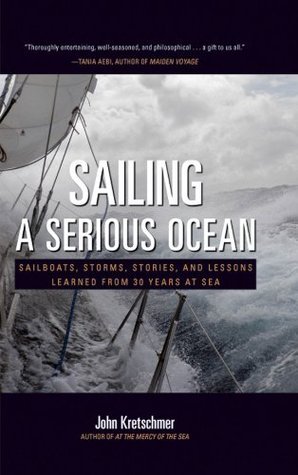
Sailing a Serious Ocean
Learn what it takes to cross an ocean from a veteran sailor
In "Sailing a Serious Ocean," author John Kretschmer uses his experiences and stories to show you what you will need to across an ocean or go around the world, in fair weather or foul. His true accounts of storms and other challenges at sea makes exciting reading and shows not only how sailboats should be handled when the chips are down, but how you should handle yourself. Learning how these boats respond to extreme circumstances will give you absolute confidence in your chosen boat's ability to keep you and your family safe in a storm.
John sails the seas for a living--delivering boats across oceans and teaching the skills of passagemaking to other sailors on their boats or his own. In thirty years of seagoing, he has weathered 300,000 ocean miles and dozens of storms in all the world's oceans. He has as much seagoing experience in as many different boats as any sailor on the planet. And he is the perfect teacher to help you achieve your long-voyage dreams.
In "Sailing a Serious Ocean," author John Kretschmer uses his experiences and stories to show you what you will need to across an ocean or go around the world, in fair weather or foul. His true accounts of storms and other challenges at sea makes exciting reading and shows not only how sailboats should be handled when the chips are down, but how you should handle yourself. Learning how these boats respond to extreme circumstances will give you absolute confidence in your chosen boat's ability to keep you and your family safe in a storm.
John sails the seas for a living--delivering boats across oceans and teaching the skills of passagemaking to other sailors on their boats or his own. In thirty years of seagoing, he has weathered 300,000 ocean miles and dozens of storms in all the world's oceans. He has as much seagoing experience in as many different boats as any sailor on the planet. And he is the perfect teacher to help you achieve your long-voyage dreams.
449 pages, Kindle Edition
First published January 1, 2013
Ratings & Reviews
Friends & Following
Create a free account to discover what your friends think of this book!
Community Reviews
Displaying 1 - 30 of 76 reviews

April 1, 2017
Extreme weather was coming our way. We reduced sail steadily during the daylight hours. The main was reefed, then dropped, as we flew along on a reach with the mizen, staysail, and a small jib. Then we furled the jib. Finally, as darkness swallowed us, we doused the mizzen and continued on a deep reach under staysail alone, at times hitting 14 knots with the wind gusting to hurricane force.
If this means something to you, if you love blue water sailing, or would like to try it, then you are going to love this book. It isn't a straight narrative but details his favourite boats, boats to buy, storms he's been in, tactics,all kind of sailing things. Even the stories of his financial advisor strategising him buying a boat for $50,000 less than it's asking price. (This was his 10 year old daughter's doing!)
One of the first times I was in a storm, gale force winds and huge waves, I was at the helm on a very fast ex-racing catamaran between Los Christianos in Tenerife (our home port) and Las Palmas de Gran Canaria where we due to pick up charter. Usually it is a 24 hour sail around the outside of Tenerife because although the passage between the islands is very short, it's normally blowing a gale - the wrong way. However this time the gale was blowing the right way so we could sail downwind all the way and the captain put me on the helm.
I don't think he realised I was quite so inexperienced or maybe he thought it would be fun. But there we were running before the wind with sails wing-on-wing going 20 knots. The speed was because we were surfing on top of the waves and I had absolutely no control. It was extremely exhilarating flying at such speed and it wasn't until later I found out how dangerous it could have been and I should have told the skipper. Still the passage took 9 hours instead of 24. More time in the bars eating tapas and drinking rough rioja wine that stained your teeth red.
Yesterday I went for a morning's sail down island. The sea was deep turquoise blue, mirror calm and there was a big brown booby bird flying alongside us looking for fish churned up in our wake. It's one of the reasons I live in the Caribbean. But if I had a chance to sail with the author or another really experienced and adventurous captain, I'd be off tomorrow, or sooner.
If this means something to you, if you love blue water sailing, or would like to try it, then you are going to love this book. It isn't a straight narrative but details his favourite boats, boats to buy, storms he's been in, tactics,all kind of sailing things. Even the stories of his financial advisor strategising him buying a boat for $50,000 less than it's asking price. (This was his 10 year old daughter's doing!)
One of the first times I was in a storm, gale force winds and huge waves, I was at the helm on a very fast ex-racing catamaran between Los Christianos in Tenerife (our home port) and Las Palmas de Gran Canaria where we due to pick up charter. Usually it is a 24 hour sail around the outside of Tenerife because although the passage between the islands is very short, it's normally blowing a gale - the wrong way. However this time the gale was blowing the right way so we could sail downwind all the way and the captain put me on the helm.
I don't think he realised I was quite so inexperienced or maybe he thought it would be fun. But there we were running before the wind with sails wing-on-wing going 20 knots. The speed was because we were surfing on top of the waves and I had absolutely no control. It was extremely exhilarating flying at such speed and it wasn't until later I found out how dangerous it could have been and I should have told the skipper. Still the passage took 9 hours instead of 24. More time in the bars eating tapas and drinking rough rioja wine that stained your teeth red.
Yesterday I went for a morning's sail down island. The sea was deep turquoise blue, mirror calm and there was a big brown booby bird flying alongside us looking for fish churned up in our wake. It's one of the reasons I live in the Caribbean. But if I had a chance to sail with the author or another really experienced and adventurous captain, I'd be off tomorrow, or sooner.

October 13, 2022
Any book written by someone who lives and loves his subject, knows how to tell a story, and knows how to write, is bound to be good. This book is no exception. It almost makes me want to sign aboard, though I know full well that I’m unsuited for life at sea.
All in all, this was a wonderful journey into modern-day sailing for the love of sailing. It got a bit technical at times, but I can easily put up with that because of the terrific, well-told narratives found within. Besides, it’s always enriching to learn a little more about a subject.
This was a worthwhile read.
All in all, this was a wonderful journey into modern-day sailing for the love of sailing. It got a bit technical at times, but I can easily put up with that because of the terrific, well-told narratives found within. Besides, it’s always enriching to learn a little more about a subject.
This was a worthwhile read.
April 13, 2017
I love books written by people who not only have the best adventures, but also know how to write about them. John Kretschmer (bluewater skipper who has logged more than 300,000 offshore sailing miles) is really good at the first, and pretty darn decent at the second. The best parts are the storms (of course) and Kretschmer's advice for surviving them. Only partway through the book, I was convinced I must someday sail with this legendary sailor.

June 21, 2021
I want to like Kretschmer's books (and stories) more than I actually do and this book is no exception. He has incredible adventures and amazing stories. Perhaps a more talented writer could make them come to life. He seems to be in a hurry to finish every story and get on to the next thing. This book also has some "filler" that has little to do with his experiences. Still, I'll keep reading his books, because few people sail as fearlessly as John and write about it.

August 14, 2023
I picked this up after a positive review by a fellow sailor and I must note she has far more experience than I. I am "bare boat certified" and have sailed the gulf stream in thunderstorms crossing from Bimini to Ft. Lauderdale and and and experienced a 3 a.m. thunderstorm in the Gulf of Mexico during a Bradenton FL to Key West race and there are few things more challenging and thrilling than that. Still, in comparison to the blue water sailing experiences described in this book, mine are relatively insignificant.
I think my 5 star rating may be out of respect and the content related to storm conditions during blue water off shore sailing, procedures and equipment and boat design comments. Note sure I would want to give up my coastal cruising status to try the extended range, but if I did I would like to take a training cruise with the author before attempting it.
The book is a bit disjointed, breaking up the narrative with sections related to a sailing glossary, tables and comments related to specific boats, weather terminology etc. Still, I enjoyed it and it brings back some great memories.
Is this a book for you? Well, here is a bit of a caption from a photo taken from just behind the sails on his boat - "Running wing and wing... is not my favorite point of sail. I would usually prefer to set the asymmetrical spinnaker. ... in light to moderate and you are dead downwind, nothing is more efficient than this rig. Note the whisker pole preventer lines and the main boom preventer, which is running forward to the midships cleat. ... Avoid point-loading the boom and the deck by running a preventer line directly to the forward cleats. The forward preventers, which should be three strand nylon for maximum stretch, allow for a soft jibe."
If that paragraph made sense to you, grab a copy, this is your kind of book. If not, you might want to start with something a bit more basic.
I think my 5 star rating may be out of respect and the content related to storm conditions during blue water off shore sailing, procedures and equipment and boat design comments. Note sure I would want to give up my coastal cruising status to try the extended range, but if I did I would like to take a training cruise with the author before attempting it.
The book is a bit disjointed, breaking up the narrative with sections related to a sailing glossary, tables and comments related to specific boats, weather terminology etc. Still, I enjoyed it and it brings back some great memories.
Is this a book for you? Well, here is a bit of a caption from a photo taken from just behind the sails on his boat - "Running wing and wing... is not my favorite point of sail. I would usually prefer to set the asymmetrical spinnaker. ... in light to moderate and you are dead downwind, nothing is more efficient than this rig. Note the whisker pole preventer lines and the main boom preventer, which is running forward to the midships cleat. ... Avoid point-loading the boom and the deck by running a preventer line directly to the forward cleats. The forward preventers, which should be three strand nylon for maximum stretch, allow for a soft jibe."
If that paragraph made sense to you, grab a copy, this is your kind of book. If not, you might want to start with something a bit more basic.

March 7, 2017
Great book to capture offshore sailing
Sailing offshore on big trips has all the joys people first think of -- endless horizons, stunning sunsets, awesome reaches, dolphins, big laughs -- but it also has the part not talked about in the brochure -- real discomfort, long hours of waiting, fear about what is exactly going to happen and moments of pure terror.
This book does a fantastic job of bringing it all together. Lots of sailors will read it for the storm stories but I think the provisioning and repair and crew handling is even more valuable.
You will see a gale, you're not likely to hit a hurricane and unless you want to you won't cross the North Atlantic in the middle of the winter.
But you can do a lot of great trips and you can enjoy them.
Inspiring.
Sailing offshore on big trips has all the joys people first think of -- endless horizons, stunning sunsets, awesome reaches, dolphins, big laughs -- but it also has the part not talked about in the brochure -- real discomfort, long hours of waiting, fear about what is exactly going to happen and moments of pure terror.
This book does a fantastic job of bringing it all together. Lots of sailors will read it for the storm stories but I think the provisioning and repair and crew handling is even more valuable.
You will see a gale, you're not likely to hit a hurricane and unless you want to you won't cross the North Atlantic in the middle of the winter.
But you can do a lot of great trips and you can enjoy them.
Inspiring.

May 7, 2022
Something very few of us manage to do, John Kretschmer has been living his passion his whole life. He managed to combine something he really loved with a way of making enough money. While delivering yachts for wealthy people to variously spread-out locations around the world he combined the 'deadline under contract' with the extreme adventure. One was clearly an 'alibi' for the other. When he got older he found his literary flair and started writing about his experiences.
Part of me wondered that although he risked his own life many times seemingly for the buzz of it, how might that affect the others who would need to come looking to rescue him if he got into trouble? Surely every mayday response (which I learned came from 1920s French m'aider) is also a commitment to risk ones own life to save another in mortal distress.
This led me to Carlo M. Cipolla's 'Basic Laws of stupidity'
1. Everyone underestimates the number of stupid people in circulation
2. Stupid people don't have a certain look or social status
3. A stupid person causes loses to others while also causing loses to them too.
As opposed to 'helpless' people who lose while others gain, or the people who take advantage of them 'bandits' who cause others losses while gaining themselves.
It's interesting to consider Cipolla's work when thinking about extreme risk takers.
On the other hand Kretschmer is clear to point out in detail all the lessons he learned and in a large part, how to apply them. His stories about storms are the most exciting and even more so about the woman who trying to take a pee off the back of his boat in the open ocean because the toilet was broken, fell off the boat. That day he searched wildly for her and managed eventually a rescue. He learned immensely from that and it comes out in detail in the book.
There is a lot of really good technical information in this book about the weather and in sailing a boat generally. Alot went over my head but I've made notes to return and learn more.
Overall the most valuable lesson seems to be John's maxim of the 'importance of maintaining optimism under pressure, and in a crisis.' It's a very good reminder for any of us who knew this, but who tend to 'forget'.
Part of me wondered that although he risked his own life many times seemingly for the buzz of it, how might that affect the others who would need to come looking to rescue him if he got into trouble? Surely every mayday response (which I learned came from 1920s French m'aider) is also a commitment to risk ones own life to save another in mortal distress.
This led me to Carlo M. Cipolla's 'Basic Laws of stupidity'
1. Everyone underestimates the number of stupid people in circulation
2. Stupid people don't have a certain look or social status
3. A stupid person causes loses to others while also causing loses to them too.
As opposed to 'helpless' people who lose while others gain, or the people who take advantage of them 'bandits' who cause others losses while gaining themselves.
It's interesting to consider Cipolla's work when thinking about extreme risk takers.
On the other hand Kretschmer is clear to point out in detail all the lessons he learned and in a large part, how to apply them. His stories about storms are the most exciting and even more so about the woman who trying to take a pee off the back of his boat in the open ocean because the toilet was broken, fell off the boat. That day he searched wildly for her and managed eventually a rescue. He learned immensely from that and it comes out in detail in the book.
There is a lot of really good technical information in this book about the weather and in sailing a boat generally. Alot went over my head but I've made notes to return and learn more.
Overall the most valuable lesson seems to be John's maxim of the 'importance of maintaining optimism under pressure, and in a crisis.' It's a very good reminder for any of us who knew this, but who tend to 'forget'.

August 26, 2016
Although I’ve been sailing a few times, adore the ocean, and the love the feel of sand between my toes, I am not a sailor, or interested in sailing voyages into the deep blue water. In fact, the only reason I picked up Krestchmer’s Sailing a Serious Ocean is because my friend and neighbor, Mike Kaufman, designed the boat showcased in this book. Kaufman handed me the book and said, “Take a look.”
At first, I thought I’d skim it, enjoy gently perusing the pages where Kaufman was mentioned. But then I discovered that not only had Kaufman designed an extraordinarily fine boat, Kretschmer wrote a captivating book. The images conjured from Krestchmer’s intricate descriptions coupled with his command of language engrossed me from the very first page and held my interest until the last word flattened into a sea of stillness. Sailor or not, reading Sailing a Serious Ocean brings us into a world full of moments that cause ourselves to pause, reflect about the choices we make as humans, the idleness of some, the risk-taking of others, and the mix that most us have in between. I now feel closer to understanding this breed of human, willing to sacrifice so much for the love of the seas, which has given me much to reflect about my life, the way I want to live, and the choices I want to make.
Kretschmer so aptly leaves us after his gripping accounts of storms, hard-learned lessons, and natural affinity for the fellowship and adoration found in the depths of the water by explaining his never-ending devotion to it: “We’ll stand our watches; keep an eye out for squalls, muscle the wheel to keep her squarely before trade wind-driven seas, and feel the thrill when we surf down a wave, and we’ll be cold wet, and miserable. But there’s one the thing I know for sure. None of us would trade places with anyone ashore.”
At first, I thought I’d skim it, enjoy gently perusing the pages where Kaufman was mentioned. But then I discovered that not only had Kaufman designed an extraordinarily fine boat, Kretschmer wrote a captivating book. The images conjured from Krestchmer’s intricate descriptions coupled with his command of language engrossed me from the very first page and held my interest until the last word flattened into a sea of stillness. Sailor or not, reading Sailing a Serious Ocean brings us into a world full of moments that cause ourselves to pause, reflect about the choices we make as humans, the idleness of some, the risk-taking of others, and the mix that most us have in between. I now feel closer to understanding this breed of human, willing to sacrifice so much for the love of the seas, which has given me much to reflect about my life, the way I want to live, and the choices I want to make.
Kretschmer so aptly leaves us after his gripping accounts of storms, hard-learned lessons, and natural affinity for the fellowship and adoration found in the depths of the water by explaining his never-ending devotion to it: “We’ll stand our watches; keep an eye out for squalls, muscle the wheel to keep her squarely before trade wind-driven seas, and feel the thrill when we surf down a wave, and we’ll be cold wet, and miserable. But there’s one the thing I know for sure. None of us would trade places with anyone ashore.”

December 15, 2013
John Kretschmer has a winner!
He has crossed ocean after ocean in boats ranging in size from 32' to 71'. He has seen his mortality and successfully beaten the odds of weathering nature's most ruthless monster storms by his shear know how, clearheadedness, and keen sense of his boat's and his crew's limitations. He's been there! Done that! And done it again, and again. I would sail with John anywhere, knowing we would find our port safely through any storm and be becalmed in the face of calamity by his great stories of experiences at the mercy of the high seas.
One can't help but be swept up by his prosaic tales of sea survival. John is a well read sailor and is as adept at story telling as Joseph Conrad, who he cites often in this wonderful book.
I've met and talked with John Kretschmer on two occasions and find his honesty and sincerity refreshing and endearing. He has read all the masters of serious offshore sailing, young and old, from Slocum to the fearless Volvo daredevils. Then went out and experienced what they've endured, and then some.
Yeah, he's sailed round the horn, alright! He recalls a moment in his little Contessa 32 off the coast of Chile, "I have a vivid memory of being picked up by a wave [30'], sinking down into it like an artillery shell into a howitzer, and then firing forward as the wave top overcame the base and started to break." (173)
He has crossed ocean after ocean in boats ranging in size from 32' to 71'. He has seen his mortality and successfully beaten the odds of weathering nature's most ruthless monster storms by his shear know how, clearheadedness, and keen sense of his boat's and his crew's limitations. He's been there! Done that! And done it again, and again. I would sail with John anywhere, knowing we would find our port safely through any storm and be becalmed in the face of calamity by his great stories of experiences at the mercy of the high seas.
One can't help but be swept up by his prosaic tales of sea survival. John is a well read sailor and is as adept at story telling as Joseph Conrad, who he cites often in this wonderful book.
I've met and talked with John Kretschmer on two occasions and find his honesty and sincerity refreshing and endearing. He has read all the masters of serious offshore sailing, young and old, from Slocum to the fearless Volvo daredevils. Then went out and experienced what they've endured, and then some.
Yeah, he's sailed round the horn, alright! He recalls a moment in his little Contessa 32 off the coast of Chile, "I have a vivid memory of being picked up by a wave [30'], sinking down into it like an artillery shell into a howitzer, and then firing forward as the wave top overcame the base and started to break." (173)
March 16, 2018
Great snippets of knowledge from someone that has spent a lot of time at sea. No aggrandized stories. The goal of the author is to provide practical examples and tips that would help other sailors accomplish bluewater sailing and experience some of the pleasures the author obviously has when sailing the open oceans.

March 28, 2026
JK’s writing is fantastic as always. Great sailing read. Felt an appreciation for heavy weather sailing I haven’t felt before while laughing the entire time

September 3, 2025
Several very interesting stories about the author's experiences of sailing expeditions, but many feel rushed or don't feel completely finished. Plenty of filler in between with practical guidance for people wishing to learn about and become an ocean sailor but I'm afraid this wasn't for me.
July 26, 2014
It is good for wannabe cruisers and weekend sailors pick up a book by long-distance cruisers for the war stories and tips on managing a boat. Kretschmer's a good story-teller and has sailed in such a wide variety of circumstances that he has an excellent understanding of boats and a better understanding of people at sea.
This book is worth the read, if only for his story of losing an experienced sailor overboard. He executes a classic man-overboard sailing strategy: beam reach, hold the course 20 seconds, come about, broad reach then harden the sails to return you downwind of the place that you lost your crew member.
"The ensuing tack was a disaster as the headsail sheets hung up on oversized brass dorade vents and teak belaying pins. Finally I realized that what we were doing, trying to effect a rescue undersail, was idiotic, and I started the engine," Kretschmer writes. He barely rescues Kim, the lost crew member, then lists how he changed the man-overboard procedure for other crews.
Books like this are always helpful in reminding us that things do fail (his worst problem was in a brand new yacht) but that there is always a solution to the problem.
His section on planning for storm handling with sails is also excellent for sailors of any type. Kretschmer's almost religious about his belief in staysails for heavy weather. It's also suitably modern, as he believes strongly in autopilots for bluewater cruising and is in that sense, the anti-Pardy.
Diagrams and photos are excellent in this book and are acceptable even in the Kindle version that I read.
This book is worth the read, if only for his story of losing an experienced sailor overboard. He executes a classic man-overboard sailing strategy: beam reach, hold the course 20 seconds, come about, broad reach then harden the sails to return you downwind of the place that you lost your crew member.
"The ensuing tack was a disaster as the headsail sheets hung up on oversized brass dorade vents and teak belaying pins. Finally I realized that what we were doing, trying to effect a rescue undersail, was idiotic, and I started the engine," Kretschmer writes. He barely rescues Kim, the lost crew member, then lists how he changed the man-overboard procedure for other crews.
Books like this are always helpful in reminding us that things do fail (his worst problem was in a brand new yacht) but that there is always a solution to the problem.
His section on planning for storm handling with sails is also excellent for sailors of any type. Kretschmer's almost religious about his belief in staysails for heavy weather. It's also suitably modern, as he believes strongly in autopilots for bluewater cruising and is in that sense, the anti-Pardy.
Diagrams and photos are excellent in this book and are acceptable even in the Kindle version that I read.

April 10, 2020
Fascinating stories that makes you want to jump off the couch and hitch a ride on the first boat you can find. Fair warning for those without a solid sailing foundation, Kretschmer uses a lot of sailing lingo. He defines many terms and includes a dictionary but it is still a little tough to get a full understanding of what he's talking about at times without looking things up. It doesn't take away from this being a really good read though.

January 26, 2017
What can I say? I really enjoyed this book - John Kretschmer doesn't gloss over the seriousness of blue water sailing - especially in heavy weather and he isn't afraid to talk about his mistakes and weaknesses. The book is well written and had me enthralled from the start. It's definitely a book for yachties though, with lists of blue water cruising boats, gear needed for ocean sailing etc etc as well as lots of stories about storms etc.

October 4, 2020
A must-read for any actual or armchair sailors looking for cruising tips, storm management strategies, dramatic sailing stories, and advice for buying a bluewater boat. Mr. Kretschmer boils down a lifetime of sailing experience with humility and surprisingly good writing. He is surely one of the most experienced small-boat sailors alive today, and anything advice he has is well worth listening to.
August 5, 2021
Nice stories and some useful explanations
I generally liked the book, found some of the stories exciting and interesting, and learned a lot of things about boats, sailing, waves, weather conditions, locations and life in the ocean, among other things. To be honest, I was often confused until the very end with some of the terminology, as the author explains it once and then assumes you know it.
I generally liked the book, found some of the stories exciting and interesting, and learned a lot of things about boats, sailing, waves, weather conditions, locations and life in the ocean, among other things. To be honest, I was often confused until the very end with some of the terminology, as the author explains it once and then assumes you know it.

April 21, 2020
I have sailed through northwest and northeast passage and I never sailed such serious seas as John had sailed in his incredible voyages. The book has a ton of useful information but John's well-told sea stories are something that makes this book worth its five stars. The book will make you want to go back to blue water sailing

November 25, 2023
The author is an accomplished sailor and storyteller. The book combines some of his personal adventures, with advice about sailing. Personally, I enjoyed more the the stories on what I found is more of a reference book. However, I am looking forward to read his other books. The narrator has a great voice, but I found the narration too dramatised.

December 13, 2015
Everything is great about this book except the fact that it's basically a series of blog posts printed out and bound together by cardboard and glue. Best for people who already know a bit about sailing because the author won't spend anytime filling you on on the basics.

September 10, 2015
my 5 year plan now involves being on a boat as much as possible. thanks a lot kretschmer!

July 24, 2020
Extremely insightful and helpful. Good storytelling while making sure to provide you with everything you need to start an ocean adventure on your own boat

October 13, 2021
I’m not a sailor but I found this book interesting. It was difficult to understand the language as I don’t speak sailor. But would love to sail with John sometime!
June 14, 2023
I love buying and reading these types of books.
Boats, yachts, historical events and books about the sea are generally excellent. If there are sequels in your series, I would love to read them.
The beauties of owning the books of important authors cannot be discussed. I'm looking forward to your new books.
For friends who want to read this book, I leave the importance of reading a book here. I wish good luck to the sellers and customers...
Top 10 benefits of reading for all ages:
1. Reading Exercises the Brain
As we read, we need to remember the different characters and settings of a particular story. Even if you enjoy reading a book in one sitting, you need to remember the details during the time you devote to reading the book. Therefore, reading is an exercise for your brain that improves memory function.
2. Reading Is a (free) Form of Entertainment
Did you know that most of the popular TV series and movies are based on books? So why not indulge in the original form of entertainment by immersing yourself in reading? Most importantly, it's free with your Markham Public Library card.
3. Reading Improves Concentration and Focus
We all agree that there can be no reading without focus, and we need to concentrate on every page we read to fully understand the story. In a world where gadgets only speed up and shorten our attention span, we must constantly practice concentration and focus. Reading is one of the few activities that requires your undivided attention, so it improves your ability to concentrate.
4. Reading Improves Literacy
Have you ever read a book where you come across a word you don't know? Books have the power to improve your vocabulary by introducing you to new words. The more you read, the more your vocabulary will improve as well as your ability to communicate effectively. Also, reading improves writing skills by helping the reader understand and learn different writing styles.
5. Reading Improves Sleep
By creating a bedtime routine that includes reading, you can signal to your body that it's time to sleep. Now more than ever, we rely on increased screen time to get through the day. That's why you put your phone away and pick up a book and tell your brain it's time to calm down. Also, since reading helps you relieve stress, reading right before bed helps calm your mind and anxiety and improve your sleep quality.
6. Reading Increases General Knowledge
Books are always full of fun and interesting facts. Whether we read fiction or non-fiction, books have the ability to provide us with information we might not otherwise know. Reading various topics can make you a more knowledgeable person and therefore improve your speaking skills.
7. Reading Is Motivating
By reading books about heroes overcoming adversity, we are often encouraged to do the same. Whether it's a romance novel or a self-help book, the right book can motivate you to never give up and stay positive.
https://numberoneboats.com/
https://theboatyacht.com/
https://theboatyacht.com/hunter-legen...
https://numberoneboats.com/hunter-leg...
https://theboatyacht.com/hunter-legen...
https://numberoneboats.com/hunter-leg...
Boats, yachts, historical events and books about the sea are generally excellent. If there are sequels in your series, I would love to read them.
The beauties of owning the books of important authors cannot be discussed. I'm looking forward to your new books.
For friends who want to read this book, I leave the importance of reading a book here. I wish good luck to the sellers and customers...
Top 10 benefits of reading for all ages:
1. Reading Exercises the Brain
As we read, we need to remember the different characters and settings of a particular story. Even if you enjoy reading a book in one sitting, you need to remember the details during the time you devote to reading the book. Therefore, reading is an exercise for your brain that improves memory function.
2. Reading Is a (free) Form of Entertainment
Did you know that most of the popular TV series and movies are based on books? So why not indulge in the original form of entertainment by immersing yourself in reading? Most importantly, it's free with your Markham Public Library card.
3. Reading Improves Concentration and Focus
We all agree that there can be no reading without focus, and we need to concentrate on every page we read to fully understand the story. In a world where gadgets only speed up and shorten our attention span, we must constantly practice concentration and focus. Reading is one of the few activities that requires your undivided attention, so it improves your ability to concentrate.
4. Reading Improves Literacy
Have you ever read a book where you come across a word you don't know? Books have the power to improve your vocabulary by introducing you to new words. The more you read, the more your vocabulary will improve as well as your ability to communicate effectively. Also, reading improves writing skills by helping the reader understand and learn different writing styles.
5. Reading Improves Sleep
By creating a bedtime routine that includes reading, you can signal to your body that it's time to sleep. Now more than ever, we rely on increased screen time to get through the day. That's why you put your phone away and pick up a book and tell your brain it's time to calm down. Also, since reading helps you relieve stress, reading right before bed helps calm your mind and anxiety and improve your sleep quality.
6. Reading Increases General Knowledge
Books are always full of fun and interesting facts. Whether we read fiction or non-fiction, books have the ability to provide us with information we might not otherwise know. Reading various topics can make you a more knowledgeable person and therefore improve your speaking skills.
7. Reading Is Motivating
By reading books about heroes overcoming adversity, we are often encouraged to do the same. Whether it's a romance novel or a self-help book, the right book can motivate you to never give up and stay positive.
https://numberoneboats.com/
https://theboatyacht.com/
https://theboatyacht.com/hunter-legen...
https://numberoneboats.com/hunter-leg...
https://theboatyacht.com/hunter-legen...
https://numberoneboats.com/hunter-leg...
March 9, 2024
I have read Sailing a Serious Ocean in a breeze at the comfort of my home, though throughout the book I was in storms most of the time. The way John wrote it, I felt so uncomfortable in my comfy home - in a good sense, I just wanted to be there in those storms, in that boat.
Imagine being in the nature of the ocean, using physics, mathematics, mechanics, psychology, humor, defining your strategy, giving quick decisions while feeling that powerful wind, with all the salt and spray - fascinating. All that while, you trust your boat.
John is an unbelievable story teller, teaching me all those life critical things while keeping me engaged without being bored for a single second. I just didn't want the book to end and wanted to learn more, be more part of it.
Yes, the book provides an unimaginable motivation to go out in the ocean but also teaches the seriousness of an ocean voyage.
Among the hundreds of things I have learnt, my key take away is not to embark on an ocean passage, even a few days of continuous sailing, without practicing it first with someone to learn from such as John.
I had ordered my boat, maybe not one that John would like, a Hanse 460 2024, and I am more impatient to onboard it after reading this book.
I have read 2 other books by John and all of them are must reads not just to learn but to get the emotional drive and excitement of all times.
Thank you John for taking the time to share such great learnings and stories to keep us ocean lovers.
Imagine being in the nature of the ocean, using physics, mathematics, mechanics, psychology, humor, defining your strategy, giving quick decisions while feeling that powerful wind, with all the salt and spray - fascinating. All that while, you trust your boat.
John is an unbelievable story teller, teaching me all those life critical things while keeping me engaged without being bored for a single second. I just didn't want the book to end and wanted to learn more, be more part of it.
Yes, the book provides an unimaginable motivation to go out in the ocean but also teaches the seriousness of an ocean voyage.
Among the hundreds of things I have learnt, my key take away is not to embark on an ocean passage, even a few days of continuous sailing, without practicing it first with someone to learn from such as John.
I had ordered my boat, maybe not one that John would like, a Hanse 460 2024, and I am more impatient to onboard it after reading this book.
I have read 2 other books by John and all of them are must reads not just to learn but to get the emotional drive and excitement of all times.
Thank you John for taking the time to share such great learnings and stories to keep us ocean lovers.

December 28, 2023
Author John Kretschmer has made a living from the ocean he loves. He is a “ferryman” delivering sail boats from one continent to another, he teaches navigation and other boating courses and writes books like this one.
He is an engaging writer who helps you appreciate the ocean like he does. He has traveled over 300,000 ocean miles and you learn from his experiences. You also learn from his land experiences, such as how he has bought boats, and more often, managed repairs.
Kretschmer has been through so many storms that he can rank his top ten. He describes each of these with how he assessed his options as the storm approached and the techniques he used to get through the fury. He gives as assessment of what he did right and what he did wrong. He shows how horrifying hurricanes can be. While he has survived them, he has stories of experienced mariners who have not. The ocean is a dangerous place and luck is a factor.
The book has an eclectic collection of charts and drawings. To name a few: “How Wind and Waves Interact”;”Ten Old but Proven Classics (boats) that Can Still Cross Oceans and Some Brief Thoughts”, “Cold Water Survival Table”;”Best Storm Sailing Literature”, “Local Winds of the Mediterranean”,“Ten Items/Essential Systems for Blue Water Passagemaking” and a chart of the nautical gods in classical mythology.
I highly recommend this book for anyone planning an ocean crossing. There is a lot of useful information, practical advice along with some great writing about the author's voyaging experiences.
He is an engaging writer who helps you appreciate the ocean like he does. He has traveled over 300,000 ocean miles and you learn from his experiences. You also learn from his land experiences, such as how he has bought boats, and more often, managed repairs.
Kretschmer has been through so many storms that he can rank his top ten. He describes each of these with how he assessed his options as the storm approached and the techniques he used to get through the fury. He gives as assessment of what he did right and what he did wrong. He shows how horrifying hurricanes can be. While he has survived them, he has stories of experienced mariners who have not. The ocean is a dangerous place and luck is a factor.
The book has an eclectic collection of charts and drawings. To name a few: “How Wind and Waves Interact”;”Ten Old but Proven Classics (boats) that Can Still Cross Oceans and Some Brief Thoughts”, “Cold Water Survival Table”;”Best Storm Sailing Literature”, “Local Winds of the Mediterranean”,“Ten Items/Essential Systems for Blue Water Passagemaking” and a chart of the nautical gods in classical mythology.
I highly recommend this book for anyone planning an ocean crossing. There is a lot of useful information, practical advice along with some great writing about the author's voyaging experiences.

November 20, 2019
A bit disorganized, but a lot here for sailing enthusiasts. "Serious Ocean" is almost like a series of last minute emails from Kretschmer to a former sailing student about to sail their boat across an ocean for the first time. "Oh wait - did I warn you about this? ... Don't forget to worry about that .... Uh - did I tell you about the time I forgot this?" The pages are filled with stories of ocean crossings alongside detailed analysis of things like the physics of a wave and the best boats for offshore sailing (I listened to some in the audio version, and the technical stuff is easier to digest in print). "Serious Ocean" is too random to be a great read, but I kept turning pages for the interesting information and honest stories from Kretschmer's depth of knowledge and experience.

September 18, 2021
This book probably has two audiences: people who want to become great passagemaking sailors, and people who just love listening to an expert talk about his craft (and perhaps learn about the sea and sailing). It's a great book for both. The author runs workshops/experiences where crews/clients come together on a sailboat and make very difficult passages through challenging conditions as full participants in the experience, not just passengers. He's one of the best writers in the world of sailing, and he shares some harrowing and inspiring stories here, as well as practical lessons. I'm hoping to get a sailboat in a few years, and would love to take one of his workshops/passages based on this book.

September 16, 2019
John Kretschmer is a treasure in the sailing world. He is an exceptional seaman with gift for telling stories and talent for gently touching on the philosophical without being preachy.
Sailing a Serious Ocean weaves Kretschmer’s skill and knowledge about sailing, especially in extreme weather, with true stories, mythology, and practical advice.
A few cliff hanger like instances of, “but I’ll tell you more about that in chapter 10,” were not my favorite way to order the material. However, the overall book and Kretschmer’s writing are excellent.
Sailing a Serious Ocean weaves Kretschmer’s skill and knowledge about sailing, especially in extreme weather, with true stories, mythology, and practical advice.
A few cliff hanger like instances of, “but I’ll tell you more about that in chapter 10,” were not my favorite way to order the material. However, the overall book and Kretschmer’s writing are excellent.

March 8, 2026
If you are a boat owner - specifically a sailboat owner, this is a great book. Having sailed in 30 and 40 knot winds this was a satisfying and validating read.
It's entertaining, well written and you can learn alot from this book, highly recommend to anyone interersted in sailing. It provides lots of insight on approaches and boat mods if you are interested in heavy weather sailing (if you sail heavy weather is unavoidable - not an interest or a choice). Looking forward to the start of the season!
It's entertaining, well written and you can learn alot from this book, highly recommend to anyone interersted in sailing. It provides lots of insight on approaches and boat mods if you are interested in heavy weather sailing (if you sail heavy weather is unavoidable - not an interest or a choice). Looking forward to the start of the season!
Displaying 1 - 30 of 76 reviews